



Carrot Farming in India: Guide to Growing Marketable Crop
A carrot gets judged on its looks long before anyone tastes it. A forked root, a green shoulder or a crack down the side can pull the price down sharply at the mandi. That’s why carrot farming rewards careful growers: most of the profit is won or lost in the soil, weeks before harvest.
The opportunity is real. Carrots sell all year, they’re used in home kitchens, juice shops and processing units, and a 90–120 day crop cycle lets you turn the land around quickly. Carrot farming in India has also spread well beyond the traditional winter belt, thanks to tropical varieties and hybrids that tolerate warmer weather.
But this isn’t a forgiving crop. The seed is tiny, germination is slow, young plants hate weed competition, and irregular watering shows up directly in the root. Carrot cultivation punishes small mistakes in a way many vegetables don’t.
This guide shows how to grow carrots from field preparation to market: climate, varieties, soil, sowing, irrigation, fertilizer, weed control, pests and diseases, harvesting, yield and profit. Where Indian research institutions give firm recommendations, you’ll see them; where a number is only an estimate, it’s labelled as one. By the end, you’ll know whether carrot farming makes sense for your land, season and market.
Key Takeaway: Quality in carrot farming is largely decided in the first three weeks. Seedbed, sowing depth and early moisture matter more than anything you spray later.

What Makes Carrot Farming Successful in Indian Conditions?
Most failed carrot crops weren’t killed by disease. They were sown in the wrong week. Temperature shapes nearly everything in carrot farming, from germination to root colour, length and sweetness.
Carrot is naturally a cool-season crop. Seeds germinate across roughly 7–30°C, but root development is pickier. Temperate types such as Nantes and Chantenay generally do best at about 15–20°C, while Asiatic (tropical) types such as the Pusa Kesar group tolerate warmer conditions, into the mid-20s.
This table shows how temperature typically affects carrot farming, so you can compare it with your local weather before fixing a sowing date. The ranges are approximate and shift with variety.
| Approximate temperature | What usually happens |
|---|---|
| Below 10°C | Slow germination and growth; roots can turn long and thin |
| 15–20°C | Best colour, shape and sweetness for temperate types |
| 20–25°C | Good for Asiatic types; temperate types start losing colour |
| Above 28–30°C | Poor germination; pale, short, stubby or bitter roots |
Carrot Farming in India: Which Sowing Window Fits Your Region?
A calendar copied from another state can mislead you. These are typical patterns; your local KVK can confirm what has been tested in your district.
- North Indian plains: heat-tolerant Asiatic types from about August–September; temperate types from October–November.
- Hills (Himachal Pradesh, Uttarakhand, Jammu & Kashmir): roughly March–July, as a summer crop.
- Central and western India: mostly September–December, depending on when winter sets in.
- South India: highlands such as the Nilgiris allow staggered planting through much of the year; plains growers rely on the cooler months.
Expert Tip: Work backwards from your target harvest date. If a variety needs about 100 days, make sure its first month falls in the temperature band it prefers. This one check prevents more disappointment in carrot farming than any input you can buy.
Which Soil Grows the Straightest Carrots?
A carrot root is only as straight as the soil allows. When the growing tip meets a stone, a hard layer or a clod, it splits or bends, and that’s a lost grade at the market.
The best soil for carrot cultivation is a deep, loose, well-drained sandy loam or loam, free of stones and rich in well-decomposed organic matter. A pH of about 6.0–7.0 suits most carrot crops, and you’ll want 25–30 cm of loose soil for long-rooted varieties.
Heavy clay is the most common reason carrot farming goes wrong on new land. It compacts, crusts over seedlings and holds water that invites rots. Very sandy soil gives smooth roots but dries fast, so it needs organic matter and closer watering.
Before committing to carrot farming on a field, dig a pit about 30 cm deep. If you find a hard layer, stones or standing water, fix that first or choose another plot.
Common Mistake in Carrot Farming: Applying fresh, half-rotted farmyard manure just before sowing. It encourages hairy, forked roots. Use only well-decomposed manure, mixed in a few weeks ahead.
Which Carrot Variety Should You Choose for Your Region?
There’s no single “best” carrot variety, and anyone who names one without asking about your season, soil and buyer is guessing.
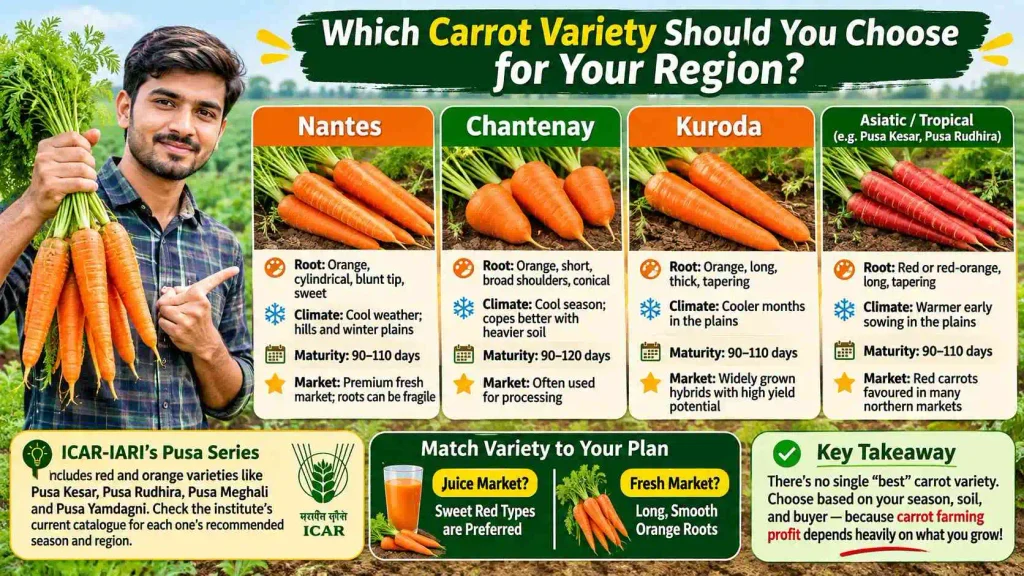
This table compares the main carrot types used in Indian carrot farming. It’s a general guide based on type-level traits, so check the seed company’s or institute’s description for any specific variety or hybrid.
| Type | Root colour and shape | Climate and season | Maturity and market notes |
|---|---|---|---|
| Nantes | Orange, cylindrical, blunt tip, sweet | Cool weather; hills and winter plains | About 90–110 days; premium fresh market; roots can be fragile |
| Chantenay | Orange, short, broad shoulders, conical | Cool season; copes better with heavier soil | About 90–120 days; often used for processing |
| Kuroda | Orange, long, thick, tapering | Cooler months in the plains | About 90–110 days; widely grown hybrids with high yield potential |
| Asiatic/tropical (e.g., Pusa Kesar, Pusa Rudhira) | Red or red-orange, long, tapering | Warmer early sowing in the plains | About 90–110 days; red carrots favoured in many northern markets |
ICAR-IARI’s Pusa series includes red and orange varieties for different sowing windows, among them Pusa Kesar, Pusa Rudhira, Pusa Meghali and Pusa Yamdagni. Check the institute’s current catalogue for each one’s recommended season and region.
Before choosing, ask who’s buying. Carrot farming for a juice market, for example, tends to favour sweet red types, while fresh-market traders in many regions prefer long, smooth orange roots. Match the variety to the plan, because carrot farming profit depends heavily on what your buyer wants. And don’t economise on carrot seeds: uncertified seed of unknown origin often germinates poorly, and in carrot farming the cheapest seed is rarely the cheapest option.
Why Poor Soil Preparation Produces Forked Carrots
Seedbed preparation is the least glamorous part of carrot farming, and the one that pays back most. Walk through a failed field at harvest and you’ll often find roots split into two or three legs, caused by clods, stones or compaction.
Here’s a practical sequence:
- Plough deep. Go 25–30 cm, preferably in a dry spell, and let the soil weather for a week or two.
- Break clods. Use a cultivator, harrow or rotavator until the top layer is fine and crumbly.
- Clear the field. Pick out stones, roots and residue by hand.
- Add organic matter. Many Indian package-of-practice recommendations suggest around 20–25 tonnes of well-decomposed farmyard manure per hectare (roughly 8–10 tonnes per acre). Mix it in during the last ploughing.
- Shape beds and drains. Level the field, form beds and cut drainage channels.
Raised or flat beds? In heavy, rain-prone or poorly drained fields, raised beds (commonly around 15–20 cm high) usually win because they keep the root zone loose and drained. On light, well-drained soil, flat beds work and cost less. For most commercial carrot farming, raised beds are worth the effort.
Quick Summary: Deep tillage, fine tilth, no stones, well-rotted manure and good drainage. Skipping any one of these is the fastest way to waste money in carrot farming.
How to Sow Carrot Seeds for Uniform Root Development
A gram of carrot seed holds roughly 800–1,000 seeds, and each is a weak competitor in its first weeks. That’s why carrot farming leaves little room for careless sowing.
The table below summarises commonly recommended sowing details for carrot farming in India. Figures vary with variety, soil and state package of practices, so treat them as a starting point and follow your seed packet and KVK where they differ.
| Parameter | Commonly recommended |
|---|---|
| Method | Direct sowing in lines |
| Seed rate | About 5–6 kg/ha (roughly 2–2.5 kg/acre); some hybrids differ |
| Sowing depth | About 1–1.5 cm |
| Row spacing | About 30–45 cm |
| Plant spacing after thinning | About 5–7.5 cm |
| Seed treatment | Biological (e.g., Trichoderma) or recommended fungicide, per label |
Carrots are sown directly because transplanting damages the taproot and causes forking. Mixing seed with fine sand helps you sow evenly, and keeping the surface moist and uncrusted until emergence matters more than any seed trick. Line sowing is the standard for commercial carrot farming, since it makes thinning, weeding and harvesting far easier.
Thinning is the step growers most often delay. Overcrowded plants give small, twisted roots, so thin in stages, starting two to three weeks after emergence, until you reach the final spacing.
Warning: Seed sown deeper than about 2 cm struggles to emerge, and broadcasting gives uneven stands that are hard to weed. Both are quick ways to lose yield in carrot farming.
How Much Water Does a Carrot Crop Actually Need?
More carrot crops are damaged by erratic watering than by too little water. Good carrot farming means steady moisture, not simply wet soil, and that’s the core of carrot irrigation management.
This table links irrigation to crop stage for carrot farming. Frequency depends on soil, weather and bed type, so read it as a pattern, not a fixed schedule.
| Stage | Moisture approach |
|---|---|
| At sowing | Sow into moist soil or irrigate lightly right after |
| Germination (about 1–2 weeks) | Keep the top few centimetres evenly moist; avoid crusting |
| Seedling to early root growth | Irrigate lightly but regularly |
| Root enlargement | Maintain even moisture; this is the most sensitive stage |
| Before harvest | Light irrigation a day or two before lifting |
Drip delivers steady moisture to raised beds with less water, making it a smart upgrade for carrot farming where water is scarce. Sprinklers help keep the surface soft during germination, and furrow irrigation still works on many farms. On sandy soil, irrigate more often and in lighter amounts than on loam.
Waterlogging invites root rot, while drought stress gives thin, tough roots. Cracking usually follows a long dry spell broken by heavy irrigation. This is where many new farmers struggle: they irrigate by the calendar instead of checking the soil.
Practical Tip: Dig a finger 3–5 cm into the soil beside the row. If it’s dry at that depth during root growth, it’s time to irrigate.
Can Excess Nitrogen Reduce Your Carrot Yield?
Lush green tops look like success. In carrots, they can signal the opposite. Heavy nitrogen pushes leaf growth at the expense of the root and can leave roots hairy, forked or poorly coloured. Many beginners in carrot farming make this mistake because they treat carrots like a leafy crop.
The table below sets out what each major nutrient does in carrot farming and what trouble looks like. It’s a diagnostic guide, not a fertilizer schedule.
| Nutrient | Role | Warning signs |
|---|---|---|
| Nitrogen | Leaf and early growth | Too much: leafy tops, small hairy roots. Too little: pale, stunted plants |
| Phosphorus | Seedling and early root establishment | Slow, stunted growth |
| Potassium | Root size, colour and quality | Weak plants, poor root colour |
| Calcium | Cell strength, root quality | Poor quality or cracking when supply is imbalanced |
| Boron | Root cell development | Cracking, brown or hollow cores |
| Organic manure | Soil structure and moisture holding | Hard, compacted soil |
Carrot fertilizer requirements vary by soil, state and variety, so no single dose fits every field. Published schedules often fall roughly in the range of 20–25 t/ha farmyard manure with N 50–100, P₂O₅ 40–60 and K₂O 50–100 kg/ha. Treat that as an indicative range only; a soil test and your state agricultural university’s schedule should set the final numbers.
Where nitrogen is split, a common approach is to apply about half with all the phosphorus and potash at sowing, and the rest as a top dressing around 30–40 days after sowing. Carrot farming rewards balanced nutrition, and keeping a simple record of what you applied means your next season starts with data, not memory.
Expert Tip: A soil test before sowing is the cheapest input in carrot farming. It tells you what to apply and what to skip.
Why Does Early Weed Competition Hurt Carrots So Much?
Carrot seedlings take weeks to put on any real size, and weeds don’t wait. Weed control in carrot farming is a race you have to win in roughly the first six weeks, the critical period when competition does the most damage.
A realistic plan combines a few methods:
- Hand weeding and hoeing: around 20–25 days after sowing, often alongside thinning, and again at about 40–45 days.
- Wheel hoe or light cultivator: between rows on larger plots.
- Mulching: straw or dry residue free of weed seed suppresses weeds and holds moisture on small plots.
- Pre-emergence herbicide: pendimethalin appears in many Indian recommendations for carrot, applied soon after sowing on moist soil. Confirm it’s currently registered for carrot and follow the label dose and timing.
On small carrot farming plots, hand weeding plus mulch is usually the most practical route. Larger farms often add a pre-emergence herbicide to cut labour, but never spray on emerged seedlings unless the label allows it.
Which Pests and Diseases Can Ruin Your Carrot Crop?
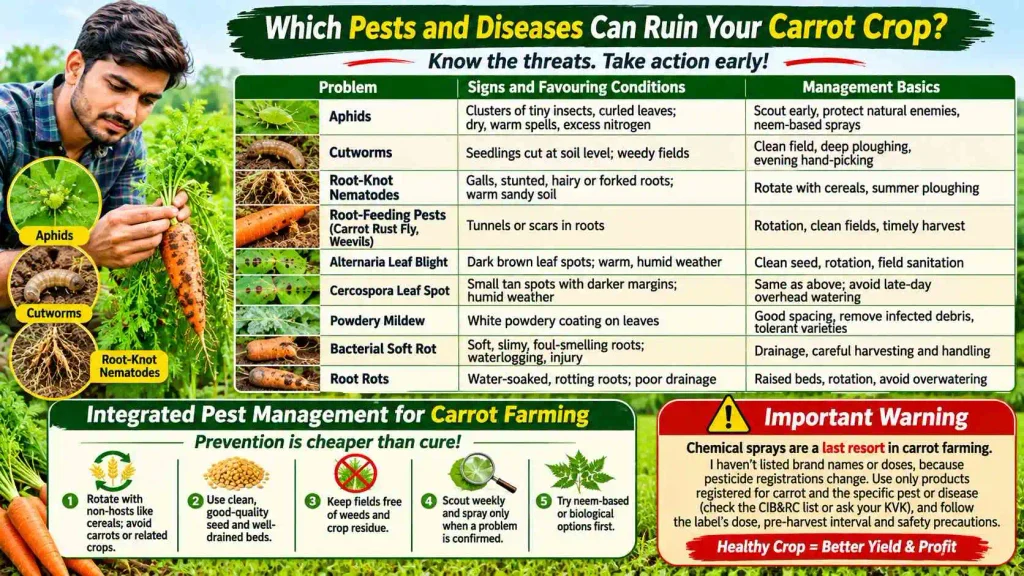
Most losses in carrot farming come from a handful of problems, and many can be reduced before a single spray. This table helps you identify the usual suspects among carrot pests and diseases. Symptoms overlap, so confirm unclear cases with your KVK or plant protection officer.
| Problem | Signs and favouring conditions | Management basics |
|---|---|---|
| Aphids | Clusters of tiny insects, curled leaves; dry, warm spells, excess nitrogen | Scout early, protect natural enemies, neem-based sprays |
| Cutworms | Seedlings cut at soil level; weedy fields | Clean field, deep ploughing, evening hand-picking |
| Root-knot nematodes | Galls, stunted, hairy or forked roots; warm sandy soil | Rotate with cereals, summer ploughing |
| Root-feeding pests (carrot rust fly in cooler regions, weevils) | Tunnels or scars in roots | Rotation, clean fields, timely harvest |
| Alternaria leaf blight | Dark brown leaf spots; warm, humid weather | Clean seed, rotation, field sanitation |
| Cercospora leaf spot | Small tan spots with darker margins; humid weather | Same as above; avoid late-day overhead watering |
| Powdery mildew | White powdery coating on leaves | Good spacing, remove infected debris, tolerant varieties |
| Bacterial soft rot | Soft, slimy, foul-smelling roots; waterlogging, injury | Drainage, careful harvesting and handling |
| Root rots | Water-soaked, rotting roots; poor drainage | Raised beds, rotation, avoid overwatering |
Integrated Pest Management for Carrot Farming
Prevention is cheaper than cure in carrot farming, and these habits do most of the work:
- Rotate with non-hosts such as cereals; avoid following carrots or related crops (coriander, celery, fennel) on the same land.
- Use clean, good-quality seed and well-drained beds.
- Keep fields free of weeds and crop residue.
- Scout weekly and spray only when a problem is confirmed.
- Try neem-based or biological options first where they’re effective.
Warning: Chemical sprays are a last resort in carrot farming. I haven’t listed brand names or doses, because pesticide registrations change. Use only products registered for carrot and the specific pest or disease (check the CIB&RC list or ask your KVK), and follow the label’s dose, pre-harvest interval and safety precautions.
How Long Does Carrot Farming Take from Sowing to Harvest?
Most carrot crops are ready in about 90–120 days, but that range hides a lot. A carrot farming cycle shortens in warm weather and stretches in cold, and variety matters as much as temperature.
The table below breaks the cycle into stages. Stages overlap, and timings are approximate.
| Stage | Approximate timing |
|---|---|
| Germination | 7–14 days, slower in cold soil |
| Seedling establishment | Up to about 3–4 weeks |
| Root development | Roughly weeks 4–8 |
| Root enlargement | Roughly weeks 8–14 |
| Harvest maturity | About 90–120 days from sowing |
Tropical types in warm plains often mature near the lower end, while temperate types in cool conditions or hills can take longer. Use the seed company’s stated maturity as a guide and confirm with a trial row.
When Should You Harvest Carrots for the Best Market Price?
Don’t pull carrots because the calendar says so. Judge carrot harvesting time from the crop: roots have reached the size your buyer wants, shoulders are filled out, colour is even and the lower leaves are yellowing.
Timing hits income directly in carrot farming. Harvest too early and roots are small, pale and light. Harvest too late and they may turn woody, crack, go hairy and become more prone to disease.
Irrigate lightly a day or two before harvest so the soil lifts easily. Loosen the soil along the row with a fork or spade and lift gently; yanking roots out of hard soil causes breakage and skin damage. Large farms may use mechanical diggers.
Post-Harvest Handling in Carrot Farming
Quality can be lost after the crop leaves the soil. Wash promptly, grade by size, shape and colour, discard damaged or forked roots, and pack in clean crates or bags. Keep them shaded and move them to market quickly. In cold storage near 0°C and high humidity, carrots can be held for several weeks; at ambient temperature they lose moisture and firmness within days.
Key Takeaway: A clean, well-graded lot usually sells better than a larger, mixed one. Careful grading is where carrot farming profit is quietly protected.
What Carrot Yield per Acre Can You Realistically Expect?
Online videos often quote yields few farms ever repeat. Realistic carrot farming yields sit well below research-station figures, and planning around the best case is a classic way to overestimate income.
The table below gives illustrative planning ranges built from commonly cited figures. They’re not guaranteed outcomes, so replace them with your district’s data when you have it.
| Scenario | Per hectare | Per acre |
|---|---|---|
| Average farm conditions | ~15–20 t | ~6–8 t |
| Good management, suited variety | ~25–30 t | ~10–12 t |
| Research trial or best case | 35 t or more | 14 t or more |
Yield moves with variety, season, soil, seed quality, plant population, irrigation, nutrition and pest pressure. The gap between the first and second rows is where good carrot farming pays: better seed, soil preparation, even moisture and timely thinning. When you plan carrot farming per acre, use marketable (graded) yield, not total weight, because forked and cracked roots won’t fetch the same price.
How Much Can You Earn from One Acre of Carrot Farming?
Here’s the honest answer: it depends, and the swing is wide. Carrot farming profit moves with yield, grade, season and, above all, the price on the day you sell.
Carrot Farming Cost per Acre: A Worked Estimate
The table below lists the main expense heads with illustrative ranges per acre. These are planning assumptions, not current market rates, so replace them with local quotes.
| Expense | Illustrative range per acre |
|---|---|
| Land preparation and beds | ₹8,000–12,000 |
| Seed (varies widely with variety or hybrid) | ₹3,000–12,000 |
| Farmyard manure and application | ₹8,000–15,000 |
| Fertilizers | ₹5,000–9,000 |
| Labour for sowing, thinning, weeding | ₹15,000–25,000 |
| Irrigation | ₹4,000–8,000 |
| Pest and disease management | ₹4,000–8,000 |
| Harvesting labour | ₹12,000–20,000 |
| Washing, grading, packing, transport | ₹10,000–20,000 |
| Approximate total | ₹69,000–1,29,000 |
These costs exclude land rent, interest and your own labour.
Carrot Farming Profit at Different Prices
This table shows gross revenue at assumed yields and farm-gate prices. The prices are placeholders; check recent rates on Agmarknet or with your local mandi.
| Marketable yield | At ₹10/kg | At ₹15/kg | At ₹20/kg |
|---|---|---|---|
| 8 t/acre | ₹80,000 | ₹1,20,000 | ₹1,60,000 |
| 10 t/acre | ₹1,00,000 | ₹1,50,000 | ₹2,00,000 |
| 12 t/acre | ₹1,20,000 | ₹1,80,000 | ₹2,40,000 |
Net profit is gross revenue minus total cost. Take 10 t/acre at ₹15/kg: gross ₹1.5 lakh; with costs around ₹1 lakh, net is about ₹50,000. At ₹10/kg the same crop only breaks even, and 8 t at ₹10/kg falls short of costs. That’s why carrot farming suits growers who’ve lined up a buyer or can grade well.
Which Carrot Farming Mistakes Cost Farmers the Most?
Most losses in carrot farming trace back to a short list of avoidable errors. The table pairs each with a fix.
| Mistake | How to avoid it |
|---|---|
| Unsuitable variety | Match to season, region, soil and buyer; trial first |
| Poorly prepared soil | Deep tillage, fine tilth, stone removal |
| Seed sown too deep | Keep to about 1–1.5 cm |
| Excess nitrogen | Follow a soil test; avoid heavy top dressing |
| Irregular moisture | Check the soil; avoid big swings |
| Ignoring early weeds | Weed within the first 3–4 weeks and again at 40–45 days |
| Delaying thinning | Thin in stages from 2–3 weeks after emergence |
| Missing pest symptoms | Scout weekly; act on confirmed problems |
| Wrong harvest stage | Harvest by root size and market need, not the date |
| No market plan | Line up buyers and grade requireme |

Is Carrot Farming Worth Starting? Your Practical Next Step
The biggest lesson in carrot farming is that planning beats spending. More fertilizer, extra sprays or costly seed cannot rescue a crop sown in poor soil, during the wrong season or without a confirmed market.
If you’re new to farming, start small, perhaps a quarter to half an acre, so you can learn from mistakes without risking too much. Settle four things before investing heavily: the variety, sowing window, soil preparation and market.
This week, visit your KVK, get your soil tested, ask which varieties are performing well in your district and speak to a mandi trader about the grades and sizes buyers prefer.
Then sow a trial plot, record your expenses and results, and expand based on your own experience. If you’re interested in exploring other vegetable-growing opportunities on a smaller scale, check out our beginner-friendly guide on how to grow chillies at home.
Newsletter