


Vertical Mud Crab Farming in India: The Complete Guide to Start, Earn Big, and Scale Fast (2026)
Introduction: Why Every Aqua Farmer Is Talking About Vertical Mud Crab Farming
Imagine earning ₹5 to ₹10 lakh from a small piece of land — land that would otherwise give you maybe one paddy crop per year. Sounds too good? It is not. Vertical mud crab farming is making this a reality for thousands of farmers across coastal India.
Traditional mudcrab farming needs large ponds, huge investment, and a lot of open land. But with vertical mud crab farming (also called stacked crab farming or tray-based crab farming), you can grow more crabs in less space, with less water, and with much better control over quality and survival. This is what makes it one of the most exciting aquaculture businesses in India right now.
Whether you are a fisherman, a small farmer, or someone who wants to start a new agri-business, this guide covers everything — from setup cost to profit, from feeding to harvesting. We will keep it simple, practical, and real.
What Exactly Is Vertical Mud Crab Farming?
Vertical mud crab farming is a system where mud crabs are raised individually in stacked trays or racks, one on top of another — just like the shelves in your kitchen, but for crabs. Each tray holds one crab, and the trays are arranged vertically in rows inside a shed or covered area.
This system is different from traditional pond-based crab farming. Instead of throwing crabs all together in a pond where they fight and eat each other, each crab gets its own tray. They are fed properly, and the water flows through each tray automatically. This is called the recirculating aquaculture system (RAS) or flow-through system.
The mud crab most commonly grown in Indian vertical crab farming is Scylla serrata — commonly known as the Giant Mud Crab or Green Mud Crab. It is the most preferred species for export markets and local high-value sale.
Why Vertical Mud Crab Farming Is Better Than Traditional Farming
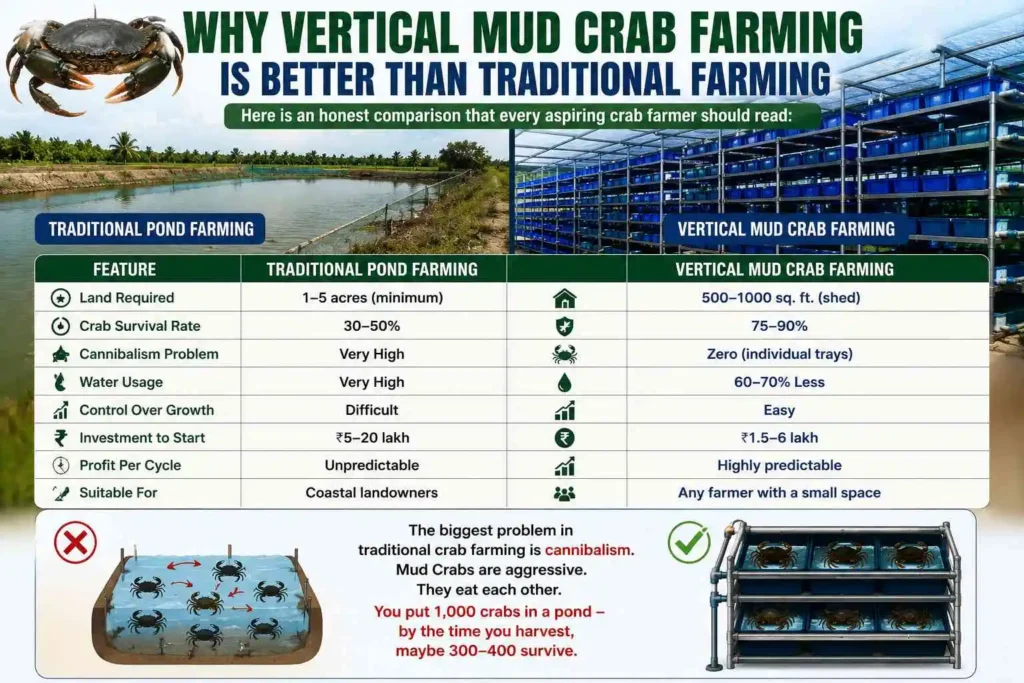
Here is an honest comparison that every aspiring crab farmer should read:
| Feature | Traditional Pond Farming | Vertical Mud Crab Farming |
|---|---|---|
| Land Required | 1–5 acres (minimum) | 500–1000 sq. ft. (shed) |
| Crab Survival Rate | 30–50% | 75–90% |
| Cannibalism Problem | Very High | Zero (individual trays) |
| Water Usage | Very High | 60–70% Less |
| Control Over Growth | Difficult | Easy |
| Investment to Start | ₹5–20 lakh | ₹1.5–6 lakh |
| Profit Per Cycle | Unpredictable | Highly predictable |
| Suitable For | Coastal landowners | Any farmer with a small space |
The biggest problem in traditional crab farming is cannibalism. Mud Crabs are aggressive. They eat each other. You put 1,000 crabs in a pond — by the time you harvest, maybe 300–400 survive. In vertical stack crab farming, every crab is alone in its own tray. Survival rate goes up to 85–90%. That changes everything.
What Species of Mud Crab Should You Choose?
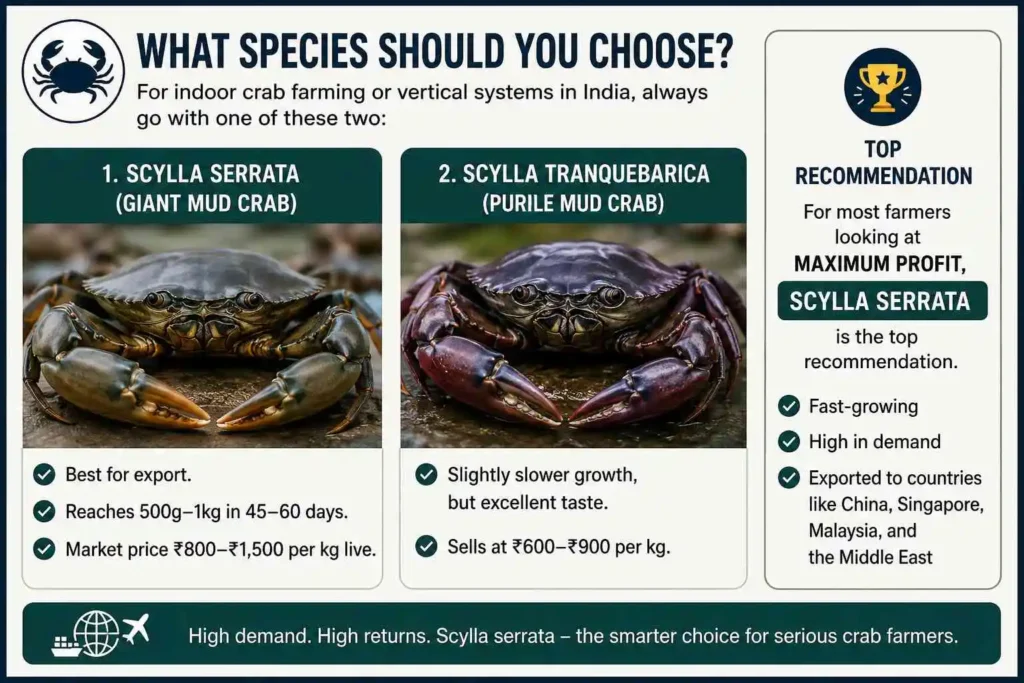
For indoor crab farming or vertical systems in India, always go with one of these two:
- Scylla serrata (Giant Mud Crab): Best for export. Reaches 500g–1kg in 45–60 days. Market price ₹800–₹1,500 per kg live.
- Scylla tranquebarica (Purple Mud Crab): Slightly slower growth, but excellent taste. Sells at ₹600–₹900 per kg.
For most farmers looking at maximum profit, Scylla serrata is the top recommendation. It is fast-growing, in high demand, and exported to countries like China, Singapore, Malaysia, and the Middle East.
How to Set Up Your Vertical Mud Crab Farm: Step-by-Step
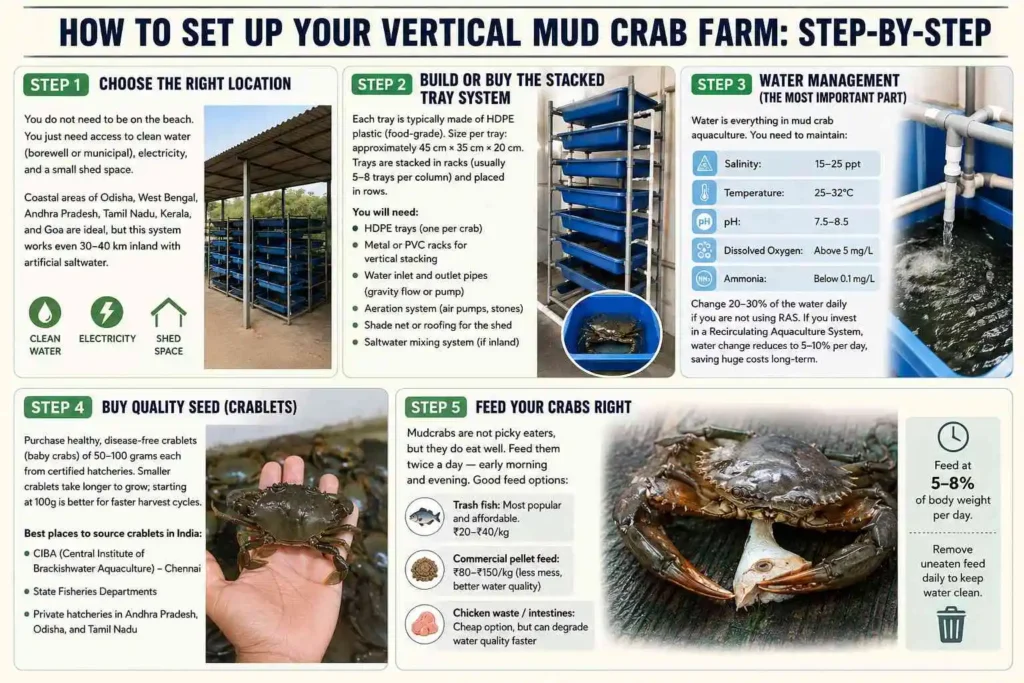
Step 1: Choose the Right Location
You do not need to be on the beach. You just need access to clean water (borewell or municipal), electricity, and a small shed space. Coastal areas of Odisha, West Bengal, Andhra Pradesh, Tamil Nadu, Kerala, and Goa are ideal, but this system works even 30–40 km inland with artificial saltwater.
Step 2: Build or Buy the Stacked Tray System
Each tray is typically made of HDPE plastic (food-grade). Size per tray: approximately 45 cm × 35 cm × 20 cm. Trays are stacked in racks (usually 5–8 trays per column) and placed in rows.
You will need:
- HDPE trays (one per crab)
- Metal or PVC racks for vertical stacking
- Water inlet and outlet pipes (gravity flow or pump)
- Aeration system (air pumps, stones)
- Shade net or roofing for the shed
- Saltwater mixing system (if inland)
Step 3: Water Management (The Most Important Part)
Water is everything in mud crab aquaculture. You need to maintain:
- Salinity: 15–25 ppt (parts per thousand)
- Temperature: 25–32°C
- pH: 7.5–8.5
- Dissolved Oxygen: Above 5 mg/L
- Ammonia: Below 0.1 mg/L
Change 20–30% of the water daily if you are not using RAS. If you invest in a Recirculating Aquaculture System, water change reduces to 5–10% per day, saving huge costs long-term.
Step 4: Buy Quality Seed (Crablets)
Purchase healthy, disease-free crablets (baby crabs) of 50–100 grams each from certified hatcheries. Smaller crablets take longer to grow; starting at 100g is better for faster harvest cycles.
Best places to source crablets in India:
- CIBA (Central Institute of Brackishwater Aquaculture) – Chennai
- State Fisheries Departments
- Private hatcheries in Andhra Pradesh, Odisha, and Tamil Nadu
Step 5: Feed Your Crabs Right
Mudcrabs are not picky eaters, but they do eat well. Feed them twice a day — early morning and evening. Good feed options:
- Trash fish: Most popular and affordable. ₹20–₹40/kg
- Commercial pellet feed: ₹80–₹150/kg (less mess, better water quality)
- Chicken waste / intestines: Cheap option, but can degrade water quality faster
Feed at 5–8% of body weight per day. Remove uneaten feed daily to keep water clean.
Vertical Mud Crab Farming: Complete Cost and Investment Breakdown
Here is a realistic cost table for a medium-scale vertical mud crab farm with 200 trays:
Table 1: One-Time Setup Cost (200 Trays)
| Item | Quantity | Unit Cost (₹) | Total Cost (₹) |
|---|---|---|---|
| HDPE Trays | 200 | ₹150 | ₹30,000 |
| Metal Racks (5-tier) | 40 | ₹2,500 | ₹1,00,000 |
| PVC Pipes & Fittings | — | — | ₹25,000 |
| Water Pump & Aerator | 2 sets | ₹8,000 | ₹16,000 |
| Shed / Roofing | 600 sq. ft. | ₹150/sq.ft | ₹90,000 |
| Saltwater Mixing Tank | 1 | ₹15,000 | ₹15,000 |
| Tools & Miscellaneous | — | — | ₹10,000 |
| Total Setup Cost | ₹2,86,000 |
Table 2: Per-Cycle Operating Cost (45–60 Days, 200 Crabs)
| Item | Details | Cost (₹) |
|---|---|---|
| Crablets (200 × ₹80 each) | 100g size, certified | ₹16,000 |
| Feed (Trash fish, 45 days) | ~3 kg/day @ ₹30/kg | ₹4,050 |
| Electricity | Pump + Aeration | ₹3,500 |
| Labour (part-time, 1 person) | 45 days | ₹9,000 |
| Water Treatment Chemicals | Salinity, pH | ₹1,500 |
| Miscellaneous | Packaging, transport | ₹2,000 |
| Total Operating Cost/Cycle | ₹36,050 |
Table 3: Revenue and Profit Calculation (Per Cycle, 200 Trays)
| Parameter | Value |
|---|---|
| Number of Crabs Stocked | 200 |
| Expected Survival Rate | 85% |
| Crabs Harvested | 170 crabs |
| Average Weight at Harvest | 600g per crab |
| Total Harvest Weight | 102 kg |
| Selling Price (Live Crab) | ₹1,000–₹1,300/kg |
| Gross Revenue | ₹1,02,000–₹1,32,600 |
| Operating Cost | ₹36,050 |
| Net Profit Per Cycle | ₹65,950–₹96,550 |
| Annual Profit (5 cycles/year) | ₹3.3 lakh–₹4.8 lakh |
Pro Tip: With 500 trays and proper management, annual net profit can cross ₹8–12 lakh.
Where to Sell Your Mud Crabs?
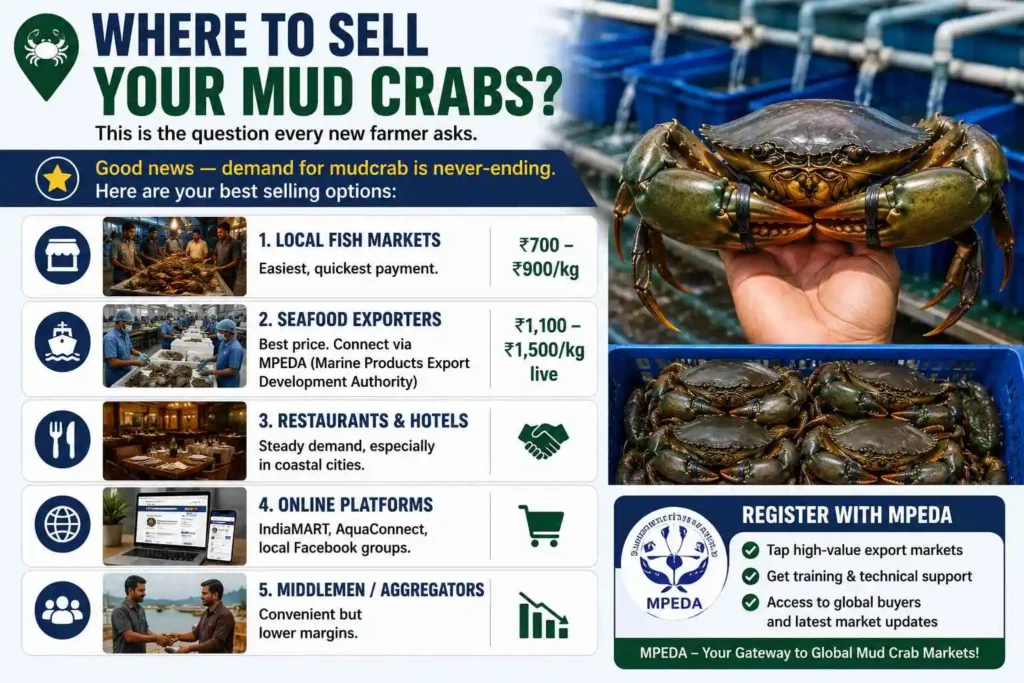
This is the question every new farmer asks. Good news — demand for mudcrab is never-ending. Here are your best selling options:
- Local fish markets: Easiest, quickest payment. ₹700–₹900/kg
- Seafood exporters: Best price ₹1,100–₹1,500/kg live. Connect via MPEDA (Marine Products Export Development Authority)
- Restaurants and hotels: Steady demand, especially in coastal cities
- Online platforms: IndiaMART, AquaConnect, local Facebook groups
- Middlemen/aggregators: Convenient but lower margins
Register with MPEDA if you want to tap export markets. They also provide training and connections.
Government Support and Schemes You Should Know
The Indian government is actively promoting modern aquaculture. Under the Pradhan Mantri Matsya Sampada Yojana (PMMSY), you can get subsidies for:
- Setting up crab farming units: up to 40% subsidy for general farmers
- SC/ST/Women farmers: up to 60% subsidy
- RAS system installation: Covered under PMMSY
- Training and skill development: Free from CIBA and state fisheries
Contact your nearest District Fisheries Office to apply. The paperwork is simpler than you think.
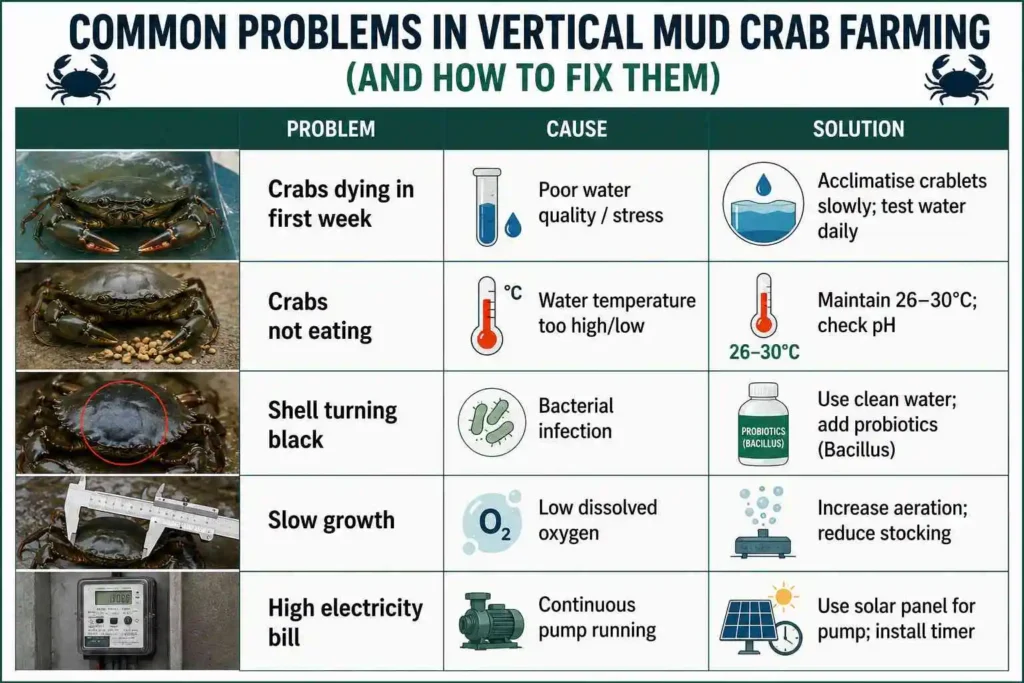
Common Problems in Vertical Mud Crab Farming (And How to Fix Them)
| Problem | Cause | Solution |
|---|---|---|
| Crabs dying in first week | Poor water quality / stress | Acclimatise crablets slowly; test water daily |
| Crabs not eating | Water temperature too high/low | Maintain 26–30°C; check pH |
| Shell turning black | Bacterial infection | Use clean water; add probiotics (Bacillus) |
| Slow growth | Low dissolved oxygen | Increase aeration; reduce stocking |
| High electricity bill | Continuous pump running | Use solar panel for pump; install timer |
Is Vertical Mud Crab Farming Right for You?
Ask yourself:
- Do you have ₹1.5 to ₹3 lakh to invest?
- Can you dedicate 2–3 hours a day to feeding and water monitoring?
- Do you live near a coastal region or have access to salt/brackishwater?
If you answered yes to all three, mud crab farming could be a great fit for you. However, since this is a specialized form of aquaculture, it’s wise not to jump in without proper guidance. Enrolling in a good training program can help you understand tank setup, water quality management, and disease control before you invest your capital. Check out our list of top institutes offering mud crab farming training in India to get hands-on knowledge and reduce your risk of early losses.
Conclusion: Time to Take Action
Vertical mudcrab farming is not just a trend — it is the future of coastal aquaculture in India. With less land, less water, and lower risk of losses due to cannibalism, this system is perfect for small and medium farmers who want real, bankable income.
The numbers do not lie. With just 200 trays, a farmer can earn ₹60,000–₹90,000 every 60 days. Scale that to 500 trays, and you are looking at ₹8–12 lakh per year.
Start small. Learn the system. Get the required licenses and government permissions in place, then watch your income grow — tray by tray.
Looking for other profitable aquaculture opportunities? Businesses such as shrimp farming, biofloc fish farming, and carp culture can also generate excellent income and are worth exploring.
Frequently Asked Questions (FAQs)

Faizanfaizansk786000@gmail.comEdit Profile
Q1. Can I do vertical mudcrab farming without being near the sea?
Yes. You can prepare artificial saltwater by mixing sea salt or marine salt with fresh water. Many successful farmers operate 40–50 km inland.
Q2. How long does one cycle of vertical mudcrab farming take?
Typically 45 to 60 days from 100g crablet to 500–700g market-size crab.
Q4. Is there training available for beginner crab farmers?
Yes. CIBA (Chennai), state fisheries departments, and MPEDA regularly conduct free or subsidised training programmes.
Q3. How many cycles can I do in a year?
5 to 6 cycles per year, depending on your management and local climate.
Q5. What is the minimum investment to start vertical mudcrab farming?
You can start with as little as ₹1.5 lakh for a 100-tray small setup.
Newsletter




I want training crab farming.
Thanks for your interest! I don’t offer training. You may contact the Central Institute of Brackishwater Aquaculture (CIBA), Chennai, for information on mud crab farming training.
Sir I am from a dry area from northern Karnataka ,,less rainfall very hot summers no near by big fish markets ,, still can it possible to start
Yes, it is possible, but in northern Karnataka, there are a few things you should consider before investing. The main challenges are the hot, dry climate, maintaining suitable salinity and water quality, and finding a reliable market for live mud crabs.
If villagers and nearby restaurants regularly consume mud crab, you may be able to sell locally. Otherwise, you may need to transport live crabs to larger cities or seafood markets, which can increase your costs.
My suggestion is to first check local demand by speaking with nearby restaurants, fish sellers, and seafood traders. If you can find reliable buyers, start with a small trial batch and test your survival rate, water management, transport, and actual profit before investing in a larger setup.
Would like to go for verticle crab farming. Can you mention the ideal market for it in and around Pune.
For vertical mud crab farming around Pune, I’d target **seafood wholesalers, premium seafood restaurants, hotels and caterers** first.
Before investing, speak to 5–10 local buyers and confirm their **preferred crab size, weekly demand, live-crab requirement and buying price**. That will help you choose the right production scale and avoid a market problem later.
SIR MY NAME IS VENKTESH AND I AM FROM ANDAMAN AND NICOBAR ISLANDS SIR I WANT TO KNOW THE ABOUT MUD CRAB FARMING IN RAS METHOD AND I NEED TOTAL INFORMATION AND PROPER TRAINING SO PLEASE KINDLY TELL ME WHEN STARTED THE NEXT BATCH..
THANK YOU 🙏🏻🙏🏻🙏🏻
Thank you, Venkatesh🙏
For practical training, I suggest contacting **ICAR–CIBA (Central Institute of Brackishwater Aquaculture), Chennai**. They conduct hands-on training programmes on mud crab farming and related aquaculture practices.
You can contact CIBA and ask specifically about the **next mud crab farming training batch and whether they have training on RAS/intensive or vertical crab farming**.
You can also enquire with **ICAR-CIARI, Sri Vijaya Puram (Andaman & Nicobar)** about local aquaculture training opportunities.
I would recommend getting practical training before investing in an RAS setup.
CIBA website: https://www.ciba.res.in/
All the best for your mud crab farming project!
Really informative and well-written article. I enjoyed reading it!
Glad you liked!
2nd lane Gandhi Nagar, Berhampur, Odisha.
760001
I am a resident of coastal West Bengal and currently working as a Fisheries Consultant in NFDB. I am willing to set up an indoor RAS-based soft shell crab farming project. For this i need to prepare a Detailed Project Report (DPR) and require some technical assistance till the completion of the setup. I would be grateful for your assistance in this regard.
Thank you for reaching out. I’d be glad to discuss your proposed indoor RAS-based soft-shell crab farming project and assist with the DPR, technical planning, system requirements, and setup process.
Please feel free to connect with me on LinkedIn, and we can discuss the project in more detail.
Can we do mud crab framing in Bangalore?
Yes, mud crab farming is possible near Bangalore, but it’s more challenging than in coastal areas. You’ll need a controlled brackish-water system, suitable salinity, good water quality, and a reliable source of seed. For inland farming, a well-designed recirculating or lined pond/tank system would be more practical than a conventional coastal pond.
My Name is Ajay Kumar.
Kindly Clarify My These Following 4 Doubts:
1) Crabs Can Escape From These Trays Easily.
2) It is Impossible To Attain 600g Size From 80g Initial Size Within 45 Days In This System.
3) Sea Salt Mixed Borewell Water is Not Fulfil All Requirements Like Minerals & Calcium.
4) Crablets Are Not Easily Available In India.
How You Will Overcome These Critical Issues ?
Thank you, Ajay, for raising these important practical concerns. You have highlighted four major challenges that anyone planning vertical mud crab farming should consider:
1. **Crab escape:** Trays need a proper design and secure covers to prevent escape while maintaining water flow.
2. **Growth rate:** Growing a crab from 80 g to 600 g in 45 days should not be assumed without reliable trial data. Growth depends on moulting, feeding, species and water conditions.
3. **Water quality:** Mixing sea salt with borewell water may not provide all the necessary minerals. Water parameters, including calcium and alkalinity, need to be tested.
4. **Crablet availability:** A reliable and consistent supply of healthy crablets must be confirmed before investing.
These challenges need practical testing and technical guidance. I would recommend starting with a small pilot project and recording actual growth, survival, operating costs and market prices before scaling up.
Thank you for bringing these points to the discussion. 🙏