



Kale Farming in India: A Practical Guide
A field guide for Indian growers: what to plant, when to plant it, and what to check before you spend a rupee.
In Kashmir, kale is so ordinary that most families don’t call it kale at all. It’s haak, a kitchen-garden green that has been picked, cooked and passed down through generations. In a metro supermarket, the same family of plants sits on a chilled shelf, sold by the small bunch at a premium. That gap between a humble home crop and a boutique product is exactly why kale farming in India deserves a careful, unhyped look.
The catch is that kale farming means growing a cool-season crop, and much of India’s farmland runs hot for most of the year. Get the variety, the planting window and the buyer right, and kale cultivation can slot into a vegetable farm, a hill-station market garden, a polyhouse or even a terrace. Get them wrong, and you’ll harvest tough, bitter, insect-chewed leaves that nobody wants to pay for.
This guide to kale farming in India follows the whole crop cycle: kale varieties in India, the kale growing season, soil, sowing and kale plant spacing, kale fertilizer requirements, irrigation, pests and diseases, kale harvesting time, yield per acre and, finally, whether it pays. The agronomy comes mainly from ICAR institutes and SKUAST-Kashmir research. Where a number is our own arithmetic or a planning assumption rather than published data, the text says so.

Why Are More Growers Taking a Second Look at Kale Farming?
Per 100 g of fresh leaf, kale carries nearly four times the calcium of cabbage and more than three times the vitamin C, according to the nutrient comparison ICAR-CITH, Srinagar, published in Indian Horticulture (September–October 2026). It also has the highest protein of any green in that table. No wonder health-conscious shoppers keep asking for it.
Nutrition alone doesn’t pay the bills in kale farming, though. A 2010 SKUAST-Kashmir paper noted that commercial kale farming was concentrated in Kashmir, with limited area in Jammu, Assam and Himachal Pradesh, and that cultivation had picked up around metropolitan cities because hotels wanted it. ICAR-CITH’s 2026 article still calls the crop underexploited in the plains. In other words, demand exists, but it’s narrow.
The buyers worth approaching in kale farming are fairly clear:
- Supermarkets and organised retailers selling bunches or packed leaves
- Restaurants, cafés and hotel kitchens
- Health-food stores, apartment-community sellers and subscription boxes
- Processors, since ICAR-CITH has already turned kale into powder, chapatti mixes, soup premixes, pickles and crackers
That last point matters because fresh kale is awkward to sell. It’s bulky, it’s 84–87% water, and ICAR-CITH puts its refrigerated shelf life at just 5–7 days. You can’t hold unsold leaves for a better price.
Key Takeaway: Treat “who will buy this, at what price, in what pack?” as your first agronomic decision in kale farming, not your last. Line up at least one buyer before you buy seed.

Which Kale Varieties in India Are Worth Growing?
Most people picture kale as one plant. It isn’t. ICAR-CITH explains that curly kale and Tuscan (Lacinato or dinosaur) kale are botanical varieties of Brassica oleracea, while Siberian and Russian kales belong to a different species, Brassica napus. That matters for kale farming because the groups differ in cold tolerance, leaf texture and how they sell.
The table below compares the four types most kale growers will meet, so you can match each one to a likely buyer.
| Type | Leaf and plant | Why growers pick it | Likely buyer |
|---|---|---|---|
| Curly kale | Ruffled, frilled leaves on an upright plant | The look shoppers recognise as “kale” | Supermarkets, bunch sales, general retail |
| Lacinato (dinosaur) | Dark green, blistered, narrow leaves with an earthy taste | Distinctive appearance and flavour | Restaurants, premium retail |
| Red Russian | Flat, toothed leaves, often with reddish stems (B. napus) | Tender leaves; good frost tolerance in ICAR-CITH trials | Baby-leaf and salad buyers, restaurants |
| Siberian | Hardy, frilly-edged leaves (B. napus) | Exceptional frost tolerance in ICAR-CITH trials; the type used in the SKUAST-Kashmir yield trial | Hill and temperate regions, local markets |
Kale farming in India has home-grown material too. Kashmiri landraces such as Khanyari (succulent, puckered leaves and better adaptation to warmer temperatures), GM Dari (large flat leaves, high yields in cool seasons) and Hanz Haak (a branching plant that keeps producing leaf rosettes for repeated picking) are conserved at ICAR-CITH. For warmer regions, ICAR-IIVR in Varanasi has developed tropical kale lines, VRKALE-1 and VRKALE-9. VRKALE-1 flowers in the plains without the weeks of winter chilling ordinary kale needs, which is a promising sign for expanding kale beyond the hills. Ask IIVR or the National Seeds Corporation about seed availability before you plan around it.
So which of these kale varieties in India should you grow? Let your growing conditions and your buyer decide. In cold hill valleys, Siberian, Russian or local landraces are the safer bet. On the plains, begin with a small trial of curly kale and, if you can get it, a tropical line. If a chef has asked for Lacinato, grow Lacinato, but only after the order is confirmed.
Expert Tip: For beginners entering kale farming, starting with a small trial plot of curly kale is often more sensible than planting an entire acre immediately. It lets you check local climate suitability, leaf quality, picking frequency and buyer response before you invest at commercial scale.
Kale Growing Season in India: Which Climate Gives Tender, Healthy Leaves?
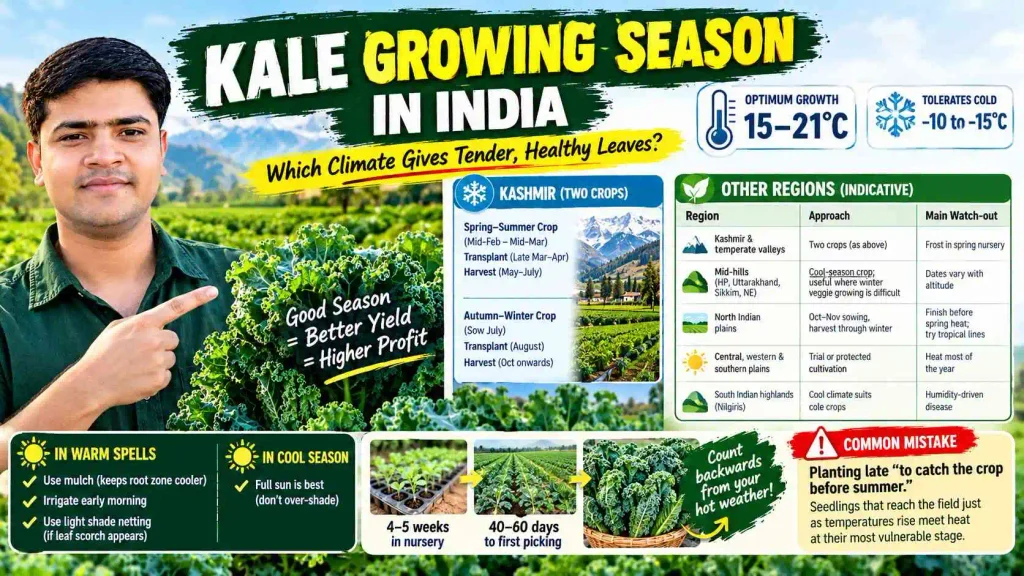
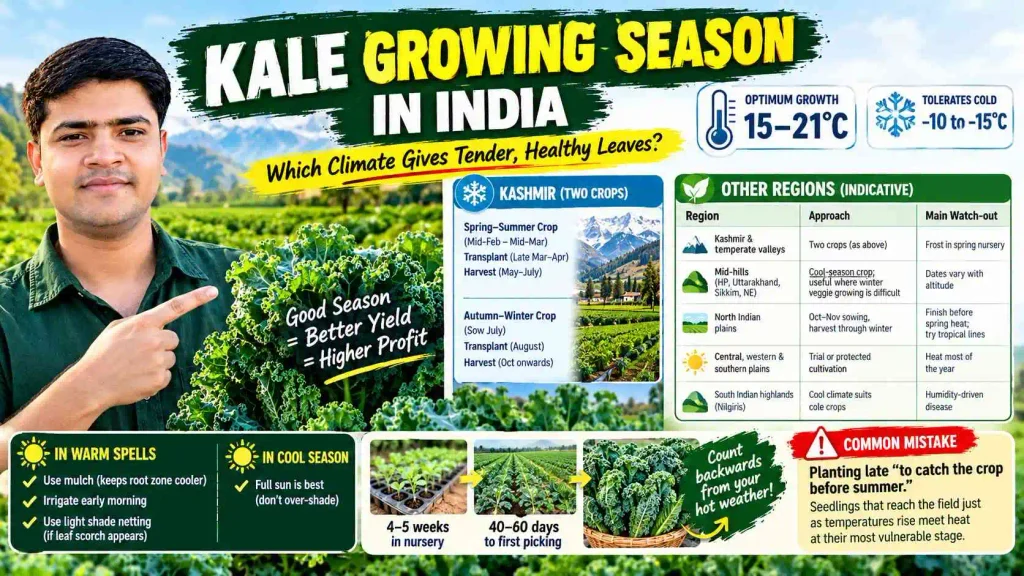
Choose your planting month before you choose your seed. Kale tolerates cold as low as −10 to −15 °C, but ICAR-CITH puts optimum growth at 15–21 °C. That’s a cool-weather window, which is why the kale growing season in India is essentially a winter-and-spring story outside the hills.
Cold is rarely the limiting factor in kale farming; heat is. As temperatures climb well above the optimum, a cool-season plant is working outside its comfort zone, and leaves turn tougher and harsher as plants age.
ICAR-CITH describes two windows for kale farming in the Kashmir Valley. The spring–summer crop is sown in the nursery from mid-February to mid-March (under cover if frost threatens), transplanted in late March–April and harvested from May to July. The main autumn–winter crop is sown in July, transplanted in August and harvested from October onwards.
Outside Kashmir, published guidance on kale farming is thinner, so the table below is indicative only. Confirm dates with your nearest KVK before you commit.
| Region | Indicative approach | Main watch-out |
|---|---|---|
| Kashmir and temperate valleys | Two crops, on the ICAR-CITH dates above | Frost during the spring nursery |
| Mid-hills of Himachal, Uttarakhand, Sikkim and the North-East | Cool-season crop; ICAR-CITH sees kale as useful where winter vegetable growing is difficult | Dates vary with altitude |
| North Indian plains | Garden-focused Indian guides point to October–November sowing, with harvest through winter | Finish picking before spring heat; trial tropical lines |
| Central, western and southern plains | No established open-field package found; treat as a trial or protected cultivation | Heat for most of the year |
| South Indian highlands such as the Nilgiris | Cool climate suits cole crops; Indian farming guides list the Nilgiris among kale-growing areas | Humidity-driven disease |
In warm spells, a few measures protect your kale crop: mulch to keep the root zone cooler, irrigate in the early morning, and use light shade netting if leaf scorch appears. In the cool season, though, kale wants full sun, so don’t over-shade it.
Common Mistake: Planting late “to catch the crop before summer.” In kale farming, seedlings that reach the field just as temperatures rise meet heat at their most vulnerable stage. Count backwards from your hot weather instead: 4–5 weeks in the nursery, then 40–60 days to the first picking.
How Do You Prepare Soil for Kale Cultivation?
What does a kale crop dislike most? Wet feet. ICAR-CITH recommends well-drained, organically rich loam with a pH between 5.5 and 6.5. Here’s why each part matters:
- Drainage. Waterlogged soil starves roots of oxygen. Plants stall, lower leaves yellow and root rots move in.
- pH. Outside the 5.5–6.5 band, nutrients get harder to absorb, and very acidic, wet soils favour clubroot, a serious soil-borne disease of the cabbage family.
- Organic matter and structure. Compacted, low-humus soil restricts roots and swings between waterlogged and bone dry.
Here’s how to prepare a field for kale farming:
- Test the soil through your KVK or a state soil-testing lab a couple of months before planting, so there’s time to correct pH.
- Add organic matter. ICAR-CITH recommends 15–20 tonnes of well-decomposed farmyard manure (FYM) or 7.5–10 tonnes of vermicompost per hectare, roughly 6–8 tonnes or 3–4 tonnes per acre, applied well before transplanting.
- Plough and level to a fine, even tilth so water doesn’t pool.
- Raise the beds in wet weather. An ICAR IPM study on rainy-season cauliflower used ridges 15–25 cm high to keep roots out of standing water.
- Rotate. Where land allows, keep cabbage, cauliflower, mustard and radish out of the field for two to three years before kale.
Warning: Use only well-decomposed manure in kale cultivation. Fresh, half-rotted FYM can burn roots and carry weed seeds and pests into your nursery and field.
How to Grow Kale from Seed: Nursery, Transplanting and Plant Spacing
Direct sowing or transplanting? Home gardeners growing kale often sow straight into the bed, but ICAR guidance for commercial kale farming uses a nursery. The reasons are practical: you protect tiny seedlings, save seed and field time, and plant only strong, evenly sized seedlings, which gives a more uniform crop.
Here’s the nursery-to-field sequence for kale farming:
- Seed. Use reliable, preferably certified seed. Roughly 400–500 g per hectare (about 160–200 g per acre) is commonly quoted for kale; confirm with your supplier, because seed size and germination vary.
- Nursery bed. Make a raised, well-drained bed. In the SKUAST-Kashmir trial, seed went in lines 5 cm apart, was covered with ash and then paddy straw until germination, and was watered lightly morning and evening. Sow shallowly, about 1–1.5 cm deep.
- Damping-off defence. Don’t overwater. ICAR guidance for cole crops lists seed treatment with Trichoderma or Pseudomonas fluorescens at 2 g per kg of seed as a biological option.
- Transplanting. ICAR-CITH recommends seedlings with 4–5 true leaves, ready about 4–5 weeks after sowing. Ease off watering for a week or so to harden them, transplant in the evening or on a cloudy day, and water straight away. The SKUAST trial filled gaps within seven days.
Kale plant spacing is where yield and quality pull in opposite directions. The table converts published spacings into plants per acre and shows what the research found.
| Spacing (cm) | Plants per acre (approx.) | What it means |
|---|---|---|
| 60 × 45 | 15,000 | Wide end of the ICAR-CITH range; room for large-leaf types |
| 45 × 30 | 30,000 | Inside the ICAR-CITH range; a sensible starting point for a trial |
| 30 × 40 | 33,700 | SKUAST-Kashmir trial: biggest leaves, highest dry matter and vitamin C, lowest total yield |
| 30 × 30 | 45,000 | Middle ground in the same trial |
| 30 × 20 | 67,000 | SKUAST-Kashmir trial: highest yield per area, but smaller leaves and lower quality |
If you sell by weight to a processor, closer spacing may pay. If you sell premium bunches where leaf size and appearance matter, go wider.
Best Practice: In kale farming, time your field preparation to your nursery sowing date. Seedlings left waiting in the nursery for seven or eight weeks turn leggy and establish slowly.
Kale Fertilizer Requirements: What Does the Crop Need for Fast Leaf Growth?
One SKUAST-Kashmir trial on Siberian kale surprised people who equate leaf crops with heavy urea: the best treatment didn’t use the full chemical dose. Half the recommended dose plus 3 tonnes of vermicompost per hectare gave the highest leaf yield (26.25 t/ha at the closest spacing), while 6 tonnes of vermicompost alone produced the highest dry matter and vitamin C.
That’s also why kale farming has no universal fertilizer schedule. ICAR-CITH, citing State Agricultural University packages, gives 60 kg N, 40 kg P₂O₅ and 40 kg K₂O per hectare at transplanting, plus 30–40 kg N three to four weeks later. That works out to roughly 24:16:16 kg per acre as the basal dose and 12–16 kg N per acre as top-dressing. The SKUAST trial treated 120:90:60 kg NPK per hectare as its full dose, applying half the nitrogen at transplanting and the rest at 30 and 45 days after transplanting (DAT).
Treat these as reference points for kale farming, not prescriptions. Your soil test, previous crop and local agricultural university package should set the final dose.
The table below explains what each nutrient does for a leaf crop and how a shortage shows up.
| Nutrient | Role in kale | Typical shortage signs |
|---|---|---|
| Nitrogen | Leaf size and green colour | Pale, yellowing older leaves; slow growth |
| Phosphorus | Root growth and early establishment | Stunted plants; purplish tint |
| Potassium | Water balance, firmness, stress tolerance | Yellowing or scorched leaf margins |
| Calcium | Cell walls and leaf firmness | Tip burn on young leaves, often triggered by uneven watering |
| Sulphur | Protein and flavour compounds; brassicas are sulphur-hungry | Pale, yellowish young leaves |
| Micronutrients (boron, molybdenum, zinc) | Small amounts, big effects | Boron: hollow or brittle stems; molybdenum problems are mostly seen in acidic soils |
Three habits pay off in kale cultivation: split the nitrogen instead of applying it all at once, keep it moderate because excess nitrogen produces soft growth that aphids and caterpillars love, and rebuild organic matter every season. Correct micronutrients only on the basis of a soil or leaf test, since overdoses (boron especially) can harm the crop.
Did You Know? In the same SKUAST-Kashmir trial, plants given 6 tonnes of vermicompost per hectare had about 50% more vitamin C than unfertilised plants (roughly 112 versus 74 mg per 100 g).
How Much Water Keeps Kale Leaves Tender Without Damaging the Roots?
Walk through a kale field after a dry fortnight followed by a heavy irrigation and you’ll see the problem: leaves that grew fast, then toughened; browning edges; yellowing lower leaves. Kale farming doesn’t demand a lot of water. It demands steady water. ICAR-CITH says consistent moisture keeps leaves tender, and it recommends drip irrigation to save water and prevent moisture-borne diseases.
Here’s how water needs change across a kale farming cycle:
- Nursery: Water lightly in the morning or evening. Heavy watering invites damping-off.
- After transplanting: Water immediately. The SKUAST trial used a rose can for the first two days, then moved to need-based irrigation.
- Growth and picking: Keep the root zone evenly moist.
- Hot weather: Irrigate early in the morning, mulch the rows, and don’t let the soil swing between dust-dry and soaked.
Irregular watering costs you twice when growing kale. Plants stall in dry spells and surge after irrigation, which gives uneven, tougher leaves and raises the risk of tip burn. Waterlogging does the opposite damage: yellowing, stunted plants and root rots. On top of that, wet foliage in the evening is an open invitation to fungal disease, which is one more reason drip beats overhead watering.
There’s no reliable Indian source that gives a litres-per-acre figure for kale farming, so treat any fixed number with caution; demand shifts with soil, temperature and crop stage. One cultivation guide quotes irrigation every three weeks, but that reflects cool hill conditions and shouldn’t be copied onto the plains.
Practical Tip: Push a finger about 5 cm into the soil beside a plant. If it’s crumbly and barely damp, irrigate. If it clumps wet, wait.
Which Pests and Diseases Threaten Kale Farming, and How Do You Manage Them Safely?
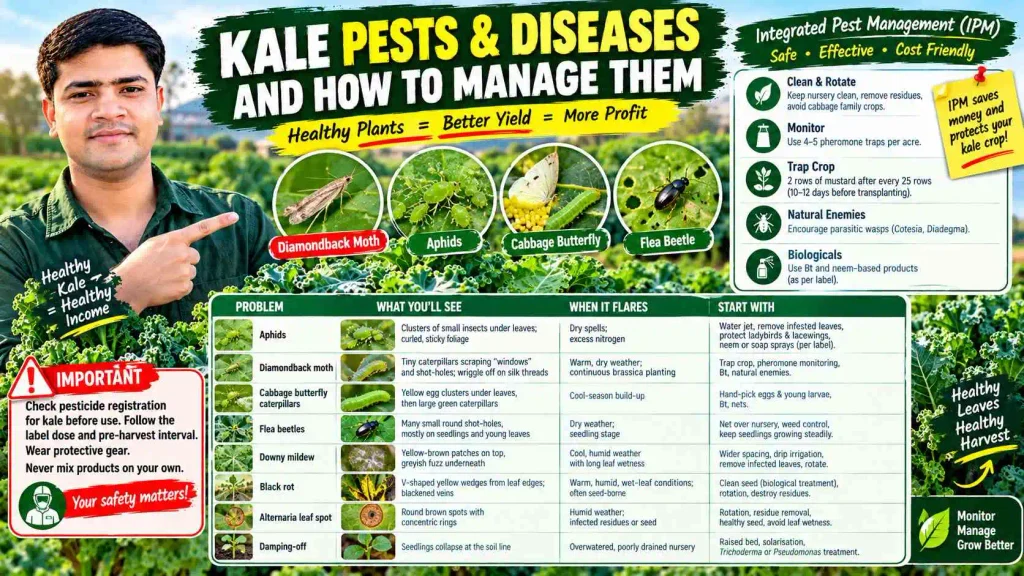
Kale farming comes with a built-in challenge: kale is a brassica, so it’s on the menu for every cabbage pest in your district. The worst offender is the diamondback moth. In cabbage, an ICAR journal review says it can cause losses above 90% in severe outbreaks, and a few large larvae can make a head unmarketable. A leaf crop sold on its looks faces the same logic: holes mean rejects.
The good news is that integrated pest management (IPM) works well in kale cultivation, as it does on other brassicas, and it’s cheaper. In an older Karnataka cabbage study (1996–97), a pheromone-trap-based IPM programme cost about $62 per hectare for crop protection against $123 for routine insecticide use, and net profit was higher. The building blocks are simple:
- Sanitation and rotation. Keep nursery beds clean, remove crop residues and avoid cabbage-family predecessors.
- Monitoring. Scout weekly. IPM guidance for cabbage suggests 4–5 pheromone traps per acre to monitor diamondback moth.
- Trap crop. Plant two rows of mustard after every 25 rows of the main crop, the first about 10–12 days before transplanting. Destroy it before caterpillars mature, or it becomes their nursery.
- Natural enemies. Parasitic wasps (Cotesia, Diadegma) keep caterpillars in check if broad-spectrum sprays don’t wipe them out.
- Biologicals. Bt (Bacillus thuringiensis) and neem-based products work on young caterpillars when used as per the label.
The table below helps you match what you see in the field to the likely cause and a first response.
| Problem | What you’ll see | When it flares | Start with |
|---|---|---|---|
| Aphids | Clusters of small insects under leaves; curled, sticky foliage | Dry spells; excess nitrogen | Strong water jet, remove infested leaves, protect ladybirds and lacewings, neem or soap-based sprays per label |
| Diamondback moth | Tiny caterpillars scraping “windows” and shot-holes; they wriggle off on silk threads | Warm, dry weather; continuous brassica planting | Trap crop, pheromone monitoring, Bt, natural enemies |
| Cabbage butterfly caterpillars | Yellow egg clusters under leaves, then large green caterpillars chewing big holes | Cool-season build-up | Hand-pick eggs and young larvae, Bt, nets |
| Flea beetles | Many small round shot-holes, mostly on seedlings and young leaves | Dry weather; seedling stage | Net over the nursery, weed control, keep seedlings growing steadily |
| Downy mildew | Yellow-brown patches on top, greyish fuzz underneath | Cool, humid weather with long leaf wetness | Wider spacing, drip irrigation, remove infected leaves, rotate |
| Black rot | V-shaped yellow wedges from leaf edges; blackened veins | Warm, humid, wet-leaf conditions; often seed-borne | Clean seed with biological seed treatment, rotation, destroy residues |
| Alternaria leaf spot | Round brown spots with concentric rings | Humid weather; infected residues or seed | Rotation, residue removal, healthy seed, avoid leaf wetness |
| Damping-off | Seedlings collapse at the soil line | Overwatered, poorly drained nursery | Raised bed, solarisation, Trichoderma or Pseudomonas seed treatment |
Warning: Kale farming is still small-scale in India, so a pesticide registered for cabbage doesn’t automatically carry a label claim for kale. Before spraying anything synthetic, check the product’s registration and label with your KVK or plant-protection officer, follow the stated dose and pre-harvest interval, and wear protective gear. Because kale is picked repeatedly, a long waiting period can clash with your harvest schedule. Never mix products on your own.
Kale Harvesting Time: When Are the Leaves Ready to Pick?
In the SKUAST-Kashmir trial, picking began 40 days after transplanting and repeated every 15 days: four pickings, at 40, 55, 70 and 85 DAT. For kale harvesting time, ICAR-CITH gives 45–60 days after transplanting for the first harvest, with multiple pickings after that. Use those figures as a kale farming calendar, but let the plant make the final call.
So how do you know a leaf is ready? Look for full-sized, firm, deep-coloured leaves from the lower, outer part of the plant, before they turn thick and leathery. Cut or snap them at the base of the leaf stalk and leave the growing tip and the young inner leaves untouched; that’s what keeps the plant producing.
In kale farming, timing changes the price you get. Pick too early and leaves are small and light, so labour per kilogram rises. Pick too late and leaves toughen and taste harsher, since mild flavour is best in young leaves. Buyers notice both.
The calendar below pulls the main timings together.
| Stage | Timing | Action |
|---|---|---|
| Nursery sowing | Day 0 | Raised bed, seed treatment, light watering |
| Transplanting | 4–5 weeks after sowing (4–5 true leaves) | Water immediately; gap-fill within a week |
| Weeding | Especially the first month after transplanting | Keep weeds off young plants |
| Nitrogen top-dressing | 3–4 weeks after transplanting, or split at 30 and 45 DAT as in the trial | Adjust to the soil test |
| First picking | 40–60 DAT | Outer leaves only |
| Repeat picking | About every 15 days (trial schedule) | Never strip the growing tip |
After picking, speed matters more than anything in kale farming. Harvest in the cool morning, keep leaves in shade, trim yellow or damaged leaves, grade by size and colour, and bunch to the weight your buyer wants. Pack in ventilated crates or perforated pouches and get the leaves into cold storage quickly; with only 5–7 days of refrigerated shelf life, plan deliveries before you plan harvests.
Practical Tip: In kale farming, agree harvest days with your buyer in advance and pick to order. Leaves that go from field to chiller to customer within a day or two arrive fresher than leaves that wait in a warm vehicle.
Kale Yield per Acre: What Can You Realistically Expect?
Ignore any source that promises one number for kale yield per acre. Published figures swing widely because the crop responds so strongly to nutrition, spacing and climate.
The table below sets the available kale farming yield figures side by side, with the conversion to acres, so you can see the gap between research plots and ordinary farms.
| Source | Yield (t/ha) | Approx. per acre | Notes |
|---|---|---|---|
| SKUAST-Kashmir trial, best treatment | 26.25 | 10.6 t | Siberian kale, closest spacing, half chemical dose plus 3 t vermicompost/ha, four pickings |
| SKUAST-Kashmir trial, unfertilised control | 6.55 | 2.7 t | Widest spacing, no manure or fertilizer |
| General range in Indian cultivation guides | 10–20 | 4–8 t | Secondary source; region and variety not specified |
| Planning assumption in this guide | 10–15 | 4–6 t | The lower half of the general range, for a cautious start |
Notice the spread in the trial alone: four-fold, from the same crop at the same station, which shows how much kale cultivation rewards good management. Variety, climate, plant density, picking frequency, nutrition and pest control all move the needle. Per plant, the trial recorded roughly 90 to 190 g of leaf across its four pickings.
Keep one more thing in mind about kale farming: research plots are tidy. On a working farm, yellowed, insect-damaged or oversized leaves get culled at grading, so marketable yield is lower than picked yield.
Common Mistake: Using the best research-plot yield to forecast kale yield per acre and income. Plan kale farming on the cautious range, then let your own trial plot tell you what your farm, your variety and your season can do.
Can One Acre of Kale Farming Generate a Good Income in India?
Start with the SKUAST-Kashmir economics, because they show how much kale farming profit per acre depends on management. In that trial the benefit-cost ratio ran from 0.92 (no manure or fertilizer, widest spacing) to 4.28 (closest spacing with half the chemical dose plus vermicompost). Same crop, same station, same seasons. Prices and costs in the paper date from 2006–07, when it assumed ₹10 per kg, so use the ratios as a lesson and not as today’s profit.
Today’s cost of kale farming depends on your region, but the cost heads are predictable:
- Land preparation and ridging or raised beds
- Seed and nursery
- Farmyard manure or vermicompost, and fertilizers
- Irrigation, including drip installation and power
- Labour for weeding, repeated picking, grading and packing
- Pest and disease management
- Packaging, cold chain and transport
- Market charges or commission, if you sell through intermediaries
The price side of kale farming is murkier. Online estimate sites quote retail kale in India at roughly ₹36–60 per kg, while a 2026 article reports urban supermarket bunches at ₹40–70 for 150 g (around ₹270–470 per kg). That’s a ten-fold gap, which tells you not to trust any single number. Retail prices include packing, cold chain and margins, and the grower sees only a fraction. For context, one Maharashtra APMC quoted spinach at about ₹18 per kg on 27 June 2026; kale sold through ordinary mandi channels may be priced against greens like that.
So work backwards. Break-even price per kg is total cost per acre divided by marketable kilograms per acre. The table uses assumed cost levels, not survey data, to show how sensitive the answer is.
| Assumed total cost per acre | At 4,000 kg | At 6,000 kg | At 8,000 kg |
|---|---|---|---|
| ₹60,000 | ₹15.00/kg | ₹10.00/kg | ₹7.50/kg |
| ₹90,000 | ₹22.50/kg | ₹15.00/kg | ₹11.25/kg |
| ₹1,20,000 | ₹30.00/kg | ₹20.00/kg | ₹15.00/kg |
Now four hypothetical one-acre kale farming scenarios, with illustrative arithmetic only (cost and price are assumptions, not forecasts):
| Scenario | Yield | Cost | Price | Net result |
|---|---|---|---|---|
| A: contracted buyer | 6,000 kg | ₹90,000 | ₹40/kg | ₹1,50,000 |
| B: same crop sold at a mandi-like price | 6,000 kg | ₹90,000 | ₹18/kg | ₹18,000 |
| C: tougher season, contracted buyer | 4,000 kg | ₹1,20,000 | ₹40/kg | ₹40,000 |
| D: tougher season, mandi-like price | 4,000 kg | ₹1,20,000 | ₹18/kg | −₹48,000 |
Same acre, same crop, and the result swings from a loss to a healthy return. That’s why, in kale farming, a confirmed buyer and consistent quality can matter more than squeezing out the highest possible yield.
Key Takeaway: Before you trust any claim about kale farming profit per acre, calculate your break-even price, then ask buyers for a quote. If the quote doesn’t clear break-even with room to spare, the crop isn’t ready for scale, no matter how good the agronomy looks.
Can You Grow Kale in Pots, Polyhouses or Hydroponic Systems?
Open-field kale farming needs the right month. Protected systems try to buy you the right climate instead, and each trades convenience for cost. The table compares three alternative kale farming systems.
| Method | Best for | What it needs | Main limits |
|---|---|---|---|
| Containers and terrace | Home growers, small premium bunches | A pot roughly 30 cm wide and deep per plant, drainage holes, compost-rich mix, full sun, regular watering | Small volume; terraces heat up fast in summer |
| Polyhouse or net house | Growers wanting more control over pests and the season | Insect-proof netting, ventilation, shade net, drip irrigation | Heat build-up inside; capital cost has to be covered by price |
| Hydroponics (NFT or deep-water culture) | Urban growers with a confirmed buyer for fresh leaf | Nutrient solution at pH 5.5–6.5; vendor guides cite EC of about 1.6–2.5 mS/cm for mature kale | Power, daily monitoring and keeping solution cool in Indian summers; published guides put harvest around 45–60 days from transplanting |
Protection can solve the pest problem as well as the climate problem. Guidance on diamondback moth recommends growing commercial brassicas under nets, and ICAR-CITH uses protective cover for its frost-prone spring nursery. Hydroponic kale farming is the most controllable and the most demanding option: it rewards technical discipline and punishes guesswork.
Quick Summary: Pots suit households, polyhouses suit growers who need pest and season control, and hydroponics suits technically confident growers with a firm buyer. For everyone else, a small open-field kale farming trial in the right month remains the cheapest way to learn.
Before You Invest in Kale Farming, Do This First
The biggest lesson in kale farming isn’t about fertilizer or spacing. It’s that a cool-season, perishable, niche crop needs three things lined up before the first seed goes in: a climate window you can trust, a variety that suits it, and someone who has agreed to buy the leaves. Agronomy can be fixed mid-season. A missing buyer can’t.
So start small. A kale cultivation trial on one-tenth to a quarter of an acre, with one or two varieties and one planting window, will teach you more than any article can: how your soil behaves, how fast pests build up, how many picks you really get, and how buyers react to your leaves.
Here’s one action to take this week, before you put money into kale farming: speak to three prospective buyers and ask each the same four questions. Which type of kale do you want? How many kilograms a week? What delivered price per kilogram or per bunch? What packing and grading do you expect? Then calculate your break-even price using the table above. If the numbers work, you’ll plant with confidence. If they don’t, you’ve saved an acre’s worth of money.
Kale farming in India won’t suit every field, and it isn’t a shortcut to easy money. But for growers in the right climate, with a buyer in hand and the patience to start small, it’s a crop worth learning properly.
Yields, prices and recommendations change by region and season. Confirm dates, doses and pesticide registration with your local KVK, state agricultural university or horticulture department before acting.
If you’re exploring other livestock farming opportunities alongside crop cultivation, our guide on duck farming in India covers breeds, costs and common mistakes.
Newsletter