


Shrimp Feeding Guide: How Much to Feed
A practical, farm-level guide for commercial Litopenaeus vannamei culture
Feed is usually the largest operating expense on a commercial shrimp farm, and it is also the one cost you control every single day. Give too little and growth stalls. Give too much and the surplus doesn’t disappear: it settles on the pond bottom, breaks down into ammonia and nitrite, eats into dissolved oxygen and pushes your feed conversion ratio (FCR) in the wrong direction.
That is why feeding decisions sit at the centre of growth, survival and profit, and why every farm needs a clear shrimp feeding guide. This shrimp feeding guide is written for farmers growing Litopenaeus vannamei, with notes on Penaeus monodon where the two species differ. You will learn how shrimp needs change with age, how to choose feed, how to work out daily feed from biomass, how to build a feeding schedule, how to read feed trays, how water quality governs appetite, and how to track FCR so you know what your feed money is really buying.
Key Takeaway: Every feeding percentage, pellet size and schedule in this shrimp feeding guide is indicative, not a universal standard. Your feed manufacturer’s chart, your pond conditions and your technical adviser’s judgement always come first.
Why Feed Management Decides the Success of a Shrimp Crop
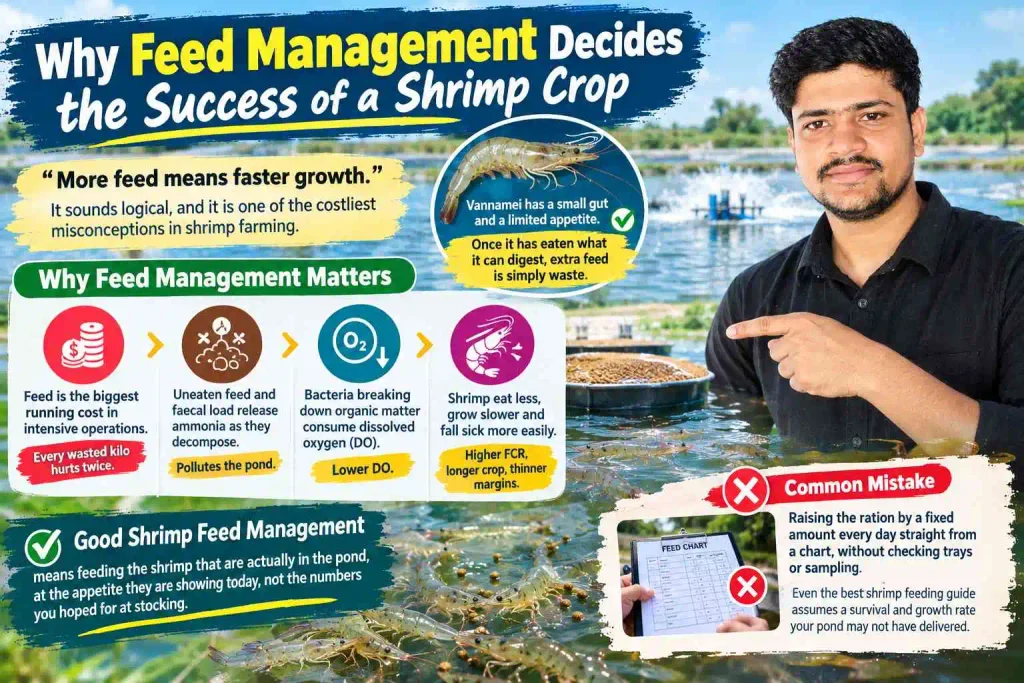
“More feed means faster growth.” It sounds logical, and it is one of the costliest misconceptions in shrimp farming. A vannamei has a small gut and a limited appetite. Once it has eaten what it can digest, extra feed is simply waste.
Here’s why this matters. Feed is the biggest running cost in most intensive operations, so every wasted kilo hurts twice: once when you pay for it, and again when it pollutes the pond. Uneaten feed and a heavy faecal load release ammonia as they decompose. Bacteria breaking down that organic matter consume dissolved oxygen (DO). Shrimp living with low oxygen and high nitrogen compounds eat less, grow slower and fall sick more easily. The result is a higher FCR, a longer crop and thinner margins.
Good shrimp feed management, the foundation of any shrimp feeding guide, means feeding the shrimp that are actually in the pond, at the appetite they are showing today, not the numbers you hoped for at stocking.
Common Mistake: Raising the ration by a fixed amount every day straight from a chart, without checking trays or sampling. Even the best shrimp feeding guide assumes a survival and growth rate your pond may not have delivered.
Shrimp Feeding Guide by Growth Stage: What Shrimp Eat
Does a shrimp in its first week in the pond need the same diet as one a fortnight from harvest? Obviously not, and any good vannamei shrimp feeding guide has to start there.
Every shrimp feeding guide begins with post-larvae (PL), which are stocked tiny and lean heavily on natural food such as plankton, microbes and organic detritus in the first days, with fine formulated feed on top. As they grow into juveniles, formulated feed gradually becomes the main nutrition source in intensive ponds and natural food shrinks to a supporting role. By pre-harvest, shrimp eat larger meals, need bigger pellets, and the sheer biomass in the pond makes any feed waste far more damaging.
The culture system changes the picture too. In extensive and low-density semi-intensive ponds, natural productivity supplies much of the nutrition and formulated feed is a supplement. In intensive, aerated ponds, formulated feed carries most of the load. In biofloc systems, microbial flocs add a protein source that can offset part of the ration, but flocs need careful management and monitoring.
The table below is a quick shrimp feeding guide to how feeding focus shifts through the crop. Size ranges are approximate and vary with stocking density, temperature and genetics.
| Stage | Approx. size | Main food | Feeding focus |
|---|---|---|---|
| Post-larvae / early nursery | PL10–15 to ~1 g | Natural food + fine crumble or micro-pellet | Small, frequent meals; protect water quality |
| Juvenile | ~1–10 g | Formulated feed, rising share | Move to tray-based feeding; sample weekly |
| Grow-out | ~10–25 g | Formulated feed dominant | Watch DO, trays and FCR closely |
| Pre-harvest | above ~25 g | Formulated feed | Avoid waste; no sudden changes |
Did You Know? Penaeus monodon is generally a slower, more deliberate feeder than vannamei and is usually stocked at lower densities. Its feeding rates and tray-check timing should follow a monodon-specific protocol, not a vannamei shrimp feeding guide.
Shrimp Feeding Guide: Which Feed Should You Choose?
Two bags can show the same crude protein on the label and perform very differently in your pond. In any shrimp feeding guide, the label is where selection starts, not where it ends.
Commercial feeds are organised by size and stage. Starter feeds, in fine crumble or micro-pellet form, suit small shrimp. Grower feeds carry the crop through most of its life, and finisher feeds support the last weeks. Nursery systems use very fine, highly digestible feeds designed for high-density rearing. Vannamei feed on or near the bottom, so sinking pellets are the standard format.
What should you actually compare?
- Crude protein: the main driver of growth, but unused protein is excreted as ammonia. Commercial vannamei feeds commonly span roughly 30% to above 40% depending on stage, brand and system, so no single figure suits every stage.
- Lipids: concentrated energy and essential fatty acids.
- Carbohydrates: an energy source that also helps bind the pellet.
- Fibre: should stay low, because shrimp digest it poorly.
- Ash: a very high value can mean low-grade ingredients and less nutrient density.
- Vitamins and minerals: needed in small amounts, but deficiencies show up as poor moulting, weak shells and slow growth.
Beyond the label, check water stability and digestibility. Shrimp are slow nibblers, so pellets must hold together for hours, not minutes, or nutrients leach into the water before they are eaten. Ask suppliers for stability and proximate analysis data.
The next table, a compact shrimp feeding guide to pellet size, gives common ranges against body weight. Treat it as a starting point and confirm with your feed manufacturer.
| Feed type | Typical ABW | Indicative size |
|---|---|---|
| Nursery / micro-pellet | PL to ~0.5 g | Very fine, ~0.2–0.5 mm |
| Starter crumble | ~0.5–3 g | ~0.5–1.2 mm |
| Grower pellet | ~3–15 g | ~1.2–2.0 mm |
| Grower / finisher pellet | above ~15 g | ~2.0–2.5 mm |
Expert Tip: Judge feed by cost per kilo of shrimp produced, not cost per bag. A cheaper feed that raises FCR or fouls the pond is usually the more expensive choice (see the cost example near the end).
How Much Feed Do Shrimp Need? A Shrimp Feeding Guide to Daily Feed Calculation
A pond is stocked with 100,000 PL. How much should you feed tomorrow? Without an estimate of biomass, you are guessing, and guesses get expensive fast. Every shrimp feeding guide worth following comes back to one principle: feed a percentage of the shrimp biomass in the pond.
The core formula in this shrimp feeding guide is:
Daily Feed (kg) = Estimated Shrimp Biomass (kg) × Feeding Rate (%) ÷ 100
Biomass itself = shrimp population × survival × average body weight (ABW). Population comes from your stocking number, ABW from sampling, and survival from your best evidence.
Worked example (shrimp feed per day): 100,000 shrimp stocked, survival estimated at 80%, so 80,000 shrimp. ABW is 10 g. Biomass = 80,000 × 10 g = 800,000 g = 800 kg. At a 3% feeding rate: 800 × 3 ÷ 100 = 24 kg per day, divided across the day’s meals.
Now suppose true survival is only 65%. Real biomass is 100,000 × 0.65 × 10 g = 650 kg, and the correct ration at 3% is 19.5 kg. You would be overfeeding by 4.5 kg a day, about 23% too much. In ten days that is 45 kg of feed going straight to the pond bottom.
Use this shrimp feeding guide table as an indicative shrimp feed chart of feeding rates by body weight. These are starting estimates drawn from the general spread seen in manufacturer charts and extension practice, not fixed rules, and your tray results always override them.
| ABW | Indicative rate (% of biomass per day) |
|---|---|
| 1–3 g | 5–8% |
| 3–8 g | 3.5–5% |
| 8–15 g | 2.5–3.5% |
| 15–25 g | 1.8–2.8% |
| above 25 g | 1.5–2.2% |
How do you estimate biomass in practice? The shrimp feeding guide answer is regular sampling. Take cast-net samples from several points around the pond, weigh a reasonable number of shrimp (100 or more is common) and calculate ABW. For survival, combine mortality records, tray counts and cast-net counts. Cast-net counts are rough, so use them as a trend rather than an exact number. During the first month, many farms follow the feed company’s blind-feeding programme and shift to tray-based adjustment afterwards.
Warning: No shrimp feeding guide can fix a wrong survival number, so never assume the survival you planned for. An optimistic assumption quietly turns into daily overfeeding.
Shrimp Feeding Guide: The Ideal Shrimp Feeding Schedule for Grow-Out Ponds
Don’t give two heavy rounds a day and call it a schedule. Shrimp are slow, frequent feeders, most active around dusk and through the night, and they use feed better when it arrives in smaller, well-spaced meals.
A typical shrimp feeding schedule starts with about four meals a day in the early weeks and runs four to five meals in grow-out. Intensive ponds with automatic feeders may feed far more often in smaller portions. Temperature, DO and appetite all shift the plan: shrimp eat less in cold or very hot water, and pre-dawn oxygen is usually the lowest point of the day, which makes early-morning feeding the riskiest meal.
Here is a sample schedule from this shrimp feeding guide for an aerated grow-out pond with shrimp of about 10 g and above. The split is illustrative and must be adjusted to your trays, DO readings and local conditions.
| Time | Share of daily ration | Notes |
|---|---|---|
| 06:30 | 20% | Only after DO has recovered; cut if morning DO is low |
| 11:00 | 20% | Good time for tray observation |
| 16:00 | 25% | Build up before the evening feeding peak |
| 21:00 | 35% | Reduce or skip if DO is falling |
Distribution matters as much as timing. Spread feed evenly around the aerated zones and perimeter, and avoid the sludge-collecting centre of the pond, where feed is wasted.
Practical Tip: Keep meal times constant, a simple rule in any shrimp feeding guide. Shrimp learn the routine and gather at feeding time, which improves intake and makes tray readings more reliable.
How to Use a Shrimp Feeding Tray: A Shrimp Feeding Guide to Avoiding Waste
A feeding tray costs very little and tells you more about your pond than any chart can, and every commercial shrimp feeding guide leans on it. Properly used, it is the best tool in this shrimp feeding guide, and on your farm, for matching feed to appetite.
Number and placement. A common rule of thumb is around four trays per acre, more in large or irregular ponds, but follow your technical team’s protocol. Spread them across the pond, away from the sludge zone and from dyke edges, mark positions with floats and keep them fixed from day to day.
Feed per tray. Place a small, fixed share of each meal in the tray (many farms use roughly 0.5–1%) and broadcast the rest.
Observation time. Check after a set interval, commonly around 1.5 to 2.5 hours, shorter for small shrimp and longer for slower feeders, then record what you see. Look at leftover pellets, but also at the shrimp: gut fullness, colour, shell condition and activity.
This table is a shrimp feeding guide to reading tray leftovers and adjusting the next meal. The adjustments are indicative; follow your own farm protocol.
| Tray observation | Likely meaning | Indicative next-meal action |
|---|---|---|
| Tray clean, guts full | Good appetite, possibly slightly underfed | Increase modestly (about 5–10%) |
| Very few pellets left | Well matched | Hold |
| Moderate leftovers | Overfeeding or reduced appetite | Reduce; check DO and water quality |
| Heavy leftovers or untouched | Stress, poor water, disease or feed problem | Cut sharply or skip; investigate |
The common errors are checking too early (so leftovers look larger than they are), checking too late (feed has already dissolved or been eaten), ignoring trays that differ from the rest of the pond, and trusting trays without checking oxygen and water quality. A clean tray in a pond with falling DO isn’t good news if shrimp are feeding only half-heartedly.
Expert Tip: When one tray is consistently different from the others, look at that spot. It often points to a sludge patch, an aeration dead zone or a local disease issue.
How to Adjust Shrimp Feeding Rate as Shrimp Grow
Sampling is the only way to learn what your shrimp actually weigh. Skip it and you are running the pond on assumptions, and no shrimp feeding guide can rescue that.
After the first month, sample about weekly. Each sampling gives you ABW, growth per week and a chance to recheck survival. Update biomass, recalculate daily feed and record everything: feed per meal, tray results, ABW, mortality and DO. This is shrimp feed quantity by size in practice, using your real shrimp rather than a printed table.
The example below uses the same pond as before. Percentages fall as shrimp grow, yet the kilograms rise because biomass climbs.
| At 10 g | At 15 g | |
|---|---|---|
| Estimated survival | 80% | 78% |
| Biomass | 800 kg | 1,170 kg |
| Feeding rate | 3.0% | 2.5% |
| Daily feed | 24 kg | 29.25 kg |
Check the arithmetic: 78,000 × 15 g = 1,170,000 g = 1,170 kg; 1,170 × 2.5 ÷ 100 = 29.25 kg. A farmer who sees the percentage drop and trims feed anyway would starve a pond that is gaining weight.
Quick Summary: In one line, this shrimp feeding guide says: sample weekly, recalculate biomass, set the daily ration, then let trays fine-tune each meal.
Shrimp Feeding Guide: How Water Quality Affects Feeding
A feeding plan that ignores water quality is only half a plan. Appetite is one of the first things to drop when a pond goes wrong, and any practical shrimp feeding guide must treat feed and water as one system.
The table below, a water-quality shrimp feeding guide, lists the parameters that most directly influence feeding in vannamei ponds. Ranges are indicative; salinity and local conditions shift what is acceptable.
| Parameter | Indicative range | Effect on feeding |
|---|---|---|
| Dissolved oxygen | ideally 5 mg/L or more; trouble below about 3–4 | Low DO suppresses appetite and wastes feed |
| Temperature | about 28–32 °C | Appetite falls outside range, and with sudden swings |
| pH | about 7.5–8.5, daily swing under 0.5 | Extremes stress shrimp; high pH raises ammonia toxicity |
| Unionised ammonia | well below about 0.1 mg/L | Toxic, reduces appetite and growth |
| Nitrite | below about 1 mg/L (lower at low salinity) | Damages gills, reduces intake |
| Alkalinity | about 120 mg/L CaCO₃ or more | Stabilises pH and supports moulting |
| Salinity | wide tolerance, but stability matters | Sudden drops after heavy rain cut feeding |
| Pond bottom | clean, no black smelly sludge | Sludge and H₂S reduce appetite |
When DO falls or toxic nitrogen builds up, shrimp stop eating long before they die. Weak consumption in the trays is therefore an early warning of a pond or shrimp health problem, not just a feeding problem.
Practical Tip: If tray consumption suddenly drops, reduce the next meal and boost aeration straight away. Test DO, pH and ammonia before the next feeding rather than after.
What to Do When Shrimp Stop Eating
It is 7 p.m. and trays in one half of the pond are still full. What now?
Many things can switch off appetite: low DO, sudden temperature or salinity change, poor water quality, high ammonia or nitrite, excess organic matter, disease and stress, poor-quality or stale feed, and mouldy or badly stored feed. The trick, as this shrimp feeding guide stresses, is to work through them in order instead of guessing.
- Check dissolved oxygen immediately, and correct it with extra aeration.
- Check temperature and pH for sudden swings.
- Inspect the trays, not just whether they are empty, but where and how much is left.
- Observe shrimp behaviour: swimming on the surface or edges, lethargy, empty guts.
- Test ammonia and nitrite.
- Inspect the pond bottom for black, smelly sludge.
- Look for disease signs, such as white faeces, red body or loose shells, and have a qualified lab confirm before treating.
- Adjust feeding according to what you find and your technical adviser’s guidance. Also check the feed itself for mould, rancid smell or damp bags.
Warning: Don’t increase feed to “tempt” shrimp into eating. Extra feed in a stressed pond adds to the pollution that caused the problem.
Shrimp Feeding Guide to FCR: Shrimp Feed Conversion Ratio Explained
Put simply, FCR tells you how many kilos of feed it takes to grow one kilo of shrimp.
FCR = Total Feed Given (kg) ÷ Total Shrimp Biomass Gain (kg)
Example: 100,000 PL at 0.01 g give a stocking biomass of about 1 kg. At harvest you net 75,000 shrimp at 25 g = 1,875 kg, so gain is about 1,874 kg. If you fed 2,625 kg in total, FCR = 2,625 ÷ 1,874 ≈ 1.40.
What moves that number?
- Overfeeding raises FCR directly; underfeeding lowers it on paper but stunts growth and lengthens the crop.
- Biomass estimates: a wrong estimate means wrong rations, so FCR drifts.
- Feed quality and digestibility: poorly digested feed turns into waste, not shrimp.
- Survival and disease: fewer shrimp share the same feed, so FCR climbs.
- Pond management and natural productivity: a pond with good natural food will show a lower FCR on formulated feed alone.
What’s a realistic range? Field reports for well-managed vannamei ponds often fall roughly between 1.2 and 1.6, but this varies widely with system, density and season, and extensive ponds rely far less on formulated feed. Check current ICAR-CIBA, MPEDA and feed-company data, and compare against your own past crops.
A low FCR alone doesn’t guarantee profit, and no shrimp feeding guide should treat it as proof of one. A pond fed too lightly may post an FCR near 1.1 and still harvest small shrimp after a long crop. Always read FCR alongside survival, harvest size, days of culture and cost per kilo of shrimp.
Key Takeaway: In this shrimp feeding guide, FCR is the scorecard, but only if biomass records are honest. Calculate a running FCR during the crop as an early warning, not just at harvest.
Can Feed Supplements Improve Shrimp Growth?
Walk into any aqua shop and you will find a shelf of additives promising lower FCR and stronger shrimp. Some have real value in the right situation; many are oversold.
This table summarises common categories, what they are meant to do and what to keep in mind. It does not endorse any product.
| Additive | Intended purpose | Caution |
|---|---|---|
| Probiotics | Gut health or water quality support | Effects are strain-specific; results vary |
| Enzymes | Improve digestion of plant ingredients | Benefit depends on the diet |
| Organic acids | Gut health, possible reduction of harmful bacteria | Evidence is mixed |
| Vitamins (e.g. vitamin C) | Meet nutritional needs, support stress tolerance | Sensitive to heat, moisture and storage |
| Minerals | Moulting, shell strength, osmoregulation | Especially relevant in low-salinity ponds |
| Immunostimulants (e.g. beta-glucans) | Boost non-specific immunity | Short-term and variable benefits |
In any shrimp feeding guide, supplements work around the edges. They cannot rescue poor water quality, unsuitable feed or sloppy pond management, and claims of guaranteed FCR drops are marketing, not science. Ask for peer-reviewed or trial data and test on a small scale first.
Most Common Shrimp Feeding Mistakes
Most feeding losses come from a handful of repeated errors. This part of the shrimp feeding guide shows what each one costs and how to correct it.
| Mistake | Consequence | Fix |
|---|---|---|
| Overfeeding | Wasted money, ammonia, higher FCR | Feed to biomass and tray results |
| Underfeeding | Slow, uneven growth, longer crop | Verify with trays, raise gradually |
| Ignoring trays | Blind over- or underfeeding | Check trays at every meal |
| Wrong pellet size | Poor intake, waste | Match size to ABW |
| Poor storage | Rancid or mouldy feed, nutrient loss | See storage practices below |
| Not updating after sampling | Ration drifts from reality | Sample weekly and recalculate |
| Feeding during low DO | Feed wasted, extra stress | Pause, aerate, resume later |
| Ignoring sudden changes | Missed early disease or water problem | Investigate the same day |
| Poor-quality feed | High FCR, dirty pond | Judge by cost per kilo of shrimp |
| Copying another farm’s chart | Different density, survival and season | Use only as a starting point |
How Should Shrimp Feed Be Stored?
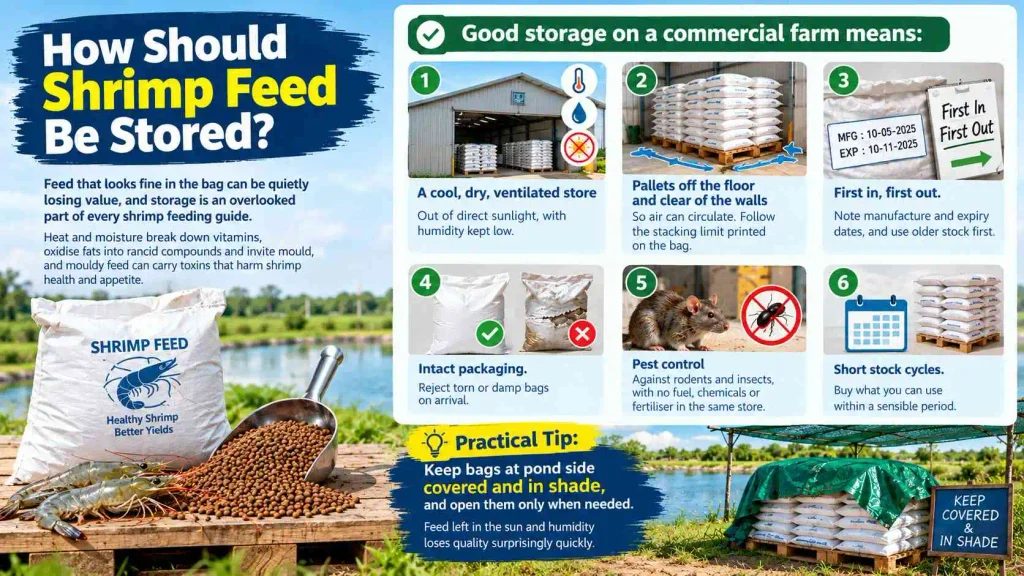
Feed that looks fine in the bag can be quietly losing value, and storage is an overlooked part of every shrimp feeding guide. Heat and moisture break down vitamins, oxidise fats into rancid compounds and invite mould, and mouldy feed can carry toxins that harm shrimp health and appetite.
Good storage on a commercial farm, as this shrimp feeding guide recommends, means:
- A cool, dry, ventilated store out of direct sunlight, with humidity kept low.
- Pallets off the floor and clear of the walls so air can circulate. Follow the stacking limit printed on the bag.
- First in, first out. Note manufacture and expiry dates, and use older stock first.
- Intact packaging. Reject torn or damp bags on arrival.
- Pest control against rodents and insects, with no fuel, chemicals or fertiliser in the same store.
- Short stock cycles. Buy what you can use within a sensible period.
Practical Tip: Keep bags at pond side covered and in shade, and open them only when needed. Feed left in the sun and humidity loses quality surprisingly quickly.
Shrimp Feeding Guide: How to Reduce Feed Costs Without Slowing Growth
Cutting feed cost doesn’t mean feeding less; it means wasting less. Strong shrimp feeding management in aquaculture, the goal of this shrimp feeding guide, rests on the habits already covered: accurate biomass estimates, consistent sampling, trays at every meal, the right pellet size, a stable schedule and good water quality. Add two more: keep tidy feed inventory and record a running FCR for every pond so problems show up early.
Here the shrimp feeding guide maths is simple: the cheapest feed is not always the cheapest crop. The table below uses hypothetical figures to show why: shrimp produced is 1,875 kg in each scenario.
| Scenario | FCR | Feed price (₹/kg) | Feed needed (kg) | Feed cost (₹) |
|---|---|---|---|---|
| A | 1.3 | 90 | 2,437.5 | 2,19,375 |
| B | 1.4 | 90 | 2,625 | 2,36,250 |
| C | 1.5 | 82 | 2,812.5 | 2,30,625 |
Improving FCR from 1.4 to 1.3 saves 187.5 kg of feed, or about ₹16,875 in this pond for one crop. And scenario A, with the dearer feed, is ₹11,250 cheaper than scenario C with the cheaper bag. Replace these figures with your own prices and results.
Expert Tip: Don’t compare feeds on one crop in one pond. Trial new feed in a comparable pond, track FCR, growth and water quality, and compare cost per kilo of shrimp.
Final Word: Feed the Shrimp You Have, Not the Shrimp You Hoped For
The thread running through this shrimp feeding guide is simple: successful feeding means matching feed quantity to real biomass and real appetite. Water quality sets the limits, trays give the daily verdict, and FCR is the scorecard that tells you whether it is working.
One action you can take immediately from this shrimp feeding guide: start a one-page daily record for every pond. Log feed per meal, tray result, DO reading and, weekly, ABW and estimated survival. Within a few weeks the pattern will show you where feed is being wasted.
Feed isn’t what grows shrimp; well-managed feed in a healthy pond is. Feed with data, use this shrimp feeding guide every week, and the pond will repay you.
Cross-check all figures against current guidance from ICAR-CIBA, MPEDA, FAO, your feed manufacturer’s technical manual and peer-reviewed shrimp nutrition research. All feeding rates, pellet sizes, schedules and cost figures here are indicative or hypothetical and should be adapted to your own farm.
Interested in exploring other profitable farming opportunities? Check out our practical guide to kale farming in India to learn about cultivation methods, growing conditions, and the potential of this high-value crop.
Newsletter