


RAS System Aquaculture: Complete Cost & Profit Guide
A RAS system aquaculture setup can produce more fish on less land and less water than almost any traditional farming method in India. That’s the pitch you’ll hear at every fisheries expo. What you won’t hear as often is this: the same technology that makes RAS efficient is also what makes mistakes expensive. A pond farmer who forgets to feed his fish for a day loses some growth. A RAS farmer who loses power for four hours can lose the entire tank.
That’s not a reason to avoid RAS. It’s a reason to understand it properly before you spend a single rupee on tanks, pumps, or biofilters.
This guide walks through how a recirculating aquaculture system actually works, what it costs to build and run in India — with real cost ranges, not vague estimates — where the biology can go wrong, and who this business model actually suits. No guaranteed returns, no magic numbers — just what an honest RAS consultant would tell you across a table.
Why RAS System Aquaculture Can Produce More Fish With Less Water
In a Recirculating Aquaculture System, water isn’t used once and discarded — it’s filtered, treated, and cycled back into the tanks continuously. Mechanical filters remove solid waste, biofilters convert toxic ammonia into less harmful nitrogen compounds, and oxygenation systems let operators maintain dissolved oxygen at levels suitable for intensive stocking, something that’s far harder to sustain in an open pond exposed to weather and seasonal change.
This means a RAS farm can hold much higher stocking density per cubic metre of water than a pond, and it can operate indoors, in cities, or in regions where water is limited or seasonal. It’s also why RAS is being promoted for cold-water species like trout in the Himalayan states, where pond farming isn’t practical year-round.
But density and control come at a cost: every parameter that nature partly manages in a pond — oxygen, ammonia removal, temperature stability — now has to be managed mechanically, continuously, without failure. That’s the trade you’re making.
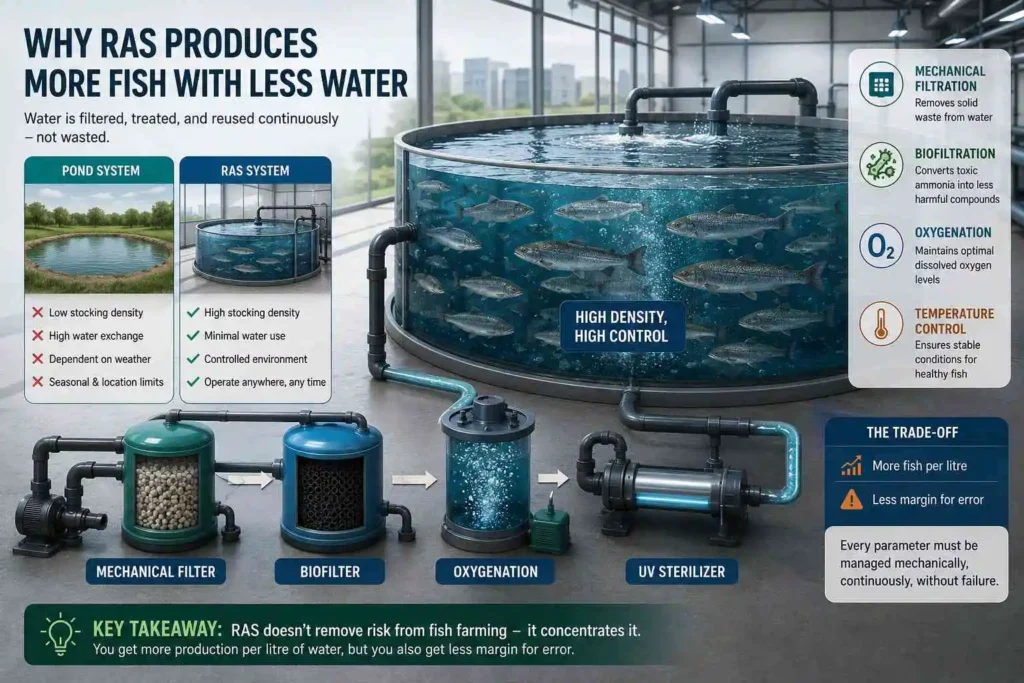
Key Takeaway: RAS doesn’t remove risk from fish farming — it concentrates it. You get more production per litre of water, but you also get less margin for error.
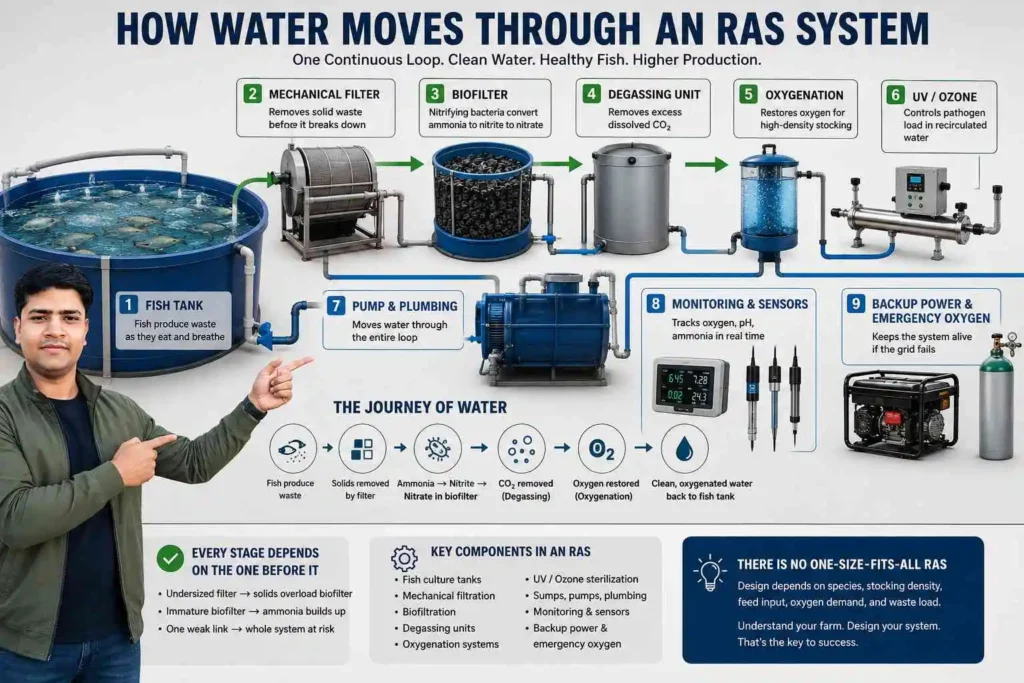
How Does Water Actually Move Through an RAS?
Before looking at individual equipment, it helps to understand the journey the water takes — because that journey is the entire system.
Fish produce waste as they eat and breathe → solid waste is physically removed by mechanical filtration → dissolved ammonia is converted biologically in the biofilter → excess carbon dioxide is stripped out through degassing → oxygen is restored → the cleaned, oxygenated water is pumped back into the fish tank.
Fish Tank → Mechanical Filter → Biofilter → Degassing → Oxygenation → Pump → Back to Fish Tank
Every stage in that loop depends on the one before it. If mechanical filtration is undersized, solids overload the biofilter. If the biofilter is immature or overloaded, ammonia builds up faster than oxygenation can compensate for the stress it causes. Once you see the system as a loop rather than a collection of machines, the rest of RAS farming starts to make a lot more sense.
With that loop in mind, here’s what each stage of the system is actually made of:
- Fish culture tanks — sized according to species, biomass target, and water flow
- Mechanical filtration (drum filters, settling tanks) — removes solid waste before it breaks down
- Biofilters (fixed-bed, trickling, or Moving Bed Biofilm Reactors) — where nitrifying bacteria convert ammonia to nitrite to nitrate
- Degassing units — removes dissolved CO2 that builds up in closed systems
- Oxygenation and aeration systems — maintains dissolved oxygen for high-density stocking
- UV or ozone sterilization — controls pathogen load in recirculated water
- Sumps, pumps, and plumbing — moves water through the entire loop
- Sensors and monitoring equipment — tracks oxygen, pH, ammonia in real time
- Backup generators and emergency oxygen — keeps the system alive if the grid fails
There is no single “standard” RAS design. A tilapia farm sized for 5 tonnes per cycle and a trout unit built for cold Himalayan water look almost nothing alike. Design always depends on species, stocking density, feed input, and the oxygen and waste load the system has to handle. Anyone who sells you a one-size-fits-all RAS package hasn’t asked enough questions about your farm.
Why the Biofilter Is the Real Engine Behind Your Farm
If the fish tank is the visible part of RAS, the biofilter is the part that actually keeps the fish alive. Fish excrete ammonia directly through their gills, and ammonia is toxic to fish even at low concentrations. The biofilter houses colonies of nitrifying bacteria that convert ammonia into nitrite, and then nitrite into the far less harmful nitrate.
Here’s a detail many beginners miss: ammonia’s toxicity isn’t fixed — the proportion of it that’s in the more dangerous, unionized form rises as pH and temperature increase. That’s why ammonia readings should never be judged in isolation; they need to be read alongside your pH and temperature logs.
Here’s the part that often gets overlooked, too: the bacterial colony in a biofilter takes weeks to establish and mature. A brand-new biofilter has almost no capacity to process ammonia, which is why farmers are advised to stock gradually rather than filling tanks to capacity on day one. Overfeeding, sudden increases in stocking density, or antibiotic use can all damage or overload a biofilter that took weeks to build.
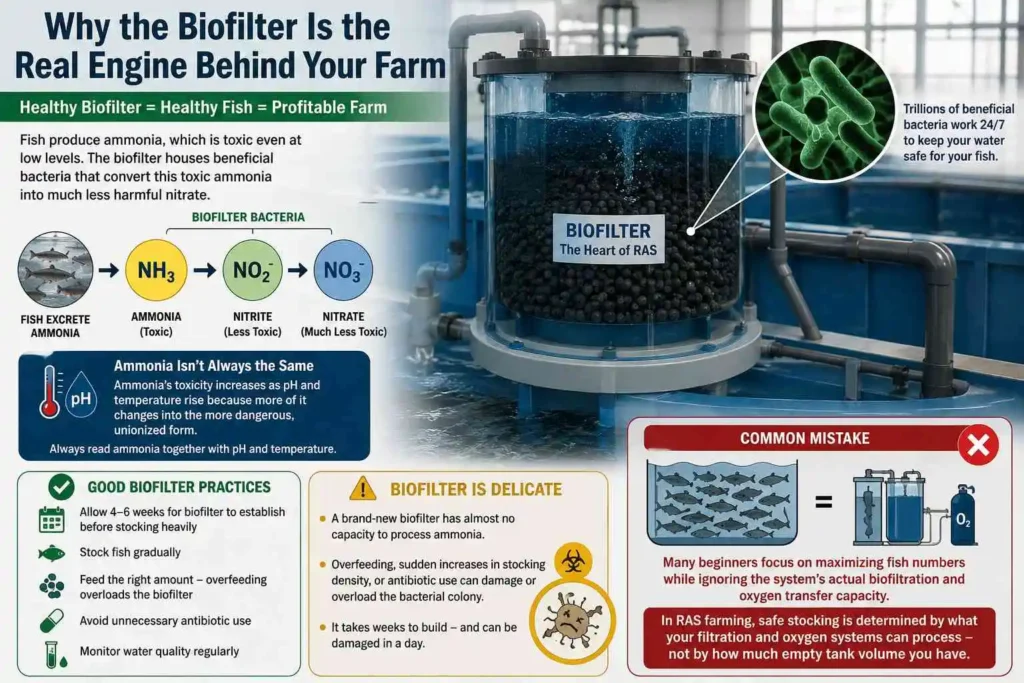
Common Mistake: Many beginners focus on maximizing fish numbers while ignoring the system’s actual biofiltration and oxygen transfer capacity. In RAS farming, safe stocking is determined by what your filtration and oxygen systems can process — not by how much empty tank volume you have.
The Water Quality Numbers Every RAS Farmer Should Watch
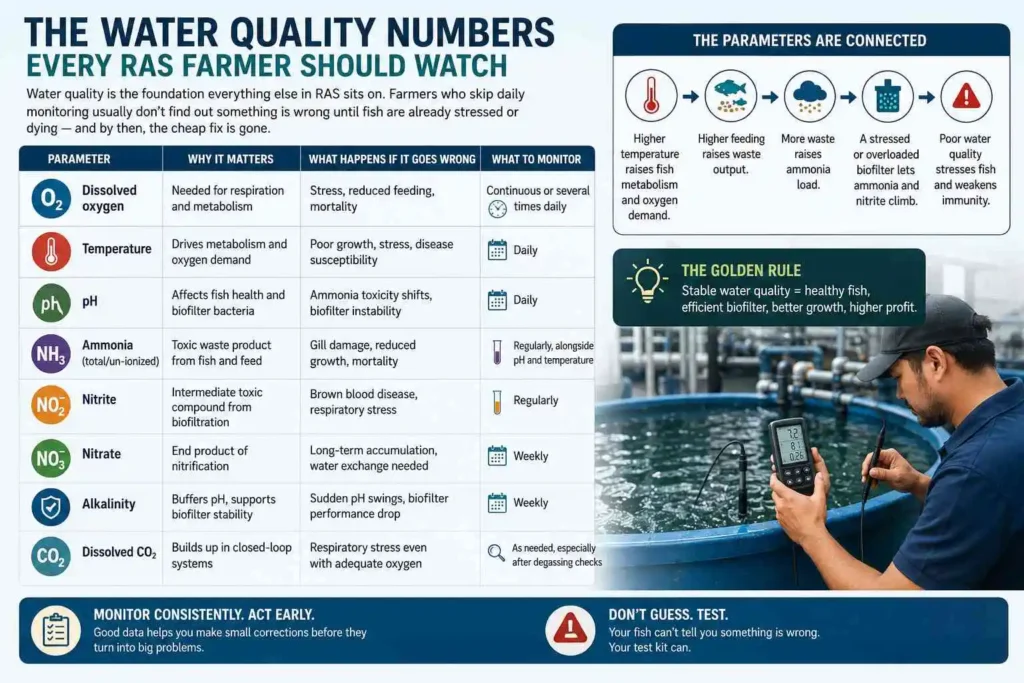
Water quality is the foundation everything else in RAS sits on. Farmers who skip daily monitoring usually don’t find out something is wrong until fish are already stressed or dying — and by then, the cheap fix is gone.
| Parameter | Why it matters | What happens if it goes wrong | What to monitor |
|---|---|---|---|
| Dissolved oxygen | Needed for respiration and metabolism | Stress, reduced feeding, mortality | Continuous or several times daily |
| Temperature | Drives metabolism and oxygen demand | Poor growth, stress, disease susceptibility | Daily |
| pH | Affects fish health and biofilter bacteria | Ammonia toxicity shifts, biofilter instability | Daily |
| Ammonia (total/un-ionized) | Toxic waste product from fish and feed | Gill damage, reduced growth, mortality | Regularly, alongside pH and temperature |
| Nitrite | Intermediate toxic compound from biofiltration | Brown blood disease, respiratory stress | Regularly |
| Nitrate | End product of nitrification | Long-term accumulation, water exchange needed | Weekly |
| Alkalinity | Buffers pH, supports biofilter stability | Sudden pH swings, biofilter performance drop | Weekly |
| Dissolved CO2 | Builds up in closed-loop systems | Respiratory stress even with adequate oxygen | As needed, especially after degassing checks |
These parameters don’t move independently — they move together. Higher temperature raises fish metabolism and oxygen demand. Higher feeding raises waste output. More waste raises ammonia load. A stressed or overloaded biofilter lets ammonia and nitrite climb. And poor aeration turns any one of these problems into a crisis very quickly. Treat your daily readings as a connected picture, not a checklist.
How Much Fish Can Your RAS System Safely Handle?
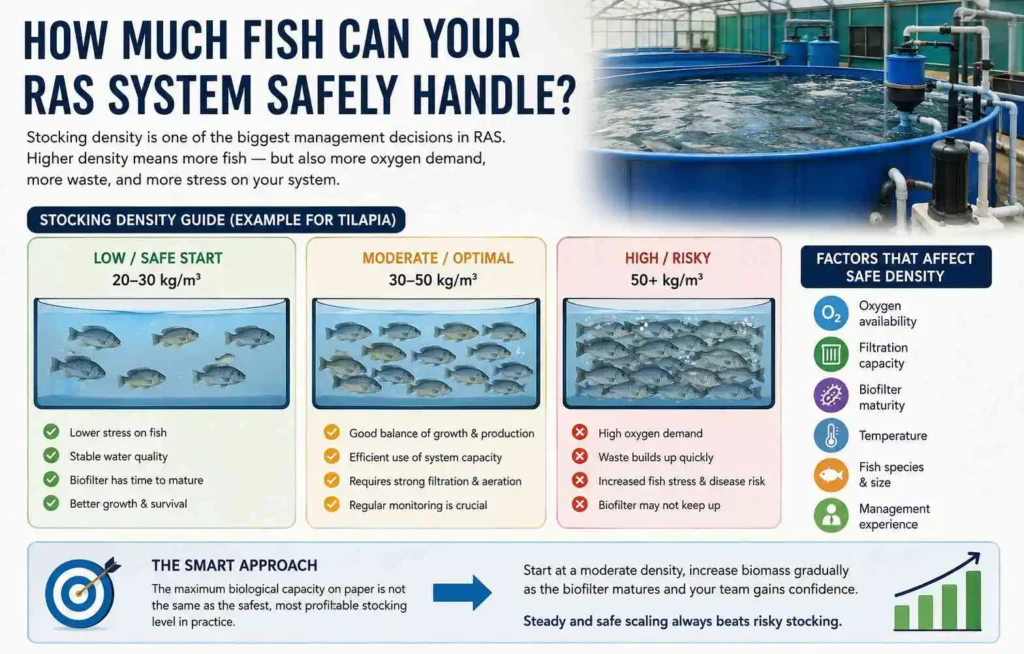
Stocking density is one of the biggest management decisions in RAS — bigger than most beginners realize. Push density higher and production per tank goes up, but so does oxygen demand, waste output, and stress on the fish. Push it too far and you get slower growth, higher disease risk, and a biofilter that can’t keep up.
The maximum biological capacity of a system on paper is not the same as the safest, most profitable stocking level in practice. For most beginners, starting at a moderate density and increasing biomass gradually as the biofilter matures and the team gains confidence is a far safer path than immediately chasing commercial-scale numbers copied from someone else’s farm.
Which Fish Species Makes the Most Sense for Your RAS Farm?
Species selection isn’t just a biology question — it’s a market question. Before choosing, an RAS farmer should weigh growth rate, feed conversion ratio, oxygen and temperature requirements, disease resistance, fingerling availability, and — most importantly — whether there’s a buyer willing to pay a workable price at harvest.
| Species | Suitability for RAS | Notes |
|---|---|---|
| Tilapia | High | Hardy, tolerates crowding, strong domestic demand |
| Catfish (Pangasius/Magur) | High | Good FCR, established Indian market |
| Trout | Medium–High | Needs cold water; suited to hill states |
| Carp | Low–Medium | Usually more economical in ponds |
| Ornamental fish | Medium | Lower biomass, higher price per unit |
The right species always depends on your climate, local market, and how comfortable your team is managing the technical side of the system. Don’t pick a species because it looks profitable online — pick one your local market will actually buy at harvest weight.
Why Overfeeding Can Destroy Your Water Quality
Feed is usually the single largest recurring cost in RAS, and every kilogram that goes into the tank eventually shows up somewhere — as fish growth, or as waste. Overfeeding doesn’t just waste money on unused feed; uneaten feed decomposes, raises ammonia load, and pushes the biofilter and oxygen systems harder than they’re designed for.
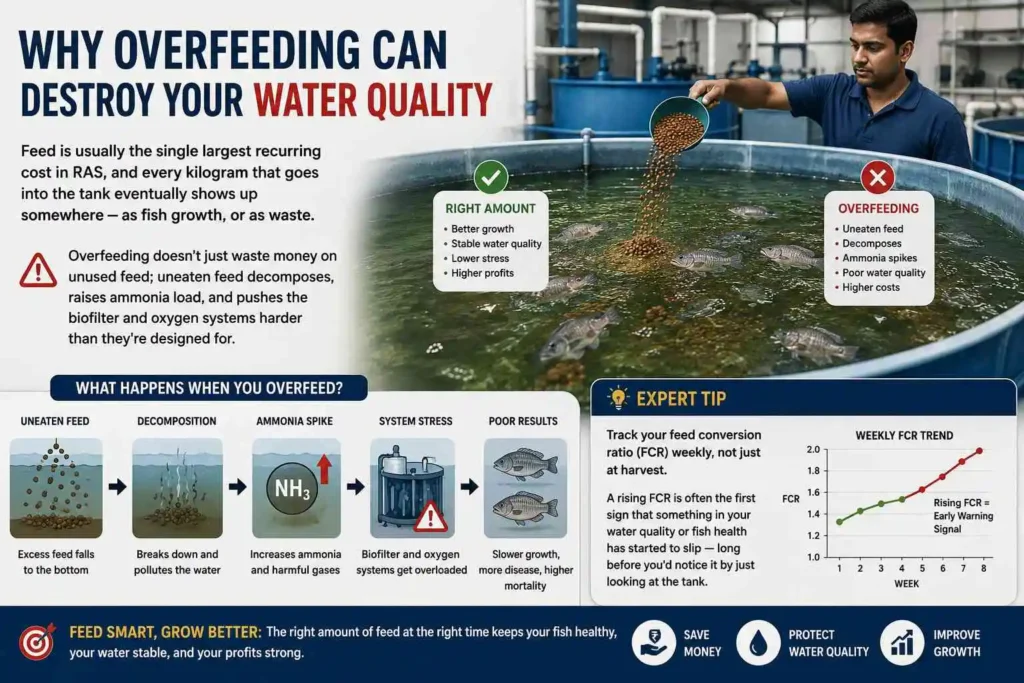
Expert Tip: Track your feed conversion ratio (FCR) weekly, not just at harvest. A rising FCR is often the first sign that something in your water quality or fish health has started to slip — long before you’d notice it by just looking at the tank.
Why Power Failure Is One of the Biggest RAS Risks
Pumps, aeration, oxygenation, and filtration in RAS all depend on continuous electricity. Unlike a pond, where fish can survive hours or even days without intervention, a densely stocked RAS tank can experience serious oxygen stress far faster if circulation and oxygenation stop — though exactly how long fish can survive depends on species, biomass, temperature, and how much dissolved oxygen was in the water to begin with.
That’s why serious RAS operations budget for backup generators, battery-backed alarms, and emergency oxygen supply as a cost of doing business, not an optional extra.
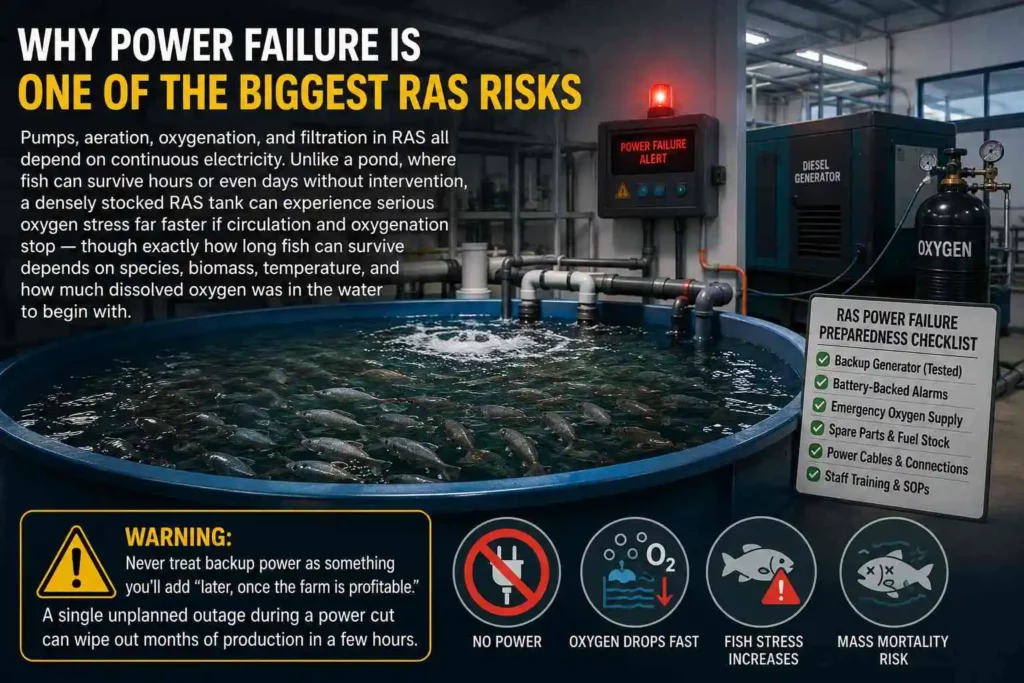
Warning: Never treat backup power as something you’ll add “later, once the farm is profitable.” A single unplanned outage during a power cut can wipe out months of production in a few hours.
How Much Does It Actually Cost to Set Up an RAS Farm in India?
This is the number every beginner wants first, and the honest answer is: it depends heavily on scale. A small backyard-style unit and a commercial-scale operation are not the same investment by an order of magnitude. Industry cost breakdowns for Indian RAS setups typically split the investment across fish tanks, water treatment units (filters, biofilters, UV), pumps and plumbing, aeration systems, monitoring equipment, backup power, and construction, with the following rough component ranges commonly quoted for a small-to-medium unit:
| Component | Typical Cost Range (₹) |
|---|---|
| Fish tanks | 2,00,000 – 5,00,000 |
| Water treatment units (filters, biofilter, UV) | 3,00,000 – 7,00,000 |
| Pumps and plumbing | 1,00,000 – 3,00,000 |
| Aeration system | 50,000 – 1,50,000 |
| Monitoring equipment | 1,00,000 – 2,50,000 |
| Backup power system | 1,50,000 – 3,00,000 |
| Construction and civil work | 2,00,000 – 5,00,000 |
Scaling this up (and down) across three broad models gives a more realistic planning picture:
| Small unit | Medium unit | Commercial unit | |
|---|---|---|---|
| Indicative tank capacity | ~10,000–20,000 litres | ~50,000–75,000 litres | 1,00,000+ litres, multi-tank |
| Typical production/cycle | 1–2 tonnes | 5–8 tonnes | 15 tonnes+ |
| Equipment + civil work | ₹8–12 lakh | ₹18–25 lakh | ₹40–50 lakh+ |
| Backup power & monitoring | ₹1.5–2.5 lakh | ₹3–5 lakh | ₹6–10 lakh+ |
| Initial fingerling stock | ₹0.3–0.6 lakh | ₹1–2 lakh | ₹3–5 lakh+ |
| Working capital (feed, power, labour for first cycle) | ₹1–2 lakh | ₹3–6 lakh | ₹8–15 lakh+ |
| Approx. total investment | ₹11–17 lakh | ₹25–38 lakh | ₹55–80 lakh+ |
Treat every figure in this table as a planning range, not a quote. Actual costs vary by supplier, automation level, region, and species, and can easily move outside these range. Always get at least two or three vendor quotations for your specific site before finalizing a budget.
On the operating side, annual running costs — electricity, feed, labour, water testing, and repairs — typically add up to around 20-30% of the initial setup cost each year, which is a useful sanity check when a vendor’s projections look too optimistic.
Did You Know? Under the Pradhan Mantri Matsya Sampada Yojana (PMMSY), the Department of Fisheries has set indicative unit costs of ₹50 lakh, ₹25 lakh, and ₹7.5 lakh for large, medium, and small RAS units respectively, with government financial assistance available at 40% of project cost for general category beneficiaries and 60% for SC/ST and women beneficiaries. These are official scheme norms, not a guarantee of what your project will cost — confirm current unit-cost ceilings and eligibility with your state fisheries department or the official PMMSY notification before budgeting around them, since scheme terms can be revised.
Where Most RAS Farming Profits Actually Disappear
This is where the excitement around RAS usually meets reality. Profitability depends on survival rate, FCR, selling price, electricity cost, and how consistently the system is utilized — not just on production capacity.
Here’s a simplified way to think about it. Suppose a medium unit produces 6 tonnes of fish in a cycle and sells at ₹180/kg — that’s roughly ₹10.8 lakh in gross revenue. On paper, that looks strong. But feed, fingerlings, electricity, labour, mortality losses, maintenance, transport, and loan interest all come out of that figure before anything counts as profit. A simple framework to run for your own numbers:
Net Profit = Fish Sales − (Feed + Fingerlings + Electricity + Labour + Maintenance + Mortality Losses + Other Operating Costs)
Run this calculation with your own local feed prices, power tariffs, and expected selling price — not with numbers borrowed from an article or a vendor’s projection — before deciding whether a given scale makes financial sense for you. Payback period varies widely with scale, species, and market access; it can realistically range from 2 to 5 years for a well-run small-to-medium unit, longer if survival rates or market prices disappoint. Anyone quoting a fixed payback number without knowing your species, scale, and local costs is guessing.
Biosecurity: The Cost of Getting Complacent
High stocking density means a disease outbreak spreads faster and hits harder than it would in a pond. Quarantine new fish before introducing them to the main system, control visitor access, sanitize equipment between batches, and remove dead fish immediately rather than at the end of the day. Don’t self-medicate with chemicals on guesswork — consult a qualified aquatic animal health professional and follow local fisheries department guidance.
Who Is RAS Farming Actually For — and Who Should Stay Away?
Not every farmer or entrepreneur is a good fit for RAS, and it’s better to find that out before construction than after.
RAS may genuinely suit someone who:
- Has reliable electricity, or is willing to invest properly in backup power
- Has access to technical support for equipment and biofilter troubleshooting
- Has a strong, confirmed local market for the species they plan to farm
- Is willing to check water quality daily, not occasionally
- Has enough capital set aside for backup systems and working capital, not just the tanks
- Understands this is a technology-driven business, closer to running a small factory than a traditional farm
RAS is probably not the right starting point for someone who:
- Has unreliable grid power and no plan for backup
- Wants a passive, low-involvement income source
- Has no prior experience with fish health or water quality management
- Has limited working capital beyond the initial construction cost
- Doesn’t yet have a confirmed buyer or market for the harvest size and species chosen
- Is planning the entire project around receiving a subsidy rather than around the underlying economics
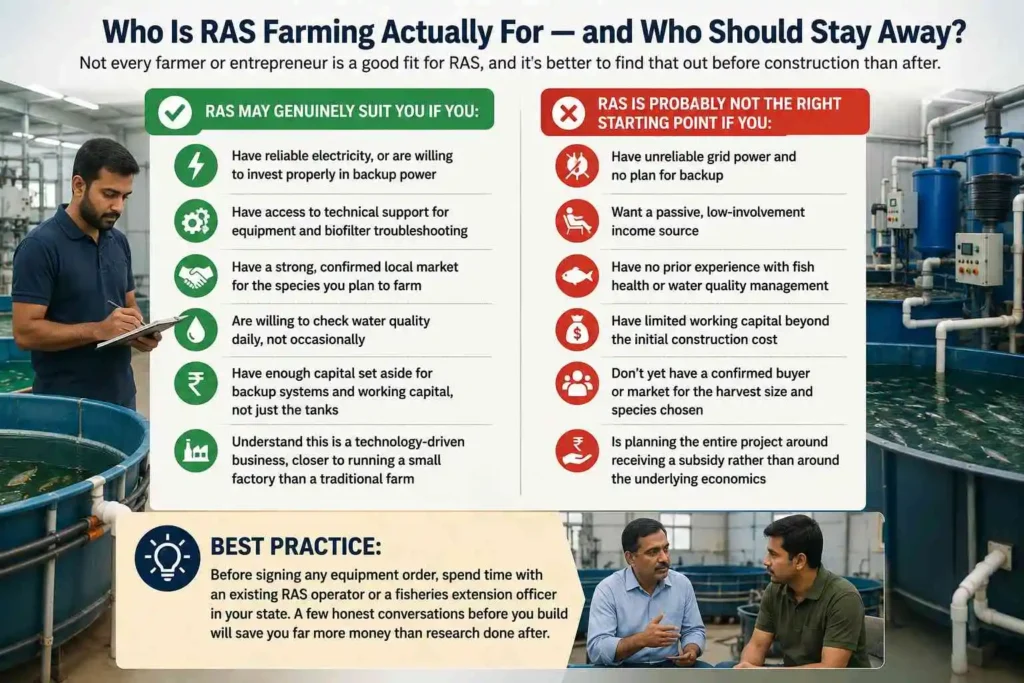
Best Practice: Before signing any equipment order, spend time with an existing RAS operator or a fisheries extension officer in your state. A few honest conversations before you build will save you far more money than research done after.
What You Should Actually Do Before You Invest
RAS farming isn’t difficult because the technology is mysterious. It’s difficult because every part of the system is connected — feed affects ammonia, ammonia affects the biofilter, biofilter performance affects oxygen demand, and oxygen demand affects how many fish you can safely keep alive.
If you’re planning to start, don’t begin by asking how many fish you can fit into a tank. Start by working out how much oxygen, filtration, electricity, labour, and market demand your budget can realistically support. If you’re considering lower-water systems, it’s also worth comparing the requirements of [Biofloc Fish Farming] with those of [Shrimp Farming] and traditional [Carp Culture] before choosing your production model. Finally, check what subsidy support your state offers under PMMSY before finalizing your capital plan. Get those numbers right first, and the fish come second.
Frequently Asked Questions About RAS System Aquaculture
How many fish can be stocked in an RAS tank?
There is no universal stocking density for every RAS system. The safe number depends on the fish species, total biomass, dissolved oxygen availability, biofilter capacity, water flow, filtration efficiency, temperature, and backup systems. Stocking should be based on the system’s biological and oxygen-handling capacity rather than simply the volume of the tank.
What happens if the electricity goes out in an RAS farm?
A power failure can quickly become a serious risk because pumps, aeration, oxygenation, and filtration may stop working. The exact survival time depends on factors such as fish biomass, species, temperature, and dissolved oxygen levels, but a prolonged outage can cause severe stress or mortality. A commercial RAS farm should have backup power, alarms, and emergency oxygen available.
Can RAS farming be done on a small area of land?
Yes. One of the main advantages of RAS is its ability to produce fish at high densities using relatively little land and water compared with traditional pond systems. However, limited land doesn’t necessarily mean low investment—the filtration, oxygenation, monitoring, backup power, and infrastructure requirements can make RAS capital-intensive.
Does PMMSY provide subsidies for RAS fish farming?
PMMSY has provisions for financial assistance for eligible fisheries and aquaculture projects, including RAS-related units, subject to applicable scheme guidelines, unit-cost ceilings, beneficiary categories, and state-level implementation. Farmers should verify the latest eligibility requirements and assistance available with their state fisheries department before including subsidy support in their financial plan.
Newsletter


Interested in Project
I’m from Hosur-Tamilnadu
Hi Uday Kumar, great to hear that you’re interested in starting an RAS aquaculture project! Before investing, I would recommend researching the local market demand for the fish species you plan to farm, along with the availability and quality of water and the reliability of electricity in your area. It’s also a good idea to visit a few established RAS farms, learn from their practical experience, and take proper hands-on training before setting up your own system. If you have any questions, feel free to ask. Wishing you the very best for your project!
Hi,
I’m looking for RAS training. If training is not available at you.could you please let me know if there are any other institutions that provide RAS training?
Hi Satish Kumar, thank you for your comment. RAS is a highly technical system, so proper hands-on training is definitely recommended before starting a project. We currently don’t provide RAS training directly, but I’d suggest checking with your **state fisheries department, fisheries universities, ICAR fisheries institutes, and established RAS training centres** for practical training programs.
If you let me know your **state/city**, I can also try to point you toward relevant fisheries institutes or training options in your area.
I’m in Hyderabad, Telangana. I’m also open to training programs anywhere in Andhra Pradesh. Do you know of any institutes in Telangana or Andhra Pradesh state that provide RAS or aquaculture training? Please let me know. Thank you.
Hi Satish Kumar, since you’re in Hyderabad and open to Andhra Pradesh, you can check a few good options:
**ICAR-CIFE Kakinada Centre** conducts aquaculture training and skill-development programmes.
**AU–Avanti Aquaculture Skill Development Centre, Andhra Pradesh** is also worth checking, as their practical training covers modern systems including **RAS**.
Since you’re in Hyderabad, I’d also suggest contacting the **National Fisheries Development Board (NFDB)** and asking about upcoming RAS or intensive aquaculture training programmes.
Before enrolling, confirm that the programme includes **hands-on RAS training**, not just classroom theory.
Hope this helps!
Thanks for update
You’re most welcome, Satish! Glad the information was helpful. I’ll keep sharing more practical content on RAS, aquaculture, and other modern farming systems. **Stay connected with KisanPreneur for more useful updates.**