



Polyhouse Farming in India: Cost, Subsidy & Profit Guide
Open-field farming is getting riskier every year. One unexpected hailstorm, one heatwave at the wrong time, or one pest outbreak, and months of hard work can vanish in a single week. That’s exactly why thousands of Indian farmers are now shifting toward polyhouse farming — a method that lets you control temperature, humidity, and pests instead of gambling on the weather.
This isn’t a passing trend. With input costs rising and vegetable and flower prices swinging unpredictably in the mandi, protected cultivation has become one of the few ways a small or mid-sized farmer can actually plan a season with confidence.
By the end of this guide, you’ll know the different types of polyhouses, what construction actually costs in India, how much subsidy you can realistically claim, which crops give the best returns, how to avoid the mistakes that sink first-time growers, and what kind of profit is genuinely possible.

Why More Farmers Are Switching to Polyhouse Farming
Here’s the simple truth: open-field yield depends on nature cooperating. Polyhouse yield depends on management. That one difference changes everything.
Inside a polyhouse, you control the variables that normally destroy a crop — excess rain, frost, scorching heat, and uncontrolled pest entry. This means more harvest cycles per year, better quality produce, and access to off-season pricing when open-field competitors have nothing to sell.
There’s also a market angle most people miss. Retailers, exporters, and premium grocery chains prefer polyhouse-grown vegetables because the size, colour, and shelf life are consistent. That consistency is what earns a farmer a better rate per kilogram, not just a bigger harvest.
Did You Know? A well-managed polyhouse can produce 3 to 5 times the yield of open-field cultivation for crops like tomato and capsicum, mainly because plant density, nutrition, and climate can all be optimised together.
The catch is that polyhouse farming rewards planning and punishes shortcuts. Skip the soil testing, guess the ventilation design, or under-invest in irrigation, and the same structure that could have earned you lakhs will instead become an expensive shed full of stressed plants.
Which Type of Polyhouse Gives the Best Return on Investment?
Not every polyhouse is built the same way, and the type you choose should match your budget, your crop, and your local climate — not the design your neighbour happens to have.
Naturally Ventilated Polyhouse (NVPH): Relies on side and roof vents for airflow, with no fans or cooling pads. This is the most common structure across India because it’s affordable and low-maintenance.
Fan-and-Pad (Climate-Controlled) Polyhouse: Uses exhaust fans and cooling pads to actively manage temperature and humidity. Ideal for high-value crops and regions with extreme heat, but the running cost is significantly higher.
Shade Net House: Not a true polyhouse, but often used alongside one for nurseries or hardening seedlings. Much cheaper, but offers far less climate control.
| Polyhouse Type | Approx. Cost (per 1000 sq. m) | Best Suited For | Maintenance Level |
|---|---|---|---|
| Naturally Ventilated | ₹8,00,000 – ₹12,00,000 | Tomato, capsicum, cucumber | Low to Moderate |
| Fan-and-Pad | ₹18,00,000 – ₹25,00,000 | Exotic vegetables, flowers, exports | High |
| Shade Net House | ₹2,50,000 – ₹4,50,000 | Nursery, seedlings, leafy greens | Low |
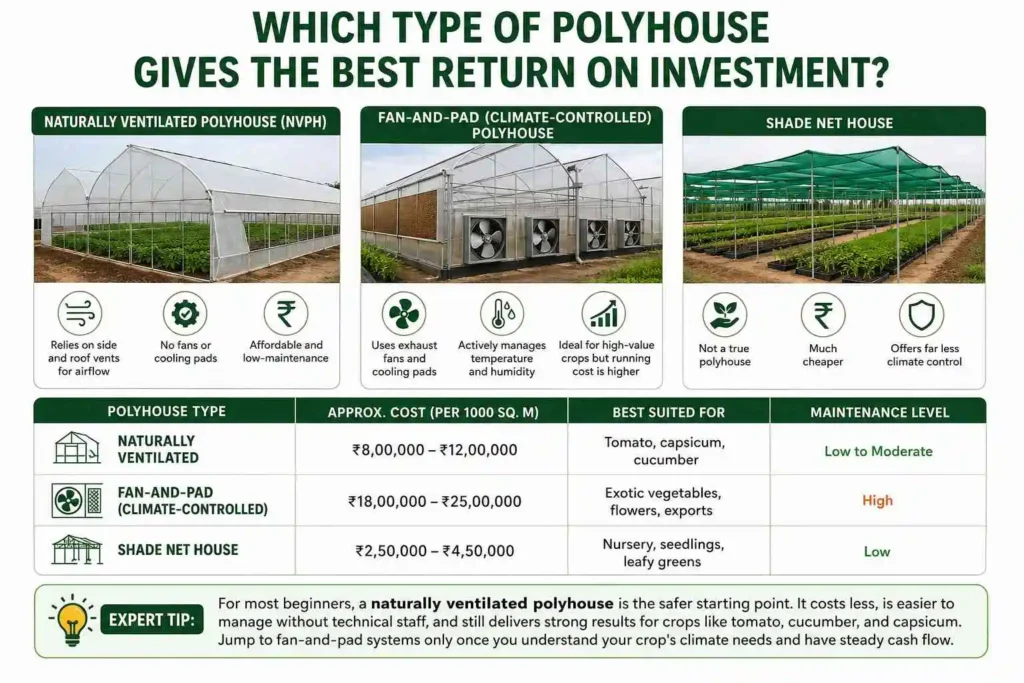
Expert Tip: For most beginners, a naturally ventilated polyhouse is the safer starting point. It costs less, is easier to manage without technical staff, and still delivers strong results for crops like tomato, cucumber, and capsicum. Jump to fan-and-pad systems only once you understand your crop’s climate needs and have steady cash flow.
Which Crops Make the Highest Profit Inside a Polyhouse?
Choosing the wrong crop is one of the fastest ways to turn a good structure into a loss-making one. Some crops simply don’t justify the investment, while others can pay back the entire structure cost within two to three seasons.
Coloured capsicum, cherry tomato, cucumber, and high-value flowers like gerbera and rose consistently top the profitability list because they command premium prices in urban and export markets. Leafy vegetables and herbs work well for quick cash flow but rarely justify a full climate-controlled setup on their own.
| Crop | Avg. Yield (per 1000 sq. m) | Approx. Market Price | Estimated Revenue per Cycle |
|---|---|---|---|
| Coloured Capsicum | 3,000 – 4,000 kg | ₹60 – ₹90/kg | ₹2,00,000 – ₹3,50,000 |
| Cherry Tomato | 2,500 – 3,500 kg | ₹50 – ₹80/kg | ₹1,50,000 – ₹2,80,000 |
| Cucumber (English) | 4,000 – 5,000 kg | ₹25 – ₹40/kg | ₹1,00,000 – ₹2,00,000 |
| Gerbera (cut flowers) | 8,00,000 – 10,00,000 stems/year | ₹4 – ₹8/stem | ₹32,00,000 – ₹80,00,000/year |
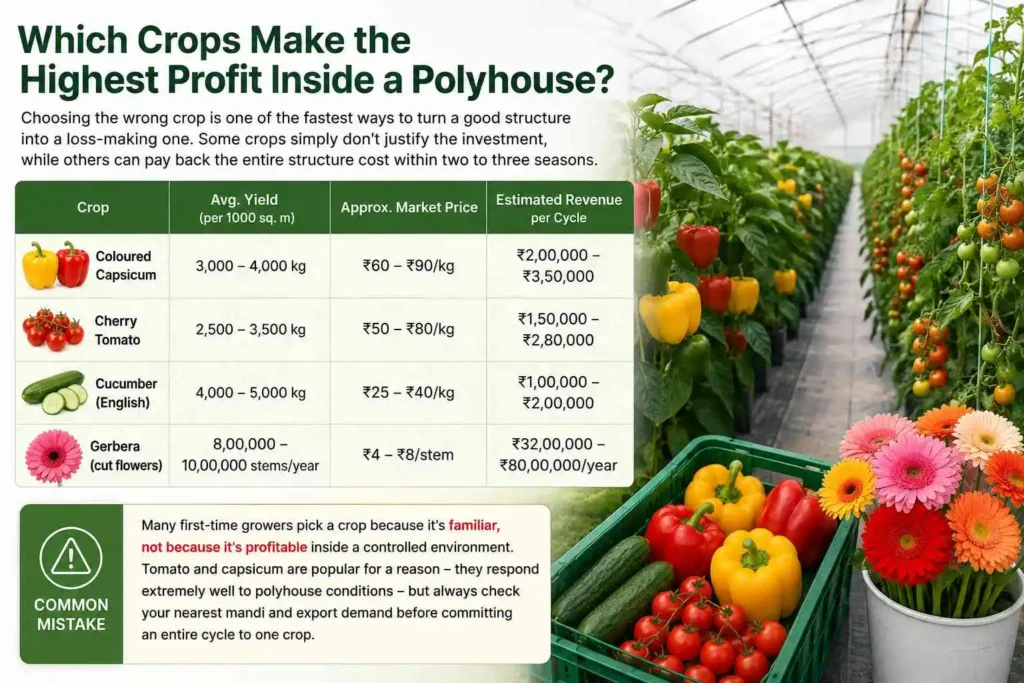
Common Mistake: Many first-time growers pick a crop because it’s familiar, not because it’s profitable inside a controlled environment. Tomato and capsicum are popular for a reason — they respond extremely well to polyhouse conditions — but always check your nearest mandi and export demand before committing an entire cycle to one crop.
How to Build a Polyhouse Without Costly Mistakes
This is where many new farmers struggle, and it usually isn’t because of bad intentions — it’s because of skipped homework.
Site selection comes first. Land should have good drainage, access to a reliable water source, and enough sunlight exposure without excessive wind load. Soil testing should happen before construction, not after, since fertigation planning depends entirely on it.
Orientation matters more than most people realise. In most parts of India, an east-west orientation reduces internal heat buildup compared to north-south facing structures. Getting this wrong means fighting excess heat for the entire life of the polyhouse.
A simple way to improve long-term reliability is choosing UV-stabilised polyethylene film rated for at least 200 microns, since cheaper film degrades fast under intense sun and needs replacement within a year or two — an expense many farmers don’t budget for upfront.
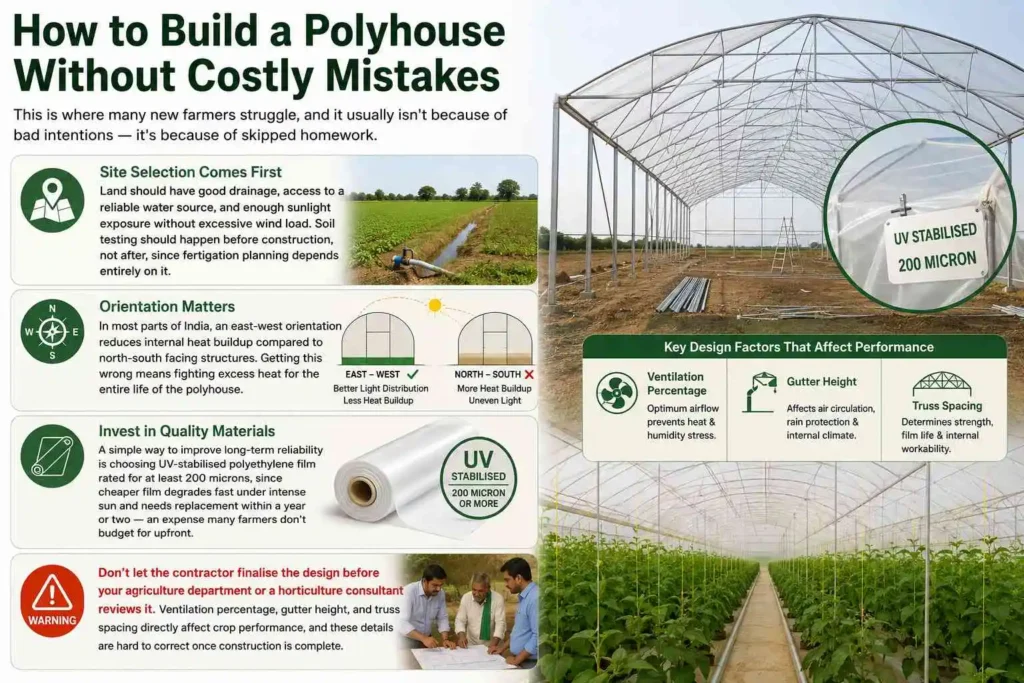
Warning: Don’t let the contractor finalise the design before your agriculture department or a horticulture consultant reviews it. Ventilation percentage, gutter height, and truss spacing directly affect crop performance, and these details are hard to correct once construction is complete.
Why Temperature Can Make or Break Your Polyhouse Crop
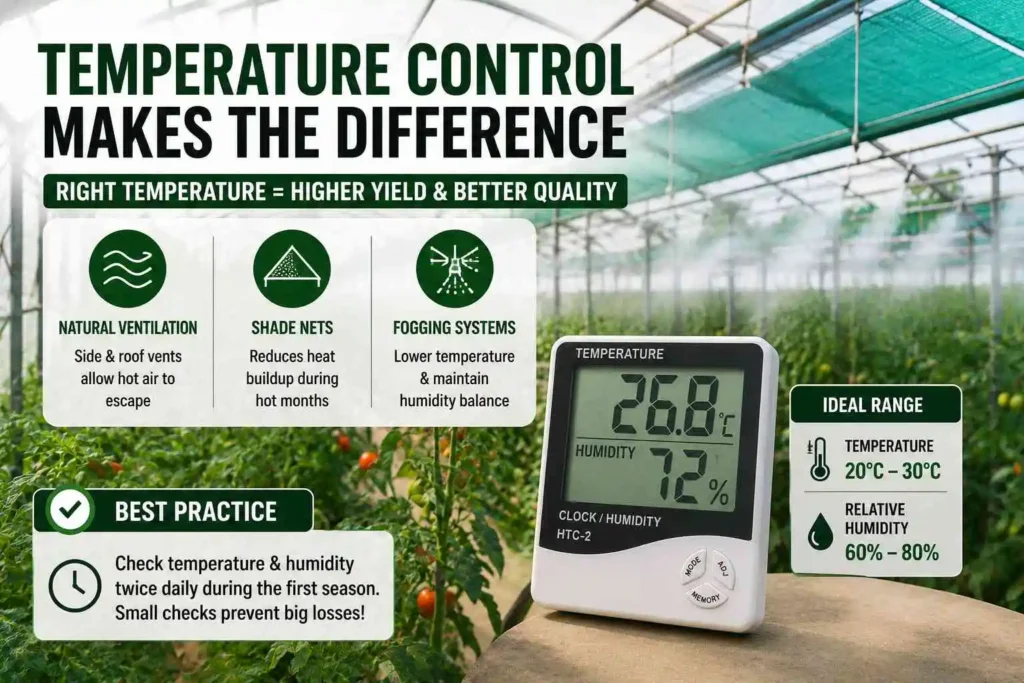
Temperature control isn’t a background detail — it’s the entire reason polyhouse farming works. Most vegetable crops perform best between 20°C and 30°C, and anything consistently outside that range slows flowering, reduces fruit set, or triggers disease pressure.
The good news is that natural ventilation, shade nets, and fogging systems can manage this without heavy electricity costs, as long as the polyhouse design accounted for airflow from the start. This is exactly why orientation and vent percentage matter so much during construction.
Best Practice: Install a simple digital thermometer-hygrometer inside the structure and check readings twice daily during the first season. This single habit helps you catch heat stress or humidity spikes before they visibly damage the crop.
Why Proper Irrigation Is the Secret to Higher Yields
A polyhouse without drip irrigation and fertigation is like a car without a steering wheel — the structure alone won’t get you anywhere close to the yields everyone talks about.
Drip irrigation combined with fertigation lets you deliver water and nutrients directly to the root zone in exact quantities, cutting water usage by 40–60% compared to flood irrigation while improving nutrient uptake. This precision is what actually drives the higher yield numbers seen in polyhouse crops.
Want to learn more? Read our detailed Drip Irrigation Guide to understand how this system saves water, improves fertilizer efficiency, and helps farmers achieve higher yields with lower input costs.
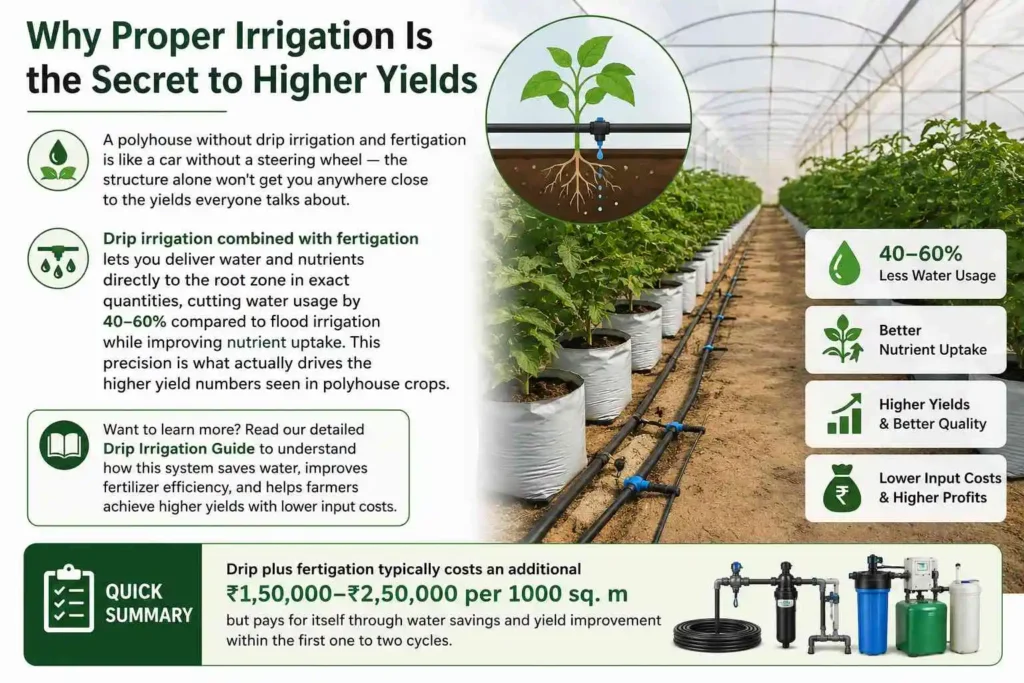
Quick Summary: Drip plus fertigation typically costs an additional ₹1,50,000–₹2,50,000 per 1000 sq. m but pays for itself through water savings and yield improvement within the first one to two cycles.
How Much Subsidy Can You Actually Get for a Polyhouse?
This is usually the first question every farmer asks, and rightly so — construction costs can look intimidating without support.
Under schemes like the National Horticulture Mission (NHM) and state-level horticulture missions, subsidies typically range from 50% for general category farmers to 65-70% for small, marginal, and SC/ST farmers, subject to area caps and state-specific guidelines.
| Farmer Category | Typical Subsidy | Area Cap (approx.) |
|---|---|---|
| General Category | 50% of unit cost | Up to 4,000 sq. m |
| Small/Marginal/SC/ST | 65% – 70% of unit cost | Up to 4,000 sq. m |
| North Eastern & Hill States | Up to 50-70% (state variation) | As per state norms |
Practical Tip: Subsidy rates and area caps change frequently between states and scheme cycles. Always confirm current rates with your district horticulture office before finalising your budget, since relying on old figures is one of the most common planning mistakes.
Can Polyhouse Farming Really Earn More Than Traditional Farming?
The honest answer is yes, but only when the numbers are managed properly — polyhouse farming isn’t automatically more profitable just because it’s more advanced.
| Factor | Open-Field Farming | Polyhouse Farming |
|---|---|---|
| Initial Investment | Low | High (partially offset by subsidy) |
| Yield per sq. m | Lower | 3–5x higher |
| Crop Cycles per Year | 1–2 | 2–3 |
| Weather Risk | High | Significantly reduced |
| Market Price Realised | Standard | Often premium |
Once you factor in subsidy support, reduced weather losses, and premium pricing for consistent quality, the return on investment for a well-managed naturally ventilated polyhouse growing capsicum or tomato typically ranges between 18 to 24 months.
Key Takeaway: Profitability doesn’t come from the structure alone — it comes from choosing the right crop, managing climate and irrigation correctly, and understanding your local market before you plant the first seedling.
Getting Started the Right Way
Polyhouse farming rewards patience and planning far more than it rewards the biggest budget. A modest, well-designed naturally ventilated structure managed with discipline will consistently outperform an oversized, poorly planned one.
Before you invest a single rupee, get your soil tested, confirm your subsidy eligibility with the district horticulture office, and speak with growers or consultants already running similar crops in your region. That groundwork costs you nothing but time, and it’s what separates farmers who scale up successfully from those who abandon the structure after one difficult season.
Start small, manage well, and let the results guide your expansion — that’s the approach that consistently turns polyhouse farming into a genuinely profitable venture.
Frequently Asked Question about Polyhouse Farming
What is the lifespan of a polyhouse?
A well-maintained galvanized steel structure can last 20–25 years or more. The polyethylene covering usually needs replacement every 3–5 years, depending on its quality and exposure to sunlight. Regular maintenance helps extend the life of the structure.
Can polyhouse farming be started on one acre?
Yes. Many farmers successfully start with one acre or even 1,000 square metres. Beginning with a smaller area helps you gain experience while reducing financial risk before expanding your operation.
Does polyhouse farming require electricity?
A naturally ventilated polyhouse requires very little electricity unless equipment such as irrigation pumps or foggers is used. Fan-and-pad polyhouses require a reliable electricity supply because cooling fans and ventilation systems operate throughout the growing season.
How much water does a polyhouse require?
Polyhouse farming uses 40–60% less water than traditional flood irrigation because drip irrigation delivers water directly to the root zone. Actual water requirements depend on the crop, weather, and stage of plant growth.
Which type of polyhouse is best for beginners?
A naturally ventilated polyhouse is generally the best choice for beginners. It has lower construction and maintenance costs, requires less technical knowledge, and is suitable for popular crops like tomato, cucumber, and capsicum.
Can vegetables be grown throughout the year in a polyhouse?
Yes. One of the biggest advantages of polyhouse farming is the ability to grow vegetables in multiple seasons by controlling temperature, humidity, and irrigation. This allows farmers to produce crops even when open-field cultivation is difficult.
Newsletter