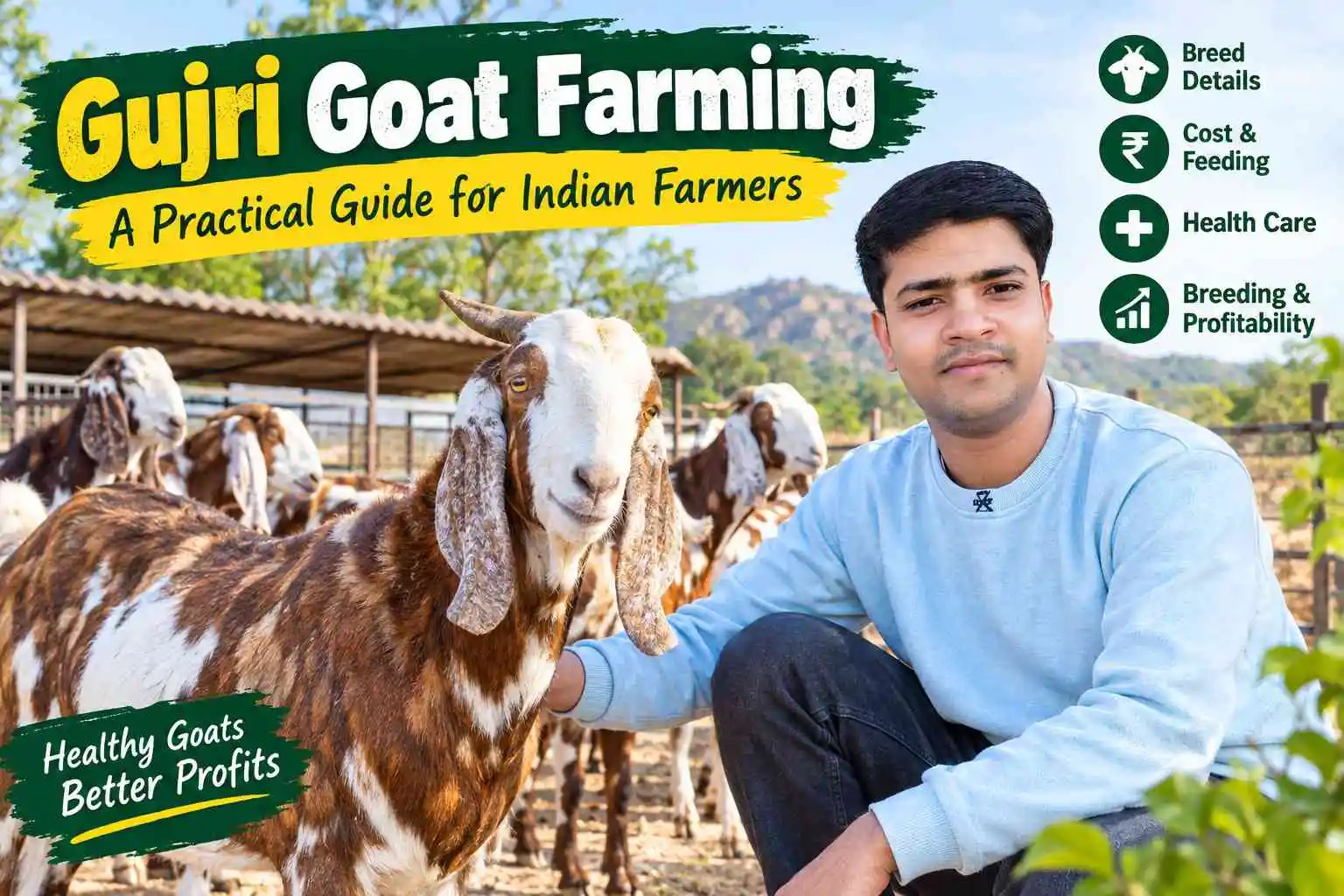

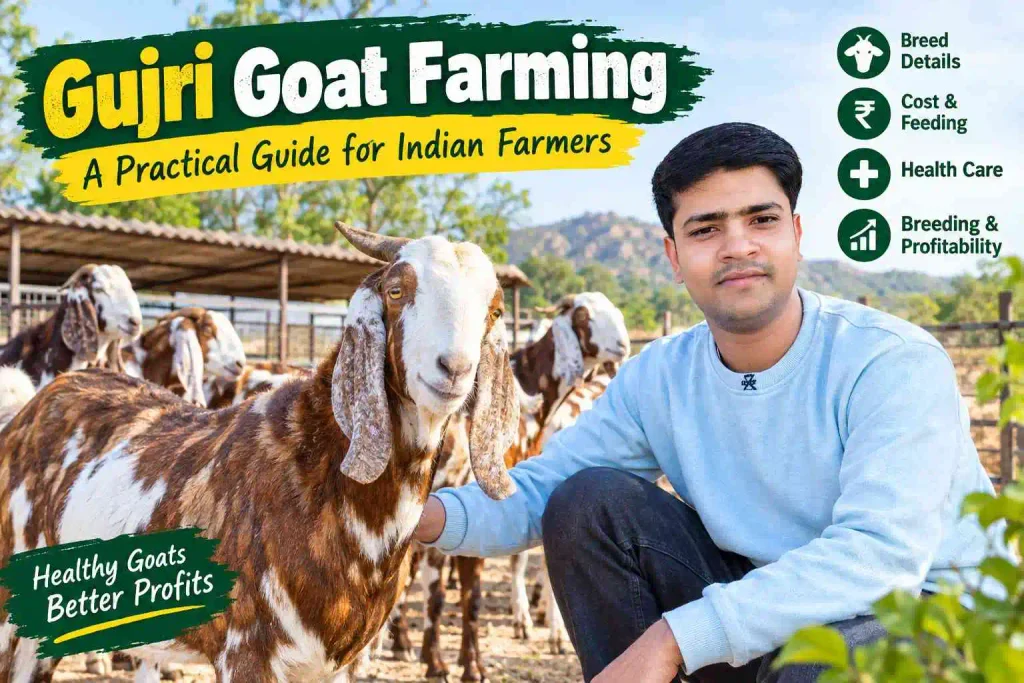
Gujri Goat Farming: A Practical Guide for Indian Farmers
Most new goat farmers pick a breed the same way they pick a car — they look at the size, the colour, and the price tag, and they assume the rest will sort itself out. It rarely does. The goats that end up losing farmers money aren’t usually diseased or badly bred. They’re often perfectly healthy animals that were simply the wrong fit for the fodder available, the climate, or the buyer’s actual production goal.
Gujri goats keep coming up in this conversation, especially among farmers in Rajasthan and neighbouring states who want a large-bodied, dual-purpose animal without shifting to an entirely different farming system. But “large-bodied” and “dual-purpose” don’t automatically translate into “profitable” or “right for you.” This article walks through what actually matters before you buy: how to judge a Gujri goat beyond its size, what it costs to feed and house one properly, where the breeding and health decisions make or lose money, and how a beginner should structure a first year on this breed rather than jumping in with fifty animals on day one.
Nothing here promises guaranteed returns. Goat farming rewards patience, correct feeding, and disciplined health management — not breed selection alone.
Understanding Gujri Goats: What the Breed Actually Is
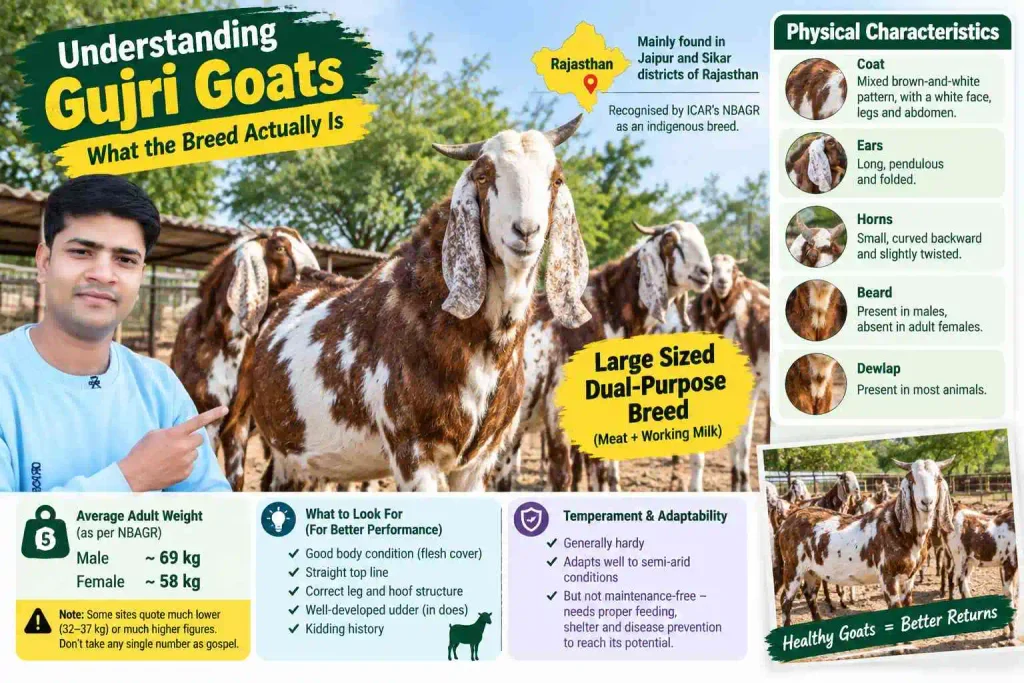
Gujri (also spelled Gujari) is a registered indigenous goat breed recognised by ICAR’s National Bureau of Animal Genetic Resources (NBAGR), distributed mainly in the Jaipur and Sikar districts of Rajasthan. NBAGR classifies it as a large-sized, dual-purpose breed, meaning it’s kept for both meat and a working amount of milk, not milk alone and not meat alone.
The physical description most breeders and NBAGR agree on:
- Coat: a mixed brown-and-white pattern, with a distinctly white face, legs, and abdomen
- Ears: long, pendulous, and folded
- Horns: small, curved backward and slightly twisted
- Beard: present in males, absent in adult females
- Dewlap: present in most animals
Did You Know? According to NBAGR’s official breed record, average adult weight is about 69 kg in males and 58 kg in females. That’s meaningfully different from the numbers you’ll see on some livestock trading sites, which sometimes quote much lower figures (around 32–37 kg) or much higher ones. This gap matters — see the “How Much Does a Gujri Goat Cost” section below for why you shouldn’t take any single number as gospel.
Here’s the thing a lot of first-time buyers get wrong: a goat that looks large isn’t automatically a productive goat. Frame size can come from bone structure, gut fill, or simply a longer-legged individual — none of which tell you anything about growth rate, feed conversion, or breeding soundness. What actually predicts performance is body condition (flesh cover over the ribs and spine), a straight top line, correct leg and hoof structure, and — in does — udder development and kidding history. A goat that photographs well at a livestock fair can still be a poor breeder if its structure is off or its parents were never properly recorded.
Temperament-wise, Gujri goats are generally described as hardy and adaptable to the semi-arid conditions of their native tract, which is one reason farmers in similar dry, scrub-fodder regions consider them. But “adaptable” doesn’t mean “maintenance-free.” Every goat, regardless of breed, needs correct feeding, shelter, and disease prevention to express its genetic potential.
Why Are Farmers Interested in Gujri Goats?
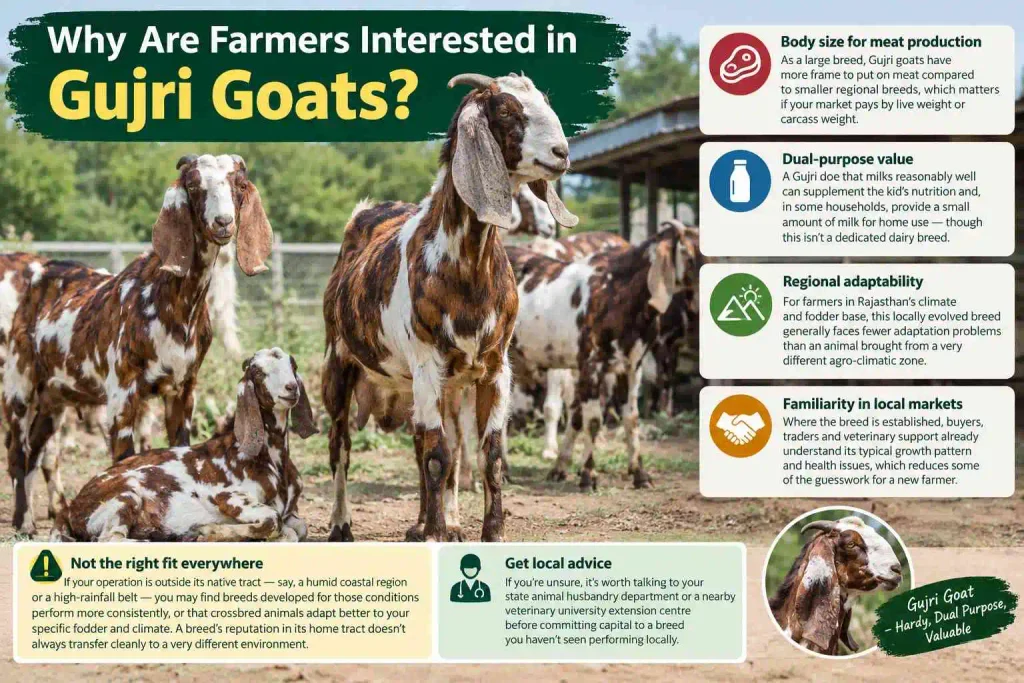
The interest isn’t accidental. A few practical reasons keep coming up:
Body size for meat production. Because it’s classified as a large breed, a well-managed Gujri goat has more frame to put meat on compared to smaller regional breeds, which matters if your market pays by live weight or carcass weight rather than by head count.
Dual-purpose value. Unlike breeds kept purely for meat, a Gujri doe that milks reasonably well can supplement the kid’s nutrition and, in some households, provide a small amount of milk for home use — though this isn’t a dedicated dairy breed and shouldn’t be bought expecting dairy-level yields.
Regional adaptability. For farmers already operating in Rajasthan’s climate and fodder base, a locally evolved breed generally faces fewer adaptation problems than an animal brought in from a very different agro-climatic zone.
Familiarity in local markets. Where the breed is established, buyers, traders, and veterinary support already understand its typical growth pattern and health issues, which reduces some of the guesswork for a new farmer.
None of this makes Gujri the automatic best choice everywhere. If your operation is outside its native tract — say, a humid coastal region or a high-rainfall belt — you may find breeds developed for those conditions perform more consistently, or that crossbred animals adapt better to your specific fodder and climate. A breed’s reputation in its home tract doesn’t always transfer cleanly to a very different environment. If you’re unsure, it’s worth talking to your state animal husbandry department or a nearby veterinary university extension centre before committing capital to a breed you haven’t seen performing locally.
Is Gujri Goat Farming Profitable?
Here’s a blunt truth worth saying upfront: no breed name, by itself, generates profit. Profit comes from the gap between what you spend and what you earn, and that gap is controlled almost entirely by management — not genetics.
The factors that actually decide whether a Gujri goat farm makes money:
- Purchase price relative to the animal’s actual productive potential
- Feed cost, which is usually the single largest recurring expense
- Kid survival rate — a doe that produces two kids but loses both to poor care contributes nothing
- Growth rate to market weight
- Breeding performance — kidding interval, litter size, conception rate
- Mortality across all age groups, not just kids
- Veterinary and medicine costs
- Labour, whether hired or your own time
- Housing investment and its upkeep
- Selling price, which depends heavily on timing and buyer type
- Scale — fixed costs like housing and a herd sire are easier to justify across 40 goats than across 4
Key Takeaway Two farmers can buy the same breed at the same price and end up with completely different results. The difference is almost never the goat. It’s feeding discipline, kid care in the first month, and how quickly health problems get noticed and treated.
Where the money is made: in strong kid survival (this alone often separates profitable from unprofitable herds), efficient use of low-cost local fodder combined with just enough concentrate to support growth and lactation, selling at the right time rather than the first offer, and keeping a health-management routine that prevents outbreaks rather than reacting to them.
Where farmers commonly lose money: overpaying for “impressive-looking” animals without checking health or breeding history, underfeeding to save costs and then losing growth and kids as a result, skipping quarantine and bringing disease into an otherwise healthy herd, and treating goat farming as a side activity with no real time budget for daily observation.
Any profitability figure you see quoted for goat farming — including in this article — depends entirely on the assumptions behind it. Be suspicious of any claim that a fixed number of goats will “easily” generate a specific lakh figure. Real returns vary by region, scale, feed cost, and management quality.
How Much Does a Gujri Goat Cost?
This is one of the most search-for questions, and it’s also one of the hardest to answer honestly, because the price of a goat depends on so many separate variables:
| Factor | Why it moves the price |
|---|---|
| Age | Weaned kids cost less than proven adult breeders |
| Sex | Breeding bucks with good conformation often command a premium over does |
| Body weight | Heavier animals of the same age generally cost more per head |
| Pregnancy status | A pregnant doe close to kidding is priced higher than an open doe |
| Breed purity | Animals with clear parentage/registration cost more than unverified “breed-type” animals |
| Health | Visibly healthy, disease-free animals command trust and a better price |
| Breeding history | A doe with a proven kidding record is worth more than a first-timer |
| Location | Prices near the native tract (Jaipur, Sikar) differ from prices further away |
| Season | Demand rises before festivals and the wedding season, pushing prices up |
| Market demand | Local supply-demand balance at the time of sale |
You’ll find online listings quoting Gujri goats anywhere from roughly ₹15,000–₹25,000 for individual animals, but these figures change constantly with location, season, and the seller’s own criteria, and they shouldn’t be treated as a fixed national price. Always verify current rates with your local mandi, a nearby registered goat farm, or your state animal husbandry department before budgeting a purchase.
Should you buy by head, by live weight, by age, or by breeding value?
For commercial farming, buying strictly “by head” (a flat price regardless of size or condition) is the approach most likely to burn a new farmer, because it rewards sellers for offloading underweight or older stock at the same price as better animals. Buying by live body weight is more transparent and is increasingly how serious buyers and sellers transact — it ties the price directly to what you’re actually getting. For breeding stock specifically, price should reflect breeding value: kidding history for does, and growth/conformation history for bucks, not just current body weight. A young, unproven buck with excellent structure may be a better long-term investment than an older buck at a lower price with no track record.
How to Select Good-Quality Gujri Goats
This is where a lot of the profit or loss in your first year actually gets decided — at the point of purchase, before the goat even reaches your farm.
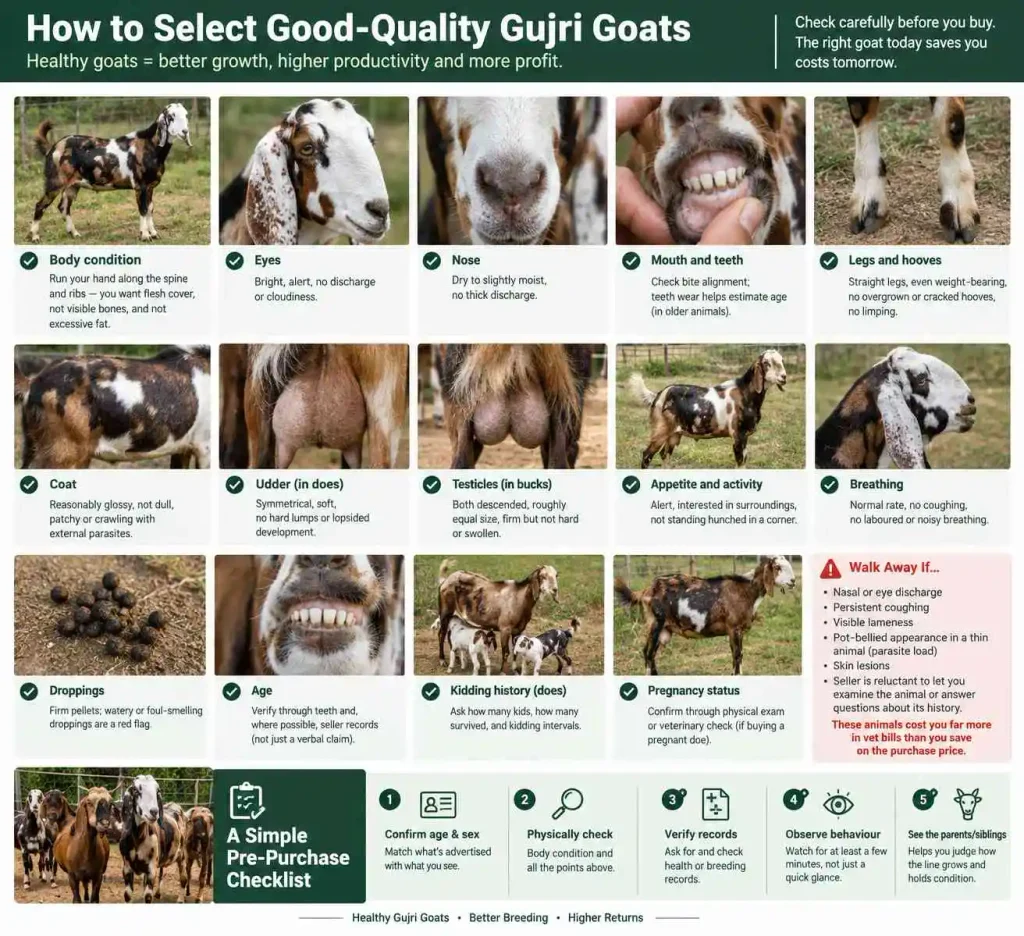
What to check on the animal:
- Body condition: run your hand along the spine and ribs — you want flesh cover, not bones you can count easily, but also not excessive fat that suggests poor exercise or age-related decline
- Eyes: bright, alert, no discharge or cloudiness
- Nose: dry to slightly moist, no thick discharge (a wet, mucus-heavy nose can signal respiratory infection)
- Mouth and teeth: check for correct bite alignment; in older animals, teeth wear tells you approximate age
- Legs and hooves: straight legs, even weight-bearing, no overgrown or cracked hooves, no limping
- Coat: should be reasonably glossy, not dull, patchy, or crawling with visible external parasites
- Udder (in does): symmetrical, soft, no hard lumps or lopsided development that could indicate past mastitis
- Testicles (in bucks): both descended, roughly equal size, firm but not hard or swollen
- Appetite and activity: a healthy goat is alert and interested in its surroundings, not standing hunched in a corner
- Breathing: normal rate, no coughing, no laboured or noisy breathing
- Droppings: firm pellets; watery or foul-smelling droppings are a red flag
- Age: verify through teeth and, where possible, seller records rather than taking a verbal claim at face value
- Kidding history (does): ask specifically how many kids, how many survived, and kidding intervals
- Pregnancy status: confirm through a physical exam or, ideally, veterinary check if buying a supposedly pregnant doe
Warning Walk away from any animal showing nasal or eye discharge, persistent coughing, visible lameness, a pot-bellied appearance in an otherwise thin animal (a sign of heavy parasite load), skin lesions, or a seller who’s reluctant to let you examine the animal closely or answer questions about its history. These are the animals that cost you far more in veterinary bills than you save on the purchase price.
A simple pre-purchase checklist: confirm age and sex match what’s advertised, physically check body condition and the points above, ask for and verify any health or breeding records, observe the animal’s behaviour for at least a few minutes rather than a quick glance, and — if you can — see the parents or siblings to judge how the line grows and holds condition.
Which Gujri Goat Is Better for Breeding?
Breeding selection deserves its own section because the mistakes here compound — a poor breeding decision doesn’t cost you once, it costs you across every kid crop that follows.
For does, prioritise: correct body structure with good width through the pelvis (easier kidding), a documented history of healthy kids and reasonable kidding intervals, good mothering behaviour (does that clean and nurse kids promptly, rather than rejecting them), sound legs and feet since a doe carries pregnancy weight for months, and body condition that isn’t so lean it compromises pregnancy or so heavy it creates kidding complications.
For bucks, the stakes are higher than most beginners realise.
Expert Tip One mistake many beginners make is treating the buck purchase as an afterthought — buying the cheapest available male “just to get breeding started.” A buck can sire dozens of kids in a season. If he’s poorly structured, slow-growing, or carries an undiagnosed health problem, that weakness shows up across your entire next generation, not just one animal. The buck is usually the single highest-leverage purchase on a small goat farm.
Look for a buck with correct leg and hoof structure, strong masculine characteristics without excessive fat, a history of good growth in his own early life if available, healthy and evenly developed testicles, and no signs of respiratory or parasitic disease. Avoid breeding closely related animals (a buck back onto his own daughters or sisters), since this increases the risk of inherited weaknesses appearing in the kid crop. If you’re running a small herd, plan to either rotate in an unrelated buck every couple of years or arrange access to a different bloodline through a local breeding cooperative or fellow farmer.
Feeding Gujri Goats for Better Growth
Feeding is where most of your recurring cost sits, and it’s also where growth, milk yield, and reproduction are won or lost. There’s no single “correct” ration for a Gujri goat — requirements shift with body weight, age, pregnancy, lactation, and whether the animal is being grown out or fattened for market. What follows is a framework, not a fixed recipe; actual quantities should be adjusted with input from your local veterinary or animal husbandry officer based on your goats’ body weight and the fodder actually available to you.
Broad feed categories:
- Green fodder: legume and non-legume green fodder (e.g., berseem, cowpea, maize fodder where available) forms the backbone of a cost-effective ration and supplies protein and moisture
- Dry fodder: crop residues like wheat or bajra straw provide bulk and fibre, especially valuable in the dry season when green fodder is scarce
- Concentrate feed: a grain-and-oilcake-based mix supplies concentrated energy and protein, used to supplement — not replace — fodder, particularly for growing kids, pregnant/lactating does, and animals being fattened
- Tree leaves (browse): species like subabul or ber leaves, where locally available and safe, can supplement the diet, particularly in scrub and semi-arid tracts
- Mineral mixture and salt: correct mineral supplementation prevents a range of deficiency-related problems (poor growth, reproductive issues, weak bones) and should be offered regularly, not occasionally
- Clean drinking water: available at all times — goats that are water-restricted eat less and grow slower
Feeding by category (illustrative only — always adjust to actual body weight and locally available fodder):
| Category | Feeding priority |
|---|---|
| Kids (pre-weaning) | Colostrum first, then gradual introduction to good-quality green fodder and a small creep-feed concentrate ration alongside continued milk |
| Growing goats | Emphasis on quality green fodder plus a modest concentrate allowance to support frame growth |
| Adult does (maintenance) | Primarily fodder-based, concentrate only if body condition or fodder quality is inadequate |
| Pregnant does (last trimester) | Increased concentrate and quality fodder to support foetal growth without over-conditioning |
| Lactating does | Higher plane of nutrition — more concentrate and green fodder to support milk production and body condition recovery |
| Breeding bucks | Maintained in good, not excessive, body condition, with attention increased just before the breeding season |
| Fattening goats (pre-sale) | Higher concentrate proportion over a defined finishing period to add weight before sale |
Common Mistake Feeding every animal in the herd the same ration regardless of category is one of the most frequent errors on small farms. A dry, non-pregnant doe and a heavily lactating doe simply don’t have the same nutritional needs — feeding them identically either wastes feed on the dry doe or underfeeds the lactating one.
Can Gujri Goats Be Raised on Low-Cost Feed?
Yes, to a real extent — but there’s a difference between cutting cost intelligently and underfeeding.
Legitimate ways to reduce feed cost:
- Maximise use of locally available, free or cheap green fodder rather than relying heavily on purchased concentrate
- Use crop residues (straw, stover) as bulk fibre during lean seasons
- Grow a dedicated fodder plot if you have even a small piece of land — this is one of the highest-return investments a goat farmer can make
- Use browse (tree leaves) where locally appropriate and safe, reducing dependence on purchased feed
- Time concentrate feeding to periods when it matters most — late pregnancy, lactation, and finishing — rather than feeding a flat concentrate ration year-round
Where cost-cutting turns into underfeeding, and starts costing you more than it saves: skipping concentrate during late pregnancy or lactation (this shows up as weak kids, poor milk, and slower doe recovery), withholding mineral supplementation to save a small recurring cost (deficiencies are expensive to treat once they appear), or restricting water to “save trouble,” which reduces intake and growth across the board.
Best Practice The cheapest option isn’t always the most economical one. A slightly higher feed cost that produces a healthy, fast-growing kid is usually a better deal than a lower feed cost that produces a stunted animal you’ll spend months and extra money bringing back to market weight.
Housing: How Much Space Do Gujri Goats Need?
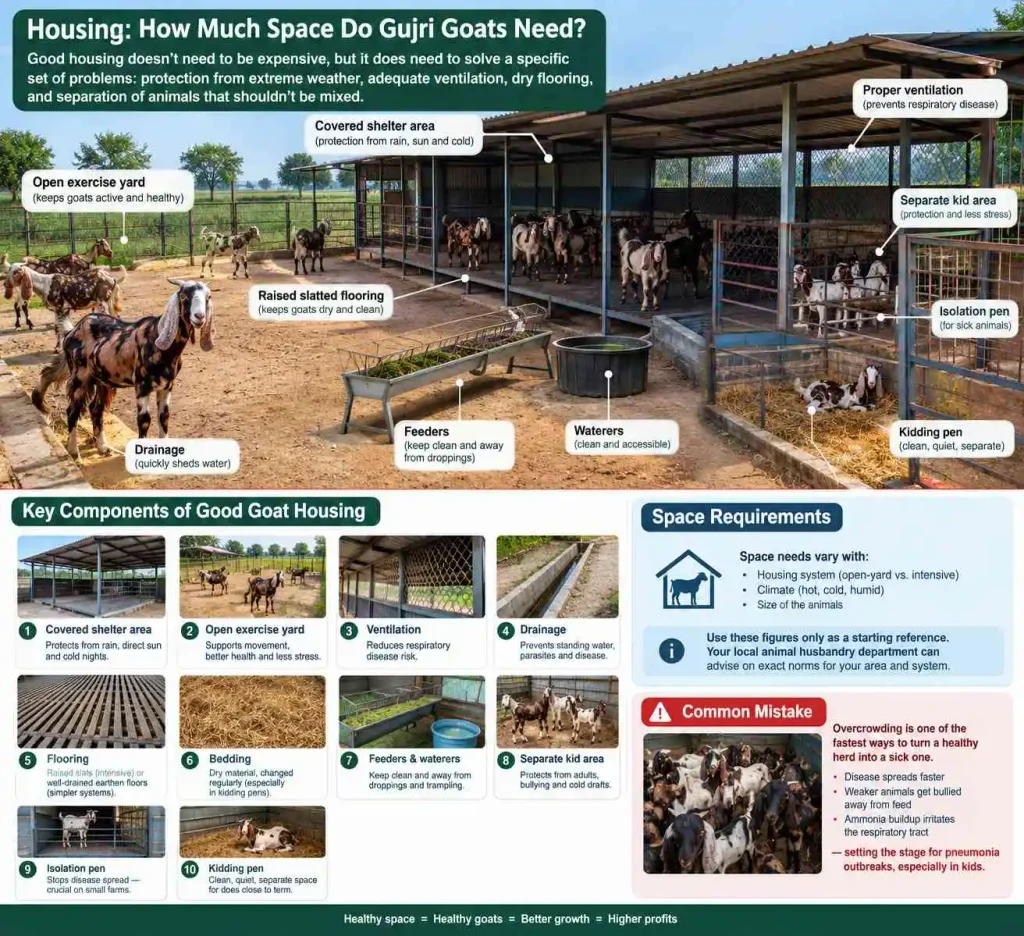
Good housing doesn’t need to be expensive, but it does need to solve a specific set of problems: protection from extreme weather, adequate ventilation, dry flooring, and separation of animals that shouldn’t be mixed.
Core components:
- Covered shelter area: protects from rain, direct sun, and cold nights
- Open exercise yard: goats are active animals and need room to move, which supports better health and reduces stress-related problems
- Ventilation: critical — poor ventilation is a major contributor to respiratory disease in closely housed goats
- Drainage: flooring and surrounding ground should shed water quickly; standing moisture breeds parasites and disease
- Flooring: raised slatted floors are commonly used in more intensive systems to keep animals away from their own droppings and moisture; simpler systems can work with well-drained, regularly cleaned earthen floors
- Bedding: dry bedding material, changed regularly, especially in kidding pens
- Feeders and waterers: positioned to minimise contamination from droppings and trampling
- Separate kid area: kids need protection from being crushed or bullied by adults and from cold drafts
- Isolation pen for sick animals: essential for stopping disease spread — this is one of the most under-built facilities on small farms
- Kidding pen: a clean, quiet, separate space for does close to term
Space requirements genuinely vary with your housing system (open-yard vs. intensive stall-fed), climate, and the size of the animals themselves, so treat any single square-footage figure as a starting reference rather than a rule — your local animal husbandry department can advise on norms suited to your specific system and climate.
Common Mistake Overcrowding is one of the fastest ways to turn a healthy herd into a sick one. When goats are packed too tightly, disease spreads faster, weaker animals get bullied away from feed, and ammonia buildup from droppings and urine irritates the respiratory tract — setting the stage for pneumonia outbreaks, especially in kids.
Breeding and Kidding Management
Getting breeding and kidding right is less about intervention and more about preparation and observation.
Before breeding: does should reach adequate body weight and condition — not just a minimum age — before being bred; breeding an underweight or immature doe leads to kidding difficulties and weak offspring. Watch for heat signs (restlessness, tail wagging, mucus discharge, reduced appetite, mounting behaviour) to time breeding correctly. Manage buck-to-doe ratios sensibly rather than overworking a single buck across too many females in a short window.
During pregnancy: nutrition should step up in the final trimester as foetal growth accelerates, but avoid over-conditioning, which can complicate kidding. Reduce handling stress and rough movement as the doe approaches term.
Kidding preparation: move the doe to a clean, dry, isolated kidding pen a few days before the expected date. Keep supervision available around the expected kidding window, since prompt help with a difficult delivery can be the difference between saving and losing both doe and kid.
After kidding:
Key Takeaway Colostrum within the first few hours of life isn’t optional — it’s the single most important thing that happens in a kid’s first day. It provides the antibodies a newborn kid has no other way of getting, and delayed or inadequate colostrum intake is one of the most preventable causes of early kid mortality.
Beyond colostrum, monitor the doe for retained placenta or excessive bleeding, keep the newborn kid warm and dry (especially critical during cold nights), and observe both doe and kid closely for the first week, when problems are most likely to surface.
How to Manage Gujri Goat Kids
The first six to eight weeks disproportionately shape how a kid performs for the rest of its life. Weak management here shows up later as poor growth, higher disease susceptibility, and lower survival to market weight.
- Colostrum: as covered above, non-negotiable and time-sensitive
- Warmth and shelter: newborn kids can’t regulate body temperature well; protect them from cold, damp, and drafts
- Navel care: clean the navel promptly to reduce infection risk — ask your veterinarian about an appropriate antiseptic for this
- Early feeding: continued nursing alongside gradual introduction to good-quality green fodder as the kid starts nibbling on its own
- Creep feeding: a small, palatable concentrate ration offered in a kid-only space (adults can’t access it) supports early growth ahead of weaning
- Monitoring growth: regular weight checks, even informal ones, help you catch a kid falling behind early rather than at weaning
- Vaccination and deworming: follow a schedule set with your local veterinarian based on regional disease risk — don’t apply a generic national schedule without local input
- Weaning: timed based on the kid’s weight and feed intake rather than a fixed calendar date alone
Because medicine dosing and timing genuinely depend on the specific product, the kid’s weight, and regional disease pressure, this is an area where guessing or copying a neighbour’s routine can do real harm. Loop in a veterinarian for vaccination and deworming decisions rather than treating this as guesswork.
Why Health Management Can Make or Break the Farm
It’s tempting to think of disease as a list of names to memorise. In practice, health management is really an economics problem: every case of illness costs you in three ways at once — treatment expense, lost growth or milk during recovery, and the risk of the disease spreading before you notice it.
Common issues relevant to goat farming in India include:
Enterotoxemia: a bacterial disease often linked to sudden dietary changes or overfeeding on concentrate/lush fodder; sudden death can occur with little warning, which is why prevention through vaccination and gradual feed transitions matters more than treatment after the fact.
PPR (Peste des Petits Ruminants): a highly contagious viral disease causing fever, discharge, mouth lesions, and diarrhoea; regional vaccination campaigns exist, and farmers should follow their state veterinary department’s PPR control programme rather than treating it casually.
Foot problems: usually linked to wet, poorly drained housing; regular hoof inspection and dry flooring go a long way toward prevention.
Pneumonia: closely tied to poor ventilation, overcrowding, and sudden temperature swings, especially dangerous in young kids.
Parasitic infections (internal and external): a major, ongoing drain on growth even when they don’t kill the animal outright; a heavily wormy goat can look reasonably healthy while still growing far below its potential.
Diarrhoea: can stem from parasites, bacterial infection, or dietary upset; in young kids especially, it can turn serious quickly due to dehydration.
Bloat: linked to sudden access to lush legume fodder or rapid feed changes; introduce new fodder gradually.
Mineral deficiencies: often show up as poor growth, reproductive problems, or weak bone development, and are preventable through consistent mineral mixture supplementation.
Warning Don’t attempt to diagnose and self-treat serious symptoms — sudden death, high fever, bloody diarrhoea, severe lameness, or a rapidly spreading illness through the herd. These need a veterinary diagnosis. Guessing wrong on treatment wastes time the animal — and potentially the rest of the herd — doesn’t have.
For each of these, the underlying farmer action is the same: watch daily for early warning signs (reduced appetite, lethargy, abnormal droppings, laboured breathing), isolate anything that looks off before it’s confirmed, and call in veterinary help rather than experimenting.
Vaccination and Deworming
Preventive health management is cheaper than reactive treatment, almost without exception. But the specifics — which vaccines, on what schedule, how often to deworm — depend on your region’s disease prevalence, the season, and your specific management system.
Rather than following a rigid schedule copied from a book or a website, work with your local veterinary officer or state animal husbandry department to build a plan around:
- Vaccination timing matched to regional disease risk (PPR, enterotoxemia, and others prevalent in your area)
- Deworming strategy based on your climate and grazing system — wetter conditions and pasture grazing generally carry higher parasite pressure than dry, stall-fed systems
- Faecal monitoring, where accessible, to check parasite load rather than deworming on a blind fixed schedule regardless of actual need
- Quarantine of newly purchased goats for a reasonable observation period before mixing them with your existing herd — this single practice prevents a large share of disease introduction
- General farm hygiene: regular cleaning of housing, feeders, and waterers, and prompt removal of manure
Best Practice Quarantining every new arrival, no matter how healthy it looks, is one of the cheapest insurance policies available to a small goat farm. A single infected animal mixed straight into your herd can undo months of careful health management.
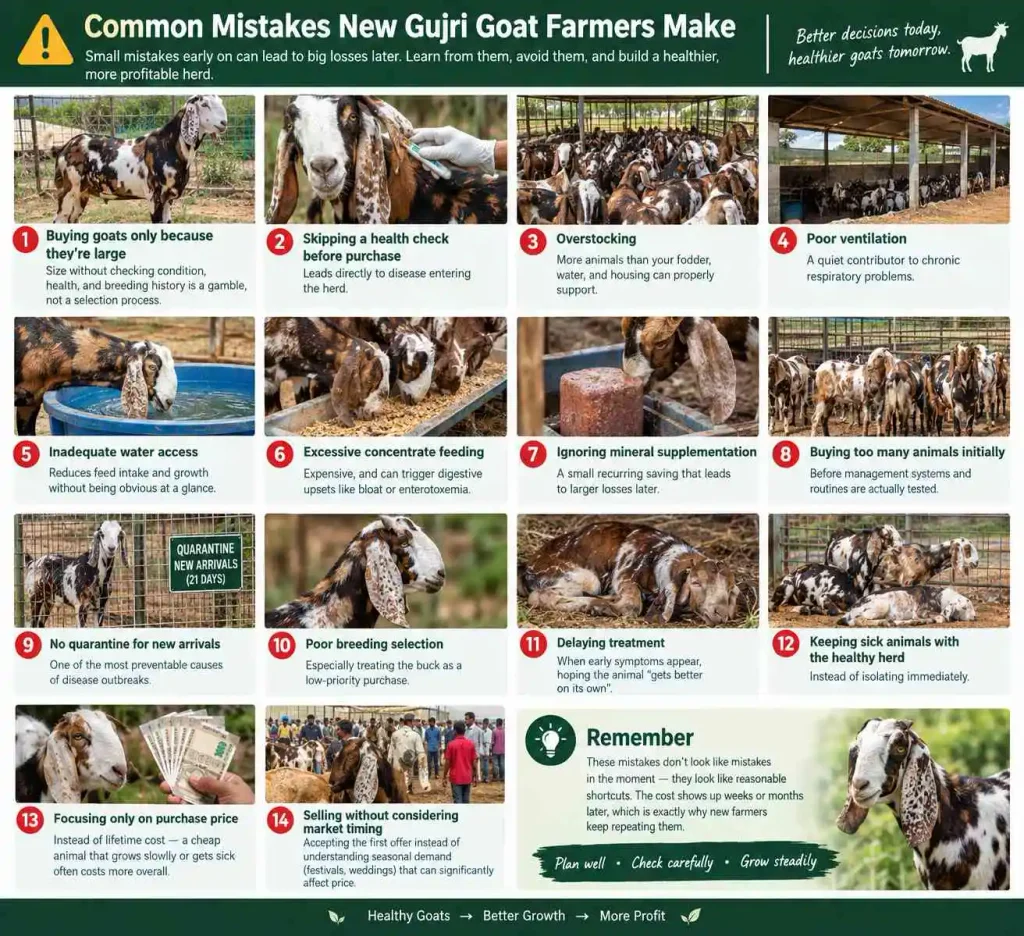
Common Mistakes New Gujri Goat Farmers Make
- Buying goats only because they’re large — size without checking condition, health, and breeding history is a gamble, not a selection process
- Skipping a health check before purchase — leads directly to disease entering the herd
- Overstocking — more animals than your fodder, water, and housing can properly support
- Poor ventilation — a quiet contributor to chronic respiratory problems
- Inadequate water access — reduces feed intake and growth without being obvious at a glance
- Excessive concentrate feeding — expensive, and can trigger digestive upsets like bloat or enterotoxemia
- Ignoring mineral supplementation — a small recurring saving that leads to larger losses later
- Buying too many animals initially — before management systems and routines are actually tested
- No quarantine for new arrivals — one of the most preventable causes of disease outbreaks
- Poor breeding selection, especially treating the buck as a low-priority purchase
- Delaying treatment when early symptoms appear, hoping the animal “gets better on its own”
- Keeping sick animals with the healthy herd instead of isolating immediately
- Focusing only on purchase price instead of lifetime cost — a cheap animal that grows slowly or gets sick often costs more overall
- Selling without considering market timing — accepting the first offer instead of understanding seasonal demand (festivals, weddings) that can significantly affect price
Each of these mistakes is common precisely because it doesn’t look like a mistake in the moment — it looks like a reasonable shortcut. The cost shows up weeks or months later, which is exactly why new farmers keep repeating them.
Gujri Goat Farming for Beginners
Here’s the realistic starting sequence, not the aspirational one.
Start small. A manageable starting herd — enough to learn feeding, health monitoring, and kidding management without being overwhelmed — beats jumping straight to a large herd you don’t yet have the systems to run. Scaling up is much easier once you understand your own management rhythm; scaling down after losses is expensive and demoralising.
Build basic infrastructure first. Shelter, a kidding pen, an isolation pen, feeders, and waterers should exist before the goats arrive, not get improvised afterward.
Buy carefully, not quickly. Apply the selection checklist covered earlier. It’s worth taking extra weeks to find genuinely healthy, well-bred animals rather than filling your pen fast.
Plan your feed before you plan your herd size. Know what fodder you can realistically grow or source locally, and size your herd to match that supply — not the other way around.
Set aside a health budget. Vaccination, deworming, and an emergency veterinary fund should be part of your initial planning, not an afterthought once something goes wrong.
Budget for labour, even if it’s your own time. Daily observation is not optional in goat farming — problems that go unnoticed for a few days often become expensive by the time they’re caught.
Keep records from day one. This habit is far easier to build from the start than to retrofit onto an established herd.
Have a breeding plan, including where your next unrelated buck will come from, before you need one.
Keep an emergency fund separate from your operating budget, for unexpected veterinary costs or feed shortages.
Scale only after your first full production cycle. One complete cycle — breeding through kidding through growth to market weight — teaches you more about your actual management capacity than any amount of planning on paper.
Can Gujri Goats Be Raised With Other Breeds?
Yes, and it’s common practice on many mixed small farms, but it’s worth separating two very different ideas: keeping different breeds together and crossbreeding them.
Keeping breeds together (without crossbreeding) can work reasonably well if you manage feed competition (larger, more assertive animals can crowd out smaller ones at the feeder), keep breeding groups separate to avoid accidental crossbreeding, maintain clear identification and records for each breed group, and apply the same disease-control standards across all animals regardless of breed.
Crossbreeding is a different decision entirely and should be driven by a clear production objective — for example, combining a trait like growth rate with another trait like disease resistance — rather than done opportunistically because two goats happened to be in the same pen. Random, unplanned crossbreeding tends to produce inconsistent results generation after generation, which makes it harder to predict performance or maintain a reliable breeding line. If you’re considering a deliberate cross, it helps to consult your state animal husbandry department or a livestock research institute on which crosses have shown reliable results in your specific region.
Gujri Goat Farming vs Other Popular Goat Breeds
Farmers considering Gujri goats are often also weighing Sirohi, Sojat, or other Rajasthan-origin breeds. None of these is universally “the best” — each fits a different farming context.
This comparison is only a starting reference; local performance depends heavily on your specific feed, climate, and management, so treat it as a conversation-starter with your local veterinary or extension officer rather than a final answer.
| Factor | Gujri | Sojat | Sirohi |
|---|---|---|---|
| Native tract | Jaipur & Sikar, Rajasthan | Pali, Jodhpur, Nagaur, Jaisalmer, Rajasthan | Sirohi district, Rajasthan & Gujarat |
| Adult male weight (NBAGR / cited sources) | ~69 kg | ~60 kg | ~50 kg |
| Adult female weight (NBAGR / cited sources) | ~58 kg | ~53 kg | ~23 kg |
| Production type | Dual-purpose (meat & modest milk) | Dual-purpose (meat & modest milk) | Dual-purpose (meat & milk), noted for resilience under poor conditions |
| Climate suited to | Semi-arid Rajasthan-type conditions | Arid to semi-arid Rajasthan-type conditions | Wide range including drier and semi-humid areas |
| Suitability for beginners | Reasonable, if within/near native tract | Reasonable, if within/near native tract | Often noted as easy to manage, popular starter breed nationally |
Note the size gap: NBAGR’s own figures show Gujri as the largest-framed of the three at the breed level, but larger frame size alone doesn’t guarantee better returns — feed cost to reach that frame, local market preference, and how well the breed suits your specific climate all matter just as much.
If you’re outside Rajasthan or a similar semi-arid zone, it’s worth checking with your state’s animal husbandry department on which of these — or a locally developed breed — has the better track record in your actual conditions before committing.
How to Market Gujri Goats
Selling well is as much a skill as buying well, and it’s one beginners tend to underinvest in.
Common sales channels include local livestock markets (mandis), butchers buying directly for meat, individual buyers purchasing for home consumption or festivals, traders who aggregate animals for onward sale, breeding-stock buyers looking specifically for quality does or bucks rather than meat animals, and direct farm sales to repeat buyers who value knowing the animal’s history.
Why accepting the first offer isn’t always smart: demand for goats — especially for meat — rises sharply around specific festivals and the wedding season in many regions, and prices can differ meaningfully depending on timing. A trader offering a price on a random Tuesday may not reflect what the same animal would fetch two weeks before a major festival.
Where practical, weigh animals before selling rather than relying purely on visual estimation or a buyer’s assessment — this protects you from underselling, especially when selling by weight rather than by head. Keeping sale records (date, buyer, weight, price) over time also helps you spot which buyers pay fairly and which seasons work best for your specific animals.
Farm Record Keeping
Records feel like paperwork until the day they save you money — usually the day you’re trying to figure out why one doe consistently produces weak kids while another doesn’t.
A serious goat farm should track, per animal where possible: purchase date and cost, identification (tag, notch, or similar), body weight at intervals, vaccination and deworming history, breeding dates, pregnancy confirmation, kidding date and outcome (number of kids, survival), feed expenses, treatment expenses and reasons, and sale price and date.
Quick Summary Good records let you identify your genuinely profitable animals — the does that consistently produce and raise healthy kids — and cull or avoid breeding from the ones that don’t, rather than guessing based on memory or impressions.
Practical Farm Economics
Any economics worked out here depends entirely on the assumptions behind it, and those assumptions will differ by region, scale, and season. Treat the framework below as a way of thinking about the calculation — not a promise of what you’ll actually earn.
Costs to account for:
- Livestock purchase cost (varies as discussed earlier)
- Housing (one-time, though it needs periodic upkeep)
- Feed (the largest ongoing cost — varies with fodder availability and concentrate use)
- Labour (your time has a cost even if unpaid)
- Healthcare (vaccination, deworming, treatment)
- Breeding costs (buck maintenance or access fees)
- Mortality (a real cost — animals lost represent sunk feed and purchase cost with no return)
- Miscellaneous (transport, minor equipment, record-keeping materials)
Revenue side: sale of market-ready goats (meat purpose), sale of breeding stock at a premium if animals are well-bred and documented, and — where applicable — modest milk sales.
The key point often missed by beginners: gross revenue is not profit. A farmer who sells ₹2,00,000 worth of goats in a year but spent ₹1,60,000 on feed, health, and replacement stock has made a much smaller return than the headline sale figure suggests — and that’s before accounting for their own labour. Work out your actual costs, category by category, for your specific scale and region before assuming a particular herd size will deliver a particular income. Anyone promising a fixed, easy profit figure for a fixed number of goats is skipping the part of the calculation that actually determines the outcome.
What Should You Actually Do Next?
If you’re seriously considering Gujri goat farming, the sequence that protects you from the most common and expensive mistakes looks like this:
Start with a small, manageable number of animals rather than a large herd on day one. Buy quality breeding stock using the selection checklist covered above — don’t compromise on health checks or breeding history to save time or a small amount of money.
Prepare your feed plan and housing before the goats arrive, not after. Set up a health-management routine, including a relationship with a local veterinarian, from the very first week. Keep records from the first animal you buy, not after you’ve lost track of who’s who. Spend time understanding your local market — who buys, when demand peaks, and what price transparency looks like in your area. Only expand your herd once you’ve been through a full production cycle and genuinely understand your own management capacity, feed costs, and disease risks.
Gujri goats can be a reasonable choice for a farmer working within or near their native semi-arid tract who’s willing to invest in correct feeding, housing, and health management. They are not a shortcut to guaranteed profit, and no breed is.
The animal you choose matters far less, in the long run, than the discipline you bring to feeding it correctly, watching it closely, and making buying and breeding decisions based on health and history rather than appearance alone. Start smaller than you’re tempted to, get the basics right through one full cycle, and let the results — not optimism — decide how fast you scale from there. If the upfront investment in shelter and stock feels out of reach, it’s worth checking whether you qualify for institutional funding — our guide to goat farming loans and subsidies of up to 50% walks through the schemes and eligibility criteria before you scale up.
1. Is Gujri goat farming profitable in India?
Profitability depends far more on management than on the breed itself. Feed cost, kid survival rate, growth rate, and selling at the right time matter more than which breed you chose. A well-managed Gujri herd within its native semi-arid tract can be profitable, but no fixed “lakh per year” figure should be trusted without checking the assumptions behind it.
2. How much does a Gujri goat cost?
Prices typically range from around ₹15,000–₹25,000 per animal, though this varies with age, sex, body weight, breed purity, pregnancy status, location, and season. Prices near the native tract (Jaipur and Sikar, Rajasthan) usually differ from prices elsewhere, and rates rise before festivals and wedding season. Always verify current prices with a local mandi or animal husbandry department before budgeting.
3. How do I identify a healthy, good-quality Gujri goat before buying?
Check body condition (flesh cover over ribs and spine), bright eyes with no discharge, straight legs and healthy hooves, a glossy coat, and — for does — a symmetrical udder with no lumps. Ask for kidding history and health records, and walk away from any animal showing nasal discharge, coughing, lameness, or a reluctant seller.
4. What do Gujri goats eat, and can feed costs be kept low?
A Gujri goat’s diet should combine green fodder, dry fodder/crop residue, a concentrate mix for growing kids and lactating does, mineral supplementation, and constant clean water. Feed costs can be reduced through a dedicated fodder plot and locally available browse, but skipping concentrate during late pregnancy or lactation, or withholding minerals, crosses from cost-cutting into underfeeding.
5. How many Gujri goats should a beginner start with?
Start with a small, manageable herd rather than a large one — enough to learn feeding, health monitoring, and kidding management without being overwhelmed. Build housing, a kidding pen, and an isolation pen before the goats arrive, and only scale up after completing one full production cycle from breeding through market weight.
Newsletter