


Sirohi Goat Farming: Why This Hardy Breed Works
A healthy Sirohi buck can fetch anywhere between ₹15,000 and ₹40,000 in the live goat market, depending on weight and body condition. That’s why this breed keeps showing up in serious business plans across Rajasthan, Gujarat, and increasingly other states too.
But Sirohi goats aren’t a “buy and forget” investment. The breed has genuine strengths—hardiness, adaptability, decent meat yield—yet farmers profit only when they understand what actually makes Sirohi different from other Indian breeds, and manage feeding, breeding, and disease prevention accordingly.
This guide covers the breed’s real characteristics, how it compares to Beetal, Barbari, Jamunapari, and Osmanabadi, realistic costs in rupees, and where to get government support, without exaggerating what any breed can deliver.
Where Do Sirohi Goats Come From, and Why Does That Matter?
Sirohi goats originated in the Sirohi district of Rajasthan, in a hot, semi-arid landscape with scarce water and patchy grazing. That native tract explains most of the breed’s behaviour today—goats developed in harsh, resource-limited conditions naturally build hardiness, disease resistance, and efficient browsing habits, and these traits carry over even when raised in other states.
Did You Know? Breeds developed in low-input environments, like Sirohi, often outperform “improved” or exotic breeds on marginal land, simply because they were never bred to depend on rich feed or intensive care.
What Does a Genuine Sirohi Goat Actually Look Like?
This matters when buying, because mixed or misrepresented stock is common in local markets, and paying “Sirohi price” for a crossbred animal is a real risk for beginners. Typical Sirohi characteristics include:
- Coat: Brown base with irregular white patches; short to medium hair length
- Ears: Medium-length, drooping—not upright like Barbari or fully pendulous like Jamunapari
- Horns: Small to medium, curving backward in both sexes
- Body size: Medium-to-large frame; adult bucks commonly reach 35–55 kg, does 25–40 kg under reasonable management
- Temperament: Calm and manageable, which helps with handling and milking
- Reproductive performance: Moderate-to-good twinning rate, with many does kidding twice in about 18 months
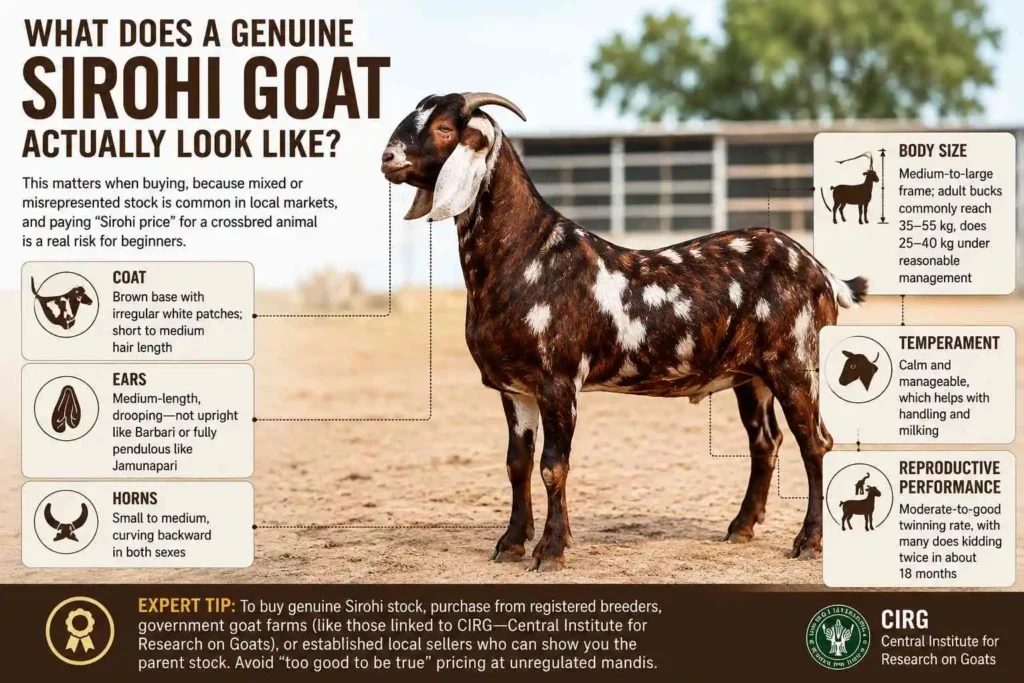
Expert Tip: To buy genuine Sirohi stock, purchase from registered breeders, government goat farms (like those linked to CIRG—Central Institute for Research on Goats), or established local sellers who can show you the parent stock. Avoid “too good to be true” pricing at unregulated mandis.
Sirohi vs Other Popular Indian Goat Breeds: Which Should You Choose?
No single breed is universally “best”—it depends on your goal, climate, and farm size.
| Breed | Main Strength | Best Suited For |
|---|---|---|
| Sirohi | Hardiness, adaptability, calm temperament | Meat production, commercial and mixed farms |
| Barbari | Compact size, prolific breeding | Small, intensive, stall-fed setups |
| Beetal | Larger body size | Meat and moderate milk yield |
| Jamunapari | Large frame, tall stature | Breeding stock, dual-purpose farms |
| Osmanabadi | Strong hardiness, good adaptability | Meat production in Deccan/Maharashtra region |
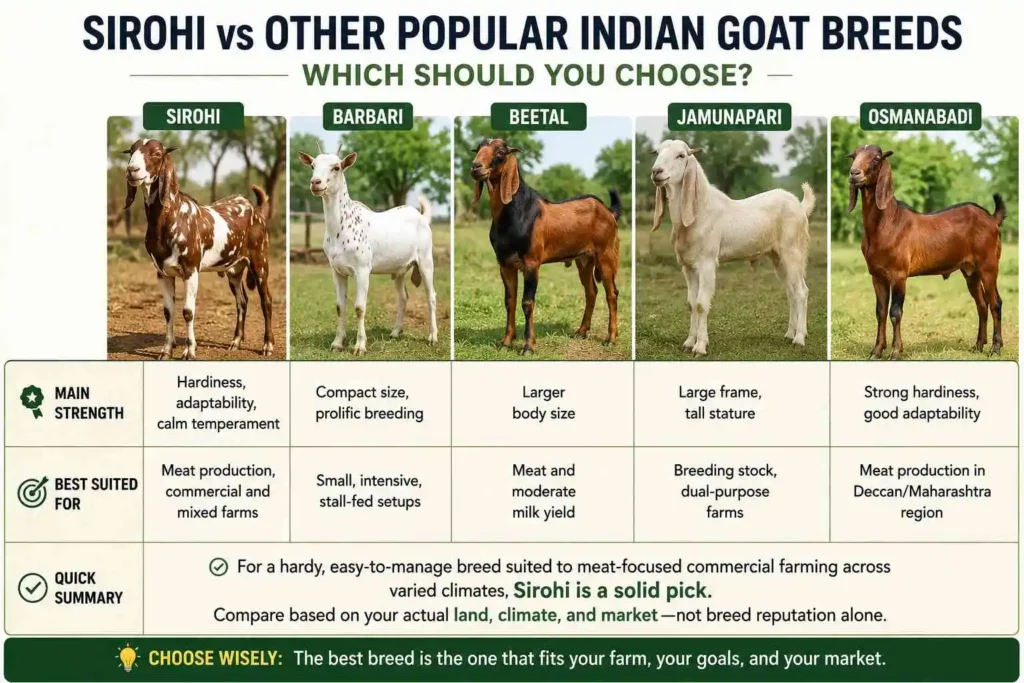
Quick Summary: For a hardy, easy-to-manage breed suited to meat-focused commercial farming across varied climates, Sirohi is a solid pick. Compare based on your actual land, climate, and market—not breed reputation alone.
How Much Land and Housing Does Sirohi Goat Farming Actually Need?
The honest answer depends on whether you plan to graze or stall-feed. A small stall-fed unit of 10–15 goats needs roughly 0.25–0.5 acre for housing, feed storage, and movement space. Combining grazing with stall feeding, with access to 1–2 acres of grazing or fodder land, significantly reduces feed costs.
Housing itself should have:
- Raised slatted flooring (1.5–2 feet off ground) to keep goats away from moisture and droppings
- 10–15 sq ft of covered space per adult goat
- Open sides with a solid roof for ventilation, rather than a fully enclosed shed
- A separate section for pregnant does and newborn kids
Common Mistake: Building a fully closed shed to “protect” goats from weather. This traps humidity and ammonia, raising respiratory disease risk. Open-sided sheds generally work better in Indian conditions.
Grazing vs Stall Feeding: Which System Fits Your Situation?
Sirohi goats are natural browsers, preferring leaves and shrubs over plain grass—part of why they do well on marginal land. Grazing lowers feed cost but exposes goats to more parasites and predators, while stall feeding gives better nutrition control at higher cost. Most commercial Sirohi farms use a mixed system: grazing part of the day, with supplementary feed to ensure consistent nutrition for pregnant and lactating does.
Are You Feeding Sirohi Goats Correctly for Their Weight and Stage?
This is probably the most misunderstood part of goat farming. There’s no single “one ration fits all” answer—actual requirements depend on body weight, age, pregnancy, and lactation status, plus how much grazing or green fodder is already available.
| Goat Category | Approximate Dry Matter Need | Concentrate Feed Guidance |
|---|---|---|
| Maintenance (non-pregnant, non-lactating adult) | ~2.5–3% of body weight/day | Minimal to none if forage quality is good |
| Pregnant doe (last 6 weeks) | Slightly increased over maintenance | 200–300 g/day, adjusted to body condition |
| Lactating doe | Higher than maintenance | 300–500 g/day depending on milk yield and kid count |
| Growing kid (post-weaning) | Higher relative to body weight | 150–250 g/day to support steady growth |
Key Takeaway: Instead of feeding a fixed quantity to every adult goat, base rations on body weight and production stage, and adjust by body condition. A local vet or animal husbandry officer can help calculate this for your herd size and forage. Poor nutrition, regardless of exact numbers, slows growth, delays breeding, and weakens disease resistance.
How Many Sirohi Goats Should a Beginner Start With?
Don’t overlook this decision. For most beginners, the safest approach is starting with 8–12 healthy does and 1 buck rather than a large herd immediately. This gives you time to learn feeding, breeding, and disease management before scaling, while limiting financial exposure in year one.
Breeding, Kidding, and Newborn Care
Does typically reach breeding age around 8–10 months, though many farmers wait until 12 months so the body is fully developed. Gestation lasts roughly 145–150 days.
The highest mortality risk occurs in the first week after birth. Make sure newborn kids get colostrum within the first few hours, stay in a clean, dry, draft-free space, and have the navel cord disinfected.
Warning: Skipping colostrum feeding in the first hours significantly raises early kid mortality risk—one of the most preventable losses in goat farming.
Vaccination and Disease Prevention: What You Should Actually Follow
Rather than following one fixed nationwide schedule, vaccination and deworming programs should follow current recommendations from your state animal husbandry department or a local veterinarian, since disease pressure varies by region and season. Farmers should still understand the common diseases goats can face and how to identify, treat, and prevent them. For a detailed overview, read our guide on Goat Diseases and Treatment Guide: PPR, FMD, Diarrhea & Prevention Tips.
| Disease/Issue | General Purpose of Prevention |
|---|---|
| PPR (Peste des Petits Ruminants) | Prevents a highly contagious, often fatal viral disease |
| FMD (Foot-and-Mouth Disease) | Prevents outbreaks affecting growth and productivity |
| Enterotoxaemia | Prevents sudden death, especially after rich feeding |
| Internal parasites (worms) | Prevents stunted growth and anaemia |
Expert Tip: Avoid deworming on a rigid fixed schedule regardless of need—overuse contributes to drug resistance in parasites. Base frequency on local parasite pressure, faecal testing where available, and veterinary advice.
Can Sirohi Goat Farming Really Be Profitable?
Yes, but not automatically, and no honest guide promises guaranteed profit. It helps to separate one-time setup costs from ongoing annual costs.
Initial setup cost (illustrative, for 10 does + 1 buck):
| Item | Approximate Cost (₹) |
|---|---|
| 10 does | ₹80,000–₹1,20,000 |
| 1 buck | ₹15,000–₹25,000 |
| Shed construction | ₹40,000–₹80,000 |
| Equipment, water setup | ₹10,000–₹20,000 |
| Total setup cost | ₹1,45,000–₹2,45,000 |
Annual operating cost:
| Item | Approximate Cost (₹) |
|---|---|
| Feed (concentrate + supplements) | ₹50,000–₹80,000 |
| Veterinary care and vaccination | ₹8,000–₹15,000 |
| Labour (if hired) | ₹0–₹60,000 |
| Miscellaneous (bedding, transport) | ₹5,000–₹10,000 |
Revenue example (illustrative only): If 10 does average 1.5 kids/year with 85% survival to sale age, that’s roughly 12–13 marketable kids. At ₹6,000–₹10,000 per kid depending on weight and local rates, gross revenue could range from ₹75,000 to ₹1,30,000 in the first full breeding cycle, before subtracting operating costs. This is an example, not a promise—actual results depend on mortality, local prices, and management quality.
Government Subsidies and Schemes for Goat Farming
Financial support does exist. The National Livestock Mission (NABARD-linked) offers subsidy support generally in the 25–33.3% range, with higher rates for women and SC/ST applicants, plus MUDRA loan access. Several states also run their own goat-distribution schemes with different subsidy percentages.
Because scheme details vary by state and change over time, verify current rules with your district Animal Husbandry Department or nearest NABARD-linked bank before applying—don’t rely on older articles for exact figures. If you’re looking for more information on financing options, eligibility, and how to apply, see our guide on Goat Farming Loan | Apply Online & Get 50% Subsidy.
Common Mistakes Beginners Make
- Buying goats before housing is ready
- Feeding a fixed ration regardless of body weight or stage
- Following a rigid deworming schedule instead of monitoring actual need
- Overcrowding sheds to save on construction cost
- Skipping colostrum feeding for newborns
- Selling without checking current local mandi rates first
Getting Started the Right Way
Sirohi goat farming isn’t a shortcut to easy money, but it’s a solid business for farmers willing to manage it with real attention—matching feed to each goat’s actual needs, following local veterinary guidance instead of generic schedules, and separating setup costs from ongoing expenses. Start with a small, healthy herd, verify genuine Sirohi stock, and check current subsidy options in your state before your first purchase.
Frequently Asked Questions about Sirohi Goat Farming
1. How much does a Sirohi goat cost in India?
Young does typically range from ₹8,000–₹12,000, while healthy adult bucks can cost ₹15,000–₹25,000 or more, depending on region and quality.
2. How is Sirohi different from Osmanabadi or Beetal goats?
Sirohi is known for its brown-and-white coat, drooping ears, and calm temperament, while Osmanabadi is hardier in Deccan conditions and Beetal tends to have a larger body frame with better milk potential.
1. How much does a Sirohi goat cost in India?
Young does typically range from ₹8,000–₹12,000, while healthy adult bucks can cost ₹15,000–₹25,000 or more, depending on region and quality.
2. How is Sirohi different from Osmanabadi or Beetal goats?
Sirohi is known for its brown-and-white coat, drooping ears, and calm temperament, while Osmanabadi is hardier in Deccan conditions and Beetal tends to have a larger body frame with better milk potential.
3. How much land is needed for Sirohi goat farming?
A stall-fed unit of 10–15 goats can work on 0.25–0.5 acre; grazing-based systems benefit from 1–2 acres of additional land.
4. What is the correct feeding quantity for Sirohi goats?
There’s no single fixed quantity—rations should be based on body weight and production stage (maintenance, pregnancy, lactation, growth), not a universal daily amount.
5. Is there a fixed vaccination schedule for Sirohi goats?
No single schedule applies everywhere. Follow your state animal husbandry department’s or local veterinarian’s current recommendations, since disease risk varies by region and season.
6. Are there government subsidies for Sirohi goat farming?
Yes, including National Livestock Mission subsidies via NABARD and various state-level schemes. Percentages and eligibility change, so confirm current details with your local Animal Husbandry Department.
Newsletter