


Duck Farming in India: Costs, Breeds and Common Mistakes
Most people who start duck farming spend their first month worrying about the pond. The people who struggle later in duck farming usually worried about the wrong thing. Feed cost, duckling losses and a weak local market decide whether a duck farm survives, far more than the water.
This guide is for beginners and small-scale farmers anywhere in India, since ponds, paddy fields and small landholdings are part of farms in many states. By the end you’ll know how to choose a system, pick a breed, set up housing, feed properly, and test your numbers before investing seriously.
Quick answer: To start duck farming, choose one purpose (eggs or meat), buy healthy ducklings of a suitable breed from a reliable hatchery, build a dry and well-ventilated shed, brood the ducklings carefully, feed stage-wise balanced feed, and confirm your buyers before you scale up. A pond helps but isn’t compulsory.
Is Duck Farming Profitable, and Is It Right for Your Farm?
Duck farming suits some farms very well. Ducks tolerate wet conditions better than chickens, are generally hardy, and many local varieties handle Indian heat and humidity reasonably. In areas with ponds, canals and paddy fields, they fit naturally into the farm.
But “suits the area” is not the same as “is profitable”. Before buying a single duckling, answer these four questions:
- Is there a buyer? Check who buys duck eggs and duck meat near you, and at what farm-gate price (not the retail price).
- Can you get feed regularly? Ducks need balanced feed. Scavenging alone will not do it.
- Is clean drinking water available all year?
- Is veterinary support within reach? Know your nearest veterinary hospital or Krishi Vigyan Kendra before you need them.
Expert Tip: Cheap ducklings are not a bargain if feed, water, a vet and a market aren’t already sorted. Confirm these first, then buy stock.
Do You Really Need a Pond to Start Duck Farming?
No. This is one of the most common beginner assumptions. Ducks enjoy swimming and it helps their welfare, but a pond is not compulsory for every system.
What ducks do need is drinking water deep enough to dip their whole bill, so they can clear their nostrils and eyes. Without this, eye and respiratory problems become more likely. Swimming water and drinking water are different things: a muddy pond doesn’t replace a clean drinker.
The following comparison will help you decide which system matches your land, budget and goals.
| System | Best for | Main limitation |
|---|---|---|
| Backyard / free-range | Family eggs, a few birds | Low output, predator and disease exposure |
| Pond-linked semi-intensive | Farms with a safe, clean water body | Water quality and disease risk need watching |
| Deep-litter housing (no pond) | Small commercial units | Needs good drainage and litter management |
| Integrated (rice-duck, fish-duck) | Farms already growing paddy or fish | Needs planning, biosecurity and care with fish ponds |
A pond helps only if it’s clean, safe from predators and not shared with other farms’ birds in a disease-prone area.
Common Mistake: Providing a big pond while neglecting balanced feed, dry resting areas and clean drinking water. Swimming access does not replace nutrition or sound housing.
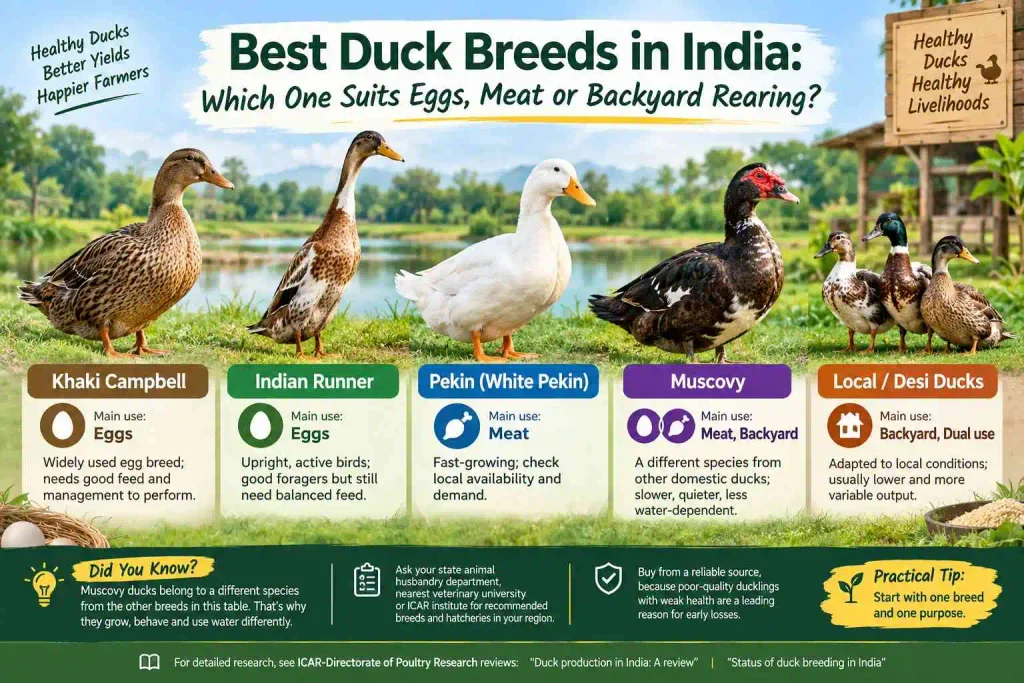
Best Duck Breeds in India: Which One Suits Eggs, Meat or Backyard Rearing?
Your main objective should drive the breed. A farmer selling eggs needs different birds from one raising ducks for meat. Performance also depends on genetics, feed, health, housing and climate, so treat any quoted figure as potential under good management, not a promise.
| Breed | Main use | Points to note |
|---|---|---|
| Khaki Campbell | Eggs | Widely used egg breed; needs good feed and management to perform |
| Indian Runner | Eggs | Upright, active birds; good foragers but still need balanced feed |
| Pekin (White Pekin) | Meat | Fast-growing; check local availability and demand |
| Muscovy | Meat, backyard | A different species from other domestic ducks; slower, quieter, less water-dependent |
| Local / desi ducks | Backyard, dual use | Adapted to local conditions; usually lower and more variable output |
Ask your state animal husbandry department, nearest veterinary university or ICAR institute which breeds and hatcheries are recommended in your region. Buy from a reliable source, because poor-quality ducklings with weak health are a leading reason for early losses.
Did You Know? Muscovy ducks belong to a different species from the other breeds in this table. That’s why they grow, behave and use water differently.
Further reading: For research-backed detail on Indian and exotic duck breeds, see the ICAR-Directorate of Poultry Research reviews Duck production in India: A review and Status of duck breeding in India.
Practical Tip: Start with one breed and one purpose. Mixing breeds and goals in your first batch makes it hard to see what’s working.
Duck Farming Shed Design: How to Keep Housing Dry, Clean and Easy to Manage
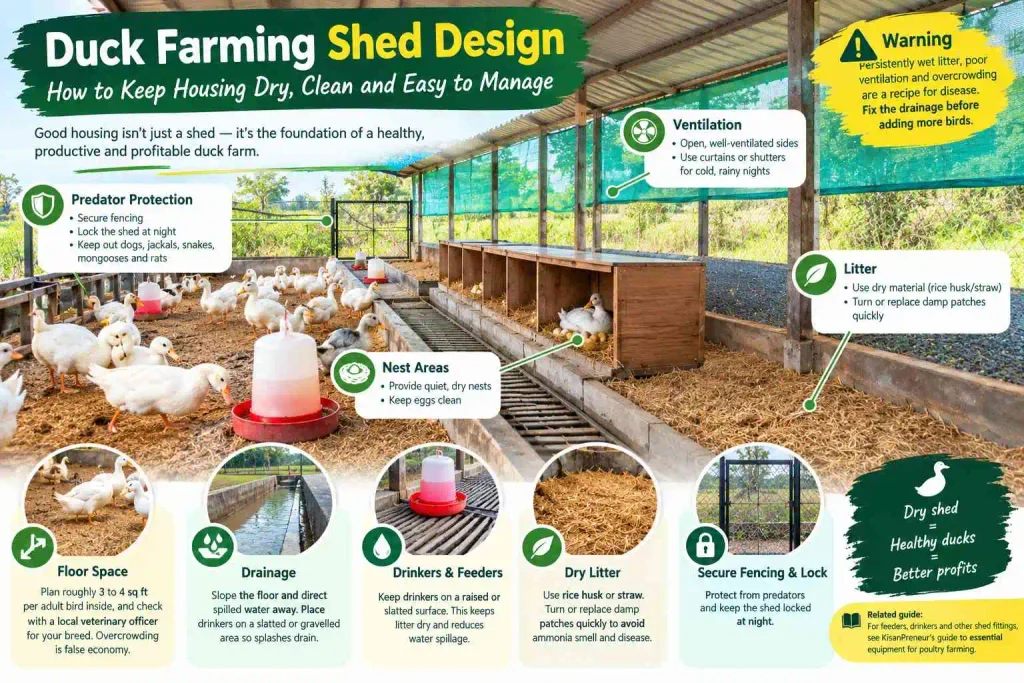
Ducks are messy with water. Wet litter breeds problems fast, from foot damage to disease and ammonia smell. So good housing is mostly about keeping things dry.
A workable shed for beginners needs:
- Floor space: Plan roughly 3 to 4 square feet per adult bird inside, and check with a local veterinary officer for your breed. Overcrowding is false economy.
- Drainage: Slope the floor and direct spilled water away. Place drinkers on a slatted or gravelled area so splashes drain.
- Ventilation: Open, well-ventilated sides with weather protection (curtains or shutters for cold, rainy nights).
- Litter: Use dry material such as rice husk or straw and turn or replace damp patches quickly.
- Predator protection: Dogs, jackals, snakes, mongooses and rats take ducks and eggs. Use secure fencing and lock the shed at night.
- Nest areas: Provide quiet, dry nests for layers so eggs stay clean.
Warning: Persistently wet litter, poor ventilation and overcrowding are a recipe for disease. Fix the drainage before adding more birds.
Related guide: For feeders, drinkers and other shed fittings, see KisanPreneur’s guide to essential equipment for poultry farming.
Duckling Care in Duck Farming: Getting the First Three Weeks Right
Most beginner losses happen early. Ducklings don’t have a mother hen’s warmth, so you provide it.
- Brooding temperature: Keep ducklings warm, around 30°C in the first week, then reduce gradually as they feather. Watch behaviour: huddling means cold, scattering and panting means hot.
- Water: Ducklings need drinking water from day one, deep enough for the bill but shallow enough that they can’t get soaked and chilled. Always keep feed and water together, as ducklings eat and drink in alternation.
- Starter feed: Use a proper starter ration suited to ducklings. Do not assume chicken starter is always adequate; ducklings have higher niacin needs, and deficiency can cause leg weakness. Ask your feed supplier or a nutritionist.
- Dry bedding: Change it often so ducklings stay dry and warm.
Expert Tip: Keep a simple daily record of deaths and signs of illness. A sudden jump tells you something is wrong while there’s still time to act.
Related guide: KisanPreneur’s chick brooding guide explains brooding basics for poultry. Remember that ducklings need extra attention to drinking water and dry bedding.
Duck Feed and Feeding: How to Control the Biggest Cost in Duck Farming
Feed is usually the biggest recurring expense in a duck unit, so it’s where beginners win or lose money. Ducks foraging in ponds and fields get some extra food, but they do not meet all their nutritional needs this way.
Feed in stages: starter for ducklings, grower for growing birds, and layer feed for laying ducks. Each stage has different protein, energy, calcium and vitamin needs. Layers especially need adequate calcium for good shells.
To check feasibility, use this simple method rather than guessing:
Monthly feed quantity = number of birds × daily feed per bird (kg) × 30
For example (illustrative only): 100 laying ducks eating about 0.15 kg per day need roughly 100 × 0.15 × 30 = 450 kg a month. Multiply by your local feed price per kg to get the monthly feed cost. Replace the intake figure with what your feed supplier or veterinarian recommends for your breed.
Lower-cost options like locally available grains or farm by-products can reduce costs, but only where they’re nutritionally adequate and safe. Don’t make up your own formula from guesswork. A qualified animal nutritionist or the local KVK can help balance a ration.
Warning: Never feed mouldy grain or spoiled feed. Aflatoxins can seriously harm ducks, which are particularly sensitive.
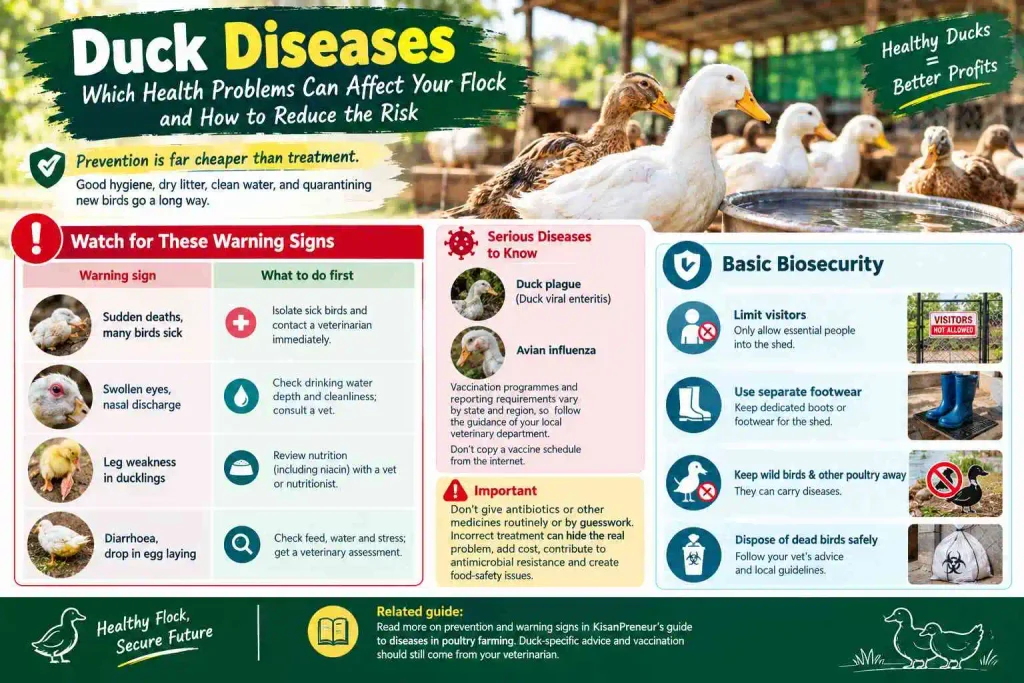
Duck Diseases: Which Health Problems Can Affect Your Flock and How to Reduce the Risk
Prevention is far cheaper than treatment. Good hygiene, dry litter, clean water, and quarantining new birds go a long way.
| Warning sign | What to do first |
|---|---|
| Sudden deaths, many birds sick | Isolate sick birds and contact a veterinarian immediately |
| Swollen eyes, nasal discharge | Check drinking water depth and cleanliness; consult a vet |
| Leg weakness in ducklings | Review nutrition (including niacin) with a vet or nutritionist |
| Diarrhoea, drop in egg laying | Check feed, water and stress; get a veterinary assessment |
Diseases such as duck plague (duck viral enteritis) and avian influenza are serious. Vaccination programmes and reporting requirements vary by state and region, so follow the guidance of your local veterinary department. Don’t copy a vaccine schedule from the internet.
Warning: Don’t give antibiotics or other medicines routinely or by guesswork. Incorrect treatment can hide the real problem, add cost, contribute to antimicrobial resistance and create food-safety issues.
Basic biosecurity: limit visitors, keep separate boots or footwear for the shed, keep wild birds and other poultry away from your flock, and dispose of dead birds safely as advised by your vet.
Related guide: Read more on prevention and warning signs in KisanPreneur’s guide to diseases in poultry farming. Duck-specific advice and vaccination should still come from your veterinarian.
What Does It Actually Cost to Start Duck Farming?
Before reading a ready-made “business plan”, build your own with local quotes. This table separates one-time setup costs from ongoing expenses, which beginners often mix up.
| One-time (initial investment) | Recurring (operating) |
|---|---|
| Shed construction or modification | Feed (usually the largest item) |
| Fencing, nests, feeders, drinkers | Veterinary care, vaccines, biosecurity |
| Brooder, heating, lighting | Labour |
| Initial ducklings | Electricity and water |
| Replacement of dead or culled birds | |
| Transport, packing, marketing |
A basic way to check viability for an egg unit:
Monthly profit = (eggs sold × farm-gate price) − (feed + labour + health + other running costs)
Be realistic about assumptions. Account for mortality, birds that lay below breed potential, and the fact that the price you receive from a trader is lower than the retail price. Revenue is not profit. Also remember ducks don’t lay at full rate from day one; there’s a rearing period before income starts, so you need working capital to carry you through.
Common Mistake: Copying someone else’s profit figures. Their feed price, mortality, buyers and management are not yours. Use your own local numbers.
Funding tip: Ask your bank and your state animal husbandry department whether a duck unit qualifies for any livestock or poultry scheme. You can also check the National Livestock Mission portal for current schemes, since eligibility and subsidy rates change. To see how costs and returns are laid out for chickens, compare with KisanPreneur’s layer poultry farm guide.
Duck Farming Rules, Manure and Waste Management
Check local requirements for livestock keeping, slaughter and the sale of eggs or meat. Rules differ by state and local body, so ask your veterinary office or panchayat before scaling up.
Manure and wastewater need a plan too. Ducks produce wet droppings. Composting manure and keeping runoff away from drinking water sources protects both your neighbours and your flock. Used well, duck manure can be a useful farm input.
Your Next Step: Start Small and Test the Market
The smartest first move in duck farming isn’t building the biggest shed you can afford. It’s proving, on a small scale, that you can reliably get feed, keep ducklings alive and sell what you produce.
So spend the next couple of weeks doing groundwork: visit your nearest veterinary officer or KVK, get written feed quotes from two suppliers, ask three local buyers what they’d pay for eggs or meat, and find a trustworthy hatchery. Then start with a small batch, keep daily records, and expand only when your own numbers, not someone’s brochure, show the farm can pay its way.
Still deciding between ducks and chickens? Read how to start chicken farming and the layer poultry farm setup guide to compare costs, housing and market demand before you commit.
Duck Farming FAQs
When do ducks start laying eggs?
It varies by breed, feeding and management, and is often several months after hatching. Check the guidance for your breed and keep birds on proper layer feed.
Do I need a licence for duck farming?
Rules differ by state and local body. Ask your veterinary department or panchayat about requirements for keeping birds and selling eggs or meat before you scale up.
Is duck farming profitable in India?
It can be, but there’s no fixed profit. Results depend on your feed price, mortality, management, breed performance and local demand. Work out your own monthly profit using local quotes before you invest.
How much space do I need to start duck farming?
Plan roughly 3 to 4 square feet of indoor floor space per adult bird, plus a dry outdoor run. Confirm the figure for your breed with a local veterinary officer.
Which duck breed is best for beginners?
Khaki Campbell and Indian Runner are commonly used for eggs, while Pekin and Muscovy are options for meat. Local varieties suit backyard keeping. Ask your veterinary university or KVK which breeds are available and recommended in your state.
Can I start duck farming without a pond?
Yes. Ducks need clean drinking water deep enough to dip their bills, a dry shed and balanced feed. A pond is useful but not compulsory.
Newsletter