



Banana Farming Guide: Cost, Profit & Yield Tips
Many people think banana farming needs huge capital and years of patience before any real income comes in. That’s not true. Banana is one of the fastest-returning fruit crops in India — the first harvest can arrive within 12 to 14 months, and a well-managed acre can keep paying back for three to four crop cycles from the same planting.
But here’s the catch. Banana farming rewards precision and punishes shortcuts. A wrong choice in planting material, spacing, or irrigation doesn’t just reduce this year’s bunch — it can drag down yield for the entire crop cycle. That’s why some farmers earn ₹3-4 lakh per acre while their neighbors, growing the same variety on similar soil, barely cross ₹1 lakh.
This guide breaks down exactly what separates an average banana crop from a genuinely profitable one — from land selection to post-harvest handling — so you know what to do at every stage, and what mistakes to avoid.

What Makes Banana Farming Attractive for Small and Commercial Farmers?
Banana isn’t just another fruit crop. It’s one of the few horticultural crops that combines short duration, strong domestic demand, and processing potential (chips, fibre, flour) into one package.
Here’s why it’s gaining ground with commercial growers:
- Fast returns — first bunch within 12-14 months, unlike orchards that take 3-5 years.
- Ratoon advantage — after the first harvest, the same root system produces a second and third crop with lower input cost.
- Strong year-round demand — banana is consumed daily across income groups, unlike seasonal fruits.
- Government support — subsidies under MIDH (Mission for Integrated Development of Horticulture) cover tissue culture planting material and drip irrigation in many states.
💡 Did You Know? India is the world’s largest banana producer, contributing close to a quarter of global production — yet productivity per hectare in top-performing states is still nearly double that of the national average. That gap is where the real profit opportunity sits.
The difference between an average crop and a profitable crop often comes down to decisions made before the first sucker even goes into the ground. Let’s start there.
Which Banana Variety Can Give Better Yield and Market Value?
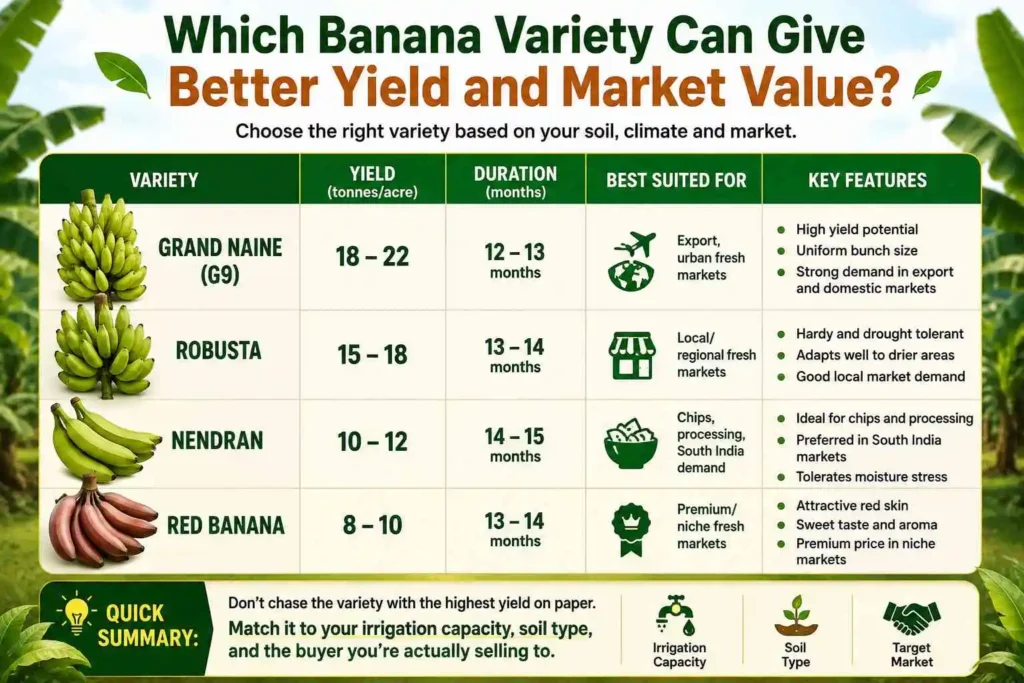
Choosing a variety isn’t about picking what’s popular in your area — it’s about matching the variety to your soil, climate, and target market (fresh fruit vs. processing vs. export).
For commercial cultivation, Grand Naine (G9) is often preferred because of its high yield potential, uniform bunch size, and strong acceptance in domestic and export markets. However, farmers in drier tracts often do better with hardier types like Robusta or Nendran, which tolerate moisture stress better even if bunch weight is slightly lower.
| Variety | Yield (tonnes/acre) | Duration | Best Suited For |
|---|---|---|---|
| Grand Naine (G9) | 18-22 | 12-13 months | Export, urban fresh markets |
| Robusta | 15-18 | 13-14 months | Local/regional fresh markets |
| Nendran | 10-12 | 14-15 months | Chips, processing, South India demand |
| Red Banana | 8-10 | 13-14 months | Premium/niche fresh markets |
📌 Quick Summary: Don’t chase the variety with the highest yield on paper. Match it to your irrigation capacity, soil type, and the buyer you’re actually selling to — a mismatch here is one of the most common causes of disappointing returns.
Tissue Culture Plants or Suckers — Which Should You Actually Plant?
This decision alone can make or break your crop’s uniformity and disease load for the entire cycle.
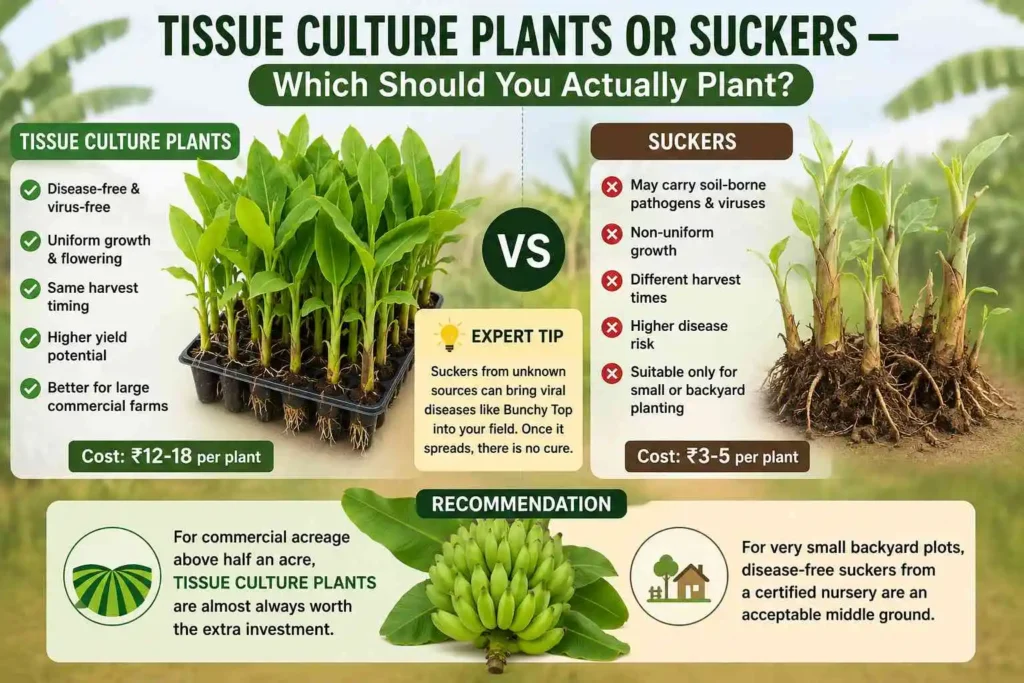
Suckers dug from a neighboring field seem like the cheaper option, but they carry a hidden cost — they often bring soil-borne pathogens and viruses along with them.
✅ Expert Tip: Many commercial banana growers avoid planting suckers from unknown sources because viral diseases like Bunchy Top can enter the field before the crop even starts, and there’s no cure once it spreads.
Tissue culture plantlets cost more upfront (typically ₹12-18 per plant vs. ₹3-5 for a sucker), but they give uniform flowering, uniform harvest timing, and disease-free starting material — which means your entire field matures together, making harvest and marketing far more efficient.
Recommendation: For commercial acreage above half an acre, tissue culture plants are almost always worth the extra investment. For very small backyard plots, disease-free suckers from a certified nursery are an acceptable middle ground.
Land Preparation and Planting: Getting the Foundation Right
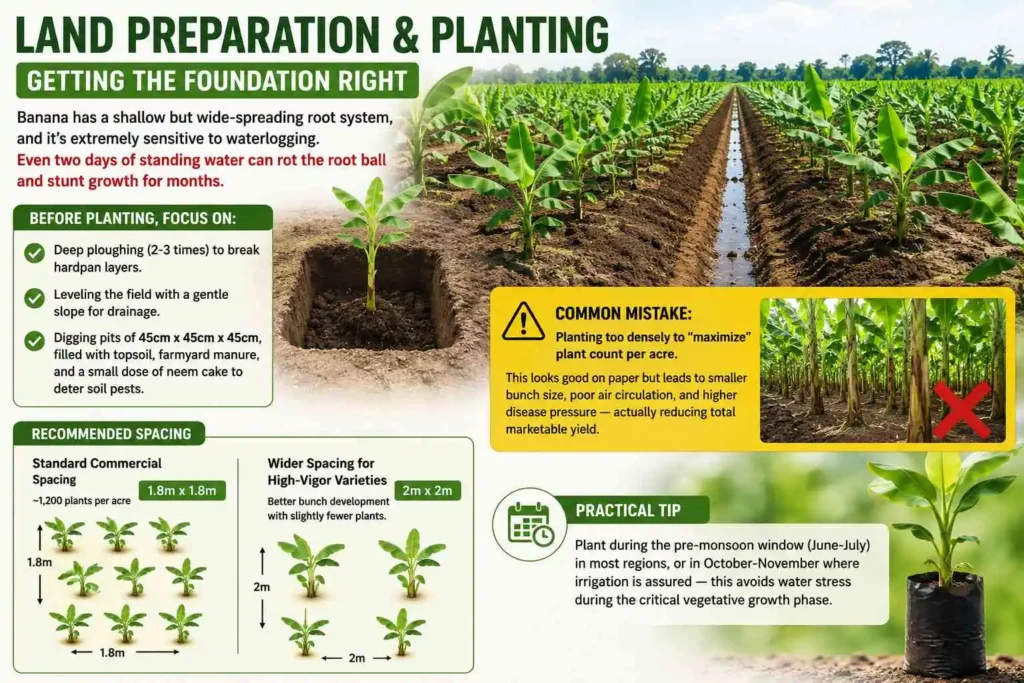
Banana has a shallow but wide-spreading root system, and it’s extremely sensitive to waterlogging. Even two days of standing water can rot the root ball and stunt growth for months.
Before planting, focus on:
- Deep ploughing (2-3 times) to break hardpan layers.
- Leveling the field with a gentle slope for drainage.
- Digging pits of 45cm x 45cm x 45cm, filled with topsoil, farmyard manure, and a small dose of neem cake to deter soil pests.
⚠ Common Mistake: Planting too densely to “maximize” plant count per acre. This looks good on paper but leads to smaller bunch size, poor air circulation, and higher disease pressure — actually reducing total marketable yield.
The standard commercial spacing is 1.8m x 1.8m, accommodating roughly 1,200 plants per acre. Wider spacing of 2m x 2m suits high-vigor varieties like Grand Naine, giving better bunch development at the cost of slightly fewer plants.
🌱 Practical Tip: Plant during the pre-monsoon window (June-July) in most regions, or in October-November where irrigation is assured — this avoids water stress during the critical vegetative growth phase.
Why Fertilizer Mistakes Can Reduce Banana Yield Even in Good Soil
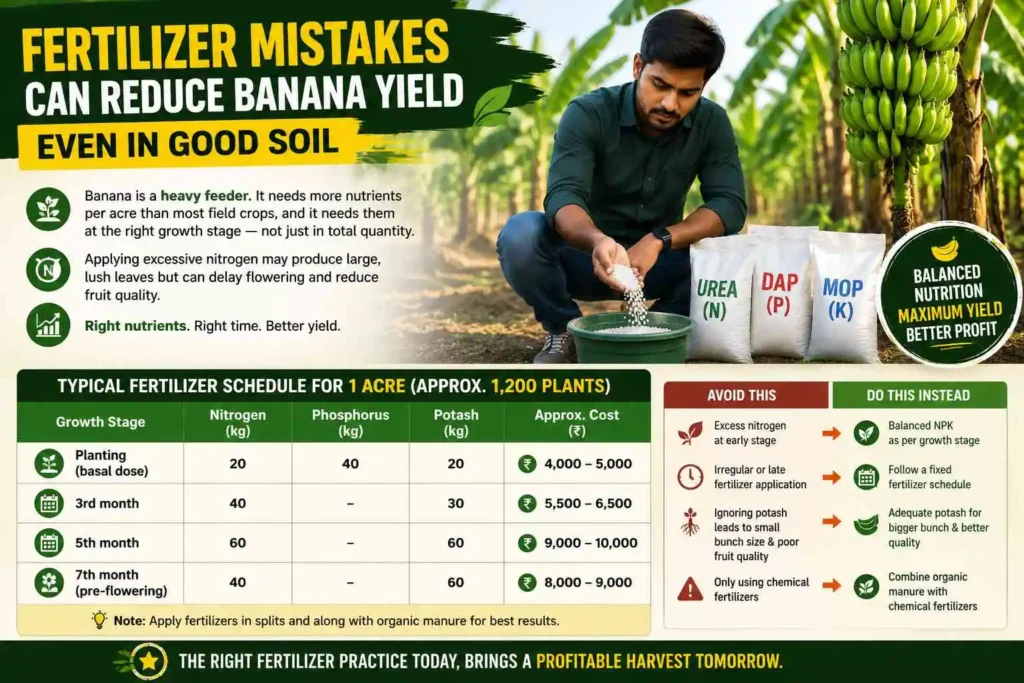
Banana is a heavy feeder. It needs more nutrients per acre than most field crops, and it needs them at the right growth stage — not just in total quantity.
Applying excessive nitrogen may produce large, lush leaves but can delay flowering and reduce fruit quality — a mistake that’s surprisingly common among first-time growers who equate “green and leafy” with healthy.
A typical fertilizer schedule for one acre (approx. 1,200 plants) looks like this:
| Growth Stage | Nitrogen (kg) | Phosphorus (kg) | Potash (kg) | Approx. Cost (₹) |
|---|---|---|---|---|
| Planting (basal dose) | 20 | 40 | 20 | 4,000-5,000 |
| 3rd month | 40 | — | 30 | 5,500-6,500 |
| 5th month | 60 | — | 60 | 9,000-10,000 |
| 7th month (pre-flowering) | 40 | — | 60 | 8,000-9,000 |
This is where many beginners struggle — they apply the full dose early because it’s “convenient,” rather than splitting it across growth stages. Split application matched to the plant’s actual growth phase is what drives bunch size and fruit filling.
How Water Management Decides the Size and Quality of Your Banana Bunches
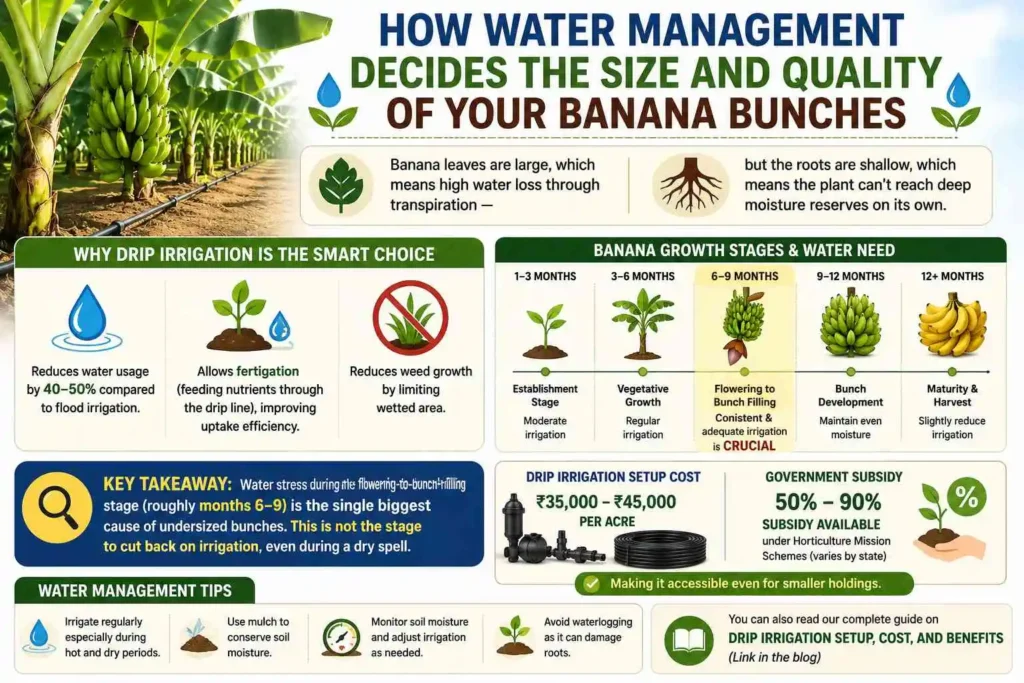
Banana leaves are large, which means high water loss through transpiration — but the roots are shallow, which means the plant can’t reach deep moisture reserves on its own.
Drip irrigation has become the standard for serious commercial growers, and for good reason:
- Reduces water usage by 40-50% compared to flood irrigation.
- Allows fertigation (feeding nutrients through the drip line), improving uptake efficiency.
- Reduces weed growth by limiting wetted area.
🔍 Key Takeaway: Water stress during the flowering-to-bunch-filling stage (roughly months 6-9) is the single biggest cause of undersized bunches. This is not the stage to cut back on irrigation, even during a dry spell.
Setting up drip irrigation costs roughly ₹35,000–45,000 per acre, but many states offer 50–90% subsidy under horticulture mission schemes, making it accessible even for smaller holdings. You can also read our complete guide on drip irrigation setup, cost, and benefits to understand the process in detail.
Weed Control, Mulching, and Intercropping — Getting More From the Same Land
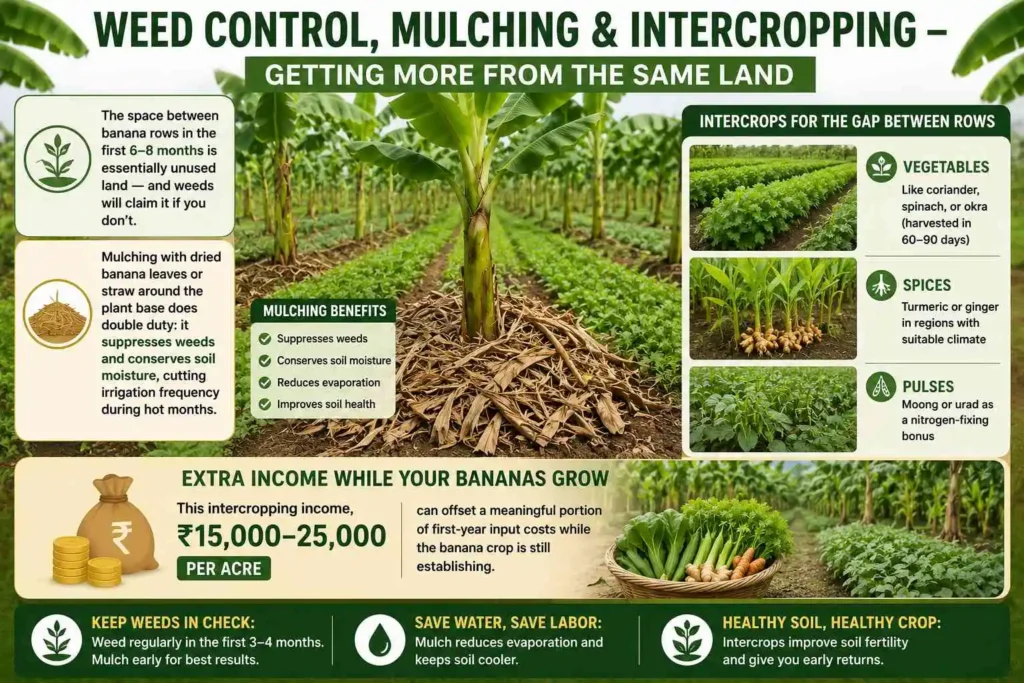
The space between banana rows in the first 6-8 months is essentially unused land — and weeds will claim it if you don’t.
Mulching with dried banana leaves or straw around the plant base does double duty: it suppresses weeds and conserves soil moisture, cutting irrigation frequency during hot months. Learn more about the benefits and techniques in our guide to [mulching in farming].
For the gap between rows, short-duration intercrops add income without competing heavily for nutrients:
- Vegetables like coriander, spinach, or okra (harvested in 60-90 days)
- Turmeric or ginger in regions with suitable climate
- Pulses like moong or urad as a nitrogen-fixing bonus
This intercropping income, typically ₹15,000-25,000 per acre, can offset a meaningful portion of first-year input costs while the banana crop is still establishing.
Disease and Pest Management: What to Watch For
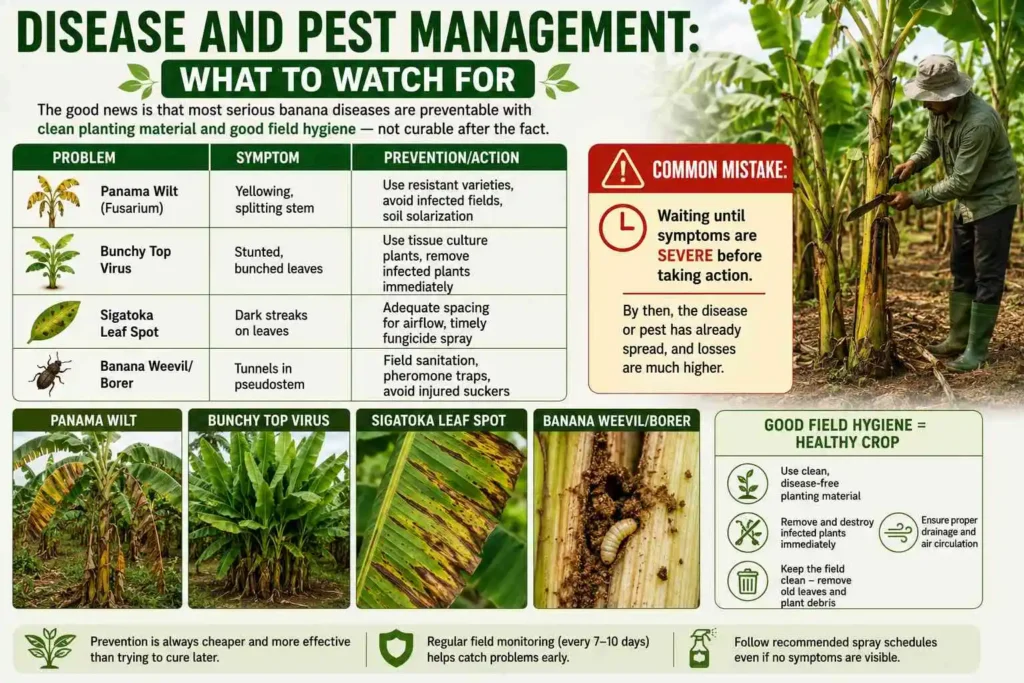
The good news is that most serious banana diseases are preventable with clean planting material and good field hygiene — not curable after the fact.
| Problem | Symptom | Prevention/Action |
|---|---|---|
| Panama Wilt (Fusarium) | Yellowing, splitting stem | Use resistant varieties, avoid infected fields, soil solarization |
| Bunchy Top Virus | Stunted, bunched leaves | Use tissue culture plants, remove infected plants immediately |
| Sigatoka Leaf Spot | Dark streaks on leaves | Adequate spacing for airflow, timely fungicide spray |
| Banana Weevil/Borer | Tunnels in pseudostem | Field sanitation, pheromone traps, avoid injured suckers |
⚠ Common Mistake: Waiting until symptoms are severe before taking action. By the time Panama Wilt is visible above ground, the fungus has usually been active in the soil for weeks — and there’s no chemical cure once it establishes.
Bunch Management and Harvesting: Protecting Your Investment at the Finish Line
After months of investment, this is the stage where careless handling can undo everything.
Once the bunch emerges fully and the last hand of fruit has formed, remove the male flower bud (deshanting) — this redirects the plant’s energy into fruit filling rather than continued flower production.
Covering the bunch with a perforated polythene sleeve protects fruit from sunscald, pest damage, and dust, while also creating a slightly warmer microclimate that speeds ripening uniformity.
Harvesting signals to watch for:
- Angularity of fingers reduces (they become more rounded)
- Fruit color changes from deep green to a lighter, slightly yellowish green
- A sample fruit cut open shows the classic banana color inside, not translucent white
📌 Quick Summary: Harvest at the right maturity stage for your transport distance — for local markets, slightly riper is fine, but for distant markets or export, harvest earlier to allow ripening time during transit without over-ripening.
Post-Harvest Handling: Where Many Farmers Lose Money Unnecessarily
A large share of banana crop value is lost not in the field, but between harvest and market — through bruising, poor transport, and inconsistent ripening.
Best practices that protect your margins:
- Handle bunches gently — bruised fruit sells at a steep discount or gets rejected entirely.
- Pack in ventilated crates rather than loose stacking in trucks.
- Use controlled ripening chambers where volume justifies the investment, ensuring uniform color for better market price.
Cost and Profit Calculation: What Can You Realistically Expect?
Numbers vary by region and management quality, but here’s a realistic estimate for one acre of Grand Naine cultivation with drip irrigation:
| Item | Approximate Cost (₹) |
|---|---|
| Planting material (tissue culture) | 18,000-20,000 |
| Land preparation | 8,000-10,000 |
| Fertilizers (full cycle) | 26,000-30,000 |
| Drip irrigation (after subsidy) | 8,000-15,000 |
| Pest/disease management | 6,000-8,000 |
| Labor (planting to harvest) | 25,000-30,000 |
| Total Cost | ~90,000-1,10,000 |
| Expected Yield | 18-20 tonnes |
| Farm-gate price (average) | ₹9-14 per kg |
| Gross Revenue | ₹1,60,000-2,80,000 |
| Net Profit (approx.) | ₹70,000-1,70,000 |
These figures reflect a single crop cycle. Since banana allows ratoon cropping, the second cycle typically costs 30-40% less to produce, pushing net profitability higher in year two if the crop is managed well.
The Real Difference Between an Average Banana Crop and a Profitable One
Banana farming isn’t complicated in theory — but it’s unforgiving of neglect at the wrong moment. The farmers who consistently do well aren’t necessarily working harder; they’re making the right call at each specific stage: clean planting material at the start, split fertilizer doses at the right growth phase, uninterrupted water during bunch filling, and careful handling at harvest.
Get those decisions right, and banana farming delivers one of the most reliable return-on-investment stories in Indian horticulture. Start with disease-free planting material, respect the crop’s water needs during flowering and fruit filling, and treat post-harvest handling as seriously as you treat the growing stage itself — that combination is what turns a decent banana crop into a genuinely profitable one.
Newsletter