


Rooftop Goat Farming: Is Your Terrace Ready to Become a Goat Farm?
A terrace in a crowded city block doesn’t look like farmland. No soil, no open pasture, no grazing ground in sight. And yet, walk up to the right rooftop in parts of urban and semi-urban India, and you’ll find goats standing under a tin shed, chewing on green fodder, completely unbothered by the traffic three floors below.
That’s rooftop goat farming — raising goats on the terrace of a house or building instead of on open land. It’s catching attention because it solves a real problem: not everyone who wants to start a livestock business owns a farm. Rooftop farming lets someone with a spare terrace and genuine commitment get into goat rearing without buying or leasing land.
But here’s the part that gets glossed over in a lot of “easy income” content online: a rooftop is not a field. It’s a built structure with weight limits, drainage systems, and heat exposure that ground-level farms simply don’t deal with. This model can work — but it works only when the person running it understands the specific risks a roof introduces.
This guide is written the way I’d explain it to someone standing on their own terrace, asking whether this could actually work for them. I spent time at Shahid Goat Farm, a working rooftop setup run by Shahid Saifi, and documented the visit in a YouTube vlog guide — so what follows is grounded in what an actual rooftop operation looks like day to day, not just theory.
We’ll go through structural safety, shed design, breed selection, feeding, disease control, manure handling, stocking limits, realistic costs in rupees, and where beginners typically lose money.
Which Goat Breeds Make Sense for a Rooftop Farm?
There’s no single “best” breed for rooftop goat farming — despite what a lot of quick-read articles claim. The right choice depends on your climate, your purpose (meat, breeding, or both), the local market, and how much space and ventilation you can realistically provide.
That said, breeds commonly considered for rooftop and confined-space systems in India include:
- Sojat — Rajasthan-origin breed, valued for fast meat weight gain and frequent twinning/tripling; sturdy and hardy, but larger frame goat.
- Sirohi — reasonably hardy, adaptable to varied climates, decent growth rate; popular for semi-intensive systems.
- Beetal — larger frame, good for meat purposes, but needs more space and feed per animal.
- Jamunapari — tall, distinctive breed, valued in some regional markets, generally needs more room to move than a small terrace allows.
- Barbari — compact size, known for adapting well to stall-fed and confined conditions, which makes it a frequent choice for rooftop setups.
- Osmanabadi — hardy and disease-resistant in many regions, decent for meat production.
- Black Bengal — small body size, early maturity, well suited to confined rearing, though individual body weight is lower.
- Boer crosses — bred for fast meat growth, but crosses can be less heat-tolerant and often need better-quality feed to perform.
💡 Practical Tip: Before finalizing a breed, visit two or three local goat markets or established farms and ask what buyers in your area actually pay a premium for. A “good” breed that no local buyer wants is a bad business decision.
Designing a Rooftop Goat Shed That Actually Works
A rooftop shed isn’t a smaller version of a ground-level shed — it has to solve problems ground sheds don’t face: heat buildup, drainage onto a sealed surface, and restricted space for expansion.
Here’s what a workable rooftop shed generally needs to account for:
| Design Element | Why It Matters on a Rooftop |
|---|---|
| Flooring | Needs to be slightly raised/slatted for drainage, without damaging the waterproof membrane below |
| Ventilation | Rooftops trap heat; cross-ventilation prevents the shed from becoming an oven |
| Shade/roofing | Insulated roofing sheets reduce direct heat transfer compared to bare tin |
| Drainage | A clear slope and channel to carry urine/wash water away without pooling |
| Fencing/railing | Must prevent both escape and accidental falls off the terrace edge |
| Feeding & watering space | Enough linear space per goat to avoid competition and stress |
| Manure access | Easy-to-clean design so waste doesn’t sit and decompose in place |
Cramming a shed into every spare inch of the terrace is a common beginner instinct — and a common mistake. Overcrowding doesn’t just look bad; it directly increases stress, hygiene problems, disease spread, and slows growth. A shed that looks “efficient” on day one often becomes a management headache within a few months.
Common problem: Beginners build the shed first and figure out ventilation and drainage later. Reversing that order — planning airflow and water exit points before construction — saves a lot of retrofitting cost.
Why Rooftop Heat Is One of the Biggest Challenges
This is where rooftop farming genuinely differs from ground-level farming, and it deserves serious attention.
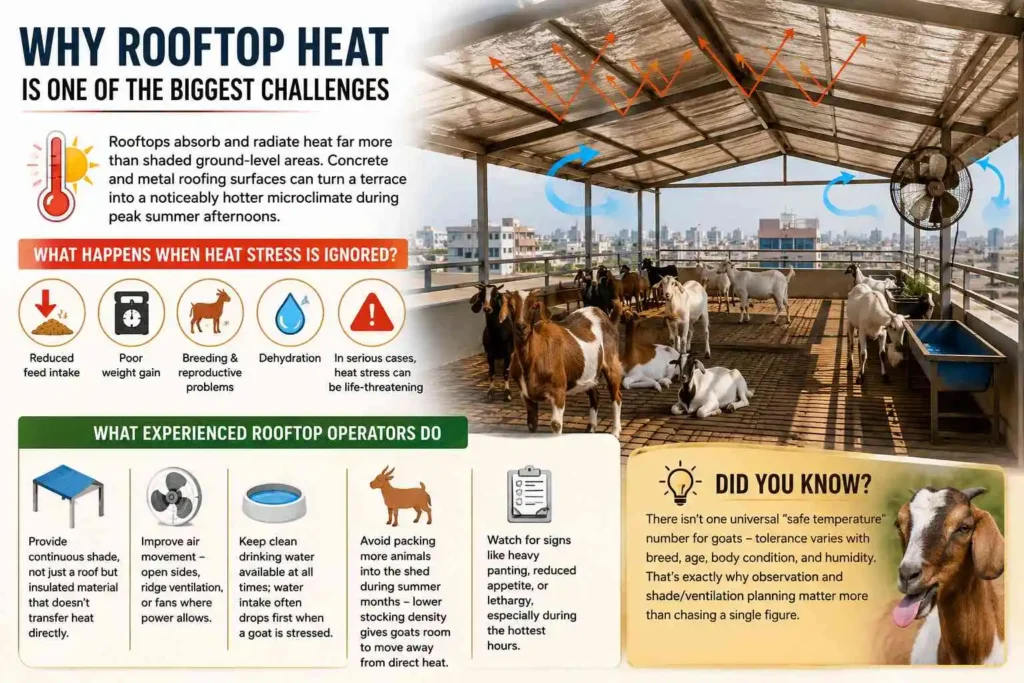
Rooftops absorb and radiate heat far more than shaded ground-level areas. Concrete and metal roofing surfaces can turn a terrace into a noticeably hotter microclimate during peak summer afternoons, especially in regions that already see high daytime temperatures.
What happens when heat stress is ignored? Reduced feed intake, poor weight gain, breeding and reproductive problems, dehydration, and in serious cases, heat stress can become life-threatening for the animal.
Here’s what experienced rooftop operators generally do to manage this:
- Provide continuous shade, not just a roof but insulated material that doesn’t transfer heat directly.
- Improve air movement — open sides, ridge ventilation, or fans where power allows.
- Keep clean drinking water available at all times; water intake often drops first when a goat is stressed, which compounds the problem.
- Avoid packing more animals into the shed during summer months — lower stocking density gives goats room to move away from direct heat.
- Watch for signs like heavy panting, reduced appetite, or lethargy, especially during the hottest hours.
❓ Did You Know? There isn’t one universal “safe temperature” number for goats — tolerance varies with breed, age, body condition, and humidity. That’s exactly why observation and shade/ventilation planning matter more than chasing a single figure.
Feeding and Nutrition: The Part That Decides Growth and Profit
Feeding isn’t just about keeping goats fed — it directly determines growth rate, body condition, reproduction, and ultimately how much money the farm makes. A shed can be perfectly built and still produce weak, slow-growing goats if the feeding plan is careless.
A balanced rooftop feeding routine generally combines:
- Green fodder — a primary source of nutrition and hydration; sourcing this consistently is one of the bigger logistical challenges on a rooftop, since you can’t grow it there.
- Dry fodder — for roughage and gut health, especially important when green fodder supply is inconsistent.
- Concentrate feed — for energy and protein, particularly for growing kids, pregnant/lactating does, or animals being finished for sale.
- Minerals and salt licks — small cost, but deficiencies here show up as poor growth and fertility issues.
- Clean drinking water — available at all times, not just during feeding.
Feed requirements shift with age, body weight, breed, and physiological stage — a pregnant doe and a growing kid simply can’t be fed the same ration and expected to do equally well.
🚫 Common Mistake: Switching feed abruptly — say, changing concentrate brands or fodder type overnight — is a frequent cause of digestive upset in goats. Any dietary change should be introduced gradually over several days.
Disease Prevention and Hygiene
On a rooftop, where space is tight and airflow is more limited than open ground, disease can spread through a herd faster if hygiene slips. Prevention is far cheaper than treatment here — and often the difference between a manageable setback and losing multiple animals.
The basics that matter most:
- Keep flooring dry; damp bedding is where most hygiene problems start.
- Maintain functioning drainage so waste doesn’t sit and breed bacteria or parasites.
- Quarantine every newly purchased goat for a couple of weeks before introducing it to the existing herd — this single habit prevents a huge share of disease outbreaks.
- Follow a vaccination schedule set by a local qualified veterinarian, since disease pressure and recommended schedules vary by region.
- Deworm and control external parasites under veterinary guidance rather than guessing dosages.
- Observe animals daily — early signs of illness (reduced appetite, isolation, dull coat) are easier and cheaper to act on than advanced symptoms.
- Isolate any sick animal immediately rather than waiting to “see if it gets better.”
This guide won’t hand you a medicine list or dosage chart — and any resource that does without knowing your region, your herd, and the specific disease is giving you a guess, not advice. Build a relationship with a local veterinarian before you need one urgently.
Why Drainage and Manure Management Matter More Than You Think
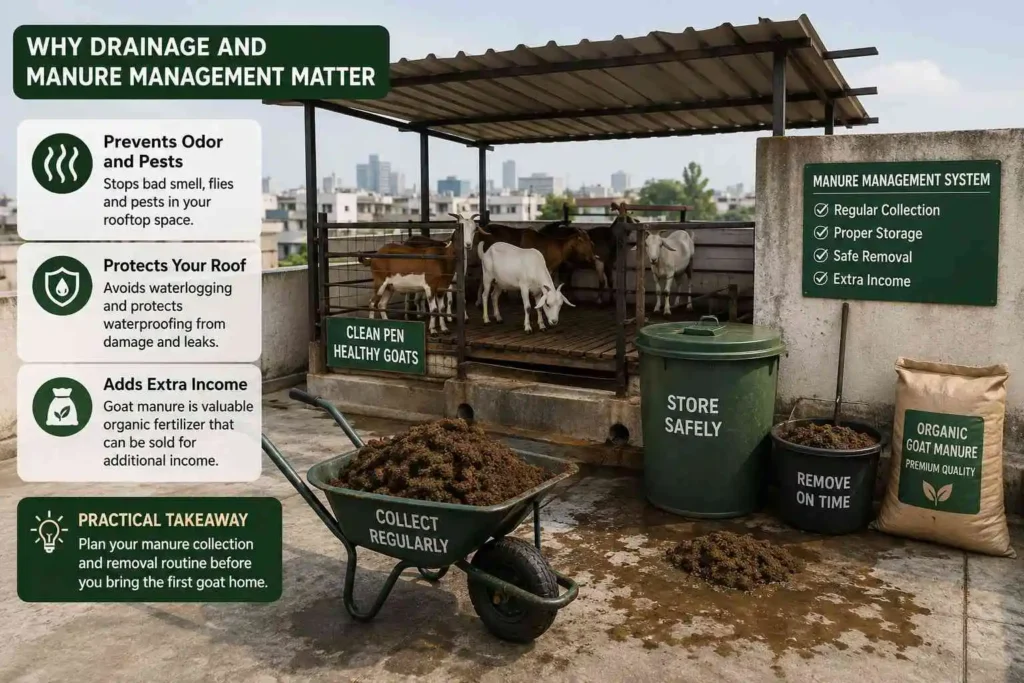
Manure management on a rooftop is a different problem than on the ground. There’s no soil to absorb waste, no natural runoff area — everything has to be actively managed, or it sits on a sealed surface that wasn’t built to handle standing waste and moisture long-term.
Left unmanaged, wet manure causes odor complaints (a real issue in residential areas), attracts flies and pests, and — more seriously — can compromise the roof’s waterproofing over time, leading to leaks into the floor below.
The upside: goat manure has real value. Many small operations collect and sell it as organic fertilizer, which offsets a portion of running costs. But that only works if there’s a system — regular collection, safe storage, and a way to move it off the roof — planned from day one, not improvised after the smell becomes a problem.
Practical takeaway: Decide your manure collection and removal routine before you bring the first goat home, not after the shed starts smelling.
How Many Goats Can You Safely Keep?
There’s no honest single number here — and any article giving you “X goats per square foot” without context isn’t accounting for your specific shed, ventilation, and structural clearance.
Stocking density should be worked out based on:
- Usable floor area after accounting for feeders, water points, and walking space
- Ventilation quality — a well-ventilated shed can support more animals comfortably than a poorly ventilated one of the same size
- Structural load clearance confirmed by your engineer
- Your own capacity to clean, feed, and monitor the animals properly
Where beginners go wrong: treating “how much space is available” as the only question, and ignoring “how much can I actually manage well.” A smaller, well-run herd generally outperforms an overcrowded one on health, growth, and stress levels.
How Much Does It Really Cost to Start?
Costs vary significantly by city, construction quality, goat breed, and local labour rates — the figures below are indicative ranges meant for planning, not fixed quotes. Always get local quotations before committing money.
One-time setup costs (indicative):
| Item | Approximate Range (₹) |
|---|---|
| Shed construction (flooring, roofing, fencing) | 40,000 – 1,50,000+ (depends heavily on size and materials) |
| Initial goat purchase (per animal, varies by breed/age) | 4,000 – 30,000+ |
| Feeders and water equipment | 3,000 – 10,000 |
| Drainage and waterproofing work | 10,000 – 40,000 |
| Initial feed stock | 3,000 – 8,000 |
Recurring monthly costs (indicative, for a small herd):
| Item | Approximate Range (₹) |
|---|---|
| Feed (green + dry fodder + concentrate) | 1,500 – 4,000 per goat |
| Veterinary/vaccination/deworming | 200 – 800 per goat |
| Labour (if hired) | Varies widely by city/region |
| Electricity, water, cleaning supplies | 500 – 2,000 total |
| Repairs and maintenance | Variable, budget for the unexpected |
📌 Quick Summary: Setup costs are heavily influenced by construction quality and shed size; recurring costs scale with herd size and feed prices. Don’t finalize a budget without at least two or three local quotations for construction and feed.
Can Rooftop Goat Farming Actually Be Profitable?
Here’s the honest answer: it can be, but nobody can promise it will be. Profitability depends on too many variables that are specific to your situation to reduce to one guaranteed number.
Factors that actually determine your outcome:
- Purchase price of goats and how efficiently they gain weight
- Mortality rate — even a small percentage lost changes the math significantly
- Feed cost, which fluctuates seasonally
- Local selling price at the time you’re ready to sell
- Breeding performance if you’re running a breeding line
- Veterinary and labour expenses
- How disciplined the day-to-day management actually is
An illustration, not a guarantee: if a goat is purchased at roughly ₹6,000, raised over several months with feed and care costing roughly ₹3,000–₹5,000, and sold at a local market for ₹12,000–₹15,000, there’s a visible margin — on paper. In practice, mortality, slower-than-expected growth, feed price spikes, or a soft local market on selling day can erode that margin quickly. Treat any profit example — including this one — as a rough illustration to help you think about the numbers, not a promised return.
Income in rooftop goat farming typically comes from a mix of:
- Sale of meat goats
- Sale of breeding stock (often at a premium over meat-market rates, if quality is good)
- Sale of kids
- Sale of manure as organic fertilizer
- Local or premium breed markets, where a specific breed commands better local demand
Where Most Beginners Lose Money
| Mistake | Why It Happens | How to Avoid It |
|---|---|---|
| Skipping the structural safety check | Assuming the roof “looks fine” | Get a structural engineer’s assessment before building |
| Overstocking the shed | Wanting to “maximize” available space | Base numbers on ventilation and management capacity, not just floor area |
| Poor ventilation and shade | Underestimating rooftop heat | Plan airflow and shading at the design stage, not after |
| Weak drainage | Treating it as a minor detail | Build drainage into the shed plan from day one |
| Buying goats without health checks | Rushing the first purchase | Inspect animals, ask for health history, buy from known sources |
| Skipping quarantine | Wanting to save time | Always isolate new animals for a couple of weeks |
| Choosing breed by size alone | Assuming bigger means more profit | Match breed to climate, space, and local market demand |
| Underestimating feed cost | Focusing only on setup cost | Budget recurring feed cost realistically, including seasonal price rises |
| Ignoring summer heat planning | Treating it as a “later” problem | Build shade and ventilation before the first summer, not during it |
| Assuming goat farming guarantees profit | Influenced by unrealistic online claims | Plan around variable outcomes, not fixed promises |
Before You Buy Your First Goat
Rooftop goat farming can genuinely put unused urban space to productive use — but the model succeeds or fails based on infrastructure and management, not on simply owning goats. A safe structure, proper ventilation, sensible stocking, disciplined feeding, hygiene, and a realistic view of costs matter far more than enthusiasm alone.
Start with a small, manageable number of animals, learn the day-to-day rhythm of the work, and scale up only once you’ve seen a full season through — heat, monsoon, and all. That patience, more than anything else, is what separates a rooftop farm that works from one that becomes an expensive lesson.
Want to see the complete process? Watch the full video on YouTube.
Frequently Asked Questions
Is rooftop goat farming legal in Indian cities?
Rules vary by state, municipal body, and housing society regulations. Some areas allow small-scale livestock keeping with conditions; others restrict it. Check with your local municipal authority and, if applicable, your housing society rules before setting up.
How much space do I need to start rooftop goat farming?
There’s no fixed minimum — it depends on how many goats you plan to keep and the shed design. What matters more than raw square footage is whether the space allows proper ventilation, drainage, and safe movement without overcrowding.
Can rooftop goats be raised for milk as well as meat?
Yes, depending on breed choice, though meat-focused rearing tends to be more common in rooftop setups due to space and management simplicity. Milk production adds its own space, hygiene, and feeding demands.
Do I need government approval or a license for rooftop goat farming?
Requirements differ by state and local body. It’s worth checking with your local municipal or agriculture department directly rather than relying on generic online claims, since rules and any support schemes can change and vary by region.
What is the biggest risk in rooftop goat farming that beginners underestimate?
Structural safety and heat management are the two most commonly underestimated factors — both because their consequences aren’t obvious on day one but build up over time.
Newsletter