


Honey Farming: A Complete Guide to Start a Profitable Bee Farming in India
Imagine earning a steady side income from a business that doesn’t need extra land, doesn’t compete with your regular crops, and works quietly in the background while you do your normal farm work. That’s exactly what honey farming offers.
Also known as beekeeping or apiculture, honey farming is fast becoming one of the most exciting agri-business ideas in India. All it takes is a few wooden boxes, some healthy bee colonies, and a bit of patience — and the bees do most of the hard work for you. Even farmers with very small landholdings are now turning a corner of their farm, or even a backyard, into a small honey business alongside their usual crops.
But here’s the real question — how do you actually start? How much money do you need? Which bees should you choose? And how much can you really earn?
This guide answers all of that in plain, simple language. From setup cost and equipment to step-by-step starting process, income potential, and government schemes that can help fund your journey — everything you need to understand the honey farming business is right here.
What is Honey Farming?
Honey farming is the practice of keeping honeybee colonies in boxes (called hives) to produce honey, beeswax, and other bee products. The bees collect nectar from flowers and convert it into honey inside the hive. The farmer manages the bee colonies, protects them from diseases, and harvests the honey at the right time.
Apart from honey, bee farming also gives beeswax, propolis, royal jelly, and bee pollen — all of which have good market value. Bees also help in pollination of nearby crops, which increases the yield of fruits and vegetables. This makes honey farming useful for the whole farm, not just for honey production.
Why Honey Farming is a Good Business Option
India is one of the largest honey producing countries in the world. The demand for pure and natural honey is increasing every year because people are becoming more health conscious. Here are the main reasons why honey farming is a smart choice:
- Low investment, high return: Compared to other agri-businesses, the starting cost is low.
- Less land required: You do not need big farmland. Even a small backyard or terrace can work.
- Extra income for farmers: Bees do not compete with other crops for land, so it works well alongside existing farming.
- Growing market demand: Domestic and export demand for honey is rising steadily.
- Government support: Central and state governments offer subsidies and training for beekeeping.
- Multiple products: Honey, wax, pollen, and propolis all bring in separate income streams.
Types of Honeybees Used in Honey Farming
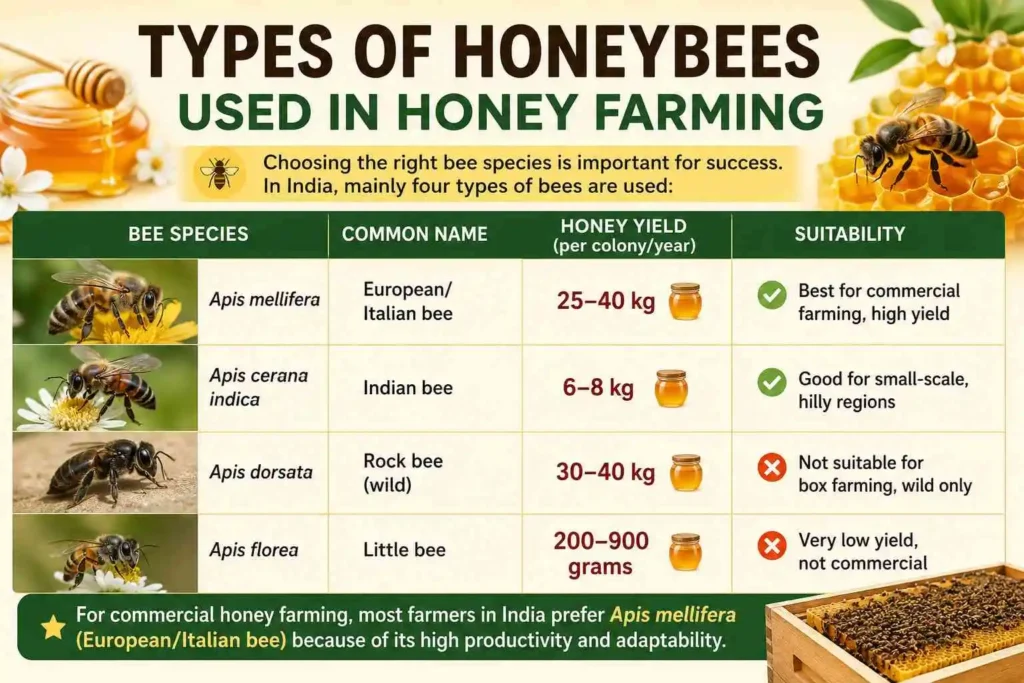
Choosing the right bee species is important for success. In India, mainly four types of bees are used:
| Bee Species | Common Name | Honey Yield (per colony/year) | Suitability |
|---|---|---|---|
| Apis mellifera | European/Italian bee | 25–40 kg | Best for commercial farming, high yield |
| Apis cerana indica | Indian bee | 6–8 kg | Good for small-scale, hilly regions |
| Apis dorsata | Rock bee | 30–40 kg (wild) | Not suitable for box farming, wild only |
| Apis florea | Little bee | 200–900 grams | Very low yield, not commercial |
For commercial honey farming, most farmers in India prefer Apis mellifera because of its higher yield and better management in wooden hive boxes.
Investment Required for Honey Farming
One of the biggest advantages of honey farming is the low starting cost. Below is an approximate breakdown of investment needed to start with 10 bee boxes, which is a common starting point for new beekeepers.
| Item | Approximate Cost (₹) |
|---|---|
| Bee boxes (10 units, wooden with frames) | ₹15,000 – ₹20,000 |
| Bee colonies (10 colonies) | ₹20,000 – ₹30,000 |
| Bee veil, gloves, smoker, hive tool | ₹5,000 – ₹7,000 |
| Honey extractor (manual) | ₹8,000 – ₹12,000 |
| Storage containers and bottles | ₹3,000 – ₹5,000 |
| Miscellaneous (transport, medicines) | ₹2,000 – ₹3,000 |
| Total Approximate Investment | ₹53,000 – ₹77,000 |
This cost can go up if you choose a mechanised honey extractor or want to start with a larger number of colonies. Many farmers start small with 5–10 boxes and expand once they gain experience.
Step-by-Step Guide to Start Honey Farming
1. Learn the Basics First
Before investing money, take basic training from institutions like the Khadi and Village Industries Commission (KVIC), State Horticulture Departments, or Krishi Vigyan Kendras (KVK). Many of these offer free or low-cost training programs.
2. Choose the Right Location
Bees need a peaceful place away from heavy traffic and pollution, with access to flowering plants within a 2–3 km radius. Areas near mustard, sunflower, litchi, or eucalyptus plantations work very well.
3. Buy Quality Bee Colonies
Purchase healthy bee colonies from a certified supplier. Check that the queen bee is active and the colony is disease-free.
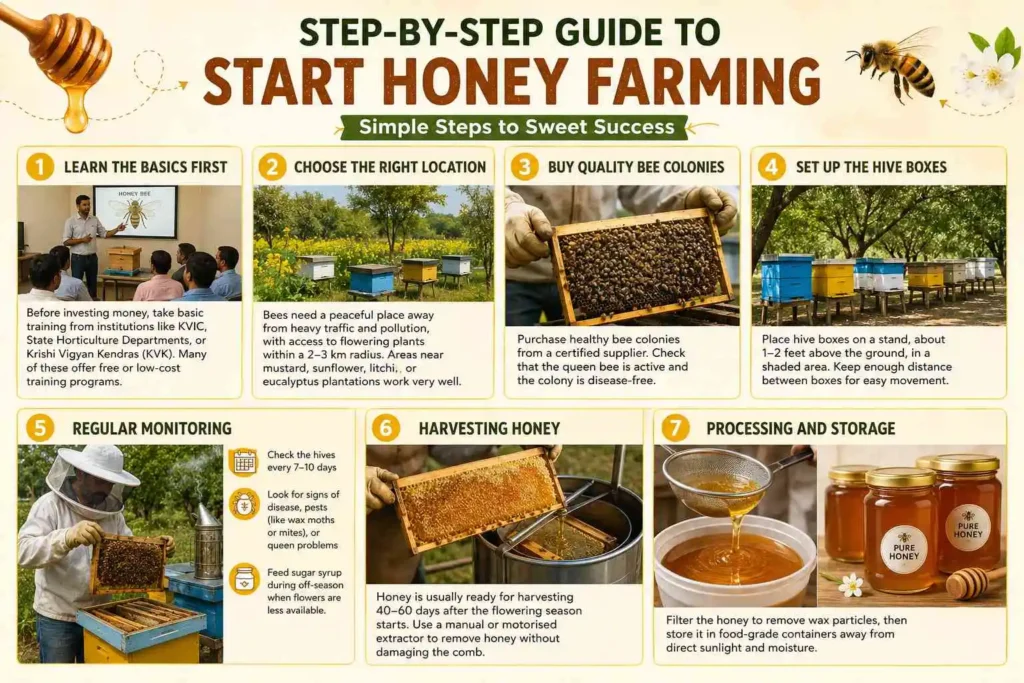
4. Set Up the Hive Boxes
Place hive boxes on a stand, about 1–2 feet above the ground, in a shaded area. Keep enough distance between boxes for easy movement.
5. Regular Monitoring
Check the hives every 7–10 days for signs of disease, pests (like wax moths or mites), or queen problems. Feed sugar syrup during off-season when flowers are less available.
6. Harvesting Honey
Honey is usually ready for harvesting 40–60 days after the flowering season starts. Use a manual or motorised extractor to remove honey without damaging the comb.
7. Processing and Storage
Filter the honey to remove wax particles, then store it in food-grade containers away from direct sunlight and moisture.
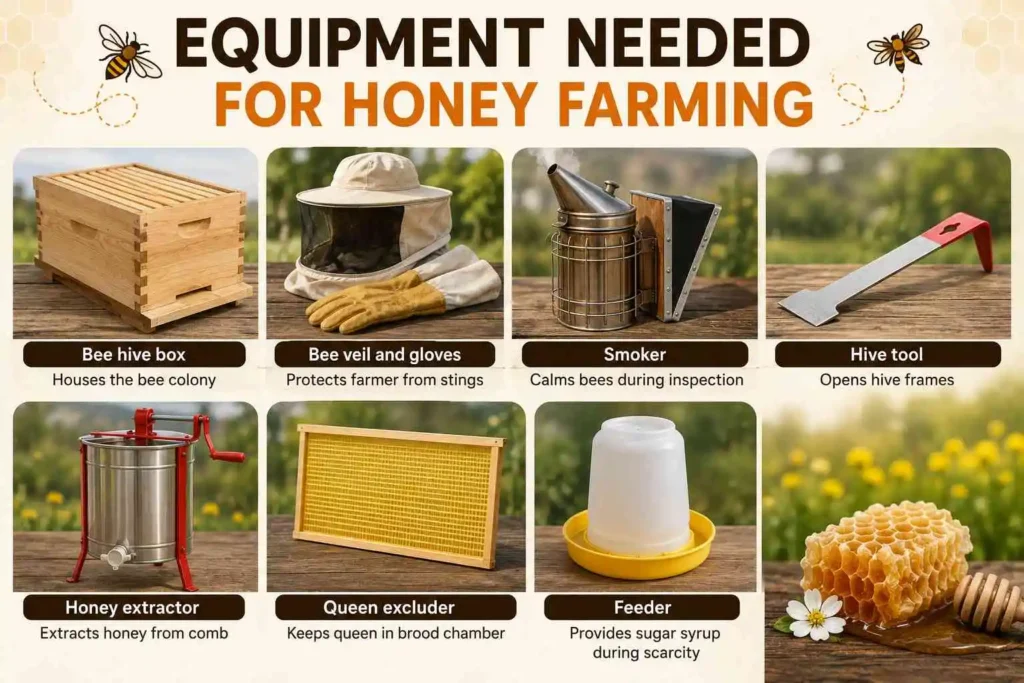
Equipment Needed for Honey Farming
| Equipment | Purpose |
|---|---|
| Bee hive box | Houses the bee colony |
| Bee veil and gloves | Protects farmer from stings |
| Smoker | Calms bees during inspection |
| Hive tool | Opens hive frames |
| Honey extractor | Extracts honey from comb |
| Queen excluder | Keeps queen in brood chamber |
| Feeder | Provides sugar syrup during scarcity |
Best Season and Climate for Honey Farming
Honey farming works best in regions with good flowering seasons. In most parts of India, the main honey flow season is between October and June, depending on the crop pattern in the area. Mustard fields (December–February), litchi orchards (March–April), and sunflower fields (October–November) are excellent for honey production.
Extreme heat, heavy rainfall, and pesticide-sprayed fields can harm bee colonies, so choosing the right season and location matters a lot.
Government Schemes Supporting Honey Farming
The Indian government actively promotes beekeeping through several schemes:
- National Beekeeping and Honey Mission (NBHM): Provides financial support for beekeeping infrastructure, training, and marketing.
- KVIC Beekeeping Programme: Offers subsidy on bee boxes and colonies, along with buy-back arrangements for honey.
- PMFME Scheme: Supports micro food processing units, which includes honey processing units.
- State Horticulture Mission subsidies: Many states offer 40–50% subsidy on beekeeping equipment.
Farmers should check with their local KVK or District Horticulture Office for the latest scheme details and application process, as terms can change from year to year.
Income Potential from Honey Farming
Income depends on the number of colonies, bee species, region, and market price of honey. Here is a general estimate for a mid-sized setup:
| Particulars | Details |
|---|---|
| Number of colonies | 50 |
| Average yield per colony | 25 kg/year |
| Total honey production | 1,250 kg/year |
| Average selling price | ₹300 – ₹400 per kg |
| Gross income | ₹3,75,000 – ₹5,00,000/year |
| Approximate annual expenses | ₹80,000 – ₹1,20,000 |
| Net profit (approximate) | ₹2,80,000 – ₹3,80,000/year |
These figures are indicative and can vary based on local market conditions, honey quality, and whether the farmer sells directly to consumers or through middlemen. Direct selling and branding usually fetch a better price than selling to bulk buyers.
Common Challenges in Honey Farming
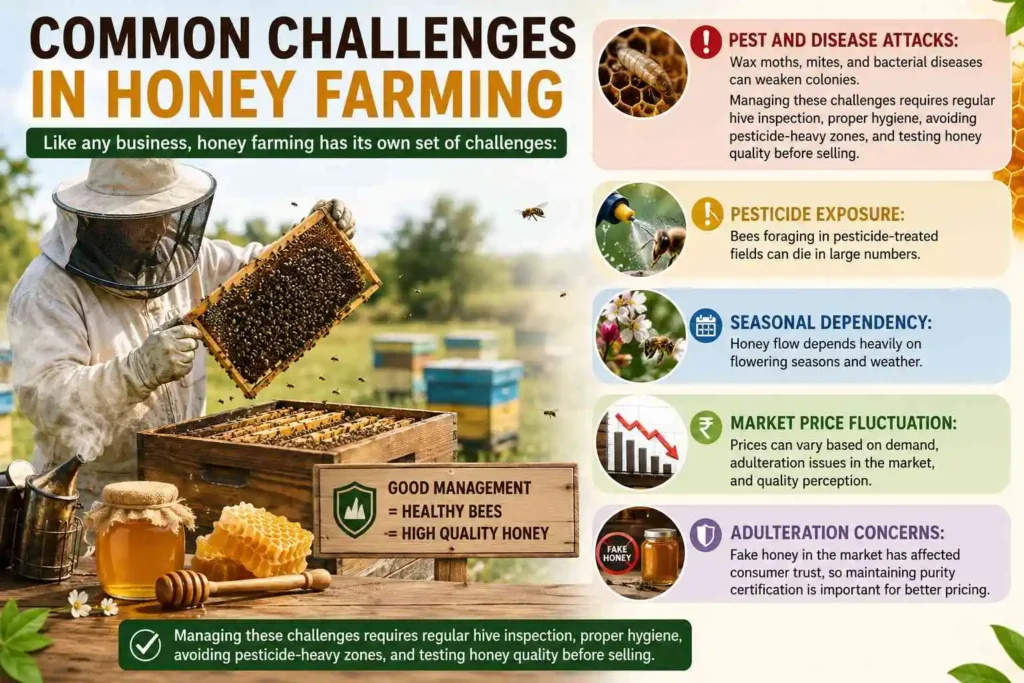
Like any business, honey farming has its own set of challenges:
- Pest and disease attacks: Wax moths, mites, and bacterial diseases can weaken colonies.
- Pesticide exposure: Bees foraging in pesticide-treated fields can die in large numbers.
- Seasonal dependency: Honey flow depends heavily on flowering seasons and weather.
- Market price fluctuation: Prices can vary based on demand, adulteration issues in the market, and quality perception.
- Adulteration concerns: Fake honey in the market has affected consumer trust, so maintaining purity certification is important for better pricing.
Managing these challenges requires regular hive inspection, proper hygiene, avoiding pesticide-heavy zones, and testing honey quality before selling.
Tips for Successful Honey Farming
- Start small with 5–10 colonies and expand gradually as you gain confidence.
- Always source colonies from a trusted and certified supplier.
- Keep hives away from pesticide-sprayed crops.
- Maintain proper spacing between hive boxes for bee movement and ventilation.
- Get your honey tested for purity to build customer trust and command better prices.
- Explore direct-to-consumer selling through local markets, online platforms, or FPOs (Farmer Producer Organisations) for higher margins.
- Diversify income by selling beeswax, propolis, and bee pollen along with honey.
Conclusion
Honey farming is a practical, low-investment, and eco-friendly business that fits well alongside traditional farming. With proper training, the right location, and consistent hive management, it can become a steady source of extra income. As demand for pure, natural honey continues to grow in India and abroad, honey farming offers strong long-term potential for those willing to learn and manage it carefully.
Before starting, it is advisable to attend a local training program, understand your region’s flowering calendar, and start with a small number of colonies to build hands-on experience before scaling up.
You can also combine honey farming with orange or dragon fruit cultivation. Bees improve the pollination of these crops, which can lead to better fruit set, higher yields, and improved fruit quality, while the flowering plants provide a rich source of nectar for the bees.
This creates a mutually beneficial relationship for both the crops and the bee colonies.
Frequently Asked Questions (FAQs)
1. How much investment is needed to start honey farming?
A basic setup with 10 bee boxes can be started with approximately ₹53,000 to ₹77,000, depending on equipment quality.
2. Which bee species gives the highest honey yield?
Apis mellifera (Italian bee) generally gives the highest yield, around 25–40 kg per colony per year.
3. Is honey farming profitable in India?
Yes, with proper management, a 50-colony setup can generate a net profit of approximately ₹2,80,000 to ₹3,80,000 per year.
4. Does the government provide subsidy for honey farming?
Yes, schemes like the National Beekeeping and Honey Mission and KVIC programs offer financial support and subsidies for beekeeping equipment and training.
5. How long does it take to get the first honey harvest?
Typically, the first harvest can be expected 40–60 days after the flowering season begins, once the colony is well established
Newsletter