


How to Make Compost at Home | Easiest Method
Let’s be honest. Most of us throw banana peels, vegetable peels, and tea leaves straight into the dustbin without a second thought. Then we go to the nursery, pay ₹150–₹300 for a bag of compost or vermicompost, and wonder why the soil in our pots or fields still feels tired.
Here’s the thing: you’re throwing away gold.
Whether you’re growing tomatoes on a balcony or running a one-acre farm, learning how to make compost at home is one of the cheapest, most effective things you can do for your soil. It costs almost nothing, doesn’t need a big backyard, and turns your daily kitchen waste and farm residue into rich, dark, nutrient-packed compost.
This guide walks you through the whole process — the Indian way, with real costs, methods that work in our climate, and how compost fits into the crops we’ve already covered on this site, from tomatoes to onions to dragon fruit.
This guide walks you through everything from scratch. By the end, you’ll have a system that turns your kitchen and yard waste into rich, dark, crumbly compost that your plants will absolutely love.
What Is Compost, Exactly?
Compost is decomposed organic matter. Vegetable peels, dried leaves, cow dung, crop residue, cardboard — when these break down together, they turn into a dark, crumbly material that improves soil structure, feeds soil microbes, holds moisture, and slowly releases nutrients to your plants.
Farmers and gardeners often call it “black gold,” and once you see what it does to hard, depleted soil, you’ll understand why. For farms already using drip irrigation, compost is the natural next step — better soil holds the water your drip system delivers instead of letting it run straight past the root zone.
The process is driven by bacteria, fungi, and worms that eat organic material and break it down. Your job is simple: give them a balanced diet, some moisture, and occasional air.
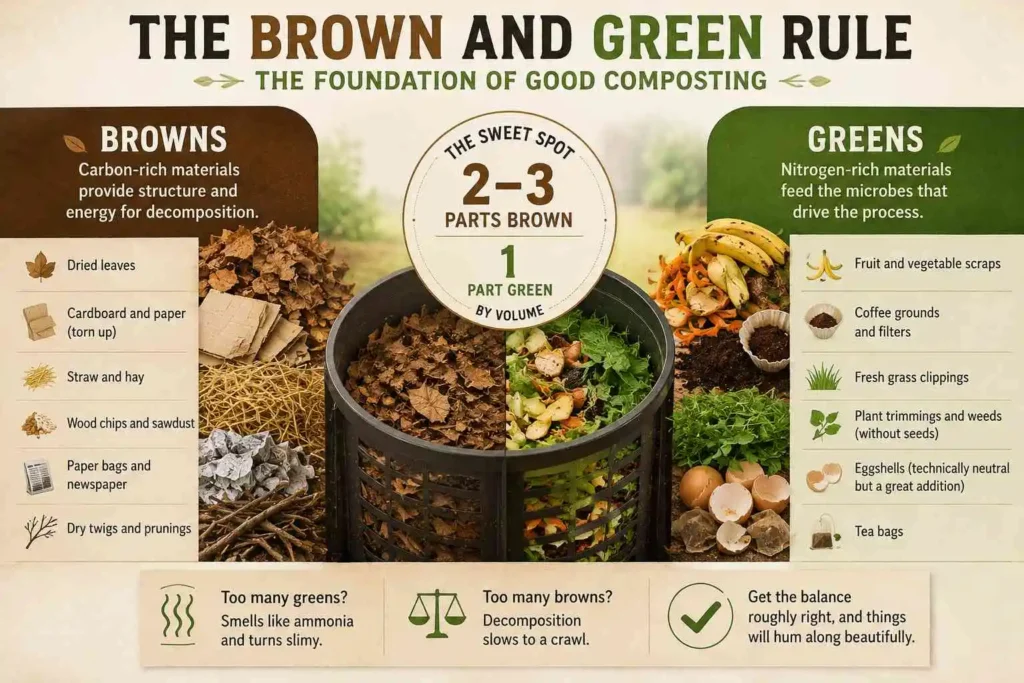
The Brown and Green Rule: The Foundation of Good Composting
Before you throw anything into a pile, understand one key idea: the carbon-to-nitrogen balance, usually simplified as browns-to-greens.
- Brown materials (carbon-rich, give structure):
- Dried leaves and straw
- Dry crop residue (wheat or paddy stubble, sugarcane trash)
- Cardboard and paper, torn up
- Coconut husk and coir waste
- Sawdust and dry twigs
- Green materials (nitrogen-rich, feed the microbes):
- Vegetable and fruit peels
- Fresh grass clippings and weeds (without seeds)
- Cow dung and farmyard manure
- Tea leaves and coffee waste
- Crushed eggshells
The sweet spot is roughly 2–3 parts brown to 1 part green by volume. Too many greens and the pile turns slimy and smells like ammonia. Too many browns and decomposition crawls to a stop. Get it roughly right and the process runs itself.
What to Compost (and What to Leave Out)
Add these:
- Vegetable and fruit peels
- Cow dung and farmyard manure
- Dry leaves, straw, and crop residue
- Tea leaves, coffee waste
- Crushed eggshells
- Shredded newspaper and cardboard
- Wood ash, in small amounts
Keep these out:
- Meat, fish, and bones (attracts pests, smells)
- Dairy products and oily food
- Dog or cat waste
Diseased plant material — this is important for farmers. If you’re composting material from a crop affected by something like tomato blossom end rot or damping-off, don’t put diseased vines or roots into your compost — the pathogen can survive and reinfect your next crop.
Weeds that have already gone to seed
Plastic, glass, coal ash, or treated wood
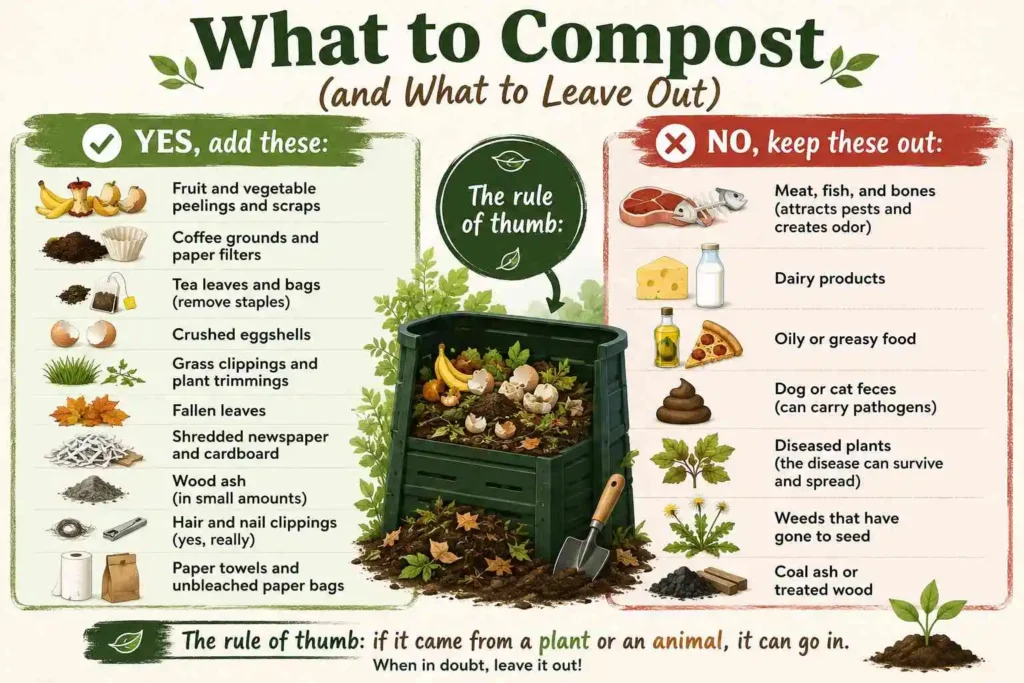
Rule of thumb: if it came from a plant or a plant-eating animal, it’s fine. Meat, fat, disease, and anything synthetic is a hard no.
Composting Methods That Work in India
There’s no single right way to compost. Your space, your volume of waste, and whether this is for a kitchen garden or a working farm will decide what suits you.
NADEP Method (best for farms) A brick-and-mortar tank method developed in India specifically for farm-scale composting. You build a rectangular tank (roughly 10 ft × 6 ft × 3 ft), layer crop residue, cow dung slurry, and soil, and seal it with a mud plaster. It produces a large volume of high-quality compost in about 3–4 months and is the standard method taught at most Krishi Vigyan Kendras. A basic NADEP tank made of local bricks costs roughly ₹3,000–₹8,000 to build once and can be reused for years.
Open Pile (cheapest option) Pick a corner of your field or garden, and start layering browns and greens directly on bare ground. Zero cost, but slower and needs more space.
Compost Bin (best for kitchen gardens) A contained bin — homemade from bricks or an old drum, or a bought plastic composter — keeps things tidy and deters pests. A drum-based DIY bin costs almost nothing if you already have an old barrel; a ready-made plastic composter bin costs roughly ₹800–₹2,500 depending on size.
Vermicomposting (best for consistent, high-quality compost) Red wiggler earthworms (Eisenia fetida) eat your organic waste and produce worm castings — some of the richest compost available, and one of the most common methods promoted under India’s organic farming schemes. A basic vermicompost bed or pit setup costs roughly ₹1,500–₹5,000 for a small kitchen garden scale, and ₹15,000 upward for a farm-scale vermicompost unit. Many state horticulture departments offer subsidies of 25–50% on vermicompost units for farmers — check with your local Krishi Vigyan Kendra or district horticulture office.
Bokashi A sealed-bin fermentation method using inoculated bran, useful for apartment dwellers who produce a lot of cooked food waste, since Bokashi can handle small amounts of cooked food and dairy that other methods can’t.
Composting Method Cost Comparison
| Method | Best for | Setup Cost (₹) | Time to Finished Compost |
|---|---|---|---|
| Open pile | Large farms, plenty of space | ₹0 | 6–12 months |
| NADEP tank | 1-acre+ farms | ₹3,000–₹8,000 | 3–4 months |
| Compost bin/drum | Kitchen gardens, small plots | ₹800–₹2,500 | 2–4 months |
| Vermicomposting | Farms and gardens wanting quality | ₹1,500–₹15,000+ | 2–3 months |
| Bokashi | Apartments, high cooked-food waste | ₹1,200–₹3,000 | 2 weeks + 1 month burial |
Compost ratio calculator
Compost ratio calculator
Enter your weekly waste to get the right browns-to-greens mix and a method suggestion.
How to Make Compost at Home: Step by Step
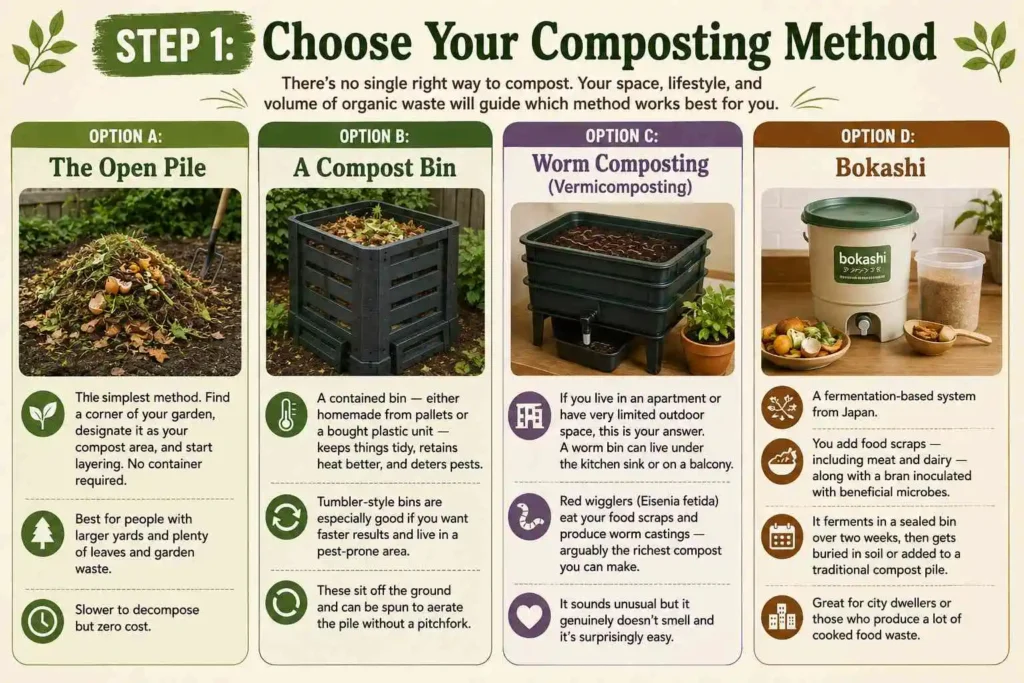
Step 1: Choose Your Composting Method
There’s no single right way to compost. Your space, lifestyle, and volume of organic waste will guide which method works best for you.
Option A: The Open Pile The simplest method. Find a corner of your garden, designate it as your compost area, and start layering. No container required. Best for people with larger yards and plenty of leaves and garden waste. Slower to decompose but zero cost.
Option B: A Compost Bin A contained bin — either homemade from pallets or a bought plastic unit — keeps things tidy, retains heat better, and deters pests. Tumbler-style bins are especially good if you want faster results and live in a pest-prone area. These sit off the ground and can be spun to aerate the pile without a pitchfork.
Option C: Worm Composting (Vermicomposting) If you live in an apartment or have very limited outdoor space, this is your answer. A worm bin can live under the kitchen sink or on a balcony. Red wigglers (Eisenia fetida) eat your food scraps and produce worm castings — arguably the richest compost you can make. It sounds unusual but it genuinely doesn’t smell and it’s surprisingly easy.
Option D: Bokashi A fermentation-based system from Japan. You add food scraps — including meat and dairy — along with a bran inoculated with beneficial microbes. It ferments in a sealed bin over two weeks, then gets buried in soil or added to a traditional compost pile. Great for city dwellers or those who produce a lot of cooked food waste.
Step 2: Set Up Your Pile or Bin
Pick a spot that’s:
- Accessible from the kitchen (you’ll thank yourself later)
- Partially shaded — too much direct sun dries it out
- On bare earth if possible, so worms can move in from below
If building a pile, start with a layer of coarse material like twigs or wood chips to aid drainage and airflow at the base.
Step 3: Start Layering
Think of your compost pile like a lasagna. Alternate layers of browns and greens:
- Base layer: 4–6 inches of browns (dried leaves, cardboard)
- Green layer: 2–3 inches of kitchen scraps or fresh grass clippings
- Thin brown layer: to cover the greens and reduce odor
- Repeat
Don’t stress about perfection. The layering is a rough guide, not a recipe. As long as you’re mixing browns and greens over time, you’ll be fine.
Step 4: Keep It Moist — But Not Wet
Your pile should feel like a wrung-out sponge. Moist enough that decomposition happens, dry enough that it doesn’t turn anaerobic and smelly.
In dry weather, water it lightly when you add new material. In very wet weather, cover it with a piece of cardboard or a lid to prevent it becoming waterlogged.
If your pile smells bad, it’s usually one of two things: too wet (add browns and turn it) or too many greens (add browns and turn it). Turning is almost always the answer.
Step 5: Turn It Regularly
Oxygen is essential. The microbes working through your pile are aerobic — they need air to function. Turning your pile introduces oxygen, redistributes moisture, and speeds up decomposition significantly.
For a hot, fast pile (compost ready in 4–8 weeks): turn it every 3–5 days. This keeps temperatures high enough to kill weed seeds and pathogens.
For a slow, cold pile (the more common approach): turn it every few weeks, or even monthly. Compost will be ready in 3–6 months. Less effort, slightly longer wait.
If you genuinely don’t want to turn it at all, that’s fine too. A static pile will still break down — it just takes longer, sometimes a year or more. Leave it alone, keep adding material, and harvest from the bottom when it looks ready.
Step 6: Know When It’s Ready
Finished compost looks, smells, and feels nothing like the stuff you put in. It should be:
- Dark brown to black
- Crumbly and loose, not slimy or chunky
- Smelling like fresh earth — that clean, forest-floor scent
- Unrecognizable from its original ingredients
If you can still see individual food scraps or leaves, it needs more time. Cover those bits back up and wait another few weeks.
Check Out Our Recommended Amazon Gardening Tools– https://amzn.to/4fCBjHz
Affiliate Disclosure: As an Amazon Associate, we earn from qualifying purchases.
Troubleshooting Common Composting Problems
My pile smells like rotten eggs. Too wet and too little oxygen. Turn it thoroughly and add dry browns like shredded cardboard or straw.
My pile smells like ammonia. Too many nitrogen-rich greens. Add more carbon-heavy browns and turn it.
Nothing seems to be happening. Usually means it’s too dry, too carbon-heavy, or the pieces are too large to decompose quickly. Add water, add greens, and chop or shred materials smaller before adding them.
I have pests. Burying food scraps under a layer of browns helps. Avoid adding meat or cooked food to open piles. A sealed bin or tumbler solves most pest problems immediately.
How to Use Your Finished Compost
Once ready, put it to work:
Field crops: Work 2–3 inches into the topsoil before sowing. This pairs especially well with drip irrigation, since better soil structure means the water from your drippers is held near the root zone instead of draining away.
Onion and vegetable beds: Mix in before transplanting — see our onion farming yield guide for how soil quality affects per-acre output.
Fruit orchards: Use as mulch around the base of trees, kept slightly away from the trunk — relevant if you’re growing dragon fruit, pomegranate, or orange.
Potting mix for kitchen gardens: Mix one part compost with two or three parts potting soil.
Compost tea: Steep finished compost in water for 24–48 hours and use the liquid as a foliar spray or soil drench for containers and raised beds.
Why This Matters for Your Farm Budget
If you’re already spending on inputs like drip irrigation systems, fertiliser, or labour, compost is one of the few costs you can bring close to zero. A NADEP tank or vermicompost pit built once, fed with waste you’re already producing (crop residue, cow dung, kitchen scraps), can replace a meaningful share of the ₹150–₹300-per-bag compost or chemical fertiliser many farmers buy every season. Over a year, that adds up — and it improves the same soil your drip system, your onion beds, or your fruit trees depend on.
A Word on Patience
Composting is a relationship. You’re working with living systems — bacteria, fungi, worms — and they operate on their own timeline. Some piles cook fast; others are slower. Temperature, moisture, the mix of materials, and how often you turn it all play a role.
But here’s what never changes: given time and basic care, organic matter will break down. You genuinely cannot fail at composting. You can only slow it down or speed it up.
Start simple. A small bin in the kitchen, a pile in the corner of the garden. Add your scraps. Add some leaves. Turn it occasionally. Check on it. In a few months, you’ll have something remarkable — rich, living soil amendment that costs nothing, reduces your household waste, and makes everything you grow a little more alive.
That’s the quiet magic of learning how to make compost at home. It’s not a chore. It’s a habit that changes how you see what you throw away.
Start with what you have. A bin, a pile, even a bucket. The worms will do the rest.
Interested in learning more about agriculture and farming? Explore our other blogs covering livestock farming, poultry farming, and horticulture.
Frequently Asked Questions
Does compost smell bad?
No. Properly maintained compost should have an earthy smell. Bad odors usually indicate excess moisture or poor airflow.
Can I compost cooked food?
It is generally better to avoid cooked foods, especially oily or meat-based items.
Can compost attract insects?
Some insects are normal and help decomposition. However, avoiding meat and dairy reduces pest problems.
Is composting difficult?
Not at all. Once you understand the basics, composting becomes a simple routine.
Can I compost during winter?
Yes, although decomposition may slow down in colder temperatures.
Newsletter