


Mud Crab Farming Training in India: Top Institutes, Courses, Fees & How to Apply
A farmer can spend lakhs building tanks, racks and filtration equipment, only to discover that running an intensive mud crab system is nothing like keeping a few crabs in a drum to see if they survive. Cannibalism wipes out a batch overnight. A missed ammonia spike during moulting kills more crabs than any disease. Grading gets skipped for a week and the biggest crabs eat the rest. None of this shows up in a project report — it shows up three weeks into the first crop.
Proper training won’t guarantee that your farm succeeds, but it does change what you notice. A day spent with someone who has actually handled live mud crabs teaches you things about moulting, water quality, feeding, stocking density, and biosecurity that no article can. This guide focuses on mud crab farming training in India specifically — where it is genuinely available, what each programme actually covers, what it costs, and how to tell a solid course from one that’s really just a general aquaculture workshop wearing a crab-shaped label.

Why Proper Training Matters More Than It Looks
Mud crabs (Scylla species) are not a forgiving animal to learn on. A few things make this species riskier for self-taught beginners than shrimp or finfish:
- Cannibalism is the default, not the exception. Crabs that aren’t segregated by size or given individual compartments will eat each other, especially right after moulting when their shells are soft.
- Moulting is the single most dangerous phase of the whole cycle. A crab is essentially helpless for several hours after shedding its shell, and water quality has to be tightly managed during this window.
- Handling technique matters for both crab and farmer. Improper handling injures claws and legs, reduces market value, and increases mortality.
- Water quality parameters (salinity, dissolved oxygen, ammonia, nitrite, pH) interact in ways that are easy to get wrong in high-density box, pen or RAS systems.
- Disease and biosecurity are not theoretical. India’s mud crab sector has had real disease events — Mud Crab Reovirus (MCRV) outbreaks have already caused mortality in cultured Scylla serrata and are actively discussed in aquaculture research and training circles.
Practical Tip: Before you buy a single tank or box, learn the fundamentals from people who farm or research crabs for a living, then visit at least one working farm. Infrastructure is the easy part — management is what determines whether the crabs survive to harvest.
What Should a Good Mud Crab Farming Course Actually Teach?
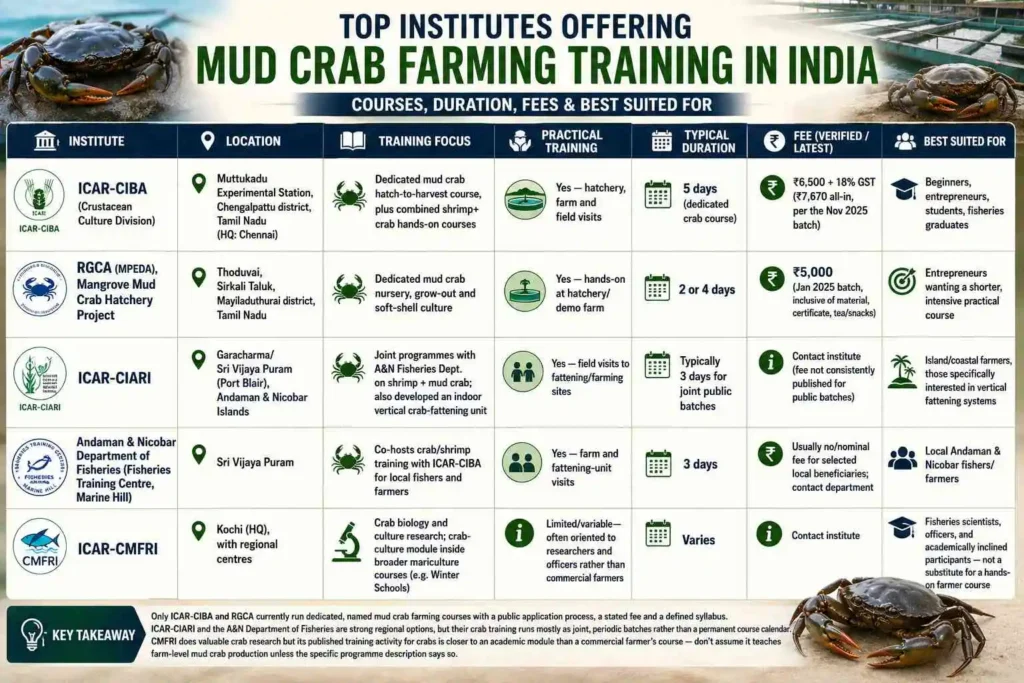
Not every “aquaculture training” is a mud crab training, and not every mud crab training covers the same ground. Before shortlisting anything, use this as a checklist of what a genuinely useful programme should include:
- Mud crab biology and species identification (India has more than one Scylla species, and they’re often confused)
- Seed/hatchery-produced seed selection versus wild-caught seed
- Handling technique and grading by size
- Stocking density and cannibalism management
- Moulting biology and soft-shell handling
- Feeding and feed formulation
- Water quality: salinity, dissolved oxygen, ammonia, nitrite, pH
- Biosecurity and disease management (including awareness of MCRV)
- Pond, box, pen and vertical/individual-compartment systems
- RAS components, where the specific programme documents it
- Harvesting, live transport and marketing
- Basic farm economics
No single course covers everything on this list in equal depth — a 2-day programme will necessarily be lighter than a 5-day one. What matters is that the organiser tells you upfront which of these topics the specific batch will cover.
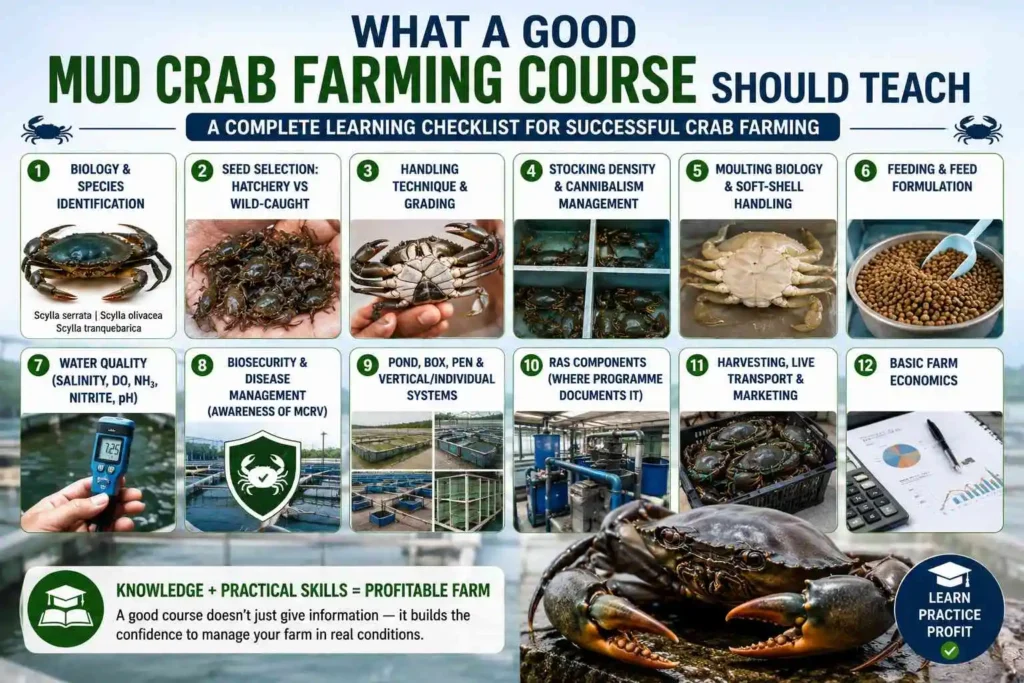
Top Institutes Offering Mud Crab Farming Training in India
This is the core of the decision. Below are the credible, verifiable options — organised by what they actually are, not by unverifiable “best of” rankings.
| Institute | Location | Training Focus | Practical Training | Typical Duration | Fee (verified/latest) | Best suited for |
|---|---|---|---|---|---|---|
| ICAR-CIBA (Crustacean Culture Division) | Muttukadu Experimental Station, Chengalpattu district, Tamil Nadu (HQ: Chennai) | Dedicated mud crab hatch-to-harvest course, plus combined shrimp+crab hands-on courses | Yes — hatchery, farm and field visits | 5 days (dedicated crab course) | ₹6,500 + 18% GST (₹7,670 all-in, per the Nov 2025 batch) | Beginners, entrepreneurs, students, fisheries graduates |
| RGCA (MPEDA), Mangrove Mud Crab Hatchery Project | Thoduvai, Sirkali Taluk, Mayiladuthurai district, Tamil Nadu | Dedicated mud crab nursery, grow-out and soft-shell culture | Yes — hands-on at hatchery/demo farm | 2 or 4 days | ₹5,000 (Jan 2025 batch, inclusive of material, certificate, tea/snacks) | Entrepreneurs wanting a shorter, intensive practical course |
| ICAR-CIARI | Garacharma/Sri Vijaya Puram (Port Blair), Andaman & Nicobar Islands | Joint programmes with A&N Fisheries Dept. on shrimp + mud crab; also developed an indoor vertical crab-fattening unit | Yes — field visits to fattening/farming sites | Typically 3 days for joint public batches | Contact institute (fee not consistently published for public batches) | Island/coastal farmers, those specifically interested in vertical fattening systems |
| Andaman & Nicobar Department of Fisheries (Fisheries Training Centre, Marine Hill) | Sri Vijaya Puram | Co-hosts crab/shrimp training with ICAR-CIBA for local fishers and farmers | Yes — farm and fattening-unit visits | 3 days | Usually no/nominal fee for selected local beneficiaries; contact department | Local Andaman & Nicobar fishers/farmers |
| ICAR-CMFRI | Kochi (HQ), with regional centres | Crab biology and culture research; crab-culture module inside broader mariculture courses (e.g. Winter Schools) — not a standing dedicated farmer-facing mud crab course | Limited/variable — often oriented to researchers and officers rather than commercial farmers | Varies | Contact institute | Fisheries scientists, officers, and academically inclined participants — not a substitute for a hands-on farmer course |
Key Takeaway: Only ICAR-CIBA and RGCA currently run dedicated, named mud crab farming courses with a public application process, a stated fee and a defined syllabus. ICAR-CIARI and the A&N Department of Fisheries are strong regional options, but their crab training runs mostly as joint, periodic batches rather than a permanent course calendar. CMFRI does valuable crab research but its published training activity for crabs is closer to an academic module than a commercial farmer’s course — don’t assume it teaches farm-level mud crab production unless the specific programme description says so.
ICAR-CIBA — Why It Deserves a Closer Look
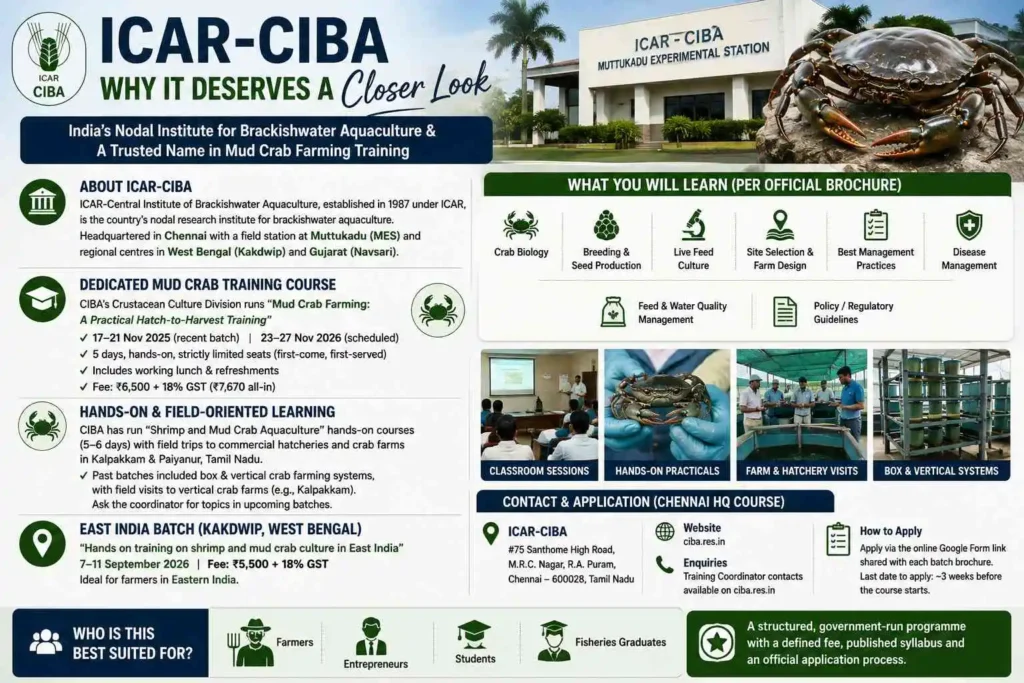
ICAR-Central Institute of Brackishwater Aquaculture, established in 1987 under ICAR, is the country’s nodal research institute for brackishwater aquaculture, headquartered in Chennai with a field station at Muttukadu (MES) and regional centres in West Bengal (Kakdwip) and Gujarat (Navsari).
CIBA’s Crustacean Culture Division runs a specifically-named course, “Mud Crab Farming: A Practical Hatch-to-Harvest Training,” organised most recently from 17–21 November 2025, and again scheduled for 23–27 November 2026 under CIBA’s published training calendar. The course content, per the official brochure, includes crab biology, breeding and seed production, live feed culture, site selection and farm design, best-management practices, disease management, feed and water-quality management, and policy/regulatory guidelines — with the training capped at a strict limit of participants on a first-come, first-served basis and working lunch/refreshments included.
Separately, CIBA’s Crustacean Culture Division has, over several years, run broader “Shrimp and Mud Crab Aquaculture” hands-on courses (5–6 days) that combine classroom sessions with field trips to commercial shrimp hatcheries and crab farms in Kalpakkam and Paiyanur, Tamil Nadu. One past batch (May 2022) specifically documented sessions on box and vertical crab farming systems, including a field visit to a vertical crab farming site at a commercial crab exporter in Kalpakkam. That confirms vertical crab farming has genuinely been part of CIBA’s curriculum in specific past batches — but it is not guaranteed for every future batch, so ask the coordinator directly what the upcoming session will cover.
CIBA also runs a parallel “Hands on training on shrimp and mud crab culture in East India” batch at its Kakdwip Research Centre in West Bengal (scheduled 7–11 September 2026, fee ₹5,500 + 18% GST) — useful for farmers in eastern India who’d rather not travel to Tamil Nadu.
Contact and application (Chennai HQ course): ICAR-CIBA, #75 Santhome High Road, M.R.C. Nagar, R.A. Puram, Chennai – 600028. Website: ciba.res.in. Applications for the dedicated mud crab course are submitted via an online Google Form link published with each batch’s brochure, with a stated last date roughly three weeks before the course starts. General training enquiries can also be sent through ICAR-CIBA’s official training coordinator contacts published in the annual training calendar on ciba.res.in.
Who is this best suited for? Farmers, entrepreneurs, students and fisheries graduates who want a structured, government-run programme with a defined fee, published syllabus and an official application process.
Training Options for Vertical and RAS Mud Crab Farming
Many readers searching for this topic are specifically interested in intensive, space-efficient systems rather than pond-based farming. It’s worth separating what’s actually documented from what’s assumed.
Vertical/box crab farming (individual compartment systems):
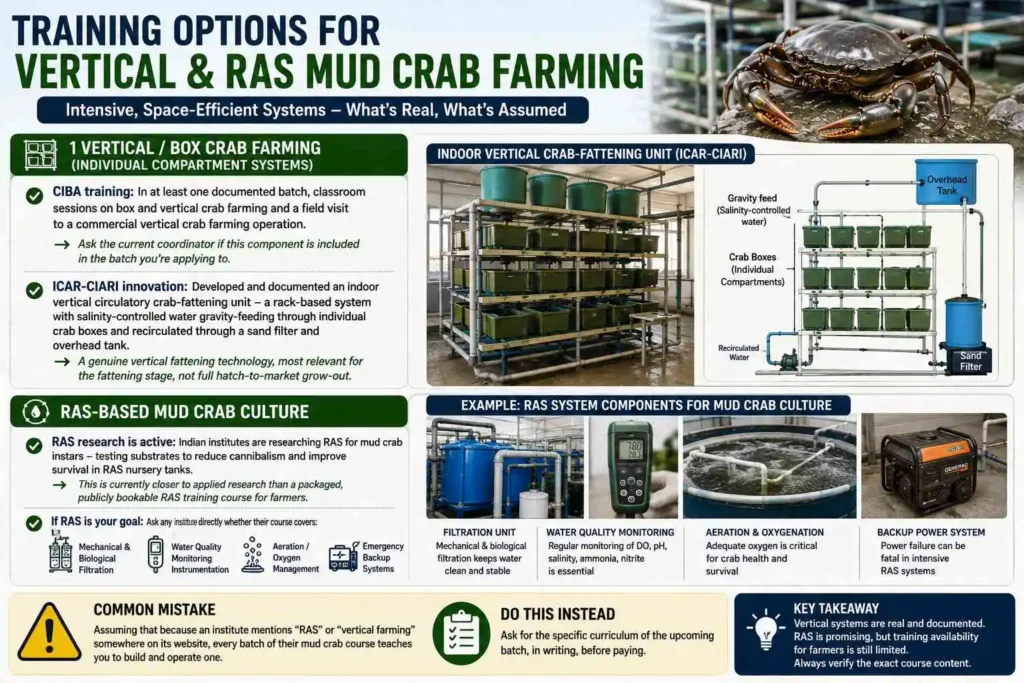
- CIBA’s crustacean training has, in at least one documented batch, included classroom sessions on box and vertical crab farming and a field visit to a commercial vertical crab farming operation. Ask the current coordinator if this component is included in the batch you’re applying to.
- ICAR-CIARI’s Marine Research Laboratory in the Andaman & Nicobar Islands has developed and documented an indoor vertical circulatory crab-fattening unit — a rack-based system where salinity-controlled water gravity-feeds through individual crab boxes and is recirculated through a sand filter and overhead tank. This is a genuine, specifically-documented vertical fattening technology, distinct from a full RAS grow-out system, and is most relevant to farmers focused on the fattening stage rather than hatch-to-market grow-out.
RAS-based mud crab culture:
- Recirculating Aquaculture System (RAS) research on mud crab instars — testing substrates to reduce cannibalism and improve survival in RAS nursery tanks — is an active area of Indian aquaculture research, but this is presently closer to applied research than a packaged, publicly bookable RAS training course for farmers.
- If RAS is your specific goal, ask any institute directly whether their course covers mechanical and biological filtration, water-quality monitoring instrumentation, aeration/oxygen management, and emergency backup systems for a crab RAS — rather than assuming a general “mud crab training” automatically includes this.
Common Mistake: Assuming that because an institute mentions “RAS” or “vertical farming” somewhere on its website, every batch of their mud crab course teaches you to build and operate one. Ask for the specific curriculum of the upcoming batch, in writing, before paying.
How Much Does Mud Crab Farming Training Cost?
Fees vary by institute type, duration, and what’s included. Here’s what’s actually documented, by programme:
- ICAR-CIBA’s dedicated mud crab hatch-to-harvest course: ₹6,500 + 18% GST (₹7,670 total) for the November 2025 batch — includes working lunch and refreshments. Travel and accommodation were separate, arranged at extra cost for participants due to limited on-campus hostel space.
- RGCA’s mud crab nursery/grow-out/soft-shell course: ₹5,000 for the January 2025 general batch, stated as inclusive of course material, training certificate, and tea/snacks.
- CIBA’s East India (Kakdwip) shrimp-and-mud-crab batch: ₹5,500 + 18% GST, per the published 2026 training calendar.
- ICAR-CIARI / state joint programmes for local Andaman farmers: typically low or no fee for selected beneficiaries, since these are often extension/livelihood programmes rather than paid public courses. Contact the institute directly for current terms.
Beyond the course fee itself, budget for:
- Travel to the training location (often coastal Tamil Nadu or the Andaman Islands)
- Accommodation, since government institute hostels are usually limited and may cost extra
- Food, where not explicitly included
- Local transport for farm/hatchery field visits
If you’re travelling from another state or from the mainland to the islands, factor this into your decision — a ₹6,500 course fee can easily be dwarfed by ₹15,000–20,000 in travel and stay.
How Long Does Mud Crab Farming Training Take?
Indian mud crab training generally falls into a few bands:
- 2-day intensive hands-on programmes (e.g., RGCA’s shorter batch) — tightly focused, good if you already have some aquaculture background and want a fast, practical refresher.
- 3-day programmes — common for joint state-fisheries/ICAR batches (e.g., the Andaman & Nicobar Fisheries Training Centre programmes), usually mixing classroom sessions with one farm/fattening-unit visit.
- 4–5 day hands-on courses — RGCA’s longer format and CIBA’s dedicated hatch-to-harvest course fall here, generally covering the full cycle from biology to harvest with multiple field exposures.
- 6-day combined courses — CIBA’s broader “shrimp and mud crab aquaculture” hands-on programmes have historically run at this length, including 20+ theory and practical sessions plus multiple field trips.
Longer isn’t automatically better. A well-structured 4–5 day hands-on course with real crab handling and a farm visit can teach you more than a 10-day classroom-heavy programme with a single afternoon at a hatchery.
Who Can Join Mud Crab Farming Training?
Eligibility differs by programme:
- ICAR-CIBA’s courses are generally open to state fisheries officials, farmers, researchers, students and entrepreneurs — the application form asks you to specify your category (aqua farmer, fisher, student, aqua industry, government, research scholar, etc.), and sponsored candidates need their sponsoring organisation’s recommendation.
- RGCA’s courses are aimed at farmers and entrepreneurs interested in commercial mud crab culture and are open on a general registration basis.
- State-run joint programmes (like the Andaman & Nicobar Fisheries Department batches) are often targeted at selected local fishers/farmers from specific districts or livelihood groups, with limited seats.
Don’t assume every course is open to walk-in registration — some batches, especially livelihood-focused ones for Scheduled Caste/Scheduled Tribe coastal communities, are specifically reserved for those beneficiary groups.
How to Apply for Mud Crab Farming Training
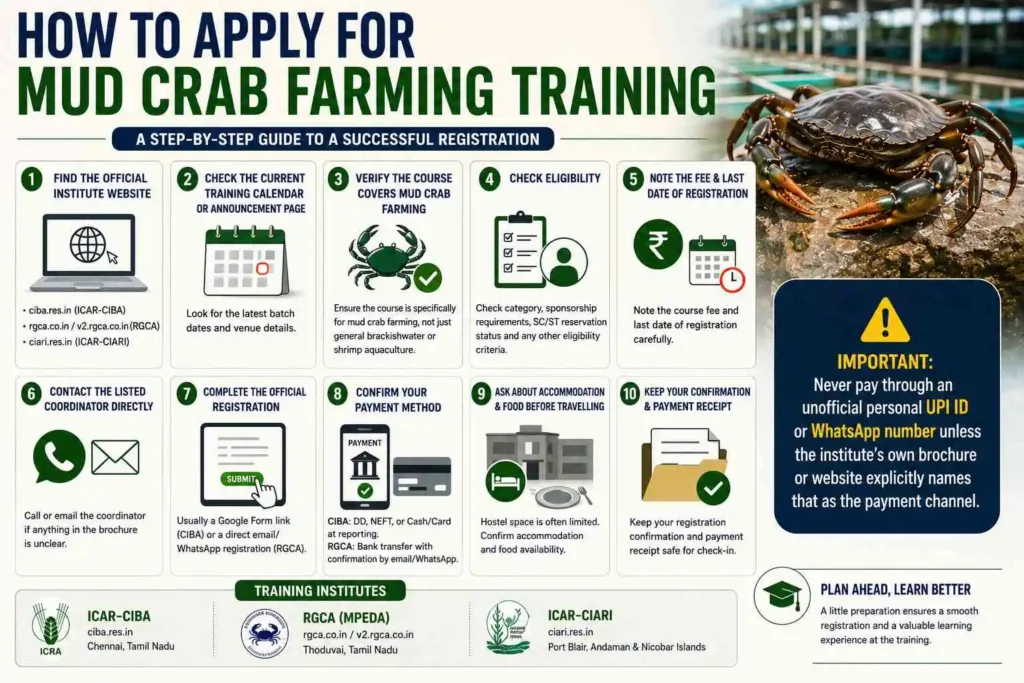
- Find the official institute website — ciba.res.in for ICAR-CIBA, rgca.co.in (or v2.rgca.co.in) for RGCA, ciari.res.in for ICAR-CIARI.
- Check the current training calendar or announcement page for the specific batch dates.
- Verify the course specifically covers mud crab farming — not just general brackishwater or shrimp aquaculture.
- Check eligibility — category, sponsorship requirements, SC/ST reservation status if applicable.
- Note the fee and last date of registration.
- Contact the listed coordinator directly by phone or email if anything in the brochure is unclear.
- Complete the official registration — usually a Google Form link (CIBA) or a direct email/WhatsApp registration (RGCA).
- Confirm your payment method — CIBA has historically accepted demand draft, NEFT, or cash/card at reporting; RGCA has typically used bank transfer with confirmation by email/WhatsApp.
- Ask specifically about accommodation and food before travelling, since hostel space is often limited.
- Keep your registration confirmation and payment receipt for reference at check-in.
Never pay through an unofficial personal UPI ID or WhatsApp number unless the institute’s own brochure or website explicitly names that as the payment channel.
How to Find the Next Training Batch
Government training institutes generally announce mud crab batches periodically through an annual or half-yearly training calendar rather than running a fixed monthly schedule. To stay ahead of the next opening:
- Check ICAR-CIBA’s training calendar page on ciba.res.in each quarter
- Monitor RGCA’s training page (rgca.co.in / v2.rgca.co.in) for new mud crab hatchery-project brochures
- Watch ICAR-CIARI’s announcements page for joint programmes with the Andaman & Nicobar Fisheries Department
- Follow ICAR’s central news page (icar.org.in) — CIBA and CIARI training events are frequently reported there
- Sign up for updates from your state fisheries department, since several batches (especially in the Islands and West Bengal) are jointly organised with them
Warning: Before booking travel, always call or email the institute to confirm the date, available seats, current fee, eligibility, whether the specific practical components you care about (vertical/RAS/hands-on handling) are on the agenda, and accommodation status. Training schedules and fees may change, so contact the institute directly for the latest batch details.
Questions to Ask Before Paying for a Private Course
Government institute courses aren’t the only option — several private trainers and consultants also offer mud crab farming workshops. Before paying any of them, ask:
- Will I actually handle live mud crabs, or is this classroom-only?
- Will I learn hands-on water-quality testing, not just theory?
- Is vertical/box farming genuinely covered, or just mentioned in passing?
- Is RAS actually demonstrated, with real equipment?
- Can I visit a working commercial farm as part of the course?
- Does the trainer personally operate, or has operated, a commercial mud crab farm?
- Will real operating costs and typical mortality/failure rates be discussed honestly?
- Is there any post-training support if I have questions once I start?
- What exactly is included in the fee — materials, certificate, food, accommodation?
- Is the fee refundable if the course is cancelled or doesn’t deliver what was advertised?
Be cautious of any course that promises: guaranteed profits, guaranteed survival rates, “100% successful farming,” unrealistic return-on-investment figures, instant subsidy approval, or guaranteed buyers for your harvest. No credible trainer — government or private — can promise these outcomes, because mud crab farming outcomes depend heavily on local water quality, seed quality, and management discipline.
Government Training vs Private Training
| Factor | Government (ICAR-CIBA, RGCA) | Private trainers |
|---|---|---|
| Cost | Generally lower, fixed and published | Varies widely, sometimes bundled with consultancy |
| Credibility | Backed by research institutions with published protocols | Depends entirely on the individual trainer’s track record |
| Practical exposure | Documented hatchery/farm visits as part of the syllabus | Varies — verify independently |
| Flexibility/scheduling | Fixed calendar, limited batches per year | Often more flexible, on-demand scheduling |
| Technical depth | Backed by ongoing institutional research (disease, genetics, feed) | Depends on trainer’s own farming/consulting experience |
| Post-training support | Limited beyond the training period, though CIBA/RGCA scientists are often reachable | Sometimes bundled as ongoing consultancy — confirm what’s included |
Neither category is automatically superior. A government course gives you research-backed fundamentals at a lower, transparent cost; a good private trainer who genuinely operates a farm can offer more flexible scheduling and closer follow-up — but you have to verify that operating experience yourself, since there’s no accreditation body specifically certifying private mud crab trainers in India.
What Will You Actually Learn During Practical Training?
Based on documented past CIBA and RGCA batches, a typical hands-on day looks roughly like this:
- Classroom introduction to crab biology and species identification
- Live handling and grading demonstration
- Water-quality testing session (salinity, DO, ammonia, pH)
- Feeding demonstration and feed discussion
- Visit to a hatchery or nursery-rearing facility
- Farm or fattening-unit field visit (pond, box or vertical system, depending on the batch)
- Harvesting and grading discussion
- Basic economics and marketing session
What’s “commonly included” versus “batch-dependent”: biology, handling, water quality and feeding sessions appear consistently across documented batches. Farm visits to a specific type of system (pond vs. box vs. vertical) vary by which commercial or demonstration site the institute partners with that year — this is exactly the kind of detail to confirm with the coordinator before you enrol. If you’re curious about vertical systems specifically, read our vertical mud crab farming blog.
Is a Certificate Enough to Start a Farm?
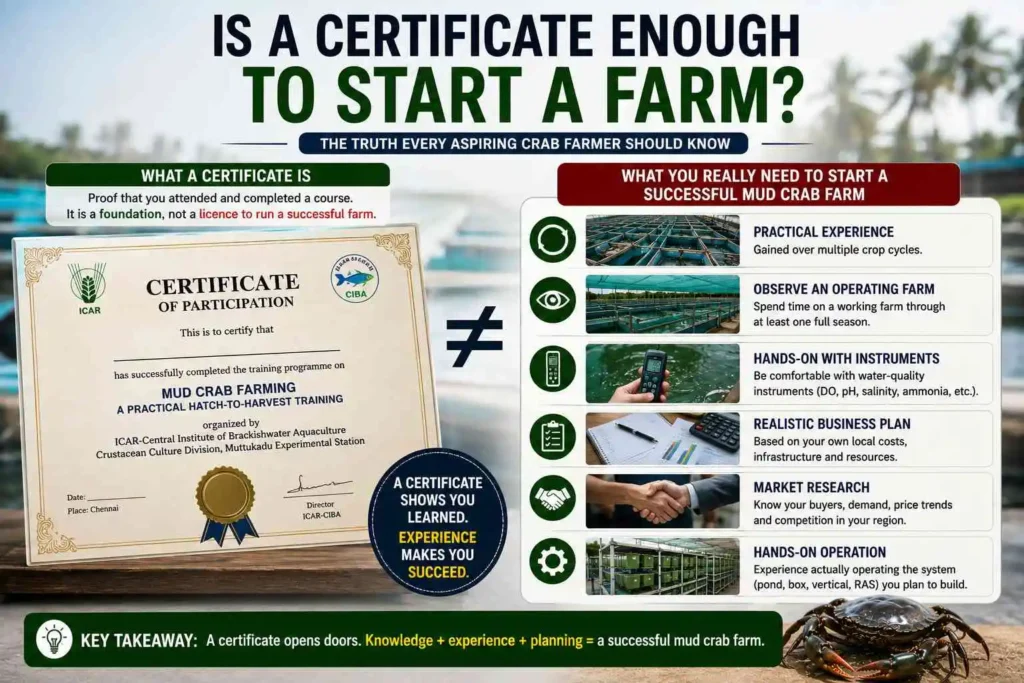
No. A training certificate documents that you attended and completed a course — it does not replace:
- Practical experience gained over multiple crop cycles
- Time spent observing an operating farm through at least one full season
- Hands-on comfort with water-quality instruments
- A realistic business plan based on your own local costs
- Market research on buyers and prices in your specific region
- Experience actually operating whatever system (pond, box, RAS) you plan to build
Treat the certificate as a foundation, not a licence to scale immediately. If you want to scale bigger, check our full guide on mud crab farming licenses and permissions.
What Should You Do After the Training?
- Visit at least one operating commercial mud crab farm, ideally more than once across a season.
- Prepare a realistic business plan with your actual local costs.
- Identify reliable hatchery-produced seed suppliers rather than relying solely on wild seed.
- Identify buyers and understand local/export price patterns before you commit capital.
- Calculate operating costs honestly, including electricity, water, feed and labour.
- Decide on your farming model — pond, box, pen, or fattening — based on your land, water and budget.
- Start with a small, manageable pilot batch, not a full-scale system.
- Track survival rate and per-crab cost closely through the first crop.
- Adjust your system and management based on what the pilot shows you.
- Only scale up once the pilot’s economics genuinely work.
Common Mistakes Beginners Make
- Choosing a course purely on price — a cheaper course with no hands-on component teaches less than a slightly costlier one with real farm exposure.
- Paying for a certificate rather than for practical knowledge — the piece of paper isn’t the goal.
- Assuming any brackishwater aquaculture course automatically teaches mud crab farming — many don’t.
- Assuming a course that mentions “RAS” teaches full crab-RAS design and operation — confirm this specifically.
- Not checking whether the trainer has actually farmed crabs commercially.
- Investing in infrastructure before ever visiting a working farm.
- Believing screenshots of profit or production figures without verifying them.
- Ignoring local market demand before building capacity.
- Underestimating electricity and water costs, especially for pumped or aerated systems.
- Building a large system immediately after training instead of piloting small.
Which Training Is Best for You?
- Completely new to aquaculture? Start with a structured, hands-on introductory course like ICAR-CIBA’s dedicated mud crab hatch-to-harvest programme.
- Planning commercial-scale farming? Prioritise a course that combines hands-on crab handling with farm-economics discussion and a genuine farm visit — CIBA and RGCA both offer this.
- Specifically interested in vertical/box or fattening systems? Confirm with the coordinator whether the current batch includes a vertical/box farming module or field visit — this has varied by batch at CIBA, and ICAR-CIARI’s documented vertical fattening unit is a useful reference point for the Andaman region.
- Interested in RAS? Ask directly whether practical RAS operation and water-quality instrumentation are part of the syllabus — don’t assume this from a general mud crab course description.
- Based in a coastal or island region? Look at the regional option nearest you — CIBA’s Kakdwip centre for East India, RGCA in coastal Tamil Nadu, or ICAR-CIARI/state fisheries programmes for the Andaman & Nicobar Islands — since local species, water conditions and buyer markets differ.
Conclusion
The cheapest training isn’t necessarily the best training, and the institute with the longest course isn’t automatically the best one either. What actually matters is whether the programme gives you practical, applicable knowledge — real crab handling, real water-quality work, a real farm visit — that you can use before you commit serious capital.
Before you enrol anywhere, verify the latest batch details directly with the institute, ask specifically about hands-on exposure, and once trained, go visit an operating farm before you build anything. Learn the water-quality management and the economics cold. Start small.
Before spending lakhs on tanks, racks or an RAS system, spend a few days learning how to actually operate one. Good practical training is inexpensive compared to the mistake it can help you avoid.
Frequently Asked Questions
Where can I get mud crab farming training in India?
The most consistently documented, dedicated options are ICAR-CIBA (Chennai/Muttukadu, with an East India batch at Kakdwip) and RGCA-MPEDA (Sirkali/Thoduvai, Tamil Nadu). ICAR-CIARI and the Andaman & Nicobar Department of Fisheries also run periodic joint programmes for island farmers.
Which is the best institute for mud crab farming training?
There isn’t a single objectively “best” institute — ICAR-CIBA runs the most structured, dedicated, publicly bookable mud crab course with a defined syllabus and fee; RGCA offers a shorter, intensive hands-on alternative; ICAR-CIARI is the strongest regional option for Andaman & Nicobar farmers, particularly those interested in vertical fattening systems.
Does ICAR-CIBA provide mud crab farming training?
Yes — CIBA’s Crustacean Culture Division runs a named course, “Mud Crab Farming: A Practical Hatch-to-Harvest Training,” typically once a year, alongside broader shrimp-and-crab hands-on programmes.
Is RAS mud crab farming training available in India?
Not yet as a standing, dedicated, publicly bookable RAS-specific crab course. RAS techniques for mud crab (e.g., substrate use to reduce cannibalism) are an active research area, and general mud crab courses may touch on RAS concepts — confirm the specific syllabus before assuming full RAS training is included.
Is vertical mud crab farming covered in training programmes?
It has been covered in specific past batches — documented sessions and field visits to vertical/box crab farming sites have occurred at ICAR-CIBA, and ICAR-CIARI has developed a documented indoor vertical crab-fattening unit. Confirm inclusion for your specific batch rather than assuming.
How much does mud crab farming training cost?
Verified recent fees range from about ₹5,000 (RGCA, 2025) to roughly ₹6,500–7,670 including GST (ICAR-CIBA, 2025–26), excluding travel and accommodation. Fee not publicly listed for some regional/joint programmes — contact the institute.
How long is mud crab farming training?
Anywhere from 2 days (RGCA’s shorter batch) to 5–6 days (CIBA’s dedicated and combined courses), with 3-day joint programmes common in the Andaman & Nicobar Islands.
Can beginners join mud crab farming courses?
Yes — both CIBA and RGCA’s courses are explicitly open to farmers, entrepreneurs and students, not only existing aquaculture professionals.
Do I need a fisheries degree?
No. Eligibility categories on CIBA’s application form explicitly include farmers, aqua technicians, input dealers and entrepreneurs alongside students and researchers.
How do I find the next training batch?
Check the institute’s official training calendar page directly — ciba.res.in, rgca.co.in, ciari.res.in — since batches are announced periodically rather than run on a fixed monthly schedule.
Is a mud crab farming certificate enough to start a farm?
No. It’s a foundation for practical experience, farm visits and a tested business plan — not a substitute for them.
Can I get mud crab farming training in Andaman and Nicobar?
Yes, periodically — through joint programmes between ICAR-CIBA/ICAR-CIARI and the Andaman & Nicobar Department of Fisheries, usually announced through the state fisheries department and local news channels.
Are private mud crab farming courses worth it?
They can be, if the trainer genuinely operates or has operated a commercial farm and the course includes real hands-on components — but verify this independently, since there’s no accreditation body specifically certifying private mud crab trainers in India.
Newsletter