
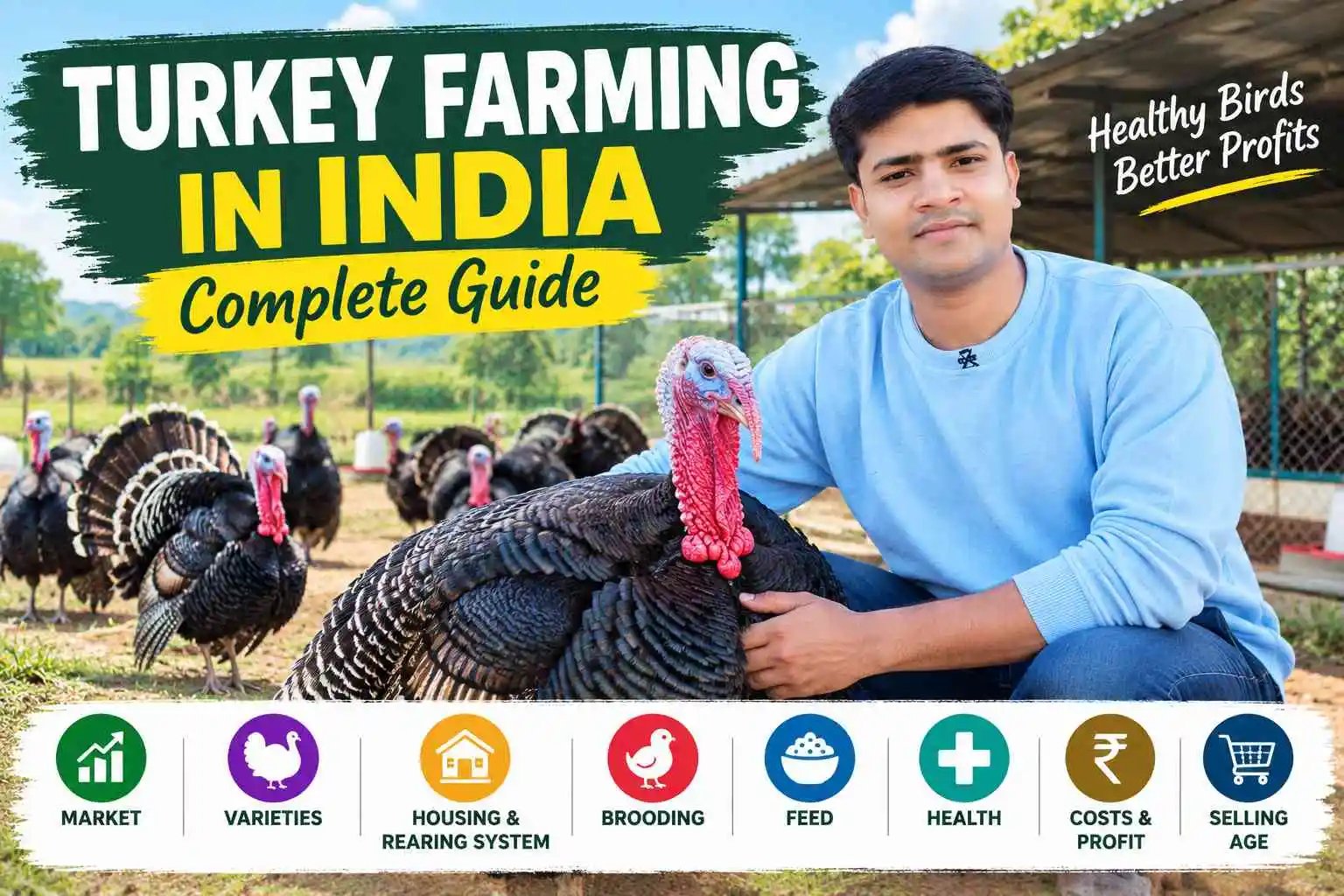

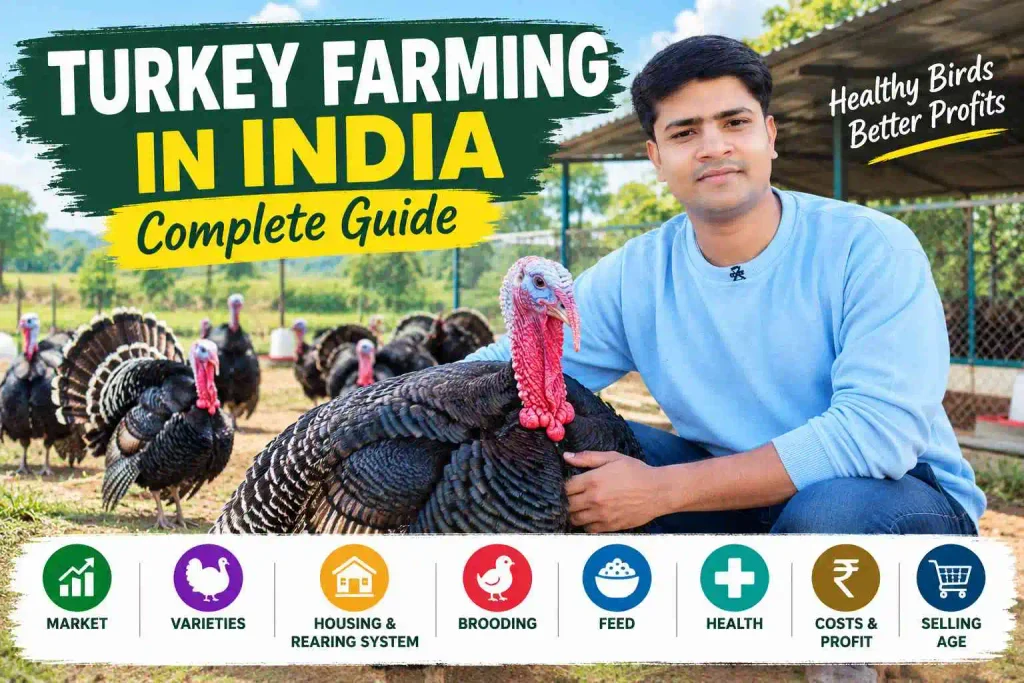
Turkey Farming in India : Complete Guide
source, we say so. Where it is our own assumption, we label it, so you can replace it with quotations from your area.A healthy turkey is not the hard part of turkey farming. The hard part is finding a buyer who will pay enough for a 6–8 kg bird to cover the 20–25 kg of feed it ate on the way there.
That gap separates the turkey farms that work from the ones that quietly lose money. Turkeys grow well, give lean meat and suit many parts of India, but turkey farming needs better brooding, richer feed and an earlier conversation with buyers than most beginners expect.
This guide to turkey farming in India follows the decisions in the order they usually matter: market, variety, rearing system, housing, brooding, feed, health, selling age and costs. Where a number comes from a published Indian.
Turkey Farming at a Glance
- Best fit: Turkey farming suits farmers who have a buyer for lean meat and can manage brooding carefully.
- Main risk: Poor early management. Mortality in the first four weeks of turkey rearing was 6–10% in CPDO’s figures and 5–35% in TNAU’s farm survey.
- Biggest cost: Feed makes up about 60% of the running costs in our turkey farming cost model below.
- Biggest disease threat: Blackhead, which is why chickens and turkeys must never share a turkey farm’s ground or sheds.
- Best first step: Talk to buyers before you start any turkey farming business.
Key Takeaway: Decide the buyer first, the shed second and the number of birds last.
Is Turkey Farming Right for Your Market, Budget and Land?
Chicken is familiar, fast-growing and sells every day, which is a big reason turkey farming has stayed a niche in India. Tamil Nadu Agricultural University (TNAU) points out that turkeys can be raised free-range or semi-intensively with modest spending on housing and equipment, which makes turkey rearing attractive where people prefer lean meat. Kerala and Tamil Nadu lead turkey production, with local turkeys also found in parts of eastern Uttar Pradesh.
The weak point of turkey farming is the market. TNAU’s farm survey found demand concentrated around Christmas, Diwali and New Year, no steady daily retail market in many areas, and a 6–8 kg bird that doesn’t fit the everyday cooking of families used to broilers. Most birds were collected from the farm by traders and sold in nearby states. Restaurants, caterers and online meat sellers may have widened demand for turkey meat since then, but confirm that in your own district rather than assume it.
Before you start a turkey farming business, get honest answers to four questions:
- Is my land free of chickens? (The blackhead section below explains why this matters.)
- Who will buy my birds, at what weight, on what price basis (live or dressed) and on what date?
- Can my batch be ready for a festive window?
- Do I have a veterinarian within reach and a reliable source of poults for my turkey farm?
Common Mistake: Buying poults before checking whether anyone nearby will buy a mature 6–8 kg bird, and at what price.
Which Turkey Varieties Make the Most Sense for Indian Farmers?
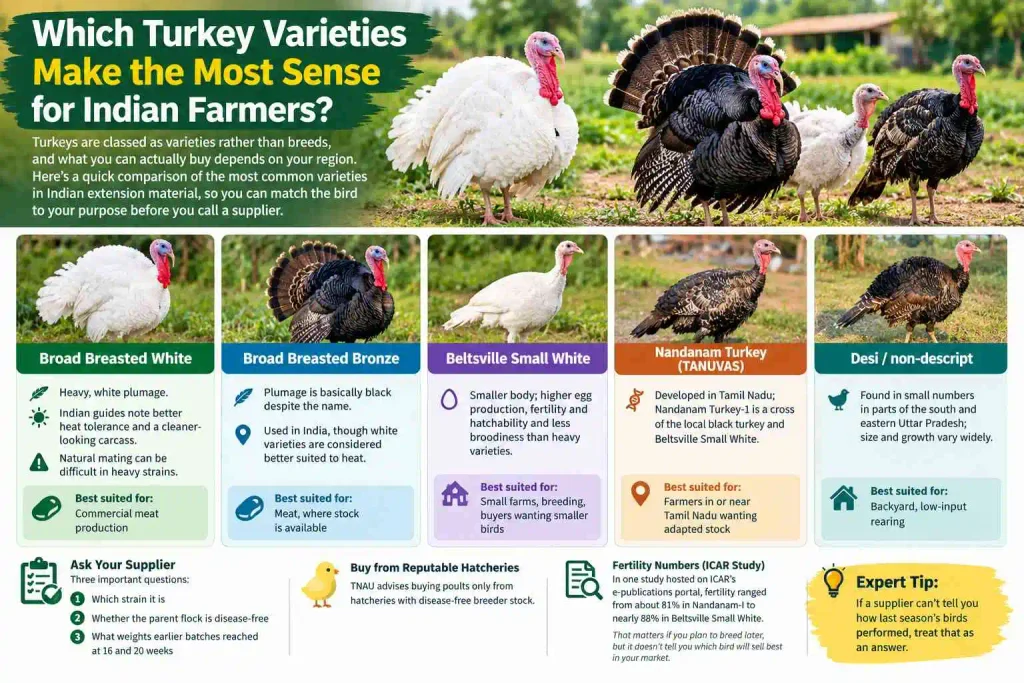
Strictly speaking, turkeys are classed as varieties rather than breeds, and what you can actually buy depends on your region. The table compares the varieties most often named in Indian extension material, so you can match the bird to your purpose before you call a supplier.
| Variety | What to know | Best suited for |
|---|---|---|
| Broad Breasted White | Heavy, white plumage. Indian guides note better heat tolerance and a cleaner-looking carcass. Natural mating can be difficult in heavy strains | Commercial meat production |
| Broad Breasted Bronze | Plumage is basically black despite the name. Used in India, though white varieties are considered better suited to heat | Meat, where stock is available |
| Beltsville Small White | Smaller body; higher egg production, fertility and hatchability and less broodiness than heavy varieties | Small farms, breeding, buyers wanting smaller birds |
| Nandanam Turkey (TANUVAS) | Developed in Tamil Nadu; Nandanam Turkey-1 is a cross of the local black turkey and Beltsville Small White | Farmers in or near Tamil Nadu wanting adapted stock |
| Desi / non-descript | Found in small numbers in parts of the south and eastern Uttar Pradesh; size and growth vary widely | Backyard, low-input rearing |
Ask any supplier three things: which strain it is, whether the parent flock is disease-free, and what weights earlier batches reached at 16 and 20 weeks. TNAU advises buying poults only from hatcheries with disease-free breeder stock, a basic rule for any turkey farm.
In one study hosted on ICAR’s e-publications portal, fertility ranged from about 81% in Nandanam-I to nearly 88% in Beltsville Small White. That matters if you plan turkey breeding later, but it doesn’t tell you which bird will sell best in your market.
Expert Tip: If a supplier can’t tell you how last season’s birds performed, treat that as an answer.
Free-Range or Intensive: Which System Fits Your Farm?
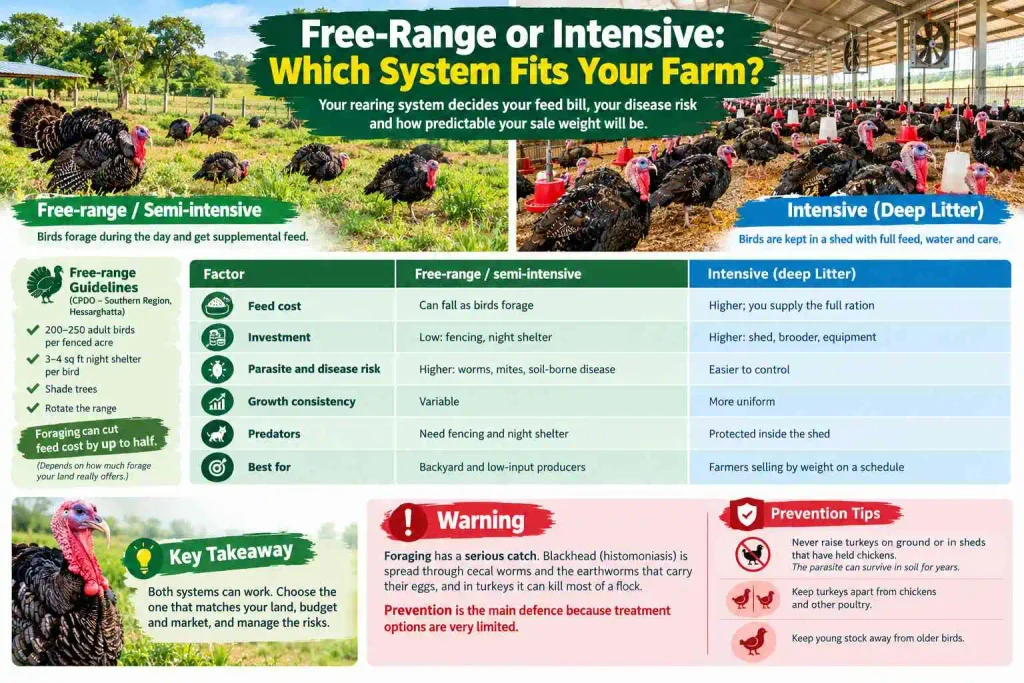
Your rearing system decides your feed bill, your disease risk and how predictable your sale weight will be. The table sets the two common options side by side for turkey farmers.
| Factor | Free-range / semi-intensive | Intensive (deep litter) |
|---|---|---|
| Feed cost | Can fall as birds forage | Higher; you supply the full ration |
| Investment | Low: fencing, night shelter | Higher: shed, brooder, equipment |
| Parasite and disease risk | Higher: worms, mites, soil-borne disease | Easier to control |
| Growth consistency | Variable | More uniform |
| Predators | Need fencing and night shelter | Protected inside the shed |
| Best for | Backyard and low-input producers | Farmers selling by weight on a schedule |
For free-range turkey farming, the Central Poultry Development Organisation (Southern Region) in Hessarghatta suggests about 200–250 adult birds per fenced acre, night shelter of 3–4 sq ft per bird, shade trees and rotation of the range. It also says foraging can cut feed cost by up to half. Read that as a best case: it depends on how much forage your land really offers.
Warning: Foraging has a catch. Blackhead (histomoniasis) is spread through cecal worms and the earthworms that carry their eggs, and in turkeys it can kill most of a flock. Prevention is the main defence because treatment options are very limited. Never raise turkeys on ground or in sheds that have held chickens, since the parasite can survive in soil for years. Keep turkeys apart from chickens and other poultry, and keep young stock away from older birds.
How Much Space Do Growing Turkeys Actually Need?
Crowding is one of the easiest mistakes to avoid in turkey farming and one of the most expensive to ignore. The table shows the allowances given by CPDO for deep-litter rearing.
| Age | Floor space (sq ft/bird) | Feeder space (cm/bird) | Waterer space (cm/bird) |
|---|---|---|---|
| 0–4 weeks | 1.25 | 2.5 | 1.5 |
| 5–16 weeks | 2.5 | 5.0 | 2.5 |
| 16–29 weeks | 4.0 | 6.5 | 2.5 |
| Breeders | 5.0 | 7.5 | 2.5 |
TNAU’s figures are similar, slightly lower for the early weeks and 3–5 sq ft for birds beyond 16 weeks. In humid regions or during the monsoon, work with the higher figure.
Some housing points that matter for turkey farming in Indian conditions:
- Site and floor: Choose an elevated, well-drained spot. A moisture-proof concrete floor is easy to clean and disinfect.
- Orientation: In hotter regions, run the long axis east–west, keep open-sided houses no wider than about 9 m, and give the roof a 1 m overhang to stop rain splash.
- Litter: Start with about 2 inches of dry litter, build up to 3–4 inches and rake often. In monsoon humidity, damp patches near drinkers are where trouble starts.
- Heat: White-plumaged birds cope better with heat, but every turkey needs shade, extra waterers in summer and feed in the cooler hours.
- Distance: Keep at least 20 m between houses, and the young-stock house 50–100 m from the adult house.
- Calm: Turkeys panic easily. Limit visitors and avoid sudden night disturbance; low-intensity night lighting is suggested to reduce stampedes.
- Separate sexes: Toms and hens have different nutritional needs, so rear them separately.
Practical Tip: For a 200-bird turkey farm, plan roughly 800 sq ft of finishing space at 4 sq ft each, plus a brooding area of about 250 sq ft (200 × 1.25). The brooding area can be a partitioned section of the same shed.
Why the First Four Weeks Can Decide Your Flock
Poults are not easy starters. CPDO reports average mortality of 6–10% in the first four weeks, while TNAU’s farm survey recorded 5–35%. That spread is the real message: where mortality is high, management is usually the cause. A leading culprit is starve-out. Young poults are nervous, see poorly and may not find feed and water in the first days.
A practical way to approach brooding in turkey farming:
- Prepare early. Get the brooder ready at least two days before the poults arrive. Spread dry litter, set a poult guard at least 1 ft high, and allow roughly double the hover space you would give chicks.
- Heat to the bird, not the thermometer alone. Start at about 95°F (35°C) at bird height in week one, then lower it by about 5°F (around 3°C) a week. In winter, brooding may run 5–6 weeks; in summer, heat can often stop earlier. Treat these figures as a starting point and let the birds guide you.
- Make feed and water easy to find. Use shallow waterers and low feeders. CPDO suggests tapping the feeder, placing coloured marbles in feeders and waterers, and adding some chopped greens to draw poults to feed.
- Watch behaviour several times a day. Poults huddled under the heat are cold, poults crowding away from it and panting are hot, and comfortable poults spread out evenly.
- Check that they are drinking. In the first 48 hours, feel a few crops to confirm they are full.
- Record every death with the likely cause.
Expert Tip: Turkey farming is not broiler farming with a bigger bulb. Poults need more space, a warmer start and closer attention to whether they are drinking.
What to Feed in Turkey Farming at Different Growth Stages
Turkeys need more protein, amino acids, vitamins and minerals than chickens, and the requirement falls as they grow. The table shows NRC-based figures reproduced by TNAU and CPDO, the reference point most Indian guides use.
| Age (weeks) | Crude protein (%) | Energy (kcal ME/kg) | Lysine (%) |
|---|---|---|---|
| 0–4 | 28 | 2,800 | 1.6 |
| 4–8 | 26 | 2,900 | 1.5 |
| 8–12 | 22 | 3,000 | 1.3 |
| 12–16 | 19 | 3,100 | 1.0 |
| 16–20 | 16–16.5 | 3,200 | 0.80 |
| 20–24 | 14 | 3,300 | 0.65 |
Here’s where many beginners in turkey farming struggle: ready-made turkey feed is hard to find. TNAU notes that farmers often top up broiler feed with a protein concentrate, and that matching NRC energy levels with local ingredients is difficult. A top-up only works if it is calculated, so ask a poultry nutritionist or your feed supplier to formulate against the table above.
- Check the tag. Many broiler starters carry less protein than the 28% listed for poults.
- No single-ingredient diets. Maize, kitchen scraps or green fodder alone cannot supply a balanced ration. Lucerne and similar legumes are good supplements, not substitutes.
- Feeders, not the ground. Change diets gradually and keep clean water in front of the birds at all times.
- Protect the legs. Calcium, phosphorus and vitamin balance affect leg strength; CPDO also recommends shell grit.
- Keep feed dry. Monsoon moisture breeds mould, and mycotoxins damage the liver and kidneys. Store feed off the floor and control rats.
Common Mistake: Giving growers the same ration from week 4 to sale. Protein needs fall steadily, so a single feed either wastes money late or limits growth early.
Which Diseases Deserve Respect in Turkey Farming?
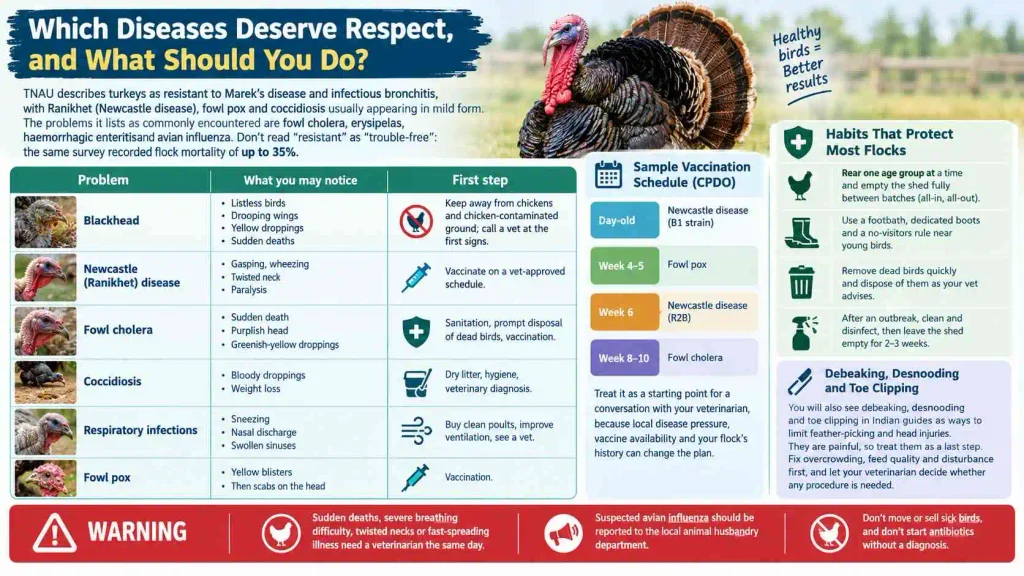
Disease control is the backbone of profitable turkey farming. TNAU describes turkeys as resistant to Marek’s disease and infectious bronchitis, with Ranikhet (Newcastle disease), fowl pox and coccidiosis usually appearing in mild form.
The problems it lists as commonly encountered are fowl cholera, erysipelas, haemorrhagic enteritis and avian influenza. Don’t read “resistant” as “trouble-free”: the same survey recorded flock mortality of up to 35%.
The table lists problems worth knowing, what you may notice and the first sensible step. It is a prompt to call your veterinarian, not a substitute for a diagnosis.
| Problem | What you may notice | First step |
|---|---|---|
| Blackhead | Listless birds, drooping wings, yellow droppings, sudden deaths | Keep away from chickens and chicken-contaminated ground; call a vet at the first signs |
| Newcastle (Ranikhet) disease | Gasping, wheezing, twisted neck, paralysis | Vaccinate on a vet-approved schedule |
| Fowl cholera | Sudden death, purplish head, greenish-yellow droppings | Sanitation, prompt disposal of dead birds, vaccination |
| Coccidiosis | Bloody droppings, weight loss | Dry litter, hygiene, veterinary diagnosis |
| Respiratory infections | Sneezing, nasal discharge, swollen sinuses | Buy clean poults, improve ventilation, see a vet |
| Fowl pox | Yellow blisters, then scabs on the head | Vaccination |
CPDO lists this sample vaccination schedule: Newcastle disease (B1 strain) at day-old, fowl pox in weeks 4–5, Newcastle disease (R2B) in week 6 and fowl cholera in weeks 8–10. Treat it as a starting point for a conversation with your veterinarian, because local disease pressure, vaccine availability and your flock’s history can change the plan.
A few habits protect most flocks on any turkey farm:
- Rear one age group at a time and empty the shed fully between batches (all-in, all-out).
- Use a footbath, dedicated boots and a no-visitors rule near young birds.
- Remove dead birds quickly and dispose of them as your vet advises.
- After an outbreak, clean and disinfect, then leave the shed empty for 2–3 weeks.
You will also see debeaking, desnooding and toe clipping in Indian turkey rearing guides as ways to limit feather-picking and head injuries. They are painful, so treat them as a last step. Fix overcrowding, feed quality and disturbance first, and let your veterinarian decide whether any procedure is needed.
Warning: Sudden deaths, severe breathing difficulty, twisted necks or fast-spreading illness need a veterinarian the same day. Suspected avian influenza should be reported to the local animal husbandry department. Don’t move or sell sick birds, and don’t start antibiotics without a diagnosis.
How Fast Do Turkeys Grow, and When Should You Sell in Turkey Farming?
The table shows CPDO’s weight and feed benchmarks for well-managed commercial birds. Use it to set turkey farming targets, not to promise yourself results.
| Age | Tom weight (kg) | Hen weight (kg) | Cumulative feed conversion (tom / hen) |
|---|---|---|---|
| 4 weeks | 0.72 | 0.63 | 1.3 / 1.3 |
| 8 weeks | 2.36 | 1.90 | 1.8 / 1.7 |
| 12 weeks | 4.72 | 3.85 | 2.4 / 2.4 |
| 16 weeks | 7.26 | 5.53 | 2.8 / 2.7 |
| 20 weeks | 9.62 | 6.75 | 3.4 / 2.9 |
Look at the last two rows. Between weeks 16 and 20, a tom eats about 8.4 kg more feed to gain about 2.4 kg, and a hen eats about 7.4 kg more to gain about 1.2 kg. The final weeks are the costliest weeks of the cycle, especially for hens.
Key Takeaway: In turkey farming, sell at the weight your buyer pays for, not at the age that feels right. Every extra week past the efficient point adds feed cost faster than it adds meat.
TNAU’s farm survey found birds marketed at around six months at 6–8 kg, far slower than the benchmark above. That gap is where your turkey farm’s margin is won or lost. Weigh a sample of 10–20 birds every week from the start, and compare the result with your feed use.t around six months at 6–8 kg, far slower than the benchmark above. That gap is where your margin is won or lost. Weigh a sample of 10–20 birds every week from the start, and compare the result with your feed use.
Which Costs Can Reduce Your Turkey Farming Profit?
Start by separating one-time setup costs from running costs. Setup costs for a turkey farm include the shed and brooder, heaters or bulbs, feeders, waterers, fencing for range birds, water and power connections, feed storage and rat-proofing. Running costs include poults, feed, vaccines and medicines, litter, electricity, labour, transport and marketing.
Don’t borrow numbers from old guides. TNAU’s survey quoted construction at ₹60–90 per sq ft and feed at about ₹10 per kg, which shows how quickly figures date. Get fresh quotations for your area.
The turkey farming cost model below is illustrative. The assumptions are ours except where noted, so swap in your own prices.
| Assumption | Value |
|---|---|
| Flock | 200 poults bought at about 4 weeks |
| Poult price | ₹250 each (assumed) |
| Mortality to sale | 8%, leaving 184 birds (assumed) |
| Feed used | About 4,200 kg, roughly 22 kg per saleable bird (TNAU’s survey reported 20–25 kg per bird to six months) |
| Feed price | ₹40 per kg, including protein top-up (assumed) |
| Average live weight at sale | 6.5 kg (TNAU reported 6–8 kg) |
| Time on farm | About 4–5 months |
The running costs under these assumptions come to the following.
| Item | Cost (₹) |
|---|---|
| Poults (200 × ₹250) | 50,000 |
| Feed (4,200 kg × ₹40) | 1,68,000 |
| Vaccines and medicines | 12,000 |
| Litter, electricity, water | 15,000 |
| Labour (family labour has a value too) | 30,000 |
| Transport and marketing | 4,000 |
| Total running cost | 2,79,000 |
The farm sells 184 × 6.5 = 1,196 kg of live weight. Divide the cost by that weight and each kilogram costs about ₹233 to produce, or about ₹1,516 per bird. That is your break-even. The next table shows what different live-bird prices would do, for illustration only.
| Live-bird price (₹/kg) | Revenue (₹) | Operating result (₹) |
|---|---|---|
| 200 | 2,39,200 | −39,800 |
| 275 | 3,28,900 | +49,900 |
| 350 | 4,18,600 | +1,39,600 |
These are operating results: revenue minus running costs. Shed cost, depreciation, interest and land come on top, so net profit is lower. Cash flow matters too. You would spend most of the ₹2.79 lakh before the first sale, and feed alone is about 60% of it.
Small changes move the result quickly:
- A ₹5 per kg change in feed price shifts costs by about ₹21,000.
- Each 1% of extra mortality removes about 2 birds, or 13 kg of saleable weight, roughly ₹3,575 at ₹275 per kg.
- Selling 0.5 kg lighter per bird across 184 birds costs about ₹25,300 at ₹275 per kg.
What will buyers actually pay? Indicative online listings for Indian-sourced fresh or frozen whole turkey run from about ₹340 to ₹700 per kg, with some restaurant-grade and imported products listed far higher. Listing prices vary widely and aren’t confirmed sales, and dressed meat is not live weight, so they can’t tell you the farm-gate rate. Only your local buyers can.
Expert Tip: Track feed use, body weight, mortality and treatment expenses from the first week. These records show early whether the batch will beat your break-even.
How Can You Find Buyers Before Your Turkeys Reach Market Weight?
The cheapest marketing is done before the poults arrive. Make a short list of likely buyers and call each one.
- Traders who lift birds from the farm, as TNAU’s survey described. Ask what weight and price basis they use.
- Hotels, restaurants and caterers, including biryani sellers, where TNAU reported demand slowly growing.
- Festive buyers around Christmas, Diwali and New Year. Count back from the festival to decide when to start brooding.
- Direct customers, if you plan to dress and sell meat yourself. Check slaughter and meat-sale licence requirements with your municipal body and FSSAI first.
Don’t depend on one trader. Aim for at least three possible buyers, and get a clear understanding on weight, price basis (live or dressed) and pick-up date.
Should You Start With Poults or Breeders?
For most beginners, poults. Breeding adds incubation (28 days), egg handling and fertility management. CPDO gives a mating ratio of 1 tom to 5 hens for medium-type birds and 1 to 3 for large types, and about 40–50 poults per breeder hen. Heavy broad-breasted strains can be hard to breed naturally, which is why some units use artificial insemination. Learn brooding and selling on one batch before you add breeders.
Frequently Asked Questions
Is turkey farming more profitable than broiler or country chicken farming? Not automatically. It depends on your buyer, feed cost, mortality and selling weight. Calculate your cost per kilogram and compare it with the price buyers offer.
How long does it take to raise turkeys for meat? CPDO’s benchmark reaches about 7.3 kg for toms and 5.5 kg for hens at 16 weeks, while TNAU’s survey found Indian farms selling at around six months. Strain, feed quality and your buyer’s preferred weight decide the right age for you.
Can I keep turkeys and chickens together? No. Chickens can carry the parasite behind blackhead, and turkeys suffer far more severely.
How many turkeys should a beginner start with? A small trial batch, perhaps 50–100 birds, is a sensible way to learn brooding and selling before scaling. TNAU has listed training facilities at TANUVAS, CARI Izatnagar and the Central Poultry Breeding Farm, Hessarghatta; confirm current courses before you plan around them.
Your Next Step This Week
The best next step is not buying birds. Call three to five potential buyers and note the price, weight, and delivery date each one wants. Get written quotations for turkey poults (including strain and parent-stock details), feed per kilogram, and shed construction. Then enter those figures into your cost model to estimate the investment and potential profit.
If the numbers still work at local prices, visit an established turkey farm or your nearest veterinary university or Krishi Vigyan Kendra (KVK). Consult a poultry veterinarian and start with a small batch. Record every expense, growth rate, mortality, and sale from day one, and expand only when your own records show that the business is profitable.
If you’re also exploring other poultry businesses, read our guide on how to start a layer poultry farm, including setup costs and profit to compare the investment, management requirements, and earning potential before choosing your next farming venture.
Cost figures in this article are illustrative assumptions, not market quotations. Always confirm prices, vaccination schedules and treatment with local suppliers and a qualified veterinarian.
Newsletter