
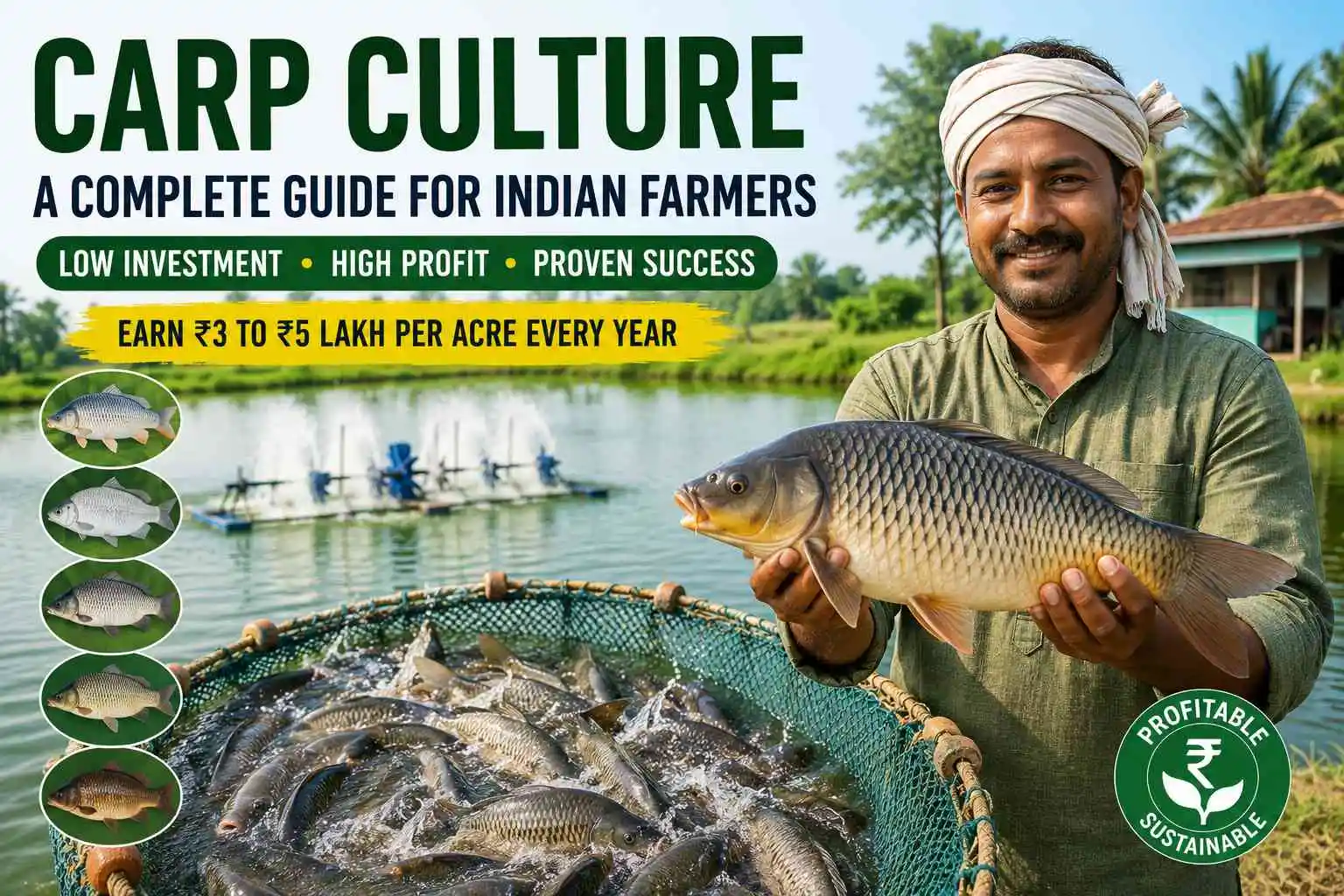

Carp Culture in India: How to Earn ₹3–5 Lakh Per Acre from Your Fish Pond
If you have a pond on your farm — even a small one — you are sitting on gold that you haven’t dug yet. Carp culture is one of the most profitable and time-tested ways for Indian farmers to earn a solid second income. Lakhs of farmers across West Bengal, Andhra Pradesh, Odisha, Bihar, and UP are already making ₹3 to ₹5 lakh per acre every year just from fish farming. And the best part? You don’t need fancy machines or a big degree. You just need the right knowledge and a little hard work.
In this guide, we will walk you through everything — from what carp culture is, which fish to choose, how to prepare your pond, what to feed, and how much money you can really make. Simple language, real numbers, and honest advice. Let’s begin.
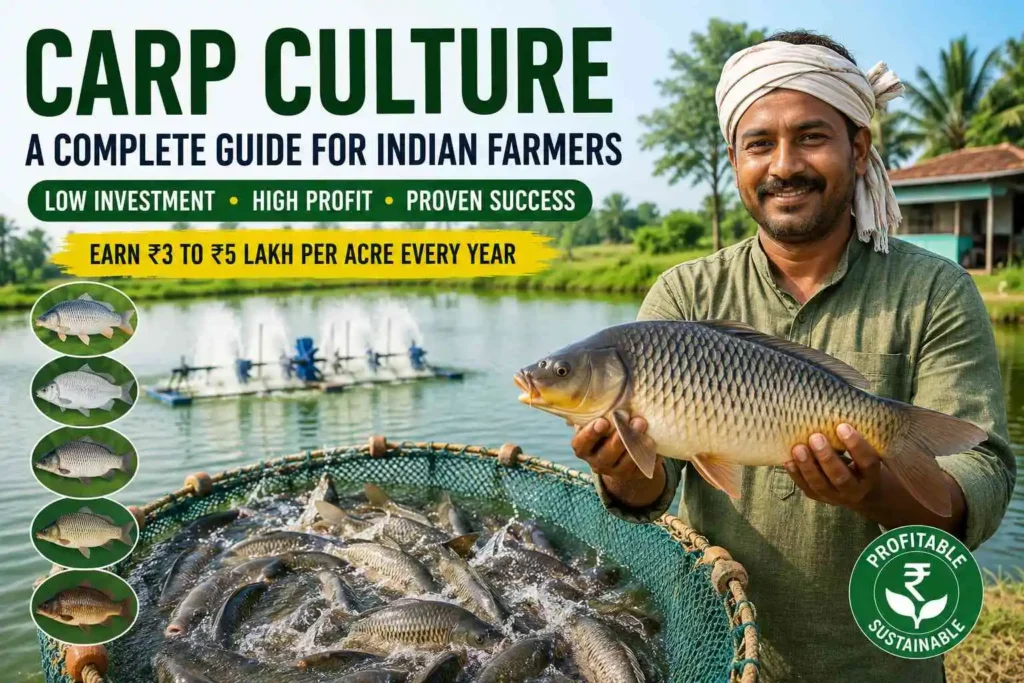
What Is Carp Culture? (And Why Should You Care?)
Carp culture means the farming of carp fish — a group of freshwater fish that grow fast, eat cheap food, and sell well in every Indian market. Carp fish are hardy. They don’t die easily. They can survive in ponds that are not perfect. This is why they are the number one choice for fish farming all over India.
India is the second-largest fish producer in the world. But 65% of that production comes from freshwater aquaculture — and carp fish make up the biggest share of it. So when you do carp culture, you are entering a market that already has crores of buyers and strong government support behind it.
Types of Carp Fish Farmed in India
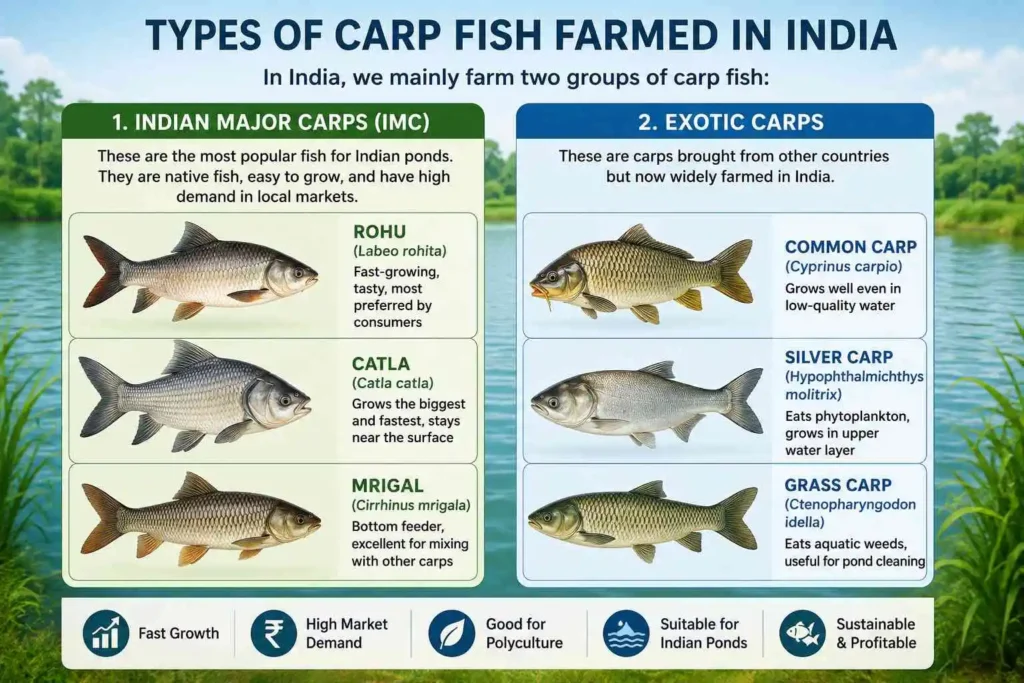
In India, we mainly farm two groups of carp fish:
1. Indian Major Carps (IMC)
These are the most popular fish for Indian ponds. They are native fish, easy to grow, and have high demand in local markets.
- Rohu (Labeo rohita) — Fast-growing, tasty, most preferred by consumers
- Catla (Catla catla) — Grows the biggest and fastest, stays near the surface
- Mrigal (Cirrhinus mrigala) — Bottom feeder, excellent for mixing with other carps
2. Exotic Carps
These are carps brought from other countries but now widely farmed in India.
- Common Carp (Cyprinus carpio) — Grows well even in low-quality water
- Silver Carp (Hypophthalmichthys molitrix) — Eats phytoplankton, grows in upper water layer
- Grass Carp (Ctenopharyngodon idella) — Eats aquatic weeds, useful for pond cleaning
The Magic of Composite Carp Culture (Polyculture)
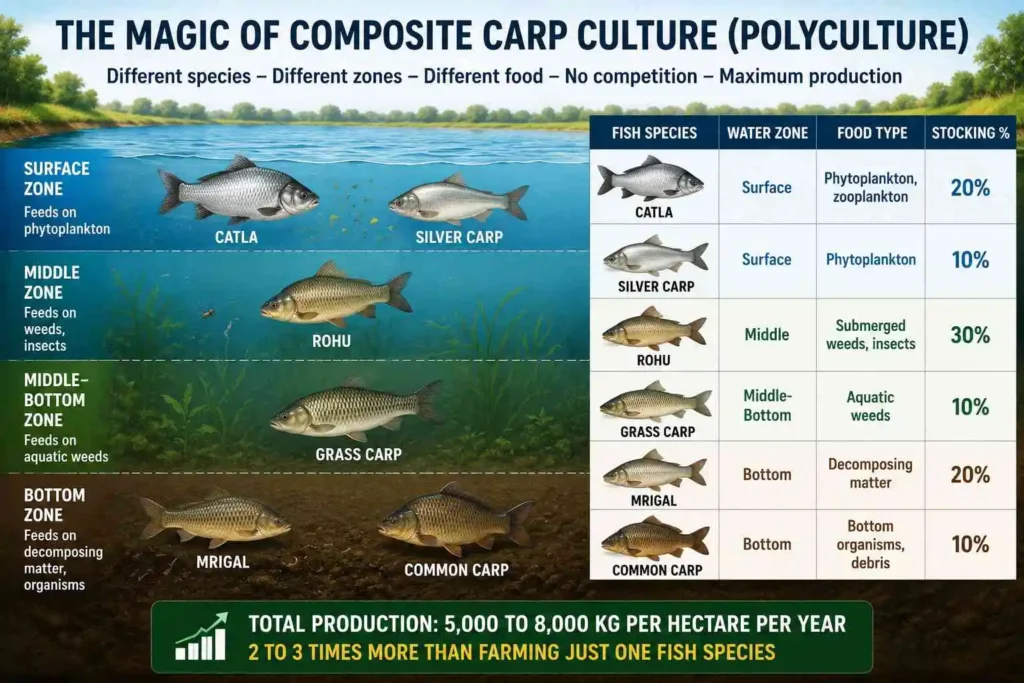
The smartest method in carp culture is called composite fish culture or polyculture. In this method, you don’t raise one type of fish — you raise 5 or 6 species together in the same pond.
Why is this so clever? Because each fish lives in a different zone of the water and eats different food. They don’t compete with each other. This means you use every part of your pond and get maximum production from the same water and the same space.
| Fish Species | Water Zone | Food Type | Stocking % |
|---|---|---|---|
| Catla | Surface | Phytoplankton, zooplankton | 20% |
| Silver Carp | Surface | Phytoplankton | 10% |
| Rohu | Middle | Submerged weeds, insects | 30% |
| Grass Carp | Middle-Bottom | Aquatic weeds | 10% |
| Mrigal | Bottom | Decomposing matter | 20% |
| Common Carp | Bottom | Bottom organisms, debris | 10% |
This combination gives you a total production of 5,000 to 8,000 kg per hectare per year — which is 2 to 3 times more than farming just one fish species.
Step-by-Step Guide to Setting Up Carp Culture
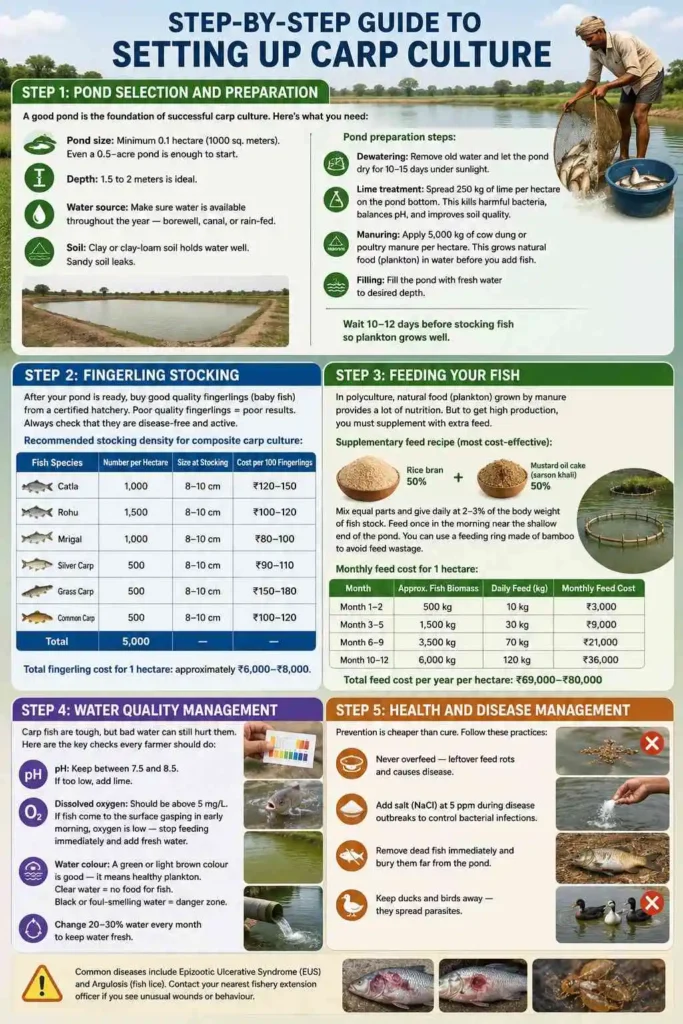
Step 1: Pond Selection and Preparation
A good pond is the foundation of successful carp culture. Here’s what you need:
- Pond size: Minimum 0.1 hectare (1000 sq. meters). Even a 0.5-acre pond is enough to start.
- Depth: 1.5 to 2 meters is ideal.
- Water source: Make sure water is available throughout the year — borewell, canal, or rain-fed.
- Soil: Clay or clay-loam soil holds water well. Sandy soil leaks.
Pond preparation steps:
- Dewatering: Remove old water and let the pond dry for 10–15 days under sunlight.
- Lime treatment: Spread 250 kg of lime per hectare on the pond bottom. This kills harmful bacteria, balances pH, and improves soil quality.
- Manuring: Apply 5,000 kg of cow dung or poultry manure per hectare. This grows natural food (plankton) in water before you add fish.
- Filling: Fill the pond with fresh water to desired depth.
- Wait 10–12 days before stocking fish so plankton grows well.
Step 2: Fingerling Stocking
After your pond is ready, buy good quality fingerlings (baby fish) from a certified hatchery. Poor quality fingerlings = poor results. Always check that they are disease-free and active.
Recommended stocking density for composite carp culture:
| Fish Species | Number per Hectare | Size at Stocking | Cost per 100 Fingerlings |
|---|---|---|---|
| Catla | 1,000 | 8–10 cm | ₹120–150 |
| Rohu | 1,500 | 8–10 cm | ₹100–120 |
| Mrigal | 1,000 | 8–10 cm | ₹80–100 |
| Silver Carp | 500 | 8–10 cm | ₹90–110 |
| Grass Carp | 500 | 8–10 cm | ₹150–180 |
| Common Carp | 500 | 8–10 cm | ₹100–120 |
| Total | 5,000 | — | — |
Total fingerling cost for 1 hectare: approximately ₹6,000–₹8,000.
Step 3: Feeding Your Fish
In polyculture, natural food (plankton) grown by manure provides a lot of nutrition. But to get high production, you must supplement with extra feed.
Supplementary feed recipe (most cost-effective):
- Rice bran: 50%
- Mustard oil cake (sarson khali): 50%
Mix equal parts and give daily at 2–3% of the body weight of fish stock. Feed once in the morning near the shallow end of the pond. You can use a feeding ring made of bamboo to avoid feed wastage.
Monthly feed cost for 1 hectare:
| Month | Approx. Fish Biomass | Daily Feed (kg) | Monthly Feed Cost |
|---|---|---|---|
| Month 1–2 | 500 kg | 10 kg | ₹3,000 |
| Month 3–5 | 1,500 kg | 30 kg | ₹9,000 |
| Month 6–9 | 3,500 kg | 70 kg | ₹21,000 |
| Month 10–12 | 6,000 kg | 120 kg | ₹36,000 |
Total feed cost per year per hectare: ₹69,000–₹80,000
Step 4: Water Quality Management
Carp fish are tough, but bad water can still hurt them. Here are the key checks every farmer should do:
- pH: Keep between 7.5 and 8.5. If too low, add lime.
- Dissolved oxygen: Should be above 5 mg/L. If fish come to the surface gasping in early morning, oxygen is low — stop feeding immediately and add fresh water.
- Water colour: A green or light brown colour is good — it means healthy plankton. Clear water = no food for fish. Black or foul-smelling water = danger zone.
- Change 20–30% water every month to keep water fresh.
Step 5: Health and Disease Management
Prevention is cheaper than cure. Follow these practices:
- Never overfeed — leftover feed rots and causes disease.
- Add salt (NaCl) at 5 ppm during disease outbreaks to control bacterial infections.
- Remove dead fish immediately and bury them far from the pond.
- Keep ducks and birds away — they spread parasites.
- Common diseases include Epizootic Ulcerative Syndrome (EUS) and Argulosis (fish lice). Contact your nearest fishery extension officer if you see unusual wounds or behaviour.
Harvesting and Marketing
When to Harvest
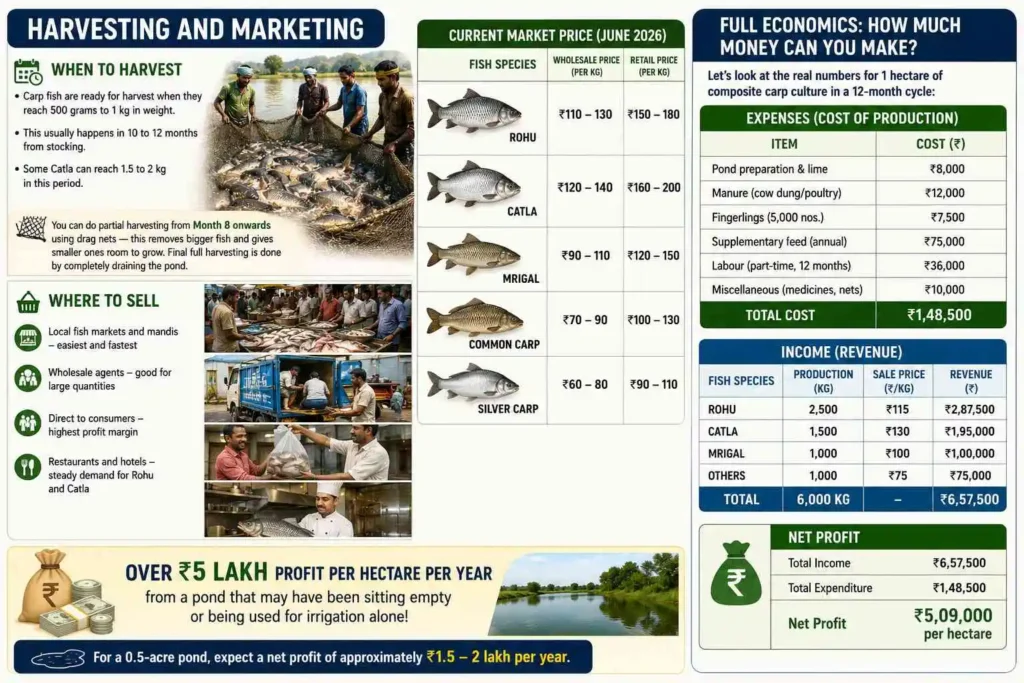
Carp fish are ready for harvest when they reach 500 grams to 1 kg in weight. This usually happens in 10 to 12 months from stocking. Some Catla can reach 1.5 to 2 kg in this period.
You can do partial harvesting from Month 8 onwards using drag nets — this removes bigger fish and gives smaller ones room to grow. Final full harvesting is done by completely draining the pond.
Where to Sell
- Local fish markets and mandis — easiest and fastest
- Wholesale agents — good for large quantities
- Direct to consumers — highest profit margin
- Restaurants and hotels — steady demand for Rohu and Catla
Current market price (June 2026):
| Fish Species | Wholesale Price (per kg) | Retail Price (per kg) |
|---|---|---|
| Rohu | ₹110–130 | ₹150–180 |
| Catla | ₹120–140 | ₹160–200 |
| Mrigal | ₹90–110 | ₹120–150 |
| Common Carp | ₹70–90 | ₹100–130 |
| Silver Carp | ₹60–80 | ₹90–110 |
Full Economics: How Much Money Can You Make?
Let’s look at the real numbers for 1 hectare of composite carp culture in a 12-month cycle:
Expenses (Cost of Production)
| Item | Cost (₹) |
|---|---|
| Pond preparation & lime | ₹8,000 |
| Manure (cow dung/poultry) | ₹12,000 |
| Fingerlings (5,000 nos.) | ₹7,500 |
| Supplementary feed (annual) | ₹75,000 |
| Labour (part-time, 12 months) | ₹36,000 |
| Miscellaneous (medicines, nets) | ₹10,000 |
| Total Cost | ₹1,48,500 |
Income (Revenue)
| Fish Species | Production (kg) | Sale Price (₹/kg) | Revenue (₹) |
|---|---|---|---|
| Rohu | 2,500 | ₹115 | ₹2,87,500 |
| Catla | 1,500 | ₹130 | ₹1,95,000 |
| Mrigal | 1,000 | ₹100 | ₹1,00,000 |
| Others | 1,000 | ₹75 | ₹75,000 |
| Total | 6,000 kg | — | ₹6,57,500 |
Net Profit
| Amount | |
|---|---|
| Total Income | ₹6,57,500 |
| Total Expenditure | ₹1,48,500 |
| Net Profit | ₹5,09,000 per hectare |
That is over ₹5 lakh profit per hectare per year — from a pond that may have been sitting empty or being used for irrigation alone!
For a 0.5-acre pond, expect a net profit of approximately ₹1.5–2 lakh per year.
Government Support for Carp Culture Farmers
The Indian government is actively pushing fish farming through several schemes:
- PM Matsya Sampada Yojana (PMMSY): Up to 40–60% subsidy on pond construction, inputs, and equipment for fish farmers. SC/ST farmers get higher subsidy.
- NFDB (National Fisheries Development Board): Provides subsidised fingerlings and training.
- Kisan Credit Card (KCC): Fish farmers can get up to ₹2 lakh at low interest rates for working capital.
- State Fisheries Departments: Most states offer free or subsidised training camps, free lime, and technical guidance through Block Fisheries Officers.
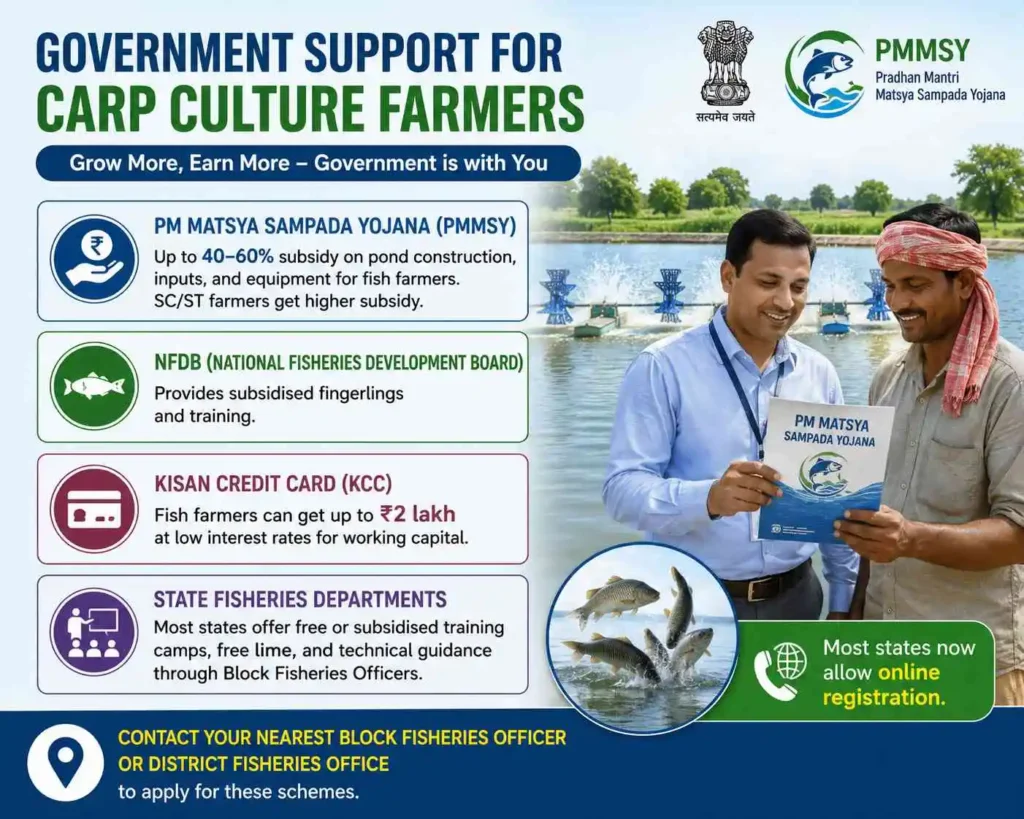
Contact your nearest Block Fisheries Officer or District Fisheries Office to apply for these schemes. Most states now allow online registration.
Tips from Experienced Fish Farmers
Here are a few golden tips passed down by farmers who have been doing carp culture for 10–20 years:
- Start small, learn well. Your first pond should be 0.1 to 0.2 hectare. Master the process before expanding.
- Keep a daily register. Note how much you feed, water colour, any dead fish. This helps you spot problems early.
- Join a fisheries SHG or cooperative. You get better price for your fish and access to bulk inputs at lower cost.
- Never mix wild-caught fish with your stock. They carry diseases.
- Aerate your pond during hot summers. A ₹5,000 paddle wheel aerator can save your entire stock.
Conclusion: Your Pond Is Your ATM
Carp culture is not rocket science. It is a proven farming practice that millions of Indian farmers have used to change their lives. With a proper pond, good fingerlings, regular feeding, and a little care — you can earn more from your fish pond than from many vegetable crops, and with far less day-to-day effort.
The water on your farm is not a waste of land. It is a resource waiting to be used. Fish farming through composite carp culture gives you a steady income, uses your farm pond productively, and fits naturally alongside your existing crops and livestock.
Start today. Talk to your local fisheries officer. Stock your pond this season. Your first lakh from fish farming is closer than you think.
Interested in higher-profit aquaculture? While carp culture is reliable and beginner-friendly, shrimp farming can offer even higher returns in suitable regions, Read our complete Shrimp Farming Guide to compare both opportunities and choose the best fit for your farm.
Frequently Asked Questions (FAQ) About Carp Culture in India
Which carp fish is most profitable in India?
Rohu and Catla are generally the most profitable because they have strong consumer demand and often fetch higher market prices than other carp species.
How much land is required to start carp farming?
You can start with a pond as small as 0.1 hectare (1,000 sq. meters). Even a 0.5-acre farm pond can generate a useful additional income when managed properly.
How much does it cost to start carp culture?
The initial investment depends on pond size, stocking density, and feeding practices. For a 1-hectare pond, annual production costs typically range between ₹1.3 lakh and ₹1.8 lakh.
How long does it take for carp fish to reach market size?
Most carp species reach a harvestable size of 500 grams to 1 kilogram within 10 to 12 months under proper feeding and pond management.
Newsletter