


Mineral Mixture for Goats: What Every Farmer Should Actually Know
A goat can clean its feed trough every single day, look reasonably healthy, and still fall short on growth, breeding, or milk. Feed intake and nutrition are not the same thing. A doe can be eating plenty of green fodder and grain and still be running on empty when it comes to calcium, phosphorus, zinc, or copper — the things that don’t show up as “hunger” but quietly control how well her body actually functions.
This is the part that trips up a lot of small and mid-sized goat farms. Farmers watch feed quantity closely, sometimes obsessively, but treat mineral mixture as an afterthought — a bag on the shelf that gets sprinkled in “when the goat looks weak.” Some farmers assume a salt lick covers it. Others assume more mineral powder means faster growth, which is its own expensive mistake.
This guide walks through why mineral nutrition matters, how deficiency actually shows up in a goat, how to pick a mineral mixture that’s worth the money, how much to feed and when, and the mistakes that quietly drain a farm’s profitability. None of this replaces a vet or a livestock nutritionist — think of it as the groundwork that lets you ask them better questions.
Why Mineral Nutrition Can Make a Bigger Difference Than Farmers Expect
Here’s the part many farmers overlook: minerals aren’t a “bonus” nutrient sitting on top of the real diet. They’re structural. Bone formation, muscle contraction, nerve signaling, enzyme activity, immune response, and hormone production all depend on adequate mineral supply. A goat can have a decent energy and protein intake and still underperform badly if the mineral side of the diet is off.
This matters most in situations where farmers expect the biggest returns — breeding, pregnancy, lactation, and kid growth. A doe short on calcium and phosphorus during late pregnancy isn’t going to announce it with a sign; she’s going to give you a weak kid, a difficult kidding, or a slow start to lactation. By the time symptoms are obvious, the cost has usually already been paid.
Did You Know? Green fodder and grain can supply plenty of energy and protein while still being poor sources of certain trace minerals — plant mineral content depends heavily on the soil the fodder was grown in.
What Exactly Does Mineral Mixture Do Inside a Goat’s Body?
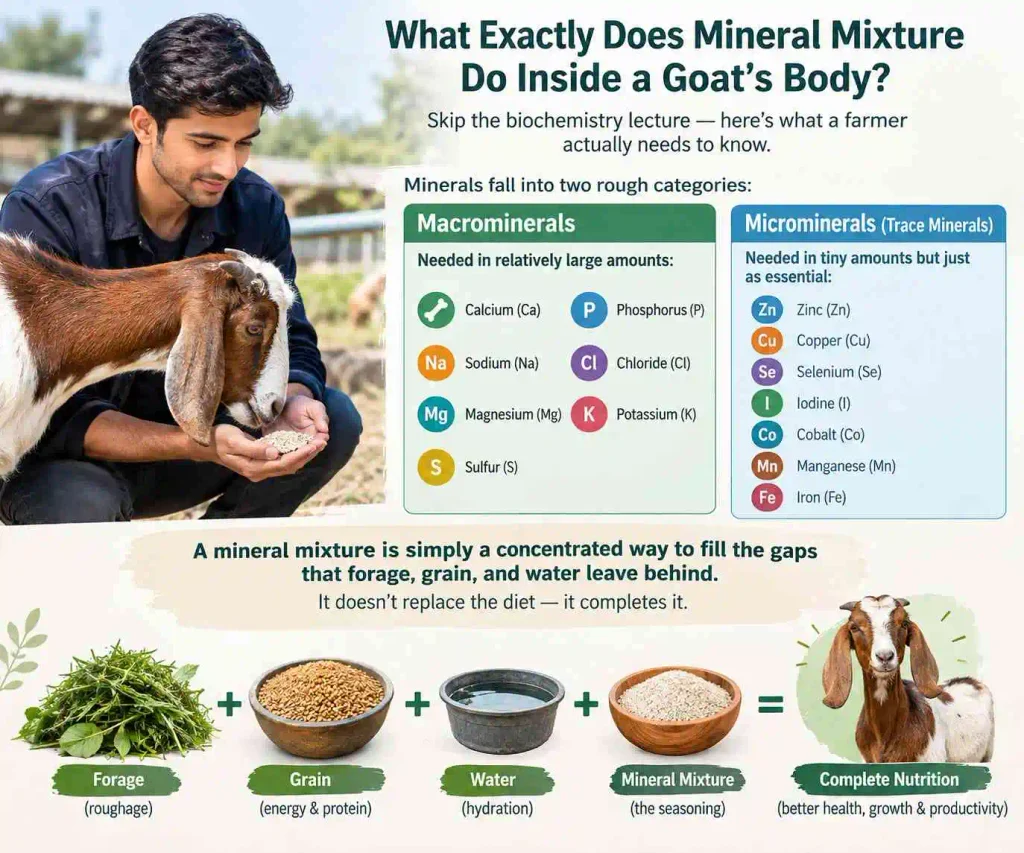
Skip the biochemistry lecture — here’s what a farmer actually needs to know. Minerals fall into two rough categories:
- Macrominerals — needed in relatively large amounts: calcium, phosphorus, sodium, chloride, magnesium, potassium, sulfur.
- Microminerals (trace minerals) — needed in tiny amounts but just as essential: zinc, copper, selenium, iodine, cobalt, manganese, iron.
A mineral mixture is simply a concentrated way to fill the gaps that forage, grain, and water leave behind. It doesn’t replace the diet — it completes it. Think of the main ration as the meal and the mineral mixture as the seasoning that makes the meal actually usable by the body.
Which Minerals Do Goats Actually Need?
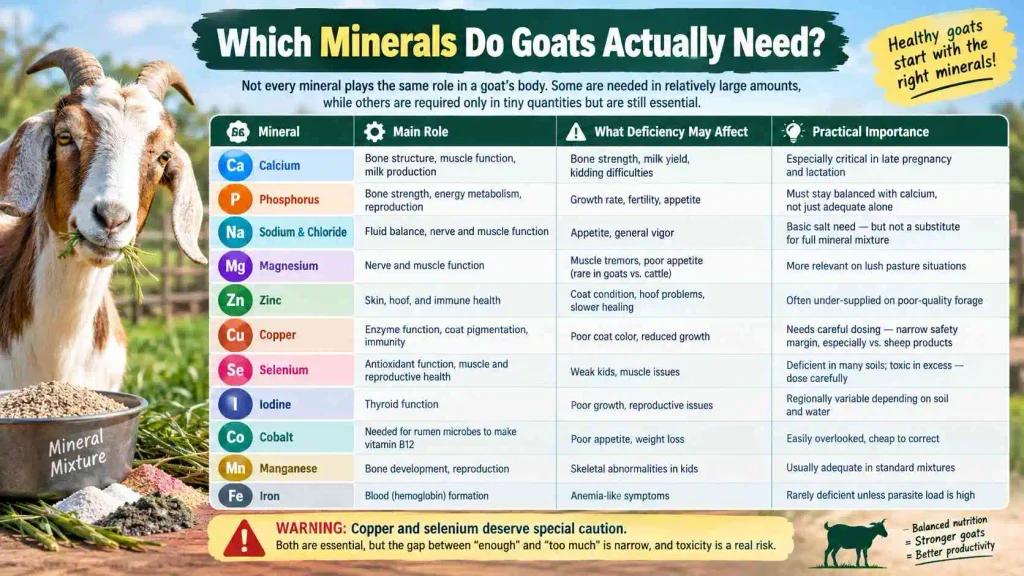
Not every mineral plays the same role in a goat’s body. Some are needed in relatively large amounts, while others are required only in tiny quantities but are still essential. The table below gives farmers a practical overview.
| Mineral | Main Role | What Deficiency May Affect | Practical Importance |
|---|---|---|---|
| Calcium | Bone structure, muscle function, milk production | Bone strength, milk yield, kidding difficulties | Especially critical in late pregnancy and lactation |
| Phosphorus | Bone strength, energy metabolism, reproduction | Growth rate, fertility, appetite | Must stay balanced with calcium, not just adequate alone |
| Sodium & Chloride | Fluid balance, nerve and muscle function | Appetite, general vigor | Basic salt need — but not a substitute for full mineral mixture |
| Magnesium | Nerve and muscle function | Muscle tremors, poor appetite (rare in goats vs. cattle) | More relevant on lush pasture situations |
| Zinc | Skin, hoof, and immune health | Coat condition, hoof problems, slower healing | Often under-supplied on poor-quality forage |
| Copper | Enzyme function, coat pigmentation, immunity | Poor coat color, reduced growth | Needs careful dosing — narrow safety margin, especially vs. sheep products |
| Selenium | Antioxidant function, muscle and reproductive health | Weak kids, muscle issues | Deficient in many soils; toxic in excess — dose carefully |
| Iodine | Thyroid function | Poor growth, reproductive issues | Regionally variable depending on soil and water |
| Cobalt | Needed for rumen microbes to make vitamin B12 | Poor appetite, weight loss | Easily overlooked, cheap to correct |
| Manganese | Bone development, reproduction | Skeletal abnormalities in kids | Usually adequate in standard mixtures |
| Iron | Blood (hemoglobin) formation | Anemia-like symptoms | Rarely deficient unless parasite load is high |
Warning: Copper and selenium deserve special caution. Both are essential, but the gap between “enough” and “too much” is narrow, and toxicity is a real risk — never combine multiple supplement sources without checking total mineral load first.
Calcium and Phosphorus: Why the Balance Matters
This is one of the most misunderstood parts of goat nutrition. Farmers often ask whether they’re giving “enough” calcium or phosphorus, but the more important question is the ratio between the two. Goats generally do best with more calcium than phosphorus in the diet, not less — an inverted ratio, where phosphorus outweighs calcium, is a common cause of urinary stones in male goats, especially those on heavy grain diets.
This is exactly why a decent commercial mineral mixture, rather than a random calcium or phosphorus powder bought on its own, tends to be the safer choice for most farms. It’s formulated to keep this ratio in a reasonable range instead of leaving it to guesswork.
Why Salt Alone Isn’t Enough
This question comes up constantly: is salt the same as mineral mixture? No. Salt supplies sodium and chloride — two minerals goats do need — but nothing beyond that. A goat licking a plain salt block is not getting calcium, phosphorus, zinc, copper, selenium, or any of the trace minerals a proper mixture provides.
Salt alone will keep a goat drinking water and eating normally. It will not prevent the reproductive, growth, or bone problems that come from missing trace minerals. If cost is the concern, a basic goat-specific mineral mixture is still a better investment than salt alone stretched further.
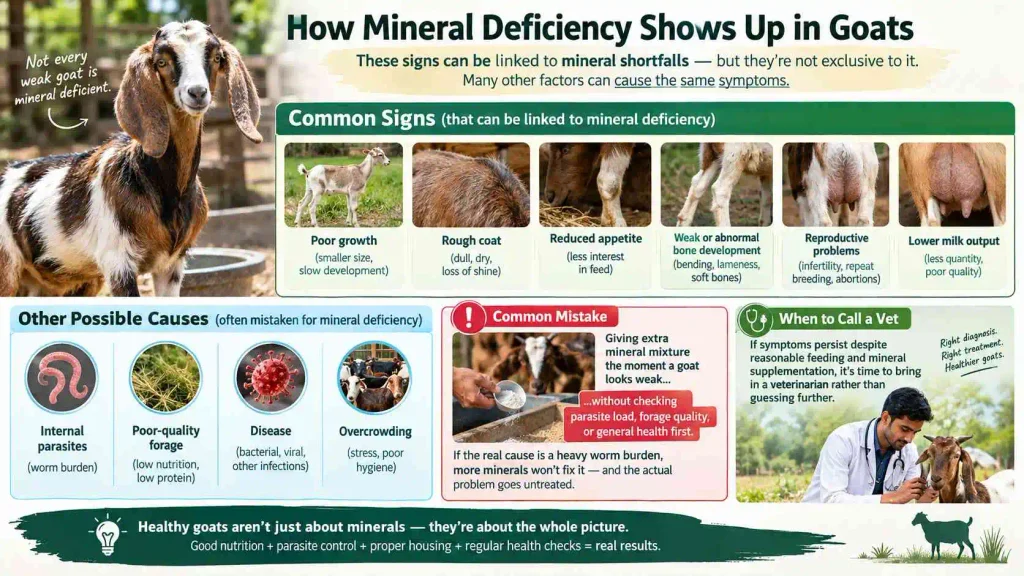
How Mineral Deficiency Shows Up in Goats
This is where farmers most often go wrong — assuming any weak or unthrifty goat must be mineral-deficient. Symptoms that can be associated with mineral shortfalls include poor growth, rough coat, reduced appetite, weak or abnormal bone development, reproductive problems, and lower milk output.
But every one of these symptoms can also be caused by internal parasites, poor-quality forage, disease, or simple overcrowding. Mineral deficiency is one possible explanation among several — not an automatic diagnosis.
Common Mistake: Giving extra mineral mixture the moment a goat looks weak, without checking parasite load, forage quality, or general health first. If the real cause is a heavy worm burden, more minerals won’t fix it — and the actual problem goes untreated.
If symptoms persist despite reasonable feeding and mineral supplementation, that’s the point to bring in a veterinarian rather than guessing further.
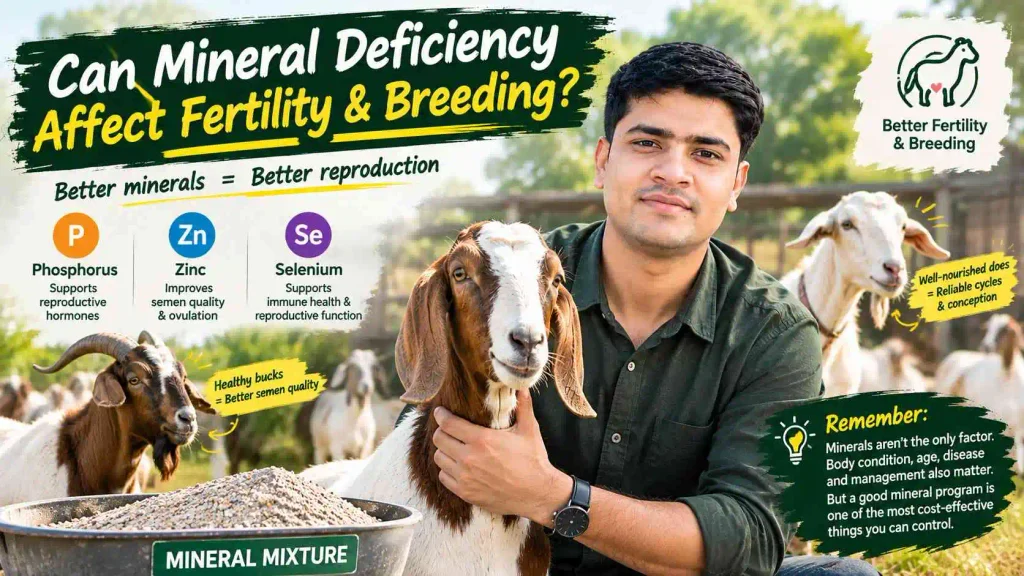
Can Mineral Deficiency Affect Fertility and Breeding?
Yes, mineral status is one of several factors that can influence fertility, though it’s rarely the only factor. Phosphorus, zinc, and selenium in particular are linked to reproductive performance in goats — bucks with adequate mineral status tend to maintain better semen quality, and does with a well-balanced mineral intake tend to cycle and conceive more reliably.
This doesn’t mean every fertility problem traces back to minerals. Body condition, age, disease, and management all play a role too. But a mineral program is one of the more cost-effective things a farmer can control directly, which makes it worth getting right before assuming a more complicated cause.
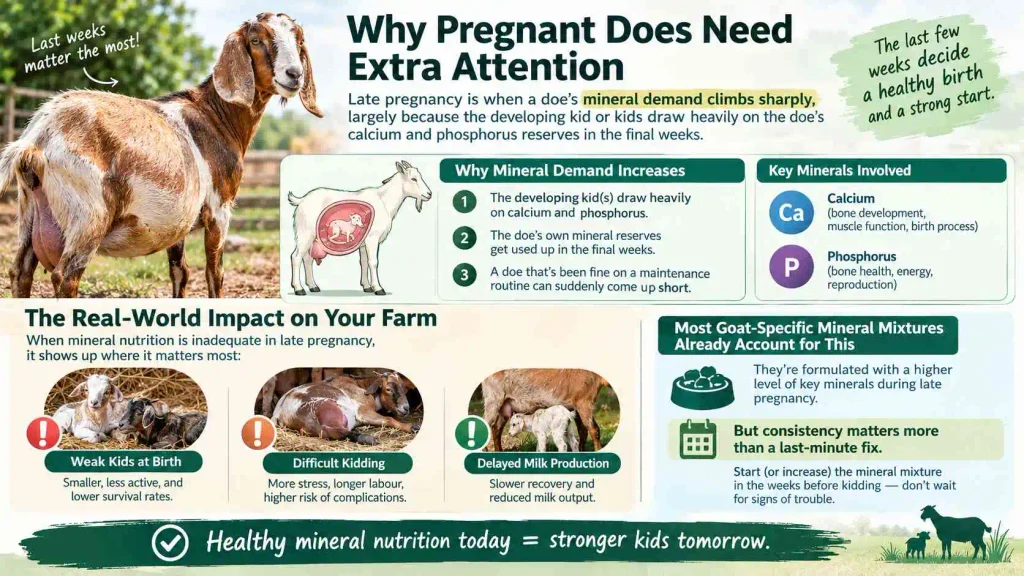
Why Pregnant Does Need Extra Attention
Late pregnancy is when a doe’s mineral demand climbs sharply, largely because the developing kid or kids draw heavily on the doe’s calcium and phosphorus reserves in the final weeks. A doe that’s been fine on a maintenance-level mineral routine for months can suddenly come up short exactly when it matters most.
From a farm-management perspective, this is the stage where cutting corners costs the most: weak kids at birth, difficult kidding, and a slow, delayed start to milk production are all more likely when late-pregnancy mineral nutrition is inadequate. Most goat-specific mineral mixtures already account for higher demand during this stage — but consistency in the weeks before kidding matters more than a last-minute correction.
What Changes During Lactation?
Milk production pulls a large, continuous amount of calcium and other minerals out of the doe’s body every single day. A lactating doe on a maintenance mineral routine designed for a dry, non-pregnant goat is very likely being under-supplied.
The practical answer is simple: mineral intake should scale up with production stage, not stay flat year-round. This is one of the reasons “just give the same handful every day regardless of the goat’s status” is a common and costly shortcut.
Do Growing Kids Need Mineral Mixture?
Yes — and this is one of the most frequently asked questions on small farms. Kids are building bone and muscle at a fast rate, and inadequate mineral supply during this window can show up later as poor frame size, weak legs, or delayed puberty. Kids should generally be introduced to a small, appropriate amount of mineral mixture once they’re eating solid feed reliably, not only once they’re fully weaned.
That said, a kid’s requirement is not the same as an adult goat’s. Overloading a young kid with a mixture formulated at adult feeding rates isn’t a shortcut to faster growth — it’s a way to create imbalances. Follow product labeling for young stock, or ask a nutritionist for a kid-appropriate rate.
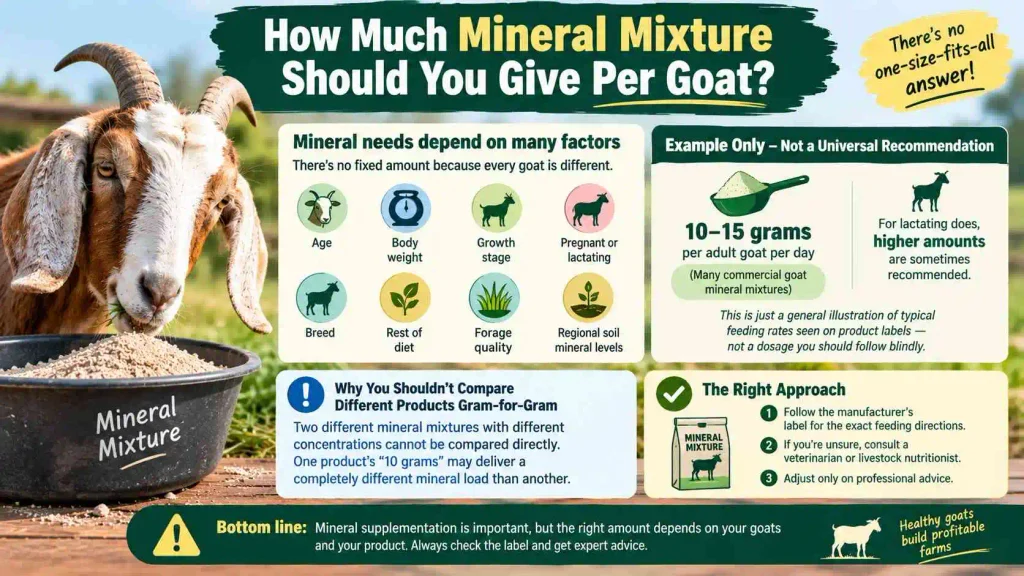
How Much Mineral Mixture Should You Give Per Goat?
This is the single most common question, and it’s also the one with no universal answer. Mineral requirement depends on the goat’s age, body weight, growth stage, whether she’s pregnant or lactating, breed, the rest of her diet, forage quality, and even regional soil mineral levels.
Example only — not a universal recommendation: many commercial goat mineral mixtures are formulated to be fed at roughly 10–15 grams per adult goat per day, with higher amounts sometimes recommended for lactating does. This is a general illustration of typical feeding rates seen on product labels, not a dosage Claude — or any article — can responsibly tell you to follow blindly.
The actual number that matters is the one printed on your specific product’s feeding directions. Two different mineral mixtures with different concentrations cannot be compared gram-for-gram; one product’s “10 grams” may deliver a completely different mineral load than another’s. When in doubt, follow the manufacturer’s label, and adjust only on the advice of a veterinarian or livestock nutritionist.
Should Mineral Mixture Be Given Daily?
Generally, yes — mineral nutrition works best as a consistent daily habit rather than an occasional dose. Minerals aren’t stored the same way fat or energy reserves are; several of them need to be replenished regularly to keep blood and tissue levels stable.
Practical Tip: Build mineral feeding into whatever routine already happens daily — the morning concentrate feeding, for instance — so it doesn’t depend on someone remembering a separate task.
Mineral Mixture in Feed vs Free-Choice Feeding
There are two broad approaches:
- Mixed into concentrate feed — a measured amount is added to the daily grain ration, ensuring every goat gets a known, controlled dose.
- Free-choice mineral feeders — goats access mineral mixture on their own from a feeder, self-regulating intake.
Mixing into concentrate gives farmers better control over exact dosage per goat, which matters most on smaller farms where individual animals can be monitored. Free-choice feeders work reasonably well on larger herds but come with a real risk: dominant goats may over-consume while shy or lower-ranking goats under-consume. If you go free-choice, keep an eye on whether feeders are being emptied unevenly.
How to Choose a Good Mineral Mixture
Choosing well comes down to what you can actually check on the packet, not marketing claims.
Not every mineral mixture on the shelf is built the same way, and price alone tells you very little. The table below gives farmers a practical checklist.
| What to Check | Why It Matters | What Farmers Should Look For |
|---|---|---|
| Guaranteed analysis | Tells you actual mineral content, not just marketing terms | Clear listing of calcium, phosphorus, and trace minerals with percentages |
| Calcium:phosphorus ratio | Wrong ratio can contribute to urinary stones or bone issues | A ratio favoring calcium over phosphorus, generally |
| Target species | A cattle or sheep mineral is not automatically safe for goats | Product labeled specifically for goats, or explicitly multi-species safe |
| Feeding rate | Determines real daily dosage and cost | Clear grams-per-animal-per-day instructions |
| Manufacturing/expiry date | Old or degraded mixtures may lose potency | Recent manufacturing date, valid shelf life remaining |
| Manufacturer reputation | Consistency and quality control vary widely | Established brand with consistent batch quality |
| Cost per goat per day | The packet price alone is misleading | Calculate actual daily cost, not just bag price |
Expert Tip: Don’t judge a mineral mixture only by the price of the packet. Calculate the approximate cost per goat per day — a slightly pricier product fed at a lower daily rate can end up cheaper overall.
What Should You Check on the Label on Mineral Mixture for Goats?
Beyond the checklist above, look specifically for the calcium and phosphorus percentages listed side by side, confirmation that trace minerals (zinc, copper, selenium, iodine, cobalt, manganese) are actually listed rather than vaguely implied, and whether the product states it’s suitable for goats specifically. Products formulated primarily for sheep, for instance, are often lower in copper — sheep are far more sensitive to copper toxicity than goats — so a sheep mineral mix may under-supply copper for a goat’s actual needs.
Chelated Minerals: Are They Worth Paying More For?
Chelated (organically bound) trace minerals are marketed as being better absorbed than standard inorganic mineral sources. There’s reasonable research support for improved absorption of some chelated trace minerals in various livestock species, though the practical, on-farm benefit for goats specifically can vary and isn’t guaranteed to translate into a dramatic visible difference.
For most small farmers, a well-formulated standard goat mineral mixture, fed consistently and correctly, will address the majority of everyday needs. Chelated products may be worth considering in specific situations — known trace mineral deficiencies confirmed by a vet, high-producing dairy herds, or breeding operations chasing marginal improvements — but they’re not a mandatory upgrade for every farm.
Can You Give Mineral Mixture With Concentrate Feed?
Yes, and for many small farms this is the simplest and most reliable method. Mixing the daily mineral dose into concentrate feed ensures it’s actually consumed rather than left in a feeder untouched. The key is measuring the amount correctly rather than eyeballing a handful — a kitchen measuring spoon or a small scale takes the guesswork out.
Can You Give Salt and Mineral Mixture Together?
Generally, yes — plain salt and a complete mineral mixture aren’t the same thing and don’t automatically overlap in a harmful way, since most mineral mixtures already account for typical salt needs. That said, avoid stacking multiple mineral products together (say, a mineral mixture plus a separate trace mineral premix) without checking total mineral load, since that’s where accidental over-supplementation happens.
What Happens If You Give Too Much?
More mineral mixture is not automatically better. Excess supplementation isn’t just wasted money — some minerals, copper and selenium in particular, have a narrow margin between an adequate dose and a toxic one. Overdosing on copper, for instance, can cause serious illness in goats, and it tends to build up in the liver over time rather than showing symptoms immediately.
Warning: More mineral mixture isn’t automatically better. Some minerals can become harmful when consumed excessively, and the effects aren’t always immediate — damage can accumulate silently before symptoms appear.
If you suspect a goat has consumed an excessive amount — whether from a feeding error or an unsupervised feeder — contact a veterinarian promptly rather than waiting to see if symptoms develop.
Common Mineral Feeding Mistakes Goat Farmers Make
| Mistake | Why It Matters | What to Do Instead |
|---|---|---|
| Guessing the dose instead of measuring | Both under- and over-dosing cause real problems | Use a scale or measuring spoon, follow the label |
| Using a cattle or sheep mineral for goats | Different species have different mineral needs and tolerances | Choose a product labeled for goats, or confirmed safe by the manufacturer |
| Choosing based on price alone | Cheapest packet may mean a higher effective daily cost | Calculate cost per goat per day, not per bag |
| Assuming salt replaces mineral mixture | Salt only supplies sodium and chloride | Provide a complete mineral mixture, with salt separately if needed |
| Combining multiple mineral products | Risk of unintentional overdose, especially copper/selenium | Stick to one complete product unless a professional advises otherwise |
| Ignoring the rest of the diet | Minerals can’t fix a poor-quality overall ration | Treat mineral mixture as one part of a balanced feeding plan |
| Storing mixture in damp conditions | Moisture can degrade quality and encourage spoilage | Store in a dry, sealed container away from direct sunlight |
| Supplementing only when a goat looks sick | Deficiency develops gradually, not overnight | Make mineral feeding a consistent daily routine |
| Assuming every goat needs the same amount | Requirements shift with age, weight, and production stage | Adjust for pregnancy, lactation, and growth stage |
| Ignoring vet advice on serious symptoms | Some conditions need diagnosis, not more supplementation | Involve a vet when symptoms are severe or persistent |
How to Build a Simple Mineral Supplement Routine
For most small farms, the simplest approach is usually to pick a reputable, goat-specific mineral mixture, follow the label’s feeding rate, and fold it into whatever feeding routine already happens daily — rather than treating it as a separate task that’s easy to forget.
A workable routine looks something like this:
- Choose a goat-specific product and read the guaranteed analysis and feeding directions.
- Measure the daily dose per goat rather than estimating by eye.
- Mix it into the concentrate feed at the same time each day, or provide it via a dedicated free-choice feeder if managing a larger herd.
- Adjust the amount for pregnant or lactating does according to label guidance.
- Keep the supply dry, covered, and away from direct sun or rain.
- Watch goats over time — coat condition, growth, breeding success — rather than expecting instant visible change.
- Bring in a vet or nutritionist if problems persist despite consistent supplementation.
Mineral Management for Small vs Large Goat Farms
| Farm Size | Why Mineral Nutrition Matters | What to Pay Attention To |
|---|---|---|
| Small farm (a handful of goats) | Individual attention is realistic; mistakes are cheaper to catch early | Measuring doses accurately; mixing into daily concentrate feed |
| Large farm (large herd) | Small per-goat errors multiply across the whole herd | Free-choice feeder placement and monitoring; batch consistency; cost per goat tracking |
How Much Does Mineral Supplementation Actually Cost?
This is where the economics matter as much as the biology. The basic calculation is straightforward:
Daily mineral cost per goat = price per kg ÷ 1,000 × grams fed per day
So, purely as an illustration: if a mineral mixture costs a certain amount per kilogram and a goat is fed roughly 12 grams a day, dividing the per-kg price by 1,000 and multiplying by 12 gives the approximate daily cost for that one goat. Multiply that by herd size for a monthly or annual figure.
This is where the “cheapest packet” mistake becomes clear. A product priced lower per kilogram but requiring a higher daily feeding rate to meet the same mineral targets can end up costing more per goat per day than a pricier product fed at a lower rate. Compare cost per goat per day, not cost per bag, before deciding.
It’s reasonable to weigh this cost against the potential downside of inadequate mineral nutrition — slower growth, weaker kids, reduced conception rates — but there’s no guaranteed dollar-for-dollar return to promise. Mineral supplementation reduces risk; it doesn’t manufacture guaranteed profit on its own.
Bringing It All Together
Mineral mixture works best when it’s treated as one working part of a properly balanced goat-feeding system — not as an emergency fix pulled out whenever a goat looks off. The goats that do best over time are usually the ones on a boring, consistent routine: an appropriate goat-specific mineral product, fed at the labeled rate, adjusted for pregnancy and lactation, stored properly, and backed up by decent forage, clean water, and normal veterinary care.
If you’re running a small herd, keep it simple: pick one reputable product, measure the dose, feed it daily, and watch your goats over months rather than days. It also helps to know where minerals fit alongside the rest of the diet — this goat feed price list and feeding chart is a useful reference for seeing typical feed types, costs, and quantities side by side, so mineral supplementation doesn’t end up being the only thing you’re tracking closely.
If something still looks wrong despite doing all this consistently, that’s the moment to call in a vet rather than reaching for a second supplement. Minerals support a healthy goat — they don’t replace the rest of good farming.
Newsletter