

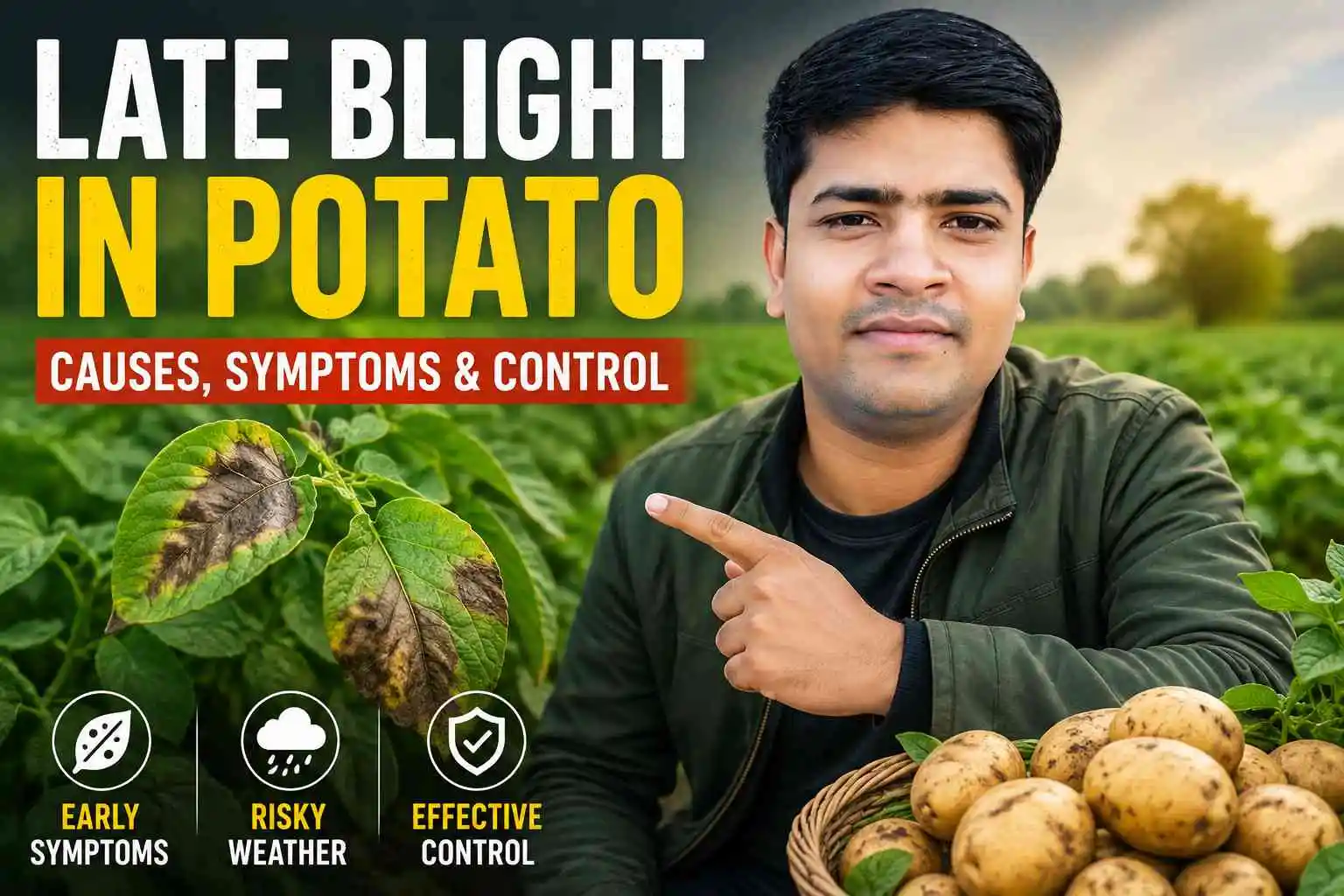

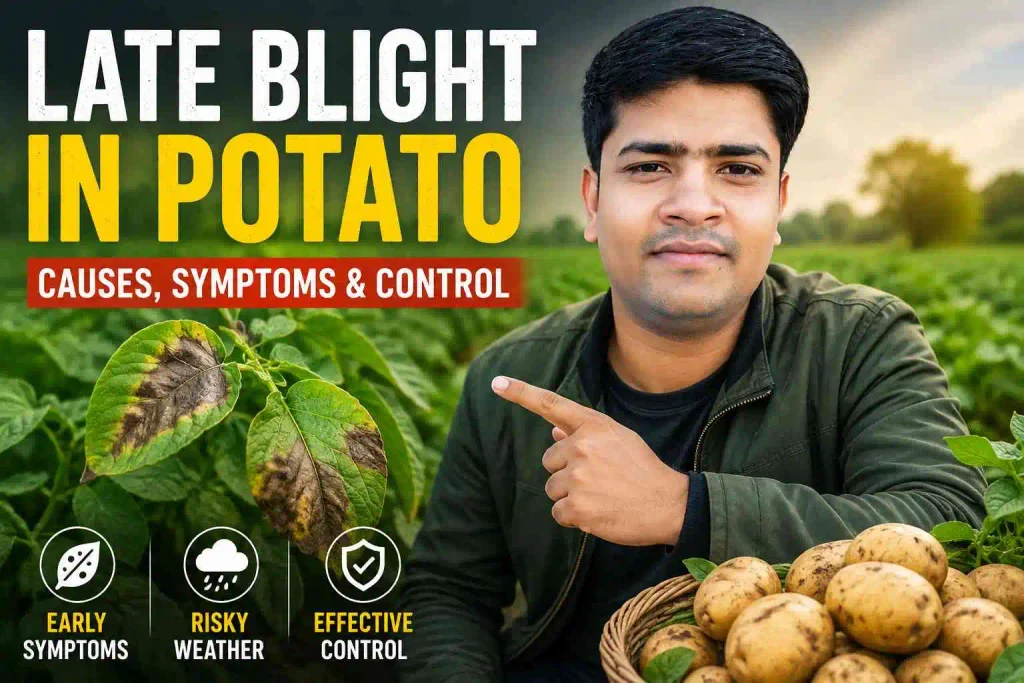
Late Blight in Potato: Causes, Symptoms & Control
A potato field can look completely fine on a Monday evening and noticeably worse by Thursday morning. That’s the nature of late blight. Under the right combination of cool nights, humid air, and a wet canopy, this disease doesn’t creep — it accelerates. Leaves that were green and healthy develop dark, water-soaked patches, and within a week those patches can join together and collapse entire sections of foliage.
For potato growers, that speed is exactly why late blight deserves more attention than almost any other foliar disease in the crop. It doesn’t just nibble away at yield the way some diseases do. Left unmanaged during a favorable spell of weather, it can reduce the crop’s ability to build tuber size and, in some cases, move into the tubers themselves, affecting quality in storage. That doesn’t mean every infection ends in disaster — many fields recover well when growers catch the disease early and respond properly. But the window to act is often shorter than farmers expect.
This article walks through what late blight actually is, how to recognize it in the field before it becomes obvious to everyone, what weather conditions tip the balance in the pathogen’s favor, and how to build a practical, integrated response — from scouting routines to fungicide rotation — suited to Indian potato-growing conditions. By the end, you should be able to look at your own field and know exactly what to check for and when to act.
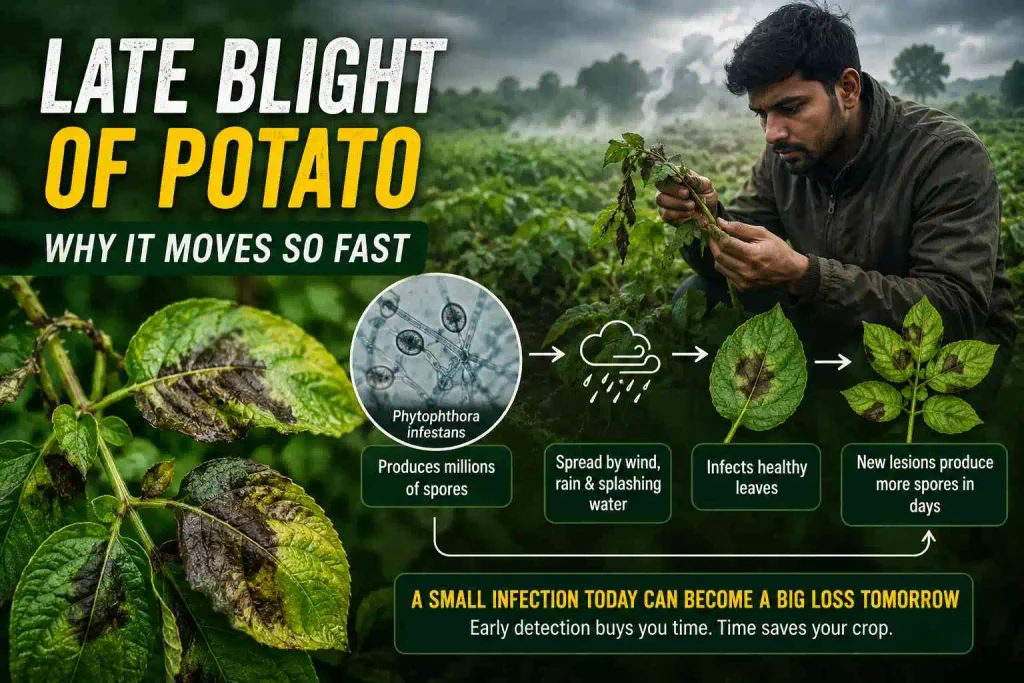
Late Blight Disease of Potato: Why It Moves Through a Field So Fast
Here’s why this disease behaves differently from most other potato problems: it isn’t caused by a typical fungus. Late blight is caused by Phytophthora infestans, an oomycete pathogen — biologically closer to water molds than to the fungi that cause diseases like early blight. That distinction matters practically, not just academically, because it’s part of why the disease spreads so aggressively under moist conditions and why certain fungicide chemistries work against it while others don’t.
Understanding how Phytophthora infestans in potato behaves is what makes the rest of this guide useful. The pathogen reproduces by producing large numbers of spores on infected leaf tissue, and under cool, humid conditions those spores are released and carried by wind and splashing water to healthy leaves nearby — sometimes across an entire field within a single humid night. Each new infection site can, in turn, start producing its own spores within days. That’s the compounding effect that catches growers off guard: a handful of lesions on a Monday can represent dozens of new infection points by the weekend if the weather stays favorable.
Did You Know? Unlike many fungal pathogens that need free water only to germinate, Phytophthora infestans spores can also spread short distances through wind-driven rain and fog, which is why the disease can appear in low-lying or shaded parts of a field first.
Takeaway: Treat late blight as a race against compounding spread, not a slow-moving problem. Early detection buys you options; late detection narrows them.
Potato Late Blight Symptoms: The First Signs Farmers Often Miss
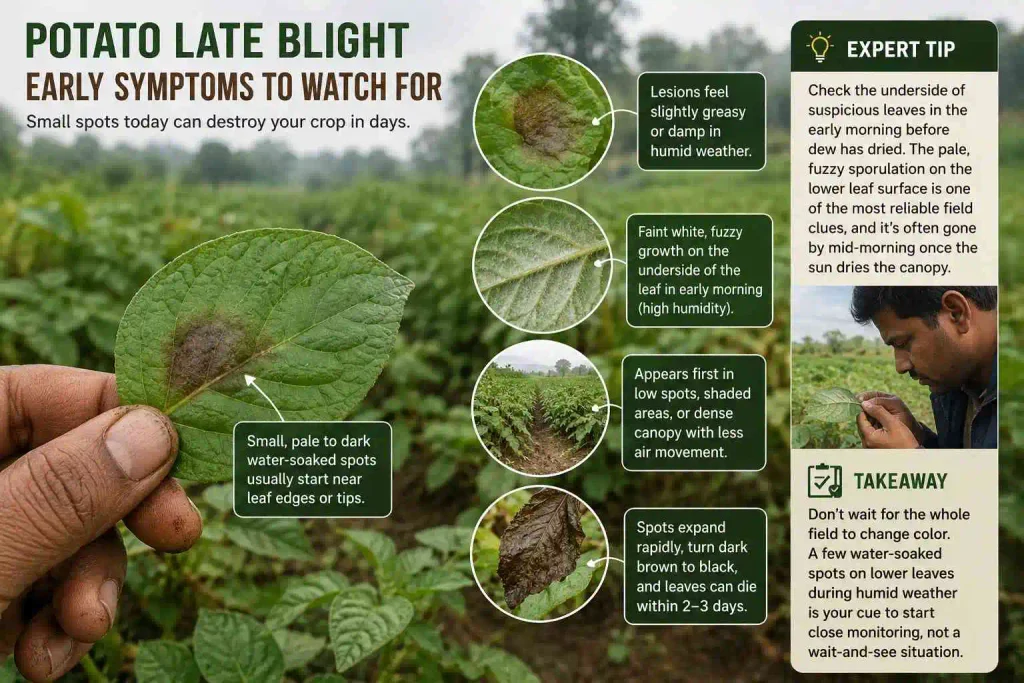
This is where many growers struggle — not because the symptoms are invisible, but because early lesions don’t look dramatic. A single small, irregular, water-soaked spot on a lower or mid-canopy leaf is easy to walk past, especially if the rest of the plant looks healthy.
Early symptoms typically include:
- Small, pale to dark green, water-soaked spots, often starting near leaf edges or tips
- Lesions that feel slightly greasy or damp to the touch in humid weather
- A faint white, fuzzy growth on the underside of the leaf directly beneath the lesion, usually visible in early morning when humidity is highest
- Symptoms that appear first in low spots, shaded areas, or parts of the field with denser canopy and less air movement
Under favorable weather, these small spots don’t stay small. They expand rapidly, turn dark brown to black, and the tissue around them collapses. Whole leaflets can die within two to three days once conditions stay cool and humid.
Expert Tip: Check the underside of suspicious leaves in the early morning before dew has dried. The pale, fuzzy sporulation on the lower leaf surface is one of the most reliable field clues, and it’s often gone by mid-morning once the sun dries the canopy.
Takeaway: Don’t wait for the whole field to change color. A few water-soaked spots on lower leaves during humid weather is your cue to start close monitoring, not a wait-and-see situation.
Late Blight Symptoms on Potato Leaves and Stems: What to Expect as It Develops
As the disease develops, symptoms become more recognizable, but they can also vary depending on cultivar, crop stage, and how long favorable weather has persisted.
On leaves, lesions expand into larger, irregular, brown-to-black patches, often with a pale green or yellow halo at the margin where healthy tissue is still being invaded. In humid weather, the characteristic white sporulation ring can be seen at the edge of actively expanding lesions — this is the pathogen actively producing new spores, and it’s a sign the infection is still spreading.
On stems and petioles, look for dark brown to black lesions that can girdle the stem. Once a stem lesion fully encircles the tissue, everything above that point often collapses, even if the leaf tissue further down still looks reasonably healthy.
Under sustained wet weather, an entire field can take on a scorched, blackened appearance within a week or two — sometimes described as a “burned” look from a distance. This is why late blight is sometimes still referred to by its historical name, potato blight, associated with major crop losses in the 19th century. It’s worth remembering that outcome isn’t automatic — it happens specifically when infection goes unmanaged through an extended favorable period.
Takeaway: Learn to distinguish early lesions (small, water-soaked, isolated) from established infection (large, blackened, girdling stems) — your management options are very different at each stage.
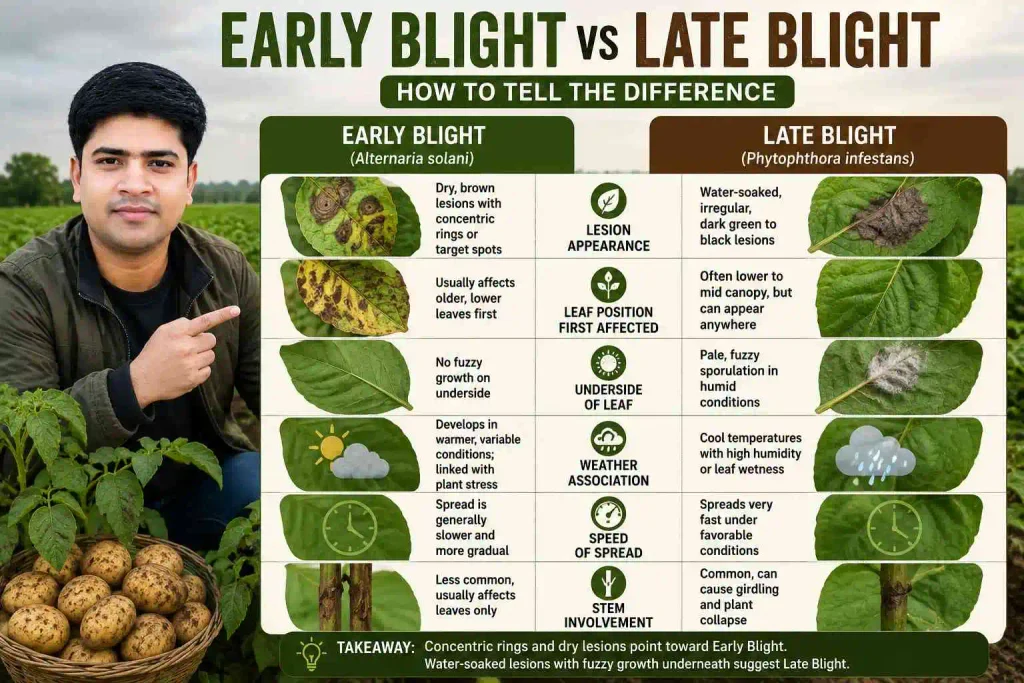
Difference Between Early Blight and Late Blight in Potato
One of the most common mix-ups in the field is confusing late blight with early blight, caused by Alternaria solani. They can appear around the same growth stage and both cause leaf spotting, but they behave very differently and often call for different responses.
| Feature | Late Blight (Phytophthora infestans) | Early Blight (Alternaria spp.) |
|---|---|---|
| Lesion appearance | Water-soaked, irregular, dark green to black | Dry, brown, often with visible concentric rings (“target spot”) |
| Leaf position first affected | Often lower to mid canopy, but can appear anywhere in humid weather | Typically older, lower leaves first |
| Underside of leaf | Pale, fuzzy sporulation in humid conditions | Usually no fuzzy growth |
| Weather association | Cool temperatures with high humidity or leaf wetness | Can develop in warmer, more variable conditions; often linked with plant stress |
| Speed of spread | Very fast under favorable conditions | Generally slower, more gradual |
| Stem involvement | Common, can cause girdling and collapse | Less common, usually leaf-focused |
If you’re ever unsure which disease you’re looking at, that uncertainty itself is a signal — it’s worth getting a sample checked by your local agricultural extension officer or a plant pathology laboratory rather than guessing and spraying the wrong product.
Takeaway: Concentric rings and dry lesions point toward early blight; water-soaked patches with fuzzy underside growth in humid weather point toward late blight. When in doubt, get it confirmed.
Weather Conditions That Raise Potato Late Blight Risk Overnight
Weather doesn’t just influence late blight — it largely determines whether an outbreak happens at all. But it’s rarely one number that matters. It’s the combination and duration of several conditions together.
The pathogen favors:
- Cool temperatures, generally in the range that suits potato growth itself, rather than hot, dry conditions
- High relative humidity, particularly sustained periods above levels that keep leaf surfaces moist
- Extended leaf wetness, from dew, fog, light rain, or irrigation, especially when it persists for many consecutive hours
- Frequent rainfall or heavy dew, which both spreads spores and maintains the moisture the pathogen needs to infect
- Dense crop canopy and poor air movement, which trap humidity within the crop and slow leaf drying after rain or dew
None of these alone reliably predicts an outbreak. A single cool night with dew usually isn’t a crisis. But several days in a row of cool nights, morning fog, and slow-drying canopy is a very different risk picture. This is the basis for disease forecasting systems used in potato production, which track weather variables over time rather than relying on a single reading. Where such forecasting tools or extension advisories are available, they can help time scouting and spray decisions — but they should be treated as decision support, not a substitute for walking the field.
Warning: A field with dense canopy and poor drainage can stay humid at ground level long after the surrounding air feels dry. Don’t judge disease risk purely by how the weather feels standing at the field edge — check conditions within the canopy itself.
Takeaway: Watch for a run of cool, humid days with slow-drying canopy rather than reacting to any single hot or rainy day in isolation.
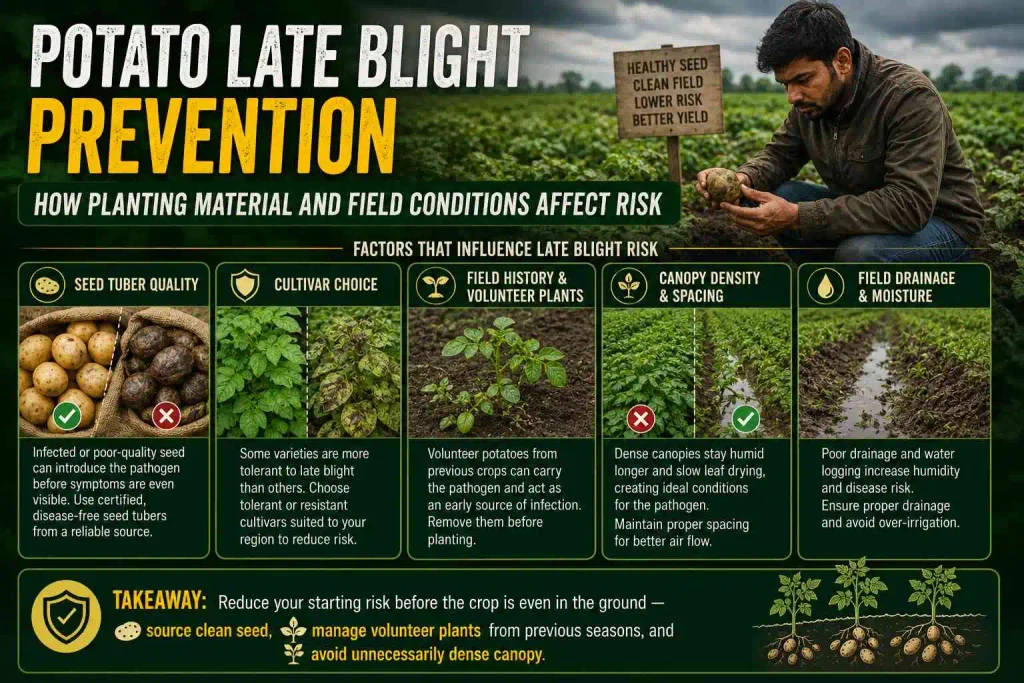
Potato Late Blight Prevention: How Planting Material and Field Conditions Affect Risk
Not every field carries the same risk, even under identical weather. A few agronomic factors tilt the odds:
Seed tuber quality is one of the most overlooked risk factors. Infected or poor-quality seed tubers can introduce the pathogen directly into a field, sometimes before symptoms are even visible above ground. Sourcing healthy, disease-free seed tubers from a reliable source is one of the simplest ways to reduce baseline risk before the season even starts.
Cultivar choice also matters. Some potato varieties show more tolerance to late blight than others, though tolerance varies by region and by the specific pathogen strains present locally. Where resistant or tolerant cultivars suited to your area are available, they can meaningfully reduce disease pressure, though they rarely eliminate the need for other management practices.
Field history and volunteer plants are a quieter risk. Potato plants that sprout from tubers left in the soil from a previous crop — volunteer potatoes — can carry the pathogen into a new season and act as an early source of infection before your planted crop even reaches a vulnerable stage.
Canopy density and spacing influence how quickly leaves dry after rain or dew. Overly dense planting can look productive early on, but it also creates the humid microclimate the pathogen favors.
Takeaway: Reduce your starting risk before the crop is even in the ground — source clean seed, manage volunteer plants from previous seasons, and avoid unnecessarily dense canopy.
The Scouting Routine That Can Catch Problems Early
Good scouting doesn’t need to be complicated, but it does need to be consistent, especially once weather turns favorable for disease.
- Increase scouting frequency during high-risk weather. During cool, humid stretches, check the field every two to three days rather than weekly. In stable, drier weather, weekly checks are often sufficient.
- Focus on vulnerable zones first. Start in low-lying areas, shaded corners, spots with poor air movement, and any area where irrigation tends to leave standing moisture longer.
- Inspect lower and mid-canopy leaves closely, since early lesions often appear here before they’re visible from a distance.
- Check the underside of suspicious leaves early in the morning, while dew is still present, for the pale sporulation that confirms active infection.
- Record and photograph anything unusual — date, location in the field, and a close-up photo make it much easier to track whether a spot is spreading over the following days, and are useful if you need to consult an expert.
- Combine field observations with weather awareness. If you’ve had several days of cool nights and humid mornings, treat that as a trigger to scout more closely, even if nothing looks obviously wrong yet.
- Know when to escalate. If lesions are spreading rapidly, appearing on stems, or you’re unsure whether you’re looking at late blight or another disease, involve your local agricultural extension officer or a plant pathology laboratory rather than delaying a decision.
Quick Summary: Scout more often in cool, humid weather. Check low spots and canopy undersides first. Record what you find. Escalate quickly if you’re unsure.
Takeaway: The goal of scouting isn’t to catch the disease once it’s obvious — it’s to catch it while your options are still good.
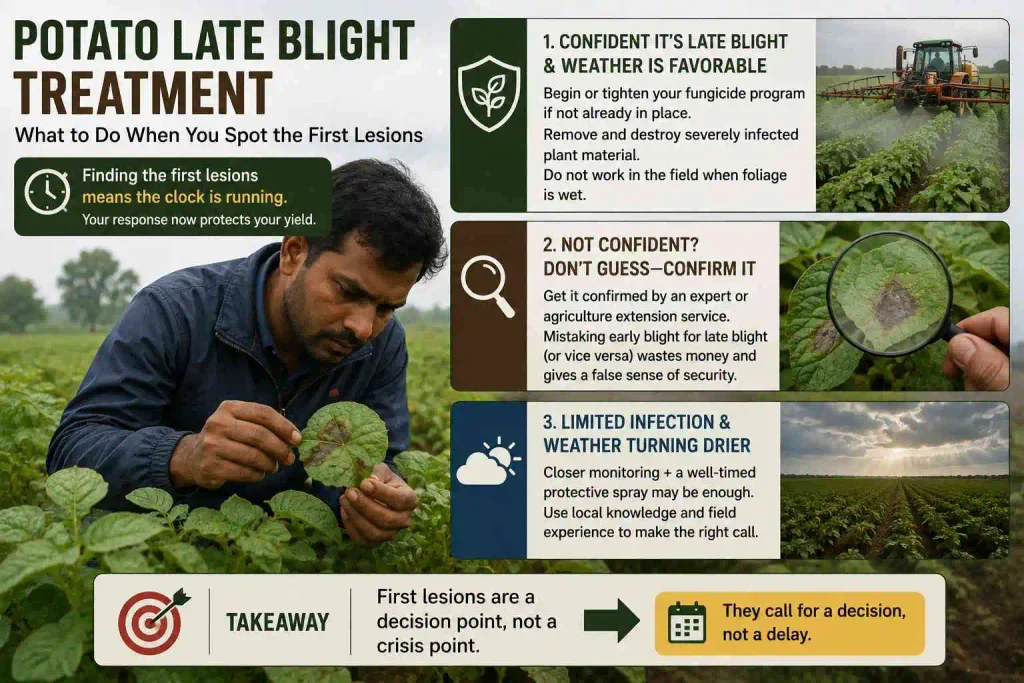
Potato Late Blight Treatment: What to Do When You Spot the First Lesions
Finding a few suspicious lesions doesn’t mean the season is lost, but it does mean the clock is running. The right response depends on how confident you are in the diagnosis and how favorable the weather is likely to stay.
If you’re confident it’s late blight and weather remains favorable, this is typically the point to begin or tighten a fungicide program if you haven’t already, and to remove and destroy severely infected plant material where practical, so it doesn’t act as an ongoing spore source. Avoid working in the field when foliage is wet, since this can physically spread spores on equipment, tools, or clothing.
If you’re not fully confident in the diagnosis, don’t guess — get it confirmed. Treating early blight as late blight, or vice versa, can lead to wasted fungicide applications and a false sense of security.
If the infection is limited to a small area and weather is turning drier, closer monitoring combined with a well-timed protective spray may be more appropriate than an aggressive reaction — but this is a judgment call best made with good local knowledge of your field and season.
Takeaway: First lesions are a decision point, not a crisis point — but they do call for a decision, not a delay.
Fungicide for Late Blight in Potato: How Products Fit Into a Spray Program
Fungicides remain an important tool against late blight, but they work best as one part of a broader disease-management strategy rather than as a standalone fix applied only after symptoms appear.
Broadly, fungicides used against late blight fall into two functional categories:
- Protectant (preventive) fungicides are applied to healthy foliage before infection occurs. They form a protective barrier on the leaf surface and work best when applied ahead of favorable disease weather, not after lesions are already visible.
- Systemic or curative-acting fungicides can move within the plant and offer activity against infections that have already begun, though “curative” doesn’t mean reversing damage already done to infected tissue — it means limiting further spread from that infection point.
Timing matters more than most growers expect. A protectant fungicide applied well before a favorable weather spell can prevent an outbreak from establishing; the same product applied after lesions are already spreading through the canopy is working from a much weaker position. Thorough spray coverage is equally important — the underside of leaves, where sporulation occurs, needs to be reached, and dense canopies can make this harder without proper spray volume and technique.
Common Mistake: Assuming that one well-timed spray protects the crop for the rest of the season. New leaf growth after spraying is unprotected, and rainfall can wash off some protectant products, meaning coverage needs to be renewed as the crop develops.
Always follow the registered label for any product you use — approved dose, crop restrictions, pre-harvest interval, and application method. Fungicide registrations and recommended products can vary by state and change over time, so check current guidance from your local agricultural department or extension service rather than relying on last season’s spray schedule. No single fungicide should be considered universally “the best” — the right choice depends on disease pressure, weather, crop stage, and what’s registered and available in your area.
Takeaway: Fungicides work best as prevention timed ahead of risk, not as a rescue treatment after the canopy is already showing damage.
Why Repeating the Same Fungicide Can Backfire
It’s tempting to stick with a product once it seems to be working, especially if it’s affordable and easy to source. But repeated use of fungicides from the same mode-of-action group puts consistent selection pressure on the pathogen population, which can increase the risk of resistant strains building up over time within a field or region.
Once resistance develops to a particular mode of action, that entire group of products can lose effectiveness — not just against your field, but potentially across a wider area if resistant pathogen populations spread. This is a slower-building risk than the disease itself, but it’s a serious one, because it can quietly remove tools from the toolbox for future seasons.
The practical response is rotation: alternating between fungicides with different modes of action through the season, rather than repeating the same product application after application. Many extension services and product labels provide mode-of-action classifications to help growers plan a rotation rather than defaulting to whatever was used last.
Key Takeaway: Rotation isn’t about switching brands — it’s about switching modes of action. Two different product names can still belong to the same resistance-risk group.
Takeaway: Build a spray plan around mode-of-action rotation from the start of the season, not as a reaction once a product seems to be losing effectiveness.
Can Late Blight Damage Potato Tubers Too?
Yes — and this is a part of the disease that catches some growers off guard, because the foliage can look like the main battlefield while the real economic risk is happening underground.
Tuber infection typically occurs when spores from infected foliage are washed down through the soil, often during heavy rain or irrigation, and come into contact with tubers near the soil surface. Infected tubers can show a reddish-brown, granular discoloration beneath the skin, and infected tissue can serve as an entry point for secondary soft-rot organisms in storage, which is often what actually causes tubers to break down after harvest.
This is why foliar management and harvest practices are connected, not separate issues. Reducing foliar disease pressure lowers the spore load available to wash down onto tubers. Maintaining good hilling, so tubers are well covered with soil, adds a physical barrier against spore movement. And at harvest, allowing infected foliage to die down before lifting tubers, where practical, can reduce the chance of spores on dying leaves contaminating tubers during the harvest process itself.
Takeaway: Protecting the canopy isn’t just about leaf health — it’s also your main defense against tuber infection and storage losses later.
How Irrigation and Field Moisture Can Increase Disease Risk
Irrigation is necessary for potato production, but it can unintentionally work against disease management if it’s not planned with late blight risk in mind.
Overhead irrigation that wets the foliage, particularly late in the day or evening, can extend the period of leaf wetness overnight — exactly the condition the pathogen favors. Frequent light irrigation that keeps the canopy and soil surface consistently damp, without allowing proper drying between cycles, can have a similar effect.
Where practical, irrigating earlier in the day so foliage has time to dry before evening, and avoiding unnecessarily frequent irrigation cycles during already-humid weather, can help reduce the extra moisture load on the canopy. This doesn’t mean under-watering the crop — potato yield is sensitive to moisture stress too — it means being deliberate about timing during periods when disease risk is already elevated from weather conditions.
Takeaway: Irrigation timing matters as much as irrigation amount when disease risk is high — aim to keep foliage drying time as short as possible.
How Crop Monitoring Can Save a Potato Farmer Money
It’s worth stating plainly: the cost of a few extra scouting visits during risky weather is small compared to the cost of a late-stage outbreak — in lost yield, reduced tuber quality, and the extra fungicide often needed to bring an established infection back under control.
Early detection means fewer, better-timed fungicide applications rather than a reactive, higher-frequency spray schedule once disease is already established across the field. It also means fewer surprises at harvest, since foliar disease pressure connects directly to the tuber infection risk covered earlier.
Growers who combine regular field walks with basic weather awareness — even without sophisticated forecasting tools — are generally in a much stronger position than those who rely on visual inspection alone during a routine field visit for other purposes.
Takeaway: Consistent monitoring isn’t an added cost — it’s what keeps fungicide spending efficient and targeted instead of reactive and excessive.
Common Mistakes That Make Late Blight Worse
| Mistake | Why Farmers Make It | What Happens | Better Approach |
|---|---|---|---|
| Waiting until most of the field shows symptoms | Early lesions are easy to overlook or dismiss as minor | Disease has already spread widely, options are limited | Scout closely during favorable weather; act on first confirmed lesions |
| Confusing late blight with early blight | Both cause leaf spotting and can appear around the same time | Wrong product or wrong urgency applied | Compare lesion appearance and underside sporulation; confirm if unsure |
| Spraying without considering weather or risk | Following a fixed calendar schedule feels simpler | Sprays may be poorly timed relative to actual risk | Adjust spray timing based on weather trends and field scouting |
| Repeating the same fungicide mode of action | Convenience, cost, or lack of awareness of resistance risk | Increases risk of resistant pathogen populations developing | Rotate modes of action through the season |
| Ignoring dense canopy and poor air movement | Canopy density isn’t always seen as a disease factor | Humid microclimate persists longer within the crop | Manage spacing and monitor low-lying, shaded areas more closely |
| Inadequate spray coverage | Time pressure or under-calibrated equipment | Underside of leaves and dense canopy areas remain unprotected | Ensure proper spray volume, pressure, and technique for full coverage |
| Ignoring infected debris or volunteer plants | These sources are easy to overlook between seasons | They act as an early infection source for the next crop | Remove volunteer potatoes and manage infected crop residue |
| Assuming one spray protects the whole season | Misunderstanding how protectant fungicides work | New growth and rain-washed leaves become unprotected | Plan repeat applications and adjust timing as the crop develops |
Takeaway: Most of these mistakes come from treating late blight management as a single event rather than an ongoing process through the season.
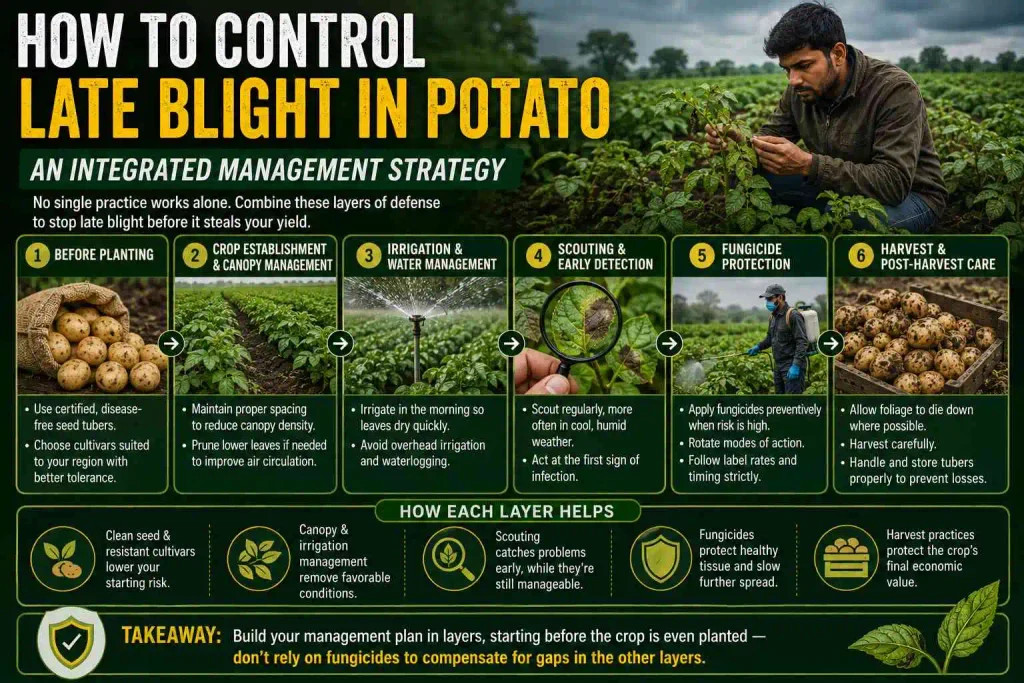
How to Control Late Blight in Potato: An Integrated Management Strategy
No single practice reliably controls late blight on its own — that’s really the core lesson behind everything covered above. The strongest approach combines several layers of defense, each addressing a different point where the disease could otherwise get a foothold.
Before planting, that means sourcing healthy seed tubers and choosing cultivars suited to your region, factoring in tolerance where reliable options exist. During the season, it means managing canopy density and irrigation timing to limit prolonged leaf wetness, combined with regular scouting that intensifies during cool, humid weather. When risk is elevated, timely, well-planned fungicide applications — rotated across modes of action and applied according to the label — provide the protective layer that agronomic practices alone can’t fully deliver. At harvest, allowing foliage to die down where practical and handling tubers carefully helps prevent field infection from turning into storage losses.
Each of these layers reduces disease pressure in a different way. Clean seed and resistant cultivars lower your starting risk. Canopy and irrigation management reduce the favorable microclimate. Scouting catches problems while they’re still manageable. Fungicides protect healthy tissue and slow further spread. Harvest practices protect the crop’s final economic value. None of them replaces the others.
Takeaway: Build your management plan in layers, starting before the crop is even planted — don’t rely on fungicides to compensate for gaps in the other layers.
Walk the Field Before the Weather Decides For You
Late blight isn’t a disease that punishes farmers for lack of effort — it punishes delay. The pathogen’s biology means that conditions favorable for infection can build over just a few days, and by the time symptoms are obvious from the edge of the field, the disease may already have a head start that’s hard to catch up to.
The growers who manage this disease well aren’t necessarily using more fungicide than everyone else. They’re the ones who know what a water-soaked lesion looks like on the underside of a lower leaf, who check the field a little more often when the mornings turn cool and foggy, and who make spray and management decisions based on what they’re actually seeing and the weather ahead, rather than habit alone.
This kind of vigilance is really just one piece of a larger picture — if you’re looking to tighten up your overall approach to the crop, from planting through harvest economics, it’s worth reading this complete guide to potato farming, cost, and yield alongside your disease-scouting routine.
Frequently Asked Questions About Late Blight in Potato
What causes late blight disease of potato?
Late blight in potato is caused by Phytophthora infestans, an oomycete pathogen rather than a true fungus. It spreads through spores carried by wind, rain splash, and moisture, and develops fastest under cool, humid conditions with extended leaf wetness.
What are the early potato late blight symptoms to watch for?
The earliest signs are small, irregular, water-soaked spots on lower or mid-canopy leaves, often with a faint white, fuzzy sporulation visible on the underside in humid early-morning conditions. These can expand into larger brown-to-black lesions within days if weather stays favorable.
What is the difference between early blight and late blight in potato?
Early blight, caused by Alternaria spp., produces dry, brown lesions with visible concentric rings, mainly on older leaves. Late blight produces water-soaked, irregular lesions with fuzzy underside sporulation and spreads far more quickly under cool, humid weather. See the comparison table above for a fuller breakdown.
What is the best potato late blight treatment once symptoms appear?
There’s no single “best” treatment — response depends on how confident the diagnosis is and how favorable the weather remains. Typical steps include confirming the diagnosis, removing severely infected material where practical, avoiding field work on wet foliage, and starting or tightening a fungicide program suited to your local conditions and label recommendations.
Which fungicide for late blight in potato works best?
No single fungicide is universally best for every situation. Effective programs generally combine protectant fungicides applied ahead of risk with systemic products where curative-type activity is needed, rotated across different modes of action to reduce resistance risk. Always follow the registered label and current local agricultural recommendations, since approved products vary by region and change over time.
How to control late blight in potato over a full season?
Control works best as a layered, integrated approach rather than fungicide alone — clean seed tubers, suitable cultivars, canopy and irrigation management, regular scouting during high-risk weather, timely and rotated fungicide applications, and careful harvest practices to protect tubers. The integrated strategy section above covers each layer in detail.
Are there effective potato late blight prevention practices before symptoms appear?
Yes. Sourcing healthy seed tubers, choosing tolerant cultivars where available, managing volunteer potato plants, avoiding overly dense canopy, and adjusting irrigation timing to limit prolonged leaf wetness all reduce the chances of an outbreak establishing in the first place.
Can late blight management in potato prevent tuber infection too?
Reducing foliar disease pressure lowers the spore load available to wash down onto tubers, and good hilling adds a physical barrier. Combined with careful harvest timing, this significantly lowers — though doesn’t entirely eliminate — the risk of tuber infection and related storage losses.
Newsletter