



How to Start Exporting Mud Crab: A Step-by-Step Guide for Farmers
Growing a healthy, heavy mud crab is hard work. But here’s the part most farmers don’t realise until they try it: growing the crab is only half the business. The other half is getting that same crab, alive and in good condition, into the hands of a buyer sitting in Singapore, Hong Kong, or China — without it dying in transit, getting rejected at the port, or eating up all your profit in freight and packaging costs.
That gap — between “I have good mud crabs” and “I am earning from the international market” — is where most first-time exporters struggle.
This guide walks you through that entire journey: Farm → Harvest → Grading → Holding → Buyer → Exporter → Packing → Documentation → Transport → International Market. By the end, you’ll know whether you can export directly, how to find genuine buyers, what registrations actually apply to you, how live crabs are packed and shipped, how the money really works out, and how to start without risking your savings on your very first shipment.

Why Exporting Mud Crab Can Be an Opportunity for Indian Farmers
Mud crab (Scylla serrata) is one of the few aquaculture products where the export price can genuinely outpace the local market. Reports from crab-farming belts in Karnataka show local sale prices of around ₹2,000 per kg, while the same quality crab can fetch close to ₹3,500 per kg in overseas markets — a difference that matters a great deal when you’re farming on thin margins.
India is currently the world’s largest exporter of live mud crab, ahead of Pakistan and Vietnam, and demand from China, Singapore, Taiwan, and Hong Kong has been growing year on year. That’s the opportunity.
But export markets are not “easy money.” They come with:
- Stricter size, weight, and quality expectations than your local trader
- Real mortality risk during transport
- Buyers who expect consistent supply, not one good batch
- Documentation and compliance that a local sale never requires
- Prices that move with season, currency, and international demand
Key Takeaway: Export isn’t a shortcut to bigger profit. It’s a different business model layered on top of your farming — with its own skills, costs, and risks.
Before going further, ask yourself honestly: can your farm consistently produce crabs that meet export standards, batch after batch — not just once? If you’re still deciding on a culture system, it’s worth comparing traditional pond culture with space-efficient methods like vertical mud crab farming, which can help smaller landholders build the consistent, gradable output that export buyers actually look for.
Before You Think About Exporting, Can Your Farm Produce Export-Quality Mud Crab?
Here’s a mistake almost every new exporter makes: assuming that having mud crabs is the same as having export-quality mud crabs. It isn’t.
International buyers typically evaluate crabs on:
- Species — usually Scylla serrata or closely related species
- Size and weight — many overseas buyers, especially in Singapore and Malaysia, prefer crabs of 700 grams and above
- Shell condition — no soft-shell crabs, no cracked or damaged shells
- Claw and leg condition — missing or damaged limbs bring the price down sharply
- Meat fullness — a crab that looks big but is hollow inside is rejected or downgraded
- Activity level — sluggish or weak crabs are a red flag for buyers
- Uniformity — buyers pay a premium for a batch that is consistent, not mixed quality
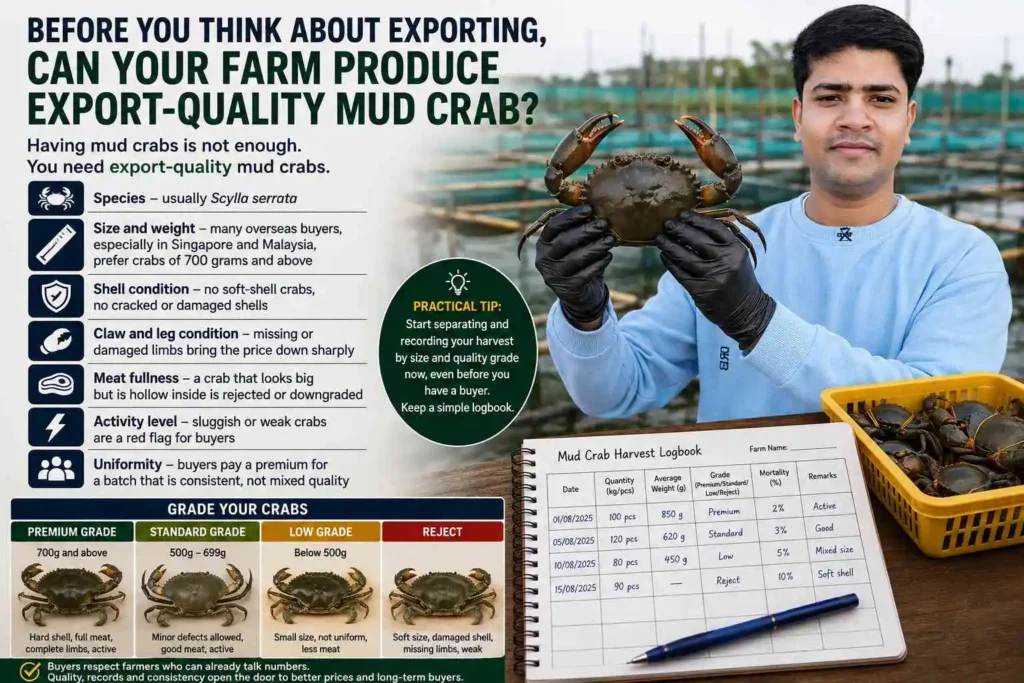
Practical Tip: Start separating and recording your harvest by size and quality grade now, even before you have a buyer. Keep a simple logbook — date, quantity, average weight, grade, mortality. Buyers respect farmers who can already talk numbers.
Should You Export Yourself or Sell to an Exporter?
This is probably the single most important decision in this entire guide — and most farmers jump straight to “I want to export myself” without weighing the alternatives.
There are five realistic routes into the export market:
- Sell to a local trader who supplies exporters
- Supply directly to an established seafood export company
- Partner with an exporter on a long-term supply arrangement
- Form a farmer group or cooperative and negotiate collectively with exporters
- Become a registered exporter yourself
| Route | Investment | Complexity | Control Over Price | Risk |
|---|---|---|---|---|
| Sell to local trader | Low | Low | Low | Low |
| Supply an established exporter | Low–Medium | Medium | Medium | Medium |
| Partner with an exporter | Medium | Medium | Medium | Medium |
| Farmer group/cooperative supplying exporters | Medium | Medium | Medium–High | Medium |
| Export directly | High | High | High | High |
Direct export gives you the highest potential margin — but it also means you personally carry mortality risk during transport, buyer payment risk, documentation errors, and the cost of finding and vetting buyers on your own.
Expert Tip: For a new farmer, the safest route is often to first become a reliable supplier to an established exporter. You learn the buyer’s quality standards, packing methods, and logistics system without taking on every export risk yourself. Direct exporting is something to graduate into, not start with.
What You Need Before Entering the Export Business
Not every requirement below applies to every person in the supply chain. This is where a lot of confusion happens, so let’s separate it clearly.
If you’re only selling to an established exporter or trader, you generally don’t need an export license yourself. What helps is:
- A bank account in your business or farm’s name
- PAN card
- Basic sale records/invoices for your own bookkeeping
- GST registration, if your turnover requires it under current GST rules
If you intend to export directly, the requirements grow considerably. Based on current government procedure:
- Import Export Code (IEC) from the DGFT (Directorate General of Foreign Trade) — this is the mandatory starting point; no export can legally happen without it
- MPEDA Registration-cum-Membership Certificate (RCMC), issued by the Marine Products Export Development Authority, under the MPEDA Act, 1972 — mandatory for anyone exporting marine products, including live mud crab, from India
- Compliance with hygiene, packing, and traceability norms that MPEDA and the importing country expect
- Coastal Aquaculture Authority registration and other farm-level permissions, where applicable to your farming operation — if you haven’t sorted this out yet, our guide on mud crab farming licenses and government permissions covers what’s needed at the farm stage, separate from export registrations
- Export documentation: commercial invoice, packing list, certificate of origin, health/sanitary certificate where required, and shipping documents
- A verified buyer agreement or purchase order before shipping
A merchant exporter or trading company (someone who buys from farmers and exports under their own registration) typically handles the IEC, MPEDA registration, customs clearance, and buyer contracts on your behalf — which is exactly why many farmers choose to sell to one rather than manage all of this themselves.
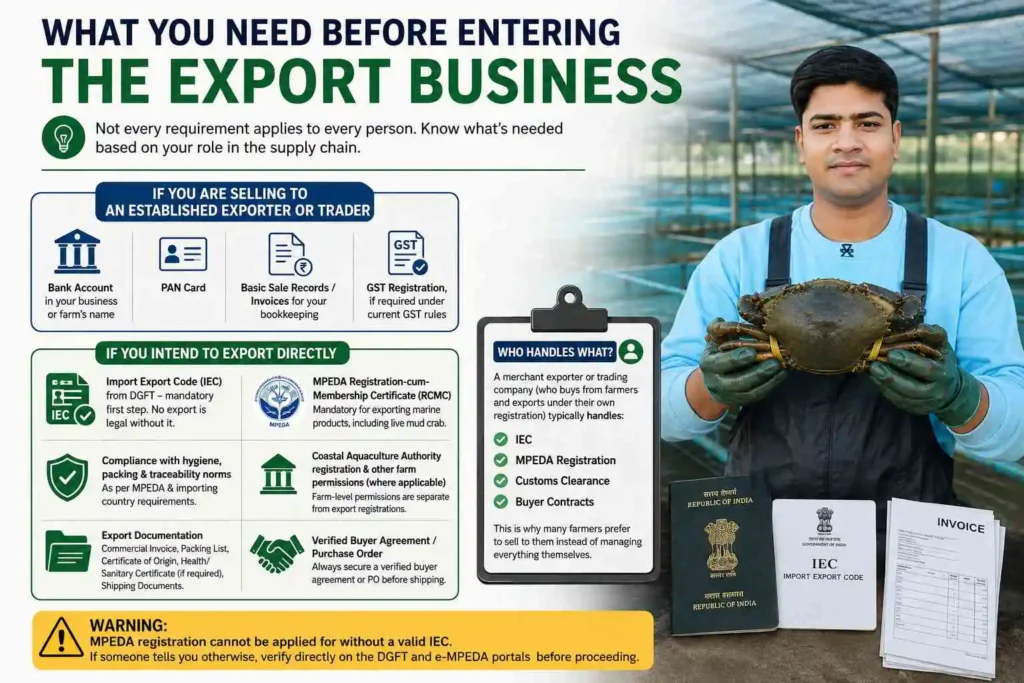
Warning: MPEDA registration cannot be applied for without a valid IEC. If someone tells you otherwise, verify directly on the DGFT and e-MPEDA portals before proceeding.
How to Find Genuine International Mud Crab Buyers
“Where do I actually find a buyer abroad?” is the question every beginner asks, and it’s a fair one.
Realistic sources include:
- Established Indian seafood exporters (many are actively looking for consistent crab suppliers)
- Seafood importers and distributors in destination countries
- B2B trade platforms for seafood
- MPEDA-organised trade fairs and buyer-seller meets
- Export promotion events and seafood industry associations
- Referrals from other farmers already supplying export markets
Watch for these warning signs of an unreliable buyer:
- No verifiable company registration or physical address
- Pressure to ship before any written agreement is signed
- Vague or shifting payment terms
- Requests for upfront “processing fees” with no clear justification
- No willingness to define product specifications or rejection policy in writing
Common Mistake: Many farmers chase the buyer offering the highest quoted price without checking payment reliability. A slightly lower price from a buyer who pays on time, every time, is worth far more than a high price from someone who delays or disputes payment.
How to Approach an International Buyer Professionally
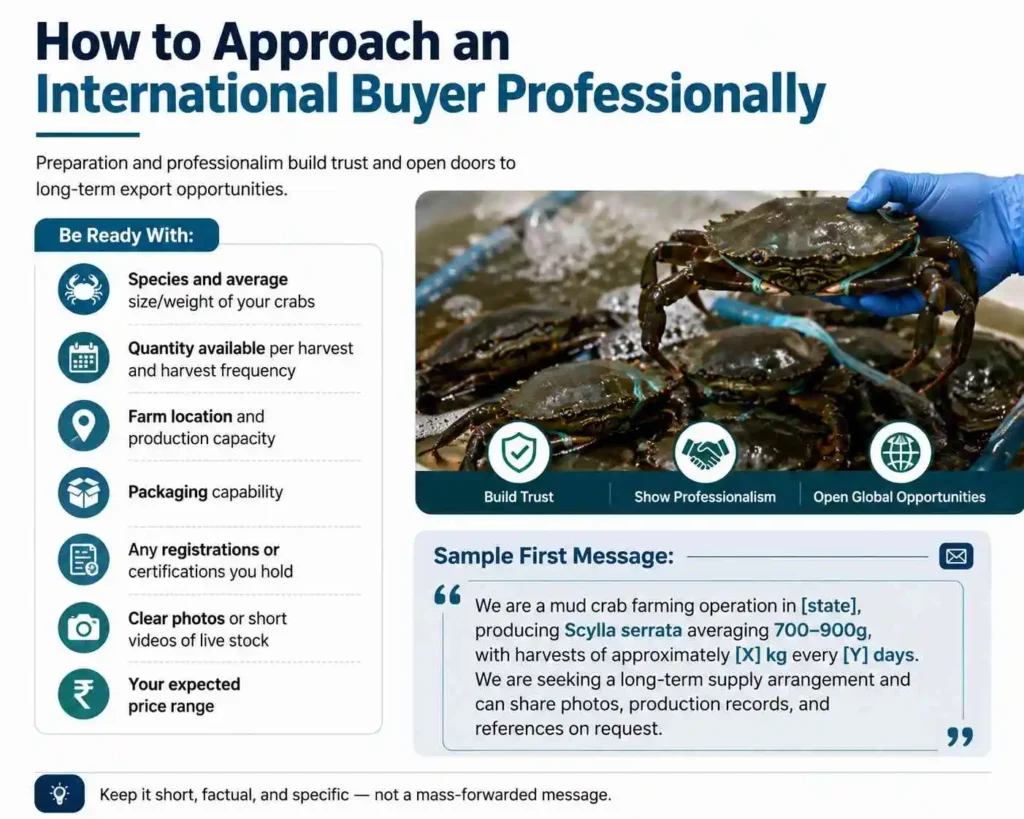
When you or your exporter reach out to a buyer, be ready with:
- Species and average size/weight of your crabs
- Quantity available per harvest and harvest frequency
- Farm location and production capacity
- Packaging capability
- Any registrations or certifications you hold
- Clear photos or short videos of live stock
- Your expected price range
A simple, professional first message might read: “We are a mud crab farming operation in [state], producing Scylla serrata averaging 700–900g, with harvests of approximately [X] kg every [Y] days. We are seeking a long-term supply arrangement and can share photos, production records, and references on request.”
Keep it short, factual, and specific — not a mass-forwarded message.
What International Buyers Actually Look for in Mud Crab
Buyers rarely pay purely on weight. They’re really paying for:
- Consistency — the same quality, shipment after shipment
- Survival rate — crabs that arrive alive and active
- Meat fullness, not just shell size
- Claw condition — intact claws hold value; missing claws don’t
- Reliable packaging that protects the shipment
A farmer who consistently delivers a slightly smaller but uniform, healthy batch is often more valuable to an exporter long-term than one who occasionally sends a few oversized crabs mixed with weak ones.
How to Grade and Prepare Mud Crab for Export
- Harvest carefully — avoid injuries during capture and handling
- Sort by species, size, and weight
- Remove crabs with cracked shells, missing limbs, or soft shells
- Check activity level — active, gripping crabs are healthier
- Hold crabs in clean, aerated, low-stress conditions before dispatch
- Avoid overcrowding during temporary holding
Quick checklist before dispatch:
- Crabs sorted by grade
- Damaged/soft-shell crabs removed
- Claws tied or immobilised as per exporter’s method
- Holding water/conditions checked
- Mortality from the batch recorded
Rough handling at this stage is one of the most common — and most preventable — causes of profit loss.
The Biggest Challenge: Keeping Mud Crab Alive During Transport
This is where export mud crab farming becomes genuinely technical. The goal isn’t simply “keep it cold” — it’s maintaining a balance of temperature, humidity, ventilation, and low handling stress for the entire transit duration, which could be anywhere from several hours to over a day depending on the destination.
Get any one of these wrong — too much heat, too little moisture, overcrowded packing, rough handling, or an unexpected transit delay — and mortality can wipe out your margin on that shipment.
Because exact conditions vary by species, packaging method, season, and destination, this is not something to improvise on your own. Established exporters and logistics providers who specialise in live seafood should be consulted for the specific method suited to your shipment.

How Mud Crabs Are Packed for Export
At a high level, commercial live-crab packing generally involves:
- Immobilising claws safely to prevent injury to the crab and to other crabs
- Using ventilated, moisture-retaining packaging (commonly foam boxes or specially designed crates)
- Managing humidity without waterlogging the crabs
- Insulating against temperature swings
- Respecting weight limits per box for handling and airline/cargo rules
- Clear labelling for customs and handling staff
There is no single universal packing method — it depends on the destination country, transit time, and transport mode (air or sea). This is typically handled by the exporter or packing facility, not the farmer, but understanding it helps you evaluate whether an exporter is handling your crabs responsibly.
How the Export Journey Works From Farm to International Buyer
Farm → Harvest → Grading → Holding → Exporter/Packing Facility → Documentation → Airport/Port → International Transport → Importer → Distributor → Final Market
At the farm and holding stage, your job is quality and consistency. From the packing facility onward, it’s the exporter’s documentation, customs clearance, and logistics network that carry the shipment through to the buyer.
What Does It Cost to Export Mud Crab?
This is the section where a lot of farmers get confused, because farming costs and export costs are two completely different things, incurred by two different parties at two different stages. Lumping them into one “export cost” table gives you a meaningless number. Instead, think of it as three separate cost layers stacked on top of each other.
Layer 1: Farm-side production costs — these are costs you already carry as a farmer, whether you export or not:
- Seed/juvenile stocking cost
- Feed cost over the grow-out period
- Labour
- Electricity and water management (aeration, pumping)
- Pond, tank, or enclosure maintenance
- On-farm mortality during the culture period
- Harvesting labour and equipment
Layer 2: Export-side handling and logistics costs — these apply only once the crab leaves your farm gate heading for export, and in most cases are borne or arranged by the exporter, not the farmer:
- Collection/transport from farm to packing facility
- Temporary holding at the facility
- Grading and sorting for export specification
- Packing materials and labour
- Freight (air or sea) and airport/port handling charges
- Customs clearance and export documentation charges
Layer 3: Buyer-related deductions — costs that only show up after the shipment reaches the buyer:
- In-transit mortality allowance
- Rejection or downgrading of part of the shipment on arrival
- Any agreed quality-based price adjustment
Warning: Do not add up per-kg figures from all three layers and treat the total as “my export cost.” Layer 1 is your cost regardless of the sales channel. Layers 2 and 3 depend entirely on your agreement with the exporter — in many farmer-to-exporter arrangements, the farmer is paid a price that already accounts for these, rather than paying them separately. Ask your exporter or trading company to spell out exactly which layer they are quoting you a price against.
Because freight rates, packaging methods, exporter margins, and rejection rates vary by season, destination, and shipment size, there is no reliable universal per-kg figure for Layers 2 and 3 — treat any number you’re quoted as specific to that deal, not as an industry standard.
How to Calculate Your Real Export Profit
The framework, in principle:
Net Profit = Price Received – Farm-Side Production Cost (Layer 1) – Any Handling/Logistics Cost You Personally Bear (Layer 2) – Any Mortality/Rejection Loss Charged Back to You (Layer 3)
The one figure worth grounding this in is the price gap itself. In parts of Karnataka’s mud crab belt, for example, crabs that sell locally at around ₹2,000 per kg have fetched close to ₹3,500 per kg through export channels — a real difference, but one that only becomes your profit after Layer 1 costs are covered and after you know exactly which of the Layer 2 and Layer 3 costs are being deducted from that price versus absorbed by the exporter.
Practical Tip: Before agreeing to any export supply arrangement, ask a single direct question: “Is the price you’re quoting me the final price to my hand, or is it before packaging, freight, and mortality deductions?” Get the answer in writing. This one clarification prevents most of the disputes that happen after the first shipment.
Which Countries Buy Indian Mud Crab?
Based on current trade data, China, Singapore, and Taiwan together account for the large majority of global live mud crab imports, with Hong Kong, Malaysia, Thailand, and the UAE as other notable markets. China alone represents nearly half of global demand for live mud crab.
Preferences differ by market — Singapore and Malaysia, for instance, generally favour larger crabs (roughly 700g and above), while size and species preferences elsewhere can vary. Since import rules, demand, and prices shift over time, always confirm current requirements with your exporter or MPEDA before targeting a specific country.
What Can Cause an Export Shipment to Fail?
| Risk | What Causes It | How to Reduce It |
|---|---|---|
| High mortality | Poor packing, temperature stress, long delays | Use experienced packers, avoid unnecessary handling |
| Buyer rejection | Wrong size, damaged claws, inconsistent grade | Grade strictly before dispatch |
| Documentation errors | Missing/incorrect paperwork | Work with a registered exporter or compliance consultant |
| Customs/transit delays | Incomplete documents, logistics disruptions | Build in buffer time, confirm flight/shipping schedules |
| Price drop before payment | Market volatility | Agree pricing and terms in writing beforehand |
Common Mistakes New Mud Crab Exporters Make
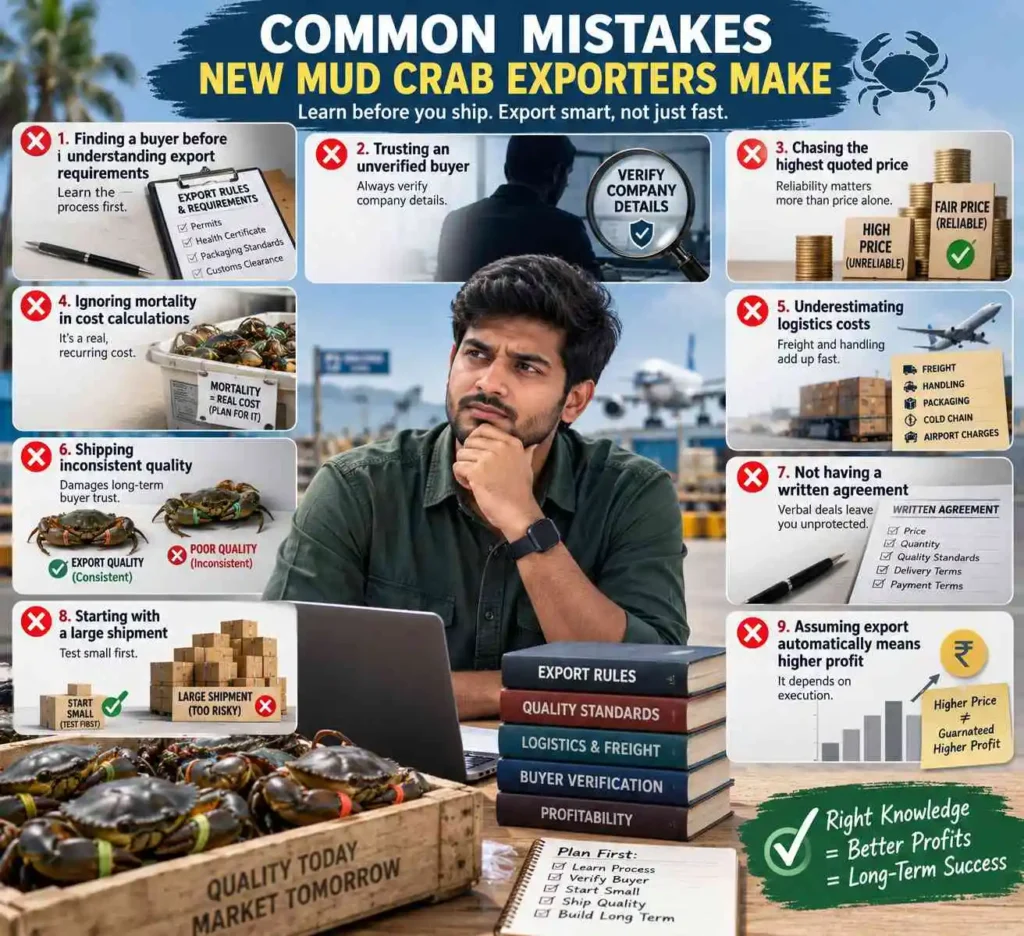
- Finding a buyer before understanding export requirements — learn the process first
- Trusting an unverified buyer — always verify company details
- Chasing the highest quoted price — reliability matters more than price alone
- Ignoring mortality in cost calculations — it’s a real, recurring cost
- Underestimating logistics costs — freight and handling add up fast
- Shipping inconsistent quality — damages long-term buyer trust
- Not having a written agreement — verbal deals leave you unprotected
- Starting with a large shipment — test small first
- Assuming export automatically means higher profit — it depends on execution
A Safer Way to Start Exporting Mud Crab as a Beginner
- Master mud crab farming and post-harvest handling first
- Understand the full export supply chain, from farm to final buyer
- Contact established exporters and ask what they look for in a supplier
- Study specific buyer and destination-country requirements
- Build consistent, gradable production before chasing export volume
- Start by supplying an established exporter, not by exporting directly
- Gain hands-on experience with documentation and logistics through that relationship
- Consider becoming a registered exporter only once you understand the economics and risks firsthand
FAQs on Mud Crab Export from India
1. Can farmers export mud crab directly from India?
Yes, but it requires an IEC from DGFT, MPEDA RCMC registration, and compliance with export documentation — it isn’t automatic just because you farm crabs.
2. What license is required to export mud crab from India?
An Import Export Code (IEC) from DGFT is the mandatory first step, followed by MPEDA registration (RCMC), since mud crab is a marine product under MPEDA’s regulatory scope.
3. Is an IEC required for mud crab export?
Yes — it’s a prerequisite. MPEDA registration cannot be completed without a valid IEC.
4. Do I need MPEDA registration if I only sell to a local trader or exporter?
No. If you’re supplying an exporter rather than shipping the crabs abroad yourself, the exporter typically holds the MPEDA registration and export documentation, not you.
5. How can I find international mud crab buyers?
Through established seafood exporters, B2B trade platforms, MPEDA-organised trade fairs, and industry referrals — always verify a buyer’s credentials before committing to a shipment.
6. Which countries import mud crab from India?
China, Singapore, and Taiwan are the largest markets, with Hong Kong, Malaysia, Thailand, and the UAE also importing significant volumes.
7. How are live mud crabs transported internationally?
Through carefully controlled packaging that manages temperature, humidity, and ventilation, usually by air freight for live shipments — the exact method depends on the exporter and destination.
8. How much does it cost to export mud crab?
Costs vary by shipment size, destination, and season, covering production, grading, packaging, freight, documentation, and an allowance for mortality or rejection — there’s no single fixed figure.
9. Is mud crab export profitable?
It can be, but profitability depends on controlling mortality, packaging quality, and logistics costs — a high export price doesn’t guarantee high farmer profit.
10. Can small farmers export mud crab?
Directly, it’s difficult due to the investment and compliance involved. Most small farmers benefit more from supplying an established exporter or joining a farmer group/cooperative.
11. What happens if crabs die during transportation?
This depends on the agreement with your buyer or exporter — always clarify in writing, before shipping, who bears mortality and rejection losses.
12. Can I sell my mud crabs to an exporter instead of exporting myself?
Yes, and for most beginners this is the more practical and lower-risk starting point.
The Real Lesson Behind Mud Crab Export
Exporting mud crab isn’t simply about finding a foreign buyer who pays more than your local market. It’s about building a reliable supply chain that can consistently deliver the right crab, in the right condition, with the right paperwork, at a cost that still leaves you a real profit.
Start where you are. If your production isn’t consistent yet, focus there first. If it is, reach out to an established exporter and learn their standards before you think about registrations of your own. Every step you take — improving grading, understanding your real costs, or simply having one honest conversation with an exporter — moves you closer to earning from the international market, not just supplying it.
Newsletter