



How to Grow Coriander at Home: A Complete Growing Guide
A step-by-step guide to growing coriander at home in pots, on balconies, and on terraces — seed prep, soil, sowing depth, watering, sunlight, and how to keep a fresh supply coming.
Ten days after sowing, half the pot is still bare soil. The seedlings that did come up are pale and thread-thin, leaning sideways as if trying to escape the container. A few lower leaves turn yellow before the plant has even filled out, foliage stays sparse no matter how long you wait, and then, just as things start looking promising, a thin stalk shoots up from the centre, a few flowers open, and the leaf growth stops for good. If any part of this sounds familiar, you’ve already met coriander’s most common home-growing problems in one sitting.
None of this means you have a bad hand with plants. Coriander runs into trouble at home far more often because of a handful of small, fixable habits — the seed you started with, how deep you buried it, the pot and soil you chose, how you watered it — than because of anything genuinely difficult about the plant itself. Handle those basics properly and coriander turns out to be one of the fastest, least demanding herbs you can grow, whether you have a full terrace or a single windowsill.
This guide walks through the whole process of how to grow coriander at home, from seed to harvest: choosing and preparing coriander seed, picking a container that actually suits it, mixing the best soil for coriander, sowing at the right depth for good germination, matching sunlight and watering to your season and part of India, encouraging bushier growth, thinning and harvesting properly, and setting up a simple sowing routine so you’re not stuck with one big batch of coriander followed by three empty weeks. It’s the everyday coriander plant care and coriander growing tips that actually make a difference, not just the theory behind them.
Keep one idea in mind through all of it: growing coriander isn’t difficult, but small mistakes at the sowing and watering stage are usually what decide whether you end up with a bushy, cut-and-come-again patch or a handful of disappointing stems.

1. Why Coriander Is One of the Best Herbs to Grow at Home
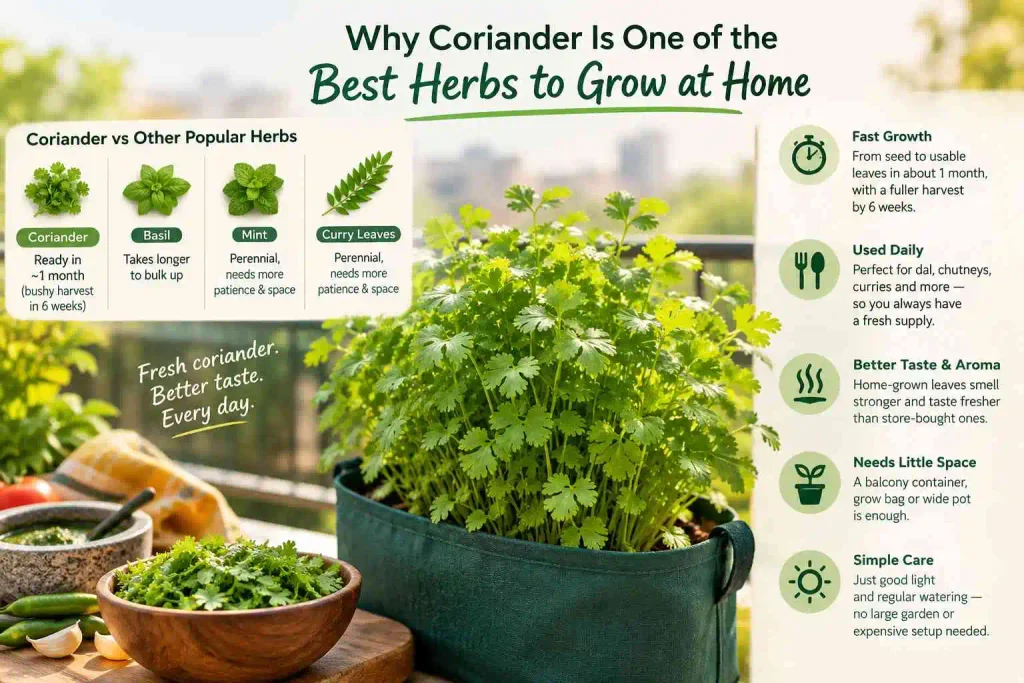
Compare coriander with the other herbs people usually try first — basil, mint, curry leaves — and it wins on sheer speed. You can go from a scattering of seed to a usable handful of leaves in about a month, and a fuller, bushy harvest by six weeks. Basil takes longer to bulk up, and curry leaf and mint are perennials that ask for more patience and space before they’re worth much in the kitchen.
That speed matters because coriander gets used almost daily in Indian cooking — over dal, in chutneys, scattered over curries — so a small, steady supply at home saves regular trips out for a bunch that wilts within two days anyway. Home-grown leaves also tend to smell stronger and taste better than ones that have already spent a day or two in transit and storage.
It asks for very little space in return. A container on a balcony railing, a grow bag on a terrace corner, or a wide pot on a bright windowsill is enough to keep a small kitchen supplied. The main thing coriander needs from you is decent light and a bit of attention to watering, not a large garden or an expensive setup.
2. Start With the Right Coriander Seeds
A lot of first-time growers reach for the same jar: the whole dried coriander sitting in the spice rack, left over from making chutney. It can work, but it’s not the most reliable starting point, and it helps to know why.
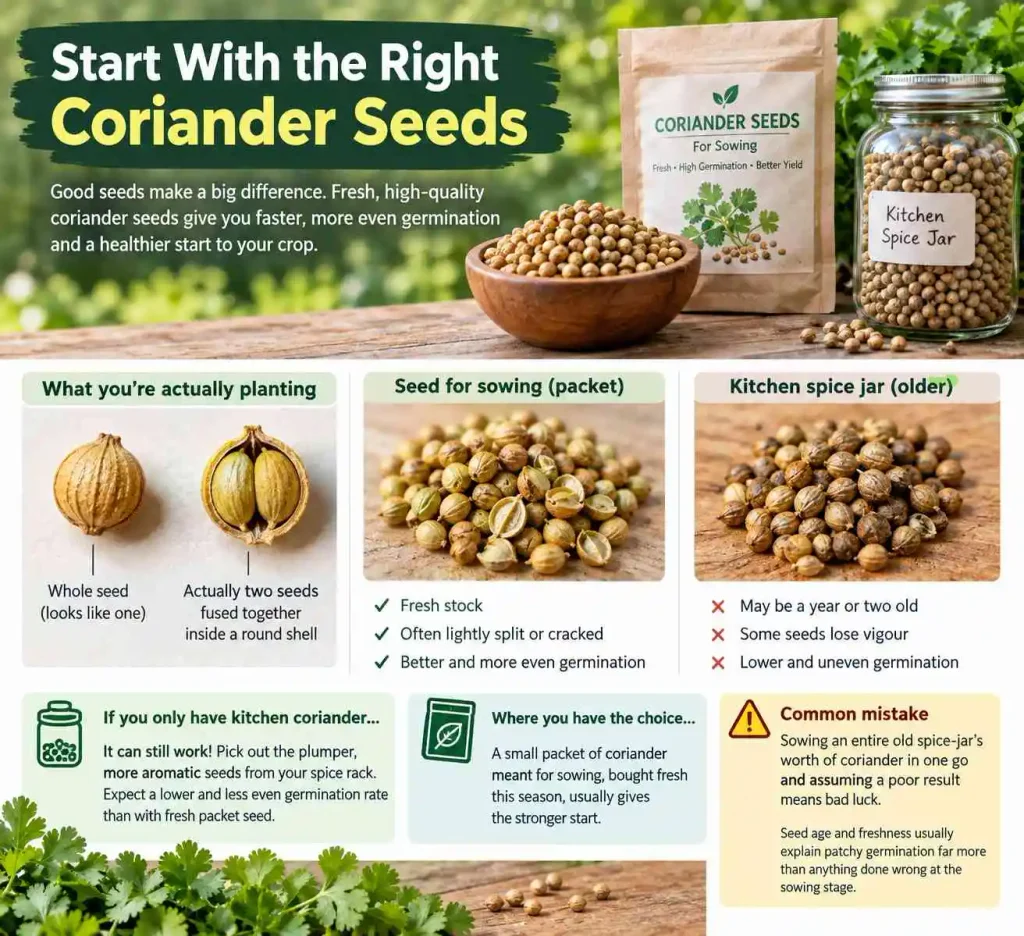
What looks like a single coriander seed is actually two seeds fused together inside a round shell. Seed sold specifically for sowing usually comes from fresher stock, and is sometimes lightly split or cracked before packaging, which exposes the two seeds inside and tends to help them sprout more evenly. Seeds that have been sitting in a kitchen jar for a year or two, on the other hand, have often lost some vigour, and a portion may simply not sprout at all.
That doesn’t make kitchen-stock coriander unusable — plenty of home gardeners grow coriander from seeds straight out of the spice rack. Pick out the plumper, more aromatic seeds if you’re using dhania from the kitchen, and expect a lower, less even germination rate than with fresh, packet seed. Where you have the choice, a small packet of coriander meant for sowing, bought fresh this season, generally gives the stronger start.
Common mistake: Sowing an entire old spice-jar’s worth of coriander in one go and assuming a poor result means bad luck. Seed age and freshness usually explain patchy germination far more than anything done wrong at the sowing stage.
3. How to Prepare Coriander Seeds Before Sowing
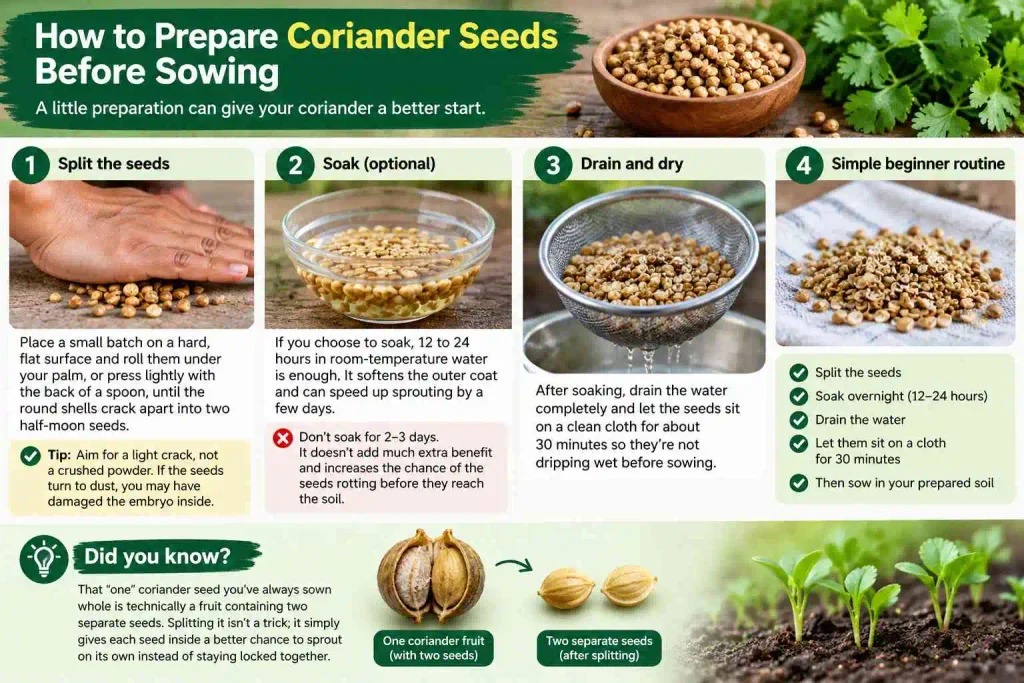
Since each coriander seed is really two seeds joined at a seam, gently splitting them before sowing is one of the few pieces of prep that consistently helps. Place a small batch on a hard, flat surface and roll them under your palm, or press lightly with the back of a spoon, until you feel the round shells crack apart into two half-moon seeds. You’re aiming for a light crack, not a crushed powder; if the seeds are turning to dust, the pressure has gone too far and damaged the embryo inside.
Soaking is optional, not compulsory. If you do soak the split seeds, 12 to 24 hours in room-temperature water is a reasonable window; it softens the outer coat and can speed up sprouting by a few days. Soaking for two or three days doesn’t add much extra benefit and raises the chance of the seed rotting before it even reaches the soil, so there’s little reason to push it that far.
For a simple beginner routine: split the seeds, soak them overnight, drain, and let them sit on a cloth for half an hour so they’re not dripping wet before sowing.
Did you know? That “one” coriander seed you’ve always sown whole is technically a fruit containing two separate seeds. Splitting it isn’t a trick; it simply gives each seed inside a better chance to sprout on its own instead of staying locked together.
4. What Pot Size Does Coriander Really Need?
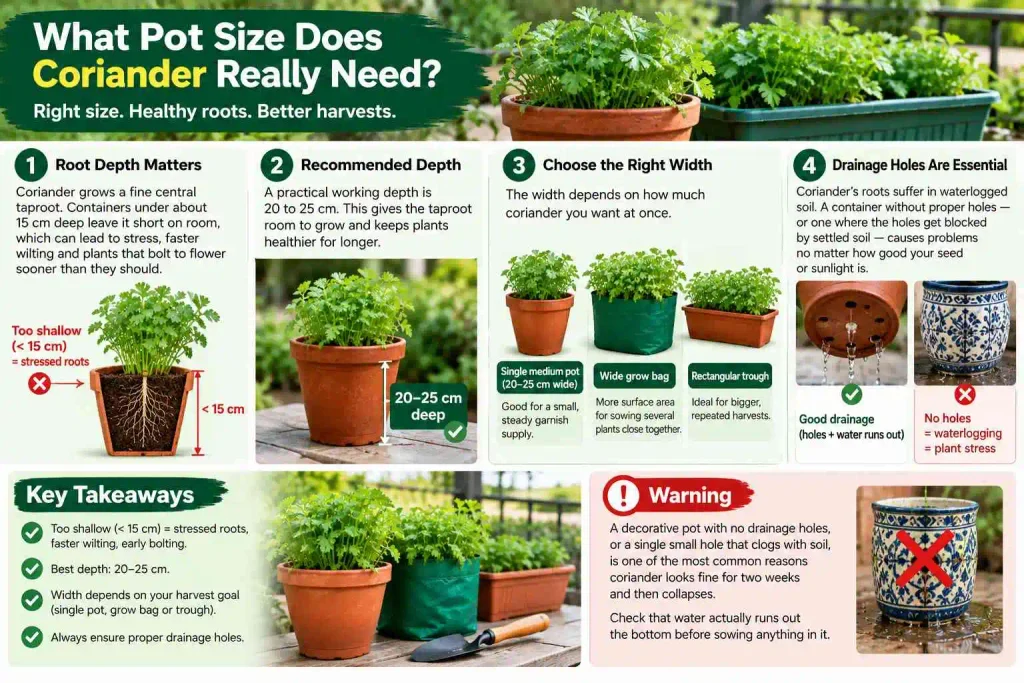
If you’re growing coriander in pots, size matters less than people assume — but shallow or overcrowded containers still create real problems. The plant grows a fine central taproot, and containers under about 15 cm deep tend to leave it short on room, which shows up later as stress, faster wilting, and plants that bolt to flower sooner than they should.
A practical working depth is somewhere around 20 to 25 cm, with width depending on how much coriander you actually want at once. A single medium pot around 20 to 25 cm wide is enough for a small, steady garnish supply. If you’re growing coriander for a bigger, repeated harvest, a wide grow bag or a rectangular trough gives more surface area for sowing several plants close together.
Drainage holes matter as much as depth. Coriander’s roots are quick to suffer in waterlogged soil, so a container without proper holes — or one where the holes get blocked by settled soil over time — causes problems that no amount of good seed or sunlight can fix. There isn’t one “correct” pot size here; it’s really a question of matching the container to how much coriander you plan to keep harvesting.
Warning: A decorative pot with no drainage holes, or a single small hole that clogs with soil, is one of the most common reasons coriander looks fine for two weeks and then collapses. Check that water actually runs out the bottom before sowing anything in it.
5. Best Soil for Coriander: The Mix That Helps It Grow Fast
Straight garden soil, scooped into a pot exactly as it comes from the ground, is one of the more common reasons coriander struggles indoors. In a container, that same soil compacts far more than it would in open ground, squeezing out the air pockets roots need and holding water long after the surface looks dry. The result is often slow growth and yellowing that has nothing to do with nutrients.
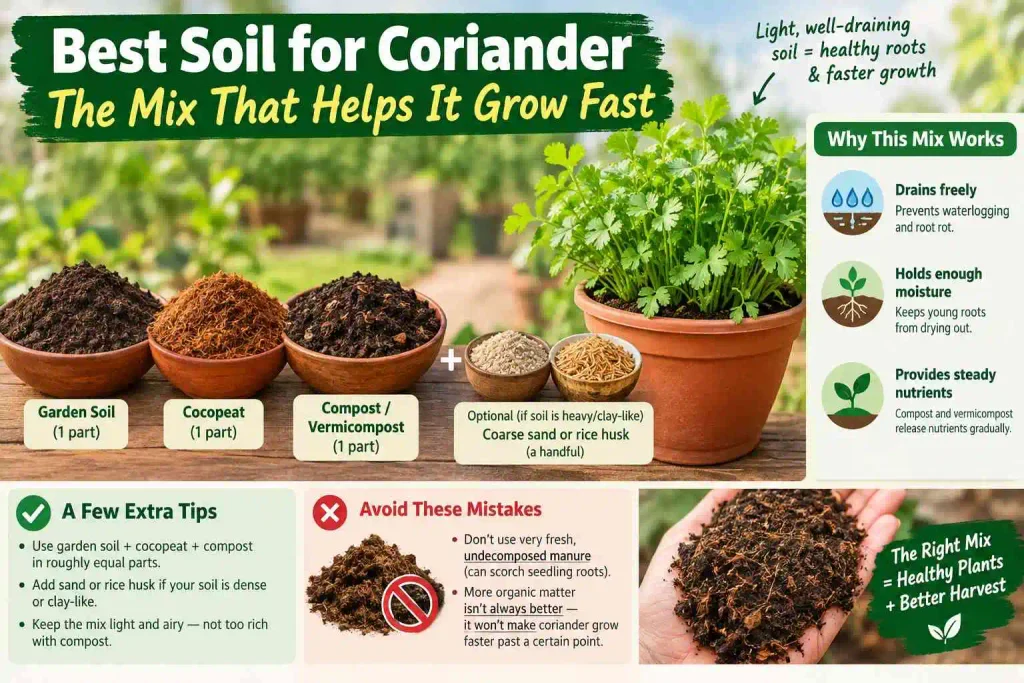
The best soil for coriander in a container is a lighter mix that drains freely but still holds enough moisture to keep young roots from drying out between waterings. A practical mix for Indian home gardens is roughly equal parts garden soil, cocopeat, and compost or well-rotted vermicompost, adjusted a little depending on how heavy your local soil is. If your soil is dense or clay-like, working in a handful of coarse sand or rice husk improves drainage further.
Compost and vermicompost release nutrients gradually as the plant grows, which suits coriander better than a large dose of strong, fresh manure at planting time. More organic matter isn’t automatically better; packing a pot with rich compost doesn’t make coriander grow faster past a certain point, and very fresh, undecomposed manure can scorch tender seedling roots.
6. How to Sow Coriander Seeds for Better Germination
This is where a lot of first attempts at coriander quietly go wrong, and it has less to do with the seed and more to do with how it’s placed in the soil.
Start with soil that’s evenly moist before you sow — not soaked, just damp all the way through, the way it feels an hour after a good watering. Scatter or place the prepared seeds and cover them with roughly 1 to 1.5 cm of fine soil or compost. Any deeper than that, and the seedling has to spend its limited energy reserves just pushing to the surface, which often means it either never emerges or comes up weak and pale. Spacing seeds 3 to 5 cm apart as you sow makes thinning easier later, though broadcasting a little thicker and thinning afterward works too.
Once the seeds are covered, water gently with a fine spray or a watering can fitted with a rose head; a hard stream from a mug or hose can wash seeds right out of position. From here, the priority is keeping the top layer of soil consistently moist, without letting it turn waterlogged, until the first seedlings appear — usually within 7 to 14 days depending on the weather. Poor coriander seeds germination at this stage is almost always a moisture or depth problem rather than a “bad seed” problem.
Quick summary: Moist soil before sowing, a shallow covering of about a centimetre, and a gentle watering right after — get these three right and most germination problems become far less common.
7. How Much Sunlight Does Coriander Need?
Once seedlings are up, the focus shifts from germination to keeping them growing steadily, and light is where people either get it right without noticing why, or struggle without knowing what’s missing.
As a general starting point, coriander does well with around 4 to 6 hours of sunlight, and gentle morning sun suits it better than harsh, direct afternoon light. Whether you’re growing coriander on a terrace or in a balcony garden, orientation matters: an east-facing spot that gets soft morning sun and shade later in the day is often kinder to coriander than a west-facing one baking under the 3 pm sun.
In peak summer across much of the northern plains, that afternoon heat can scorch leaves and push plants to flower earlier than you’d like, so some afternoon shade — a taller plant nearby, a shade net, or simply moving the pot — helps. In cooler months, or in hill regions where the sun is gentler year-round, plants can usually handle more direct light without the same stress.
Too little light causes its own problem: seedlings kept in a dim corner tend to stretch upward, thin and pale, reaching for a light source instead of building sturdy leaf growth. If your coriander looks leggy rather than bushy, checking how many real hours of bright light it gets is often more useful than reaching for fertilizer.
8. Watering Coriander: The Mistake That Can Ruin the Crop
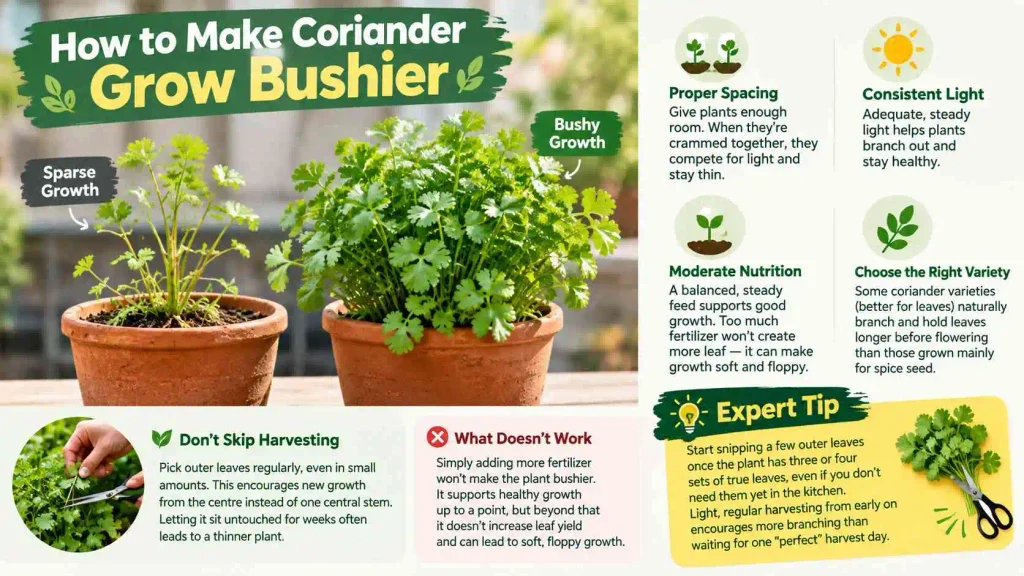
Before worrying about fertilizer or feeding schedules, there’s one thing that affects coriander far more: how often to water coriander in the first place. More home coriander is lost to overwatering than to underwatering, usually out of good intentions — a daily habit rather than something the plant actually needed that day.
Coriander does need consistently moist soil while germinating and through its first couple of weeks, since seeds and shallow young roots dry out fast in a small container. But consistent moisture isn’t the same as wet all the time. Once soil sits soggy for days, roots start to suffocate and rot, which shows up later as yellowing, wilting, or a musty smell from the pot.
Rather than watering on a fixed schedule, check before you water. Push a finger 2 to 3 cm into the soil, or lift the pot to feel how heavy it is; light and dry means it’s time, still heavy and cool means it can wait. How often that works out to depends heavily on weather: containers can dry out once a day or faster in peak Indian summer, while the same pot might need water only every two to three days during the monsoon or in cooler winter conditions. When you do water, water properly, enough that it runs out from the drainage holes, rather than a light daily sprinkle that only dampens the surface and keeps roots shallow.
Warning: If the soil in your pot still feels wet two days after you last watered it, stop watering on your usual schedule immediately. Adding more water on top of already-wet soil is the fastest route to root rot in coriander.
9. How to Make Coriander Grow Bushier
This is probably the single most common question from anyone growing coriander at home: why does the neighbour’s pot look like a small green bush while mine stays thin and sparse?
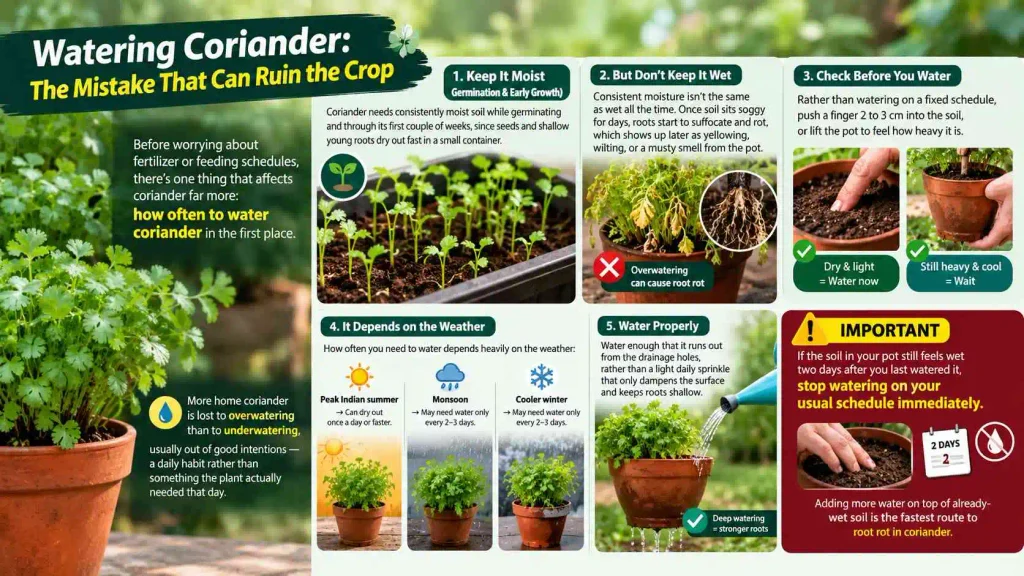
Bushiness usually comes down to several things working together rather than one trick. Proper spacing matters; plants crammed together compete for light and end up thin, while ones with a little breathing room branch out more. Consistent light and moderate, steady nutrition play a part too, and so does the coriander variety itself, since some leaf-focused varieties naturally branch and hold leaf longer before flowering than varieties grown mainly for spice seed.
The factor people underestimate most is harvesting. Picking outer leaves regularly, even in small amounts, tends to encourage the plant to keep pushing out new growth from the centre rather than putting all its energy into one central stem.
Letting a plant sit untouched for weeks, waiting for it to “fill out” on its own, often backfires. What doesn’t reliably deliver a bushier plant is simply adding more fertilizer; extra feed supports healthy growth up to a point, but past that point it doesn’t translate into noticeably more leaf, and can push soft, floppy growth instead.
Expert tip: Start snipping a few outer leaves once the plant has three or four sets of true leaves, even if you don’t need them yet in the kitchen. Light, regular harvesting from early on encourages more branching than waiting for one “perfect” harvest day.
10. When Should You Thin Coriander Seedlings?
Two weeks after sowing, a pot can look like a tiny, crowded forest — dozens of thread-thin seedlings all reaching up at once. It looks promising, but left that way, most of them will stay weak.
Crowded seedlings compete directly for light, nutrients, and airflow. The usual result is a mat of pale, spindly plants rather than a smaller number of strong, leafy ones, and poor airflow between overcrowded seedlings also raises the risk of fungal problems at the base of the stems.
Thin once seedlings have grown their first two or three true leaves — the finely divided leaves that appear after the initial rounded pair. Remove the weakest-looking ones, aiming to leave the stronger seedlings spaced around 4 to 5 cm apart, or a little more if you want fewer, bushier plants rather than more, smaller ones. Snip the unwanted seedlings at soil level with small scissors instead of pulling them out, since tugging can disturb the roots of the ones you’re keeping. The thinnings aren’t waste, either; they’re tender enough to use straight away as a garnish.
Common mistake: Feeling reluctant to thin seedlings because it seems wasteful to remove ones that already sprouted. Left crowded, nearly all of them stay stunted; thinning early is usually what gives you more usable coriander overall, not less.
11. Does Coriander Need Fertilizer?
Not as much as the fertilizer aisle would have you believe. If your soil mix already includes a reasonable amount of compost or vermicompost, that’s often enough nutrition to carry coriander through a full harvest cycle without any extra feeding.
Where feed genuinely helps is in containers being harvested repeatedly over several weeks, since regular cutting and watering both draw down nutrients faster than they’d deplete in open garden soil. A mild, diluted liquid feed, or a dilute vermicompost tea, every couple of weeks during active growth is usually plenty for a home container.
Overdoing it causes its own problems. Excess fertilizer, especially strong synthetic feeds, can build up salts in a small volume of soil quickly enough to scorch roots and leaf edges. Heavy nitrogen in particular tends to push soft, watery growth rather than sturdier leafy growth, which can make plants more prone to flopping over or picking up pest and fungal issues.
Best practice: Feed only when the plant actually looks like it needs it — pale colour or stalled growth despite good light and watering — rather than on a fixed weekly schedule regardless of how it looks.
12. Why Is My Coriander Turning Yellow?
Yellow leaves are the symptom every home gardener asks about, and the honest answer is that there’s no single cause. It’s worth checking a few things before deciding what’s actually wrong.
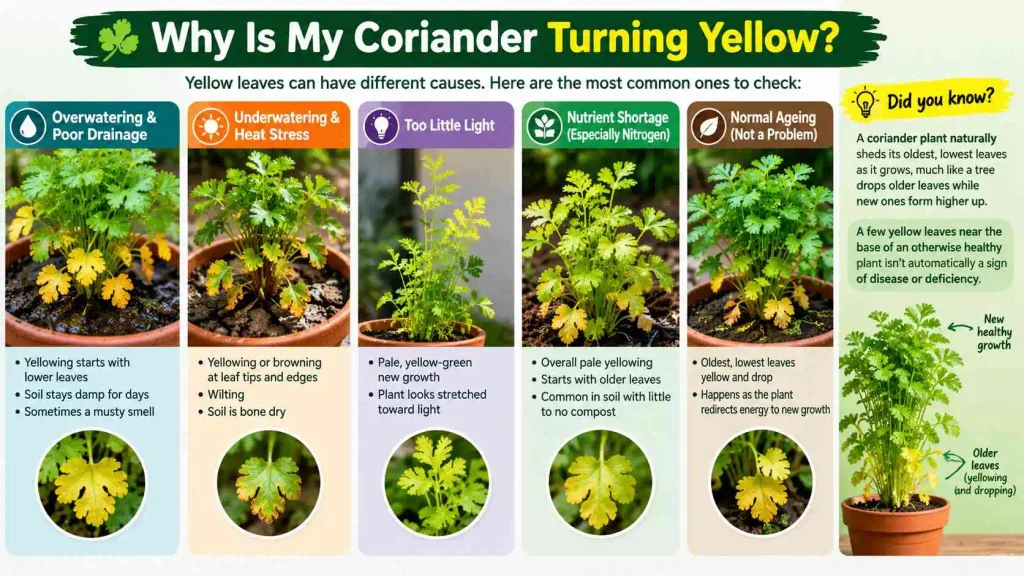
Overwatering and poor drainage are the most frequent culprits in containers, usually showing up as yellowing that starts with the lower leaves, soil that stays damp for days after watering, and sometimes a faintly musty smell from the pot.
Underwatering and heat stress look different — yellowing or browning that starts at the leaf tips and edges, alongside wilting and soil gone bone dry. Too little light tends to produce pale, yellow-green new growth on a plant that’s also stretching toward whatever light it can get, rather than yellowing on the older leaves. A genuine nutrient shortage, particularly nitrogen, usually shows as an overall pale yellowing starting with the older leaves on a plant growing in soil with little to no compost.
Then there’s the cause that isn’t really a problem at all: it’s normal for the very oldest, lowest leaves on a maturing coriander plant to yellow and drop as the plant redirects energy into new growth, especially as it nears flowering. If the new leaves at the top still look healthy, that’s usually just the plant ageing normally.
Did you know? A coriander plant naturally sheds its oldest, lowest leaves as it grows, much like a tree drops older leaves while new ones form higher up. A few yellow leaves near the base of an otherwise healthy plant isn’t automatically a sign of disease or deficiency.
13. Why Does Coriander Flower Too Quickly?
Watching coriander send up a flower stalk within weeks of a promising start can feel like a personal failure, but bolting — the shift from leaf growth to flowering — is driven mostly by things outside your control.
Rising temperature is the biggest trigger, which is why coriander sown right before or during peak summer tends to bolt fastest. Plant age plays a part too, since every coriander plant eventually flowers as it matures regardless of how well it’s cared for. Stress from drought, overcrowding, or a root-bound container can push flowering earlier than it would otherwise happen, and some varieties are simply bred to bolt sooner or later than others.
What you do about it depends on what you actually want from the plant. If the goal is maximum leaf, sowing during cooler months, offering afternoon shade once temperatures climb, watering consistently, harvesting often, and succession sowing so a fresh batch is always coming up all help delay the point where you’re left with mostly flower stalks. If you’re growing coriander partly for its seed, letting a portion of the crop bolt and flower on purpose is exactly what you want.
Quick summary: To delay bolting — sow in cooler months where possible, give afternoon shade once the heat rises, keep watering consistent rather than swinging between soaked and bone-dry, and keep a new batch coming up through succession sowing.
A Quick Reference for Common Coriander Problems
By this point, most coriander problems trace back to some combination of water, light, heat, and crowding, which makes a side-by-side reference more useful than hunting back through separate sections every time something looks off.
| Problem | Likely cause | What to check | What to do |
|---|---|---|---|
| Seeds not germinating | Old or unsplit seed; sown too deep; soil too dry, cold, or hot | Seed age, sowing depth, soil moisture and temperature | Use fresher, split seed; sow about 1–1.5 cm deep; keep soil evenly moist; avoid sowing in extreme heat or cold |
| Seedlings falling over | Damping off from excess moisture and poor airflow; weak stems from overcrowding | Soil wetness, spacing, airflow around the pot | Water less often, improve drainage, thin crowded patches, keep the pot where air can circulate |
| Yellow leaves | Overwatering, underwatering, low light, nutrient shortage, or natural leaf ageing | Soil moisture, light hours, whether old or new leaves are affected | Adjust watering first, then check light, and feed lightly only if new growth is also pale |
| Slow growth | Cold weather, low light, nutrient-poor soil, cramped roots | Season and temperature, light hours, soil richness, container size | Move to a brighter, warmer spot; feed lightly with compost or vermicompost tea; use a larger container next time |
| Thin, leggy plants | Insufficient light or overcrowded sowing | Light hours, spacing between seedlings | Move to a brighter spot; thin to the recommended spacing |
| Flowering too early | Heat, plant maturity, water stress, or variety | Temperature, plant age, recent watering consistency | Offer afternoon shade in heat, water consistently, succession sow, accept some bolting as normal for the season |
| Soil staying wet | Poor drainage, blocked or missing holes, heavy soil, overwatering | Drainage holes, soil texture | Improve the mix with cocopeat or sand, clear blocked holes, water less often |
| Leaves drying at the edges | Underwatering, heat or wind stress, fertilizer burn | Watering frequency, recent feeding, exposure to hot wind | Water more consistently, add some shade in extreme heat, flush soil with plain water after heavy feeding |
| Overcrowded seedlings | Dense sowing or broadcasting without later thinning | Spacing between seedlings | Thin to the recommended spacing and use the thinnings as garnish |
14. When to Harvest Coriander: Recognizing the Right Stage
Coriander gives you two reasonable harvest points, and which one you aim for depends on what you need right now.
A light, baby-leaf harvest is usually possible from around three to four weeks after sowing, once seedlings have several sets of true leaves and stand roughly 10 to 15 cm tall. A fuller, bushier harvest — the kind that gives a proper handful rather than a garnish — is generally ready by around 40 to 45 days, once the plant has filled out with multiple branching stems.
Rather than watching the calendar alone, look at the plant itself: enough leaves to spare some without stripping it bare, a reasonable size, and stems sturdy enough to handle cutting without the whole plant coming loose from the soil. Depending on what you need that day, you can pinch off a few individual leaves or cut a larger portion of stems at once; neither is more “correct” than the other.
15. How to Harvest Coriander Without Stopping New Growth
How you cut matters almost as much as when you cut, if you want the plant to keep producing rather than fizzling out after one harvest.
For ongoing, cut-and-come-again harvesting, take the outer, older leaves and stems first, leaving the smaller, newer growth at the centre untouched to keep developing — the same logic used with lettuce and other leafy greens. If you’re cutting a larger portion at once, snip stems an inch or two above the soil rather than right at the base, so enough leaf structure and growing points remain for the plant to send up new stems afterward.
If your intention is a single, complete harvest — clearing a container before resowing it, say, or picking everything just before a plant is about to bolt — cutting close to the soil is reasonable, but don’t expect much regrowth from a plant cut that low. Deciding in advance whether you want repeated smaller harvests or one bigger one changes how hard you should cut.
Expert tip: Use small scissors rather than pinching leaves off with your fingers, especially in humid weather. A clean cut heals faster and gives fungal problems less of an opening than a torn or bruised stem.
16. How to Grow Coriander Continuously at Home
Sow every seed you have in one container on day one, and you’ll likely end up with more coriander than you can use for two or three weeks, followed by nothing at all once that batch bolts or gets used up.
Succession sowing solves this by spreading out your sowing instead of concentrating it. Sow a small batch every 10 to 15 days rather than everything at once, using a few small pots or separate sections of a wider grow bag so each batch can be tracked and harvested on its own timeline. Label each container with its sowing date; it’s easy to lose track of which batch is which once you have three or four going.
As one batch finishes and starts to bolt, resow that same container while a middle-aged batch is at peak harvest and a newer one is just coming up as seedlings. That overlap is what gives you a steady supply instead of feast-or-famine. The interval between sowings isn’t fixed; it needs to flex a little with the season, since growth and bolting both speed up in heat and slow down in cooler weather.
Best practice: Keep at least two or three small containers going on a staggered rotation rather than one large pot sown all at once. It takes barely more effort and gives you fresh coriander far more consistently through the month.
Getting the Basics Right Is the Whole Trick
None of this requires an elaborate setup or expensive inputs. Successful coriander growing is less about money spent and more about getting the basics right: fresh seed, suitable soil, sensible watering, enough light, proper spacing, and regular sowing.
If you’re trying this for the first time, resist the urge to fill every spare pot and railing on day one. Start with one or two containers, get comfortable with how your specific balcony or terrace behaves through a full growing cycle, and expand once you’ve seen what actually works in your space. If that expansion eventually means turning the whole terrace into a proper growing space, it’s worth reading how to build a rooftop kitchen garden that survives first — it covers the setup decisions that decide whether a bigger garden holds up long-term.
Pick a pot, get your hands on some fresh seed, and sow the first small batch this week — the next one is only ten days behind it.
Frequently Asked Questions About Growing Coriander at Home
How long does coriander take to germinate?
Usually 7 to 14 days, depending on the weather. Warm-but-not-hot conditions with fresh, split seed tend to germinate faster; cold weather can stretch this to two or three weeks. What is the best time to sow coriander in India?
Cooler months generally give the best leafy growth, since heat pushes coriander to flower faster. In most of the northern plains that means roughly October to February; coastal and southern regions with milder year-round temperatures have more flexibility, though peak summer heat is best avoided everywhere.
Can coriander grow in pots?
Yes, comfortably. A container around 20 to 25 cm deep with good drainage suits it well, and pots are actually one of the easier ways to control watering and soil quality for this plant.
What is the best soil for growing coriander?
A light, well-draining mix works best: roughly equal parts garden soil, cocopeat, and compost or vermicompost. Straight garden soil alone tends to compact in a container and hold too much water, which is one of the more common reasons coriander struggles in pots.
How much sunlight does coriander need?
Around 4 to 6 hours is a reasonable target, with gentle morning sun generally better than harsh afternoon sun in hot weather. Plants can usually take more direct sun in cooler months or cooler regions.
How often should coriander be watered?
There’s no fixed number of days that works everywhere. Check the top couple of centimetres of soil and water when it feels dry, adjusting for how hot or humid the weather is.
Why is my coriander growing tall and thin?
Most often it’s a light or spacing issue: either the plant isn’t getting enough bright light and is stretching to find it, or seedlings are too crowded and competing for light.
Newsletter