


Coconut Plantation: Full Coconut Farming Guide
Coconut is one of the most in-demand crops in the agriculture market, and high-demand produce always fetches a good price. The demand for coconut will only grow in the coming years because of its incredibly wide range of uses — cosmetics, medicine, cooking oil, and hair oil, to name a few. Beyond that, a single coconut tree provides fiber (coir), timber, coconut water, fuel, and much more. Coconut is known for its health benefits, antibacterial properties, and nourishing effects on hair and skin.
In this guide, we will cover everything you need to know about coconut plantation — from climate and soil requirements to harvesting and post-harvest processing. By the end, you will be fully equipped to start your own coconut farming venture. Let’s get started.
Climate and Soil Requirements for Coconut Plantation
Climate Requirements
Coconut trees thrive in tropical climates with warm temperatures and high humidity. That said, coconut plantation can succeed in any region where temperatures stay above 10°C (50°F), though maximum yields are achieved in true tropical climates. Here are the key climate requirements:
Temperature
- Coconut plantation performs best at temperatures between 27°C (80°F) and 32°C (90°F).
- Young coconut plants are sensitive to frost, which can be fatal to them.
Sunlight
- Coconut trees require plenty of sunlight for photosynthesis.
- A minimum of 6–8 hours of direct sunlight per day is ideal for healthy growth.
Rainfall
- While coconuts can tolerate mild drought, they thrive with well-distributed rainfall.
- The ideal annual rainfall for coconut plantation is around 150 to 300 cm (60–120 inches).
Humidity
- High humidity levels, typically above 60%, benefit coconut plantation significantly.
- Prolonged dry conditions can affect both growth and fruit production.
Soil Requirements for Coconut Plantation
Coconut trees are adaptable to various soil types, but the following conditions support the best results:
Well-Draining Soil
- Coconuts prefer well-draining soils to prevent waterlogging, which causes root rot.
- Sandy or loamy soils are ideal, allowing excess water to drain freely from the roots. Adding organic manure is also beneficial.
pH Levels
- Coconut trees thrive in slightly acidic to slightly alkaline soils, within a pH range of 5.0 to 8.0.
- Soil pH outside this range can affect nutrient availability.
Texture
- Sandy loam or loamy soils — a good mix of sand, silt, and clay — provide the best conditions for coconut cultivation.
- These soils offer good aeration, drainage, and nutrient retention.
Depth and Surface Conditions
- Coconut palms have a surface root system, so they do not require very deep soil.
- However, compacted surface soil can hinder root development. Keep the topsoil loose for better overall plant health.
Organic Matter
- Although coconut palms tolerate low-nutrient soils to some extent, adding well-rotted manure or compost during planting significantly improves soil fertility and long-term yield.
Coconut Plantation: Propagation and Planting
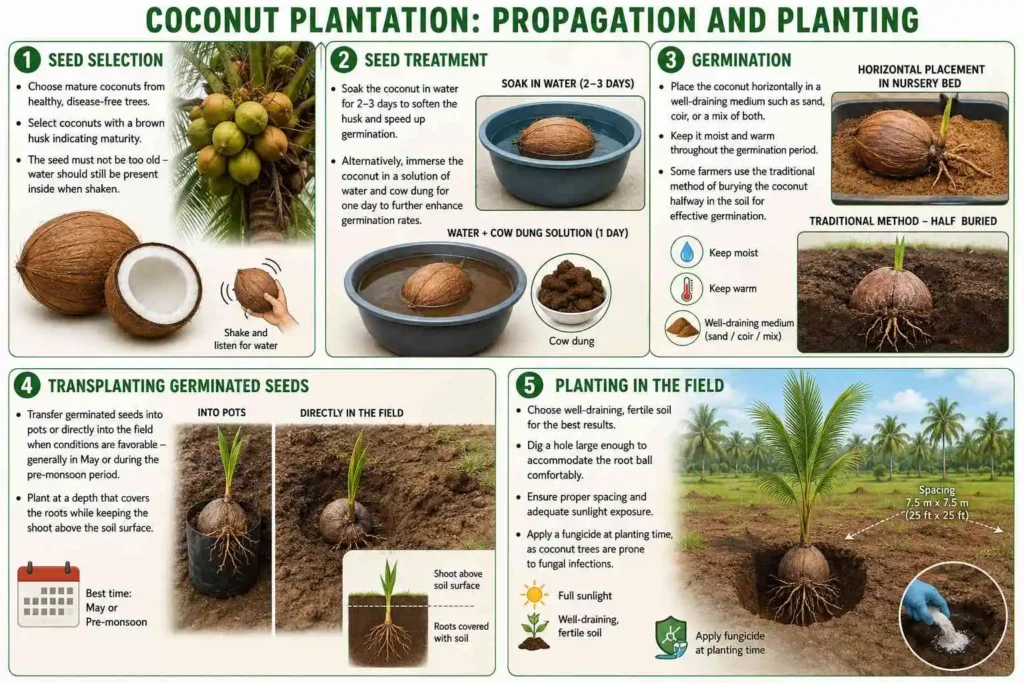
1. Seed Selection
- Choose mature coconuts from healthy, disease-free trees to reduce the risk of poor-quality plants.
- Select coconuts with a brown husk indicating maturity. The seed must not be too old — water should still be present inside when shaken.
2. Seed Treatment
- Soak the coconut in water for 2–3 days to soften the husk and speed up germination.
- Alternatively, immerse the coconut in a solution of water and cow dung for one day to further enhance germination rates.
3. Germination
- Place the coconut horizontally in a well-draining medium such as sand, coir, or a mix of both.
- Keep it moist and warm throughout the germination period.
- Some farmers use the traditional method of burying the coconut halfway in the soil for effective germination.
4. Transplanting Germinated Seeds
- Transfer germinated seeds into pots or directly into the field when conditions are favorable — generally in May or during the pre-monsoon period.
- Plant at a depth that covers the roots while keeping the shoot above the soil surface.
5. Planting in the Field
- Choose well-draining, fertile soil for the best results.
- Dig a hole large enough to accommodate the root ball comfortably.
- Ensure proper spacing and adequate sunlight exposure.
- Apply a fungicide at planting time, as coconut trees are prone to fungal infections.
Coconut Plantation: Spacing and Arrangement
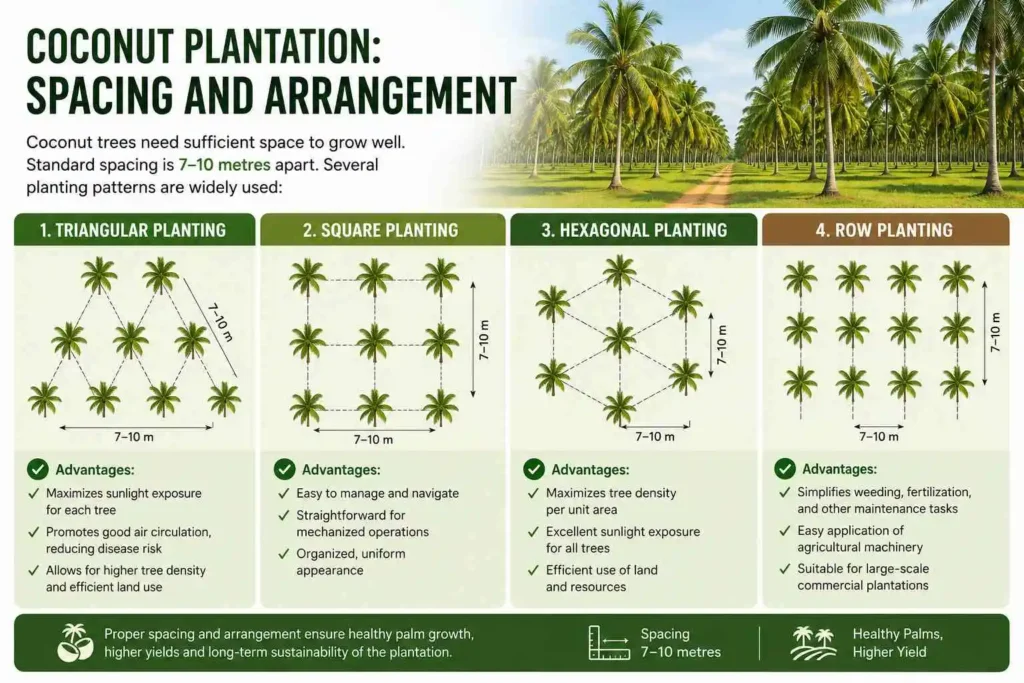
Coconut trees need sufficient space to grow well. Standard spacing is 7–10 metres apart. Several planting patterns are widely used:
1. Triangular Planting
Trees are arranged in an equilateral triangle pattern at 7–10 metres apart.
Advantages:
- Maximizes sunlight exposure for each tree
- Promotes good air circulation, reducing disease risk
- Allows for higher tree density and efficient land use
2. Square Planting
Trees are planted in a straight grid pattern with equal spacing in all directions (7–10 metres).
Advantages:
- Easy to manage and navigate
- Straightforward for mechanized operations
- Organized, uniform appearance
3. Hexagonal Planting
Each tree is positioned at the centre of a hexagon, creating a honeycomb-like arrangement at 7–10 metres spacing.
Advantages:
- Maximizes tree density per unit area
- Excellent sunlight exposure for all trees
- Efficient use of land and resources
4. Row Planting
Trees are planted in straight rows with defined spacing between trees and between rows.
Advantages:
- Simplifies weeding, fertilization, and other maintenance tasks
- Easy application of agricultural machinery
- Suitable for large-scale commercial coconut plantation
Top Coconut Plantation Varieties
Many coconut varieties are widely cultivated around the world. The choice of variety depends on climate, soil conditions, and local agricultural practices. Here is an overview of the most popular ones:
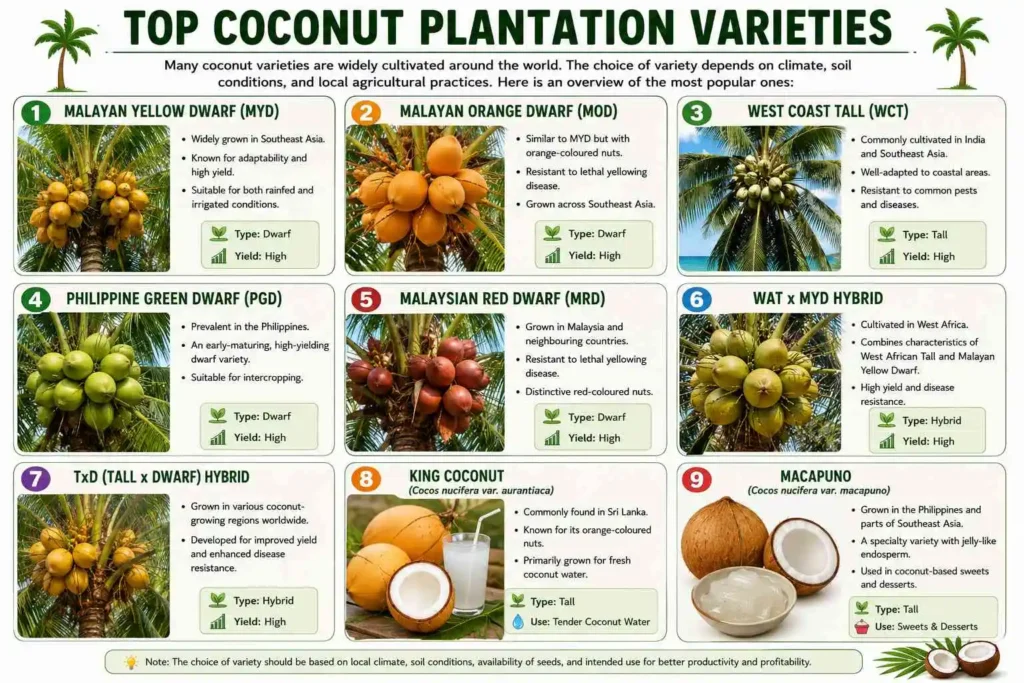
- Malayan Yellow Dwarf (MYD): Widely grown in Southeast Asia. Known for adaptability and high yield. Suitable for both rainfed and irrigated conditions.
- Malayan Orange Dwarf (MOD): Similar to MYD but with orange-coloured nuts. Resistant to lethal yellowing disease. Grown across Southeast Asia.
- West Coast Tall (WCT): Commonly cultivated in India and Southeast Asia. Well-adapted to coastal areas and resistant to common pests and diseases.
- Philippine Green Dwarf (PGD): Prevalent in the Philippines. An early-maturing, high-yielding dwarf variety suitable for intercropping.
- Malaysian Red Dwarf (MRD): Grown in Malaysia and neighbouring countries. Resistant to lethal yellowing disease, with distinctive red-coloured nuts.
- WAT x MYD Hybrid: Cultivated in West Africa. Combines characteristics of West African Tall and Malayan Yellow Dwarf for high yield and disease resistance.
- TxD (Tall x Dwarf) Hybrid: Grown in various coconut-growing regions worldwide. Developed for improved yield and enhanced disease resistance.
- King Coconut (Cocos nucifera var. aurantiaca): Commonly found in Sri Lanka. Known for its orange-coloured nuts and primarily grown for fresh coconut water.
- Macapuno (Cocos nucifera var. macapuno): Grown in the Philippines and parts of Southeast Asia. A specialty variety with jelly-like endosperm, used in coconut-based sweets and desserts.
Irrigation in Coconut Plantation
Water Requirements
- Young trees: Newly planted coconut trees require regular watering until their root systems are fully established.
- Mature trees: Mature coconut plantation also needs consistent irrigation, particularly during dry spells, to support healthy fruit development.
Irrigation Methods
- Drip Irrigation: The most efficient method — delivers water directly to the root zone and minimizes wastage.
- Sprinkler Irrigation: Covers a larger area and works well where water supply is adequate.
- Basin Irrigation: Basins dug around each tree hold water and allow it to percolate slowly into the soil.
- Furrow Irrigation: Water is channelled along furrows between rows of coconut trees.
Frequency and Timing
- Water during early morning or late afternoon to minimize evaporation loss.
- Mature coconut trees generally need irrigation every 7–14 days. Young trees may need watering more frequently depending on soil and climate conditions.
Soil Moisture Monitoring
- Monitor soil moisture regularly using sensors or manual methods such as soil probing to ensure the trees are receiving adequate water without over-irrigation.
Fertilization in Coconut Plantation
Fertilization is a crucial component of productive coconut plantation management.
Nutrient Requirements
- Nitrogen (N): Essential for leaf and shoot development
- Phosphorus (P): Promotes root development and flowering
- Potassium (K): Supports overall growth and fruit development
Micro-Nutrients: Magnesium (Mg), Boron (B), Copper (Cu), Zinc (Zn), Iron (Fe), Manganese (Mn), and Molybdenum (Mo) are all needed in smaller quantities but are equally important for long-term tree health.
Soil Analysis
- Conduct regular soil tests to identify nutrient levels and deficiencies.
- Adjust your fertilization programme based on the results.
Fertilizer Application
- Organic Fertilizers: Well-rotted compost or farmyard manure improves soil structure and provides slow-release nutrients.
- Inorganic Fertilizers: Apply balanced fertilizers suitable for coconut trees, such as NPK 16-16-16.
- Slow-Release Fertilizers: These provide a steady supply of nutrients over a longer period and are ideal for coconut plantation.
Fertilization Timing
- Young trees: Benefit from frequent, smaller doses during the first few years.
- Mature trees: Fertilize at the start of the growing season and after each harvest.
- Split applications: Divide the annual fertilizer dose into multiple applications throughout the year for best results.
Always consult your local agriculture department for a soil profile overview specific to your region before choosing fertilizers.
Pest and Disease Management in Coconut Plantation
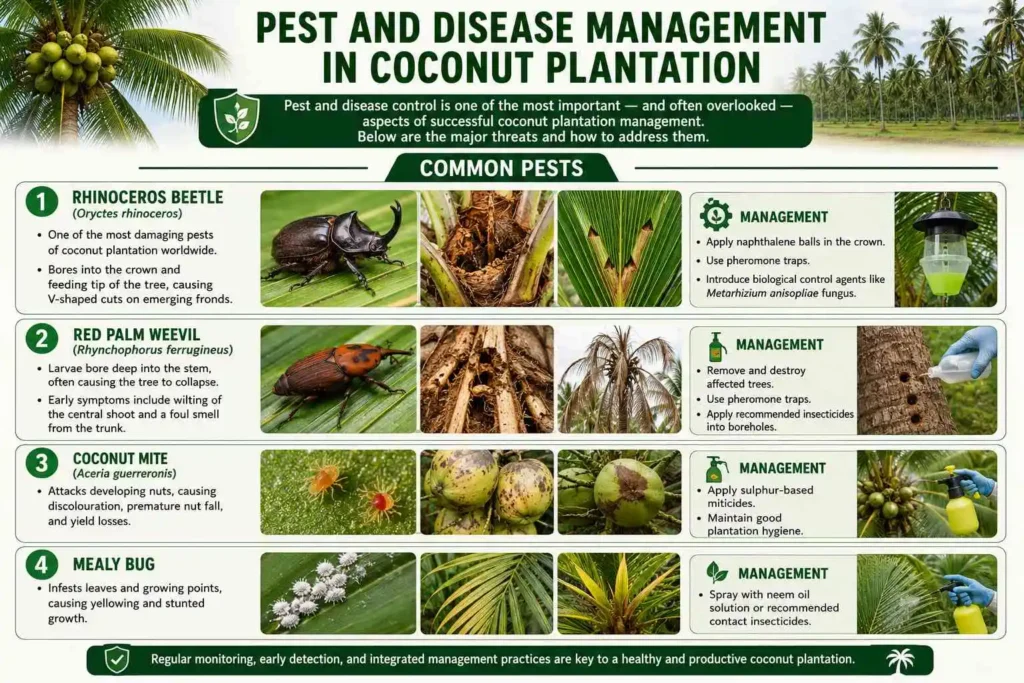
Pest and disease control is one of the most important — and often overlooked — aspects of successful coconut plantation management. Below are the major threats and how to address them.
Common Pests
Rhinoceros Beetle (Oryctes rhinoceros)
- One of the most damaging pests of coconut plantation worldwide.
- Bores into the crown and feeding tip of the tree, causing V-shaped cuts on emerging fronds.
- Management: Apply naphthalene balls in the crown, use pheromone traps, and introduce biological control agents like Metarhizium anisopliae fungus.
Red Palm Weevil (Rhynchophorus ferrugineus)
- Larvae bore deep into the stem, often causing the tree to collapse.
- Early symptoms include wilting of the central shoot and a foul smell from the trunk.
- Management: Remove and destroy affected trees, use pheromone traps, apply recommended insecticides into boreholes.
Coconut Mite (Aceria guerreronis)
- Attacks developing nuts, causing discolouration, premature nut fall, and yield losses.
- Management: Apply sulphur-based miticides and maintain good plantation hygiene.
Mealy Bug
- Infests leaves and growing points, causing yellowing and stunted growth.
- Management: Spray with neem oil solution or recommended contact insecticides.
Common Diseases
Bud Rot (Phytophthora palmivora)
- A fungal disease that rots the growing bud, causing wilting and death of the central spear leaf.
- Management: Remove affected tissue, apply Bordeaux mixture or copper-based fungicides to the crown.
Stem Bleeding (Thielaviopsis paradoxa)
- Characterized by reddish-brown gummy liquid oozing from the stem.
- Management: Chisel out affected bark, apply coal tar mixed with Bordeaux paste on the wound.
Lethal Yellowing Disease
- A phytoplasma disease spread by planthoppers, causing yellowing and death of the entire tree.
- Management: No reliable cure exists. Plant resistant varieties like MYD or MOD and control the insect vector.
Root Wilt
- Causes yellowing, wilting, and progressive decline of the tree. Common in certain parts of Kerala, India.
- Management: Use certified disease-free planting material, apply balanced fertilizers, and ensure good soil drainage.
General Preventive Practices
- Keep the plantation clean and free of debris that harbours pests.
- Maintain proper spacing for good air circulation.
- Regularly inspect trees for early signs of pest and disease damage.
- Avoid wounding trees during agricultural operations.
Intercropping in Coconut Plantation
Intercropping is one of the best ways to improve the profitability of coconut plantation, especially in the early years when coconut trees are not yet bearing fruit.
Why Intercrop?
- Generates income during the 4–6 year wait before the first coconut harvest.
- Makes efficient use of the wide spacing between coconut trees.
- Improves soil fertility through root diversity and organic matter.
Suitable Intercrops
| Crop | Benefits |
| Banana | Provides quick returns, adds organic matter |
| Pineapple | Low-maintenance, thrives in similar tropical conditions |
| Turmeric / Ginger | High market value, grows well in partial shade |
| Groundnut | Nitrogen-fixing legume, improves soil health |
| Elephant Foot Yam | High yield, good market demand |
| Pepper (Black) | Can be trained on coconut trunks as support |
| Cocoa | Grows well under partial shade in humid regions |
Key Points for Successful Intercropping
- Choose intercrops that do not compete aggressively for nutrients with young coconut trees.
- Increase fertilizer input to compensate for the additional nutrient demand.
- Avoid crops that are prone to the same diseases as coconut.
Harvesting Coconut Plantation Produce
1. Harvesting Time
- Coconuts are typically ready for harvest when they are about 5–7 months old (for tender coconut water) or 11–12 months old (for copra and oil).
- Harvesting too early results in immature nuts, while delayed harvesting leads to over-mature coconuts with reduced water content.
2. Harvesting Methods
- Manual Harvesting: Use long poles or specialized tools to reach and cut mature coconuts.
- Climbing: Skilled harvesters climb the tree to harvest coconuts by hand.
3. Harvesting Frequency
- Coconuts are generally harvested every 45–60 days.
- Regular harvesting ensures a consistent supply of fresh produce.
4. Selective Harvesting
- Harvest only the mature coconuts while leaving younger ones to ripen for the next cycle.
- This practice maintains a continuous and uniform supply.
5. Harvesting Tools
- Use sharp harvesting knives or sickles for clean cuts.
- Always use proper safety equipment, especially when climbing tall trees.
Post-Harvest Processing
- Dehusking: Remove the husk using a machete or mechanical dehusking machine, being careful not to damage the inner shell (endocarp).
- Cleaning: Wash coconuts to remove any residual husk fibers or dirt.
- Storage: Store in a cool, well-ventilated area. Do not stack directly on the ground to prevent rotting.
- Grading: Grade coconuts by size, weight, and appearance to ensure uniformity in packaging and pricing.
- Packaging: Use well-ventilated bags or crates to allow air circulation. Packaging must be clean and free from contaminants.
- Transportation: Handle coconuts carefully during transit and avoid overloading to prevent bruising or crushing.
- Value-Added Processing: Coconuts can be processed into coconut oil, coconut milk, desiccated coconut, coconut water, coir, and activated carbon from shells — significantly increasing profitability.
- Quality Control: Implement regular checks for freshness and freedom from pests and diseases before processing or dispatch.
- Marketing: Develop strategies to promote coconut products both locally and in export markets. Highlight the nutritional benefits and versatility of coconut-based products.
- Waste Utilization: Coconut husks and shells can be used for composting, coir production, and bioenergy — ensuring near-zero waste from a well-managed coconut plantation.
- Record Keeping: Maintain detailed records of harvest dates, quantities, inputs used, and post-harvest processes for planning, quality control, and farm management.
Conclusion
Indonesia, the Philippines, and India are the three largest coconut-producing countries in the world, and the global demand for coconut products continues to rise every year. With the right variety selection, soil preparation, irrigation, pest management, and harvesting practices, coconut plantation can be an extremely rewarding and sustainable agricultural venture.
We hope this complete coconut plantation guide gives you the confidence to start or improve your own farming operation. If you have any questions, feel free to leave a comment below or reach out on social media.
Organic fertilizers are important in every type of farming. Be sure to check out our compost-making blog to learn how to create nutrient-rich compost at home.
Frequently Asked Questions (FAQ)
1. How many coconut plants can be accommodated in one acre of land?
Approximately 180–200 coconut plants per acre, depending on the spacing pattern used.
2. What is the yield of a single coconut plant?
A healthy coconut tree yields 70–150 nuts per year, depending on the variety and farming practices.
3. How many years does a coconut tree take to bear fruit?
Most coconut varieties take 4–6 years to begin bearing fruit. Dwarf and hybrid varieties tend to bear fruit earlier — sometimes within 3–4 years.
6. What is the most profitable coconut product?
Virgin coconut oil (VCO) typically commands the highest market price. Coconut water, coconut milk, and value-added coir products also offer excellent returns from a well-run coconut plantation.
7. Can coconut plantation be done in non-coastal areas?
Yes. While coconut trees naturally thrive near coasts due to sandy soil and high humidity, they can be successfully grown in inland areas provided the temperature, rainfall, and soil conditions are suitable. Many productive coconut plantations exist in inland tropical regions across India, Indonesia, and the Philippines.
Newsletter