



Buffalo Dairy Farming Guide: Breed Selection, Feeding & Profit Tips
Two dairy farmers can buy the same breed of buffalo, pay almost the same price, and still end up with completely different bank balances a year later. One is calculating profit per litre and reinvesting steadily. The other is wondering why feed bills keep climbing while milk income barely moves.
The difference almost never comes down to luck. It comes down to a handful of decisions made before the first litre of milk is ever sold — which animal to buy, how she’s fed, how heat and hygiene are managed, and whether her reproductive cycle is tracked or left to chance.
Buffalo dairy farming rewards planning far more than it rewards enthusiasm. This guide walks through the practical decisions that actually separate a profitable buffalo dairy operation from one that struggles quietly for years — breed selection, buying the right animal, feeding economics, housing, breeding, calf care, disease prevention, and the real numbers behind cost and profit. If you’re starting a small unit or scaling up an existing herd, there’s something here worth applying before your next investment.

Why Breed Selection Isn’t Just About Milk Yield on Paper
Choosing a buffalo breed feels like a simple decision until you realize how much it actually shapes your farm’s day-to-day economics. Breed affects milk yield, fat content, body size, feed requirements, heat tolerance, and how well the animal adapts to your local climate — not just the number printed on a sales flyer.
A high-yielding breed that struggles in your climate or needs feed you can’t reliably source often ends up less profitable than a moderate-yielding animal that thrives on what your farm can actually provide.
| Breed | Typical Strength | Best Suited For |
|---|---|---|
| Murrah | Strong milk yield potential, wide availability | Commercial dairies across most regions |
| Nili-Ravi | High milk fat content | Farms selling to fat-based payment systems |
| Jaffarabadi | Larger body size, good adaptability | Farms with strong fodder availability |
| Mehsana | Moderate yield, good heat tolerance | Warmer climates, mixed farming systems |
| Surti | Good milk fat, smaller body size | Small farms with limited feed resources |
| Bhadawari | High fat percentage, hardy | Regions with limited-quality fodder |
For many commercial dairy farmers, Murrah buffaloes remain a popular choice because of their strong production potential and relatively easy availability of quality stock. That said, the best animal for your farm still depends on climate, feed access, breeding quality, and your budget — not the breed name alone.
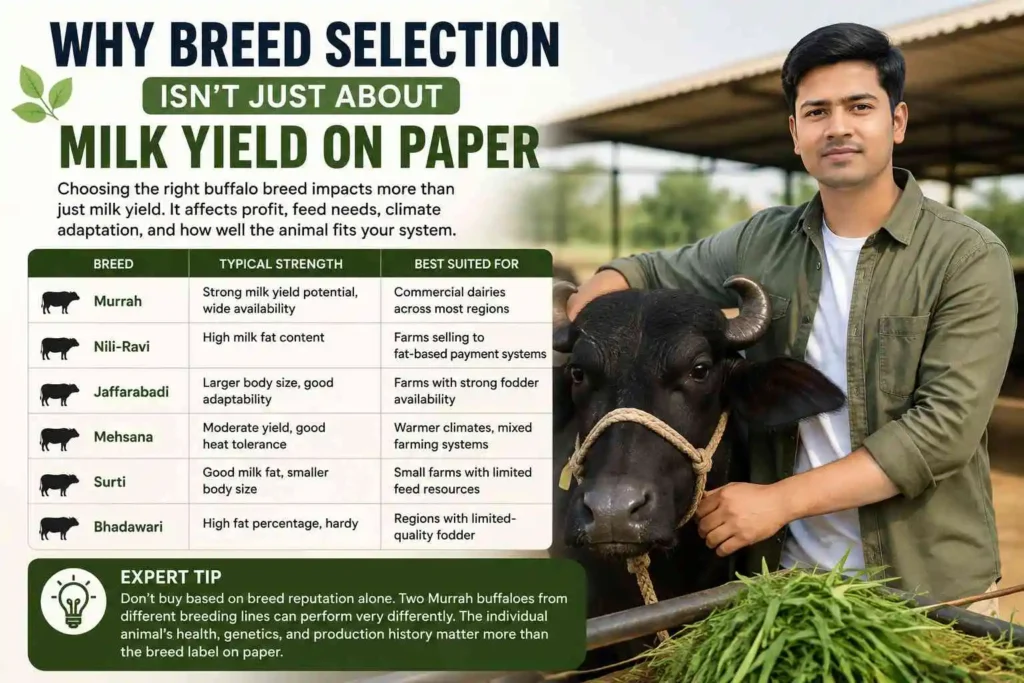
Expert Tip Don’t buy based on breed reputation alone. Two Murrah buffaloes from different breeding lines can perform very differently. The individual animal’s health, genetics, and production history matter more than the breed label on paper.
What to Actually Check Before You Buy a Buffalo
Buying a buffalo is one of the largest single financial decisions in dairy farming, and it’s also where a lot of new farmers get burned. A large, healthy-looking animal isn’t automatically a profitable one — appearance tells you very little about actual milk production or reproductive history.
Before handing over money, verify:
- Age and number of previous lactations
- Current milk yield — ideally verified through repeated milking, not just the seller’s word
- Stage of lactation and pregnancy status
- Udder structure and teat condition, checking for lumps, damage, or asymmetry
- Body condition and overall health
- History of mastitis or other disease
- Vaccination records
- Previous calving interval — a long gap between calvings can signal fertility problems
- Source and ownership history
Common Mistake Buying a buffalo purely because she looks large and well-fed. Body size has very little correlation with actual milk production, and a poor reproductive history won’t show up just by looking at the animal.
Involving a qualified veterinarian or experienced livestock professional before a high-value purchase is money well spent. A one-time inspection fee is far cheaper than discovering a fertility problem or hidden disease six months into ownership.
Why Feed Costs Quietly Decide Whether You Actually Make Money
Feed is usually the single largest recurring expense on a buffalo dairy farm, and it directly influences milk yield, milk fat, fertility, and immunity — not just body weight. Underfeeding reduces production. Overfeeding without balance wastes money without proportional returns.
Nutrition needs change constantly. A buffalo in early lactation, peak lactation, late lactation, and the dry period all have different requirements, and feeding the same ration throughout the cycle is a common reason farmers see declining milk yield or repeat breeding failures.
Feed categories that matter:
- Green fodder — supports milk yield and provides essential moisture and nutrients
- Dry fodder — provides bulk and fiber, important for rumen health
- Concentrate feed — supplies energy and protein, especially important during peak lactation
- Legume fodder — adds protein without the higher cost of concentrate feed
- Mineral mixture and salt — often overlooked, but critical for fertility, immunity, and milk quality
- Clean drinking water — directly affects feed intake and milk yield, and is frequently underestimated
Did You Know? Buffaloes typically need considerably more drinking water during lactation than most farmers assume. Restricted water access is a quiet, common cause of lower-than-expected milk yield, even when feed quantity looks adequate.
Feed requirements vary by body weight, milk yield, fat percentage, lactation stage, and feed quality — so there’s no single universal ration that works across every farm. A local feed analysis and guidance from a qualified veterinarian or animal nutritionist will always give more reliable results than a generic formula.
Why Fodder Planning Can Matter More Than Buying Expensive Feed
A farm with strong milk yield but heavy year-round dependence on purchased concentrate can actually be less profitable than a slightly lower-yielding herd supported by well-planned fodder production. Growing your own green fodder, storing dry fodder properly, and making silage where feasible all reduce dependence on expensive market-bought feed.
Poor chaffing and feed wastage also quietly inflate costs. Even a well-planned fodder system loses value if a significant portion ends up trampled or spoiled before the animal eats it.
Why Buffaloes Struggle More in Heat Than Most Farmers Expect
Buffaloes have dark skin and a limited ability to dissipate heat compared to cattle, which makes them noticeably more vulnerable to heat stress. This isn’t just a comfort issue — heat stress reduces feed intake, which directly lowers milk yield, and it can also disrupt reproductive cycles, delaying conception.
Practical steps during hot weather:
- Ensure continuous access to clean drinking water throughout the day
- Provide adequate shade during the hottest hours, not just a roof over the shed
- Improve ventilation in enclosed housing to prevent heat buildup
- Use wallowing, sprinklers, or bathing systems where water availability allows
- Avoid unnecessary handling, transport, or breeding activity during extreme heat
Farmer’s Warning Don’t assume shade alone solves heat stress in enclosed sheds with poor airflow. Trapped heat inside a poorly ventilated structure can be worse than direct sun with a breeze, especially during humid months.
Why Shed Design Affects Milk Yield More Than Most Farmers Realize
A good buffalo shed isn’t about expensive construction — it’s about creating conditions that keep animals clean, comfortable, and free from unnecessary stress. Poor housing design contributes to mastitis, foot problems, injuries, and reduced feed intake, all of which quietly cut into milk production.
| Housing Element | Why It Matters | Consequence If Ignored |
|---|---|---|
| Floor drainage | Prevents standing water and manure buildup | Increased mastitis and foot infections |
| Non-slip flooring | Reduces injury risk | Leg injuries, reduced mobility |
| Ventilation | Reduces heat stress | Lower feed intake, reduced milk yield |
| Adequate floor space | Reduces overcrowding stress | Increased aggression, injury, disease spread |
| Clean resting area | Supports rest and rumination | Lower milk yield, poor body condition |
Whether you choose individual housing, loose housing, or a group system depends on herd size and available labour — no single system is universally superior, but drainage, ventilation, and cleanliness matter regardless of which system you pick.
Why Milking Hygiene Directly Affects Your Milk Income
Milk production doesn’t end when the buffalo enters the milking area — hygiene and routine during milking directly influence both udder health and the price you eventually receive for your milk.
A reliable milking routine includes:
- Clean udder preparation before milking
- Clean hands, equipment, and milking containers
- A consistent milking time and routine, since irregular timing can affect yield
- Checking for abnormal milk — clots, discoloration, or unusual smell — as an early mastitis signal
- Quick cooling of milk after collection where infrastructure allows
Poor hygiene during milking is one of the most preventable causes of mastitis, higher bacterial counts, and milk rejection at collection centers. Whether hand milking or machine milking makes more sense depends on herd size and labour economics rather than one method being universally better.
Why Delayed Breeding Quietly Drains Farm Profit
Reproductive efficiency is one of the least visible but most important drivers of dairy profitability. Every additional month an animal remains non-pregnant after her ideal breeding window increases maintenance costs while reducing the total number of productive lactations over her lifetime.
Proper heat detection, adequate body condition, and timely veterinary support all influence conception success. Breeding a buffalo in poor body condition, or missing her heat cycle due to inconsistent observation, are common and costly mistakes.
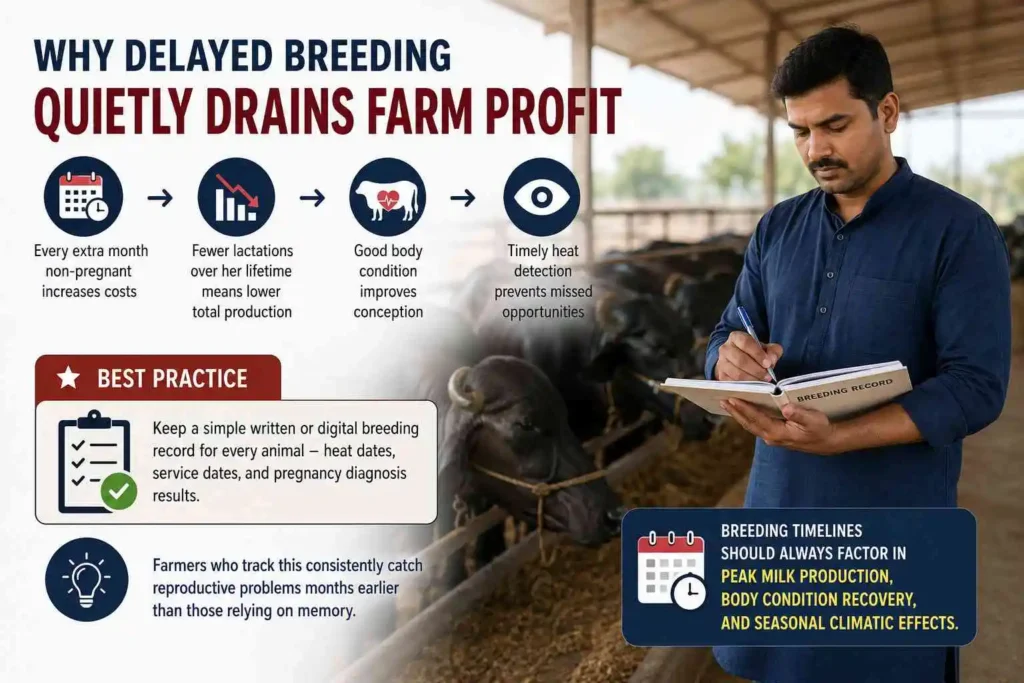
Best Practice Keep a simple written or digital breeding record for every animal — heat dates, service dates, and pregnancy diagnosis results. Farmers who track this consistently catch reproductive problems months earlier than those relying on memory.
Breeding timelines should always factor in the individual animal’s postpartum recovery, nutrition status, and veterinary guidance — a fixed calendar approach ignores real variation between animals.
Why Calf Care Decides Herd Profitability Years Later
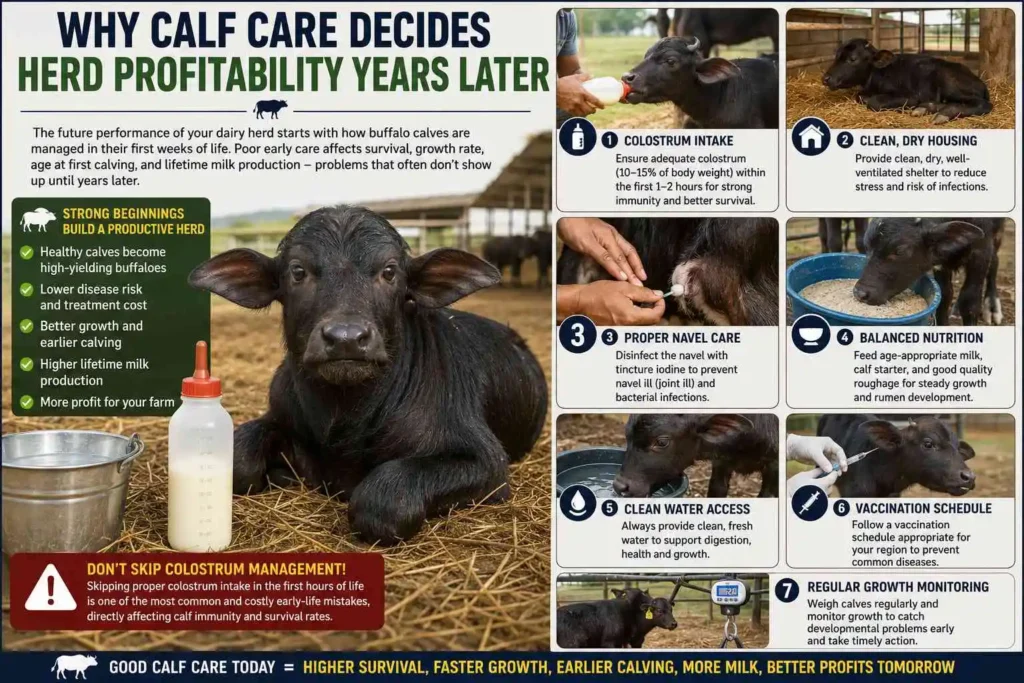
The future performance of your dairy herd starts with how calves are managed in their first weeks of life. Poor early care affects survival, growth rate, age at first calving, and lifetime milk production — problems that often don’t show up until years later.
Calf management priorities:
- Ensuring adequate colostrum intake within the first hours after birth
- Clean, dry housing to reduce infection risk
- Proper navel care to prevent infection
- Balanced nutrition appropriate to age
- Clean water access
- A vaccination schedule appropriate for your region
- Regular growth monitoring to catch developmental problems early
Skipping proper colostrum management in particular is one of the most common and costly early-life mistakes, directly affecting calf immunity and survival rates.
Catching Disease Early: What Actually Matters in the Field
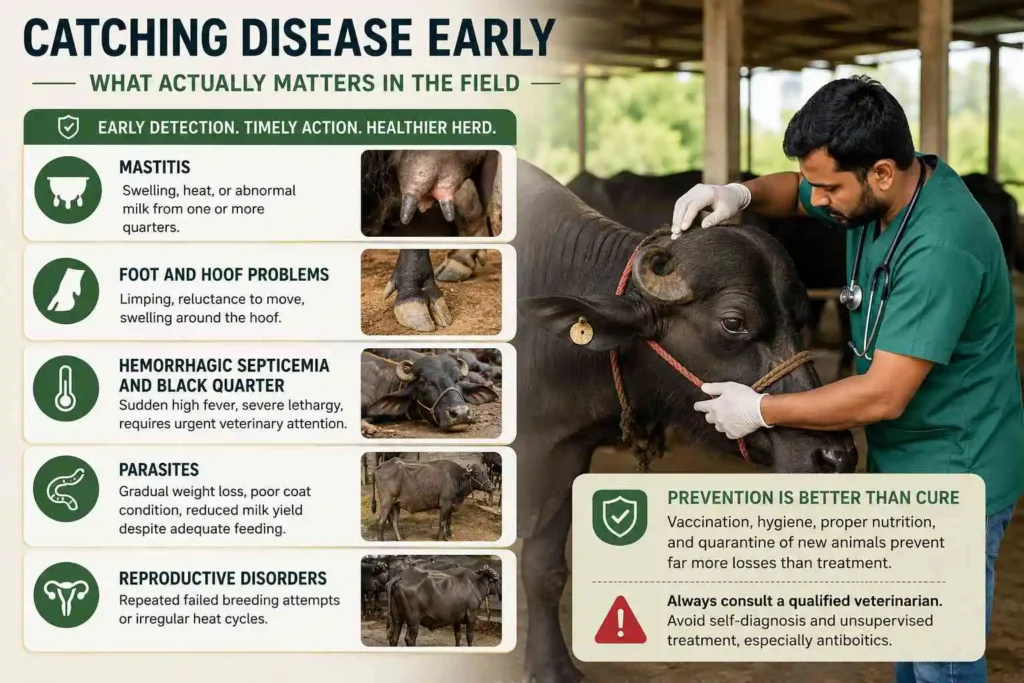
Disease management on a buffalo dairy farm works best as prevention, not crisis response. For serious conditions, self-diagnosis and unsupervised treatment often do more harm than good.
Health issues to monitor for:
- Mastitis — swelling, heat, or abnormal milk from one or more quarters
- Foot and hoof problems — limping, reluctance to move, swelling around the hoof
- Hemorrhagic septicemia and black quarter — sudden high fever, severe lethargy, requiring urgent veterinary attention
- Parasites — gradual weight loss, poor coat condition, reduced milk yield despite adequate feeding
- Reproductive disorders — repeated failed breeding attempts or irregular heat cycles
Prevention through vaccination, hygiene, proper nutrition, and quarantine of newly purchased animals prevents far more losses than treatment after the fact. Any medication, especially antibiotics, should only be used under veterinary guidance, following correct dosage and withdrawal periods before milk is sold.
Why Records Turn Guesswork Into a Real Business
Professional dairy farming runs on records, not memory. Tracking milk yield, breeding dates, vaccination history, and expenses per animal is what actually reveals which buffaloes are profitable and which ones are quietly costing you money.
A farmer who doesn’t track individual animal performance often has no reliable way of identifying underperforming animals until the losses have already accumulated over months.
What Buffalo Dairy Farming Actually Costs — And What It Can Return
The figures below are illustrative estimates for a small commercial unit of 5 buffaloes and will vary significantly by region, breed, and season — treat them as a planning framework, not a guarantee.
| Cost Category | Estimated Cost (₹) |
|---|---|
| Buffalo purchase (5 animals, varies by breed and yield) | 3,50,000 – 6,00,000 |
| Shed construction (basic, per unit) | 1,50,000 – 3,00,000 |
| Feeding and milking equipment | 30,000 – 60,000 |
| Green and dry fodder (monthly, 5 animals) | 12,000 – 18,000 |
| Concentrate feed (monthly, 5 animals) | 15,000 – 25,000 |
| Mineral mixture and salt (monthly) | 1,500 – 2,500 |
| Labour (monthly) | 8,000 – 15,000 |
| Veterinary care and vaccination (monthly average) | 2,000 – 4,000 |
| Electricity and water (monthly) | 2,000 – 4,000 |
Against this, milk revenue depends heavily on yield per animal, milk fat content, and local selling price. At an illustrative rate of ₹50-65 per litre depending on fat and SNF content, five buffaloes averaging 8-10 litres per day per animal could generate a monthly gross revenue roughly in the range of ₹60,000 to ₹97,500 — though this swings substantially with lactation stage, season, and local pricing systems.
Quick Summary Net profit depends on managing recurring costs tightly — feed, labour, and veterinary expenses — against actual milk revenue. Never assume a fixed profit figure; calculate your own numbers based on local input prices and current milk rates.
Why the Highest-Yielding Buffalo Isn’t Always the Most Profitable One
It’s tempting to assume more milk automatically means more profit, but that’s not always true. Milk fat and SNF content, depending on your local payment system, directly influence the price received per litre — a moderate-yield animal with high fat content can sometimes out-earn a higher-yield animal on a fat-based payment structure.
Where you sell also matters. Cooperatives often offer reliable collection and payment security, private dairies may offer better rates but with less consistency, and direct-to-consumer sales can offer the highest margins but require more time and effort. The right choice depends on your scale, location, and how much time you can dedicate to sales versus animal care.
For many small dairy farms, investing first in reliable fodder production and clean water infrastructure delivers a better return than spending heavily on decorative shed construction that doesn’t improve animal comfort or productivity.
The Real Lesson Behind Every Profitable Buffalo Dairy Farm
Profitable buffalo dairy farming isn’t about owning the highest-yielding animals or the most expensive shed. It’s about managing the entire system — breed suitability, feeding economics, housing comfort, breeding efficiency, and disease prevention — as connected parts of one operation rather than isolated tasks.
Before expanding or starting your herd, calculate your real feed costs, buy animals with verified health and production history, plan fodder availability across the full year, and keep consistent breeding and milk records. These decisions, made quietly and consistently, are what actually determine whether your buffalo dairy farm turns a steady profit or simply breaks even year after year.
If you’re considering dairy farming with cows instead, you can also read our HF Cow Dairy Farming Guide to understand the key costs, management practices, and profitability factors involved.
Frequently Asked Questions About Buffalo Dairy Farming
Is buffalo dairy farming profitable in India?
Yes, buffalo dairy farming can be profitable when feed costs, milk yield, animal health, breeding, and selling price are managed properly. Profit varies by breed, milk production, local feed prices, labour costs, and milk rates.
Which buffalo breed is best for dairy farming?
Murrah is one of the most popular choices for commercial dairy farming because of its strong milk production potential and availability. However, the best breed depends on your climate, fodder availability, budget, and local market.
How much does it cost to start a buffalo dairy farm?
The investment depends on herd size, buffalo purchase price, shed construction, equipment, and working capital. For a 5-buffalo unit, the article’s illustrative estimate puts buffalo purchases at around ₹3.5 lakh–₹6 lakh, with additional costs for the shed and equipment.
How much milk does a buffalo give per day?
Milk production varies significantly by breed, genetics, feed, health, and stage of lactation. The guide uses 8–10 litres per day per buffalo as an illustrative figure for calculating potential revenue, not as a guaranteed production level.
What should I feed a dairy buffalo for higher milk production?
A balanced ration can include green fodder, dry fodder, concentrate feed, legume fodder, mineral mixture, salt, and sufficient clean drinking water. Feed requirements should be adjusted according to the animal’s body weight, milk yield, fat percentage, and lactation stage.
Newsletter