

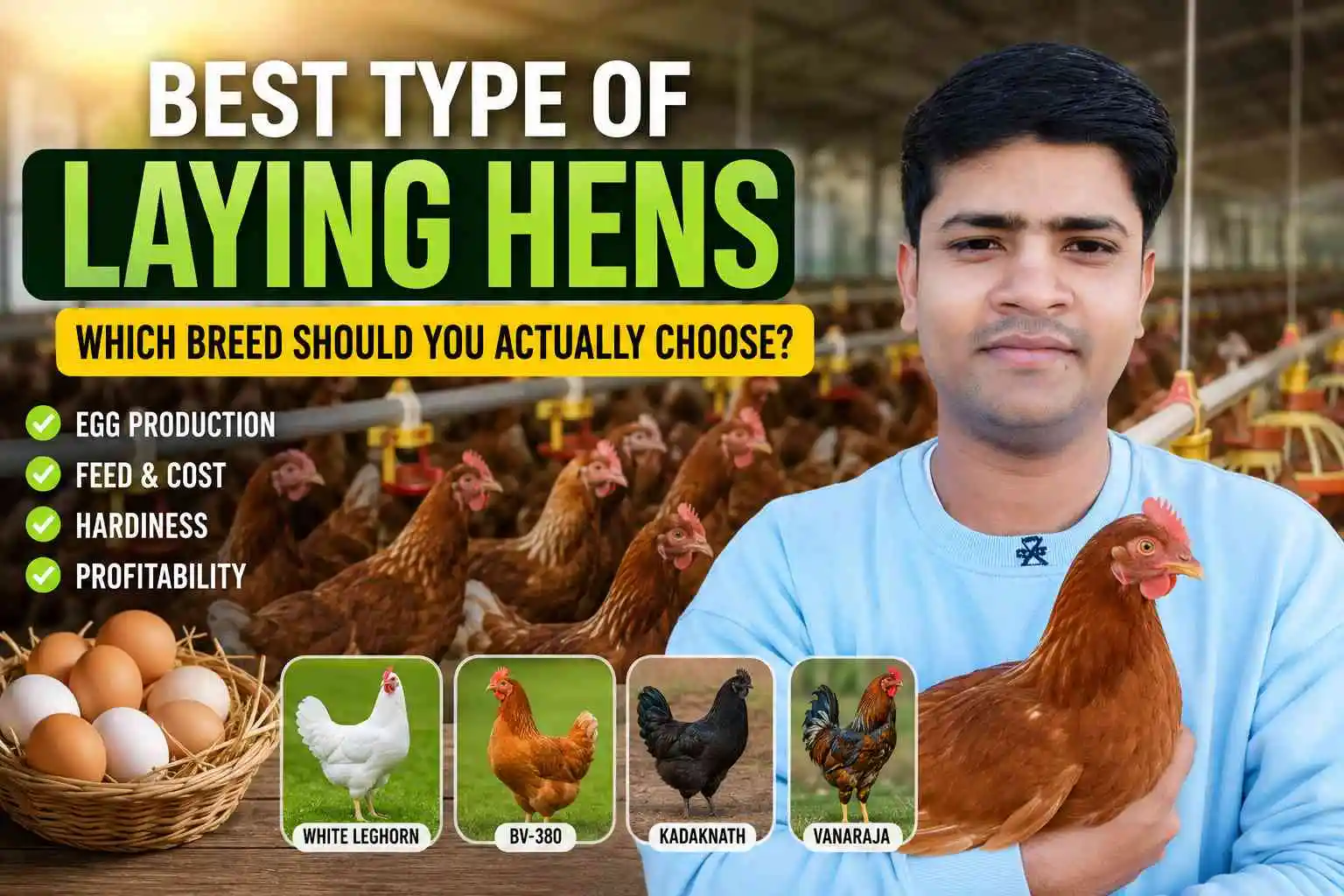

Best Type of Laying Hens: Which Breed Should You Actually Choose?
Ask five poultry farmers which is the best type of laying hens, and you’ll get five different breed names — White Leghorn, BV-380, Kuroiler, Vanaraja, Kadaknath. All of them are right, depending on what you’re actually optimising for. The best type of laying hens isn’t a single breed that beats all others on every count — it’s whichever breed matches your climate, your market, your feed budget, and whether you want pure egg output or a dual-purpose bird that also gives you meat.
This guide breaks down what the major layer breeds available in India actually deliver — eggs per year, feed needs, hardiness, and where each one genuinely makes sense — so you can pick based on your farm, not just the breed with the biggest number attached to it.

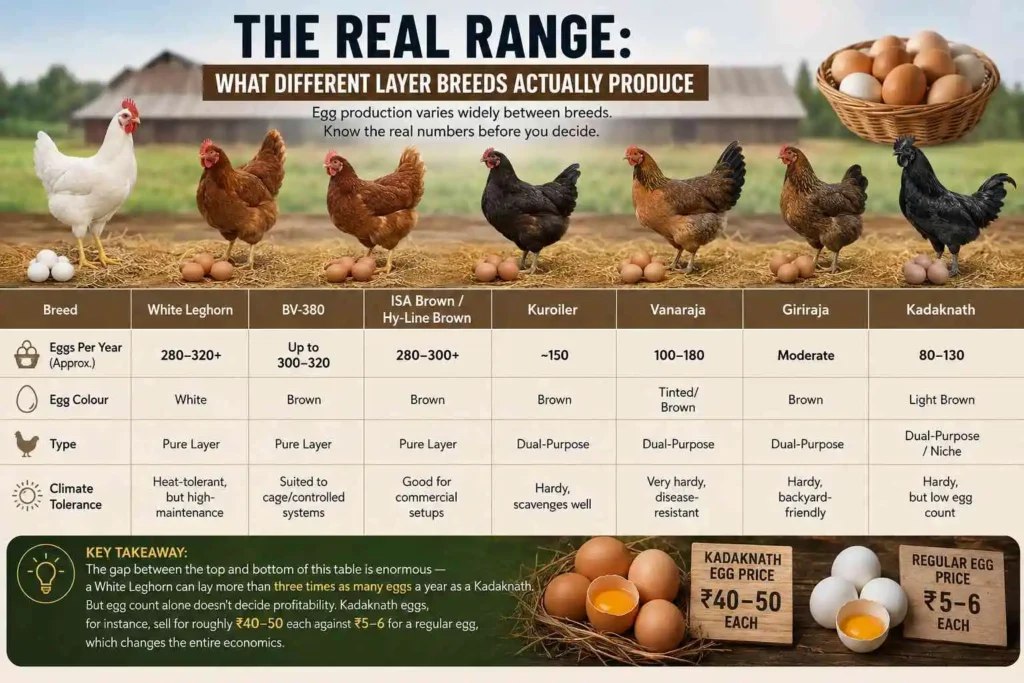
The Real Range: What Different Layer Breeds Actually Produce
Before comparing anything else, look at the honest spread in annual egg output across breeds commonly reared in India.
| Breed | Eggs Per Year (Approx.) | Egg Colour | Type | Climate Tolerance |
|---|---|---|---|---|
| White Leghorn | 280–320+ | White | Pure layer | Heat-tolerant, but high-maintenance |
| BV-380 | Up to 300–320 | Brown | Pure layer | Suited to cage/controlled systems |
| ISA Brown / Hy-Line Brown | 280–300+ | Brown | Pure layer | Good for commercial setups |
| Kuroiler | ~150 | Brown | Dual-purpose | Hardy, scavenges well |
| Vanaraja | 100–180 | Tinted/brown | Dual-purpose | Very hardy, disease-resistant |
| Giriraja | Moderate | Brown | Dual-purpose | Hardy, backyard-friendly |
| Kadaknath | 80–130 | Light brown | Dual-purpose/niche | Hardy, but low egg count |
Key Takeaway: The gap between the top and bottom of this table is enormous — a White Leghorn can lay more than three times as many eggs a year as a Kadaknath. But egg count alone doesn’t decide profitability. Kadaknath eggs, for instance, sell for roughly ₹40–50 each against ₹5–6 for a regular egg, which changes the entire economics.
Pure Layers vs Dual-Purpose Breeds: The First Decision
Before picking a specific breed, decide what you actually want from your flock:
- Pure layer breeds (White Leghorn, BV-380, ISA Brown, Hy-Line Brown) are bred almost entirely for egg output. They’re lightweight, feed-efficient, and lay prolifically — but they have little meat value and often need more controlled housing to perform well.
- Dual-purpose breeds (Kuroiler, Vanaraja, Giriraja, Kadaknath) give you meaningfully fewer eggs, but the bird itself has real meat value at the end of its laying life, and most of them tolerate backyard or free-range conditions far better than pure layers do.
Common Mistake: Farmers new to poultry sometimes pick a pure layer breed because of the impressive egg count, then struggle because their setup — open-sided sheds, scavenging feed, no calcium supplementation — doesn’t match what that breed actually needs to perform. Match the breed to your management capacity first, egg count second.

White Leghorn: The Highest Egg Count, With Conditions Attached
White Leghorn is the closest thing to an industry benchmark for egg production — commercial operations worldwide use it precisely because it converts feed into eggs more efficiently than almost any other breed, typically producing 280 to over 320 eggs a year.
The trade-off:
- Needs a controlled environment — proper housing, consistent feed, calcium supplementation
- More flighty and easily stressed than dual-purpose breeds, and stress shows up directly as reduced laying
- Lower body weight means little meat value once laying declines
- Performs best in cage or deep-litter commercial systems rather than free-range backyard setups
Practical Tip: If you’re running a serious commercial layer operation with proper housing and feed control, White Leghorn or a similar commercial brown-egg hybrid is usually the economically stronger choice. If your setup is closer to backyard or semi-free-range, it’s often the wrong bird for the conditions.
BV-380, ISA Brown, and Hy-Line Brown: Commercial Brown-Egg Options
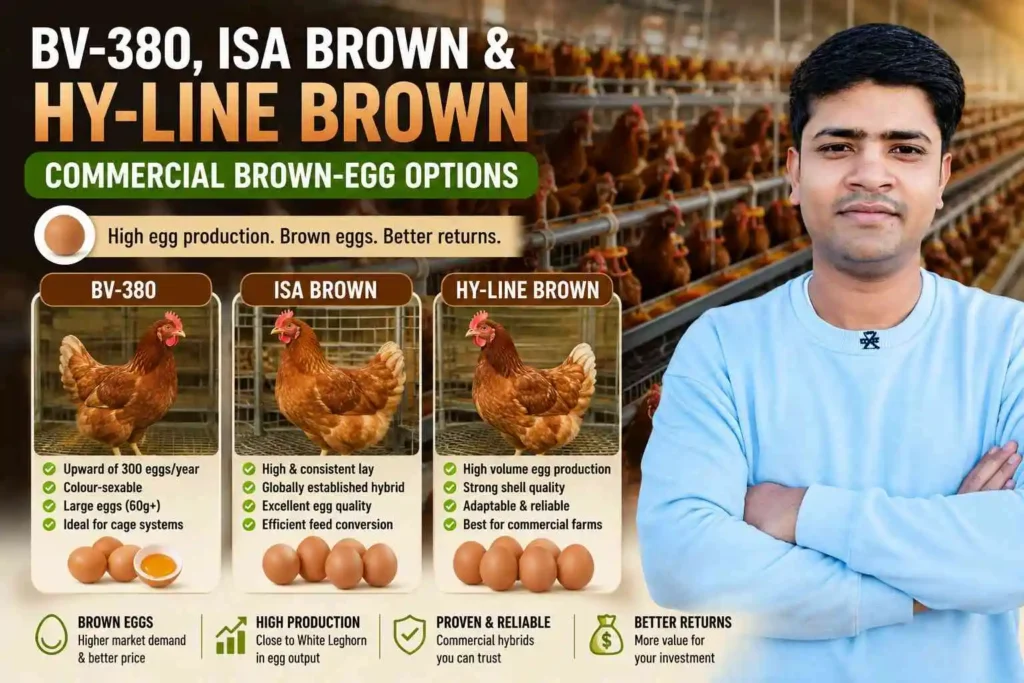
For farmers who want brown eggs (which command a price premium in many Indian markets) without sacrificing much output, breeds like BV-380, ISA Brown, and Hy-Line Brown are the commercial standard:
- BV-380 is a colour-sexable brown layer capable of upward of 300 eggs a year, with reasonably large eggs (60g+), and is commonly used in cage-based systems
- ISA Brown and Hy-Line Brown are globally established commercial hybrids known for consistent, high-volume brown egg production
These breeds sit close to White Leghorn in output but with the added advantage of brown eggs, which many Indian consumers associate with being more “natural” and are willing to pay slightly more for — even though nutritionally there’s little real difference between white and brown eggs.
Kuroiler, Vanaraja, and Giriraja: Trading Egg Count for Hardiness
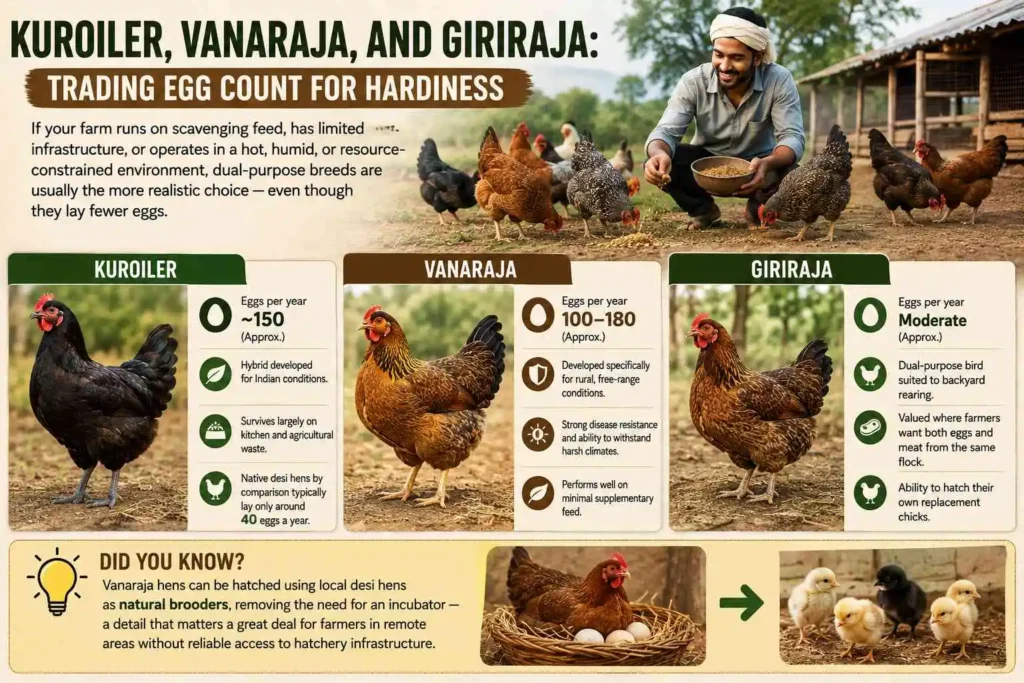
If your farm runs on scavenging feed, has limited infrastructure, or operates in a hot, humid, or resource-constrained environment, dual-purpose breeds are usually the more realistic choice — even though they lay fewer eggs.
- Kuroiler — a hybrid developed for Indian conditions, producing around 150 eggs a year while surviving largely on kitchen and agricultural waste; native desi hens by comparison typically lay only around 40 eggs a year
- Vanaraja — developed specifically for rural, free-range conditions, producing roughly 100–180 eggs depending on management, with strong disease resistance and the ability to withstand harsh climates with minimal supplementary feed
- Giriraja — another dual-purpose bird suited to backyard rearing, valued where farmers want both eggs and meat from the same flock, and the ability to hatch their own replacement chicks
Did You Know? Vanaraja hens can be hatched using local desi hens as natural brooders, removing the need for an incubator — a detail that matters a great deal for farmers in remote areas without reliable access to hatchery infrastructure.
Kadaknath: The Low-Yield, High-Price Exception
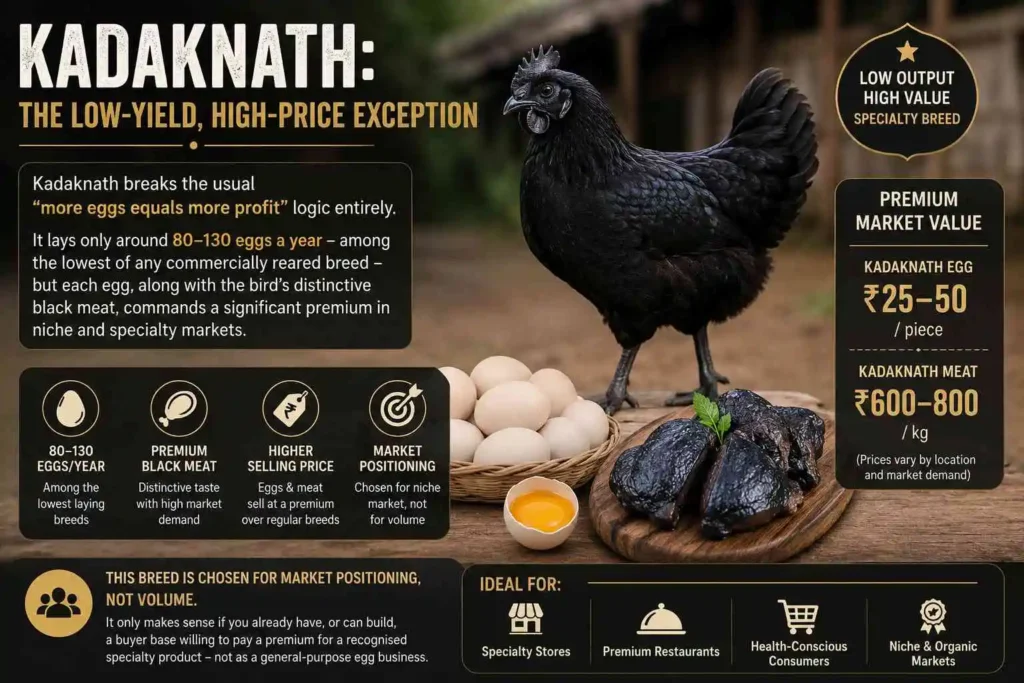
Kadaknath deserves its own mention because it breaks the usual “more eggs equals more profit” logic entirely. It lays only around 80–130 eggs a year — among the lowest of any commercially reared breed — but each egg, along with the bird’s distinctive black meat, commands a significant premium in niche and specialty markets.
This is a breed chosen for market positioning, not volume. It only makes sense if you already have, or can build, a buyer base willing to pay a premium for a recognised specialty product — not as a general-purpose egg business.
What Actually Affects Egg Output, Regardless of Breed
Breed sets the ceiling, but several factors decide how close any flock gets to it:
- Feed quality — layers need adequate protein (16–18%) and calcium; poor feed suppresses output regardless of breed genetics
- Lighting — commercial layers typically need 14–16 hours of light a day to sustain peak laying; shorter daylight naturally reduces output
- Age — hens start laying around 18–20 weeks, peak in the following months, then gradually decline; most commercial layers are productive for 72–80 weeks before replacement
- Stress — overcrowding, predators, sudden changes in feed or handling routine, and extreme heat all reduce egg output, sometimes sharply
- Health and hygiene — clean housing and regular deworming/vaccination prevent the disease-driven yield crashes that are common in poorly managed flocks
Warning: Even the highest-yielding breed on paper will underperform badly if calcium, lighting, or stress management is neglected. Breed selection solves maybe half the problem — daily management solves the rest.
Feed Cost and Profit: A Quick Economic Picture
Feed typically makes up 65–70% of the recurring cost in layer farming, which is why breed efficiency (eggs per kg of feed) matters as much as raw egg count.
| Item | Typical Figure (Indicative) |
|---|---|
| Setup cost for ~1,000 birds (shed, feed, equipment) | Roughly ₹5–5.5 lakh |
| Feed share of total recurring cost | 65–70% |
| Typical egg selling price (regular layer egg) | ₹5–6 per egg |
| Kadaknath egg selling price | ₹40–50 per egg |
| Typical net profit per egg (regular layer) | ₹1–2 per egg |
| Indicative annual profit, 1,000-bird well-managed farm | ₹4–5 lakh |
These are indicative figures only — actual costs shift with regional feed prices, egg market rates, and how the farm is managed, so use them as a planning reference rather than a guarantee.
Choosing the Right Breed for Your Farm: A Quick Decision Framework
| Your Situation | Breed to Consider |
|---|---|
| Commercial setup, controlled housing, egg volume is the priority | White Leghorn, ISA Brown, Hy-Line Brown |
| Want brown eggs at near-commercial volume | BV-380 |
| Backyard/free-range, limited infrastructure, want eggs + meat | Kuroiler, Vanaraja, Giriraja |
| Remote area, no hatchery access, need natural brooding | Vanaraja |
| Have (or can build) a premium niche market | Kadaknath |
The Real Lesson Behind Choosing Laying Hens
There is no single best type of laying hens — there’s only the breed that’s best matched to your housing, feed capacity, climate, and market. A White Leghorn in a poorly ventilated backyard shed will disappoint you just as much as a Vanaraja will underwhelm a commercial cage operation expecting 300 eggs a year.
Start by being honest about your setup and your market, not the breed with the highest number on paper. If you can offer controlled housing and consistent feed, a pure layer breed will reward you with volume. If your farm runs closer to free-range or backyard conditions, a hardy dual-purpose breed will likely give you a more reliable—if smaller—return.
Once you’ve chosen the right breed, the next step is setting up your farm correctly. Our comprehensive guide on How to Start a Layer Poultry Farm: Setup, Cost, Profit & ROI (2026) covers everything from housing design and equipment to feed management, investment, and expected returns.
FAQs on Choosing the Best Type of Laying Hens
1. What is the best type of laying hens for egg production?
White Leghorn is generally considered the top pure egg-laying breed, producing 280–320+ eggs a year, but the “best” choice depends on your housing, feed setup, and target market.
2. Which laying hen breed is best for backyard or free-range farming?
Dual-purpose breeds like Vanaraja, Kuroiler, and Giriraja are better suited to backyard conditions, since they tolerate scavenging feed and variable climates far better than pure layer breeds.
3. How many eggs does a Kadaknath hen lay per year?
Around 80–130 eggs a year — low compared to commercial layers, but each egg sells at a significant premium due to the breed’s niche market value.
4. Is White Leghorn suitable for Indian climate?
White Leghorn is generally heat-tolerant, but it needs controlled housing, consistent feed, and careful management to sustain its high egg output — it’s not ideal for basic backyard setups.
5. Which breed gives brown eggs at high volume?
BV-380, ISA Brown, and Hy-Line Brown are the common commercial choices for high-volume brown egg production.
6. What affects egg-laying performance apart from breed?
Feed quality, lighting hours, hen age, stress levels, and overall health and hygiene all significantly affect egg output, regardless of breed.
7. Which laying hen is most profitable for a small farmer?
It depends on infrastructure: pure layers can be more profitable at commercial scale with proper housing, while dual-purpose breeds are often more reliable and lower-risk for smaller, less controlled setups.
8. How much feed does a layer hen need per day?
Layer feed requirements vary by breed and production stage, but adequate protein (16–18%) and calcium are essential across all breeds to sustain consistent egg output.
9. Can dual-purpose breeds like Vanaraja be used for both eggs and meat?
Yes — that’s their core advantage. They produce fewer eggs than pure layers but retain meaningful meat value, which pure layer breeds largely lack.
10. Why do brown eggs cost more than white eggs in the market?
Mostly due to consumer perception rather than nutrition — brown eggs are often seen as more “natural,” which supports a price premium even though the nutritional difference is minimal.
Newsletter