Bamboo Farming : Species, Cultivation, Cost and Profit
A farmer who plants bamboo correctly can keep harvesting from the same clump for 40 to 50 years without replanting. That single fact is what draws so many people toward bamboo farming. But here’s the part that rarely makes it into the pamphlets: the plantation you’re managing in year 15 is entirely a product of decisions you made before you ever put a rhizome in the ground.
Bamboo farming in India is not a “plant it and forget it” crop, whatever the folklore around wild bamboo suggests. Commercial cultivation involves real choices around species selection, spacing, irrigation, nutrition, and — the one question most beginners skip — who’s actually going to buy the produce. Get these right and bamboo can become a genuinely productive long-term asset on the farm. Get them wrong, and you’ll have a green, fast-growing plantation with nowhere to sell it.
This guide walks through the practical side of bamboo cultivation: choosing the right species for your land and market, preparing soil and planting material, managing water and nutrition, handling pests, harvesting correctly, and understanding realistic costs, yields and returns. Along the way, we’ll flag the mistakes that trip up first-time bamboo growers most often.
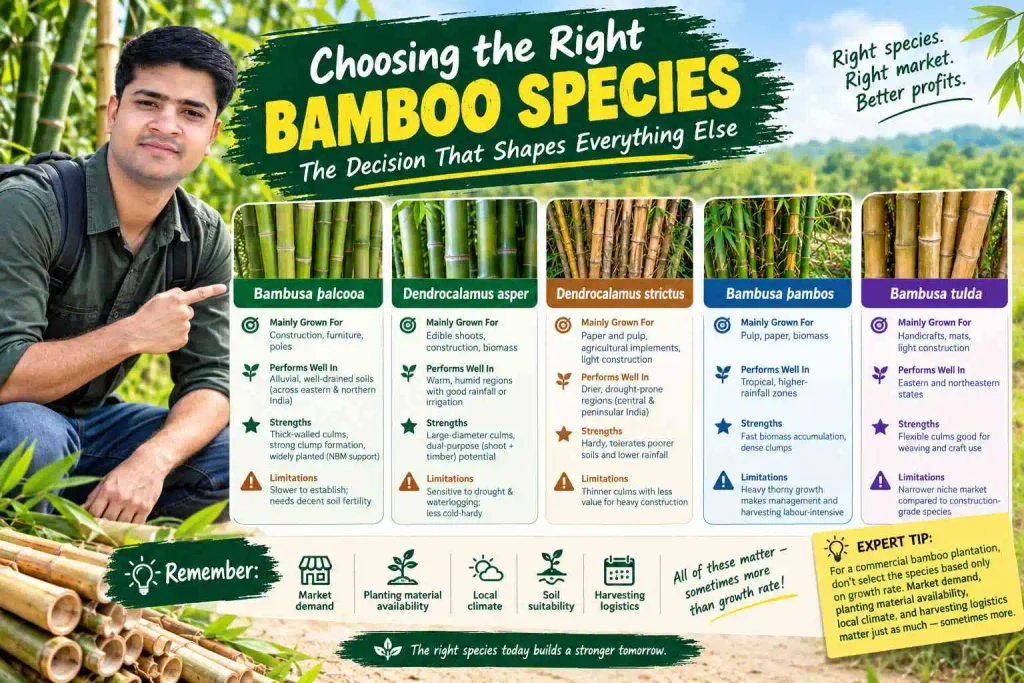
Choosing the Right Bamboo Species: The Decision That Shapes Everything Else
Before you buy a single planting stock, ask yourself one thing: who will buy your bamboo, and what will they use it for? Species selection isn’t a botanical detail — it’s a business decision, and it’s the one decision that’s hardest to reverse once a plantation is three years old.
Different bamboo species are suited to different end uses, climates, and markets. A species that produces excellent poles for construction may be a poor fit if your nearest buyer is a paper mill or an agarbatti (incense stick) unit. Growth rate matters, but it’s only one factor among soil suitability, culm characteristics, harvest age, and — critically — local demand.
Here’s how some of the commonly cultivated species in India compare:
Species
Mainly Grown For
Performs Well In
Strengths
Limitations
Bambusa balcooa
Construction, furniture, poles
Alluvial, well-drained soils across eastern and northern India
Thick-walled culms, strong clump formation, widely planted under NBM-supported programs
Slower to establish than some Dendrocalamus species; needs decent soil fertility
Dendrocalamus asper
Edible shoots, construction, biomass
Warm, humid regions with good rainfall or irrigation
Sensitive to prolonged drought and waterlogging; less cold-hardy
Dendrocalamus strictus
Paper and pulp, agricultural implements, light construction
Drier, drought-prone regions, central and peninsular India
Hardy, tolerates poorer soils and lower rainfall
Thinner culms with less value for heavy construction
Bambusa bambos
Pulp, paper, biomass
Tropical, higher-rainfall zones
Fast biomass accumulation, dense clumps
Heavy thorny growth makes management and harvesting labour-intensive
Bambusa tulda
Handicrafts, mats, light construction
Eastern and northeastern states
Flexible culms good for weaving and craft use
Narrower niche market compared to construction-grade species
None of these is “the best” bamboo variety in any universal sense. A farmer near a paper mill has a completely different optimal choice than one supplying a furniture cluster or a shoot-processing unit. Before finalising a species, visit an established plantation of that variety in your district if you can, and talk to whoever is actually buying culms from it today.
Expert Tip: For a commercial bamboo plantation, don’t select the species based only on growth rate. Market demand, planting material availability, local climate, and harvesting logistics matter just as much — sometimes more.
Climate and Soil: Why Drainage Can Matter More Than Fertility
Many people assume bamboo will grow anywhere because it survives in the wild along riverbanks and forest edges. Commercial plantations are a different proposition entirely — you’re aiming for uniform, harvestable culms across acres, not scattered wild growth.
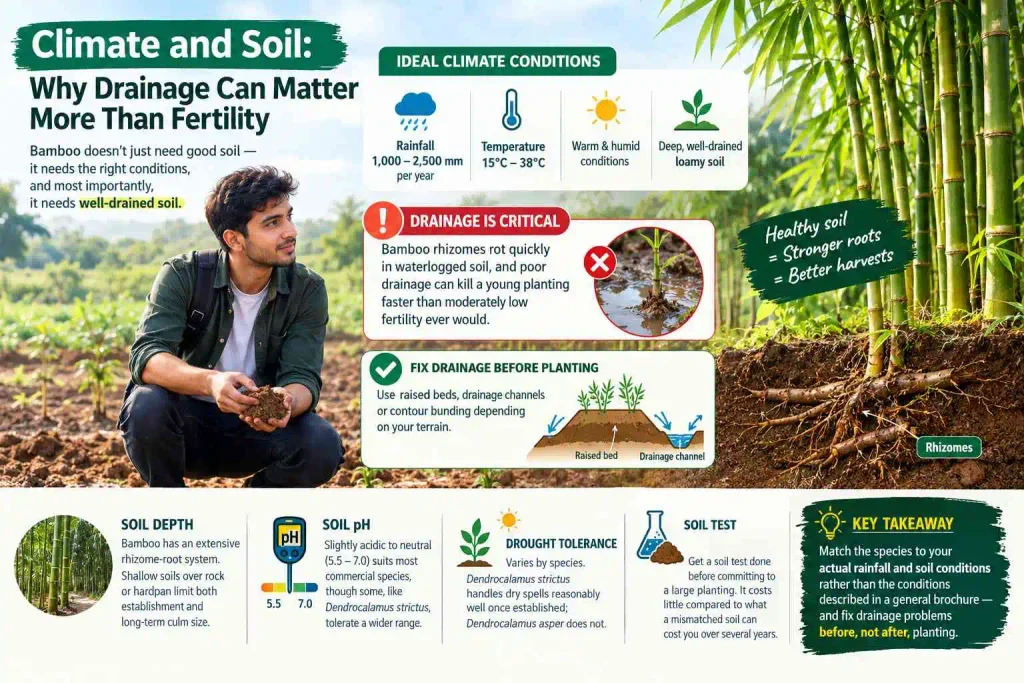
Most commercially grown bamboo species prefer warm, humid conditions with annual rainfall in the range of 1,000–2,500 mm, temperatures between 15°C and 38°C, and deep, well-drained loamy soil. But the details matter more than the averages:
Drainage is often the single biggest factor in early plantation failure. Bamboo rhizomes rot quickly in waterlogged soil, and poor drainage can kill a young planting faster than moderately low fertility ever would. If your field holds water after rain, correct that before planting — raised beds, drainage channels, or contour bunding, depending on the terrain.
Soil depth matters because bamboo develops an extensive rhizome-root system. Shallow soils over rock or hardpan limit both establishment and long-term culm size.
Soil pH in the slightly acidic to neutral range (roughly 5.5–7.0) suits most commercial species, though some, like Dendrocalamus strictus, tolerate a wider range.
Drought tolerance varies sharply by species. Dendrocalamus strictus handles dry spells reasonably well once established; Dendrocalamus asper does not.
Get a soil test done before committing to a large planting. It costs little compared to what a mismatched soil can cost you over several years. Where drainage is poor, correct it with contour drains or raised planting mounds rather than assuming the plantation will “manage.”
Key takeaway: Match the species to your actual rainfall and soil conditions rather than the conditions described in a general brochure — and fix drainage problems before, not after, planting.
Land Preparation and Spacing: Getting the Foundation Right
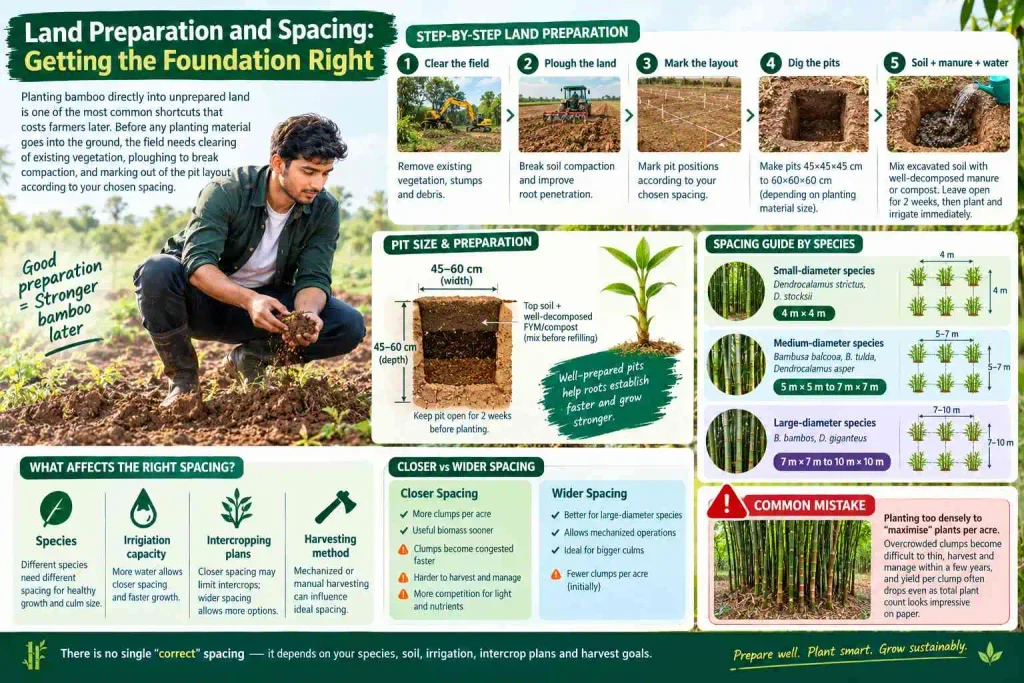
Planting bamboo directly into unprepared land is one of the most common shortcuts that costs farmers later. Before any planting material goes into the ground, the field needs clearing of existing vegetation, ploughing to break compaction, and marking out of the pit layout according to your chosen spacing.
Pits are typically dug 45 cm × 45 cm × 45 cm to 60 cm × 60 cm × 60 cm, depending on the size of the planting material, and left open for a couple of weeks before planting so the soil can weather. Mix the excavated soil with well-decomposed farmyard manure or compost before refilling, and irrigate immediately after planting.
Spacing is where a lot of first-time growers go wrong by copying a number they saw somewhere without checking whether it fits their species and objective. As a general pattern:
Small-diameter species (Dendrocalamus strictus, D. stocksii): around 4 × 4 m
Medium-diameter species (Bambusa balcooa, B. tulda, Dendrocalamus asper): roughly 5 × 5 m to 7 × 7 m
Large-diameter species (B. bambos, D. giganteus): 7 × 7 m up to 10 × 10 m
Closer spacing gives more clumps per acre and useful biomass sooner, but crowded clumps become congested faster, make harvesting harder, and increase competition for light and nutrients. Wider spacing suits large-diameter species, mechanized inter-row operations, and plantations aiming for bigger individual culms rather than sheer volume. There’s no single “correct” spacing — it depends on the species, your irrigation capacity, whether you plan to intercrop, and how you intend to harvest.
Common Mistake: Planting too densely to “maximise” plants per acre. Overcrowded clumps become difficult to thin, harvest, and manage within a few years, and yield per clump often drops even as total plant count looks impressive on paper.
Planting Material: The Decision You Can’t Easily Undo
If land preparation is the foundation, planting material is what determines whether that foundation actually holds. Poor-quality planting stock can compromise an entire plantation, and by the time the problem is obvious — patchy establishment, mixed species, disease — it’s usually too late to start over cheaply.
The common options are:
Rhizome cuttings — reliable establishment when taken from healthy, mature clumps, but bulky to transport and limited in quantity.
Culm cuttings — economical for bulk propagation, though success rates vary by species and cutting age.
Branch cuttings — useful for species that root easily from branches, offering a middle ground between cost and reliability.
Nursery-raised plants — consistent quality if sourced from a reputable nursery, with an establishment head start.
Tissue-cultured plants — the most disease-free and genetically uniform option, increasingly used in NBM-supported plantations, though typically the most expensive per plant.
Before buying, check for healthy roots or rhizomes, visible freedom from disease or pest damage, correct species labeling, and a source you can verify — a government nursery, an agricultural university, or an established private supplier with a track record. Don’t buy planting material purely because it’s the cheapest option available; a plant that fails to establish costs you the land, labour, and time you invested in it, which is almost always more expensive than the saving on the sapling itself.
Irrigation and Water Management: Establishment Is Where Bamboo Is Most Vulnerable
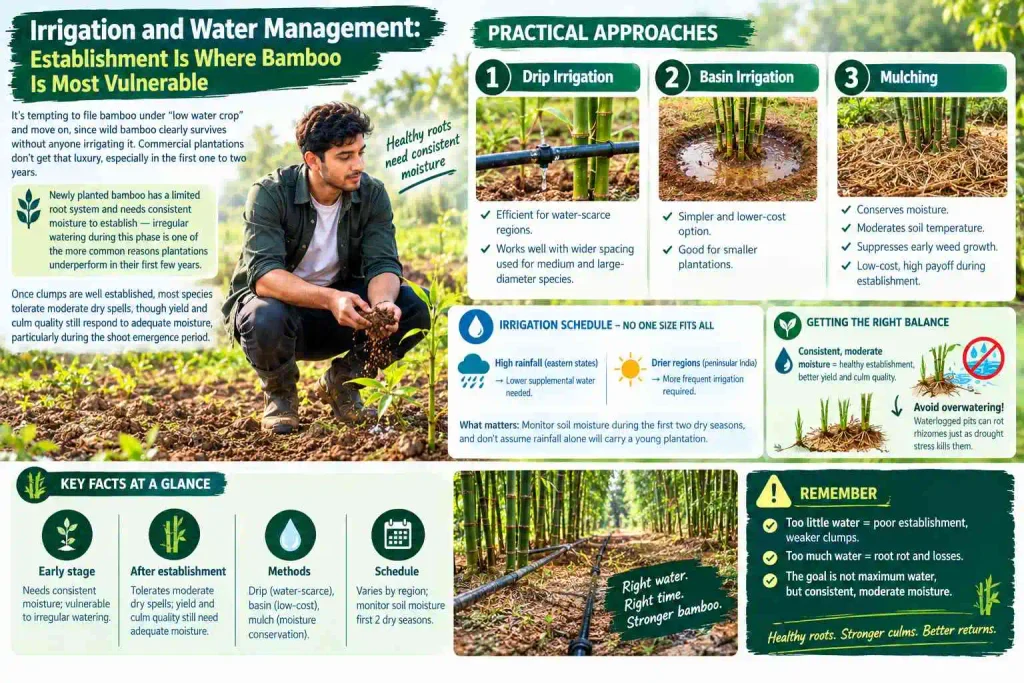
It’s tempting to file bamboo under “low water crop” and move on, since wild bamboo clearly survives without anyone irrigating it. Commercial plantations don’t get that luxury, especially in the first one to two years.
Newly planted bamboo has a limited root system and needs consistent moisture to establish — irregular watering during this phase is one of the more common reasons plantations underperform in their first few years. Once clumps are well established, most species tolerate moderate dry spells, though yield and culm quality still respond to adequate moisture, particularly during the shoot emergence period.
Practical approaches:
Drip irrigation is efficient for water-scarce regions and works well with the wider spacing used for medium and large-diameter species.
Basin irrigation around each clump is a simpler, lower-cost option for smaller plantations.
Mulching around the base conserves moisture, moderates soil temperature, and suppresses early weed growth — a low-cost intervention with a real payoff during establishment.
There’s no single irrigation schedule that fits every region; a plantation in a high-rainfall eastern state will need far less supplemental water than one in a drier peninsular district. What matters is monitoring soil moisture during the first two dry seasons and not assuming rainfall alone will carry a young plantation through.
But there’s a catch: overwatering is just as damaging as underwatering. Waterlogged pits during establishment can rot rhizomes just as effectively as drought stress kills them. The goal is consistent, moderate moisture — not maximum water.
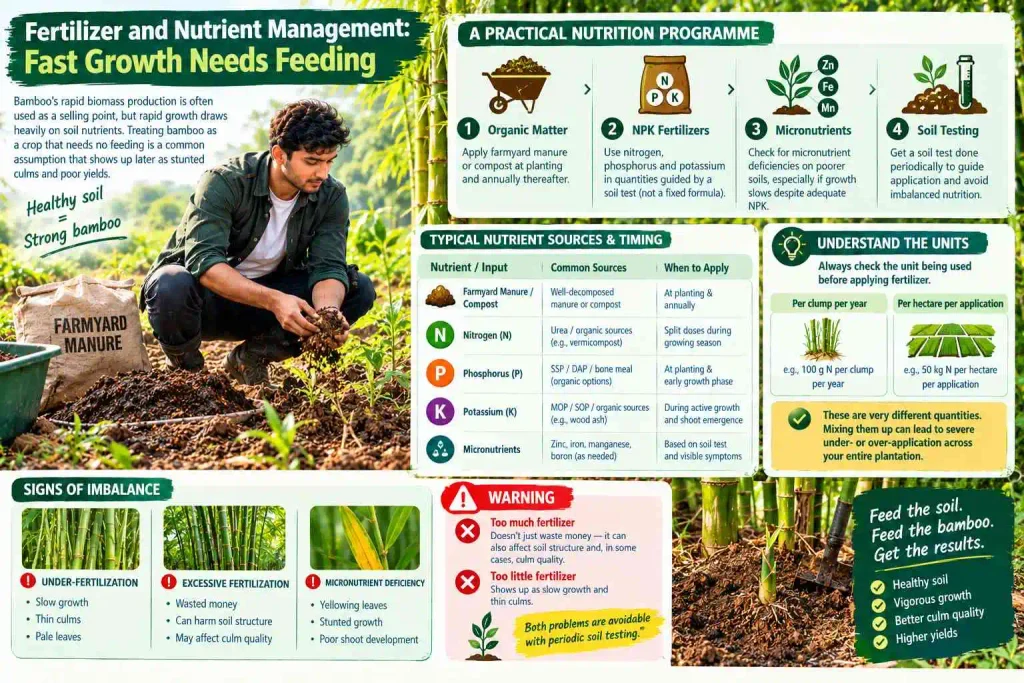
Fertilizer and Nutrient Management: Fast Growth Needs Feeding
Bamboo’s rapid biomass production is often used as a selling point, but rapid growth draws heavily on soil nutrients. Treating bamboo as a crop that needs no feeding is a common assumption that shows up later as stunted culms and poor yields.
A practical nutrition programme typically includes farmyard manure or compost applied at planting and annually thereafter, along with nitrogen, phosphorus, and potassium in quantities guided by a soil test rather than a fixed formula copied from another farm. Micronutrient deficiencies can show up on poorer soils over time and are worth checking for if growth slows despite adequate NPK application.
Whenever fertilizer quantities are mentioned anywhere — including in this guide — pay close attention to the unit being used. A recommendation “per clump per year” is a completely different quantity than one “per hectare per application,” and mixing these up is an easy way to over- or under-apply fertilizer across an entire plantation.
Warning: Excessive fertilizer application doesn’t simply waste money — it can also affect soil structure and, in some cases, culm quality. Under-fertilization shows up as slow growth and thin culms. Both problems are avoidable with periodic soil testing rather than routine, undifferentiated application.
Weed Management: The Establishment-Period Priority
Weed competition matters most in the first one to two years, before bamboo clumps have grown enough to shade out competing vegetation on their own. During this window, weeds compete directly for the water and nutrients a young plant needs to establish its root system.
Manual weeding around each clump, combined with mulching, handles most of the workload in smaller plantations. Larger operations sometimes use mechanical inter-row cultivation between planting rows, and some farmers use appropriate intercrops during the establishment period to occupy the ground and offset labour costs (more on this below). Herbicide use should be limited to products legally permitted for the crop and situation, applied according to label instructions — bamboo’s extensive shallow root system near the soil surface makes careless herbicide application riskier than it might seem.
Once clumps mature and canopy closure reduces light reaching the ground, weed pressure drops substantially and maintenance weeding becomes far less labour-intensive.
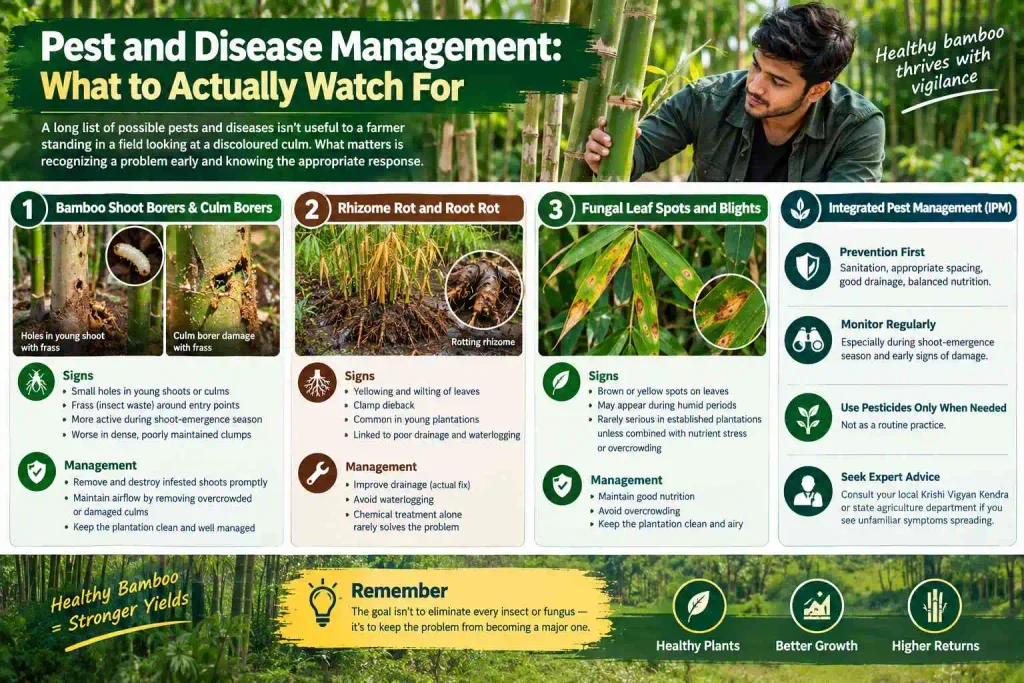
Pest and Disease Management: What to Actually Watch For
A long list of possible pests and diseases isn’t useful to a farmer standing in a field looking at a discoloured culm. What matters is recognizing a problem early and knowing the appropriate response.
Bamboo shoot borers and culm borers are among the more commonly reported pests in Indian bamboo plantations. Farmers may notice small holes in young shoots or culms, sometimes with visible frass (insect waste) around the entry point. These pests are more active during the shoot-emergence season and tend to be worse in dense, poorly maintained clumps. Preventive sanitation — removing and destroying infested shoots promptly — combined with maintaining airflow through the clump by removing overcrowded or damaged culms, reduces pressure considerably.
Rhizome rot and root rot, usually linked to poor drainage and waterlogging, show up as yellowing, wilting, or clump dieback, particularly in young plantations. Correcting drainage is the actual fix here — chemical treatment without addressing waterlogging rarely solves the underlying problem.
Fungal leaf spots and blights can appear during humid periods but rarely cause serious damage to established plantations unless combined with nutrient stress or overcrowding.
The broader principle worth following is Integrated Pest Management: prioritise prevention (sanitation, appropriate spacing, good drainage, balanced nutrition) over routine pesticide application, monitor plantations regularly especially during the shoot-emergence season, and consult your local Krishi Vigyan Kendra or state agriculture department if you notice unfamiliar symptoms spreading — misidentifying a problem and treating it incorrectly wastes both money and time.
Plantation Maintenance: The Work Doesn’t End at Planting
Planting bamboo is the beginning of a management relationship that continues for decades, not a one-time task. Overcrowded clumps are the single biggest maintenance issue commercial growers face as plantations mature — left unmanaged, they become difficult to walk into, difficult to harvest selectively, and prone to producing progressively thinner culms.
Ongoing maintenance includes removing unwanted or weak shoots to concentrate the clump’s energy on stronger culms, periodically removing old, damaged, or diseased culms to open up the clump interior, continued fertilization and irrigation according to season, and general plantation sanitation — clearing dead material that can harbour pests.
A well-managed clump should have a mix of culm ages, with the oldest culms removed on a rotation as new ones mature, rather than either leaving everything standing indefinitely or over-harvesting a young clump before it’s established a strong root and rhizome system.
Intercropping During Establishment
Since bamboo takes a few years to fully occupy its planted spacing, many farmers use the interim period to grow short-duration intercrops between rows, generating some income and offsetting establishment costs while the bamboo matures.
Suitable intercrops depend heavily on your region, spacing, and irrigation — legumes, vegetables, and some short-duration cereals are commonly used where spacing and light allow. The key is recognizing when to stop: as bamboo canopy closes and clump size increases, competition for water, nutrients and light intensifies, and continuing to intercrop past that point can hold back the bamboo’s own growth rather than simply making efficient use of otherwise idle land. Most farmers phase out intercropping within the first two to four years, depending on species and spacing.
Harvesting Bamboo: Timing and Technique Both Matter
Harvesting is where all the earlier decisions pay off — or don’t. Cutting bamboo too early, or cutting it carelessly, can undercut both product quality and the future productivity of the clump.
Most commercial species reach a workable harvest age somewhere between three and five years for the first cutting, though this varies by species, growing conditions, and intended use — there isn’t one universal harvest age that applies across all bamboo. Mature culms are typically identified by colour change, culm hardness, and branching pattern rather than by age alone, since growing conditions can shift maturity timing from the “typical” figure.
Practical harvesting principles:
Harvest selectively, removing only mature culms and leaving younger ones to develop.
Cut close to the ground, typically just above the first or second node, to avoid leaving stubs that can harbour pests or rot.
Time harvesting for the dry season in most regions, when starch content in culms is lower and the material is less attractive to borers.
Avoid damaging new shoots and younger culms during the harvesting operation — this is one of the more common causes of long-term yield decline in otherwise well-managed plantations.
Practical Tip: Harvesting immature culms might seem like a way to get an early return, but underdeveloped culms fetch lower prices, and repeatedly cutting too early can weaken the clump’s long-term productivity. Patience at this stage protects years of future harvests.
Bamboo Yield: What the Numbers Actually Depend On
Any yield figure quoted without context should be treated with caution. Bamboo yield depends on species, planting density, plantation age, soil fertility, irrigation, climate, and management quality — and the same species can show a wide yield range across different regions and management levels.
Government sources tracking bamboo production at the national level have noted that reported annual yields on existing plantations often run well below the potential shown in experimental or intensively managed plots — commonly cited figures put average national yield in the range of a few tonnes per hectare per year, compared to considerably higher outputs achievable under optimal management. This gap matters: a plantation’s realistic yield in its early productive years should be estimated conservatively, based on comparable local plantations rather than the best-case figures sometimes quoted in promotional material.
If you don’t have reliable region-specific yield data for your species and area, the honest approach is to say so and use a conservative estimate — not to substitute a more attractive number from elsewhere.
Bamboo Farming Cost: Breaking Down the Real Investment
Establishment cost is the number every prospective bamboo farmer wants upfront, but it only means something when broken into components, since costs vary significantly by state, labour rates, and the choices made at each stage.
Cost Component
What It Includes
Land preparation
Clearing, ploughing, levelling
Planting material
Rhizome/culm cuttings, nursery plants, or tissue-culture plants
Pit preparation
Digging, manure mixing, labour
Manure/fertilizer
Organic inputs and chemical fertilizer across establishment years
Irrigation
Drip system installation (if used) and ongoing water costs
Labour
Planting, weeding, and general maintenance
Plant protection
Pest and disease management inputs
Harvesting
Cutting, handling, and transport to buyer
Miscellaneous
Fencing, tools, and other farm expenses
Actual figures for each of these components differ by state, local wage rates, whether you use rain-fed or drip irrigation, planting material source, and existing farm infrastructure. Any single estimated cost-per-acre figure you see quoted should be treated as an illustration of the categories involved, not a guarantee applicable to your specific field — get local quotes for planting material and labour before finalising a budget.
Bamboo Farming Profitability: Beyond “Revenue Minus Cost”
It’s easy to see a selling price per culm, multiply it by an assumed number of culms per acre, and arrive at an impressive profit figure. Real bamboo economics involve more moving parts than that simple subtraction.
A realistic profitability picture accounts for the initial establishment cost spread over the years before commercial harvest begins, ongoing maintenance expenses during that non-productive period, the actual yield achieved (not the maximum possible), the selling price at your specific buyer or market — which can vary considerably by product use and region — plus harvesting and transportation costs to reach that buyer.
The useful distinctions to keep in mind are:
Gross revenue — total sales value before any costs are deducted.
Net return — gross revenue minus both establishment cost (amortized) and operating cost.
Payback period — how many years of harvests it takes to recover the initial establishment investment.
Because bamboo plantations typically don’t generate meaningful commercial harvest income until year three to five, the payback period is inherently longer than an annual crop. This isn’t a reason to avoid bamboo — it’s a reason to plan cash flow for the establishment years rather than assuming returns will begin immediately.
Key takeaway: Treat any profitability figure — including anything in this article — as an illustration built on stated assumptions, not a guaranteed outcome. Build your own numbers from local labour costs, local buyer prices, and realistic yield expectations for your specific plantation.
Bamboo Market and Selling: The Question That Should Come First
The most important question in bamboo farming isn’t “how fast does it grow” — it’s “who is going to buy it, and at what price.” Plantations established without a clear buyer in mind are one of the more common and costly mistakes in the sector.
Bamboo finds markets in construction and scaffolding, furniture manufacturing, handicrafts, agarbatti (incense stick) production, paper and pulp, biomass and bioenergy, bamboo board and panel manufacturing, and — for suitable species — the edible shoot market. Demand for each of these varies sharply by region; a district with an active agarbatti cluster has a very different demand profile from one near a paper mill.
Before committing to a large plantation, it’s worth identifying local traders and mandis, checking whether any processing units or bamboo-based industries operate nearby, exploring farmer-producer organizations that may offer better collective bargaining, and looking into whether any legitimate contract-farming arrangements exist in your area. Value addition — even something as simple as basic processing or grading before sale — can meaningfully improve realized prices compared to selling raw, unprocessed culms.
Government Schemes and Support: What to Verify Before You Rely On It
The National Bamboo Mission is the main central government scheme supporting bamboo cultivation in India, working through state nodal departments and implemented as a centrally sponsored scheme with funding shared between the Centre and states. Its objectives include increasing bamboo production using improved varieties, supporting primary processing infrastructure, and strengthening market linkages for bamboo and bamboo-based products.
That said, scheme details — funding shares, eligibility criteria, application procedures, and subsidy structures — vary by state and change over time, and coverage differs across the roughly two dozen states and union territories where the mission currently operates. Before assuming any specific subsidy applies to your situation:
Check with your state’s agriculture or horticulture department, since implementation details are handled at the state level.
Confirm current eligibility requirements rather than relying on older articles or word-of-mouth figures.
Ask specifically about which activities are covered — plantation establishment, processing units, and infrastructure support are often treated differently.
Never assume a subsidy figure quoted online — including anywhere in this article — is current. Scheme guidelines change, and verifying with the relevant government department before making financial commitments is worth the extra step.
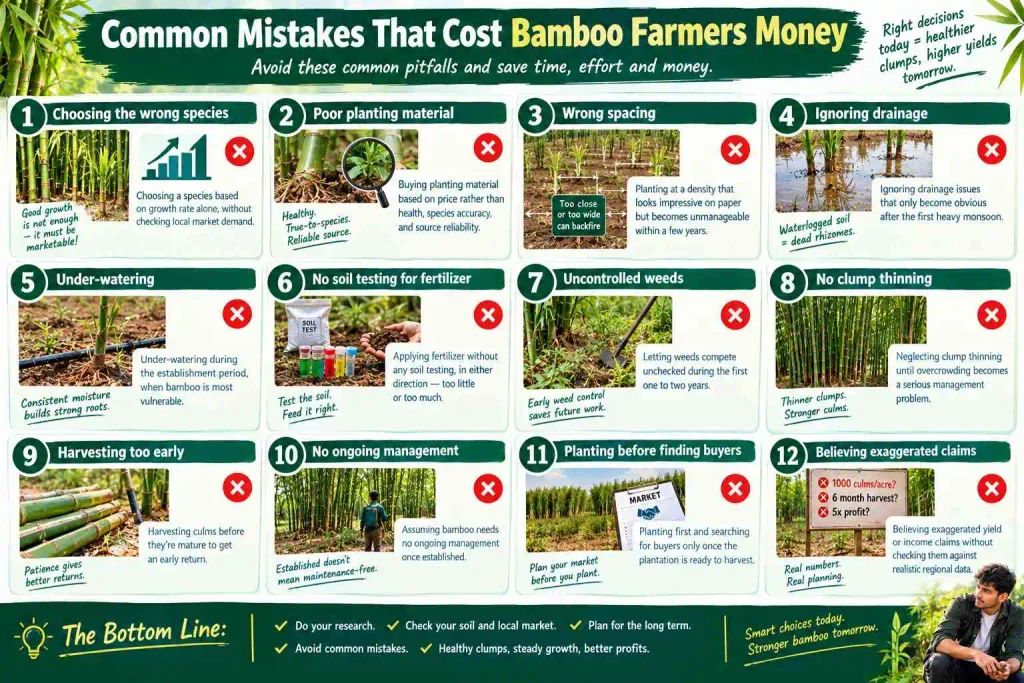
Common Mistakes That Cost Bamboo Farmers Money
A few patterns show up again and again in bamboo plantations that underperform:
Choosing a species based on growth rate alone, without checking local market demand.
Buying planting material based on price rather than health, species accuracy, and source reliability.
Planting at a density that looks impressive on paper but becomes unmanageable within a few years.
Ignoring drainage issues that only become obvious after the first heavy monsoon.
Under-watering during the establishment period, when bamboo is most vulnerable.
Applying fertilizer without any soil testing, in either direction — too little or too much.
Letting weeds compete unchecked during the first one to two years.
Neglecting clump thinning until overcrowding becomes a serious management problem.
Harvesting culms before they’re mature to get an early return.
Assuming bamboo needs no ongoing management once established.
Planting first and searching for buyers only once the plantation is ready to harvest.
Believing exaggerated yield or income claims without checking them against realistic regional data.
Each of these is avoidable with planning done before, not after, the first rhizome goes into the ground.
Frequently Asked Questions
Is bamboo farming profitable in India?
It can be, but profitability depends heavily on species choice, local market access, management quality, and realistic yield expectations. Establishment costs and the multi-year wait before commercial harvest mean returns take time to materialize — treat any specific profit figure with caution unless it’s built on your own local costs and buyer prices.
How many bamboo plants can be planted in one acre?
This depends entirely on spacing, which itself depends on species. Smaller-diameter species planted at 4 × 4 m spacing accommodate considerably more plants per acre than large-diameter species planted at 8 × 8 m or wider. Calculate it for your specific spacing: plants per acre = total area ÷ area occupied per plant.
Which bamboo variety is best for commercial farming?
There’s no single best variety — it depends on your climate, soil, and, most importantly, who will buy the produce and for what use (construction, pulp, handicrafts, shoots, etc.).
How long does bamboo take to reach harvest?
Most commercially cultivated species reach a workable first harvest somewhere between three and five years, though this varies by species and growing conditions.
How much water does bamboo require?
Requirements vary by species, age, and climate. Establishment-phase plants need consistent moisture; mature clumps of many species tolerate moderate dry spells, though yield and quality still respond to adequate water, particularly during shoot emergence.
Can bamboo be grown in dry areas?
Some species, notably Dendrocalamus strictus, tolerate drier conditions and lower rainfall better than others. Species selection matters more than any general statement about bamboo’s drought tolerance.
Where can farmers sell bamboo?
Markets include construction and furniture buyers, agarbatti and handicraft units, paper and pulp mills, biomass/bioenergy buyers, and local trader networks. Identifying buyers before establishing a large plantation is strongly advisable.
Bamboo farming rewards planning more than it rewards optimism. The plantation you’ll be harvesting from in year ten is really a product of the species you chose, the drainage you corrected, the spacing you selected, and the buyer relationships you built, all decided well before the bamboo itself did any of the visible growing.
If you’re considering it seriously, start with a soil test, a conversation with your state agriculture or horticulture department about current scheme support, and a visit to an established plantation of your shortlisted species nearby. Those three steps will tell you more than any yield chart can. And if a ten-year wait doesn’t suit your cash flow, it’s worth comparing bamboo against shorter-cycle alternatives likechia seed farming, where the same planning-first approach applies but returns come within a single season.
Newsletter
2 Comments
Can i get bamboo rice? Newly harvested?
Bamboo rice isn’t something we sell or supply. Our article focuses on commercial bamboo cultivation and management. Bamboo rice is produced from the seeds of flowering bamboo, which is a rare and irregular event rather than a normal harvest from newly grown bamboo.









Can i get bamboo rice? Newly harvested?
Bamboo rice isn’t something we sell or supply. Our article focuses on commercial bamboo cultivation and management. Bamboo rice is produced from the seeds of flowering bamboo, which is a rare and irregular event rather than a normal harvest from newly grown bamboo.