



Aloe Vera Farming: From One Acre to a Profitable Business
Aloe Vera farming is often sold to new farmers as a low-risk, low-maintenance business — plant it, ignore it, and collect money. That picture is incomplete. The plant is genuinely tough and drought-tolerant, but growing healthy leaves is only half the job. The real test of commercial Aloe Vera farming is whether you have a buyer ready to purchase your harvest at a price that covers your costs. Plenty of farmers have raised a thick, healthy crop and still lost money because nobody was lined up to buy it.
This guide walks through Aloe Vera cultivation the way an agronomist and a market analyst would — covering soil, irrigation, pests, harvesting, and the money side, so you know what you’re actually signing up for before you plant your first acre.
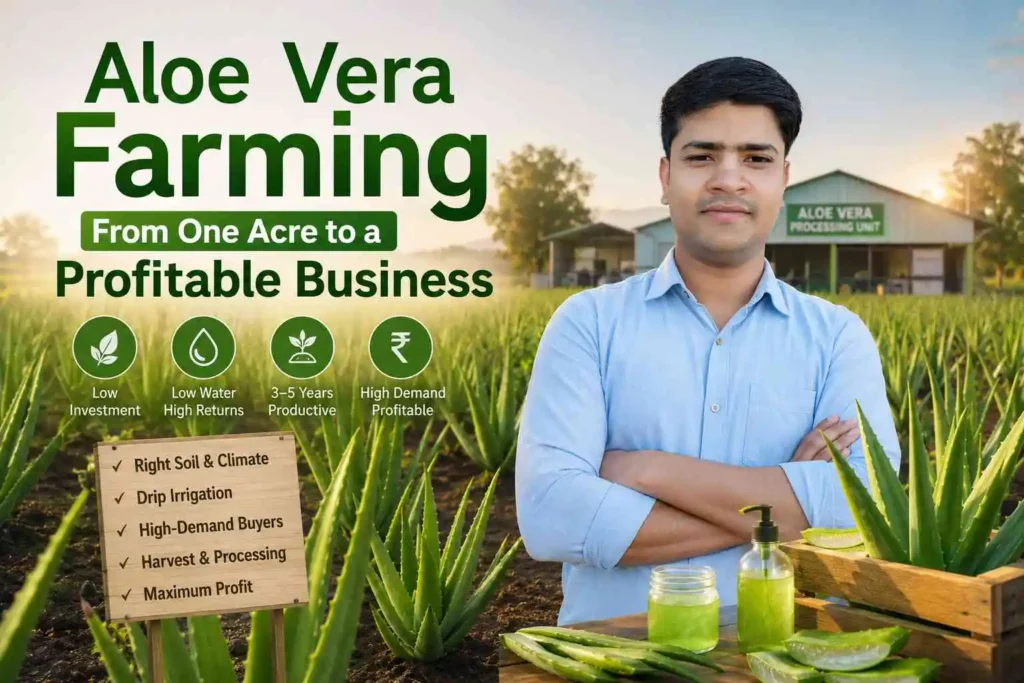
Why Aloe Vera Farming Can Be Profitable — But Isn’t Automatic
Aloe Vera has real advantages. It needs less water than most row crops, survives semi-arid conditions, and once established, keeps producing leaves for three to five years without replanting. Demand from cosmetic, herbal, and nutraceutical companies has been rising steadily, and processed products — gel, juice, powder — can fetch better margins than raw leaves.
But the limitations are just as real. Fresh leaves are bulky, perishable, and low-value unless there’s a nearby buyer or processing unit. Organized markets don’t exist in every region, prices swing depending on demand from a handful of large buyers, and transport costs eat into margins fast if your nearest buyer is far away.
Common Mistake: Many new Aloe Vera farmers plant the crop first and search for buyers later. Fresh leaves don’t store well, so if you don’t have a confirmed buyer, harvested leaves can lose value within days. Line up at least one realistic buyer — a processor, cosmetic company, or contract farming agreement — before you plant a commercial area.
Is Your Climate Actually Right for Aloe Vera?
Aloe Vera tolerates heat and dry spells well, but “drought-tolerant” doesn’t mean “grows anywhere.” It prefers warm temperatures, plenty of sunlight, and moderate rainfall. What it can’t handle is prolonged waterlogging or frost.
Here’s why this matters: in high-rainfall zones, excess moisture sitting around the roots invites fungal rot, even if the rainfall total looks moderate on paper. In colder regions, frost and prolonged cold slow growth and can damage plant tissue outright. Semi-arid and arid belts of India — parts of Gujarat, Rajasthan, Andhra Pradesh, and Tamil Nadu — are commonly cited as suitable, but suitability within any state still depends on local drainage, groundwater, and irrigation access, not the state boundary itself.
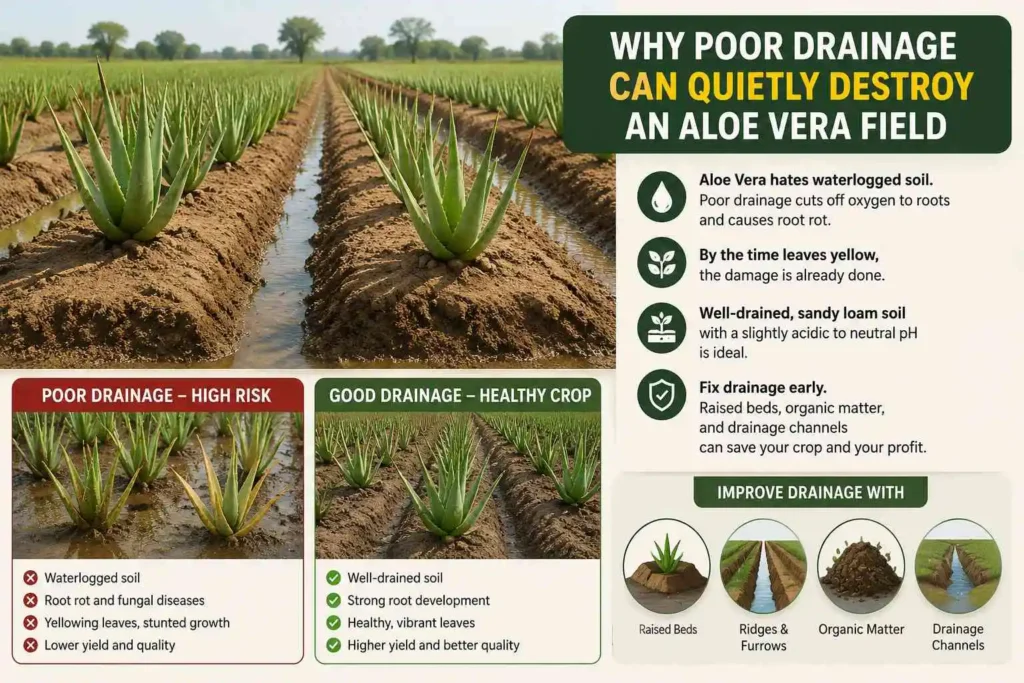
Why Poor Drainage Can Quietly Destroy an Aloe Vera Field
Soil selection is one of the most important decisions you’ll make, and it’s often underrated because Aloe Vera “looks” like it can handle anything.
Aloe Vera prefers well-drained sandy loam soil with a slightly acidic to neutral pH. Organic matter helps, but drainage is non-negotiable. When roots sit in waterlogged clay soil after rain, oxygen supply to the roots drops, and root rot sets in — often before you notice anything wrong above ground. By the time leaves start yellowing, the damage is usually already done.
If your land has heavy clay or poor natural drainage, don’t skip corrective work. Raised beds, ridges and furrows, added organic matter, and dedicated drainage channels can turn marginal land into workable Aloe Vera fields. Skipping this step to save money upfront is one of the most common — and expensive — mistakes in commercial cultivation.
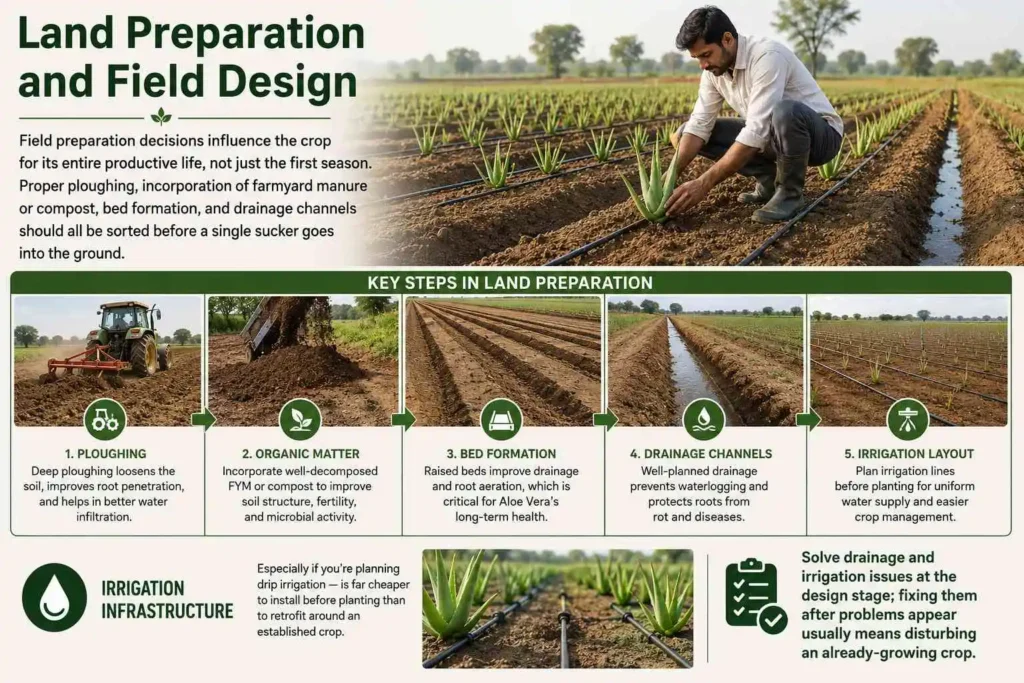
Land Preparation and Field Design
Field preparation decisions influence the crop for its entire productive life, not just the first season. Proper ploughing, incorporation of farmyard manure or compost, bed formation, and drainage channels should all be sorted before a single sucker goes into the ground.
Irrigation infrastructure — especially if you’re planning drip irrigation — is far cheaper to install before planting than to retrofit around an established crop. Solve drainage and irrigation issues at the design stage; fixing them after problems appear usually means disturbing an already-growing crop.
Which Aloe Vera Variety Should You Actually Plant?
Don’t just pick whatever planting material is locally available. Consider leaf size, gel yield, disease resistance, and — most importantly — what your buyer wants. Some buyers may specify requirements related to gel yield, quality, or aloin content, so check the buyer’s specifications before selecting planting material. Note that aloin content isn’t simply a “higher is better” quality marker — many cosmetic, food, and wellness applications actually require low or controlled aloin levels for regulatory and safety reasons, so the “right” level depends entirely on the end use.
Several named cultivars and commercial planting stocks circulate in the trade, but claims about their exact gel content or performance vary widely across sources and aren’t always independently verified. One example of a documented institutional release is CIM-Sheetal, a barbaloin-free variety released by CIMAP (Central Institute of Medicinal and Aromatic Plants, Lucknow) suited to rainfed cultivation. Before committing to any named variety, it’s worth checking directly with CIMAP, your state horticulture department, or a recognized nursery for verified performance data, rather than relying solely on trade names. No single variety is universally “most profitable” — the right choice depends on your target market and buyer specifications.
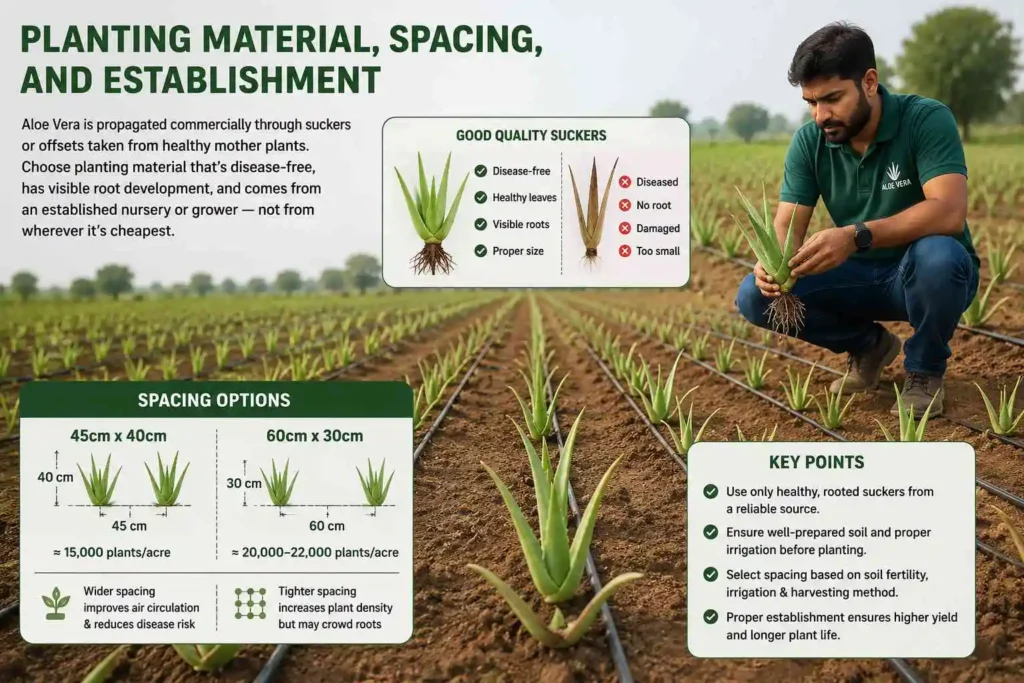
Planting Material, Spacing, and Establishment
Aloe Vera is propagated commercially through suckers or offsets taken from healthy mother plants. Choose planting material that’s disease-free, has visible root development, and comes from an established nursery or grower — not from wherever it’s cheapest.
Spacing affects more than just how many plants fit in an acre. Wider spacing improves air circulation and reduces disease risk but means fewer plants; tighter spacing raises plant density but can crowd roots and complicate harvesting. Commercial spacing commonly runs between 45cm x 40cm and 60cm x 30cm, giving a plant population roughly in the range of 15,000–22,000 plants per acre — but the right spacing for you depends on soil fertility, irrigation, and harvesting method.
How Much Water Does Aloe Vera Actually Need?
This is where many beginners overcorrect. Aloe Vera needs consistent moisture at establishment and during active growth, but once roots are set, it tolerates dry spells far better than most crops.
The bigger risk is usually overwatering, not underwatering. Waterlogged soil starves roots of oxygen and invites rot — a slower, more silent killer than drought stress. Drip irrigation is worth the investment for most commercial growers: it cuts water use significantly, reduces weed growth between rows, and often qualifies for government subsidy support. During monsoon months, irrigation should be reduced or paused entirely based on actual soil moisture, not a fixed calendar.
Expert Tip: Check soil moisture at root depth before irrigating, rather than following a rigid schedule. Overwatering is one of the most common — and most preventable — causes of yield loss in Aloe Vera fields.
Fertilizer, Weeds, Pests, and Disease — Where Vigilance Pays Off
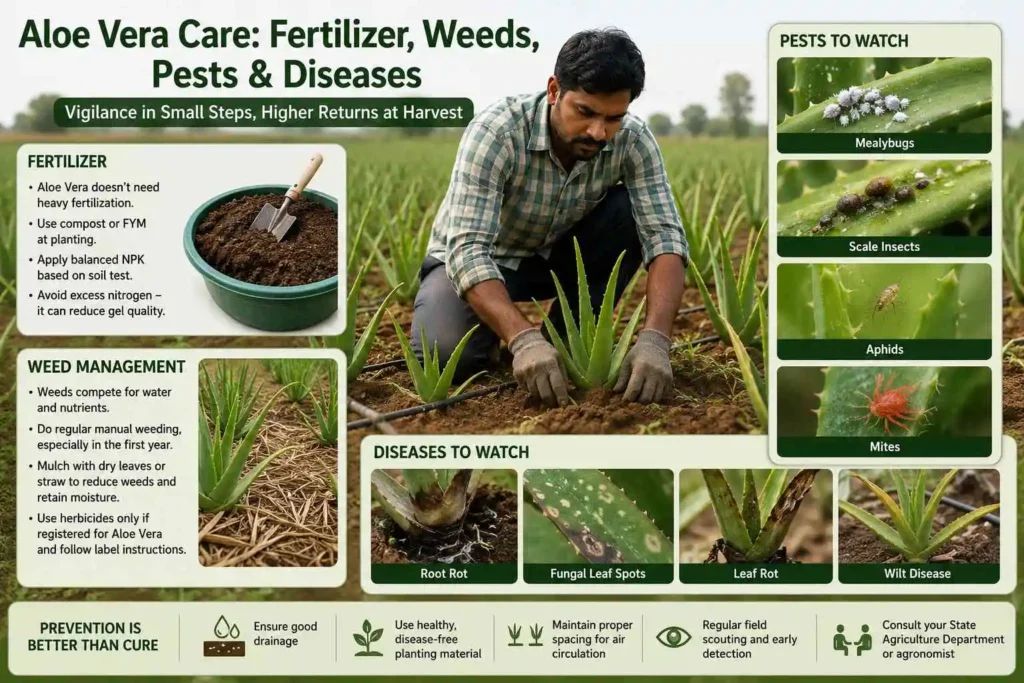
Aloe Vera doesn’t need heavy fertilization. Over-application of nitrogen can actually reduce gel quality even as it boosts leaf size. Farmyard manure or compost at planting, supplemented with modest, soil-test-guided doses of NPK, generally works better than blanket fertilizer schedules.
Weeds compete for water and nutrients, especially during the first year before the canopy closes. Manual weeding and mulching are the standard approach for most smallholders; herbicides should only be used if registered for the crop, following label instructions.
Root rot, fungal leaf spots, mealybugs, and scale insects are the main problems to watch for. Prevention — good drainage, healthy planting material, proper spacing, and regular field scouting — is far cheaper than treatment. Where chemical control becomes necessary, use only locally registered products and consult your state agriculture department or a qualified agronomist.
Harvesting Without Weakening the Plant
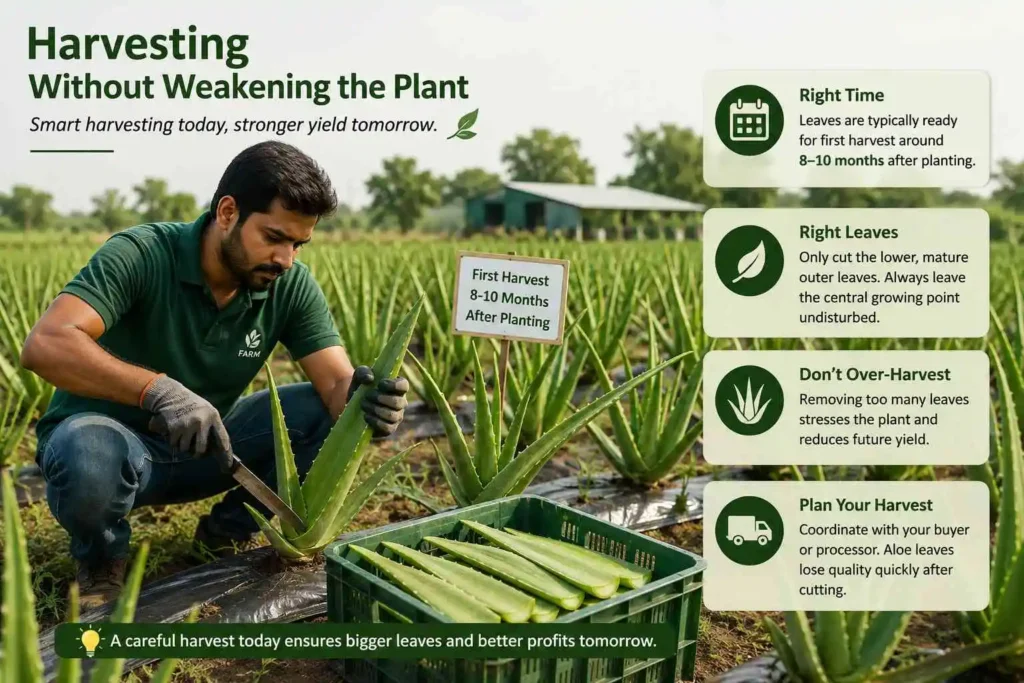
Harvesting isn’t just cutting whichever leaf looks biggest. Leaves are typically ready for first harvest around 8–10 months after planting, and only the lower, mature outer leaves should be cut, leaving the central growing point undisturbed. Over-harvesting stresses the plant and reduces future yield — a mistake that shows up months later as declining leaf size, not immediately.
Coordinate harvest timing with your buyer’s delivery schedule. Leaves lose quality quickly after cutting, so a harvest with no immediate buyer or processing plan is a wasted harvest.
What Does Aloe Vera Farming Actually Cost in India?
Cost estimates online vary wildly — from ₹25,000 to ₹2 lakh per acre — mostly because they include different assumptions about drip irrigation, land development, and plant density. The table below is a realistic range for a farmer with basic land already in cultivable condition.
| Cost Head | Approximate Cost (₹/acre, Year 1) |
|---|---|
| Land preparation & manure | ₹12,000 – ₹20,000 |
| Planting material (suckers) | ₹30,000 – ₹45,000 |
| Planting labour | ₹6,000 – ₹10,000 |
| Drip irrigation (optional, one-time) | ₹20,000 – ₹30,000 |
| Fertilizer & inputs | ₹5,000 – ₹8,000 |
| Weeding & pest management | ₹6,000 – ₹10,000 |
| Harvesting & transport | ₹8,000 – ₹15,000 |
| Total Year 1 investment | ₹85,000 – ₹1,40,000 |
From Year 2 onward, since plants produce their own offsets and don’t need replanting, operating costs typically drop to ₹25,000–₹40,000 per acre annually, covering labour, irrigation, weeding, and harvesting.
Revenue depends heavily on yield and the price you negotiate. Raw leaf prices commonly range between ₹6 and ₹18 per kg depending on buyer and region, with reported yields ranging from roughly 8 to 20 tonnes per acre once the crop is established. That’s a wide range deliberately — actual results depend on soil, plant density, irrigation, survival rate, and how well you time your harvest with buyer demand.
Warning: Treat any claim of a guaranteed ₹8–10 lakh profit per acre with caution. That level of return, where achievable at all, generally requires processed products (gel, juice) sold directly or premium contract agreements — not raw leaf sales. For raw leaf farming with a standard buyer arrangement, a more realistic net return is in the range of ₹1–3 lakh per acre once the field is fully established, and even that assumes good management and a reliable buyer.
Farmers cultivating Aloe Vera and other medicinal plants may also be eligible for financial assistance under schemes run by the National Medicinal Plants Board — worth checking with your state horticulture department before finalizing your budget.
Fresh Leaves or Processed Products — Which Should You Sell?
Selling raw leaves is simpler but generally lower-margin. Moving into gel, juice, or powder production can improve returns, but it isn’t automatic — processing requires equipment, hygiene standards, quality control, packaging, and often regulatory compliance. Don’t assume value addition guarantees higher profit; treat it as a separate business decision requiring its own investment and market research.
Finding a Buyer Before You Plant
This is where the real risk in Aloe Vera farming lives — not in the agronomy. Before committing serious acreage, identify potential buyers: herbal and Ayurvedic manufacturers, cosmetic companies, nutraceutical firms, or established processors. Some offer contract farming with buyback agreements at fixed rates, which reduces price risk considerably. Whichever route you choose, confirm minimum quantity requirements, quality standards, delivery schedules, and payment terms in writing before scaling up.
A confirmed buyer at a modest price is worth more than a theoretical high price with no one committed to pay it.
The Bottom Line
Aloe Vera isn’t difficult to grow, but commercial Aloe Vera farming is a business built on several linked decisions — soil, drainage, irrigation, variety selection, harvesting discipline, and above all, market access. Before you put a large area under cultivation, confirm your soil suitability, set up proper drainage and irrigation, source healthy planting material, and — most importantly, lock down a buyer. Get those pieces right, and Aloe Vera has a genuine chance of becoming a working farm business rather than just a field full of leaves nobody’s buying.
If you’re exploring other high-value farming opportunities, you may also want to look into Orchid Farming, Heirloom Tomato Farming, Grape Farming, and Pomegranate Farming. Each crop has different requirements for climate, investment, crop management, and market access, so choose based on what suits your land and local market.
Frequently Asked Questions About Aloe Vera Farming
Is Aloe Vera farming profitable in India?
Yes, Aloe Vera farming can be profitable, but profitability depends heavily on yield, production costs, selling price, and access to a reliable buyer. Farmers should confirm market demand and buyer arrangements before planting on a large scale.
How much does it cost to start Aloe Vera farming on one acre?
A typical first-year investment can range from around ₹85,000 to ₹1.4 lakh per acre, depending on planting material, labour, land preparation, and whether drip irrigation is installed.
How much can I earn from one acre of Aloe Vera?
Income varies significantly by yield and market price. Under favourable conditions, established farms may generate a reasonable net return, but farmers should be cautious about exaggerated claims of extremely high profits from raw Aloe Vera leaves.
Which soil is best for Aloe Vera farming?
Aloe Vera performs best in well-drained sandy loam soil with good drainage and a slightly acidic to neutral pH. Avoid fields where water regularly stands after rainfall.
Is drip irrigation necessary for Aloe Vera farming?
Drip irrigation is not always essential, but it can be beneficial for commercial cultivation. It helps deliver water efficiently and can make irrigation management easier, especially where water availability is limited.
Newsletter