


How to Grow Mint at Home: Pudina in Pots, Balconies and Small Gardens
Most of us have bought a bunch of pudina for chutney or raita, used half, and watched the rest turn black in the fridge. A pot of mint on the balcony fixes that problem, because you pick only what you need, fresh, whenever you cook. The catch is that mint in a pot can turn leggy, dry out in the heat or sulk in soggy soil if its conditions are wrong.
The good news is that how to grow mint at home is not complicated once you understand what the plant wants: roots with room to spread, soil that stays moist but drains freely, bright light without scorching afternoon sun, and regular, careful harvesting.
This guide takes you from choosing a plant or cutting to your first harvest. You’ll learn how to grow mint from cuttings or a nursery plant, which pot and soil mix to use, how much sun and water it needs, how to keep it bushy instead of tall and weak, how to handle pests and yellow leaves, and how to stop it from taking over your garden.
Why Mint Is One of the Easiest Herbs to Grow at Home
Mint grows well in containers, often roots from a healthy stem cutting, and puts out fresh growth after careful harvesting. For a beginner, that combination is hard to beat. A single pot on a balcony, terrace or sunny windowsill can supply leaves for everyday cooking.
“Easy” has limits, though. Mint will not survive neglect, waterlogged soil, scorching heat with no relief or a spot that never sees daylight. Here’s where many beginners go wrong: they assume a plant that spreads like a weed in a garden bed will forgive any treatment in a small pot. In a container, the roots have nowhere to go, so soil quality, drainage and watering matter more.
A healthy mint plant has bright green leaves, firm stems and steady new shoots at the tips. If your balcony, terrace or windowsill gets several hours of bright light and you can water regularly, you have what you need.
Key Takeaway: Mint is forgiving about propagation, but not about waterlogged roots, deep shade or extreme heat.
Which Type of Mint Should You Grow?
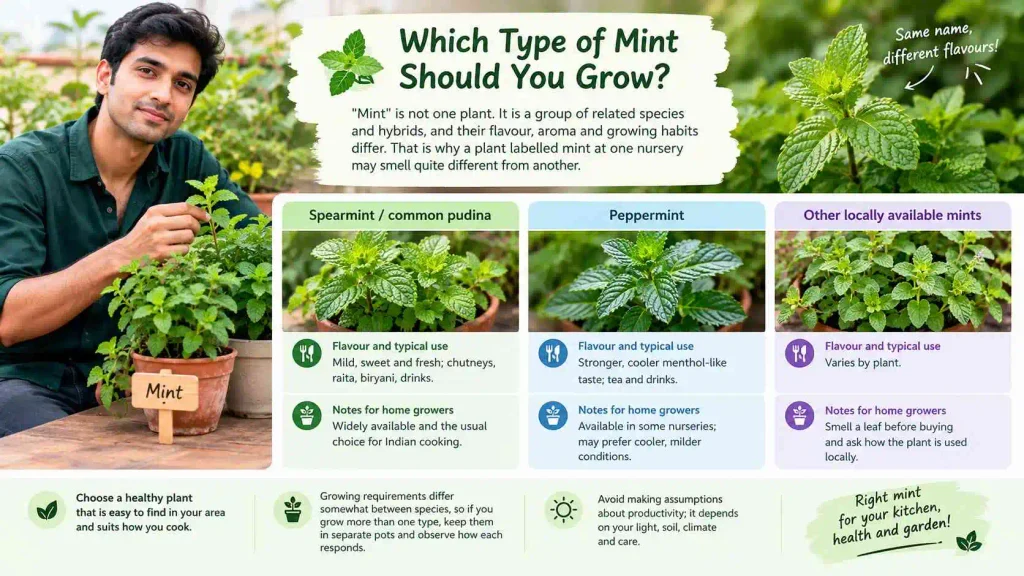
“Mint” is not one plant. It is a group of related species and hybrids, and their flavour, aroma and growing habits differ. That is why a plant labelled mint at one nursery may smell quite different from another.
The table below sets out the types Indian home gardeners most commonly come across, so you can match one to your kitchen.
| Type | Flavour and typical use | Notes for home growers |
|---|---|---|
| Spearmint / common pudina | Mild, sweet and fresh; chutneys, raita, biryani, drinks | Widely available and the usual choice for Indian cooking |
| Peppermint | Stronger, cooler menthol-like taste; tea and drinks | Available in some nurseries; may prefer cooler, milder conditions |
| Other locally available mints | Varies by plant | Smell a leaf before buying and ask how the plant is used locally |
Choose a healthy plant that is easy to find in your area and suits how you cook. Growing requirements differ somewhat between species, so if you grow more than one type, keep them in separate pots and observe how each responds. Avoid making assumptions about productivity; it depends on your light, soil, climate and care.
Is It Better to Grow Mint from Cuttings or Seeds?
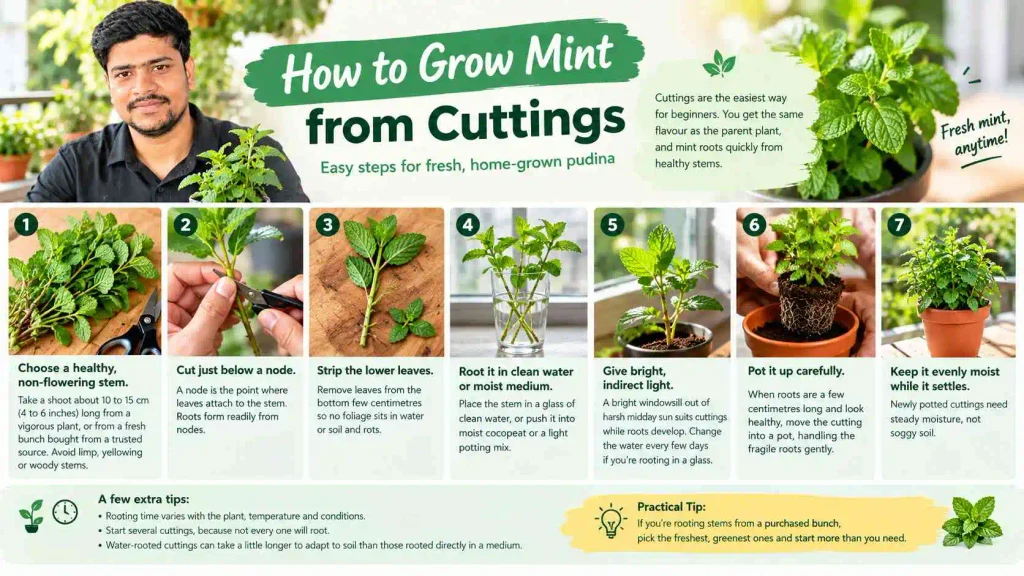
For most beginners, healthy stem cuttings or a small nursery plant are the easiest starting point. A cutting is a piece of an established plant, so you know what flavour you’re getting. Seeds can be unreliable: germination and the character of the resulting plants vary by species and variety, and some mint types, such as peppermint, are generally propagated from cuttings or divisions rather than seed.
How to grow mint from cuttings
- Choose a healthy, non-flowering stem. Take a shoot about 10 to 15 cm (4 to 6 inches) long from a vigorous plant, or from a fresh bunch bought from a trusted source. Avoid limp, yellowing or woody stems.
- Cut just below a node. A node is the point where leaves attach to the stem. Roots form readily from nodes.
- Strip the lower leaves. Remove leaves from the bottom few centimetres so no foliage sits in water or soil and rots.
- Root it in clean water or moist medium. Place the stem in a glass of clean water, or push it into moist cocopeat or a light potting mix.
- Give bright, indirect light. A bright windowsill out of harsh midday sun suits cuttings while roots develop. Change the water every few days if you’re rooting in a glass.
- Pot it up carefully. When roots are a few centimetres long and look healthy, move the cutting into a pot, handling the fragile roots gently.
- Keep it evenly moist while it settles. Newly potted cuttings need steady moisture, not soggy soil.
Rooting time varies with the plant, temperature and conditions, so don’t be alarmed if some cuttings take longer than others. Start several cuttings, because not every one will root. Water-rooted cuttings can take a little longer to adapt to soil than those rooted directly in a medium.
Practical Tip: If you’re rooting stems from a purchased bunch, pick the freshest, greenest ones and start more than you need.
What Pot Is Best for Growing Mint?
A pot that is wide rather than tall suits mint, because its roots and runners spread sideways near the surface. A good starting size for one or two plants is a container about 30 cm (12 inches) wide and 20 to 25 cm (8 to 10 inches) deep. A bigger pot will hold moisture longer and give more room, while a tiny decorative pot dries out quickly and chokes the roots.
Whatever you choose, it must have drainage holes. Standing water around the roots is one of the fastest ways to kill a mint plant.
| Container | Advantages | Watch out for |
|---|---|---|
| Plastic pot or grow bag | Light, inexpensive, holds moisture longer | Can heat up in direct sun; make sure drainage is good |
| Terracotta / clay | Breathable, stable | Dries faster in summer, so check moisture more often |
| Recycled containers (with holes drilled) | Cheap and roomy | Holes must be adequate; avoid containers that held harmful chemicals |
Growing mint in its own pot is the easiest way to control its spreading roots and runners. Don’t crowd it with other herbs, as that reduces airflow and the plants compete for water and nutrients. When roots circle densely, push out of the drainage holes or growth slows despite good care, it’s time to divide the plant or move it to a larger container.
How to Prepare Potting Soil That Keeps Mint Healthy
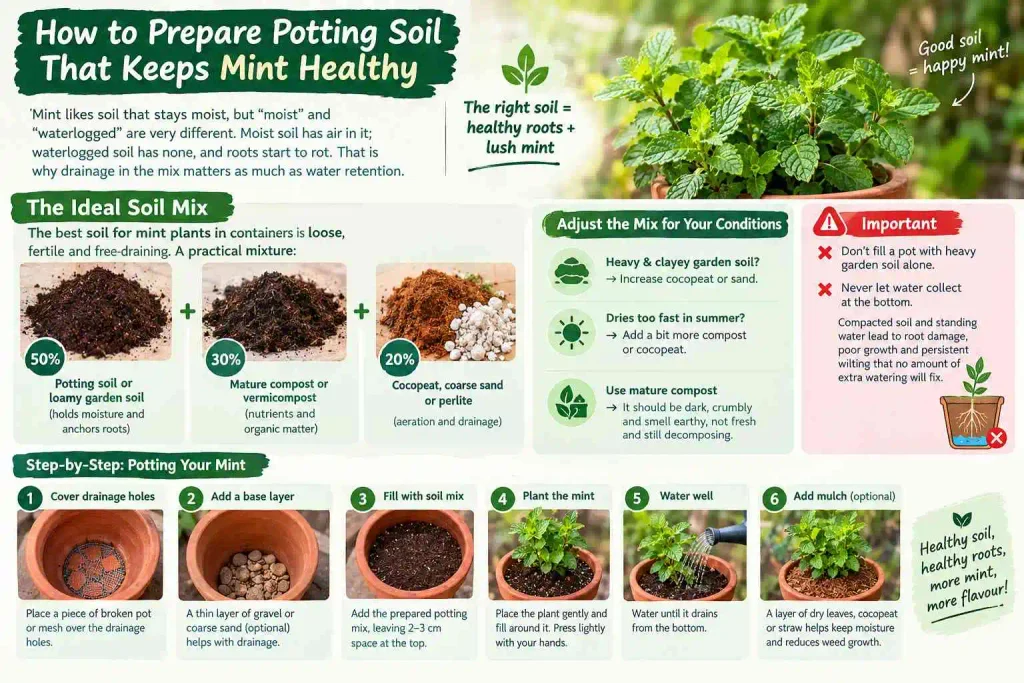
Mint likes soil that stays moist, but “moist” and “waterlogged” are very different. Moist soil has air in it; waterlogged soil has none, and roots start to rot. That is why drainage in the mix matters as much as water retention.
The best soil for mint plants in containers is loose, fertile and free-draining. A practical mixture:
- 50% potting soil or loamy garden soil (the base that holds moisture and anchors roots)
- 30% mature compost or vermicompost (nutrients and organic matter)
- 20% cocopeat, coarse sand or perlite (aeration and drainage)
These proportions are a starting point. If your garden soil is heavy and clayey, increase the cocopeat or sand. If the mix dries too fast in summer, add a bit more compost or cocopeat. Make sure the compost is mature, dark and earthy-smelling, not fresh and still decomposing.
Warning: Don’t fill a pot with heavy garden soil alone, and never let water collect at the bottom. Compacted soil and standing water lead to root damage, poor growth and persistent wilting that no amount of extra watering will fix.
Cover the drainage holes with a piece of broken pot or mesh, fill the container, and leave a couple of centimetres of space at the top so water doesn’t spill over.
How Much Sunlight Does Mint Actually Need?
Mint generally grows well in bright light with some direct sun, but the ideal amount depends on the variety, temperature and your local climate. A common range is around four to six hours of sunlight, ideally morning sun, with protection from the harshest afternoon heat.
This is particularly important during an Indian summer. Mild morning sun is helpful; intense afternoon sun in May or June can scorch leaf edges and dry out a small pot within hours. If your balcony faces west, move the pot or provide light shade, such as a shade net, during the hottest part of the day.
Don’t make the opposite mistake of keeping mint in deep shade just because it likes moisture. Moisture-loving does not mean shade-loving. In too little light, mint produces long, weak, pale stems with widely spaced leaves.
If you’re moving a plant from a shady spot to a sunnier one, do it gradually over about a week so the leaves can adjust.
What to look for:
- Long, weak stems with sparse leaves: may point to insufficient light.
- Scorched or dried leaf edges: may point to excess heat or moisture stress.
- Healthy new growth with good colour: the light is about right.
How Often Should You Water Mint?
Mint needs consistent moisture but does not tolerate permanently waterlogged roots. There is no universal answer to how often to water mint, because it depends on the pot size and material, temperature, wind, sunlight and how large the plant has grown. A fixed daily schedule is a common beginner trap.
Instead, use this simple method:
- Check the growing medium. Push a finger about 2 cm (under an inch) into the soil. If it feels dry at that depth, it’s time to water. If it’s still damp, wait.
- Water thoroughly. Water until it drains from the bottom, so the whole root zone is moistened.
- Let excess water drain freely. Never leave the pot sitting in a saucer of water.
- Check more often in hot, dry or windy weather, when small pots can dry out quickly.
You can also lift the pot. A pot that feels light after a hot day usually needs water, while a heavy one probably doesn’t.
Before adding more water, check the soil. Underwatering and overwatering can look alike, because both can make the plant wilt: dry roots can’t supply water, and rotting roots can’t absorb it. If the soil is dry, water. If it’s wet and the plant is wilting, stop watering and improve drainage.
Expert Tip: Water the soil rather than the leaves, and do it in the morning if possible, so foliage dries during the day.
Does Mint Need Fertiliser to Produce More Leaves?
Mint is harvested for its leaves and stems, so it keeps using nutrients to put out new growth. In a small pot, those nutrients eventually run low, which is why container mint benefits from occasional replenishment.
A conservative approach works best:
- Mix mature compost or vermicompost into the potting medium at the start.
- Top-dress the pot with a thin layer of compost every so often as the plant grows.
- If growth slows or leaves look pale despite good watering and light, use a balanced fertiliser according to the product label.
How much and how often depends on your growing medium, the plant’s growth and how frequently you harvest, so there is no universal dosage. More is not better. Too much fertiliser can cause soft, weak growth that attracts pests, and in containers it can build up salts that damage roots.
Before reaching for fertiliser, check whether yellowing is actually caused by something else. Soggy soil, poor drainage and the natural ageing of older lower leaves can all cause yellowing that has nothing to do with nutrition. Feeding a plant in waterlogged soil makes matters worse.
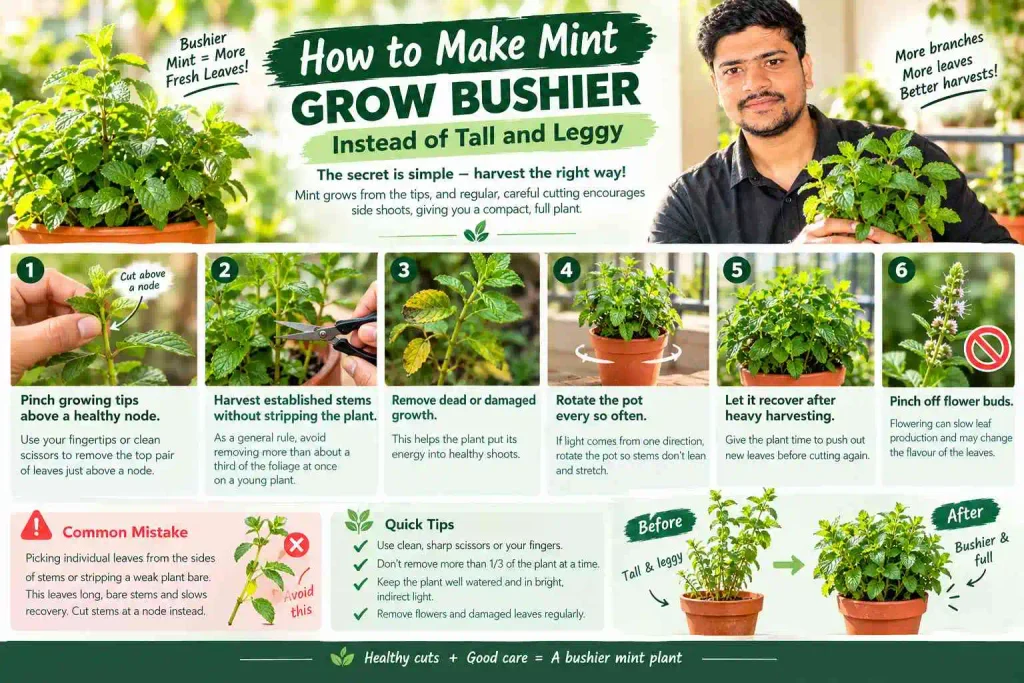
How to Make Mint Grow Bushier Instead of Tall and Leggy
If you want to know how to make mint bushy, the answer is mostly in how you harvest. Mint grows from the tips of its stems, and when you cut a stem above a leaf node, the plant sends out side shoots from the nodes below. Regular, careful cutting is what produces a compact, full plant.
- Pinch growing tips above a healthy node. Use your fingertips or clean scissors to remove the top pair of leaves just above a node.
- Harvest established stems without stripping the plant. As a general rule of thumb, avoid removing more than about a third of the foliage at once on a young plant.
- Remove dead or damaged growth so the plant puts its energy into healthy shoots.
- Rotate the pot every so often if light comes from one direction, so stems don’t lean and stretch.
- Let it recover after heavy harvesting. Give the plant time to push out new leaves before cutting again.
Common Mistake: Picking individual leaves from the sides of stems or stripping a weak plant bare. This leaves long, bare stems and slows recovery. Cut stems at a node instead.
Also pinch off any flower buds that appear. Flowering can slow leaf production, and many gardeners find the flavour of leaves changes once the plant starts to flower. Don’t expect a set yield or number of harvests; it depends on your plant’s vigour, season and conditions.
Why Is Your Mint Plant Turning Yellow, Drying Out, or Losing Leaves?
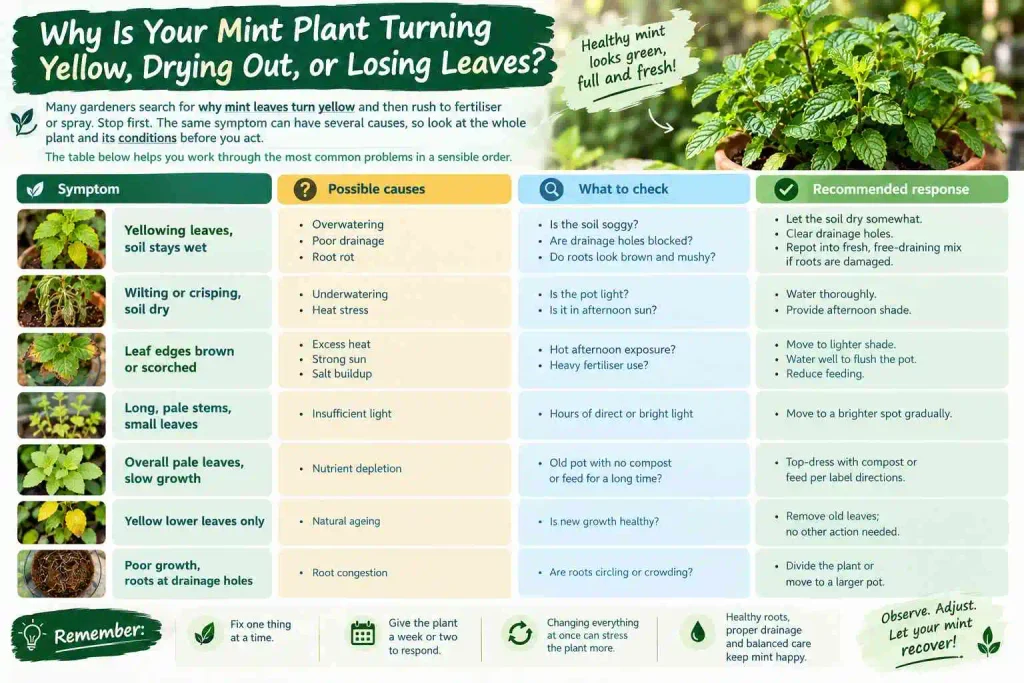
Many gardeners search for why mint leaves turn yellow and then rush to fertiliser or spray. Stop first. The same symptom can have several causes, so look at the whole plant and its conditions before you act.
The table below helps you work through the most common problems in a sensible order.
| Symptom | Possible causes | What to check | Recommended response |
|---|---|---|---|
| Yellowing leaves, soil stays wet | Overwatering, poor drainage, root rot | Is the soil soggy? Are drainage holes blocked? Do roots look brown and mushy? | Let the soil dry somewhat, clear drainage, repot into fresh, free-draining mix if roots are damaged |
| Wilting or crisping, soil dry | Underwatering, heat stress | Is the pot light? Is it in afternoon sun? | Water thoroughly, provide afternoon shade |
| Leaf edges brown or scorched | Excess heat, strong sun, salt buildup | Hot afternoon exposure? Heavy fertiliser use? | Move to lighter shade, water well to flush the pot, reduce feeding |
| Long, pale stems, small leaves | Insufficient light | Hours of direct or bright light | Move to a brighter spot gradually |
| Overall pale leaves, slow growth | Nutrient depletion | Old pot with no compost or feed for a long time? | Top-dress with compost or feed per label directions |
| Yellow lower leaves only | Natural ageing | Is new growth healthy? | Remove old leaves; no other action needed |
| Poor growth, roots at drainage holes | Root congestion | Are roots circling or crowding? | Divide the plant or move to a larger pot |
Fix one thing at a time and give the plant a week or two to respond. Changing everything at once makes it impossible to know what helped.
How to Protect Mint from Common Pests and Diseases
Mint is fairly tough, but it can attract aphids, spider mites, leaf-chewing caterpillars or beetles, and fungal problems such as leaf spots or rust, especially in humid or overcrowded conditions.
Make inspection a habit. Look at new growth and under the leaves, where mites and aphids hide. Early signs include curled new leaves, sticky residue, fine webbing, speckled leaves, holes or orange or brown spots.
Start with low-risk measures:
- Remove badly damaged leaves and dispose of them away from the plant.
- Wash aphids or mites off with a gentle stream of water.
- Improve airflow by avoiding overcrowding.
- Water the soil rather than unnecessarily wetting the foliage.
- Keep the pot clean and remove fallen or decaying leaves.
Identify the problem before choosing any treatment. If the problem is serious and simple measures fail, use a pesticide only if it is legally labelled for use on the plant, the pest and the setting, and follow all label directions, including any interval between treatment and harvest. Homemade sprays are not guaranteed to be safe or effective, and some can burn leaves.
Warning: Mint leaves are eaten fresh. Always respect treatment-to-harvest intervals on any product you use, and wash harvested leaves thoroughly before use.
Can You Grow Mint All Year Round in India?
In much of India, you can keep mint going for most of the year with a few seasonal adjustments, but there is no single calendar that suits every region.
Hot summers. Containers dry out fast and leaves can scorch. Move pots to a spot with morning sun and afternoon shade, use a larger pot, and check moisture daily if needed.
Monsoon. Humidity and heavy rain raise the risk of fungal problems and waterlogging. Make sure drainage holes are clear, avoid letting pots sit in water, and move them under cover if rain is heavy. Good airflow matters more than ever.
Cooler winters. Growth often slows, and the plant needs less water. Reduce watering, place the pot in the sunniest spot, and protect it from frost and cold winds. In colder parts of north India, mint may die back and regrow when warmth returns.
Regional differences. In warmer southern and coastal regions, growth can continue through much of the year, though extreme heat and heavy rain still need managing. In northern plains, summer heat and winter cold are bigger challenges. Observe how your own plant responds, and ask local nurseries or horticulture extension services what works in your area.
When and How Should You Harvest Mint Leaves?
Wait until the plant is established, with several healthy stems and steady new growth, before taking your first meaningful harvest. If you’ve just potted a cutting, a few small tips are fine, but let it settle first.
If you’re wondering when to harvest mint leaves, the answer is whenever you have healthy, leafy stems, rather than on a fixed weekly schedule. Harvest according to the plant’s size and vigour.
- Choose fresh, healthy stems. Select growth that is vigorous and green.
- Cut above a node. Use clean scissors or pinch with your fingers just above a pair of leaves, so side shoots form.
- Take a moderate amount. Don’t strip the plant. Leave plenty of foliage so it can recover.
- Let it recover. Wait for new growth before the next big harvest.
Rinse harvested leaves in clean water. For short-term storage, wrap them in a slightly damp paper towel in a container in the fridge, or stand stems in a glass of water, and use them within a few days. Fresh mint is best added to chutneys, raita, tea, drinks and biryani close to serving time.
How to Keep Mint from Taking Over Your Garden
Planted straight into a garden bed, many mint types spread through underground stems and runners and can occupy far more space than expected, crowding out neighbouring plants.
If you want to control it, grow mint in containers. This also lets you manage different varieties separately and give each the watering it needs.
If you do want mint in the ground, sink a large pot into the soil with its rim a few centimetres above the surface, or edge the planting area with a deep physical barrier. Check regularly and remove runners that escape. No barrier is guaranteed to stop all spread, so inspection and trimming remain part of the job.
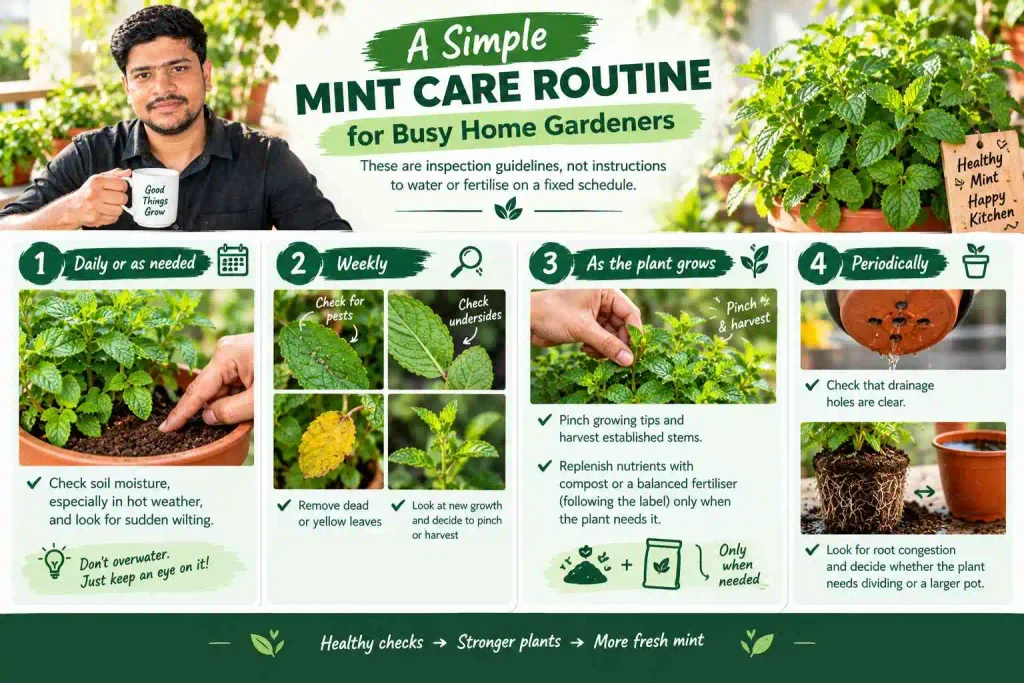
A Simple Mint Care Routine for Busy Home Gardeners
These are inspection guidelines, not instructions to water or fertilise on a fixed schedule.
Daily or as needed
- Check soil moisture, especially in hot weather, and look for sudden wilting.
Weekly
- Inspect leaves for pests and spots, including the undersides.
- Remove dead or yellow leaves.
- Look at new growth and decide whether it’s time to pinch or harvest.
As the plant grows
- Pinch growing tips and harvest established stems.
- Replenish nutrients with compost or a balanced fertiliser (following the label) only when the plant needs it.
Periodically
- Check that drainage holes are clear.
- Look for root congestion and decide whether the plant needs dividing or a larger pot.
Frequently Asked Questions
Can I grow mint from the stems I buy at the market? Often, yes. Choose fresh, healthy stems, remove the lower leaves and root them in water or moist medium. Not every stem will root, so start several.
How long do mint cuttings take to root? It varies with temperature, light and the plant. Many cuttings show roots within a couple of weeks in warm conditions, but some take longer.
Can I grow mint indoors? It can work on a bright windowsill, but mint grows best with several hours of direct light. In low light it becomes leggy and weak.
Why is my mint plant tall with few leaves? Usually insufficient light, or leaves being picked without cutting stems back. Move the plant to a brighter spot and pinch the tips above a node.
Is mint safe to grow with other herbs in one pot? It’s better to give it its own pot. Its roots spread aggressively and it will crowd out other plants.
Should I let mint flower? Most home gardeners pinch off flower buds, since flowering can reduce leaf production and change the flavour of the leaves.
Does mint come back every year? Mint is a perennial and often regrows after winter or heat setbacks if the roots stay healthy, though this depends on your climate and care.
Start with One Healthy Cutting
Mint does best when its roots have room to spread, the soil stays moist without becoming waterlogged, and the plant gets bright light with some relief from the afternoon sun. Add regular, careful harvesting at the nodes, and it will reward you with fresh, fragrant leaves.
You don’t need a garden or special equipment. Take one healthy cutting or a small nursery plant, set it in a 30 cm pot with drainage holes and a loose mix of soil, compost and cocopeat, and place it where it gets morning sun. Results will vary with your climate and season, but a single well-drained pot is enough to start learning what your mint plant needs. Once you’re comfortable with mint, you can add another kitchen herb to your balcony or windowsill. This complete guide to growing coriander at home is a good next step, since coriander also grows well in containers but has different needs from mint.
Newsletter