



Rose Farming Business Guide: Start a Profitable Rose Farm
Two farmers can plant the same variety, in the same district, in the same month, and end up with very different results. One sells most of the crop at a good price. The other watches flowers wilt at the market gate.
The difference is rarely the plant. It’s usually the decisions made before planting: who will buy the flowers, which variety suits that buyer, whether the soil and water can support a commercial crop, and whether the flowers will still look good when they arrive.
Rose farming can be commercially attractive. The crop flowers repeatedly, demand runs through weddings, festivals, temples and retail, and there are several routes to market. But the risks are just as real: high setup costs in protected cultivation, disease pressure, price swings and perishability.
This guide walks through the decisions in the order a farmer actually has to make them, starting with the one most beginners put last.

Who Will Buy Your Roses? Decide This Before You Buy a Single Plant
Here’s the part many new growers overlook: a rose crop that has no market is just a garden. Before you think about varieties or spacing, find out where the flowers will go.
Your realistic options include:
- Local flower markets and wholesale traders: the easiest to access, but prices swing sharply with season and supply.
- Retail florists, hotels and event companies: they pay for consistency, stem length and colour.
- Wedding decorators: high demand in season, and they expect volume and reliability at short notice.
- Temples and religious markets: steady demand for loose flowers and garlands, especially around festivals.
- Direct and online sales: better margins in some cases, but you take on packing, delivery and customer service.
- Contract buyers and export-oriented markets: demanding on quality, cold-chain handling and documentation. Treat these as a later step, not a starting point.
Visit the market you plan to sell in. Note what’s selling, in what form (loose, bunched, garlands), at what grade, and how prices move across the year. Ask buyers what they wish they could get more of.
Key Takeaway: A profitable rose farm is built around production and market access. If you can’t describe your buyer, you aren’t ready to choose a variety.
Once you know who’s buying, the variety question becomes much easier.
Which Rose Variety Should You Plant for Your Market?
Variety selection is a commercial decision, not a gardening preference. The rose that looks best in a catalogue may be the wrong one for a garland market. The variety that wins at a wedding decorator’s counter may struggle in your climate.
It helps to separate four ideas that farmers often blur together:
- High-yielding: produces many stems or flowers per plant.
- High-quality: long straight stems, good bud form, clean colour, good vase life.
- High-value: commands a premium in a specific market, often through colour, size or rarity.
- Market-preferred: what your local buyers consistently ask for.
These don’t always overlap. A heavy-yielding variety with short stems may sell for less than a lower-yielding one with premium stems. The comparison below shows how different production goals point toward different choices.
| Production goal | What matters most | Typical direction |
|---|---|---|
| Cut flowers for florists and events | Stem length, bud shape, colour, vase life | Cut-flower hybrids, mostly under protected cultivation |
| Loose flowers for local markets | Flower count, fragrance, colour acceptance | Traditional loose-flower types suited to open field |
| Garlands and religious use | Fragrance, petal quantity, local preference | Region-specific traditional roses |
| Rose products (petals, rose water, gulkand, essential oil) | Fragrance and oil content, processing access | Aromatic types such as Rosa damascena, grown near processing units |
| Landscaping and garden roses | Plant form, hardiness, repeat flowering | Garden and landscape types |
Names change with breeders, regions and market trends, so ask ICAR institutes, your state agricultural university or horticulture department, and established growers in your area which varieties are performing well locally.
Expert Tip: Don’t select a variety simply because another farmer is growing it successfully. First check whether their climate, production system and target market match yours.
Common Mistake: Chasing a trending colour without checking whether buyers pay more for it consistently, or only for a few weeks of the year.
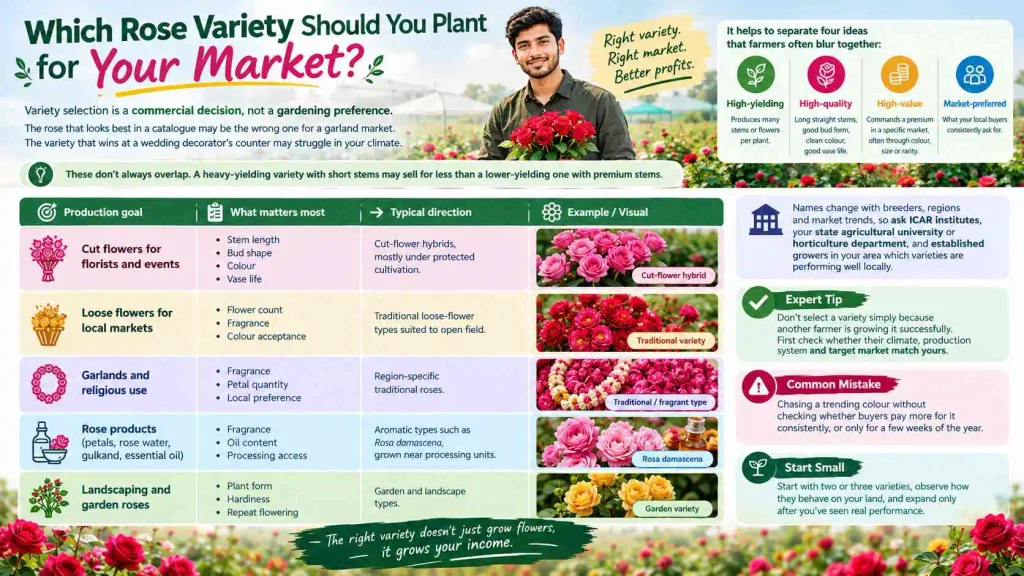
Start small with two or three varieties, observe how they behave on your land, and expand only after you’ve seen real performance.
Can Your Climate Grow Roses Commercially, or Just Keep Them Alive?
Roses survive in a wide range of conditions. That’s exactly what misleads people. Survival isn’t the same as producing flowers a buyer will pay for.
For commercial cut-flower quality, roses generally do best with moderate temperatures, good sunlight, decent air movement and no extremes. Many growers aim for a comfortable day-night range rather than heat or frost. Hot spells can produce small, thin-petalled flowers with poor colour, while cold snaps or frost can damage buds and slow growth.
Before you commit, check these factors for your specific site:
- Temperature: watch for prolonged heat stress and any frost risk.
- Humidity and rainfall: high humidity and wet spells invite fungal disease and spoil open-field flowers.
- Sunlight: roses need plenty, but intense summer sun can scorch flowers and reduce quality.
- Wind: damages open-field plants and flowers and dries out beds.
- Water: availability through the dry months, and its quality.
- Access: how far, and how easily, flowers can reach the market.
That last point matters more than most people expect. A rose that takes a bumpy, hot, six-hour trip loses value before anyone sees it.
Open field or protected cultivation? Open-field production has lower setup cost and suits loose flowers and traditional types. Protected cultivation (polyhouse or greenhouse) gives more control over temperature, humidity, rain and pests, and generally supports higher-quality cut flowers. But it requires much higher investment, technical skill, and a market that pays for the difference.
Did You Know? Many of India’s established commercial cut-rose clusters grew up in places with naturally moderate climates and good market or transport links. Location advantages are as much about logistics as weather.

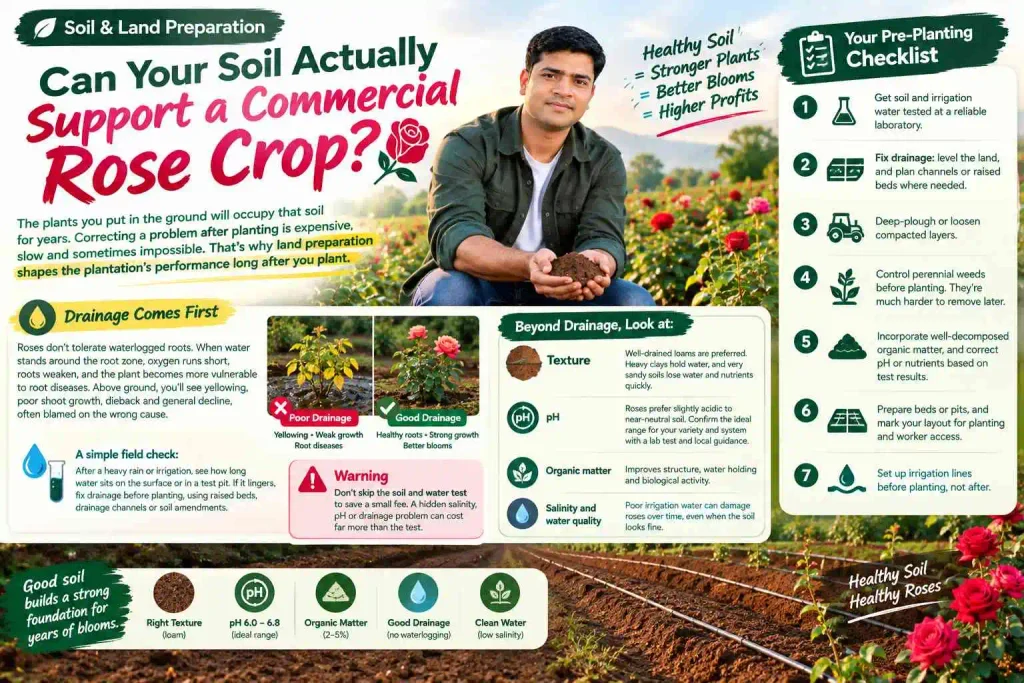
Can Your Soil Actually Support a Commercial Rose Crop?
The plants you put in the ground will occupy that soil for years. Correcting a problem after planting is expensive, slow and sometimes impossible. That’s why land preparation shapes the plantation’s performance long after the day you plant.
Drainage comes first. Roses don’t tolerate waterlogged roots. When water stands around the root zone, oxygen runs short, roots weaken, and the plant becomes more vulnerable to root diseases. Above ground, you’ll see yellowing, poor shoot growth, dieback and general decline, often blamed on the wrong cause.
A simple field check: after a heavy rain or irrigation, see how long water sits on the surface or in a test pit. If it lingers, fix drainage before planting, using raised beds, drainage channels or soil amendments.
Beyond drainage, look at:
- Texture: well-drained loams are generally preferred. Heavy clays hold water, and very sandy soils lose water and nutrients quickly.
- pH: roses generally prefer slightly acidic to near-neutral soil. Confirm the ideal range for your variety and system with a lab test and local guidance.
- Organic matter: improves structure, water holding and biological activity.
- Salinity and water quality: poor irrigation water can damage roses over time, even when the soil looks fine.
Warning: Don’t skip the soil and water test to save a small fee. A hidden salinity, pH or drainage problem can cost far more than the test.
Your pre-planting checklist:
- Get soil and irrigation water tested at a reliable laboratory.
- Fix drainage: level the land, and plan channels or raised beds where needed.
- Deep-plough or loosen compacted layers.
- Control perennial weeds before planting. They’re much harder to remove later.
- Incorporate well-decomposed organic matter, and correct pH or nutrients based on test results.
- Prepare beds or pits, and mark your layout for planting and worker access.
- Set up irrigation lines before planting, not after.
Where Should You Buy Planting Material, and How Far Apart Should Plants Go?
Cheap planting material is one of the costliest mistakes in rose farming. Weak, diseased or mixed-up plants create problems that follow you for years. Buy from reputable nurseries, ideally ones that can show healthy stock and true-to-type varieties, and inspect plants before you accept them. Many cut-flower growers use grafted or budded plants on suitable rootstocks, and the quality of the union and rootstock matters. Ask your horticulture department or agricultural university for trusted sources.
Now spacing. There’s no single correct figure. Spacing depends on:
- Variety and its growth habit
- Production system (open field or protected)
- Training method
- Canopy development over time
- Airflow and disease pressure
- Ease of harvesting and worker movement
The trade-off is simple. Too close, and you get overcrowding, poor airflow, more disease and harder harvesting. Too wide, and land is used inefficiently.
Recommendations differ between sources. Protected cut-flower beds are typically planted much more densely than open-field loose-flower plantations, and even within one system, advice varies by variety and training style. Treat published spacing as a starting point, then adjust it to your variety and local expert guidance.
Common Mistake: Many beginners focus on maximum plant population without considering airflow, disease pressure and ease of harvesting. The goal isn’t the most plants. It’s a productive, manageable canopy.
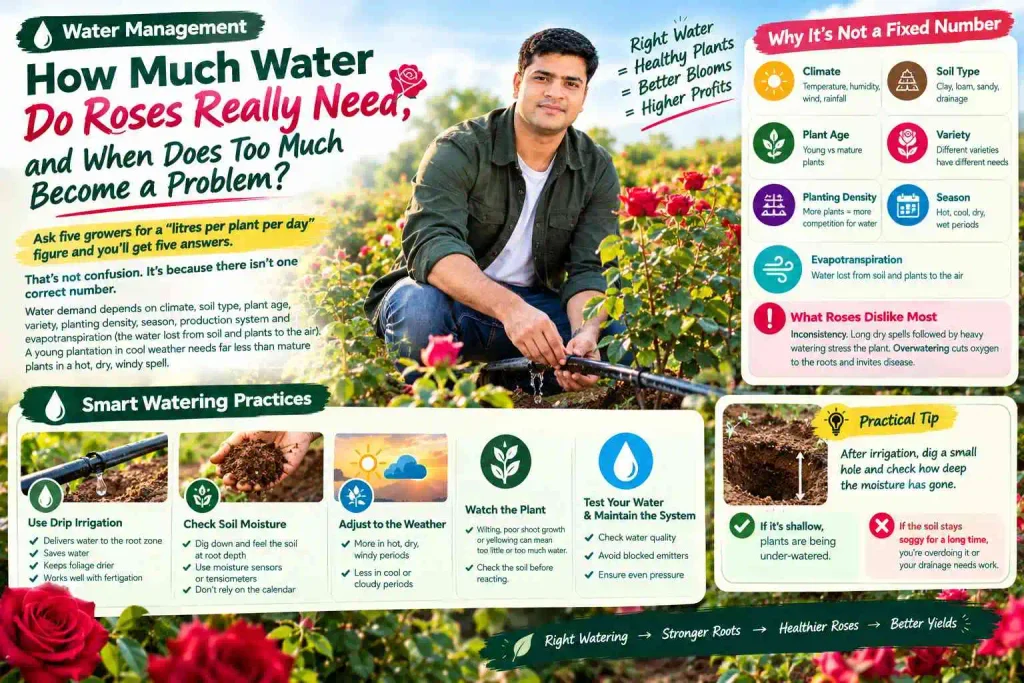
How Much Water Do Roses Really Need, and When Does Too Much Become a Problem?
Ask five growers for a “litres per plant per day” figure and you’ll get five answers. That’s not confusion. It’s because there isn’t one correct number.
Water demand depends on climate, soil type, plant age, variety, planting density, season, production system and evapotranspiration (the water lost from soil and plants to the air). A young plantation in cool weather needs far less than mature plants in a hot, dry, windy spell.
What roses dislike most is inconsistency. Long dry spells followed by heavy watering stress the plant and can affect shoot development and flower quality. Overwatering is just as damaging, cutting oxygen to the roots and inviting disease.
A practical approach:
- Use drip irrigation where possible. It delivers water to the root zone, saves water, keeps foliage drier and works well with fertigation.
- Check actual soil moisture by digging down and feeling the soil at root depth, or using simple moisture sensors or tensiometers, rather than following the calendar.
- Adjust to the weather: irrigate more in hot, dry, windy periods and less in cool or cloudy ones.
- Watch the plant: wilting, poor shoot growth or yellowing can signal too little or too much water, so check the soil before reacting.
- Test your water and maintain your system. Blocked emitters and uneven pressure create uneven crops.
Practical Tip: After irrigation, dig a small hole and check how deep the moisture has gone. If it’s shallow, plants are being under-watered. If the soil stays soggy for a long time, you’re overdoing it or your drainage needs work.
Why More Fertilizer Doesn’t Always Mean More Roses
It’s tempting to think that heavier feeding means heavier flowering. In roses it often means the opposite.
Excess nitrogen, for example, pushes soft, leafy growth at the expense of good flowers, and lush growth is also more attractive to sap-sucking pests and more prone to disease. Overfeeding can also build up salts, harm roots and waste money.
Start with a soil test, and repeat it periodically. Roses need the major nutrients (nitrogen, phosphorus, potassium), secondary nutrients (calcium and magnesium) and micronutrients. The right mix depends on your soil, variety, production system and how the plants respond.
Some principles that work in the field:
- Split applications or fertigation give steadier nutrition than one large dose.
- Organic matter improves the soil’s ability to hold and supply nutrients.
- Watch the plants. Pale or yellowing leaves, weak stems, poor bud development and tip burn can point to specific deficiencies or excesses, but confirm with a soil or leaf test before acting.
- Keep records of what you applied, when, and how plants responded.
Published fertilizer schedules from ICAR institutions, universities and horticulture departments are a good starting point, but they differ from one another because soils, varieties and systems differ. Adjust based on your own tests and crop response, ideally with local expert advice.
Key Takeaway: Feed the crop based on tests and plant response, not on what the input dealer suggests or what a neighbour applies.
What and When Should You Prune?
Pruning isn’t tidying. It decides where new shoots come from, how strong they are and when they flower. Pruning is often what turns a plantation from decent into consistently productive.
Before you cut, look at the plant. What you generally want to remove:
- Dead, diseased or damaged wood: these harbour pathogens and drain energy.
- Weak, thin growth: it rarely produces quality flowers.
- Crossing or crowded branches: they block airflow and light.
- Old, unproductive wood, encouraging fresh, vigorous shoots.
Cut just above a healthy, outward-facing bud so new growth opens the plant rather than crowding it.
Timing varies by region, variety and system, so follow local recommendations. Open-field roses in many regions are pruned at specific seasonal windows to control the flowering cycle, while protected cut-flower roses are shaped continuously through bending, pinching and harvesting techniques that keep the plant balanced.
Tool hygiene matters. Dirty secateurs spread disease from plant to plant. Clean them regularly, and disinfect them after cutting diseased material.
Common Mistake: Unnecessary cuts. Every cut is a wound, and heavy, careless pruning slows recovery and reduces flowering.
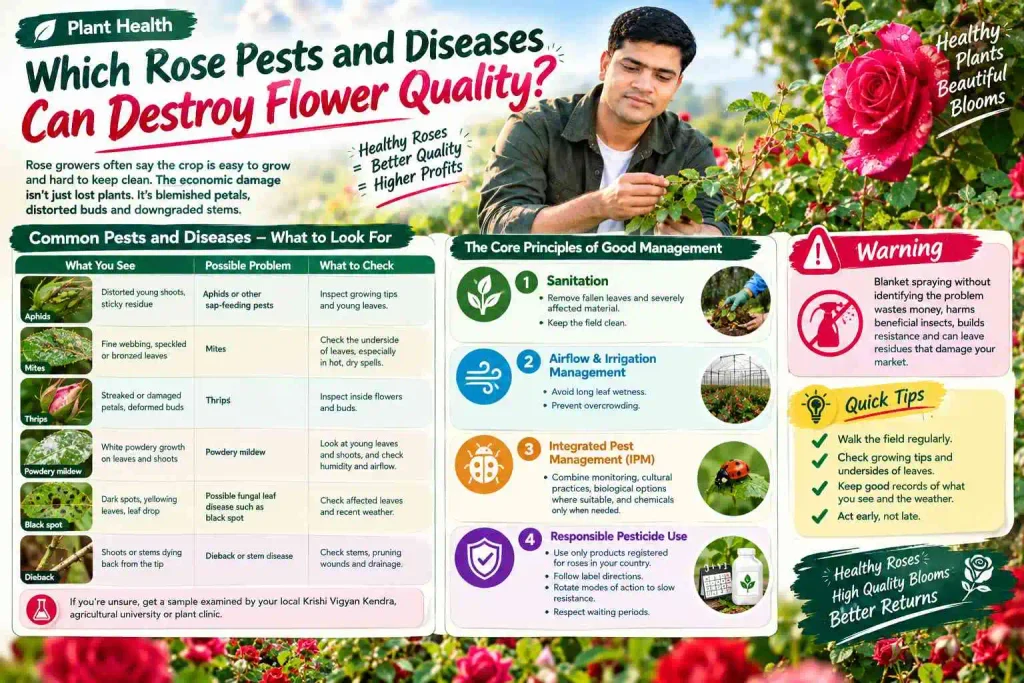
Which Rose Pests and Diseases Can Destroy Flower Quality?
Rose growers often say the crop is easy to grow and hard to keep clean. The economic damage isn’t just lost plants. It’s blemished petals, distorted buds and downgraded stems.
The most important habit is regular monitoring. Walk the field often, look closely at growing tips and the undersides of leaves, and catch problems early. The table below links what you see to what it might be. Many symptoms have more than one possible cause, so use it as a starting point for inspection, not a final diagnosis.
| What you see | Possible problem | What to check |
|---|---|---|
| Distorted young shoots, sticky residue | Aphids or other sap-feeding pests | Inspect growing tips and young leaves |
| Fine webbing, speckled or bronzed leaves | Mites | Check the underside of leaves, especially in hot, dry spells |
| Streaked or damaged petals, deformed buds | Thrips | Inspect inside flowers and buds |
| White powdery growth on leaves and shoots | Powdery mildew | Look at young leaves and shoots, and check humidity and airflow |
| Dark spots, yellowing leaves, leaf drop | Possible fungal leaf disease such as black spot | Check affected leaves and recent weather |
| Shoots or stems dying back from the tip | Dieback or stem disease | Check stems, pruning wounds and drainage |
If you’re unsure, get a sample examined by your local Krishi Vigyan Kendra, agricultural university or plant clinic.
The core principles of good management:
- Sanitation: remove fallen leaves and severely affected material, and keep the field clean.
- Airflow and irrigation management: avoid long leaf wetness and overcrowding.
- Integrated pest management (IPM): combine monitoring, cultural practices, biological options where suitable, and chemicals only when needed.
- Responsible pesticide use: use only products registered for roses in your country, follow label directions, rotate modes of action to slow resistance, and respect waiting periods.
Warning: Blanket spraying without identifying the problem wastes money, harms beneficial insects, builds resistance and can leave residues that damage your market.
When Should You Cut Roses to Get Better Quality and Longer Vase Life?
The farmer isn’t paid simply for the flower that grows in the field. The farmer gets paid for the quality that reaches the buyer.
A flower cut too early may never open properly. One cut too late has a short shelf life and gets bruised in transit. Both lose value even if field yield looked excellent.
Harvest stage. For cut roses, growers typically harvest at the tight-bud stage, with the outer petals just starting to loosen, though the ideal stage differs by variety, colour, season and market distance. Ask your buyers and check variety-specific advice.
Time and technique:
- Harvest in the cooler parts of the day, usually early morning or evening.
- Use clean, sharp secateurs and cut at the right point on the stem, leaving healthy buds on the plant.
- Move cut stems into clean water or a hydrating solution quickly.
After harvest:
- Cool the flowers promptly, since heat shortens vase life.
- Sort and grade by stem length, bud size, colour and freedom from damage. Consistent grading builds buyer trust and price.
- Bunch and pack carefully, protecting buds without crushing them.
- Transport in shaded or cooled conditions where possible, and avoid long delays.
Loose flowers, sold by weight, follow different rules. Harvest timing, gentle handling and quick delivery matter just as much, particularly for fragrance-driven markets and garlands.
Practical Tip: Ask your best buyer to send you feedback on a few consignments: bud stage, stem quality, and how the flowers looked after a day or two. It’s the cheapest quality control you’ll ever get.
How Do You Actually Sell Roses at a Good Price?
Marketing needs planning as seriously as cultivation. Good roses can still earn poor returns if they’re sold through the wrong channel, at the wrong time or on the wrong terms.
Think through the practical questions:
- Seasonal demand: which festivals, wedding seasons and holidays drive prices, and can your crop timing align with them?
- Price fluctuations: prices can drop sharply when supply floods the market. Spreading your harvest and channels reduces the risk.
- Commission and payment terms: ask what’s deducted, and how quickly you’ll be paid.
- Distance and packaging: longer routes need better packing and cooling.
- Buyer relationships: reliable quality and delivery earn loyalty and often better prices.
- Multiple channels: don’t depend on a single buyer.
Consider planning production and marketing together. Timing pruning cycles and harvest peaks with known demand periods can matter as much as yield itself.
What Does Rose Farming Really Cost, and How Do You Judge Profitability?
Nobody can honestly promise a fixed profit per acre. Returns depend on your location, variety, production system, scale, input and labour costs, yields, flower quality and market prices. What you can do is understand the costs and the variables that drive them.
The table below lists the main cost categories you’ll need to plan for. Use local quotes and actual prices to build your own figures.
| Cost | What it includes |
|---|---|
| Land preparation | Ploughing, beds, drainage |
| Planting material | Healthy plants or suitable planting material |
| Irrigation | Drip system, pumps, filters and maintenance |
| Fertilizers | Macro and micronutrients, organic matter |
| Plant protection | Monitoring and control measures |
| Labour | Planting, pruning, harvesting, grading |
| Infrastructure | Fencing, support structures, protected cultivation |
| Packaging | Boxes, sleeves and other materials |
| Transport | Moving flowers to market |
| Marketing | Commission and selling expenses |
The basic logic is:
Yield × Saleable quality × Selling price − Total production cost = Operating return
Notice “saleable quality” in the middle. Here’s why it matters, using round numbers for illustration only, not as real farm data. Suppose a farm harvests 100,000 stems in a year. If 70% meet the premium grade and the rest sell cheaply, revenue looks healthy. If disease, late harvest or poor handling drops that premium share to 50%, revenue falls noticeably, even though the same number of stems were grown and the costs stayed the same.
That’s why the phrase to remember is: don’t confuse high yield with high profit.
Also remember that setup costs are front-loaded, especially in protected cultivation, and that returns take time to build. Explore support schemes through your state horticulture department and national programmes such as MIDH (Mission for Integrated Development of Horticulture), and check current eligibility and norms directly, since these change.
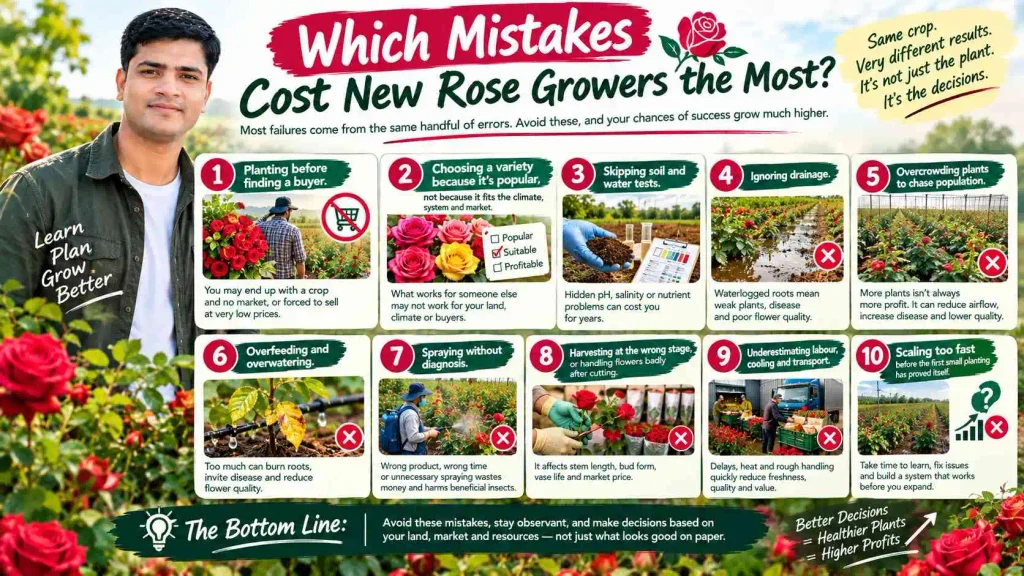
Which Mistakes Cost New Rose Growers the Most?
Most failures come from the same handful of errors:
- Planting before finding a buyer.
- Choosing a variety because it’s popular, not because it fits the climate, system and market.
- Skipping soil and water tests.
- Ignoring drainage.
- Overcrowding plants to chase population.
- Overfeeding and overwatering.
- Spraying without diagnosis.
- Harvesting at the wrong stage, or handling flowers badly after cutting.
- Underestimating labour, cooling and transport.
- Scaling too fast before the first small planting has proved itself.
Your First Move: Start With the Buyer, Not the Nursery
Rose farming rewards farmers who think like business owners: right market, right variety, right production system, good crop management, quality harvesting and reliable marketing. Every link depends on the one before it.
If you’re planning your first rose plantation, don’t start by ordering plants. Start with a soil test, check your water, visit the market where you plan to sell, and speak with buyers about the flower quality they actually want. Then talk to your nearest agricultural university, KVK or horticulture department, and visit at least two working rose farms to see the real costs, problems and returns up close.
Once those pieces are clear, choosing the variety and production system becomes much easier. And if you decide to begin, start with a manageable plot, learn what your land and market teach you, and grow from there. As your farm business matures, you may also want to explore a longer-term crop that suits parts of your land the roses don’t, such as bamboo, with its species choices, cultivation cost and profit potential.
Newsletter