



Tilapia Fish Farming: Complete Business Guide
A tilapia pond can double a farmer’s income in one production cycle — or it can quietly eat through a family’s savings. The fish itself is remarkably forgiving: it grows fast, tolerates crowded conditions, and survives water quality that would kill most other species. That toughness is exactly what gets new farmers into trouble. Because tilapia looks easy to farm, many beginners skip the decisions that actually determine whether a pond makes money — seed quality, stocking density, oxygen management, and feed discipline.
This guide to tilapia fish farming walks through those decisions the way an experienced consultant would, sitting across the table from someone who’s serious about starting or improving a tilapia farming business. You’ll get a realistic picture of investment requirements, which strains to stock, how many fish per pond, what feed and water management actually look like day to day, how long it takes to reach market size, and — most importantly — how to work out whether a given plan will actually turn a profit. Nothing here is a guaranteed number. Your actual returns will depend on your stocking density, survival rate, feed conversion, seed quality, local market price, and how tightly you manage the system.

What Makes Tilapia Fish Farming One of the Most Popular Aquaculture Businesses?
Tilapia is farmed on nearly every continent for a simple reason: it converts feed into flesh efficiently, tolerates a wide range of water conditions, breeds easily (sometimes too easily), and reaches a marketable size faster than most freshwater species. Globally, it sits just behind carp as one of the most farmed fish groups, which tells you something about how forgiving — and how commercially viable — it can be under the right management.
In India, tilapia occupies an interesting position. It’s not a traditional Indian food fish the way rohu or catla are, but demand has grown steadily in urban markets, live-fish outlets, and increasingly in processed and export-oriented supply chains. The government’s dissemination strategy has targeted a national production goal of 2.4 million metric tonnes of tilapia by 2030, which signals real institutional confidence in the species — but that target also tells you the industry is still being built, and market access varies a lot by state and region.
Expert Tip: Before investing in infrastructure, spend time at your nearest wholesale fish market or talk to local fish vendors. Tilapia’s biology is fairly consistent everywhere; the market for it is not.
Here’s the part that surprises a lot of newcomers: tilapia’s biggest advantage — its ability to survive low oxygen, high stocking density, and marginal water quality — is also what tempts farmers into cutting corners. A tilapia pond can look fine on the surface while the fish are stressed, growing slowly, and heading toward a disappointing harvest. Nothing in this guide is meant to scare you away from the species. It’s meant to help you avoid the mistakes that turn a genuinely profitable business into a break-even one.
Tilapia Fish Farming Rules in India: What You Must Know Before You Start
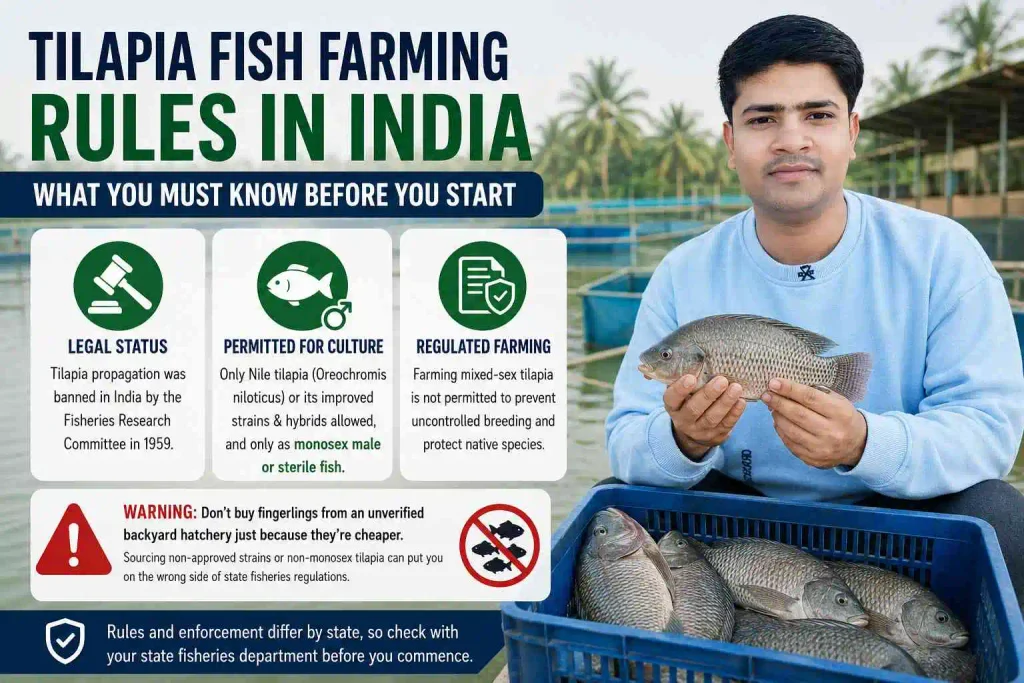
This is worth addressing before anything else, because it changes what “getting started” actually means. Tilapia propagation was banned in India by the Fisheries Research Committee back in 1959, and the species remained restricted for decades afterward due to concerns about it escaping into natural waters and outcompeting native fish.
That’s no longer the case, but farming isn’t unregulated either. Under the government’s current guidelines, only Nile tilapia (Oreochromis niloticus) or its improved strains and hybrids are permitted for culture in India, and only as monosex male or sterile fish — produced either through hormonal treatment or cross-breeding. Farming mixed-sex tilapia that can freely reproduce is not permitted, largely because uncontrolled breeding in ponds (more on why that’s a production problem below) and the risk of fish escaping into open waterways were exactly the concerns that led to the original ban.
Warning: Don’t buy fingerlings from an unverified backyard hatchery just because they’re cheaper. Beyond the production risk of poor genetics, sourcing non-approved strains or non-monosex tilapia can put you on the wrong side of state fisheries regulations. Buy from a hatchery that can show you it supplies certified monosex Nile tilapia or GIFT-derived stock.
Rules and enforcement differ by state, so check with your state fisheries department before you commit money to pond construction. This is a five-minute phone call that can save you a very expensive mistake.
Tilapia Strains for Fish Farming: Which One Grows Fastest?
“Tilapia” isn’t one uniform product. The strain and the sex ratio of what you stock will directly affect your growth rate, harvest uniformity, and ultimately your income per pond.
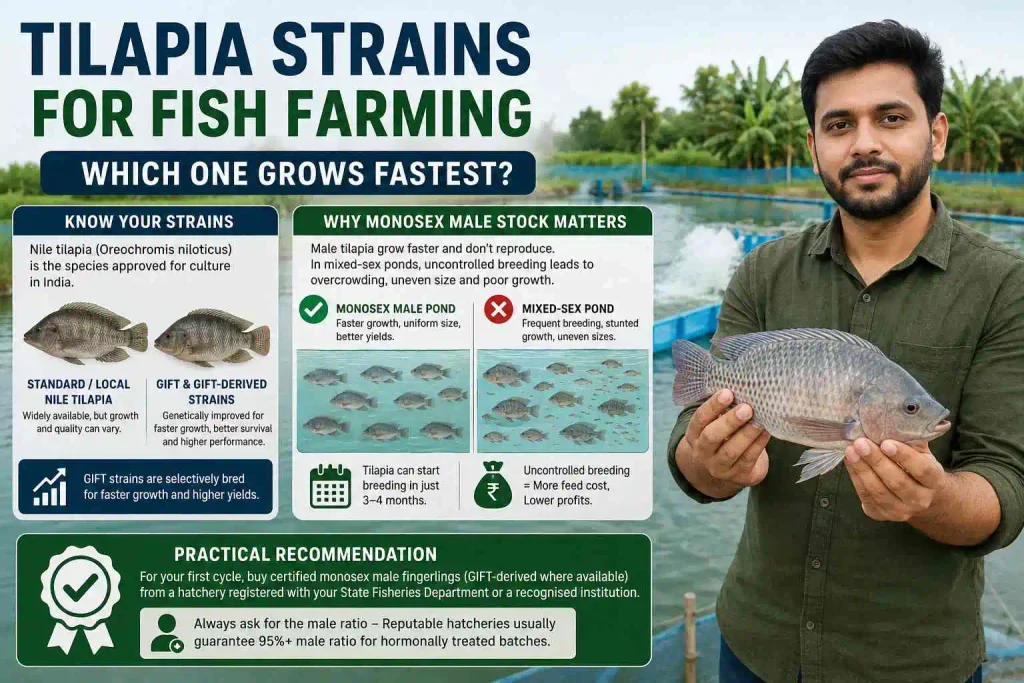
Nile tilapia (Oreochromis niloticus) is the base species approved for culture in India. Within Nile tilapia, farmers generally have access to two broad categories of stock:
- Standard/local Nile tilapia strains — widely available, but growth performance and genetic quality can vary a lot depending on the hatchery and how carefully broodstock has been managed over generations.
- GIFT (Genetically Improved Farmed Tilapia) and GIFT-derived strains — developed through systematic selective breeding for growth rate, survival, and other economically important traits, originally coordinated internationally through what is now the WorldFish center. In India, GIFT has been disseminated through a Satellite Breeding Program run with the Rajiv Gandhi Centre for Aquaculture (RGCA), reaching thousands of farmers.
Why monosex male stock matters: Male tilapia grow noticeably faster than females, and in a mixed-sex pond, tilapia will breed continuously once they mature — often within a few months. That uncontrolled reproduction is one of the most common reasons a new tilapia farmer ends up disappointed with their harvest. A pond that started with a clean, even stocking of fingerlings ends up crowded with several generations of fish at wildly different sizes, competing for the same feed and oxygen. Growth slows across the board, and the harvest is a mix of marketable fish and stunted juveniles that buyers don’t want.
This is why monosex male production — achieved either through hormonal sex-reversal during the fingerling stage or through genetic/cross-breeding techniques that produce mostly male offspring — has become standard commercial practice, and is what current Indian guidelines require.
Common Mistake: Buying cheap, unverified fingerlings can become expensive. If the batch isn’t reliably monosex, you’ll only discover the problem three to four months in, when the pond is suddenly full of fry you never stocked — by which point you’ve already spent on feed for a crop that won’t perform as planned.
Practical recommendation: For a first cycle, source certified monosex male fingerlings (GIFT-derived where available) from a hatchery registered with your state fisheries department or a recognised institution. Ask specifically what percentage male ratio they guarantee — reputable hatcheries will usually state 95%+ male ratio for hormonally treated batches.
Tilapia Farming Setup: Pond, Biofloc, or RAS — Which System Fits Your Situation?
This is where a lot of the investment decision gets made, and it’s not a question with one right answer. Each system trades off investment, operating cost, skill requirement, and production potential differently.
| System | Typical Investment | Operating Complexity | Water/Land Need | Oxygen Risk | Best Suited For |
|---|---|---|---|---|---|
| Extensive earthen pond | Low | Low | High land, moderate water | Lower risk (low density) | Beginners, limited capital, land available |
| Semi-intensive pond | Moderate | Moderate | High land, moderate water | Moderate — needs some aeration | Farmers ready to invest in aeration and better feed |
| Intensive aerated pond | Moderate–High | High | High land, high water use | High — depends entirely on aeration | Experienced farmers, reliable power supply |
| Biofloc tank system | Moderate | High (daily monitoring) | Low land, low water use | High — needs constant aeration | Farmers with limited land, willing to manage water chemistry closely |
| RAS (Recirculating Aquaculture System) | High | Very high (technical) | Very low land, very low water use | Managed by system, but equipment failure is catastrophic | Well-capitalised, technically confident operators |
| Cage culture (reservoirs) | Low–Moderate | Moderate | Requires access to a reservoir/water body | Naturally lower risk (open water) | Farmers near suitable public/communal water bodies, subject to permission |
A stocking density that works beautifully in an aerated biofloc tank can be a disaster in a basic pond with no backup aeration. This is the single most important principle in this whole guide: your stocking density decision has to follow your oxygen management decision, not the other way around.
Practical recommendation for beginners: Unless you already have aquaculture experience or a technical background, start with a semi-intensive earthen pond with basic aeration capacity (even a single paddlewheel aerator or air blower as backup). It’s far more forgiving than biofloc or RAS, and it lets you learn the fish’s behaviour and your local market before committing to higher-cost, higher-risk systems.
Cage culture is worth a specific mention for India. Government guidelines permit tilapia cage culture in reservoirs, but restrict cage area to no more than 1% of the effective water area, require stocking size above 50 grams, and recommend prior clearance from institutions like CIFA before permission is granted. If a reservoir near you looks like an opportunity, treat the permission process as step one, not an afterthought.
Tilapia Stocking Density: How Many Fish Should You Stock Per Pond?
New farmers often ask for a single stocking density number, as if it were a universal constant. It isn’t. Government guidelines reference stocking densities such as around 5 fish per square metre for certain systems, but explicitly note this can vary depending on how intensive the culture system is — the actual right number for your pond depends on your oxygen supply, water exchange capacity, and management skill.
A rough way to think about it:
- Extensive, low-input pond, no mechanical aeration: lower densities, because the pond has to supply all the oxygen and waste processing naturally.
- Semi-intensive pond with some aeration and water exchange: moderate densities are workable, but you need a plan for what happens during a power cut or a hot, still night.
- Intensive systems with reliable aeration (paddlewheel, blowers, or diffusers): can support meaningfully higher densities — but only as long as the aeration keeps running.
Expert Tip: Don’t choose your stocking density before deciding how you’ll manage dissolved oxygen. Work out your aeration capacity and your backup plan (generator, battery-backed aerator) first, then size your stocking to what that system can safely support — not the other way around.
The financial temptation is obvious: more fish per pond looks like more revenue. But overstocking increases competition for oxygen and feed, degrades water quality faster, slows individual growth rates, and raises disease risk. The end result is often a lower total harvest weight than a moderately stocked pond, plus a higher cost per kilogram of fish produced, because you’ve spent more on feed and lost more fish to stress and mortality. A well-managed, moderately stocked pond usually outperforms an overloaded one on a per-rupee-invested basis.
Water Quality Management in Tilapia Fish Farming: Why It Can Wreck Your Growth
Tilapia has a reputation for being tough, and it is — relative to species like trout or many ornamental fish. But “tough” doesn’t mean “immune to bad water.” It means the fish can survive conditions that will still slow growth, suppress immunity, and eventually cause losses if left unmanaged.
Here’s what actually matters day to day, and why:
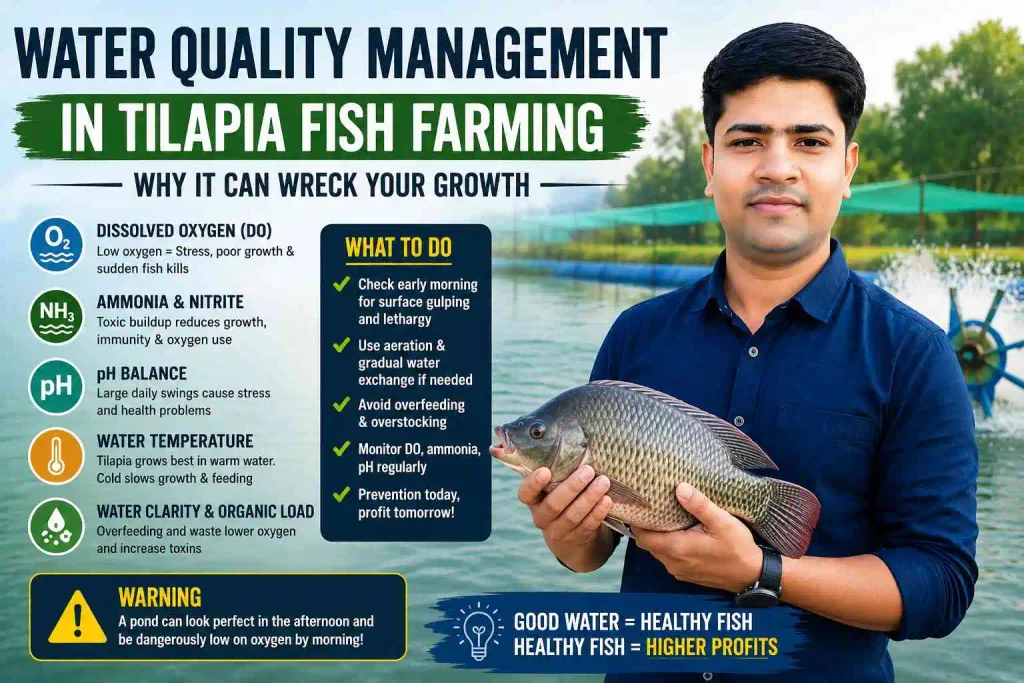
Dissolved oxygen (DO). This is the parameter that causes the most sudden, serious losses in tilapia ponds. Oxygen levels drop overnight as pond plants and algae respire (and stop photosynthesising), and they’re typically at their lowest just before sunrise. If oxygen falls too low, fish will crowd near the surface, gulping air — a clear behavioural warning sign. Left unaddressed, this can progress quickly to mass mortality, sometimes within a single night.
Warning: A pond that looks completely healthy in the afternoon can have dangerously low dissolved oxygen by early morning. If you only check your pond once a day, check it before sunrise, not after breakfast.
Ammonia and nitrite. These build up from uneaten feed and fish waste. High ammonia stresses fish, suppresses growth, and increases disease susceptibility even when it doesn’t kill fish outright. Nitrite buildup interferes with the fish’s ability to carry oxygen in its blood — so a pond can have adequate dissolved oxygen and still have fish behaving as if they’re oxygen-starved, because nitrite is compromising how they use that oxygen.
pH. Tilapia tolerates a fairly wide pH range, but large daily swings (common in ponds with heavy algae blooms) are more damaging than a stable pH that’s slightly outside the ideal range. Sudden pH crashes are also linked to fish stress and, in severe cases, mortality.
Water temperature. Tilapia is a warm-water species and growth slows significantly below around 20°C, with feeding activity dropping off further as temperatures fall. This is directly relevant to Indian conditions — see the seasonal section below.
Water transparency and organic load. Murky, over-fertile water with a heavy load of organic matter (from overfeeding or excess waste) drives down oxygen levels overnight and fuels ammonia production. It’s usually a downstream symptom of a feeding or stocking problem rather than an independent issue.
What to actually do: Check for early-morning surface gulping and lethargic feeding response as your two lowest-cost daily indicators — you don’t need a full water-testing kit to catch trouble early, though a basic DO meter and test strips for ammonia/pH are worth the investment once you’re running more than a pond or two. If oxygen looks low, run aeration or exchange water gradually — never dump in a large volume of cold new water suddenly, which can shock the fish. When in doubt about a persistent water-quality problem, it’s worth consulting your state fisheries extension officer rather than guessing.
Tilapia Fish Feed and Feeding Rate: How to Feed Without Wasting Money
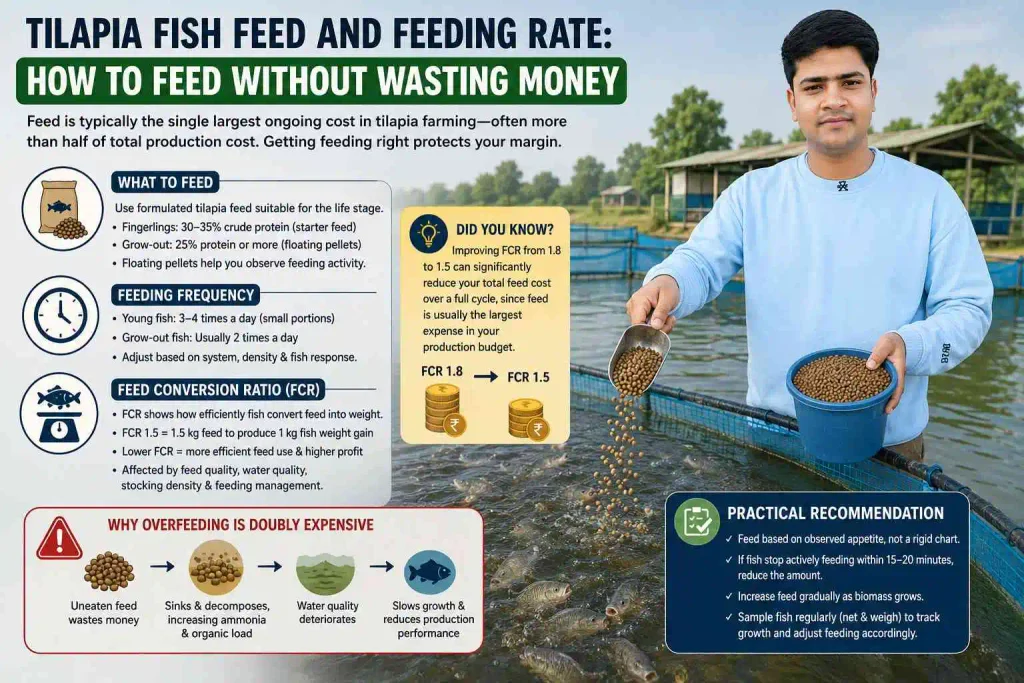
Feed is typically the single largest ongoing cost in commercial tilapia farming — often more than half of total production cost by the time you add up a full cycle. Getting feeding right isn’t just about growth; it’s about protecting your margin.
What to feed: Tilapia needs a formulated feed appropriate to its life stage. Young fingerlings need higher protein content (commonly in the 30-35% crude protein range in commercial starter feeds), tapering down to lower protein, more economical grow-out feeds as fish mature — government guidance for cage culture specifies a minimum of 25% protein in floating pellet feed, which gives a sense of the lower end used in later grow-out stages. Sinking versus floating pellets matters too: floating feed lets you directly observe how actively fish are feeding, which is a genuinely useful management tool.
Feeding frequency: Younger fish generally do better with more frequent, smaller feedings (multiple times a day); as fish mature, farmers often move to two feedings a day. The exact schedule that works best will depend on your system and stocking density — this is one area where watching your own fish’s feeding response over the first few weeks teaches you more than a fixed rule would.
Feed Conversion Ratio (FCR) is the number that ties feeding directly to your bottom line. It tells you how efficiently fish convert feed into body weight. If your FCR is 1.5, it means roughly 1.5 kg of feed was needed to produce 1 kg of fish weight gain. A lower FCR means more efficient (and more profitable) feed use. FCR is affected by feed quality, water quality, stocking density, and how much feed is wasted rather than eaten.
Did You Know? Even a modest improvement in FCR — say from 1.8 down to 1.5 — can meaningfully change your total feed cost across a full cycle, because feed is usually the largest line item in your production budget. Small efficiency gains compound.
Why overfeeding is doubly expensive: Uneaten feed doesn’t just waste money directly — it sinks, decomposes, and drives up ammonia and organic load in the pond, which then damages water quality and can slow the growth of the very fish you were trying to feed. Poor feeding doesn’t just waste feed; it can trigger a water-quality problem that costs you again on the production side.
Practical recommendation: Feed based on observed appetite, not a rigid chart. Reduce the amount if fish stop actively feeding within 15-20 minutes of floating feed being offered, and increase gradually as the pond’s total fish biomass grows. Sample fish periodically (netting a small batch and weighing them) to track actual growth against what you expected — this tells you whether your feeding plan is working before you’re surprised at harvest.
Tilapia Growth Rate: What a Healthy Farming Cycle Looks Like
Tilapia is prized commercially because it reaches marketable size relatively quickly compared to many freshwater species — CIFA studies in India showed production levels of 5-6 tonnes per crop over a 4-6 month duration with GIFT tilapia. That range — roughly four to six months to harvest — is a reasonable planning window for Indian pond conditions, though actual timing depends heavily on your strain, stocking size, water temperature, and feed management. Ponds in consistently warm regions with good management tend toward the shorter end of that range; cooler seasons or less intensive management push it longer.
Regular sampling — netting a small, representative group of fish every few weeks and weighing them — is how you catch problems early rather than discovering them at harvest. If growth is noticeably behind where you expected, that’s your signal to look at feeding rate, water quality, and stocking density before the problem compounds.
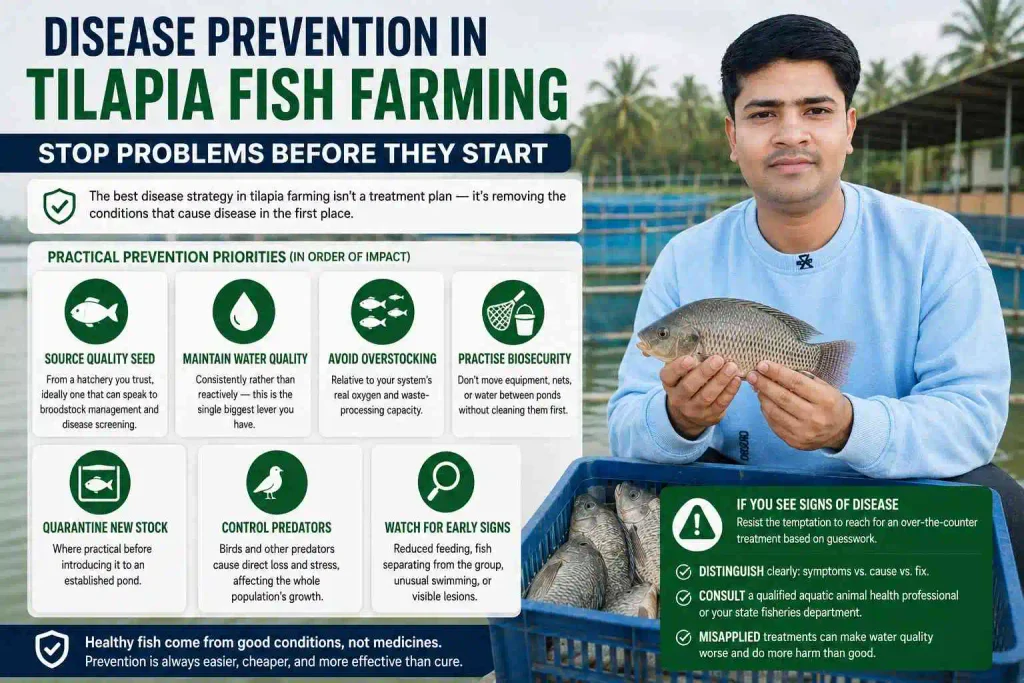
Disease Prevention in Tilapia Fish Farming: Stop Problems Before They Start
The best disease strategy in tilapia farming isn’t a treatment plan — it’s removing the conditions that cause disease in the first place. Stressed fish in poor water quality, overcrowded conditions, or on inadequate nutrition are far more susceptible to disease outbreaks than well-managed fish in good conditions.
Practical prevention priorities, roughly in order of impact:
- Source quality seed from a hatchery you trust, ideally one that can speak to broodstock management and disease screening.
- Maintain water quality consistently rather than reactively — this is the single biggest lever you have.
- Avoid overstocking relative to your system’s real oxygen and waste-processing capacity.
- Practise basic biosecurity — don’t move equipment, nets, or water between ponds (especially ponds with different fish batches) without cleaning them first.
- Quarantine new stock where practical before introducing it to an established pond.
- Control predators — birds and other predators aren’t just a direct loss; the stress of repeated predation attempts also affects the whole population’s feeding and growth.
- Watch for early warning signs: reduced feeding response, fish separating from the group, unusual swimming behaviour, or visible lesions.
If you do see signs of disease, resist the temptation to reach for an over-the-counter treatment based on guesswork. Distinguish clearly between what you’re observing (symptoms), what might be causing it (which often isn’t obvious without proper diagnosis), and what the actual fix is. This is a case where consulting a qualified aquatic animal health professional or your state fisheries department is genuinely worth the time — misapplied treatments can make water quality worse and don’t fix a problem that’s actually rooted in stocking density or oxygen management.
Tilapia Harvesting and Marketing: Where the Real Money Gets Made or Lost
Growing good fish is only half the business. What you do at harvest and how you sell determines whether that growth turns into profit.
Live versus fresh-fish sales: Tilapia commands a price premium in many Indian markets when sold live, because buyers — especially in urban wet markets — associate live fish with freshness and quality. Selling live requires careful handling, adequate oxygenation during transport (aerated tanks or oxygen-packed bags for shorter distances), and a nearby enough market that transport time doesn’t become the limiting factor. Fresh (recently harvested but not live) sales widen your potential market radius but typically fetch a lower price per kilogram.
Practical recommendation: Before you finalise your farm’s scale, actually visit your target market — whether that’s a local wet market, a live-fish vendor, or a processor — and ask what they’re currently paying and what size fish they want. Tilapia buyers often have size preferences, and a harvest of undersized or oversized fish (a common outcome of uneven growth from a poorly managed, mixed-sex pond) can mean accepting a lower price than a uniform harvest would fetch.
Transport and timing: Plan your harvest and sale logistics before harvest day, not during it. Mortality or quality loss during a poorly planned transport leg can undo weeks of careful pond management in a matter of hours.
Tilapia Fish Farming Profit: How Much Can You Actually Earn Per Pond?
This is the question every prospective farmer wants answered first, and it’s also the one that’s easiest to answer irresponsibly. There is no single, reliable profit figure for tilapia farming — anyone who quotes you one without asking about your pond size, system, seed quality, and local market price is oversimplifying.
What you can do is build your own realistic estimate using a straightforward framework:
Total production (kg) = Number of fish stocked × Survival rate × Average harvest weight
Feed cost = Total feed used (kg) × Feed price per kg
Gross revenue = Total kg of fish sold × Average selling price per kg
Estimated net profit = Gross revenue − Total production costs (feed + fingerlings + labour + electricity/aeration + pond maintenance + transport + any lease/land cost)
A worked example (illustrative only — not a guarantee)
Say a farmer stocks a 0.1-hectare (roughly quarter-acre) semi-intensive pond with 3,000 monosex male GIFT fingerlings.
| Item | Assumption (example only) | Result |
|---|---|---|
| Fish stocked | 3,000 | — |
| Survival rate | 80% (a reasonable target with decent management; can be lower with poor practices) | 2,400 fish harvested |
| Average harvest weight | 500 g per fish after ~5-6 months | 1,200 kg total production |
| FCR | 1.6 | ~1,920 kg feed required |
| Feed price (illustrative) | ₹80/kg | ₹1,53,600 feed cost |
| Fingerling cost (illustrative) | ₹6 per fingerling | ₹18,000 |
| Other costs (labour, electricity, aeration, maintenance — illustrative) | — | ₹40,000-60,000 |
| Total estimated cost | — | ~₹2,15,000-2,35,000 |
| Selling price (illustrative, live/fresh) | ₹150/kg | ₹1,80,000 gross revenue |
| Estimated net result | — | Roughly breakeven to modest loss at this price point |
This example is deliberately built to show something important: at a selling price of ₹150/kg with these costs, the numbers are tight — even mildly disappointing. Push the selling price up, improve survival rate, or tighten FCR even slightly, and the picture changes meaningfully. This is exactly why survival rate and feed conversion often matter more to your final margin than the headline selling price. Treat every number in this table as illustrative — your actual feed prices, fingerling costs, and market price will differ by state, season, and supplier, and you should build this same calculation with your own real, local numbers before committing capital.
Quick Summary: Good seed + appropriate stocking + reliable aeration + disciplined feeding + water-quality monitoring = the foundation of profitable tilapia farming. Skip any one of these and the others can’t fully compensate.
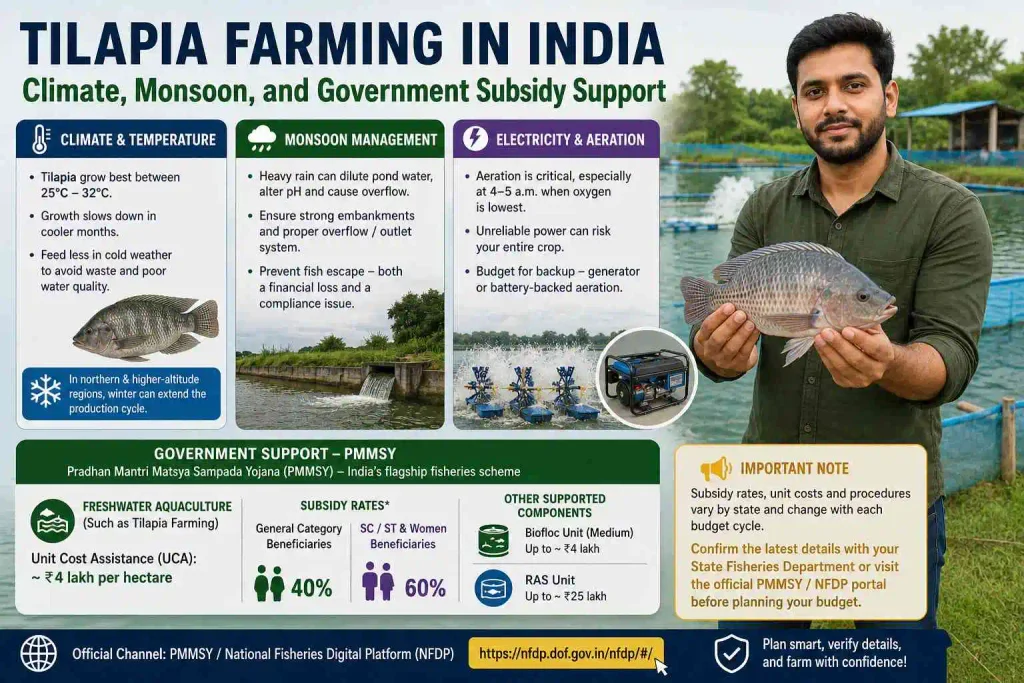
Tilapia Farming in India: Climate, Monsoon, and Government Subsidy Support
Seasonal temperature swings matter more than many first-time farmers expect. Tilapia growth slows significantly in cooler months, which affects both your production timeline and your feeding rate — feed less when fish are feeding less actively due to cold, or you’ll simply waste feed and degrade water quality. In northern and higher-altitude regions, winter temperatures can meaningfully extend your production cycle or even require you to pause stocking during the coldest months.
Monsoon management is a real operational consideration for pond-based systems: heavy rain can dilute pond water suddenly, alter pH, and cause pond overflow (with fish escaping, which is both a financial loss and — given the regulatory history around tilapia in India — a compliance concern). Make sure your pond has proper embankments and an overflow/outlet system designed with monsoon volumes in mind, not just dry-season conditions.
Electricity reliability deserves specific attention if you’re planning any aerated or intensive system. Aeration is only useful if it’s running when you need it — which is often at 4 or 5 a.m., exactly when oxygen is lowest. If your area has unreliable power, budget for backup (a small generator, or battery-backed aeration) as a core cost, not an optional extra.
Government support: The Pradhan Mantri Matsya Sampada Yojana (PMMSY), the central government’s flagship fisheries scheme, continues to be funded, with the Union Budget allocating further support for the current period. Under the scheme, subsidy assistance for freshwater aquaculture inputs — including tilapia farming — has been offered at a unit cost around ₹4 lakh per hectare, with subsidy rates around 40% for general-category beneficiaries and 60% for SC/ST and women beneficiaries in at least some state implementations. Biofloc and RAS components have also been supported under PMMSY, with subsidy up to roughly ₹4 lakh for a medium biofloc unit and up to roughly ₹25 lakh for a RAS unit in some state programmes.
These figures and percentages can vary by state and change with each budget cycle, so confirm current subsidy rates, unit costs, and application procedures directly with your state fisheries department or the official PMMSY/National Fisheries Digital Platform channels before you plan your budget around them. Don’t build your financial model on a subsidy figure you read online without verifying it’s still current for your state.
Starting Your Tilapia Fish Farming Business: What to Do Next
Don’t start by chasing the highest stocking density or the biggest possible pond. Start by working out your own numbers — your realistic feed cost, your local fingerling price, what buyers in your area will actually pay, and how reliable your power supply is for aeration. Build the cost calculation shown above with your own figures before you spend on pond construction or fingerlings.
A well-managed pond with certified monosex seed, a stocking density matched to your actual oxygen capacity, disciplined feeding, and consistent water monitoring will usually outperform a bigger, overloaded system run on guesswork — both in survival and in profit per rupee invested. Start at a scale you can genuinely manage closely for your first cycle, keep proper records of what you spend and what you harvest, and use that first cycle’s real numbers — not anyone else’s estimates — to decide how and whether to expand.
If your power supply is unreliable or you’re land-constrained and considering a recirculating system instead of an open pond, it’s worth comparing the two on cost and profit before committing — this RAS system aquaculture cost and profit guide breaks down the numbers for that setup the same way.
Frequently Asked Questions About Tilapia Fish Farming
Is tilapia fish farming profitable in India?
It can be, but it isn’t guaranteed. Profitability depends on survival rate, feed conversion ratio, fingerling and feed costs, and — critically — your local selling price. Use the profit calculation shown earlier in this guide with your own real numbers before assuming a positive return.
How much does it cost to start a tilapia fish farming business?
Costs vary widely by system and scale. An extensive earthen pond needs far less capital than an aerated intensive pond, biofloc tank, or RAS setup. Major cost heads include pond or tank construction, fingerlings, feed, aeration equipment, electricity backup, and labour — build a full cost sheet for your specific pond size and system rather than relying on a single national average figure.
What is a good stocking density for tilapia farming?
There’s no single correct number. Stocking density has to match your system’s oxygen and water-exchange capacity — a basic pond without aeration needs a far lower density than an intensively aerated pond or biofloc tank. Decide your aeration and backup power plan first, then size your stocking to what that system can safely support.
How long does tilapia take to reach market size?
Under good management in Indian pond conditions, tilapia commonly reaches harvest size in roughly four to six months, though this depends heavily on the strain, stocking size, water temperature, and feeding programme. Cooler seasons or less intensive management can extend this window.
Which tilapia strain is best for fish farming in India?
Only Nile tilapia and its approved improved strains or hybrids may be farmed in India, and only as monosex male or sterile stock. GIFT (Genetically Improved Farmed Tilapia) and GIFT-derived strains are widely favoured for their selectively bred growth performance, and are distributed in India through government-linked breeding programmes.
Do I need a licence or government approval for tilapia farming?
Tilapia farming in India is regulated — only approved strains and monosex production are permitted, and cage culture in reservoirs requires specific clearance. Rules and enforcement vary by state, so confirm requirements with your state fisheries department before investing in infrastructure or fingerlings.
Where can I buy quality tilapia fingerlings?
Source fingerlings from a hatchery registered with your state fisheries department, or one that can verify a certified monosex male ratio (reputable hatcheries typically guarantee 95%+ male). Avoid unverified backyard suppliers — poor genetics or an unreliable sex ratio often aren’t obvious until months into the cycle, by which point you’ve already spent on feed.
Newsletter