



Hydroponic Fodder: Cost, Setup & 7-Day Growing Guide
A dairy farmer feeding 10 animals typically spends more on green fodder than on anything else in the shed — more than concentrate, more than mineral mixture, sometimes more than the milk they sell can justify. So when someone says you can grow fresh green fodder from seed to feed in six or seven days, without a single acre of land, the natural reaction is disbelief.
But hydroponic fodder isn’t a gimmick. It’s a real production system, already running on dairy farms, goat farms, and even a few commercial fodder-supply businesses across India. The question isn’t whether it works — it does. The real question is whether it makes financial sense for your farm, your herd size, and your local costs.
That’s what this article is about. Not hype, not a sales pitch — a practical breakdown of how hydroponic fodder is grown, what it costs to set up and run in Indian Rupees, where beginners lose money, and how to work out whether it’s actually worth doing.
By the end, you’ll understand:
- How the hydroponic fodder system actually works, step by step
- Which seeds work best and why maize isn’t always the right choice
- Real yield numbers — and why fresh weight is misleading
- Water, electricity, labour and shed requirements
- Setup cost and recurring cost in ₹, with a working example
- Cost per kg of fodder vs cost per kg of actual nutrition
- Mould, poor germination and hygiene — the problems that quietly kill profitability
- Whether it suits dairy cows, buffaloes, goats, and sheep
- A straight answer on whether it’s profitable for a small farm

What Exactly Is Hydroponic Fodder, and Why Are Farmers Paying Attention to It?
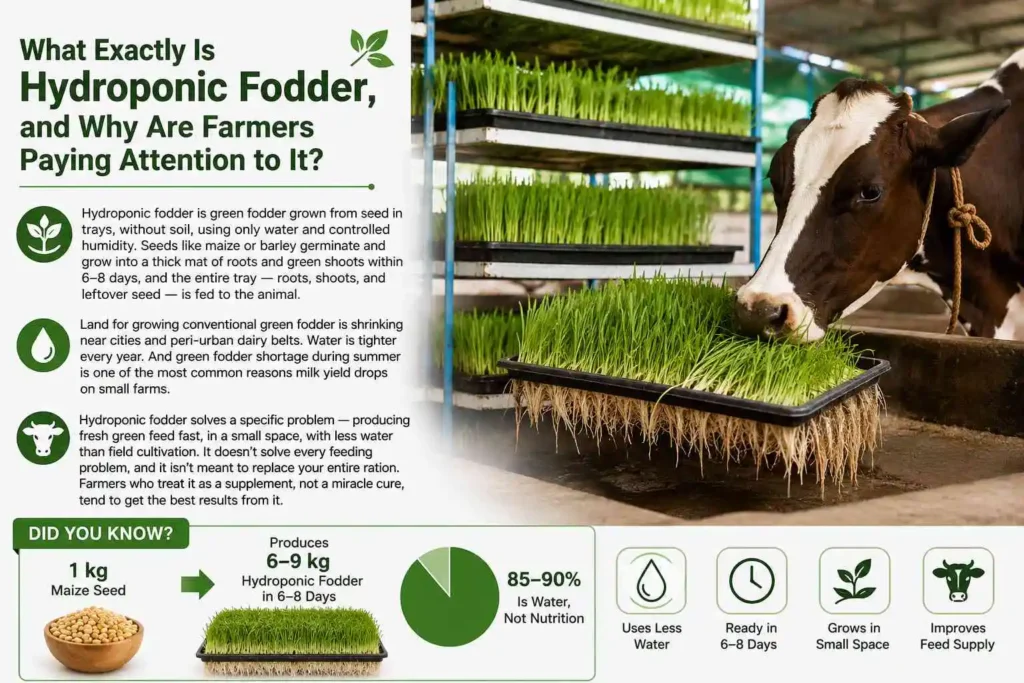
Hydroponic fodder is green fodder grown from seed in trays, without soil, using only water and controlled humidity. Seeds like maize or barley germinate and grow into a thick mat of roots and green shoots within 6–8 days, and the entire tray — roots, shoots, and leftover seed — is fed to the animal.
Here’s why it matters: land for growing conventional green fodder like napier or lucerne is shrinking near cities and peri-urban dairy belts. Water is tighter every year. And green fodder shortage during summer is one of the most common reasons milk yield drops on small farms.
Hydroponic fodder solves a specific problem — producing fresh green feed fast, in a small space, with less water than field cultivation. It doesn’t solve every feeding problem, and it isn’t meant to replace your entire ration. Farmers who treat it as a supplement, not a miracle cure, tend to get the best results from it.
Did You Know? One kilogram of maize seed can produce roughly 6–9 kg of fresh hydroponic fodder in about a week — but nearly 85–90% of that weight is water, not nutrition.
Which Seed Should You Actually Use — And Why Maize Isn’t Always the Winner?
Not every crop performs equally well in a hydroponic tray. Germination speed, seed cost, and local availability all affect the economics far more than most beginners expect.
Maize (corn): Cheap, widely available, and produces a bulky fodder mat that cattle and buffaloes eat readily. Slightly higher risk of mould in humid weather because of its starch content.
Barley: Considered the gold standard globally for hydroponic fodder — good germination, lower mould risk, and well accepted by dairy animals. Seed cost in India is usually higher than maize.
Wheat: Easy to source, decent germination, but yields a thinner mat than barley or maize.
Sorghum (jowar): Good for goats and sheep; needs careful soaking as some varieties carry cyanogenic compounds if fed at the wrong stage — always use fodder-grade seed, not sowing-grade.
| Crop | Approx. Seed Cost (₹/kg) | Germination Time | Mould Risk | Best Suited For |
|---|---|---|---|---|
| Maize | ₹28–35 | 6–7 days | Medium-High | Cattle, buffaloes |
| Barley | ₹35–45 | 6–8 days | Low | Dairy cattle, goats |
| Wheat | ₹25–32 | 7–8 days | Medium | Mixed livestock |
| Sorghum | ₹30–40 | 6–7 days | Medium | Goats, sheep |
(Prices are indicative market ranges as of 2026 and vary by region and season. Always check current rates with your local seed supplier before budgeting.)
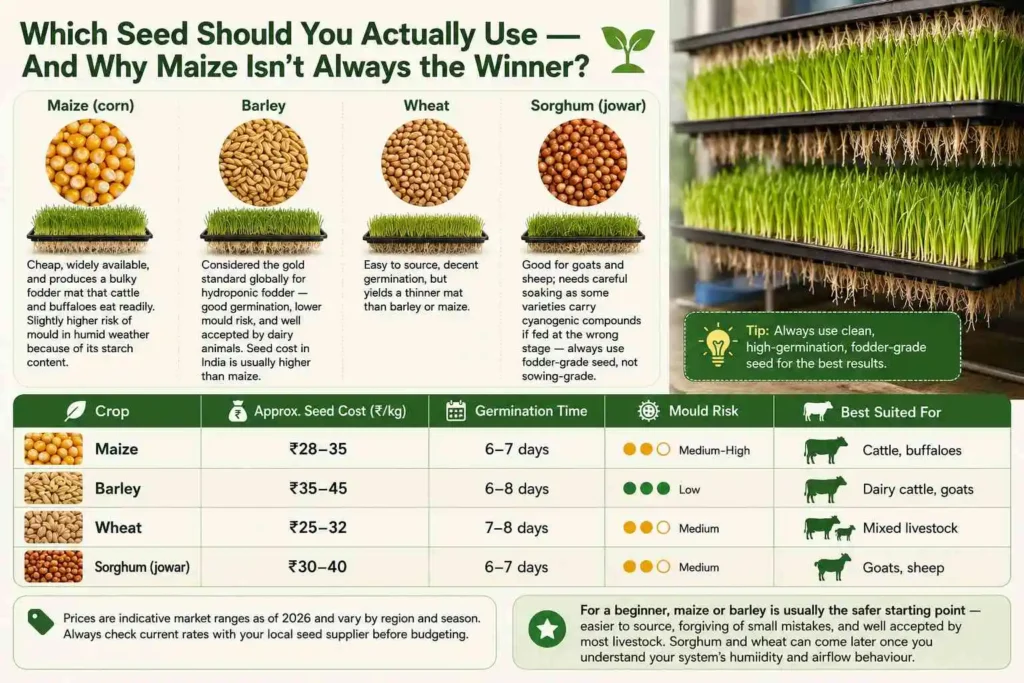
For a beginner, maize or barley is usually the safer starting point — easier to source, forgiving of small mistakes, and well accepted by most livestock. Sorghum and wheat can come later once you understand your system’s humidity and airflow behaviour.
The Daily Production Cycle — What Actually Happens Inside the Tray?
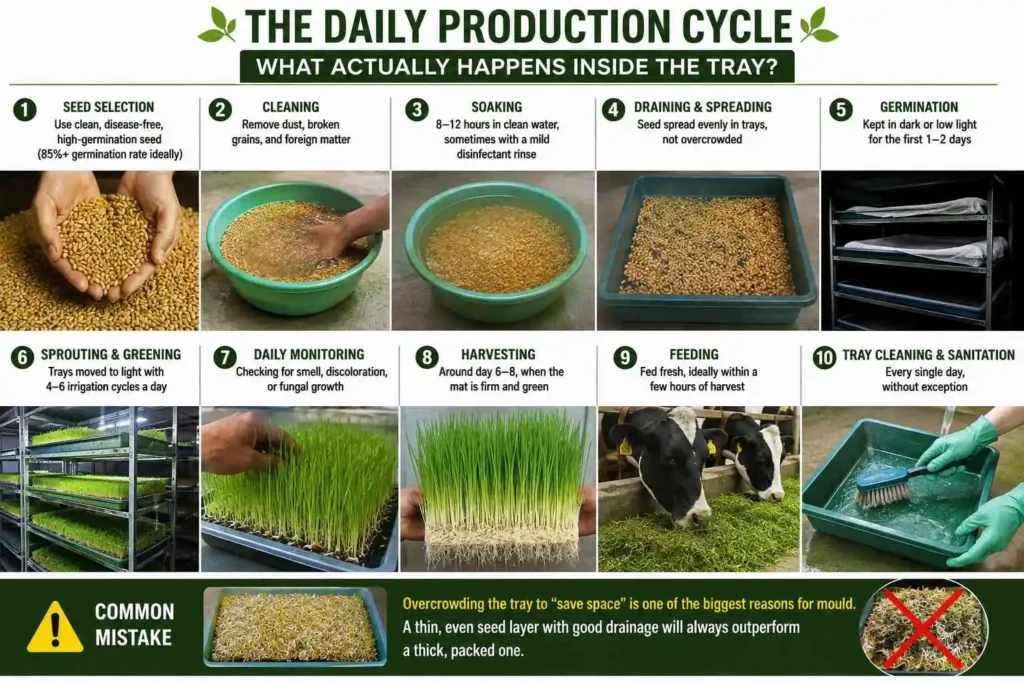
Hydroponic fodder isn’t “set it and forget it.” It’s a daily discipline, and skipping steps is exactly where beginners lose money.
- Seed selection – use clean, disease-free, high-germination seed (85%+ germination rate ideally)
- Cleaning – remove dust, broken grains, and foreign matter
- Soaking – 8–12 hours in clean water, sometimes with a mild disinfectant rinse
- Draining and spreading – seed spread evenly in trays, not overcrowded
- Germination – kept in dark or low light for the first 1–2 days
- Sprouting and greening – trays moved to light with 4–6 irrigation cycles a day
- Daily monitoring – checking for smell, discoloration, or fungal growth
- Harvesting – around day 6–8, when the mat is firm and green
- Feeding – fed fresh, ideally within a few hours of harvest
- Tray cleaning and sanitation – every single day, without exception
Common Mistake Overcrowding the tray to “save space” is one of the biggest reasons for mould. A thin, even seed layer with good drainage will always outperform a thick, packed one.
How Much Fodder Can You Really Get From 1 Kg of Seed?
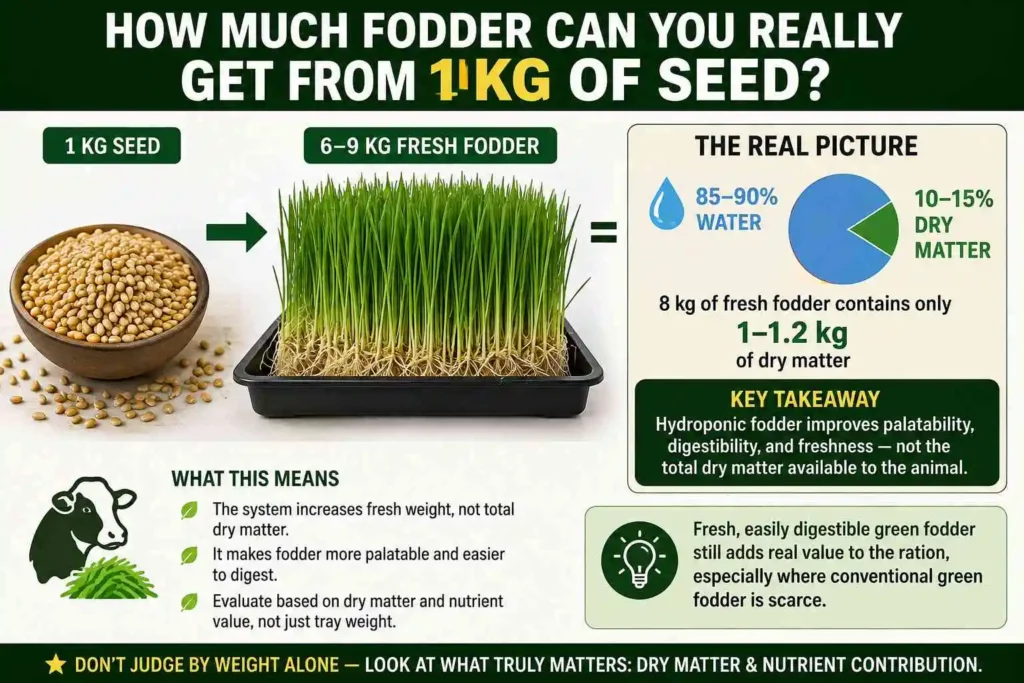
This is where marketing claims and reality often part ways. Yes, 1 kg of seed can become 6–9 kg of fresh fodder. That sounds impressive — until you account for what that weight actually is.
Fresh hydroponic fodder is typically 85–90% water. The dry matter — the part that actually carries protein, energy, and fibre — is only around 10–15% of that fresh weight. So 8 kg of fresh fodder might contain roughly 1–1.2 kg of dry matter, which is barely more than the dry matter you started with in the seed itself, just in a more digestible, palatable form.
Key Takeaway Hydroponic fodder mainly improves palatability, digestibility, and freshness — not the total dry matter available to the animal. Don’t judge the system by fresh weight alone.
This doesn’t mean it’s not useful. Fresh, easily digestible green fodder still has real value in a ration, especially where conventional green fodder is scarce. But it should be evaluated on dry matter and nutrient contribution, not on how full the tray looks.
Water, Shed, and Electricity — What Does the System Actually Need?
One of hydroponic fodder’s genuine advantages is water efficiency compared to field-grown fodder, but the numbers depend heavily on your setup.
Water: A well-designed system can produce 1 kg of fresh fodder using roughly 2–3 litres of water, compared to significantly higher water use for the equivalent field-grown green fodder. Poor drainage or excessive irrigation cycles can push this number up quickly.
Shed/growing room: Needs to be shaded, well-ventilated, and protected from direct hot sun and heavy rain. A simple shade-net structure works for small setups; commercial units may use insulated rooms with cooling pads.
Electricity: Needed mainly for the water pump and, in automated systems, timers and exhaust fans. A basic manual system can run on minimal power; a fully automated commercial unit will have a meaningfully higher electricity bill.
Temperature and humidity: Ideal range is roughly 20–30°C with moderate humidity. Hot, humid, poorly ventilated sheds are the number one cause of mould outbreaks — more than any single mistake in seed handling.
How Much Does It Really Cost to Set Up Hydroponic Fodder in India?
This is the section most farmers actually want, so let’s be direct about it — with the clear caveat that these are indicative ranges, not fixed prices. Local labour, material, and equipment costs vary significantly by state and supplier.
Initial Investment (Small Manual Setup — for feeding 5–10 animals)
| Item | Approx. Cost (₹) |
|---|---|
| Shade-net/simple shed structure | ₹15,000 – ₹30,000 |
| Racks (bamboo/metal) | ₹8,000 – ₹15,000 |
| Trays (30–40 units) | ₹6,000 – ₹12,000 |
| Manual irrigation setup (pipes, sprinkler heads) | ₹3,000 – ₹6,000 |
| Water tank and small pump | ₹5,000 – ₹10,000 |
| Total (approximate) | ₹37,000 – ₹73,000 |
Initial Investment (Semi-Automated Commercial Unit)
| Item | Approx. Cost (₹) |
|---|---|
| Insulated growing chamber/room | ₹1,50,000 – ₹4,00,000+ |
| Automated irrigation with timers | ₹40,000 – ₹80,000 |
| Racks and trays (commercial grade) | ₹60,000 – ₹1,20,000 |
| Cooling/ventilation system | ₹50,000 – ₹1,50,000 |
| Total (approximate) | ₹3,00,000 – ₹7,50,000+ |
Warning Fully automated units are marketed heavily, but they only make financial sense at scale — typically for commercial fodder sellers or large dairy operations with 30+ animals. For a small farm, a well-managed manual system usually delivers better return on investment.
Recurring Monthly Costs (Small Manual Setup, feeding ~8 animals)
| Item | Approx. Monthly Cost (₹) |
|---|---|
| Seed (maize, ~25 kg/day) | ₹18,000 – ₹22,000 |
| Electricity | ₹800 – ₹1,500 |
| Water | ₹300 – ₹600 |
| Labour (part-time, 1–2 hrs/day) | ₹3,000 – ₹5,000 |
| Cleaning/sanitation supplies | ₹300 – ₹500 |
| Total (approximate) | ₹22,400 – ₹29,600 |
Sample calculation: Daily seed cost (₹700) × 30 days + electricity (₹1,000) + water (₹450) + labour (₹4,000) + sanitation (₹400) = ≈ ₹27,000/month for roughly 8 animals getting a fodder supplement.
Replace these figures with your own local seed price, electricity tariff, and wage rate — the formula matters more than the exact numbers.
Cost Per Kg of Fodder vs Cost Per Kg of Actual Nutrition — The Calculation Most Farmers Skip
This is arguably the most important financial lesson in this entire article.
If your monthly cost is ₹27,000 and you’re producing roughly 200 kg of fresh fodder per day (6,000 kg/month), your cost per kg of fresh fodder works out to around ₹4.5/kg. That sounds cheap compared to market green fodder.
But remember — fresh hydroponic fodder is ~85–90% water. So that 6,000 kg of fresh fodder might only represent 700–900 kg of actual dry matter. Recalculated on a dry matter basis, the real cost is significantly higher — often ₹30–38 per kg of dry matter, depending on your setup efficiency.
Expert Tip Always ask two numbers before deciding: cost per kg of fresh fodder, AND cost per kg of dry matter. Comparing only fresh weight against dry conventional feed (like dry fodder or concentrate) will make hydroponic fodder look cheaper than it really is.
This doesn’t automatically mean it’s a bad investment — dry matter isn’t the only value it offers; palatability, digestibility, and freshness matter too. But going in with realistic numbers prevents disappointment six months later.
Why Mould and Poor Germination Can Quietly Destroy Your Economics
Mould is the single biggest reason small hydroponic fodder setups fail. It develops from a combination of:
- Excess moisture and poor drainage
- Overcrowded trays
- Poor ventilation and high humidity
- Contaminated or low-quality seed
- Irregular cleaning of trays and racks
What to do the moment you spot mould: discard that tray’s produce immediately. Do not feed visibly mouldy fodder to any animal — it can cause digestive upsets and, in some cases, more serious mycotoxin-related health issues. Clean the tray thoroughly with a mild disinfectant before reuse, and review your ventilation and seed density before the next batch.
Poor germination is usually traced back to old seed, incorrect soaking time, or seed that wasn’t disease-free to begin with. If germination consistently falls below 80%, the problem is almost always the seed source, not the system.
Can Cows, Buffaloes, Goats, and Sheep All Eat Hydroponic Fodder?
Generally yes, with some common-sense limits.
Dairy cattle and buffaloes tolerate hydroponic fodder well as a supplement, typically 15–25% of the green fodder portion of the ration, alongside dry fodder, concentrate, and minerals.
Goats and sheep also accept it readily, often preferring the tender shoots, but their smaller rumen means they still need adequate dry roughage alongside it.
Whatever the species, hydroponic fodder should be treated as a fresh, palatable supplement — not a full replacement for a balanced ration. Animals still need adequate dry matter, energy, protein, fibre, minerals, and water from other sources. Claims that hydroponic fodder alone can sustain livestock, or that it dramatically boosts milk yield on its own, aren’t well supported and should be treated with caution.
Storage, Shelf Life, and Daily Feeding Reality
Harvested hydroponic fodder doesn’t store well. It’s best fed fresh, ideally within 6–8 hours of harvest. Left longer, especially in warm weather, it begins to heat up, lose freshness, and become more prone to spoilage.
This has a real operational implication: you can’t “stock up” hydroponic fodder like hay or silage. Production has to be planned daily, matched closely to your herd’s actual daily requirement — not overproduced just because trays are available.
Is Hydroponic Fodder Actually Profitable for a Small Dairy Farm?
The honest answer: it depends on your specific numbers, not on a general yes or no.
It tends to make more sense when:
- Land or water for conventional green fodder is genuinely limited
- You have consistent daily labour available to manage it properly
- Your herd size is large enough to justify the recurring cost
- Local seed prices are reasonable and dry conventional fodder is expensive or seasonal
It tends to make less sense when:
- You already have reliable access to affordable green fodder
- You can’t commit to daily monitoring and cleaning
- You’re comparing it against dry matter cost without adjusting for water content
- You’re being sold an expensive automated unit before testing a small manual setup first
Practical Tip Before investing a single rupee in racks or trays, run a two-week trial with 3–4 small trays using a bucket, netting, and manual watering. It costs almost nothing and tells you exactly how your local seed, water, and climate behave in practice.
Inside a Commercial Hydroponic Fodder Operation: A Visit to Shunya Agritech’s Delhi Headquarters
Everything covered so far describes hydroponic fodder as a farm-level system — a few racks, a handful of trays, a bucket of water. But there’s a second, larger version of this story: hydroponic fodder run as an organised, technology-driven business, at a scale where it feeds tens of thousands of animals instead of eight or ten.
To see what that actually looks like, I visited Shunya Agritech’s headquarters in New Delhi — the company is headquartered out of Collative, White House, Global Foyer, NBCC Tower, Sector 5, Pushp Vihar, New Delhi. Shunya Agritech was founded in 2023 by Vijay Singh, after he spent time travelling across roughly 15 states studying green fodder shortages in rural dairy belts. That research turned into a company built specifically around solving the fodder problem at scale, rather than selling farmers a one-time machine.
During the visit, I was shown around by Kashish, Assistant Manager at Shunya Agritech, who walked me through the full production cycle at one of their Growth & Logistics Centres — from seed soaking and tray loading through to germination, daily rack management, and final harvesting. Seeing the process end-to-end, rather than reading about it, made one thing obvious: at commercial scale, hydroponic fodder isn’t really “farming” in the traditional sense — it’s closer to a controlled manufacturing line, with each rack and tray on its own schedule, and staff moving through the facility checking specific stages rather than tending to a crop as a whole.
What the business model actually looks like. Shunya doesn’t just sell hydroponic equipment — it runs a fodder-as-a-service system, with a few different entry points depending on how involved a farmer or entrepreneur wants to be:
- Fodder delivery on subscription — fresh fodder supplied directly to dairy farms without the farmer running any equipment
- On-farm production units — hydroponic units set up on a farmer’s own land, run using Shunya’s protocols and app-based monitoring
- Production Partner Program — an entrepreneurial route where someone with land sets up a full Growth & Logistics Centre (GLC) and sells fodder back to Shunya, effectively running it as a standalone business
- Technology subscriptions — licensing Shunya’s operating protocols for existing hydroponic operators who want tighter quality control
How production is actually monitored. The part that stood out most during the visit was how much of the day-to-day “farming” decision-making has been converted into a data problem rather than a judgement call. Growth-cycle data, tray temperature, and humidity are tracked through a mobile app, with AI/ML-based monitoring used to flag batches that are trending toward mould or poor germination before it becomes visible to the eye — the same risks covered earlier in this article, just caught systematically instead of by habit. The company currently operates Growth & Logistics Centres in locations including Kanpur, Agra, and Gurugram, alongside its Delhi headquarters, and has partnered with ICAR-IIMR to research hydroponic maize varieties suited specifically to Indian growing conditions.
Expert Tip Whether or not you ever work with a company like this, the underlying discipline is worth copying: logging germination rate, tray temperature, and mould incidents daily turns hydroponic fodder from guesswork into a manageable process — the same principle works just as well on a single-shed setup with a notebook and a thermometer.
It’s worth staying grounded here too. A fodder-as-a-service or production-partner model shifts cost and risk differently than building your own manual tray system — the economics covered earlier in this article (cost per kg of dry matter, daily labour, local seed price) still apply, whether you’re subscribing to fodder or running your own trays. Ask for dry matter figures, not just fresh weight, before comparing any commercial provider’s pricing against your own numbers.
Want to Start Commercially? How Shunya Agritech’s Production Partner Program Works
For farmers or entrepreneurs who have spare land and want to run hydroponic fodder as a business rather than just a feeding supplement, Shunya Agritech runs a structured Production Partner Program. Based on what the company shares publicly, the broad requirements and terms are:
| Requirement | Approx. Range |
|---|---|
| Land needed | 2,000 – 10,000 sq ft (varies by daily capacity) |
| Investment needed | ₹10 – ₹50 lakh (varies by unit size) |
| Reported ROI | 20% – 30% |
| Land ownership | Owned or leased land accepted |
| Buyback | Shunya reports buying back the fodder produced, so the partner isn’t responsible for finding buyers |
| Support offered | Setup assistance, training, and technology/app-based operations support |
The company also offers a free viability assessment report for anyone who shares their land location, which is meant to estimate local feed demand and unit potential before committing any money — worth requesting before making a decision, regardless of which hydroponic provider or setup you’re considering.
Practical Tip Treat any ROI or buyback figure a company quotes you the same way you’d treat your own projections — ask for it in writing, understand the buyback price per kg, and run it against the dry-matter cost calculation covered earlier in this article before signing anything.
Shunya Agritech — Contact Details
| Purpose | Details |
|---|---|
| Head Office | Collative, White House, Global Foyer, NBCC Tower, Sector 5, Pushp Vihar, New Delhi – 110017 |
| Regional Office (North) | 7th Floor, Global Foyer Mall, Sector 43, Gurugram, Haryana – 122002 |
| Regional Office (West) | Regus, Symphony IT Park, A Wing, 5th Floor, Chandivali, Mumbai – 400072 |
| Regional Office (South) | 126, RNS Plaza, Sy. No. 47, Konappana Agrahara, Electronic City Phase 2, Bengaluru – 560100 |
| General enquiries | info@shunya.live |
| Phone/WhatsApp | 011 4118 9120 (Mon–Sat: 8:30 AM–7:30 PM, Sun: 8:30 AM–4:30 PM) |
| Production Partner enquiries | partner@shunya.live / +91 86552 10711 |
| Website | shunya.live |
(Contact details are as published by the company at the time of writing — always verify current details on their official website before reaching out, since business contact information can change.)
Practical Tip If you reach out to Shunya Agritech after reading this, do mention that you found them through KisanPreneur. This isn’t a paid or sponsored mention — we simply visited them independently to research this article — but letting them know helps us and doesn’t cost you anything.
Watch the full GLC visit and process breakdown here –
Before You Invest: The One Calculation That Matters Most
Hydroponic fodder isn’t a miracle system, and it isn’t a scam either — it’s a production tool that works well for the right farm, under the right management, at the right scale. The single biggest mistake beginners make isn’t in the growing process; it’s skipping the financial homework beforehand.
Before you buy a single tray, calculate your herd’s actual daily dry fodder requirement, get current local prices for seed, water, and electricity, and work out your realistic cost per kg of dry matter — not just fresh weight. Compare that number honestly against what you currently pay for green fodder in your area. If you’re still setting up your animal side of the business, it’s worth reading up on the basics first — whether that’s how to start goat farming in India or the full breakdown of HF cow dairy farming in India — cost, feed, and profit — since your herd size and feed budget from those calculations directly decide whether hydroponic fodder is worth adding to your system.
A simple, well-managed manual setup that you can clean, monitor, and operate consistently every single day will almost always outperform an expensive automated system that gets neglected after the first month. Start small, track your real numbers for a few weeks, and let the calculation — not the sales pitch — decide whether hydroponic fodder belongs on your farm.
Frequently Asked Questions
How much seed is needed to produce 1 kg of fodder?
Roughly 130–160 grams of seed produces about 1 kg of fresh fodder, depending on the crop and germination rate.
How many days does hydroponic fodder take to grow?
Typically 6–8 days from soaking to harvest, depending on crop type and temperature.
Does hydroponic fodder need sunlight?
It needs light, but not necessarily direct sunlight — diffused natural light or basic artificial lighting both work. Direct hot sun can dry out or scorch the mat.
Can it be grown throughout the year?
Yes, but summer heat and monsoon humidity both increase mould risk and require better ventilation and temperature control.
Can maize be used for hydroponic fodder?
Yes, maize is one of the most commonly used and cost-effective options, though it carries slightly higher mould risk than barley.
How long can harvested fodder be stored?
Very briefly — ideally fed within 6–8 hours of harvest. It isn’t a storable feed like hay or silage.
Is a commercial automated machine necessary to start?
No. A simple manual rack-and-tray system is often the better starting point for small farms, with automation considered later once daily production volumes justify the cost.
How can I start a hydroponic fodder business commercially in India?
Companies like Shunya Agritech run structured Production Partner Programs where you provide land (typically 2,000–10,000 sq ft) and investment (reportedly ₹10–50 lakh depending on capacity), while the company handles setup assistance, training, technology, and buyback of the fodder produced. Request a written viability assessment and buyback pricing before committing.
Newsletter