



Orchid Farming: Cost, Profit & Complete Guide
A single stem of a good Dendrobium orchid sells for ₹25-40 in the wholesale market. A single stem of Phalaenopsis, packed well and sold to a hotel or event decorator, can fetch ₹150-300. Now compare that to marigold, which often sells for a few rupees a kilo during peak season crashes.
This is why orchid farming has quietly become one of the most talked-about opportunities in Indian floriculture. Weddings, five-star hotels, corporate gifting, home décor, and export buyers are all chasing the same thing—premium, long-lasting, exotic-looking flowers. Orchids fit that demand perfectly.
In this guide, you’ll learn which orchid varieties actually make money, how much climate and greenhouse setup really cost, the growing medium and watering routine that keeps orchids healthy, feeding schedules, common diseases, and—most importantly—what kind of profit you can realistically expect. No fluff, no textbook definitions. Just what you need to know before you put money into this business.

Why Orchid Farming Is Becoming One of the Most Profitable Floriculture Businesses
Here’s why this matters: orchids aren’t priced like regular flowers. They’re priced like premium products, because they last longer, look exotic, and can’t be grown just anywhere.
A rose or gerbera flower wilts in 3-4 days. A cut orchid stem, if handled properly, stays fresh for 2-3 weeks. That single fact changes everything about how orchids are bought and sold—hotels prefer them because they don’t need daily replacement, and export buyers prefer them because they survive long shipping times.
The demand side is growing fast too. Urban weddings, corporate events, and gifting culture have pushed orchid demand up every year, and India still imports a large share of its orchids from Thailand and the Netherlands. That gap is exactly where a new grower can step in.
Did You Know? India is one of the few countries with native orchid biodiversity—over 1,200 wild orchid species grow in the Northeast alone. Yet most commercial orchids sold in Indian markets are still imported. That mismatch is the opportunity.
Practical takeaway: Don’t enter orchid farming thinking of it as “just another flower crop.” Think of it as a premium horticulture product where quality and consistency matter more than quantity.
Which Orchid Variety Gives the Best Commercial Returns?
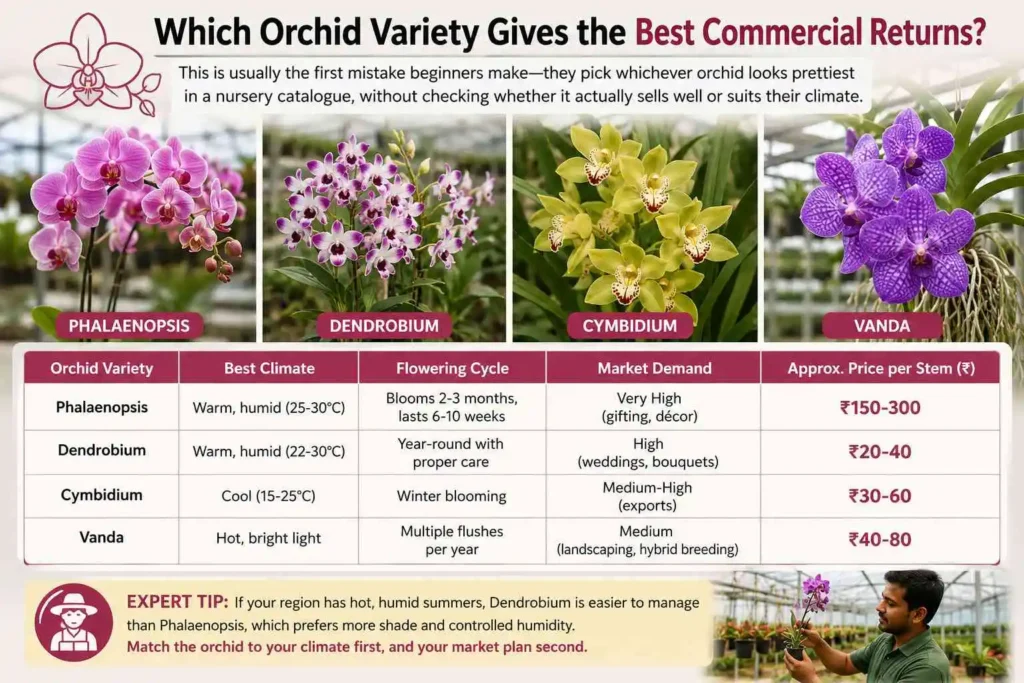
This is usually the first mistake beginners make—they pick whichever orchid looks prettiest in a nursery catalogue, without checking whether it actually sells well or suits their climate.
For most beginners, Phalaenopsis and Dendrobium are usually the safest choices because they’re widely cultivated, have strong market demand, and adapt well to commercial greenhouse conditions. Cymbidium and Vanda are more specialized and need cooler or very specific climates, so they suit experienced growers more than first-timers.
| Orchid Variety | Best Climate | Flowering Cycle | Market Demand | Approx. Price per Stem (₹) |
|---|---|---|---|---|
| Phalaenopsis | Warm, humid (25-30°C) | Blooms 2-3 months, lasts 6-10 weeks | Very High (gifting, décor) | ₹150-300 |
| Dendrobium | Warm, humid (22-30°C) | Year-round with proper care | High (weddings, bouquets) | ₹20-40 |
| Cymbidium | Cool (15-25°C) | Winter blooming | Medium-High (exports) | ₹30-60 |
| Vanda | Hot, bright light | Multiple flushes per year | Medium (landscaping, hybrid breeding) | ₹40-80 |
Expert Tip: If your region has hot, humid summers, Dendrobium is easier to manage than Phalaenopsis, which prefers more shade and controlled humidity. Match the orchid to your climate first, and your market plan second.
Why Temperature and Humidity Decide Your Orchid Success
Here’s the thing about orchids—they don’t forgive careless climate management the way a vegetable crop might. Get the temperature or humidity wrong, and the plant simply won’t flower, even if it stays alive.
Most commercial orchids need daytime temperatures between 25-30°C and nighttime temperatures around 18-22°C. Humidity should stay between 60-80%. Below 50% humidity, flower buds often drop before they even open.
This matters because flower drop is invisible until it’s too late—you won’t notice the problem until the buds that should have opened simply fall off. That’s lost income you can’t recover for that flowering cycle.

Common Mistake: Many beginners assume that more water compensates for low humidity. It doesn’t. Orchids need humid air around their roots and leaves, not wet growing medium. Misting and humidity trays work far better than overwatering.
Best Practice: Install a simple humidity meter (available for ₹300-500) in your growing area. It’s a small investment that prevents a big loss.
Do You Really Need a Greenhouse for Orchid Farming?
Short answer: yes, if you’re serious about commercial volumes and consistent quality. A greenhouse isn’t a luxury here—it’s what lets you control temperature, humidity, and light, which are exactly the three things orchids are picky about.
This is why understanding polyhouse farming is important before starting orchid cultivation, as protected structures create the controlled environment needed for premium flower production.Short answer: yes, if you’re serious about commercial volumes and consistent quality. A greenhouse isn’t a luxury here—it’s what lets you control temperature, humidity, and light, which are exactly the three things orchids are picky about.
A basic shade-net structure can work for hobby-scale growing, but it won’t protect against monsoon damage, sudden heat waves, or pest infestations the way a proper polyhouse does. For commercial orchid farming, most successful growers invest in a polyhouse or greenhouse with shade nets, misting systems, and fans.
| Setup Type | Approx. Cost (per 1,000 sq. ft.) | Suitable For |
|---|---|---|
| Basic shade-net structure | ₹1.5-2.5 lakh | Small-scale, hobby to semi-commercial |
| Polyhouse with misting system | ₹8-12 lakh | Commercial Phalaenopsis/Dendrobium production |
| Climate-controlled greenhouse | ₹18-25 lakh | Export-quality, premium varieties like Cymbidium |
Government subsidies under schemes like the National Horticulture Mission can cover 40-50% of greenhouse costs in several states, which significantly reduces the upfront burden. It’s worth checking with your local horticulture department before finalizing your budget.
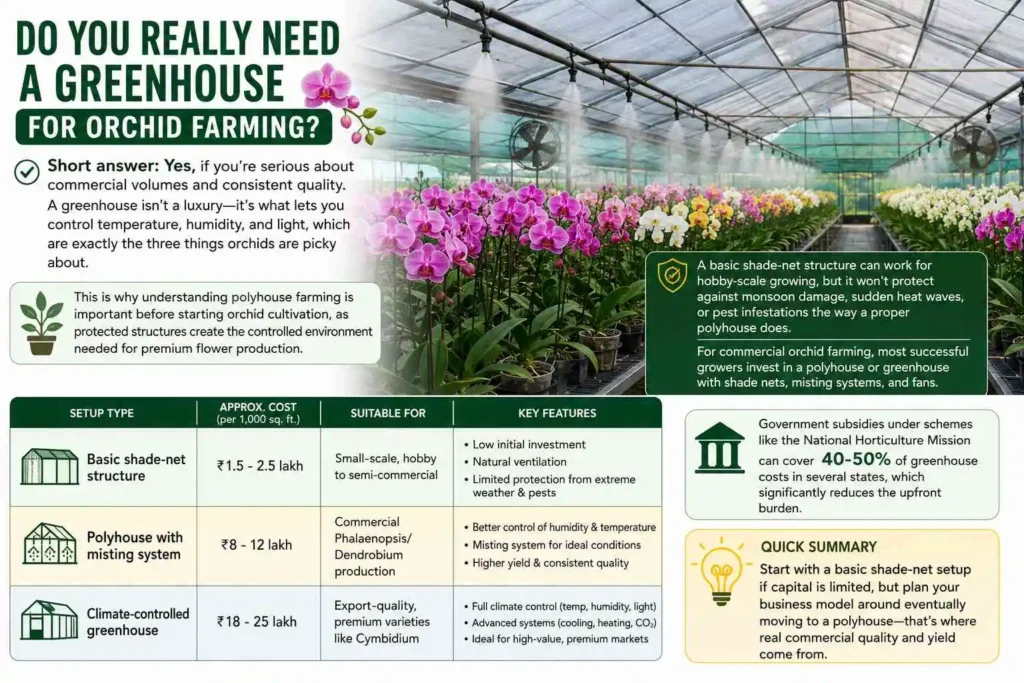
Quick Summary: Start with a basic shade-net setup if capital is limited, but plan your business model around eventually moving to a polyhouse—that’s where real commercial quality and yield come from.
Choosing the Right Growing Medium Can Save Months of Hard Work
One mistake many beginners make is treating orchids like regular potted plants and growing them in garden soil. Orchid roots need air circulation, and regular soil suffocates them within weeks.
Commercial orchid growers typically use a mix of:
- Broken charcoal pieces
- Coconut husk chips
- Sphagnum moss
- Perlite or brick pieces for drainage
This combination lets air reach the roots while still holding enough moisture. Get this wrong, and you’ll see yellowing leaves and root rot within a month or two—a problem that’s hard to reverse once it starts.
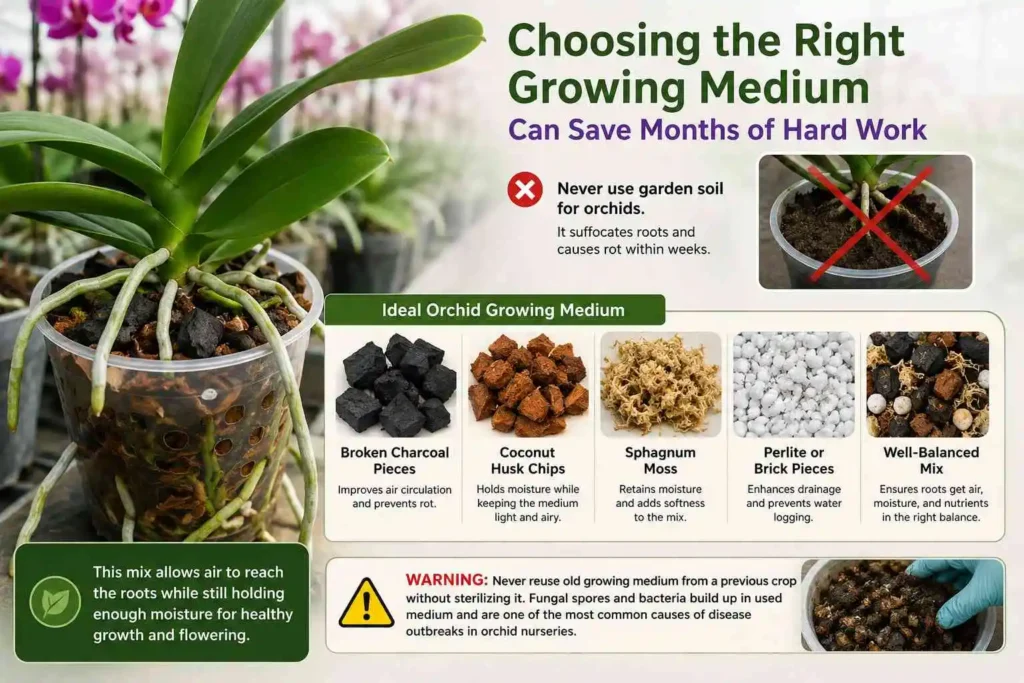
Warning: Never reuse old growing medium from a previous crop without sterilizing it. Fungal spores and bacteria build up in used medium and are one of the most common causes of disease outbreaks in orchid nurseries.
How Much Water Do Orchids Actually Need?
This is where many new growers struggle, because orchid watering doesn’t follow the “daily watering” habit most people bring from vegetable or fruit farming.
Orchids are epiphytes in nature—they grow on trees, not in soil, and their roots are adapted to dry out between waterings. Overwatering is actually the number one killer of commercial orchid crops, more common than any pest or disease.
A simple, reliable approach: water only when the growing medium feels dry to touch, usually every 3-5 days depending on your climate and greenhouse humidity. In cooler or high-humidity conditions, this can stretch to once a week.
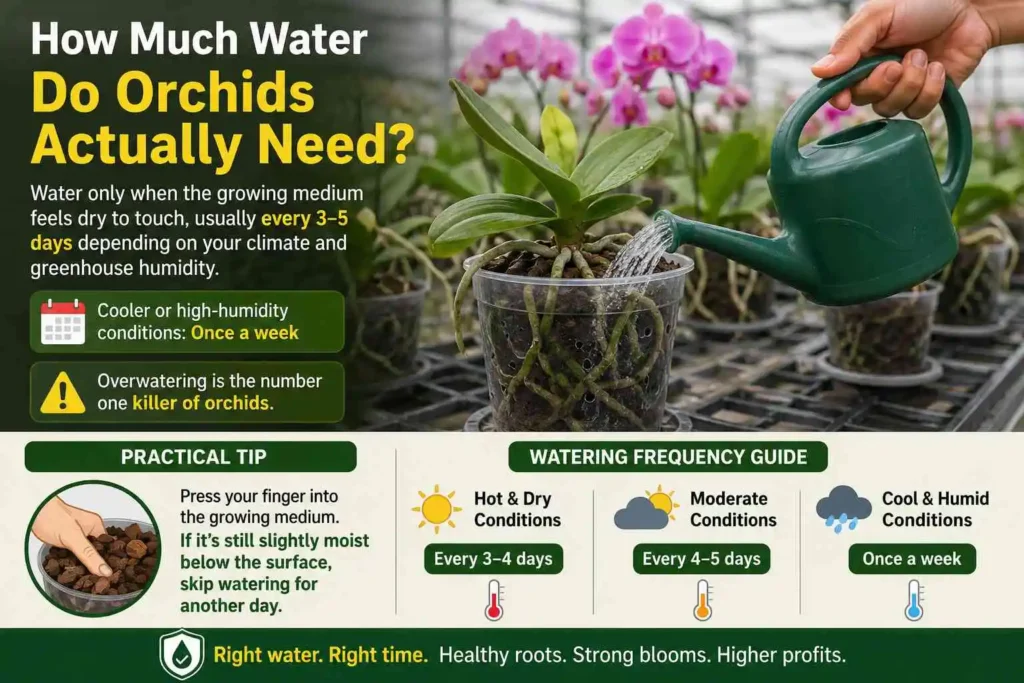
Practical Tip: Press your finger into the growing medium. If it’s still slightly moist below the surface, skip watering for another day. This one habit prevents most root-rot problems before they start.
The Feeding Mistakes That Stop Orchids From Flowering
A common misconception is that orchids need heavy, frequent fertilizing to bloom well. In reality, orchids are light feeders, and overfeeding damages roots just as badly as overwatering.
| Growth Stage | Fertilizer Type | Frequency | Approx. Monthly Cost (per 1,000 plants) |
|---|---|---|---|
| Vegetative growth | Balanced NPK (20-20-20) | Every 2 weeks | ₹800-1,200 |
| Pre-flowering | High phosphorus (10-30-20) | Every 2 weeks | ₹1,000-1,500 |
| Flowering | Balanced with micronutrients | Monthly | ₹600-900 |
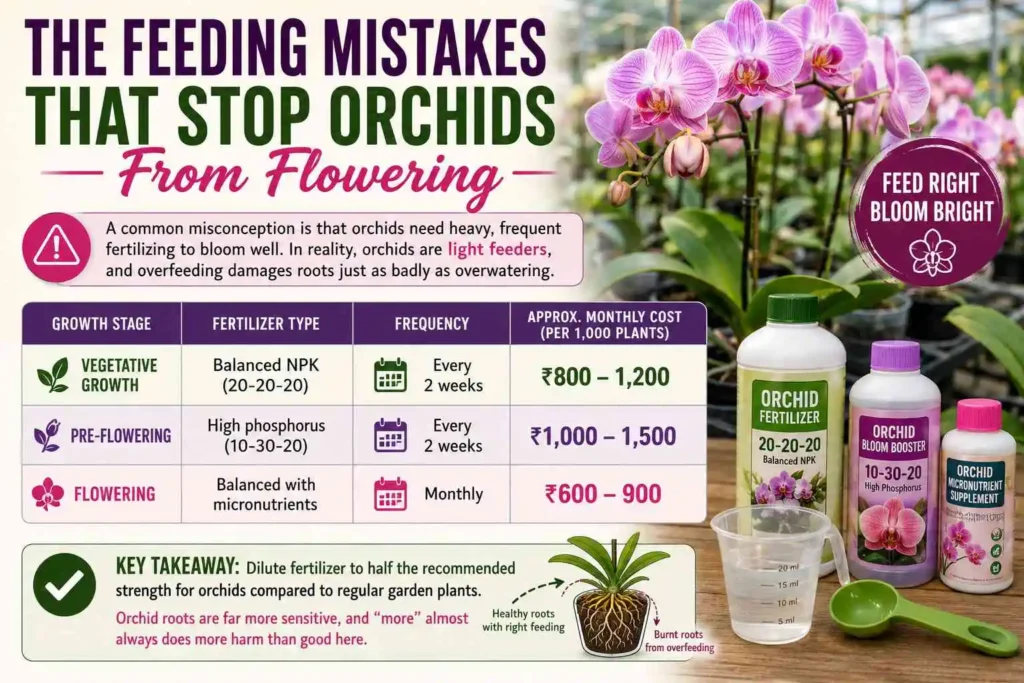
Key Takeaway: Dilute fertilizer to half the recommended strength for orchids compared to regular garden plants. Orchid roots are far more sensitive, and “more” almost always does more harm than good here.
The Most Common Orchid Problems—and How to Prevent Them
Orchid diseases spread fast in humid greenhouse conditions, which is exactly the environment orchids need to thrive. That trade-off is something every commercial grower has to manage carefully.
| Problem | Symptoms | Prevention |
|---|---|---|
| Root rot | Soft, blackened roots | Avoid overwatering, ensure good drainage |
| Bacterial soft rot | Water-soaked, foul-smelling patches | Improve air circulation, remove infected tissue immediately |
| Scale insects | Small brown bumps on leaves/stems | Regular inspection, neem oil spray |
| Fungal leaf spot | Yellow-brown spots on leaves | Reduce leaf wetness, apply copper-based fungicide |
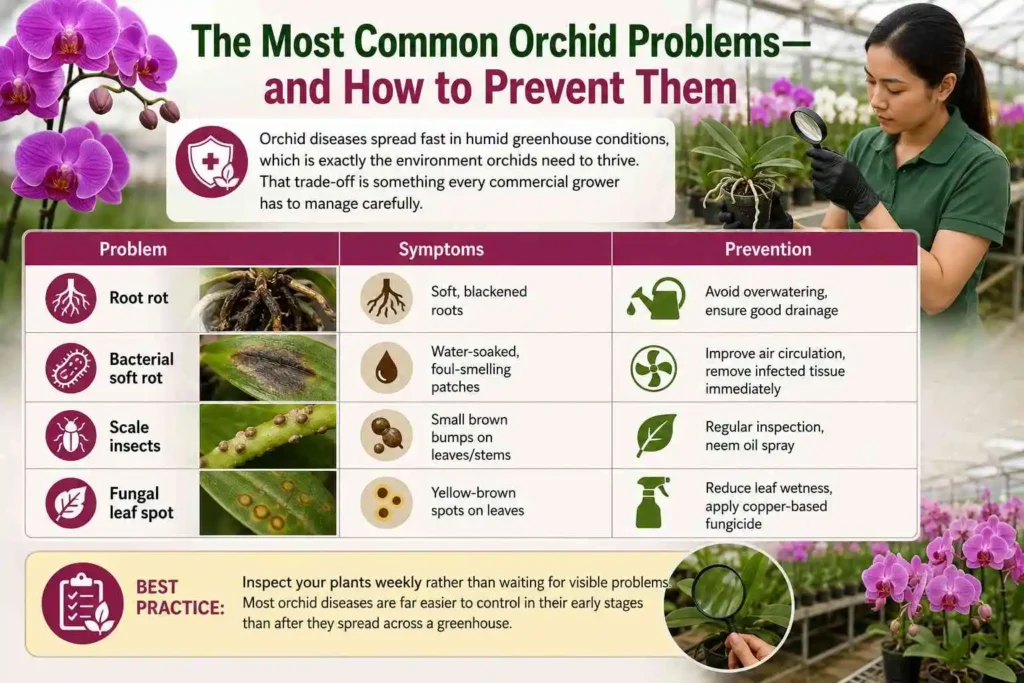
Best Practice: Inspect your plants weekly rather than waiting for visible problems. Most orchid diseases are far easier to control in their early stages than after they spread across a greenhouse.
Can Orchid Farming Really Become a High-Income Business?
Here’s a realistic number: a well-managed 1,000 sq. ft. polyhouse can hold around 3,000-4,000 orchid plants. At an average selling price of ₹40-60 per stem (blending Dendrobium and Phalaenopsis), and with each plant producing multiple stems across flowering cycles, annual revenue from a unit this size can range between ₹8-15 lakh, depending on variety and market access.
| Item | Approx. Annual Figure (₹) |
|---|---|
| Greenhouse setup (one-time, amortized over 5 years) | ₹1.5-2 lakh/year |
| Planting material, fertilizer, labor | ₹3-4 lakh |
| Total annual revenue (1,000 sq. ft. unit) | ₹8-15 lakh |
| Estimated net profit | ₹3-6 lakh |
These numbers vary widely based on variety choice, market access, and how well climate control is managed—but they show why orchid farming attracts serious commercial interest, not just hobby growers.
/Quick Summary: The profit potential is real, but it depends entirely on getting the basics right—climate, medium, watering, and disease control—before scaling up.
Getting Started the Right Way
The biggest takeaway here isn’t the profit numbers—it’s that orchid farming rewards patience and precision more than capital alone. A grower with a modest shade-net setup who understands humidity, watering, and feeding will consistently outperform someone who builds an expensive greenhouse but skips the basics.
If you’re just starting out, spend your first season learning plant care and understanding your local market—florists, hotels, event planners—before committing to a large-scale setup. Get comfortable with one or two varieties, watch how they respond to your specific climate, and build from there.
The orchid market in India still has room to grow, and the gap left by imported flowers isn’t closing on its own. Start small, learn the plant, and scale only once you’ve seen your own greenhouse deliver consistent, healthy blooms.
FAQs About Orchid Farming
Which orchid variety is best for commercial farming?
Phalaenopsis and Dendrobium are among the most suitable orchid varieties for commercial farming because of their strong market demand, attractive flowers, and adaptability to greenhouse conditions. Beginners should select varieties based on their local climate and target customers.
How much land is required for orchid farming?
Orchids can be grown even in a small area because they are usually cultivated vertically or in greenhouse systems. A 1,000 sq. ft. greenhouse can accommodate around 3,000-4,000 orchid plants depending on the variety, spacing, and growing system used.
Do orchids need a greenhouse for commercial production?
A greenhouse or polyhouse is highly recommended for commercial orchid farming because orchids require controlled temperature, humidity, and light conditions. Small-scale growers can start with shade-net structures, but consistent commercial production is difficult without climate management.
How long does it take for orchids to flower?
The flowering time depends on the orchid variety and growing conditions. Many commercial orchids start producing flowers within 12-24 months after planting, while mature plants can continue producing blooms for several years with proper care.
Is orchid farming suitable for beginners?
Yes, beginners can start orchid farming on a small scale to learn plant management and market demand. Starting with a limited number of plants before investing in a large greenhouse helps reduce risk and improves practical experience.
Newsletter