



HF Cow Dairy Farming in India: Complete Guide to Cost, Feed, and Profit
One HF cow can out-milk three-four ordinary desi cows put together. That single fact is why HF cow dairy farming is spreading faster than almost any other dairy business in India right now, from small sheds in Punjab to new farms coming up in Tamil Nadu.
HF stands for Holstein Friesian, the highest milk-yielding cattle breed on the planet, and India needs exactly what this breed offers. The country already milks over 300 million cattle and buffaloes and produces close to a quarter of the world’s milk, more than any other nation on earth.
But here’s the catch: milk yield per animal in India still trails far behind countries like the USA and the Netherlands. More cows, less milk per cow. That gap is precisely the opportunity HF cow dairy farming fills.
So is this breed worth your money and your land? This guide walks you through everything you need to decide, and then to succeed: breed features, setup cost, feed chart, income, vaccination schedule, and government subsidy. Every rupee figure here is based on current Indian rates, so you can plan your own farm budget, not someone else’s.

What Is HF Cow Dairy Farming? Why This Breed Matters in India
HF cow dairy farming simply means raising Holstein Friesian cows, or their crossbred versions, for commercial milk production. The Holstein Friesian breed originally comes from the Netherlands and northern Germany, where farmers spent centuries breeding cattle purely for high milk output.
The breed reached India through government cattle-breeding programmes and has since spread across the country’s major dairy belts, including Punjab, Haryana, Gujarat, Maharashtra, Karnataka, and Tamil Nadu. Today, both pure HF cows and HF-crossbred cattle (HF mixed with Sahiwal, Tharparkar, or local desi breeds) are common on Indian dairy farms, from small backyard sheds with 2-3 animals to organised farms with hundreds of cows.
How Much Milk Does an HF Cow Give Per Day?
| HF Cow Type | Expected Milk Per Day |
|---|---|
| Pure HF cow | 25–30 litres |
| High-yielding pure HF | 35–40+ litres |
| HF crossbred | 10–15 litres |
| First-lactation HF cow | Usually lower than mature cows |
Actual milk yield varies depending on genetics, lactation stage, feed quality, heat stress, and overall farm management.
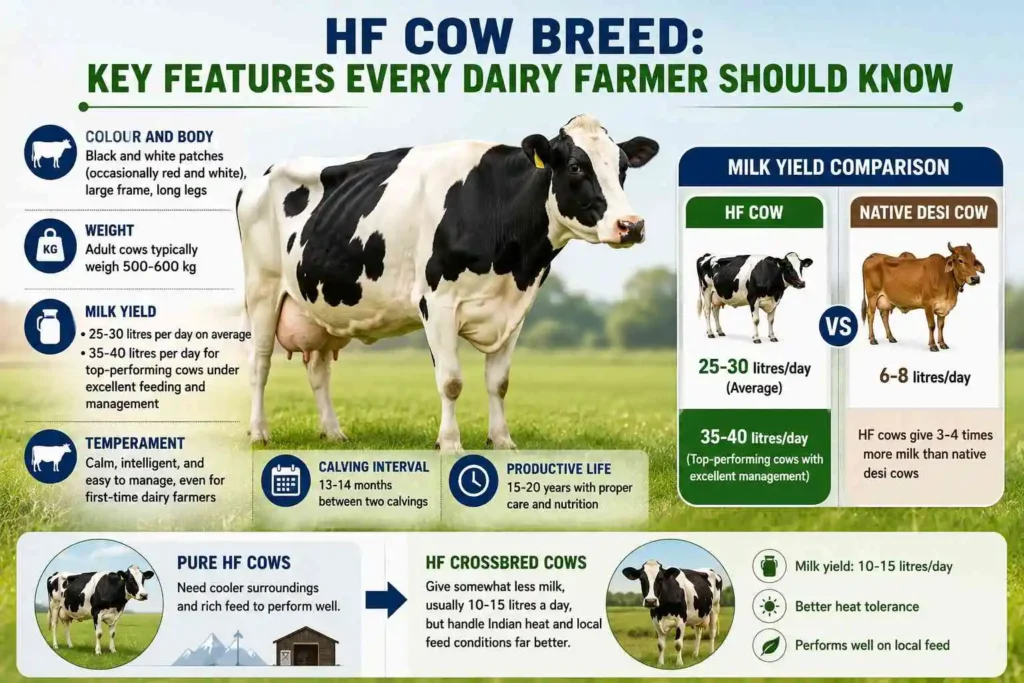
HF Cow Breed: Key Features Every Dairy Farmer Should Know
Before buying an HF cow, it helps to know exactly what you’re paying for. Here are the breed’s defining features:
- Colour and body: Black and white patches (occasionally red and white), large frame, long legs
- Weight: Adult cows typically weigh 500-600 kg
- Milk yield: 25-30 litres per day on average, and 35-40 litres per day for top-performing cows under excellent feeding and management
- Comparison: Native desi cows usually give only 6-8 litres a day, which shows why HF cows are in such demand
- Temperament: Calm, intelligent, and easy to manage, even for first-time dairy farmers
- Calving interval: 13-14 months between two calvings
- Productive life: 15-20 years with proper care and nutrition
Pure HF cows need cooler surroundings and rich feed to perform well, which is why many farmers in hotter states go for HF-crossbred cattle instead. A crossbred HF cow gives somewhat less milk, usually 10-15 litres a day, but handles Indian heat and local feed conditions far better than a pure imported-line HF cow.
HF Cow vs Other Dairy Breeds in India
It pays to compare the HF cow against other dairy breeds that Indian farmers commonly keep, before you spend any money.
| Breed | Average Milk/Day | Fat % | Price Range (₹) | Best Suited For |
|---|---|---|---|---|
| HF (Pure) | 25-30 L (up to 40 L) | 3.5-4% | 40,000 – 1,50,000 | Cool areas, intensive stall-fed farms |
| HF Crossbred | 10-15 L | 3.5-4% | 35,000 – 70,000 | Most parts of India |
| Jersey | 15-20 L | 4.5-5% | 40,000 – 80,000 | Small farmers, hot & humid regions |
| Sahiwal | 8-15 L (up to 20 L) | 4.5-5% | 60,000 – 90,000 | Heat tolerance, A2 milk demand |
| Gir | 6-15 L (up to 20 L) | 4.6% | 40,000 – 1,50,000 | A2 milk, dry and drought-prone areas |
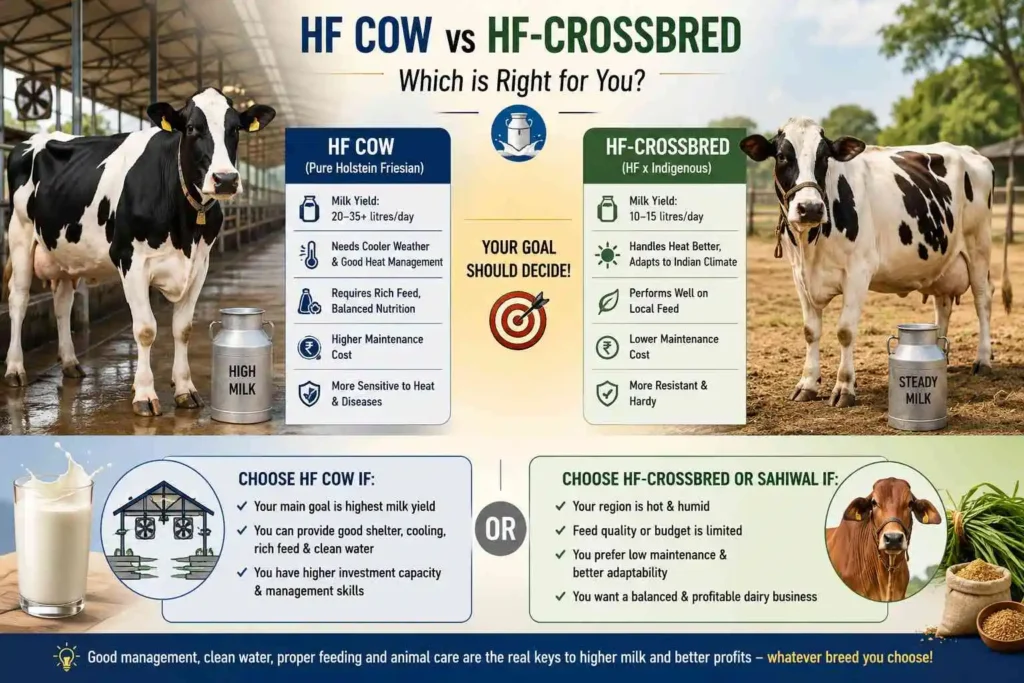
If your main goal is the highest possible litres per day, and you can provide good shelter, feed, and clean water, the HF cow is hard to beat. If your region is very hot, or your budget for feed and shed cooling is limited, an HF-crossbred or a hardy indigenous breed like Sahiwal may work out better for you.
Cost of Starting HF Cow Dairy Farming in India
The setup cost for HF cow dairy farming depends mainly on herd size, shed quality, and whether you already own land. Here’s a realistic breakdown for two common starting sizes.
| Item | 5 HF Cows (₹) | 10 HF Cows (₹) |
|---|---|---|
| Cow purchase (₹50,000-80,000/cow) | 2,50,000 – 4,00,000 | 5,00,000 – 8,00,000 |
| Shed construction | 1,50,000 – 2,50,000 | 2,50,000 – 4,00,000 |
| Equipment (milking setup, buckets, chaff cutter) | 40,000 – 70,000 | 70,000 – 1,20,000 |
| Fodder storage & minor land preparation | 30,000 – 60,000 | 60,000 – 1,00,000 |
| Working capital (1-month buffer) | 50,000 – 60,000 | 1,00,000 – 1,10,000 |
| Total (approx.) | 5,20,000 – 8,40,000 | 9,80,000 – 15,30,000 |
This table does not include land cost, since most small dairy farmers already own farmland or a backyard plot. If you need to buy land, add that separately based on the rate in your area.
HF Cow Feed Chart and Daily Feeding Cost
Feed is the single largest running cost in HF cow dairy farming, and it directly decides how much milk you get. A healthy 500 kg HF cow producing around 20 litres a day typically needs the following daily ration.
| Feed Item | Quantity/Day | Approx. Cost/Day (₹) |
|---|---|---|
| Green fodder (maize/napier) | 20-25 kg | 40-55 |
| Dry fodder (wheat/paddy straw) | 2-3 kg | 12-18 |
| Concentrate/cattle feed | 8-9 kg | 180-220 |
| Mineral mixture | 100-150 g | 8-12 |
| Total | — | 240-300 |
For a cow giving 30 litres or more, concentrate needs go up, and total feed cost can cross ₹350 per day. Feed prices shift by region and season, so check your local green fodder and cattle feed rates before finalising your budget.
If you can grow your own fodder, such as napier grass, maize, or berseem, on even half an acre of land, your daily feed bill can drop by close to a third.
Shed and Housing Management for HF Cows
HF cows feel heat far more than desi cattle, so shed design needs extra attention. A well-planned HF cow shed usually includes:
- A high roof, around 12-14 feet, with good ventilation to let hot air escape
- Fans, foggers, or sprinklers in hot states like Rajasthan, Gujarat, and parts of Uttar Pradesh
- About 40 square feet of covered space per cow, plus an open loafing area outside
- A slightly sloped, non-slip floor that drains urine and wash water easily
- Clean drinking water at all times — an HF cow can drink 60-80 litres of water a day, more in summer
Many Indian dairy farms use a head-to-head shed layout, with two rows of cows facing each other and a common feeding passage in between. This design saves labour during feeding and cleaning, which matters when you’re managing the shed largely on your own.
Breeding and Calf Care in HF Cow Dairy Farming
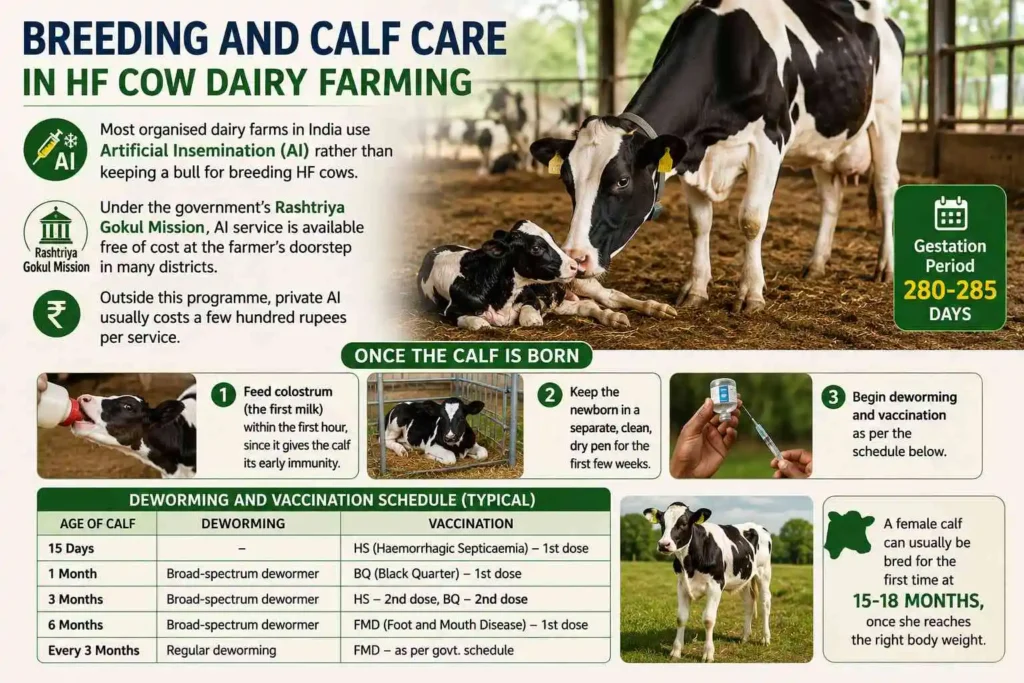
Most organised dairy farms in India use Artificial Insemination (AI) rather than keeping a bull for breeding HF cows. AI gives access to better genetics and avoids the cost of maintaining a bull through the year. Under the government’s Rashtriya Gokul Mission, AI service is available free of cost at the farmer’s doorstep in many districts; outside this programme, private AI usually costs a few hundred rupees per service.
An HF cow carries her calf for about 280-285 days. Once the calf is born:
- Feed colostrum (the first milk) within the first hour, since it gives the calf its early immunity
- Keep the newborn in a separate, clean, dry pen for the first few weeks
- Begin deworming and vaccination as per the schedule below
- A female calf can usually be bred for the first time at 15-18 months, once she reaches the right body weight
Health Care and Vaccination Schedule for HF Cows
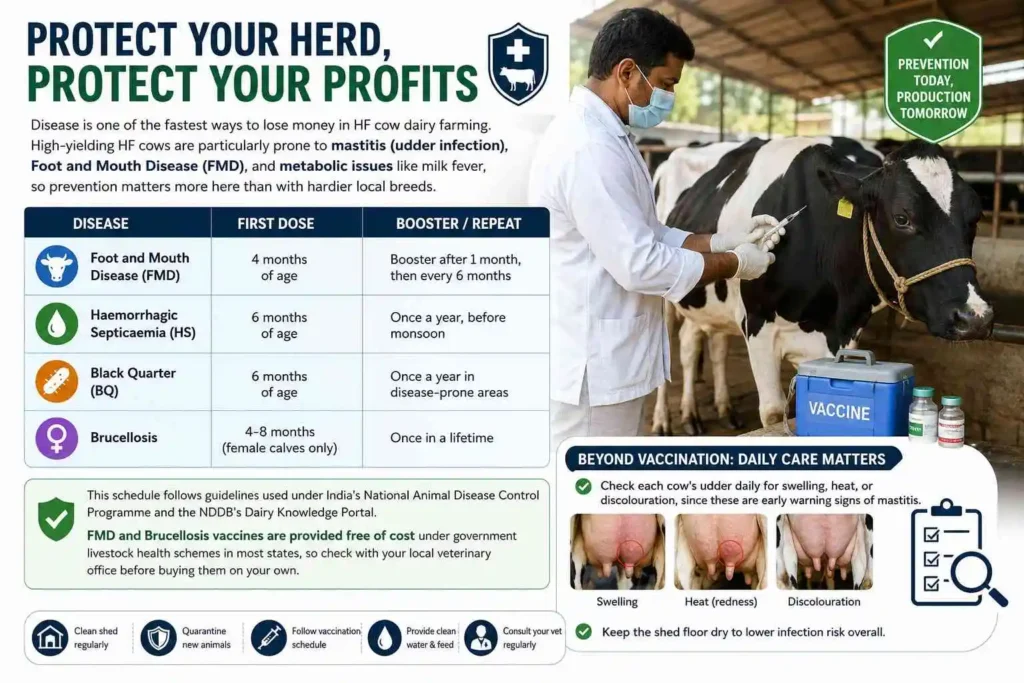
Disease is one of the fastest ways to lose money in HF cow dairy farming. High-yielding HF cows are particularly prone to mastitis (udder infection), Foot and Mouth Disease (FMD), and metabolic issues like milk fever, so prevention matters more here than with hardier local breeds.
| Disease | First Dose | Booster / Repeat |
|---|---|---|
| Foot and Mouth Disease (FMD) | 4 months of age | Booster after 1 month, then every 6 months |
| Haemorrhagic Septicaemia (HS) | 6 months of age | Once a year, before monsoon |
| Black Quarter (BQ) | 6 months of age | Once a year in disease-prone areas |
| Brucellosis | 4-8 months (female calves only) | Once in a lifetime |
This schedule follows guidelines used under India’s National Animal Disease Control Programme and the NDDB’s Dairy Knowledge Portal. FMD and Brucellosis vaccines are provided free of cost under government livestock health schemes in most states, so check with your local veterinary office before buying them on your own.
Beyond vaccination, check each cow’s udder daily for swelling, heat, or discolouration, since these are early warning signs of mastitis, and keep the shed floor dry to lower infection risk overall.
Milk Yield and Income From HF Cow Dairy Farming
This is the part every dairy farmer wants to see clearly: what does HF cow dairy farming actually pay?
Take one HF cow giving an average of 20 litres a day, sold at a typical cooperative rate of around ₹37 per litre for cow milk (cow milk rates generally range ₹35-45 per litre across states, depending on fat and SNF, or solids-not-fat, content).
| Particulars | Per Cow/Day (₹) | Per Cow/Month (₹) | 5 Cows/Month (₹) |
|---|---|---|---|
| Milk revenue (20 L × ₹37) | 740 | 22,200 | 1,11,000 |
| Feed cost | 270 | 8,100 | 40,500 |
| Other costs (labour, electricity, medicine) | 60 | 1,800 | 9,000 |
| Net profit | 410 | 12,300 | 61,500 |
A farmer running 5 well-managed HF cows can reasonably expect a net monthly profit close to ₹60,000, before any loan EMI. Cows yielding 25-30 litres a day, or milk sold at ₹40-45 per litre through a private dairy or direct customers, will push this figure higher still.
Keep in mind that this profit is on top of the one-time setup cost, so most of the first year usually goes towards recovering your initial investment.
Government Schemes and Subsidy for HF Cow Dairy Farming in India
The Indian government backs HF cow dairy farming through several schemes run by NABARD and the Department of Animal Husbandry and Dairying (DAHD).
| Scheme | What It Offers | Subsidy / Benefit |
|---|---|---|
| NABARD Dairy Entrepreneurship Development Scheme (DEDS) | Loan subsidy on dairy unit cost, through banks | 25% (general category), 33.33% (SC/ST) |
| Animal Husbandry Infrastructure Development Fund (AHIDF) | Loans for dairy processing and infrastructure | Up to 90% loan, plus a 3% discount on loan interest for 8 years |
| Rashtriya Gokul Mission | Breed improvement, free AI service | Up to 50% subsidy on setup cost for select components |
| MUDRA Loan (Shishu/Kishore/Tarun) | Collateral-free loan for small dairy units | Up to ₹10 lakh |
| National Livestock Mission (NLM) | Entrepreneurship and productivity support | Up to 50% subsidy on setup cost for select units |
To apply, prepare a Detailed Project Report (DPR) and approach a bank branch empanelled under these schemes, or contact your district Animal Husbandry office directly. Under most schemes, the subsidy is credited only after your loan account runs satisfactorily for 6-12 months, so don’t plan your cash flow around receiving it upfront.
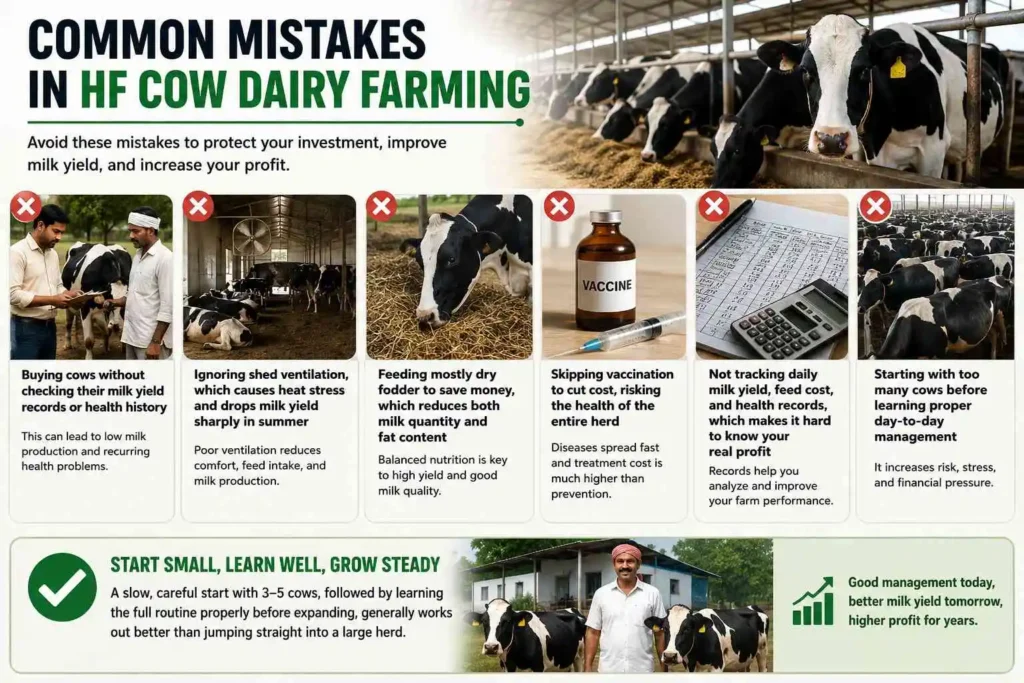
Common Mistakes in HF Cow Dairy Farming
Many new dairy farmers lose money in HF cow dairy farming, not because of the breed itself, but because of a few avoidable mistakes:
- Buying cows without checking their milk yield records or health history
- Ignoring shed ventilation, which causes heat stress and drops milk yield sharply in summer
- Feeding mostly dry fodder to save money, which reduces both milk quantity and fat content
- Skipping vaccination to cut cost, risking the health of the entire herd
- Not tracking daily milk yield, feed cost, and health records, which makes it hard to know your real profit
- Starting with too many cows before learning proper day-to-day management
A slow, careful start with 3-5 cows, followed by learning the full routine properly before expanding, generally works out better than jumping straight into a large herd.
Is HF Cow Dairy Farming Profitable? Final Word
Yes, HF cow dairy farming continues to be one of the more profitable rural businesses in India, provided feed cost, shed environment, and animal health are all managed with care. The breed’s greatest strength, its very high milk yield, is also the reason it demands more from the farmer: better feed, cooler housing, and closer daily management than a hardy desi breed would need.
If you have access to decent fodder, clean water, and can build a proper shed, HF or HF-crossbred cows can bring in steady daily income from milk sales, backed further by NABARD, AHIDF, and Rashtriya Gokul Mission support.
Start small, track your numbers every month without fail, and expand only once your first batch of cows is giving healthy, consistent milk. For those looking to go beyond raw milk sales, milk processing can open up additional income opportunities.
If you’re interested in expanding beyond cattle farming, you may also enjoy reading our detailed guides on Dorper sheep farming and Boer goat farming. Both are excellent livestock options with strong profit potential and growing demand.
FAQs on HF Cow Dairy Farming
How many litres of milk does an HF cow give per day?
A healthy, well-fed HF cow gives 25-30 litres per day on average, and up to 35-40 litres under excellent management.
What is the price of an HF cow in India?
A pure HF cow usually costs between ₹40,000 and ₹1,50,000, depending on age, milk yield, and location. HF-crossbred cows are cheaper, generally ₹35,000-70,000.
Is HF cow dairy farming suitable for hot Indian states?
Pure HF cows struggle in extreme heat without fans or coolers. HF-crossbred cows, or breeds like Sahiwal and Gir, adapt better to very hot regions.
How much does it cost to feed one HF cow per day?
Roughly ₹240-300 per day for a cow giving 20-25 litres, depending on local fodder and concentrate feed prices.
Can I get a loan for HF cow dairy farming?
Yes. NABARD’s DEDS, the AHIDF, and MUDRA loans all support dairy farming, with subsidy of 25-33% available under most central schemes.
Newsletter