


Breeding Dorper Sheep in India: Complete Guide (2026)
Sheep farming in India is changing. For decades, most flocks were kept for wool or sold young into the local mutton trade with very little planning behind it. Now, more farmers are asking about one South African breed by name: the Dorper. If you’re thinking about breeding Dorper sheep for better meat income or a hardier flock, this guide walks through everything that actually matters — picking your first ram and ewe, feeding, health care, government subsidy, and honest profit numbers, all in Indian rupees.
Quick takeaways:
- Dorper sheep are meat-only, non-seasonal breeders that can lamb up to 3 times in 2 years
- A crossbred Dorper ewe in India typically costs ₹12,000–₹22,000; a good ram costs more
- A 20-ewe starter unit needs roughly ₹4–5.1 lakh to set up
- The government’s National Livestock Mission covers 50% of a larger breeding unit’s cost, up to ₹50 lakh
- Most small, well-run 20-ewe units can expect a net income in the range of ₹40,000–₹70,000 a year once settled
Why Dorper Sheep Are Winning Over Indian Farmers
The Dorper was developed in South Africa in the 1930s by crossing Dorset Horn and Blackhead Persian sheep. The goal was a sheep that grows fast, needs little daily care, and still produces good meat on dry, tough land. That’s exactly why it’s catching on here too.
What makes the breed stand out:
- No shearing needed. Dorpers shed their coat on their own each year, saving you labour and cutting down the fly and skin problems that come with wool in humid weather.
- Fast growth. Lambs can reach market weight in around 4–6 months.
- Breeds all year round. Unlike wool breeds that only cycle in a fixed season, Dorper ewes can come into heat any time of year.
- Easy lambing and good mothering. Ewes generally lamb without much fuss and look after their young well.
- Tough and adaptable. They handle heat, dry land, and average grazing better than most meat breeds — though very humid, heavy-monsoon regions do need extra care, which we’ll get to later.
- Lean, well-liked meat. Dorper mutton is known for good taste and low fat, and that’s helping push up both demand and price in Indian meat markets.
None of this makes Dorper a “set and forget” animal. Good results still come down to how you select your stock, feed them, and manage their health — which is what the rest of this guide covers.
Dorper Sheep Breeding Basics: Age, Cycle & Gestation
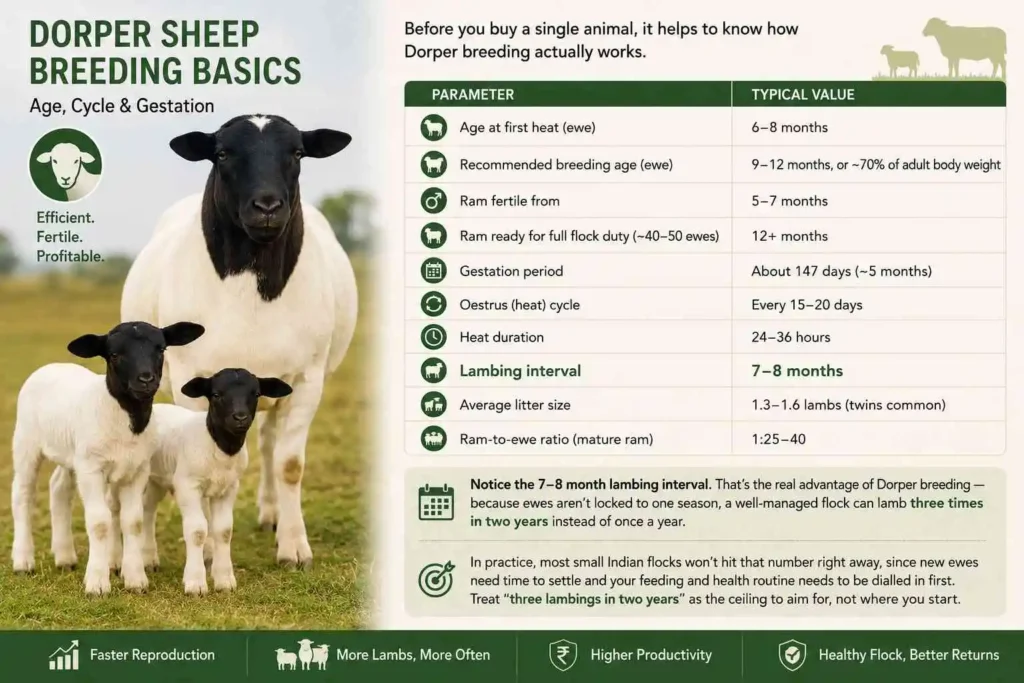
Before you buy a single animal, it helps to know how Dorper breeding actually works.
| Parameter | Typical Value |
|---|---|
| Age at first heat (ewe) | 6–8 months |
| Recommended breeding age (ewe) | 9–12 months, or ~70% of adult body weight |
| Ram fertile from | 5–7 months |
| Ram ready for full flock duty (~40–50 ewes) | 12+ months |
| Gestation period | About 147 days (~5 months) |
| Oestrus (heat) cycle | Every 15–20 days |
| Heat duration | 24–36 hours |
| Lambing interval | 7–8 months |
| Average litter size | 1.3–1.6 lambs (twins common) |
| Ram-to-ewe ratio (mature ram) | 1:25–40 |
Notice the 7–8 month lambing interval. That’s the real advantage of Dorper breeding — because ewes aren’t locked to one season, a well-managed flock can lamb three times in two years instead of once a year. In practice, most small Indian flocks won’t hit that number right away, since new ewes need time to settle and your feeding and health routine needs to be dialled in first. Treat “three lambings in two years” as the ceiling to aim for, not where you start.
How to Select the Right Ram and Ewe for Breeding
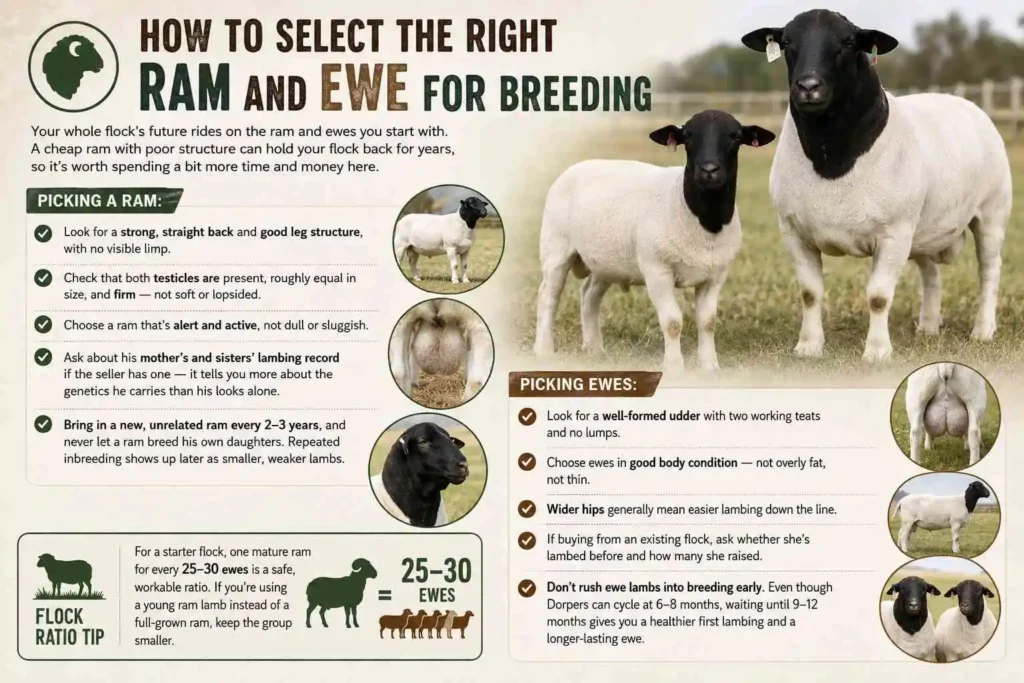
Your whole flock’s future rides on the ram and ewes you start with. A cheap ram with poor structure can hold your flock back for years, so it’s worth spending a bit more time and money here.
Picking a ram:
- Look for a strong, straight back and good leg structure, with no visible limp.
- Check that both testicles are present, roughly equal in size, and firm — not soft or lopsided.
- Choose a ram that’s alert and active, not dull or sluggish.
- Ask about his mother’s and sisters’ lambing record if the seller has one — it tells you more about the genetics he carries than his looks alone.
- Bring in a new, unrelated ram every 2–3 years, and never let a ram breed his own daughters. Repeated inbreeding shows up later as smaller, weaker lambs.
Picking ewes:
- Look for a well-formed udder with two working teats and no lumps.
- Choose ewes in good body condition — not overly fat, not thin.
- Wider hips generally mean easier lambing down the line.
- If buying from an existing flock, ask whether she’s lambed before and how many she raised.
- Don’t rush ewe lambs into breeding early. Even though Dorpers can cycle at 6–8 months, waiting until 9–12 months gives you a healthier first lambing and a longer-lasting ewe.
For a starter flock, one mature ram for every 25–30 ewes is a safe, workable ratio. If you’re using a young ram lamb instead of a full-grown ram, keep the group smaller.
Pure Dorper vs Crossbred: Which Should You Buy?
Very few Indian flocks run pure, full-blood Dorpers. Most Dorper sheep sold here — through IndiaMART, local livestock markets, or breeders — are crossbred: a Dorper ram mated to a hardy local ewe (breeds like Deccani, Madras Red, Nellore, or Malpura, depending on your state), with the offspring graded up over generations. You’ll often see this labelled F1, F2, F3 and so on, with each generation carrying a higher share of Dorper blood.
This isn’t a lesser option — for most beginners, it’s the smarter one:
- Crossbred animals cost far less than pure imports or high-grade pure lines.
- They keep some of the local breed’s resistance to Indian heat, ticks, and monsoon conditions.
- They’re easier to find nearby, which cuts down transport stress and disease risk.
Pure or high-grade Dorpers make more sense once you have experience, a reliable buyer for premium breeding stock, and the budget to manage a more delicate, higher-value animal.
| Type | Price Range (₹) |
|---|---|
| Crossbred Dorper lamb (F1), 3–4 months | ₹6,000 – ₹12,000 |
| Crossbred Dorper ewe, breeding age | ₹12,000 – ₹22,000 |
| Crossbred Dorper ram, breeding age | ₹18,000 – ₹35,000 |
| High-grade / near-pure Dorper ram | ₹35,000 – ₹80,000+ |
| Pure / imported-line Dorper ewe | ₹25,000 – ₹45,000 |
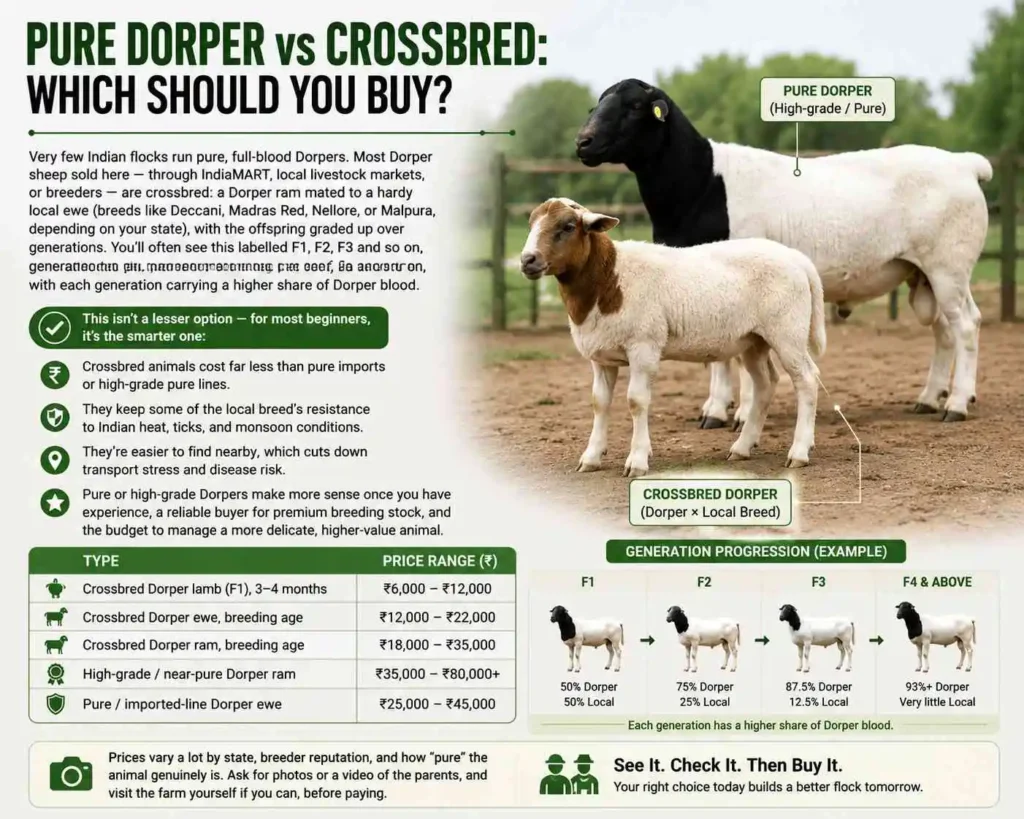
Prices vary a lot by state, breeder reputation, and how “pure” the animal genuinely is. Ask for photos or a video of the parents, and visit the farm yourself if you can, before paying.
Housing and Shelter for Your Breeding Flock
The good news: Dorpers don’t need an expensive shed. What they need is dry ground, fresh air, and shade.
- A raised or well-drained shed works best — wet mud floors breed foot rot and worms.
- Allow roughly 10–15 sq ft per adult sheep inside the shed, more if animals stay indoors during heavy rain.
- Keep a separate, clean pen ready for lambing. Move ewes here as they get close to term so you can watch them and step in if there’s trouble.
- Good airflow matters more than four solid walls — an open-sided shed with a strong roof works fine across most of India.
- Raise feed and water troughs off the ground to cut down contamination and worm load.
Feeding Management for Breeding Dorper Sheep
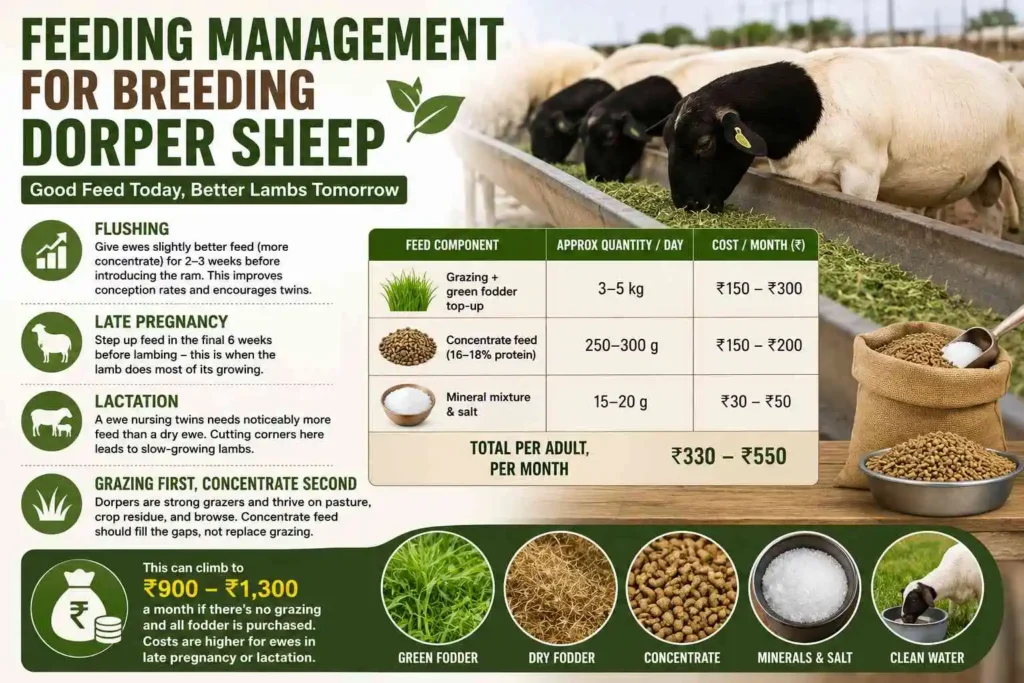
Feeding is where most of your running cost — and most of your results — comes from. A few rules that matter:
- Flushing: Give ewes slightly better feed (a bit more concentrate) for 2–3 weeks before you bring in the ram. This can lift conception rates and encourage twins.
- Late pregnancy: Step up feed in the final 6 weeks before lambing — this is when the lamb does most of its growing.
- Lactation: A ewe nursing twins needs noticeably more feed than a dry ewe. Cutting corners here shows up later as slow-growing lambs.
- Grazing first, concentrate second: Dorpers are strong grazers and do well on pasture, crop residue, and browse where it’s available. Concentrate feed should fill the gaps in the diet, not replace grazing entirely.
| Feed Component | Approx Quantity/Day | Cost/Month (₹) |
|---|---|---|
| Grazing + green fodder top-up | 3–5 kg | ₹150 – ₹300 |
| Concentrate feed (16–18% protein) | 250–300 g | ₹150 – ₹200 |
| Mineral mixture & salt | 15–20 g | ₹30 – ₹50 |
| Total per adult, per month | ₹330 – ₹550 |
This can climb to ₹900–₹1,300 a month if there’s no grazing at all and every bit of fodder is bought in, and it goes up further for ewes in late pregnancy or lactation.
Health Care: Vaccination and Deworming Schedule
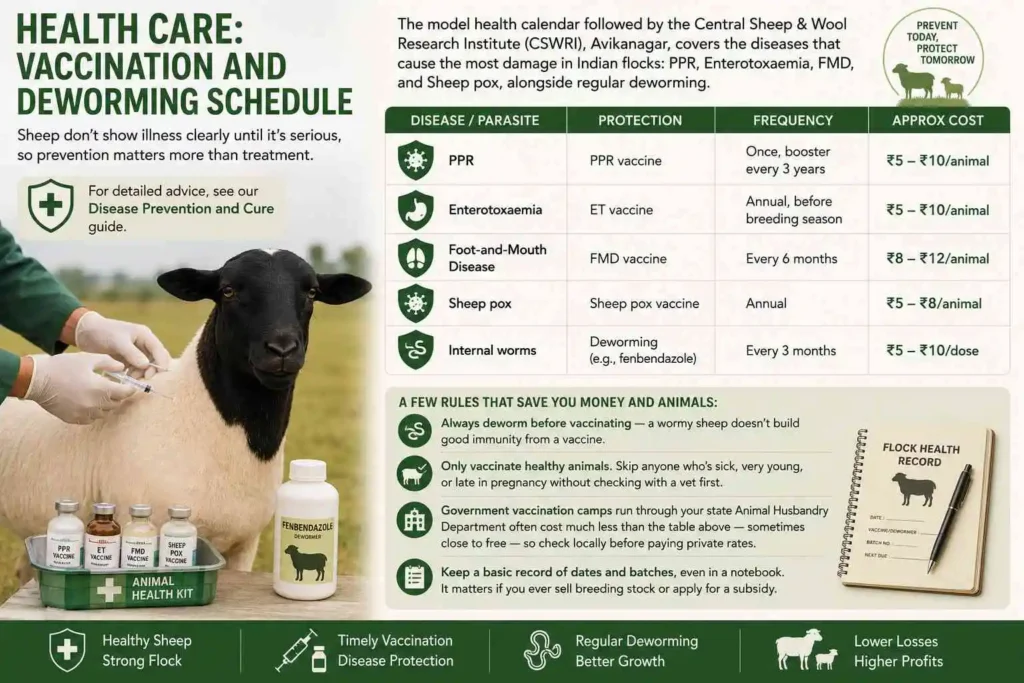
Sheep don’t show illness clearly until it’s serious, so prevention matters more than treatment. For detailed advice, see our Disease Prevention and Cure guide. The model health calendar followed by the Central Sheep & Wool Research Institute (CSWRI), Avikanagar, covers the diseases that cause the most damage in Indian flocks: PPR, Enterotoxaemia, FMD, and Sheep pox, alongside regular deworming.
| Disease / Parasite | Protection | Frequency | Approx Cost |
|---|---|---|---|
| PPR | PPR vaccine | Once, booster every 3 years | ₹5 – ₹10/animal |
| Enterotoxaemia | ET vaccine | Annual, before breeding season | ₹5 – ₹10/animal |
| Foot-and-Mouth Disease | FMD vaccine | Every 6 months | ₹8 – ₹12/animal |
| Sheep pox | Sheep pox vaccine | Annual | ₹5 – ₹8/animal |
| Internal worms | Deworming (e.g., fenbendazole) | Every 3 months | ₹5 – ₹10/dose |
A few rules that save you money and animals:
- Always deworm before vaccinating — a wormy sheep doesn’t build good immunity from a vaccine.
- Only vaccinate healthy animals. Skip anyone who’s sick, very young, or late in pregnancy without checking with a vet first.
- Government vaccination camps run through your state Animal Husbandry Department often cost much less than the table above — sometimes close to free — so check locally before paying private rates.
- Keep a basic record of dates and batches, even in a notebook. It matters if you ever sell breeding stock or apply for a subsidy.
Cost of Starting a Dorper Sheep Breeding Farm in India
Here’s a rough budget for a small starter unit of 20 breeding ewes and 1–2 rams — a size a family can manage directly, and big enough to be worth taking seriously.
| Item | Approx Cost (₹) |
|---|---|
| 20 crossbred ewes @ ~₹13,000 avg | ₹2,60,000 |
| 1–2 breeding rams | ₹35,000 – ₹60,000 |
| Shed (low-cost, local materials) | ₹60,000 – ₹1,20,000 |
| Fencing, feeders, water troughs | ₹20,000 – ₹30,000 |
| Medical kit + first vaccinations | ₹3,000 – ₹5,000 |
| Working capital (feed, first 3 months) | ₹25,000 – ₹35,000 |
| Total | ≈ ₹4.0 lakh – ₹5.1 lakh |
This assumes you already have land for grazing or growing fodder. If you need to lease or buy land, add that separately — and remember, costs shift a lot depending on your state and how “pure” your starting stock really is.
Dorper Sheep Farming Profit: What Can You Really Expect?
This is the question everyone actually wants answered, so let’s be direct — and honest that no one can promise you a fixed number.
| Particulars | Approx Value |
|---|---|
| Breeding ewes in flock | 20 |
| Lambs produced per year (~1.2/ewe, realistic smallholder average) | ~24 |
| Average sale weight (5–6 months) | ~25 kg |
| Average sale rate (live weight, meat market) | ₹300 – ₹350/kg |
| Gross revenue from lamb sales | ≈ ₹1.8 lakh – ₹2.1 lakh |
| Annual feed, health & upkeep cost | ≈ ₹1.2 lakh – ₹1.7 lakh |
| Approx net income | ≈ ₹40,000 – ₹70,000 |
Treat this as a planning tool, not a promise. A disease outbreak, a bad monsoon, or a dip in local mutton prices can eat into this fast. On the upside, selling even a few lambs as breeding stock instead of for meat — think ₹15,000–₹20,000 each instead of ₹7,000–₹9,000 — can lift your net income well above this range. Year one is usually weaker than this table, since new ewes take time to settle in; from year two or three onward, as you retain some ewe lambs to grow your own flock, the unit gets bigger and the numbers improve — but so does your feed bill.
Government Subsidy for Sheep Farming: National Livestock Mission
If cost is what’s holding you back, it’s worth checking the National Livestock Mission (NLM), run by the Department of Animal Husbandry & Dairying, Government of India. Its entrepreneurship component pays for half the cost of setting up a sheep or goat breeding unit — up to <cite index=”20-3″>₹50 lakh for the largest unit size — with feed and fodder infrastructure also covered.</cite> <cite index=”20-3″>A standard project starts at a minimum of 100 ewes and 5 rams, with smaller step-downs like 100+5 or 200+10 also allowed</cite>, but not much below that.
That means a 20-ewe starter flock like the one costed above won’t qualify for NLM funding on its own — it’s a realistic goal to grow toward once you’ve proven your management skills, not a day-one option. Individuals, Farmer Producer Organisations, and Self-Help Groups can apply through the NLM portal (nlm.udyamimitra.in), and the subsidy is released after the project is verified, not upfront, so plan your own funds for the early stages. Many state governments also run their own smaller sheep and goat schemes alongside NLM — your local Animal Husbandry Department or Krishi Vigyan Kendra (KVK) is the best place to check what’s currently active and what paperwork it needs.
Challenges You Should Know Before You Start
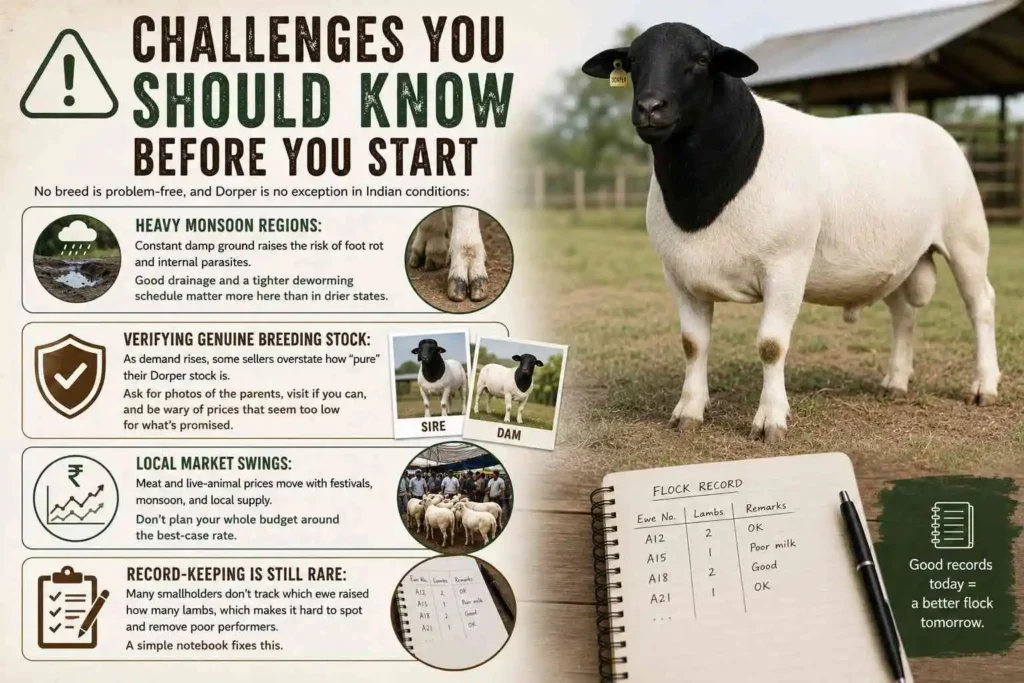
No breed is problem-free, and Dorper is no exception in Indian conditions:
- Heavy monsoon regions: Constant damp ground raises the risk of foot rot and internal parasites. Good drainage and a tighter deworming schedule matter more here than in drier states.
- Verifying genuine breeding stock: As demand rises, some sellers overstate how “pure” their Dorper stock is. Ask for photos of the parents, visit if you can, and be wary of prices that seem too low for what’s promised.
- Local market swings: Meat and live-animal prices move with festivals, monsoon, and local supply. Don’t plan your whole budget around the best-case rate.
- Record-keeping is still rare: Many smallholders don’t track which ewe raised how many lambs, which makes it hard to spot and remove poor performers. A simple notebook fixes this.
Where to Sell Your Dorper Sheep and Lambs
You have more options than just the local mandi:
- Local livestock markets/mandis — the quickest option, usually at meat-market rates.
- Direct sale to other breeders — for good ewe lambs and rams, this pays better than the meat rate.
- Online listings (IndiaMART, farmer WhatsApp and Facebook groups) — helps you reach buyers outside your immediate area.
- Meat processors or butchers directly — cuts out a middleman once you have steady volume.
Building a reputation for healthy, well-vaccinated stock is ultimately what lets you sell above the basic meat rate.
Final Thoughts
Breeding Dorper sheep in India isn’t a get-rich-quick idea, but it’s a genuinely solid option for farmers who want a hardy, fast-growing meat breed that doesn’t demand constant attention. Start small — 15–20 good ewes and one strong ram — get your feeding and health routine right, and let the numbers guide how fast you scale up. The breed’s biology does the rest: steady growth, easy lambing, and meat that sells well.
Frequently Asked Questions about Breeding Dorper Sheep
1. What is the best age to start breeding Dorper sheep?
Ewes are best bred at 9–12 months, once they’ve reached a good share of their adult weight. Rams can be used lightly from 7–8 months but handle full flock duty better from 12 months onward.
2. How many lambs can a Dorper ewe have in a year?
Under good management, Dorper ewes can lamb up to three times in two years, often with twins. Most smallholder flocks in India will see somewhat lower numbers, especially in the first year or two, as management and nutrition improve.
3. Is Dorper sheep farming actually profitable in India?
It can be, especially if you sell some animals as breeding stock rather than only for meat, and keep feed and health costs under control. Like any livestock business, returns depend on local prices, lambing success, and flock management — treat any profit figure, including the ones in this guide, as an illustration rather than a guarantee.
4. Can Dorper sheep handle Indian summers and monsoons?
They handle heat and dry conditions very well — that’s what they were originally bred for. Heavy monsoon regions need extra attention to drainage, foot care, and deworming, since damp ground raises disease risk.
5. Should a beginner buy pure Dorper or crossbred sheep?
For most beginners, crossbred Dorper (F1/F2) animals are the practical choice — cheaper, easier to find, and better suited to local conditions. Move toward higher-grade or pure stock once you have experience and buyers for premium breeding animals.
6. What government support is available for sheep farming in India?
The National Livestock Mission offers a 50% capital subsidy, up to ₹50 lakh, for setting up larger sheep and goat breeding units, starting at a minimum of 100 ewes and 5 rams. Apply through nlm.udyamimitra.in or your local Animal Husbandry office, which can also tell you about smaller state-level schemes.
Newsletter