


Solar Pump Subsidy 2026: PM-KUSUM Scheme, Cost, Eligibility & Online Apply
Diesel is costly. Electricity from the grid is not always there when your crop needs water most. Every farmer knows this pain. But there is good news. The Government of India runs a solar pump subsidy scheme that can cut your solar pump cost by 60% to as much as 90% in some states.
This scheme is called PM-KUSUM. In this guide, you get simple, honest answers: how much subsidy you get, what a solar pump actually costs in rupees, who can apply, what papers you need, and how to apply online step by step, without paying any agent.
In this guide: what the scheme is, how much subsidy you get, real pump costs, who is eligible, documents needed, the step-by-step application process, state-wise differences, the latest 2026 updates, common mistakes to avoid, and quick answers to common questions.
What Is the Solar Pump Subsidy Scheme?
The full name is Pradhan Mantri Kisan Urja Suraksha evam Utthaan Mahabhiyan, or PM-KUSUM for short. The Ministry of New and Renewable Energy (MNRE) started this scheme in 2019. Its job is simple: help farmers install solar pumps and solar power plants, and cut the country’s dependence on diesel pumps in farming.
The scheme has three parts, called components:
- Component A: Set up a small solar power plant (500 kW to 2 MW) on your barren or unused land, and sell the power to your local electricity company (DISCOM).
- Component B: Get a brand-new standalone solar pump for irrigation, mainly for farms with no grid electricity connection.
- Component C: Convert your existing electric pump to run on solar power, and sell any extra power back to the grid.
Most individual farmers apply under Component B, since it gives a new solar pump directly. That is the main focus of this guide.
Why This Solar Pump Subsidy Matters to You
- No diesel bill. No electricity bill for irrigation.
- Water during the day, when your crop needs it, not just when the grid decides to give power at night.
- A solar pump usually works well for around 25 years.
- Less smoke, less noise, cleaner air on your own farm.
- Under Component A and C, you can earn extra income by selling surplus power.
How Much Solar Pump Subsidy Do You Actually Get?
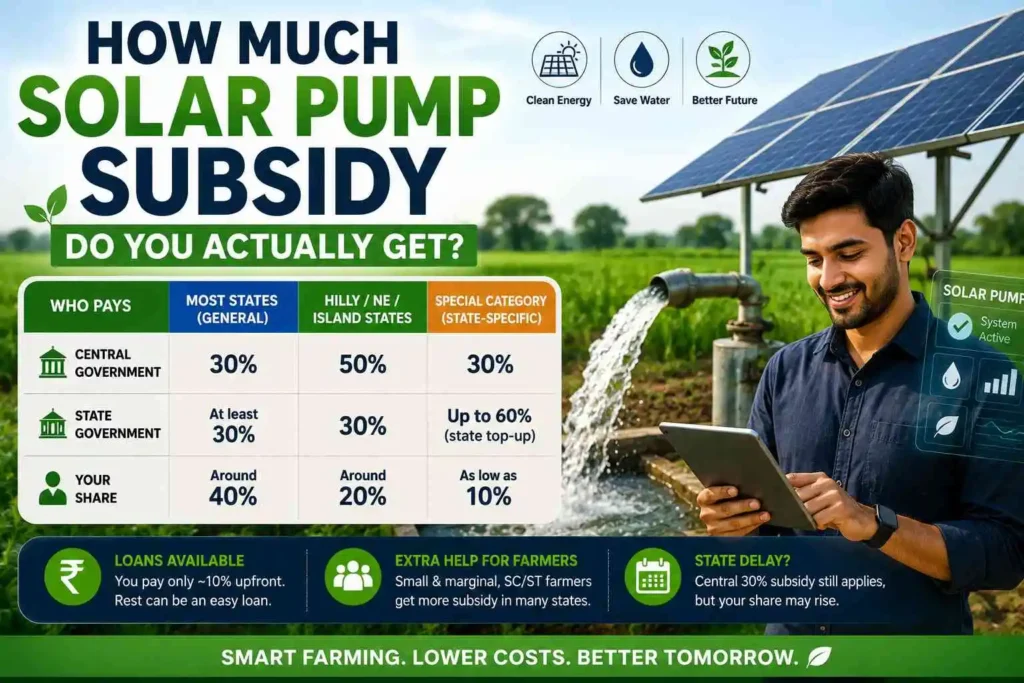
This is the part every farmer wants to know first. Under Component B, the cost is shared between the central government, the state government, and you.
| Who Pays | Most States (General) | Hilly / NE / Island States | Special Category (State-Specific) |
|---|---|---|---|
| Central Government | 30% | 50% | 30% |
| State Government | At least 30% | 30% | Up to 60% (state top-up) |
| Your Share | Around 40% | Around 20% | As low as 10% |
A few things to keep in mind:
- The “hilly / NE / island” column covers the North-Eastern states, Sikkim, Jammu & Kashmir, Himachal Pradesh, Uttarakhand, Ladakh, Lakshadweep, and the Andaman & Nicobar Islands.
- Many states give extra help to small and marginal farmers and to SC/ST farmers. For example, in parts of Madhya Pradesh, farmers in notified tribal blocks pay only around 10% of the pump cost, while general-category farmers in the same state pay around 40%. Uttar Pradesh gives an extra state subsidy to ST, Vantangia, and Musahar farmers, beyond the general rate.
- Your share does not have to come fully from your own pocket. Banks give loans for this share, so in many cases you pay only around 10% in cash upfront, with the rest as an easy loan.
- If your state government has not released its 30% share yet, the central 30% subsidy still applies, but your own share may rise until the state catches up.
Solar Pump Cost in Rupees: What You Actually Pay
Solar pump prices depend on horsepower (HP), the type of pump (surface or submersible), and your state’s fixed benchmark cost. Here is a realistic picture, based on current benchmark ranges across states:
| Pump Capacity | Typical Cost Before Subsidy | Total Subsidy (up to 60%) | Your Approx. Share |
|---|---|---|---|
| 3 HP | ₹1.5 lakh – ₹2 lakh | ₹90,000 – ₹1.2 lakh | ₹60,000 – ₹80,000 |
| 5 HP | ₹2.5 lakh – ₹3 lakh | ₹1.5 lakh – ₹1.8 lakh | ₹1 lakh – ₹1.2 lakh |
| 7.5 HP | ₹3.5 lakh – ₹4 lakh | ₹2.1 lakh – ₹2.4 lakh | ₹1.4 lakh – ₹1.6 lakh |
To put this in real terms: one state nodal agency fixed the 2026 benchmark cost of a 5 HP submersible solar pump at around ₹2.80 lakh. A general-category farmer there pays close to ₹1.12 lakh. An SC/ST farmer in a notified tribal block pays only around ₹28,000, close to a tenth of the total cost.
Standard Component B pumps go up to 7.5 HP in most states. Farmers in NE, hilly, and island states can get support for pumps up to 15 HP, thanks to the higher central subsidy available there.
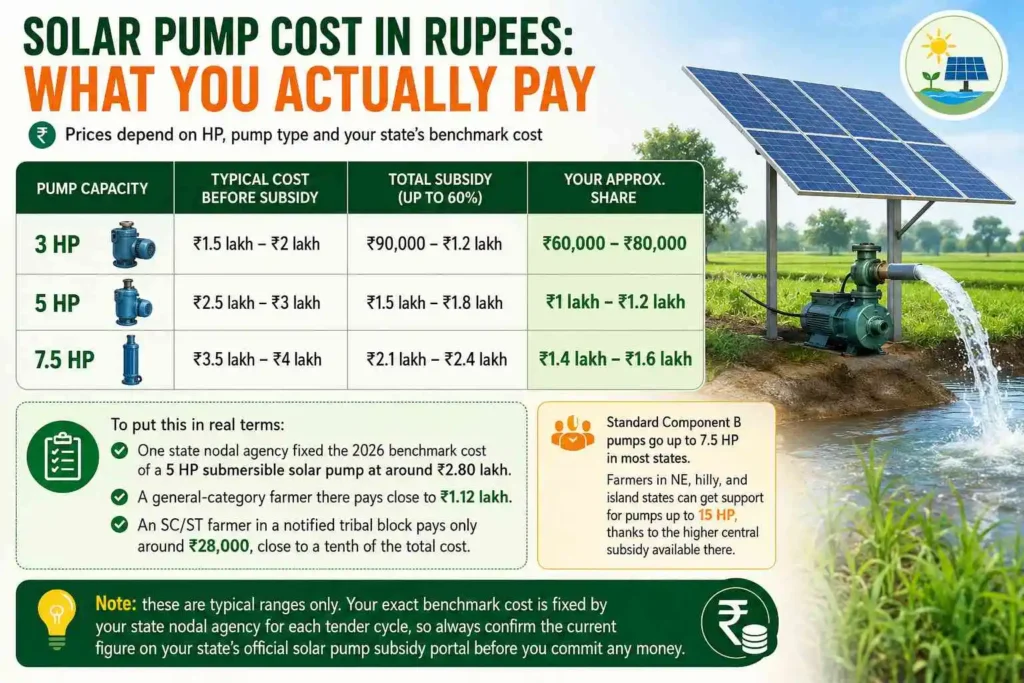
Note: these are typical ranges only. Your exact benchmark cost is fixed by your state nodal agency for each tender cycle, so always confirm the current figure on your state’s official solar pump subsidy portal before you commit any money.
Are You Eligible for the Solar Pump Subsidy?
You can apply if you are:
- An individual farmer, a group of farmers, a Farmer Producer Organisation (FPO), a cooperative society, a panchayat, or a Water User Association.
- The owner of cultivable agricultural land with clear land records in your name, or a registered tenant with the landowner’s written consent.
- Applying for a field that has a water source (borewell, open well, canal, or pond) but no existing grid-connected electric pump, if you want Component B. If you already have a grid-connected pump, apply under Component C instead.
Important: if you already received a solar pump subsidy under a similar scheme in the last seven years, you cannot apply again under PM-KUSUM, whatever the pump size.
Priority usually goes to small and marginal farmers (land holding up to 2 hectares), SC/ST applicants, and farmers already using drip or sprinkler irrigation.
Documents You Will Need
Keep these ready before you start your application:
- Aadhaar card
- Land ownership document (7/12 extract, khasra-khatauni, jamabandi, or patta, depending on your state), or a tenancy agreement with the landowner’s consent
- Bank passbook or account details, linked to Aadhaar
- One recent passport-size photograph
- A working mobile number, for OTP and status updates
- Caste certificate, if applying under the SC/ST/OBC category for extra subsidy
- Proof of a water source on your field
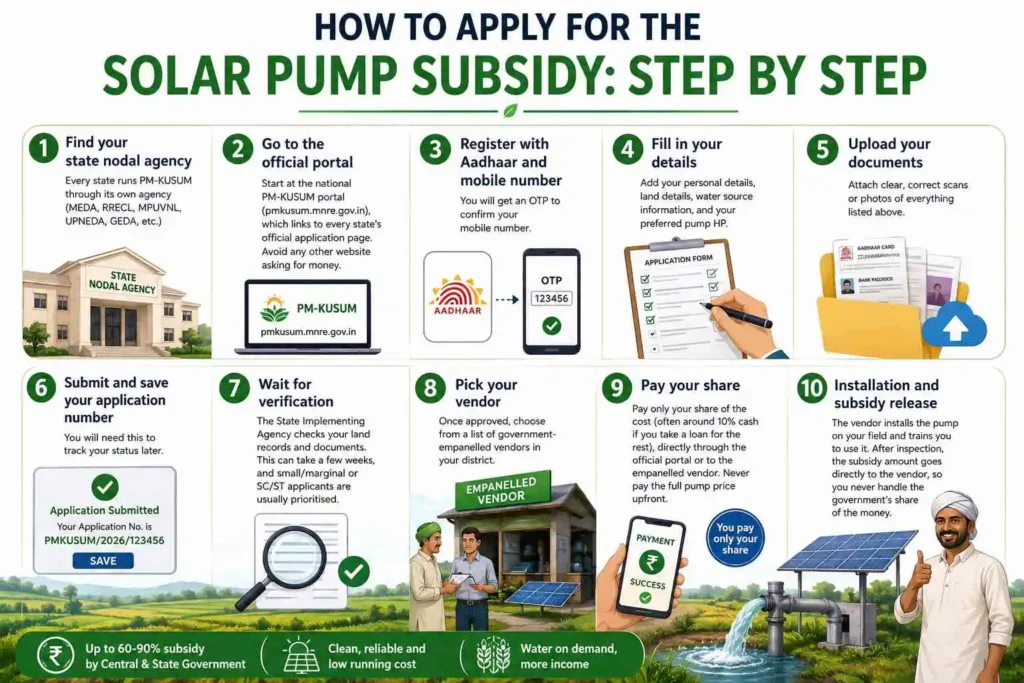
How to Apply for the Solar Pump Subsidy: Step by Step
- Find your state nodal agency. Every state runs PM-KUSUM through its own agency: MEDA in Maharashtra, RRECL in Rajasthan, MPUVNL in Madhya Pradesh, UPNEDA in Uttar Pradesh, GEDA in Gujarat, and similar bodies elsewhere.
- Go to the official portal. Start at the national PM-KUSUM portal (pmkusum.mnre.gov.in), which links to every state’s official application page. Avoid any other website asking for money to “register” you.
- Register with Aadhaar and mobile number. You will get an OTP to confirm your mobile number.
- Fill in your details. Add your personal details, land details, water source information, and your preferred pump HP.
- Upload your documents. Attach clear, correct scans or photos of everything listed above.
- Submit and save your application number. You will need this to track your status later.
- Wait for verification. The State Implementing Agency checks your land records and documents. This can take a few weeks, and small/marginal or SC/ST applicants are usually prioritised.
- Pick your vendor. Once approved, choose from a list of government-empanelled vendors in your district.
- Pay your share. Pay only your share of the cost (often around 10% cash if you take a loan for the rest), directly through the official portal or to the empanelled vendor. Never pay the full pump price upfront.
- Installation and subsidy release. The vendor installs the pump on your field and trains you to use it. After inspection, the subsidy amount goes directly to the vendor, so you never handle the government’s share of the money.
How the Solar Pump Subsidy Differs by State
| State | Nodal Agency | Special Point to Know |
|---|---|---|
| Maharashtra | MEDA (Mahaurja) | Farmer share around 10% general, around 5% for SC/ST |
| Rajasthan | RRECL | Strong push on Component A, using fallow land for solar plants |
| Madhya Pradesh | MPUVNL | Notified tribal blocks can reach up to 90% total subsidy |
| Uttar Pradesh | UPNEDA | Enhanced state subsidy for ST, Vantangia, and Musahar farmers |
| Gujarat | GEDA | Fully online application, fast document processing |
| NE States, J&K, HP, Uttarakhand, Ladakh, A&N Islands | Respective state agency | Central subsidy raised to 50%, farmer share as low as 20% |
Always check your own state’s portal for the current benchmark cost and open application window, since quotas and timing change through the year.
What’s New in the Solar Pump Subsidy Scheme in 2026
What’s New in the Solar Pump Subsidy Scheme in 2026
The solar pump subsidy scheme continues to support farmers in 2026, with the government focusing on faster installation, wider adoption, and better access to clean irrigation solutions. Under the current phase, implementation timelines have been extended in several areas, allowing states and approved vendors more time to complete pending installations and reduce delays faced by farmers.
For farmers, the biggest change is not just the availability of subsidy but the growing push toward solar-powered irrigation as a way to reduce diesel costs, improve energy independence, and provide reliable water access in areas with limited electricity supply.
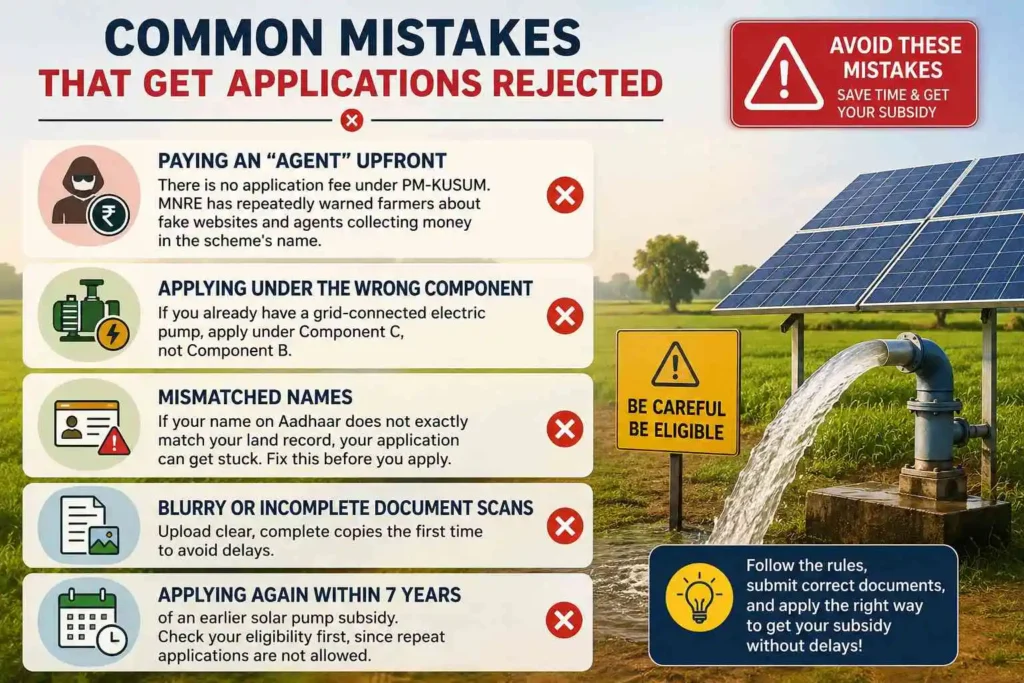
Common Mistakes That Get Applications Rejected
- Paying an “agent” upfront. There is no application fee under PM-KUSUM. MNRE has repeatedly warned farmers about fake websites and agents collecting money in the scheme’s name.
- Applying under the wrong component. If you already have a grid-connected electric pump, apply under Component C, not Component B.
- Mismatched names. If your name on Aadhaar does not exactly match your land record, your application can get stuck. Fix this before you apply.
- Blurry or incomplete document scans. Upload clear, complete copies the first time to avoid delays.
- Applying again within seven years of an earlier solar pump subsidy. Check your eligibility first, since repeat applications are not allowed.
Final Word
The solar pump subsidy under PM-KUSUM is one of the most useful schemes running for Indian farmers today. It cuts your biggest recurring cost, whether that is diesel or unreliable grid power, and can even turn your land into a small source of extra income. Keep your documents ready, apply only through your state’s official portal, and never pay anyone extra to “speed up” your file. The subsidy is real, it is government-backed, and thousands of farmers are already using it every season.
For the latest official updates, always check pmkusum.mnre.gov.in and mnre.gov.in.
Reducing irrigation costs is only one part of improving farm profitability. Many farmers are now combining crop production with livestock activities to create multiple income sources. If you are planning to start goat farming, check our detailed goat farming subsidy guide to learn about available government schemes, eligibility, application process, and financial assistance.
Frequently Asked Questions
What is the maximum solar pump subsidy available in India?
In most states, the combined central and state subsidy goes up to 60% of the pump cost. In hilly, North-Eastern, and island states, and for some SC/ST categories in certain states, the effective subsidy can reach 80-90%.
Do I need to pay anything upfront?
Yes, but only your own share, often around 10% in cash if you take a bank loan for the rest, or up to 40% if you pay it all yourself. You never pay the government’s share, and you never pay an “agent” a registration fee.
Can I get this subsidy if I already have an electric pump?
Yes, but through Component C, which solarises your existing grid-connected pump, not Component B, which is for a brand-new standalone pump.
How long does approval usually take?
It varies by state and by how many applications are pending, but many farmers see initial verification within a few weeks of submitting a complete, correct application.
Is there one last date to apply in 2026?
There is no single fixed national deadline. Each state opens and closes its application window based on its own yearly quota, so check your state’s portal regularly instead of waiting for one national date.
Newsletter




Very helpful guide!