


Drip Irrigation System Cost in India: Cheapest Setup Guide (2026)
Picture this.
You wake up before sunrise, water your field for two hours straight, go home and drink your chai — and by noon, half your tomato plants are still wilting in the heat. The water reached the soil, yes. But it didn’t reach the roots where it actually matters. Half of it evaporated. A quarter of it ran off. You worked hard, used a lot of water, and your crops still suffered.
Sound familiar?
If you’ve farmed for even one season, you know this frustration. And chances are, someone has already told you: “Bhai, try drip irrigation.” But then you asked the cost — and got ten different answers from ten different people.
That’s exactly why I’m writing this. No confusing numbers. No technical language that sounds like it’s meant for engineers, not farmers. Just a clear, honest look at the drip irrigation system cost — broken down simply, so you can decide if it makes sense for your land.
Let’s get into it.
For a typical 1-acre farm in India, a drip irrigation system can cost roughly ₹35,000–₹60,000 for a basic material setup, while a professionally designed and installed system may cost ₹80,000–₹1.2 lakh or more, depending on the crop, spacing, water source, filtration, automation, and system design. Government subsidy can significantly reduce the farmer’s actual contribution, but the amount varies by state, farmer category, crop, and scheme rules.
First, What Exactly Does Drip Irrigation Do?
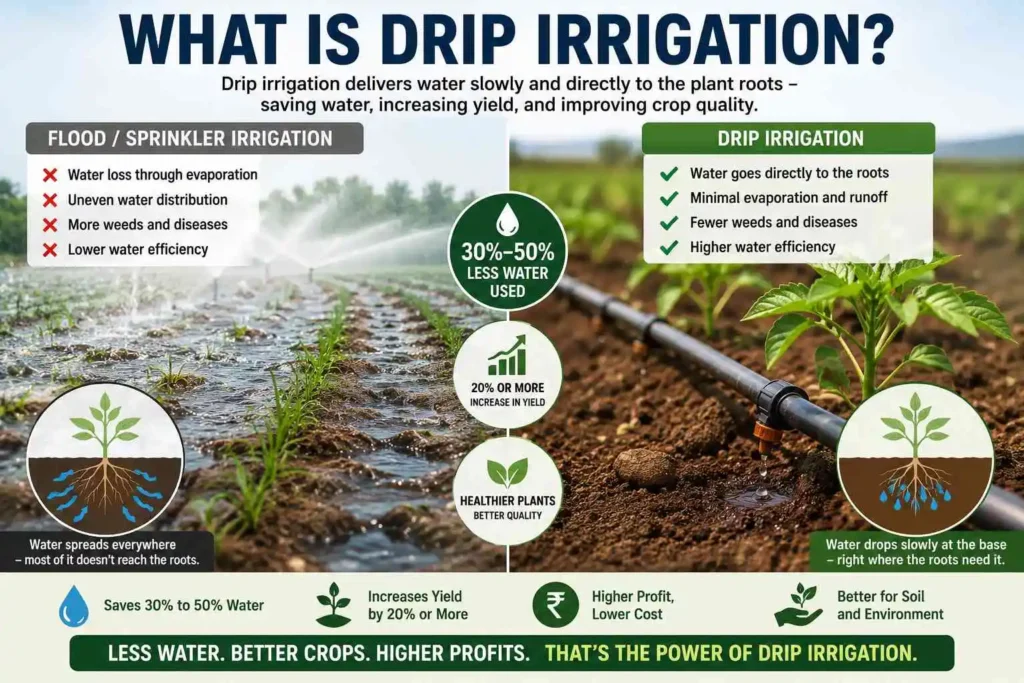
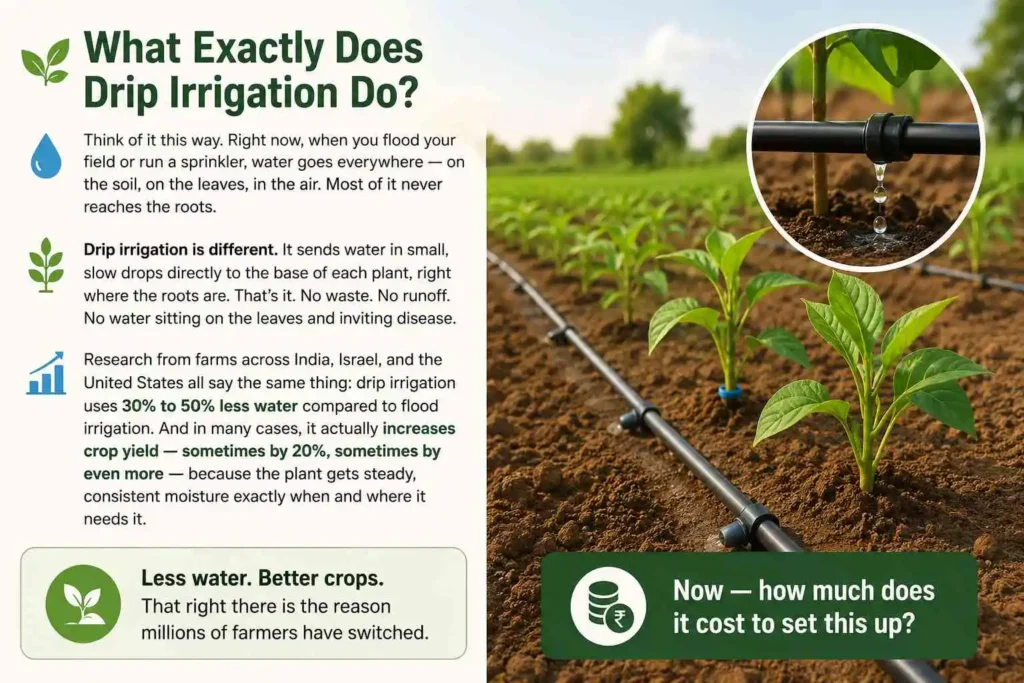
Think of it this way. Right now, when you flood your field or run a sprinkler, water goes everywhere — on the soil, on the leaves, in the air. Most of it never reaches the roots.
Drip irrigation is different. It sends water in small, slow drops directly to the base of each plant, right where the roots are. That’s it. No waste. No runoff. No water sitting on the leaves and inviting disease.
Research from farms across India, Israel, and the United States all say the same thing: drip irrigation uses 30% to 50% less water compared to flood irrigation. And in many cases, it actually increases crop yield — sometimes by 20%, sometimes by even more — because the plant gets steady, consistent moisture exactly when and where it needs it.
Less water. Better crops. That right there is the reason millions of farmers have switched.
Now — how much does it cost to set this up?
What Makes Up the Drip Irrigation System Cost?
Here’s the honest truth: there is no single price. The cost depends on your land size, your crop, and how simple or advanced you want your system to be.
But every drip system — big or small — has the same basic parts. Let me explain each one in simple terms:
The main pipe runs along your field like a backbone. It’s a thick plastic pipe that carries water from your source (a pump, a tank, or a tap) to your entire field. For a small home garden, you might need just a few metres. For a 5-acre farm, you’ll need hundreds of metres. The cost grows with the length.
The smaller water lines branch off from the main pipe and run between your plant rows. These are thin tubes — almost like a long, flexible straw. Water flows through them to each plant. You can buy cheap lines that last 2–3 seasons, or slightly better ones that last 5–7 seasons. The choice you make here affects your long-term cost.
The drippers are tiny little devices, about the size of a coin, attached to the small lines near each plant. They let out water in slow drops — not a flood, just a steady drip. A dripper that releases half a litre of water per hour is usually enough for vegetables. For fruit trees, you might need one that releases a little more. Each dripper costs very little — but on a large farm with thousands of plants, the total adds up.
The filter is something many farmers skip — and then regret. Drippers are tiny. If your water has even a little sand, mud, or rust, those tiny holes will block within days. A good filter sits at the start of your system and cleans the water before it enters the pipes. Don’t skip this. A basic filter costs very little but saves your entire system.
The timer is optional but life-changing. You set it once, and the system waters your field automatically — at whatever time you choose. You can sleep. You can work somewhere else. The water runs on its own. A simple timer is not expensive. A fancy digital one that you can control from your phone costs more, but some farmers say it’s the best money they ever spent.
Labour — if you hire someone to install the system for you — will add about 40–60% to the total cost. On a small plot, you can easily do it yourself over a weekend. On a large farm, professional help is worth it.
Drip Irrigation Cost Per Acre in India
| Farm/Crop Situation | Approximate Cost Per Acre |
|---|---|
| Basic drip system | ₹35,000–₹60,000 |
| Professionally designed system | ₹80,000–₹1,20,000+ |
| High-density vegetable crops | Can be higher |
| Orchards with wider spacing | Can vary depending on layout |
| Automation/fertigation added | Additional cost |
Note: The prices mentioned above are indicative market ranges and should be used only for initial budgeting. Actual drip irrigation costs can vary depending on crop type, plant spacing, field size and layout, water source, filtration requirements, pipe quality, automation, and installation charges. For an accurate estimate, get a detailed quotation from a reputable drip irrigation supplier or approved vendor after a site assessment.
Drip Irrigation System Cost by Farm Size
Here’s a clear breakdown by farm size:
| Farm / Plot Size | Setup Type | Cost (INR) | Cost (USD)* |
|---|---|---|---|
| Kitchen/home garden (up to 200 sq ft) | Ready-made kit | ₹1,500 – ₹5,000 | $16 – $53 |
| Backyard / half-bigha (500–1,000 sq ft) | Basic DIY setup | ₹5,000 – ₹18,000 | $53 – $190 |
| 1 acre | DIY install | ₹35,000 – ₹60,000 | $375 – $640 |
| 1 acre | Professional install | ₹80,000 – ₹1,20,000 | $850 – $1,275 |
| 5–10 acres | Full system (filter + timer) | ₹2,50,000 – ₹8,00,000 | $2,650 – $8,500 |
| 25+ acres | Large-scale system | ₹15,00,000 – ₹40,00,000+ | $16,000 – $42,500+ |
*USD figures are calculated at roughly ₹94 to the dollar (mid-2026 rate). Exchange rates move, so treat these as rough reference points, not exact numbers.
Here’s what those numbers mean on the ground:
Small kitchen garden or home garden (up to 200 square feet): You can buy a ready-made kit for ₹1,500 to ₹5,000 (roughly $16–$53). Everything comes in one box — pipes, drippers, filter, and a simple timer. You connect it to a tap and you’re done. No expert needed.
Backyard or half-bigha plot (500–1,000 square feet): At this size, expect to spend ₹5,000 to ₹18,000 (roughly $53–$190). You’ll want a slightly better filter, maybe a basic automatic timer, and a few more lines. Still easy to set up yourself over a day or two.
1-acre farm: This is where real farming begins, and where the decision really matters. A basic drip system for 1 acre — which you install yourself — costs roughly ₹35,000 to ₹60,000 (roughly $375–$640) in materials. If you hire a contractor to design and install it properly, it can go up to ₹80,000 to ₹1,20,000 (roughly $850–$1,275). For crops like tomatoes, chillies, or sugarcane, the extra investment in a good system pays back fast.
5 to 10-acre farm: A proper system with good pipes, a quality filter, and an automatic timer runs ₹2,50,000 to ₹8,00,000 (roughly $2,650–$8,500). If you want a fertilizer injection system too — where you mix fertilizer directly into the water — add some more to that budget. It sounds expensive, but divide it by your acres and the per-acre cost starts looking reasonable.
Large farm of 25 acres or more: Here the cost ranges from ₹15,00,000 to ₹40,00,000 or more (roughly $16,000–$42,500+). These are big systems with multiple pipes running across the entire farm, strong filters, digital controllers, and sometimes remote monitoring. The good news — at this scale, buying in bulk lowers your per-acre cost significantly.
5 Things That Make Your Cost Go Up or Down
Same field size, very different prices — why? Here’s what changes the number:
Your crop type. Vegetables like spinach, onion, and chilli need drippers placed close together. Fruit trees and sugarcane have wider spacing and need fewer drippers overall. More drippers = higher cost.
Your water quality. If your borewell water has sand or rust in it, you need a stronger filter. That costs more. If your water is clean from a canal or pipeline, a simple cheap filter is enough.
Your land shape. Flat land is easy — water flows evenly. Sloped land is trickier. You need special drippers that adjust themselves for the slope to make sure every plant gets the same amount of water. These cost a bit more.
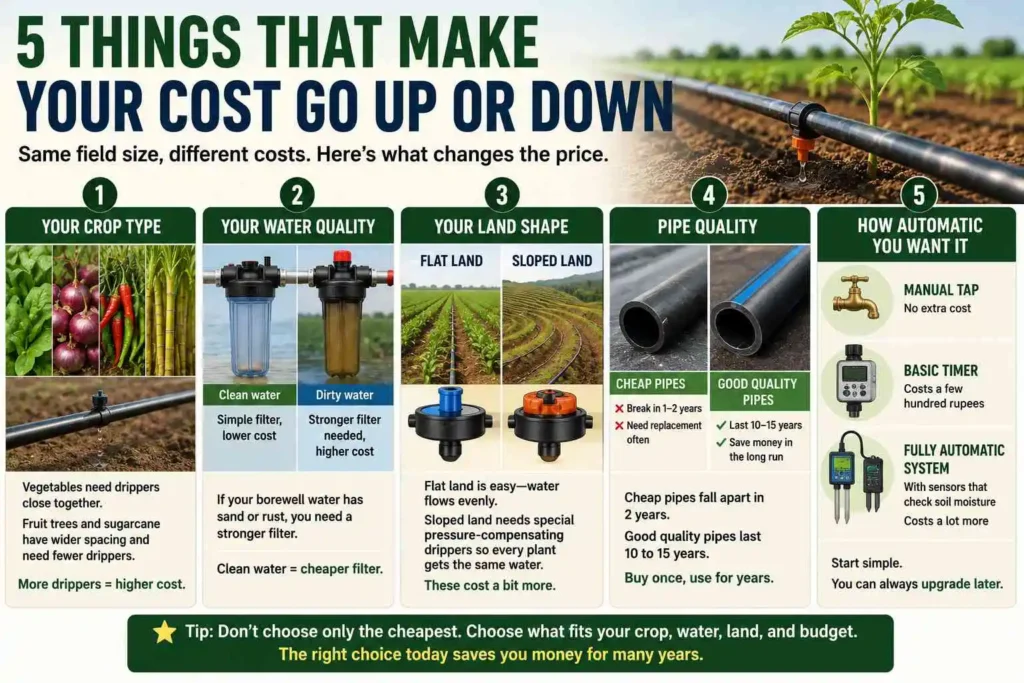
Pipe quality. You can buy cheap plastic pipes that fall apart in 2 years. Or you can spend a bit more on good quality pipes that last 10 to 15 years. On a large farm, always choose quality. Replacing pipes every 2 years costs more in the long run than buying good ones once.
How automatic you want it. A manual tap costs nothing extra. A basic timer costs a few hundred rupees. A fully automatic system with sensors that check soil moisture costs a lot more. Start simple. You can always upgrade later.
Should You Install It Yourself or Hire Someone?
This one is simple.
For a small garden or up to half an acre — do it yourself. A good drip kit comes with clear instructions, and most farmers can set it up over a weekend. There’s no complicated skill involved. If something doesn’t work, it’s almost always a blocked dripper or a loose connector — easy to fix.
For 1 acre and above — seriously consider hiring a professional, at least for the planning. Here’s why. A badly designed system wastes water just like flood irrigation. If your pipes are laid wrong or your drippers are spaced wrong for your crop, you’ll spend money on a system that doesn’t fully work. A good installer will walk your land, look at your crops, check your water source, and design a system that actually delivers water to every plant evenly. That planning is worth paying for.
The Costs Nobody Warns You About
Every guide talks about buying the system. Very few talk about what happens after.
Small connectors and end caps — the tiny fittings that join pipes together — are cheap individually but you’ll need more of them than you think. Keep ₹2,000 to ₹5,000 aside for extra fittings when you’re installing.
Cleaning the filter — you’ll need to do this every few weeks, especially if your water has sediment. It takes 10 minutes and costs nothing. But if you forget, your drippers block, your plants don’t get water, and you only realize it when they start wilting.
Rats and rodents — this one surprises many new users. Rats love chewing through irrigation pipes in the field at night. It sounds funny until you walk out to find 20 plants without water. Check your pipes every week or two, especially in the first season.
Replacing drip tape — the thin tube near your plants is not meant to last forever. Budget for replacing it every 3 to 5 years, depending on quality.
When Will You Get Your Money Back?
This is the most important question of all — and the answer is better than most farmers expect.
On a small garden or home setup, you recover the cost within a year or two just from your lower water bill.
On a farm, it’s a bigger calculation. But here’s how it works out for most farmers:
You save 30–50% on water. You save on labour because you’re not standing in the field with a pipe for hours. Your fertilizer goes further because you can mix it into the drip water and send it directly to the roots — nothing washes away. And your yield goes up because the plants get steady water and never stress.
Farmers across India — in Maharashtra, Gujarat, Andhra Pradesh, and Karnataka — who have switched to drip irrigation report recovering their full investment in 18 months to 3 years. After that, every rupee saved on water and every extra kilogram of produce is pure profit.
The Best Way to Lower Your Drip Irrigation System Cost
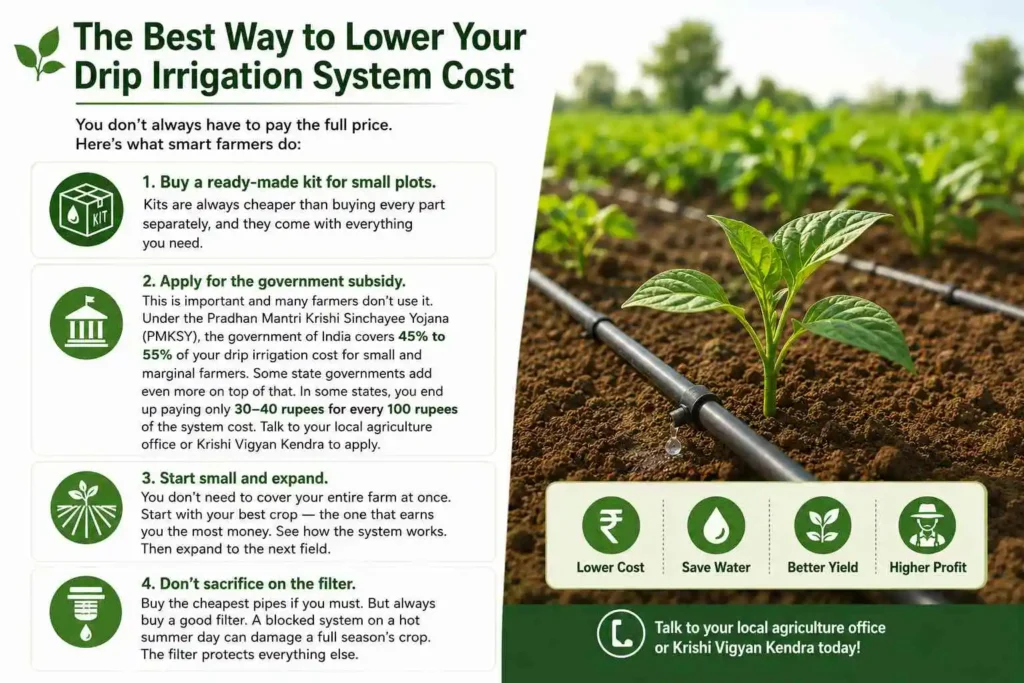
You don’t always have to pay the full price. Here’s what smart farmers do:
Buy a ready-made kit for small plots. Kits are always cheaper than buying every part separately, and they come with everything you need.
Apply for the government subsidy. This is important and many farmers don’t use it. Under the Pradhan Mantri Krishi Sinchayee Yojana (PMKSY), the government of India covers 45% to 55% of your drip irrigation cost for small and marginal farmers. Some state governments add even more on top of that. In some states, you end up paying only 30–40 rupees for every 100 rupees of the system cost. Talk to your local agriculture office or Krishi Vigyan Kendra to apply.
Start small and expand. You don’t need to cover your entire farm at once. Start with your best crop — the one that earns you the most money. See how the system works. Then expand to the next field.
Don’t sacrifice on the filter. Buy the cheapest pipes if you must. But always buy a good filter. A blocked system on a hot summer day can damage a full season’s crop. The filter protects everything else.
The Simple Truth
The drip irrigation system cost is not a small number. But it’s also not a loss. It’s the kind of money that comes back to you — in saved water, saved labour, and better crops.The real question is not “can I afford drip irrigation?” The real question is: “Can I keep farming efficiently without it — especially when water is getting scarcer and more expensive every year?”
Most farmers who install drip irrigation say the same thing after one season: “I wish I had done this 5 years ago.”Maybe you’re not ready yet. Maybe you just want to start small with a ₹2,000 garden kit and see how it feels. That’s fine. Start anywhere.
Just start.Because the day you stop losing water to the sun and the soil — is the day your farm starts working harder for you.
Best Crops to Grow With Drip Irrigation
Not every crop benefits equally from drip irrigation, but two stand out for the return they offer relative to the investment: tomatoes and onions.
Tomato farming responds especially well to drip irrigation because tomatoes are sensitive to inconsistent watering — too much or too little at the wrong stage affects fruit size, cracking, and disease resistance. Drip irrigation delivers steady, controlled moisture right at the root zone, which tends to improve both yield and fruit quality compared to flood irrigation.
Onion farming also pairs well with drip systems. Onions have shallow root systems and are prone to bulb rot if the soil stays too wet, so the precise, controlled watering that drip irrigation provides — rather than flooding the field — helps produce healthier, more uniform bulbs.
If you’re deciding where to install your first drip system on a limited budget, starting with whichever of these two crops makes up the larger share of your land is usually the fastest way to see a return.
Frequently Asked Questions
1.How long does a drip irrigation system actually last?
It depends on which part you mean. Good-quality main pipes can last 10–15 years. The drip tape/laterals near the plants are the weakest link and usually need replacing every 3–5 years. Drippers and filters last several years if you clean them regularly. Budget for replacing the cheaper, exposed parts rather than expecting to redo the whole system at once.
2.Will my borewell water clog the drippers?
f your borewell water carries sand, silt, or rust — which is common — yes, it will block the tiny dripper openings within days unless you install a proper filter at the start of the system. Canal or clean tap water usually gets by with just a basic filter.
3.Does drip irrigation work for every crop?
It works best for row crops, vegetables, fruit orchards, sugarcane, and cotton — anything planted in defined rows. Crops grown by broadcasting seed across the whole field, like paddy or wheat, are still usually irrigated by flood or sprinkler, since spacing individual drippers for them isn’t practical.
4.How do I actually apply for the PMKSY subsidy?
The process is broadly the same across states, though the portal name differs: you register on your state’s agriculture or horticulture department portal (sometimes called the MIP portal), or go in person to your nearest Krishi Vigyan Kendra or Block Development Office. You’ll need a layout and quotation from a state-empanelled vendor, since the subsidy is usually only paid if you install through an approved vendor. After your land and water source are field-verified, you install the system, and the subsidy is credited directly to your bank account once it’s inspected.
Newsletter