



Orange Farming in India: Full Guide for High Profit
Picture this — it’s February in Nagpur. The air smells faintly of citrus, trucks loaded with bright orange fruit are lining up on dusty roads, and a farmer with a 5-acre orchard is quietly calculating a profit that would make most salaried people envious.
That’s the quiet, underrated power of orange farming in India.
And here’s the thing — most people still treat it as a “Nagpur thing.” A regional specialty. A fruit you eat at halftime. But the reality is that India is one of the world’s leading citrus producers, and orange farming is quietly becoming one of the most financially rewarding horticultural investments a farmer can make — if done right.
Whether you’re a farmer exploring a shift from conventional crops, an investor looking at agri-business opportunities, or simply someone who wants to understand this sector better, this guide covers everything you need to know about orange farming in India — from picking the right variety to estimating your profit per acre.
Let’s get into it.

Why Orange Farming in India Deserves More Attention Than It Gets
India produces roughly 10–11 million metric tonnes of citrus fruits annually, with oranges making up a significant share. And yet, when you compare India’s per-hectare yield to global leaders like China, Spain, or the USA, there’s a clear productivity gap — which, if you think about it, isn’t a problem. It’s actually a massive opportunity.
Most Indian orange orchards are still managed using traditional methods. Introduce modern irrigation, better planting density, improved varieties, and proper nutrient management — and the same land produces 30–50% more fruit with better quality.
The demand side is equally strong:
- Domestic consumption of oranges grows 5–7% annually
- Processed orange products (juice, concentrate, essential oils) are a growing market
- Export demand from Southeast Asia and the Middle East is rising steadily
The combination of rising demand and underdeveloped supply-side practices makes this a genuinely exciting space for serious farmers.
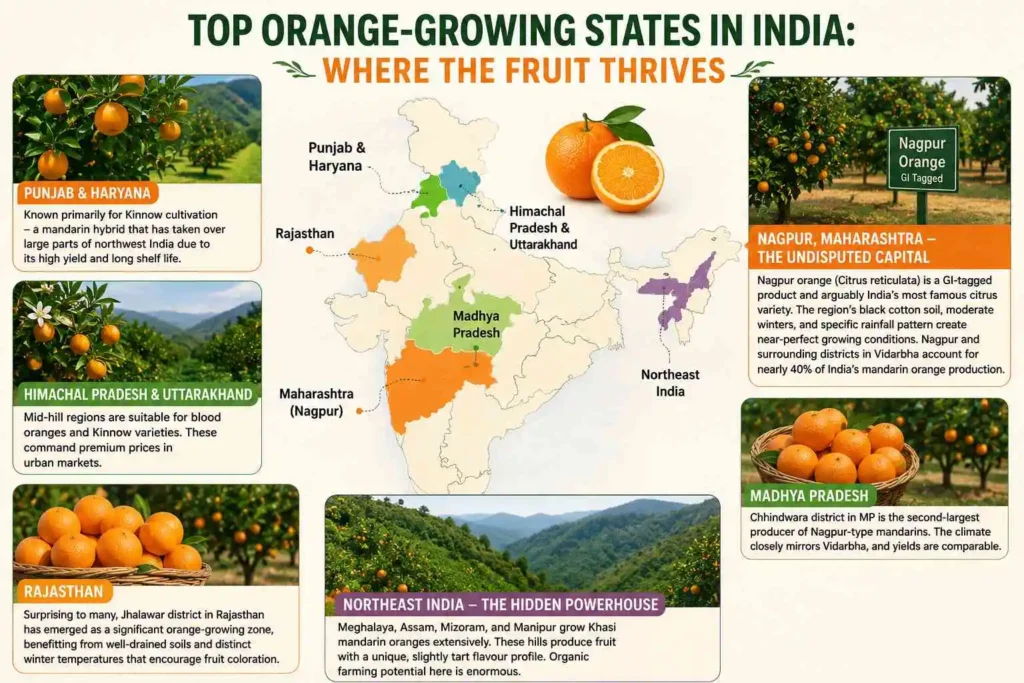
Top Orange-Growing States in India: Where the Fruit Thrives
Orange farming in India is geographically concentrated, but the crop is more adaptable than most people think. Here are the primary producing regions:
Nagpur, Maharashtra — The Undisputed Capital
Nagpur orange (Citrus reticulata) is a GI-tagged product and arguably India’s most famous citrus variety. The region’s black cotton soil, moderate winters, and specific rainfall pattern create near-perfect growing conditions. Nagpur and surrounding districts in Vidarbha account for nearly 40% of India’s mandarin orange production.
Madhya Pradesh
Chhindwara district in MP is the second-largest producer of Nagpur-type mandarins. The climate closely mirrors Vidarbha, and yields are comparable.
Rajasthan
Surprising to many, Jhalawar district in Rajasthan has emerged as a significant orange-growing zone, benefitting from well-drained soils and distinct winter temperatures that encourage fruit coloration.
Northeast India — The Hidden Powerhouse
Meghalaya, Assam, Mizoram, and Manipur grow Khasi mandarin oranges extensively. These hills produce fruit with a unique, slightly tart flavour profile. Organic farming potential here is enormous.
Himachal Pradesh and Uttarakhand
Mid-hill regions are suitable for blood oranges and Kinnow varieties. These command premium prices in urban markets.
Punjab and Haryana
Known primarily for Kinnow cultivation — a mandarin hybrid that has taken over large parts of northwest India due to its high yield and long shelf life.
Orange Varieties in India: Which One Should You Grow?
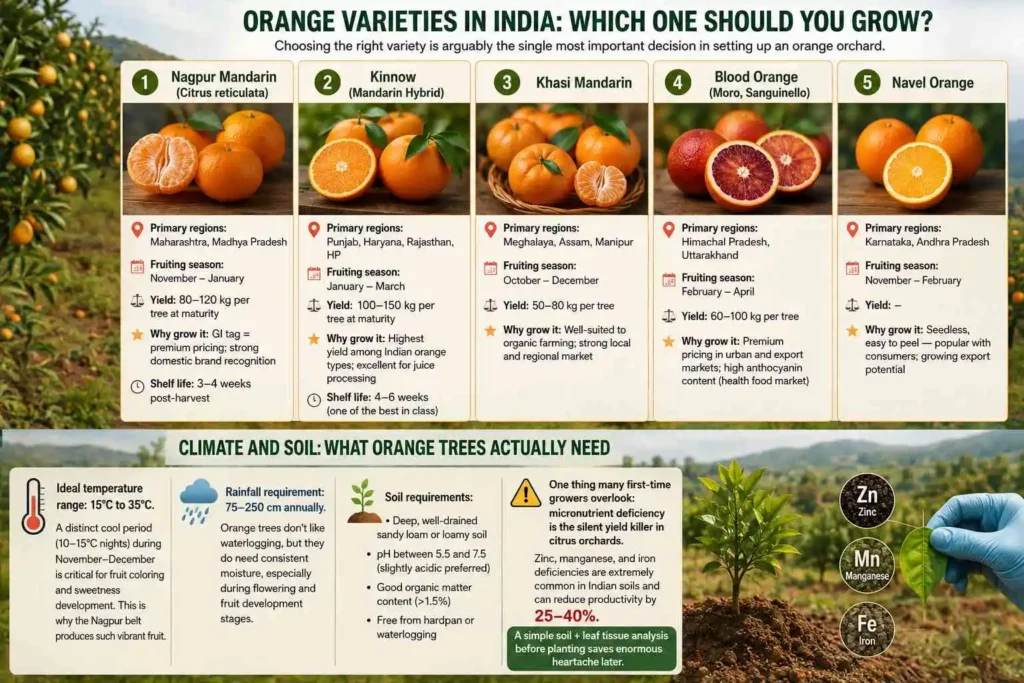
Choosing the right variety is arguably the single most important decision in setting up an orange orchard. Here’s a breakdown of the main commercially grown varieties:
1. Nagpur Mandarin (Citrus reticulata)
- Primary regions: Maharashtra, Madhya Pradesh
- Fruiting season: November – January
- Yield: 80–120 kg per tree at maturity
- Why grow it: GI tag = premium pricing; strong domestic brand recognition
- Shelf life: 3–4 weeks post-harvest
2. Kinnow (Mandarin Hybrid)
- Primary regions: Punjab, Haryana, Rajasthan, HP
- Fruiting season: January – March
- Yield: 100–150 kg per tree at maturity
- Why grow it: Highest yield among Indian orange types; excellent for juice processing
- Shelf life: 4–6 weeks (one of the best in class)
3. Khasi Mandarin
- Primary regions: Meghalaya, Assam, Manipur
- Fruiting season: October – December
- Yield: 50–80 kg per tree
- Why grow it: Well-suited to organic farming; strong local and regional market
4. Blood Orange (Moro, Sanguinello)
- Primary regions: Himachal Pradesh, Uttarakhand
- Fruiting season: February – April
- Yield: 60–100 kg per tree
- Why grow it: Premium pricing in urban and export markets; high anthocyanin content (health food market)
- Primary regions: Karnataka, Andhra Pradesh
- Fruiting season: November – February
- Why grow it: Seedless, easy to peel — popular with consumers; growing export potential
Climate and Soil: What Orange Trees Actually Need
Orange trees are forgiving compared to some other horticultural crops — but they do have non-negotiables.
Ideal temperature range: 15°C to 35°C. A distinct cool period (10–15°C nights) during November–December is critical for fruit coloring and sweetness development. This is why the Nagpur belt produces such vibrant fruit.
Rainfall requirement: 75–250 cm annually. Orange trees don’t like waterlogging, but they do need consistent moisture, especially during flowering and fruit development stages.
Soil requirements:
- Deep, well-drained sandy loam or loamy soil
- pH between 5.5 and 7.5 (slightly acidic preferred)
- Good organic matter content (>1.5%)
- Free from hardpan or waterlogging
One thing many first-time growers overlook: micronutrient deficiency is the silent yield killer in citrus orchards. Zinc, manganese, and iron deficiencies are extremely common in Indian soils and can reduce productivity by 25–40%. A simple soil + leaf tissue analysis before planting saves enormous heartache later.
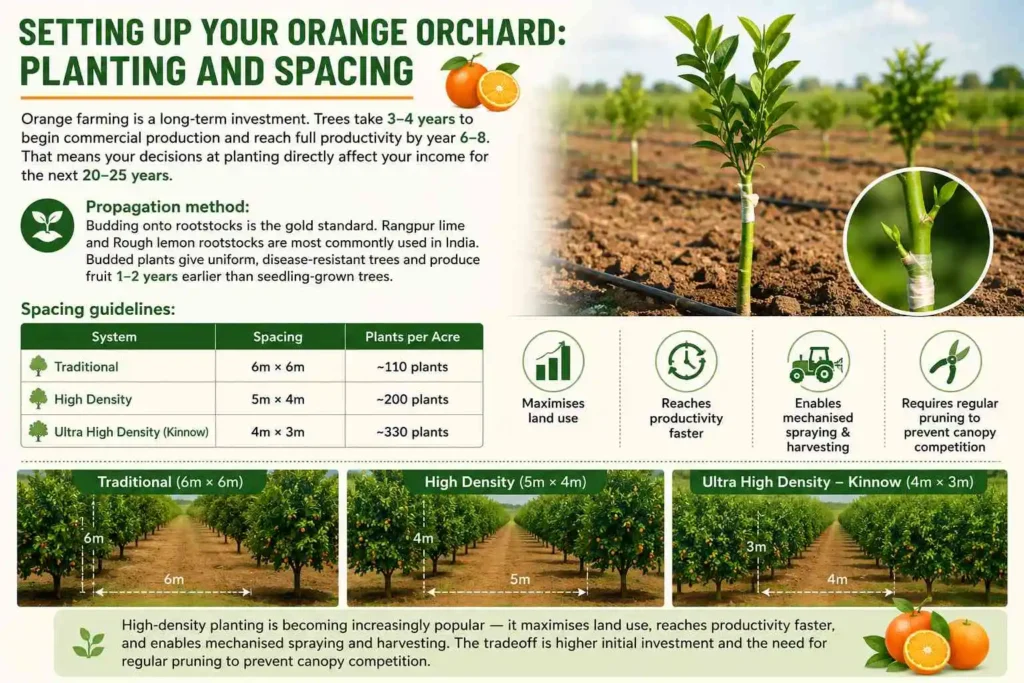
Setting Up Your Orange Orchard: Planting and Spacing
Orange farming is a long-term investment. Trees take 3–4 years to begin commercial production and reach full productivity by year 6–8. That means your decisions at planting directly affect your income for the next 20–25 years.
Propagation method: Budding onto rootstocks is the gold standard. Rangpur lime and Rough lemon rootstocks are most commonly used in India. Budded plants give uniform, disease-resistant trees and produce fruit 1–2 years earlier than seedling-grown trees.
Spacing guidelines:
| System | Spacing | Plants per Acre |
|---|---|---|
| Traditional | 6m × 6m | ~110 plants |
| High Density | 5m × 4m | ~200 plants |
| Ultra High Density (Kinnow) | 4m × 3m | ~330 plants |
High-density planting is becoming increasingly popular — it maximises land use, reaches productivity faster, and enables mechanised spraying and harvesting. The tradeoff is higher initial investment and the need for regular pruning to prevent canopy competition.
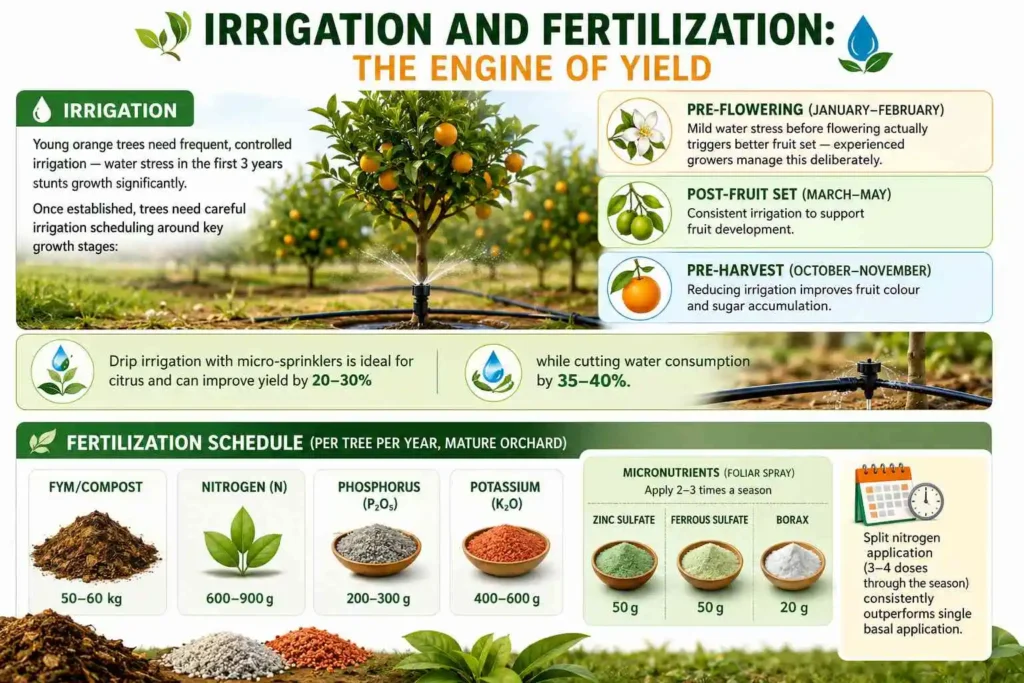
Irrigation and Fertilization: The Engine of Yield
Irrigation:
Young orange trees need frequent, controlled irrigation — water stress in the first 3 years stunts growth significantly. Once established, trees need careful irrigation scheduling around key growth stages:
- Pre-flowering (January–February): Mild water stress before flowering actually triggers better fruit set — experienced growers manage this deliberately
- Post-fruit set (March–May): Consistent irrigation to support fruit development
- Pre-harvest (October–November): Reducing irrigation improves fruit colour and sugar accumulation
Drip irrigation with micro-sprinklers is ideal for citrus and can improve yield by 20–30% while cutting water consumption by 35–40%. You can Check Drip Irrigation Blog for cheap setup guide.
Fertilization schedule (per tree per year, mature orchard):
- FYM/Compost: 50–60 kg
- Nitrogen (N): 600–900 g
- Phosphorus (P₂O₅): 200–300 g
- Potassium (K₂O): 400–600 g
- Micronutrients: Zinc sulfate (50g), Ferrous sulfate (50g), Borax (20g) — applied as foliar spray 2–3 times a season
Split nitrogen application (3–4 doses through the season) consistently outperforms single basal application.
Pest and Disease Management in Orange Orchards
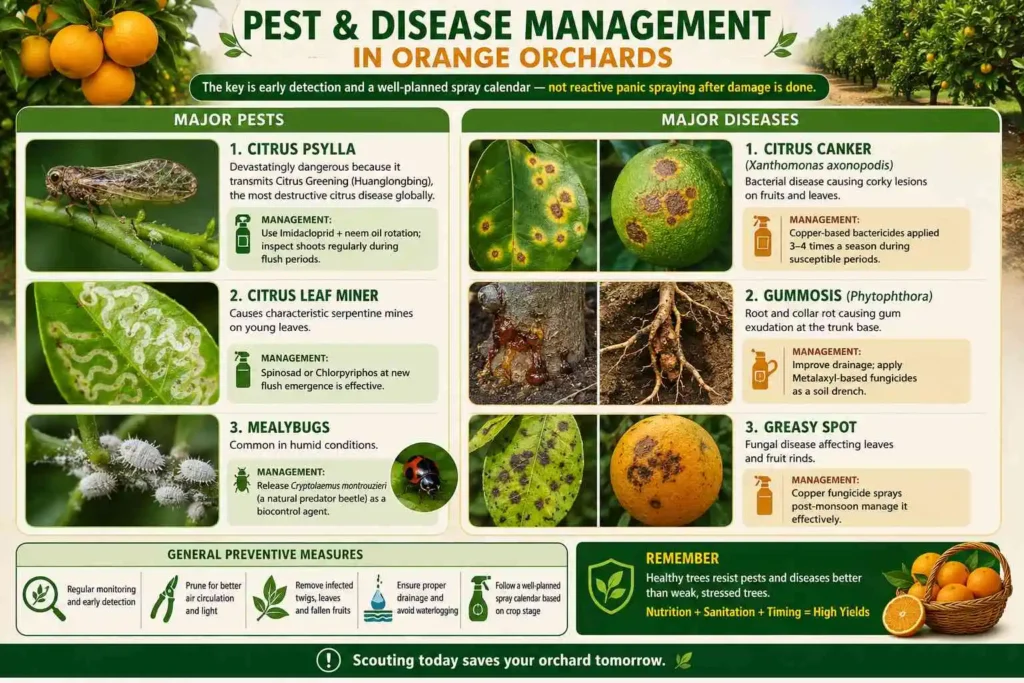
Citrus orchards face a fairly predictable set of threats every season. The key is early detection and a well-planned spray calendar — not reactive panic spraying after damage is done.
Major pests:
- Citrus Psylla — Devastatingly dangerous because it transmits Citrus Greening (Huanglongbing), the most destructive citrus disease globally. Use Imidacloprid + neem oil rotation; inspect shoots regularly during flush periods.
- Citrus Leaf Miner — Causes characteristic serpentine mines on young leaves. Spinosad or Chlorpyriphos at new flush emergence is effective.
- Mealybugs — Common in humid conditions. Release Cryptolaemus montrouzieri (a natural predator beetle) as a biocontrol agent.
Major diseases:
- Citrus Canker (Xanthomonas axonopodis) — Bacterial disease causing corky lesions on fruits and leaves. Copper-based bactericides applied 3–4 times a season during susceptible periods are the primary management tool.
- Gummosis (Phytophthora) — Root and collar rot causing gum exudation at the trunk base. Improve drainage; apply Metalaxyl-based fungicides as a soil drench.
- Greasy Spot — Fungal disease affecting leaves and fruit rinds. Copper fungicide sprays post-monsoon manage it effectively.
Orange Farming in India: Yield and Profit Per Acre
Let’s get to the numbers that matter.
Yield expectations (mature orchard, 6+ years):
| Variety | Trees per Acre | Yield per Tree | Total Yield per Acre |
|---|---|---|---|
| Nagpur Mandarin | 110 | 80–100 kg | 8,800 – 11,000 kg |
| Kinnow | 200 | 100–130 kg | 20,000 – 26,000 kg |
| Khasi Mandarin | 110 | 50–70 kg | 5,500 – 7,700 kg |
Profit calculation (Nagpur Mandarin, 1 acre, mature orchard):
| Particulars | Amount (₹) |
|---|---|
| Fertilizers + micronutrients | ₹25,000 |
| Irrigation charges | ₹8,000 |
| Plant protection chemicals | ₹15,000 |
| Labour (pruning, harvesting, grading) | ₹20,000 |
| Packaging + transport | ₹10,000 |
| Total Annual Input Cost | ~₹78,000/acre |
Revenue: 10,000 kg × ₹25/kg (wholesale mandi average) = ₹2,50,000
Net Profit: ~₹1,72,000 per acre per year (mature orchard)
In a good price year when Nagpur oranges fetch ₹35–45/kg, that number crosses ₹2.5–3 lakh per acre. That’s the upside that makes serious horticulturalists so bullish on citrus.
6 Practical Tips to Maximise Your Orange Orchard Output
- Never skip micronutrient foliar sprays — Three sprays of zinc + iron + manganese per season consistently improve fruit size and colour by 15–20%
- Prune annually after harvest — Open the canopy to let sunlight reach inner branches. Shaded fruits are smaller and less coloured
- Practice regulated deficit irrigation before flowering — 3–4 weeks of reduced water triggers synchronised flowering and better fruit set
- Invest in a pre-cooling facility or cold storage access — Post-harvest losses in oranges average 25–30% without proper storage. A single cold chain link can double your effective price realisation
- Maintain a farm diary — Track spray schedules, flowering dates, and yield per tree. Data-driven decisions outperform intuition in perennial crop management
- Join an FPO (Farmer Producer Organisation) — Collective bargaining for inputs and collective selling for output. Nagpur-belt FPOs regularly fetch 20–30% above individual farmer mandi prices
This was all about orange farming in India, but there are many other farming setups that can generate good income, such as dragon fruit farming and onion farming.
Frequrently Asked Questions (FAQs) about Orange Farming in India
How much time does an orange tree take to give fruits?
Orange trees usually start producing fruits in about 3–5 years after planting, with commercial production increasing as the tree matures.
What type of soil is best for orange farming?
Well-drained loamy soil with good organic matter and a slightly acidic to neutral pH is ideal for orange cultivation.
How much water is required for orange farming?
Orange plants need regular irrigation, especially during flowering and fruit development. Drip irrigation is commonly preferred to save water.
What is the lifespan of an orange tree?
A healthy orange tree can remain productive for 20–30 years or more with proper care.
Newsletter