



Kiwi Farming in India: Compelete Guide
Grade A kiwi from Arunachal Pradesh fetches around ₹120 a kilogram, while lower grades can drop to ₹20-40. Same vine, same orchard, very different income. That gap is the real story of kiwi farming in India, and it explains why some orchards become long-term earners while others stall.
Kiwi farming is attracting attention in India’s hill regions because apple returns are under pressure and imported fruit still fills our shops. But success depends less on buying expensive plants and more on climate fit, pollination, a strong trellis and a buyer waiting at harvest.
This guide to kiwi farming covers where kiwi grows, which varieties to choose, land preparation, male and female plants, spacing, irrigation, pruning, pests, harvesting, yield, cost per acre and profit. Every figure comes from Indian research or is marked as an illustrative estimate.

Why Is Kiwi Farming Becoming an Interesting Opportunity for Indian Farmers?
Kiwi farming has moved from experiment to serious option in a few decades. The first commercial orchard was set up in 1985 at Dr Y.S. Parmar University in Solan, Himachal Pradesh, and large-scale orchards followed in Arunachal Pradesh in the early 2000s. Figures vary by source, but India grows kiwi on roughly 5,000 hectares and produces somewhere between 13,000 and 18,000 tonnes.
Demand is the draw for kiwi farming. Much of the kiwi in our fruit shops is imported from countries such as New Zealand, Chile and Iran. Arunachal Pradesh supplies about half of India’s output, and the Centre launched a ₹167-crore Arunachal Kiwi Mission in 2026 to fix storage, branding and exports. Uttarakhand has started its own kiwi mission too.
One Himachal grower told ThePrint that kiwi needs about ₹100 per plant a year in inputs against ₹500 for apple. That’s one farmer’s account, not a rule, but it shows why kiwi farming appeals to apple growers.
Now the catch. Kiwi farming is a long-term investment. Vines start bearing around year four or five, and the National Horticulture Board (NHB) model project puts commercial production at seven or eight years. The trellis can cost more than the plants, and you need a market plan before the first harvest.
Kiwi farming also doesn’t suit every region. Kiwi was first planted at Lalbagh in Bangalore, but insufficient chilling hours held it back there. Cool-feeling weather isn’t enough.
Key Takeaway: Kiwi farming rewards patience, the right altitude and a planned market. It punishes impulse planting.
Which States Suit Kiwi Farming in Himachal Pradesh, Uttarakhand, Arunachal Pradesh and Beyond?
Three things decide whether kiwi farming suits your area: altitude, winter chilling and the risk of spring frost. A hill that looks perfect on a postcard can still fail on any of them.
The table below separates regions with established production from those still proving themselves. Treat it as a screening tool for kiwi farming, not a planting recommendation.
| Region | Status | What to know |
|---|---|---|
| Arunachal Pradesh | Largest producer; about 650 ha reported | Ziro Valley is the hub; Dirang is also named in the state mission. Mostly organic. |
| Himachal Pradesh | Oldest research base for kiwi farming | KVK Chamba cites 900-1,800 m. State subsidy schemes exist. |
| Uttarakhand | Early expansion of kiwi farming under a state mission | Learning from Arunachal; verify altitude block by block. |
| Jammu and Kashmir | Research orchards exist | Root rot reported in a Kashmir orchard; site-specific. |
| Sikkim, Meghalaya | Cultivation has begun | Limited data; confirm local pockets with the state department. |
| Nagaland | Pilot stage for kiwi farming | Early growers faced marketing trouble; plant only with a confirmed buyer. |
Indian references put the suitable altitude for kiwi farming at 800-1,500 m (NHB) or 900-1,800 m (KVK Chamba), with 600-800 chilling hours below 7°C. Frost during spring flowering and autumn is damaging, and summer heat above 35°C can scorch leaves.
Warning: Never recommend or choose a site by temperature alone. Check winter chilling hours, last-frost dates and summer heat for your exact village, ideally with the nearest KVK or horticulture office.
Which Kiwi Variety Should You Choose for Kiwi Farming in Your Region?
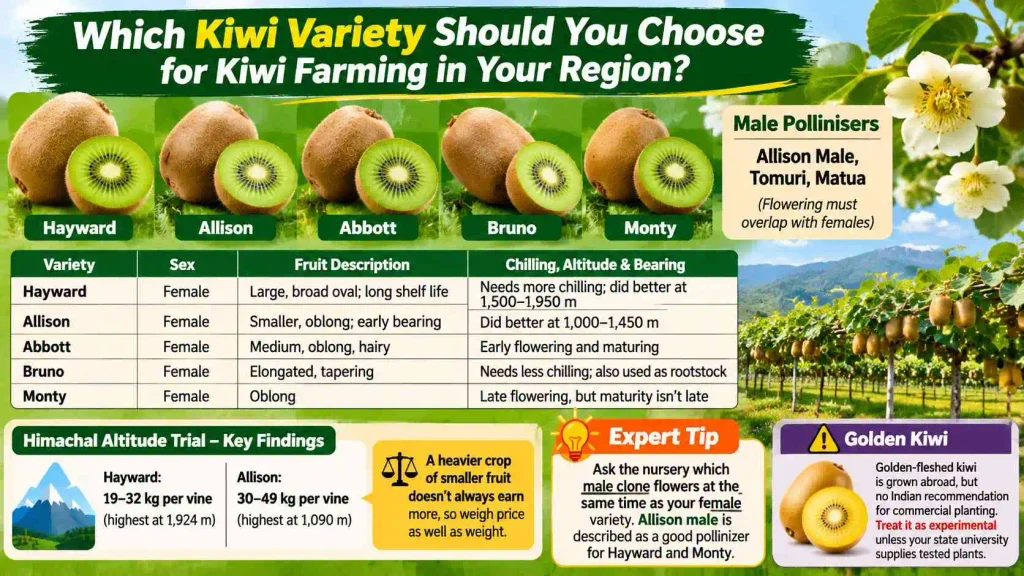
In kiwi farming, variety choice depends on altitude as much as taste. Indian practice centres on a few female (fruit-bearing) varieties plus male pollinisers. The table summarises published Indian material; fruit descriptions are indicative and vary with site.
| Variety | Sex | Fruit | Chilling, altitude, bearing |
|---|---|---|---|
| Hayward | Female | Large, broad oval; long shelf life | Needs more chilling; did better at 1,500-1,950 m |
| Allison | Female | Smaller, oblong; early bearing | Did better at 1,000-1,450 m |
| Abbott | Female | Medium, oblong, hairy | Early flowering and maturing |
| Bruno | Female | Elongated, tapering | Needs less chilling; also used as rootstock |
| Monty | Female | Oblong | Late flowering, but maturity isn’t late |
| Allison male, Tomuri, Matua | Male | Not grown for fruit | Flowering must overlap with the females |
The Himachal altitude trial is the best Indian guide to variety choice in kiwi farming. Across five sites from 1,090 m to 1,924 m, Hayward averaged 19-32 kg per vine, highest at the top site. Allison gave 30-49 kg per vine, highest at the lowest site. A heavier crop of smaller fruit doesn’t always earn more, so weigh price as well as weight.
Golden-fleshed kiwi is grown abroad, but I found no Indian recommendation establishing it commercially. Treat golden kiwi farming as experimental unless your state university supplies tested plants.
Expert Tip: Ask the nursery which male clone flowers at the same time as your female variety. Allison male is described as a good pollinizer for Hayward and Monty.
Climate and Soil for Kiwi Farming: Check These Conditions First
Climate is the most expensive decision in kiwi farming, because you can’t fix it after planting. A poor soil can be improved over seasons; a warm winter can’t.
The table gathers kiwi farming requirements reported by NHB and ICAR-linked research.
| Factor | Requirement |
|---|---|
| Chilling | 600-800 hours below 7°C |
| Altitude | About 800-1,800 m, depending on variety and region |
| Rainfall | About 150 cm a year, well spread through the growing season |
| Heat | Above 35°C with low humidity scorches leaves |
| Soil | Deep, rich, well-drained sandy loam |
| Soil pH | Slightly below 6.9 is best; up to 7.3 can cut yield through manganese deficiency |
| Wind and frost | Vigorous vines with big leaves are easily damaged |
Waterlogging is the silent killer in kiwi farming. Kiwi roots rot quickly in standing water, so drainage matters more than fertility.
Did You Know? Fruit matures earlier at lower altitudes and later at higher ones. That timing shapes your kiwi farming harvest window and your market.
How to Prepare Land for Kiwi Farming and Avoid Years of Damage
Good land preparation for kiwi farming is cheap compared with replacing a failed orchard. Start a year ahead if you can.
- Choose the site: gentle slope, a reliable water source and shelter from strong wind.
- Test the soil: pH, organic matter and nutrients, through a soil testing lab or KVK.
- Terrace steep land: contour terraces, with rows running north-south for maximum sunlight.
- Fix drainage: add channels before planting, not after yellowing starts.
- Prepare pits: dig and fill pits with farmyard manure and soil by December, so they settle before January planting.
- Fence the plot: barbed wire guards against animals, and NHB includes it in its model.
Many farmers grow vegetables or legumes between young vines for the first five years. That earns something while kiwi farming is still in its waiting phase.
Kiwi Farming Layout: Plant Spacing, Male-Female Ratio and Planting Steps
For kiwi farming, plant in the dormant season, usually January. Use healthy grafted or well-rooted cutting plants from a certified nursery; private nurseries in Himachal were selling plants at roughly ₹180-250 each in 2022, and state nurseries are often cheaper. Plant at nursery depth, firm the soil and cut back hard to about 30 cm to push vigorous growth.
Pit dimensions vary by soil and plant size, and I didn’t find one consistent Indian figure, so follow your department’s guidance.
Kiwi is dioecious: male and female flowers grow on separate vines. Males bear no fruit, but without them females set none. Most Indian sources recommend one male for every eight or nine females; one Ziro orchard uses 1:10 while experts there recommend 1:8.
The next table shows common kiwi farming spacings and the plants per acre I calculated from them (1 acre = 4,047 sq m).
| Layout | Plants per acre | Males at 1:8 | Females |
|---|---|---|---|
| T-bar, 4 m x 5 m | about 202 | about 22 | about 180 |
| T-bar, 4 m x 6 m (also used in ICAR Manipur and Ziro) | about 169 | about 19 | about 150 |
| 5 m x 5 m | about 162 | about 18 | about 144 |
Spacing is 4 m between rows and 5-6 m between plants for T-bar; pergola systems need about 6 m between rows.
Row 1:  F  F  M  F  F  M
Row 2:  F  F  F  F  F  F
Row 3:  F  F  F  F  F  F
Practical Tip: Place males where pollen blows toward females, and put one male in the first pit of each row facing the flowering-time wind, as the ICAR Manipur Centre advised.
Why Does Kiwi Farming Need a Strong Support Structure?
A mature vine carries 50-100 kg of fruit according to NHB. That weight, plus wind, tests every post and wire. In kiwi farming, a weak trellis fails just when the orchard starts earning.
The T-bar system is most common. Posts 1.8-2.0 m high stand about 6 m apart, with a 1.5 m cross arm carrying outrigger wires and a tensile wire on top. Pergola gives higher yields but is costlier and harder to manage.
| System | Strengths | Limits |
|---|---|---|
| T-bar | Widely used, easier to manage, lower cost | Needs strong end posts and tight wire |
| Pergola | Higher yield potential | Costly and more difficult to manage |
Trellis costs in kiwi farming differ sharply. The NHB model project, based on older prices, allowed ₹90,000 for a one-acre structure. A Himachal grower now reports about ₹3,000 per plant, which is near ₹5 lakh for roughly 170 plants.
Common Mistake: Over-straining wire at installation. NHB warns that it can snap at the knot under crop load.
Erect the supports before planting or as early as possible, and train young vines to the wire from the first year.
Water and Fertiliser in Kiwi Farming: How Much Is Enough?
Kiwi farming demands steady moisture for young vines, and drip irrigation helps. NHB suggests irrigation every 10-15 days during September-October fruit growth, and hill orchards should plan for summer dry spells too.
Overwatering invites root rot, and water stress gives small fruit. Excess nitrogen makes growth too vegetative at the cost of fruit.
The NHB model suggests the following per vine per year. Treat these as starting points and adjust with soil tests and local advice.
- Young vines: 20 kg farmyard manure and 0.5 kg NPK mixture containing 15% nitrogen.
- After 5 years: 850-900 g nitrogen, 500-600 g phosphorus and 800-900 g potassium, plus manure.
- Timing: half to two-thirds of the nitrogen in January-February, the rest after fruit set in April-May.
Kiwi needs chloride, while excess boron and sodium harm it. Ziro’s organic orchards use only 5-7 kg of farmyard manure or vermicompost per plant.
Warning: These doses are per vine, not per acre, and come from an older model. Check them against your state university’s current recommendation before buying fertiliser.
How to Prune and Train Kiwi Vines for Better Fruit Production
Pruning is where good kiwi farming separates from average. The vine fruits on shoots from last season’s wood, so what you keep decides next year’s crop.
First year: tie one strong shoot to a stake and take it up to the wire. This becomes the permanent trunk.
Next years: select two permanent leaders along the top wire and train lateral canes across the T-bar. These carry the fruiting shoots.
Winter pruning: in the dormant season, remove old, exhausted canes and keep well-placed young ones as replacements.
Summer pruning: cut back vigorous shoots beyond the fruit and remove crowding growth, so sunlight and air reach the fruit.
In kiwi farming, overcrowded canopies reduce flowering and keep leaves damp, which favours disease. Young orchards need shaping; mature ones need steady renewal of fruiting wood.
Expert Tip: Use a trained pruner for the first two seasons, or attend a KVK demonstration. Mistakes in vine structure are hard to reverse later.
When Does a Kiwi Orchard Start Fruiting, and When Should You Harvest?
Patience is the price of entry into kiwi farming. This table gives a realistic timeline from NHB and field studies.
| Orchard age | What to expect |
|---|---|
| Year 1-3 | Vine and trellis building; no meaningful crop |
| Year 4-5 | First fruit; NHB says bearing begins around this time |
| Year 7-8 | Commercial production, per NHB |
| Mature orchard | Full cropping, with steady renewal pruning |
Some growers report fruit as early as year two, but in kiwi farming that’s the exception. Plan for the longer wait.
In Ziro, flowering occurs in April-May, fruit grows through September-October and harvest runs from October to early November. In the Himachal trials, harvest maturity fell between early October and late November depending on altitude, and fruit reached optimum maturity about 190 days after full bloom in one study.
Kiwi gives no obvious colour cue. Indian studies found firmness, total soluble solids (TSS) and days from full bloom reliable, and the Himachal trials harvested at TSS above 6.2°Brix. Dry matter is also used abroad; ask your KVK about testing.
Farmers harvest kiwi hard. Fruit softens to eating stage in about two weeks. Pick the largest first, rub off hairs and grade by weight.
Did You Know? Hard fruit that tastes sour isn’t immature in the commercial sense. Physiological maturity (sugar build-up) and eating softness are different stages.
How Many Kilograms of Kiwi Can One Acre Produce?
Yield in kiwi farming depends on variety, altitude, pollination, vine age and management. Never read a mature-orchard number as a first-year promise.
The table mixes research and a field case. The per-acre figures are my arithmetic from published per-vine data, using about 152 female vines per acre, so treat them as indicative.
| Source or stage | Reported yield | Per acre (indicative) |
|---|---|---|
| First 3 years | No crop | Nil |
| NHB model, year 4 | 5 t per acre modelled | Optimistic; treat as best case |
| HP trial, Hayward | 19-32 kg per vine | about 2.9-4.9 t |
| HP trial, Allison | 30-49 kg per vine | about 4.6-7.4 t |
| NHB, trellised vines after 7 years | about 25 t per ha | about 10 t |
| Ziro organic orchard (about 14 years) | 2-3 t on one acre | 2-3 t |
Notice the spread. A well-managed Himachal trial vine out-yields a low-input Ziro orchard, and a model can look rosier than a real farm.
Grade also matters. NHB treats fruit of 70 g and above as grade A, while Ziro growers separate fruit above 100 g for export. Larger fruit earns disproportionately more.
Quick Summary: A cautious planning figure from the table is 3-5 tonnes per acre in good conditions for kiwi farming, not the best figure in a brochure, and nothing for the first three years.
Common Pests and Diseases in Kiwi Farming and How to Prevent Them
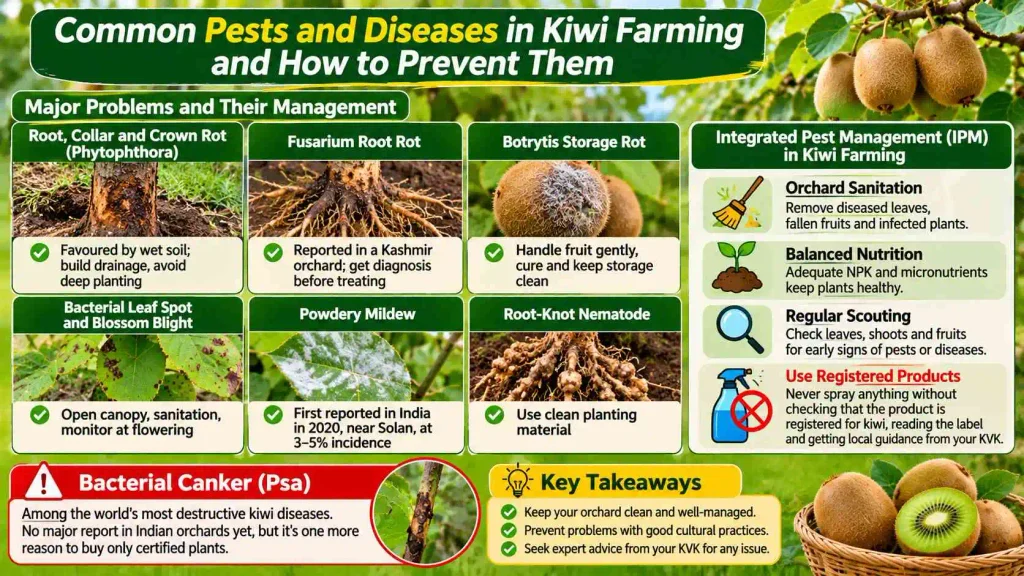
Early reports said kiwi farming faced no serious pest or disease problems in India. That’s changing as orchards expand.
| Problem | Conditions and prevention |
|---|---|
| Root, collar and crown rot (Phytophthora) | Favoured by wet soil; build drainage, avoid deep planting |
| Fusarium root rot | Reported in a Kashmir orchard; get diagnosis before treating |
| Botrytis storage rot | Handle fruit gently, cure and keep storage clean |
| Bacterial leaf spot and blossom blight | Open canopy, sanitation, monitor at flowering |
| Powdery mildew | First reported in India in 2020, near Solan, at 3-5% incidence |
| Root-knot nematode | Use clean planting material |
Bacterial canker (Psa) is among the world’s most destructive kiwi diseases. I found no report establishing it as a major problem in Indian orchards, but it’s one more reason to buy only certified plants.
Integrated pest management (IPM) in kiwi farming starts with orchard sanitation, balanced nutrition and regular scouting. Never spray anything without checking that the product is registered for kiwi, reading the label and getting local guidance from your KVK.
Kiwi Farming Cost per Acre in India: What Does Establishment Really Take?
Kiwi farming cost per acre varies enormously with terrain, trellis and water source. The NHB model project priced a one-acre orchard at ₹2.5 lakh, but it used older rates, including labour at ₹70 a day.
The table below is my illustrative estimate for current conditions, built from the sources above and typical hill costs. Get local quotes before relying on it.
| Component (per acre) | Illustrative range |
|---|---|
| Land development, terracing, fencing | ₹40,000-1,00,000 |
| Pits, manure, planting labour | ₹25,000-40,000 |
| Kiwi plants (about 170, at ₹180-250) | ₹30,000-45,000 |
| Trellis and wires | ₹1,50,000-5,00,000 |
| Drip system and water source | ₹40,000-1,20,000 |
| Grading and storage shed | ₹30,000-1,00,000 |
| Establishment total | about ₹3.2-9 lakh |
Before commercial production, kiwi farming also costs you yearly for manure, pruning, labour and monitoring with no fruit income. Once bearing, recurring costs add harvesting, grading, packing and transport. As a rough planning figure, assume ₹80,000-1,50,000 a year per acre, depending on labour rates and scale.
Subsidies can lower the burden of kiwi farming. Arunachal’s Atma Nirbhar Bagwani Yojana offers 45% subsidy with 45% bank finance, and Himachal runs a kiwi promotion scheme. Check current eligibility with your department.
Is Kiwi Farming Profitable in India? A Realistic Look at Returns and Payback
Kiwi farming can pay well, but nobody can promise a fixed profit. Revenue depends on yield, grade and price, and prices swing widely: DoNER reports about ₹120 per kg for Arunachal grade A and ₹20-40 for lower grades, while Himachal growers told ThePrint they have received ₹250-350 per kg.
The table shows three kiwi farming scenarios for a mature acre. Gross revenue is yield times average price; net profit subtracts yearly costs. All figures are my illustrations, not forecasts.
| Scenario | Yield | Average price | Gross revenue | Yearly cost | Net |
|---|---|---|---|---|---|
| Cautious | 2.5 t | ₹70/kg | ₹1.75 lakh | ₹1.0 lakh | about ₹0.75 lakh |
| Moderate | 5 t | ₹100/kg | ₹5.0 lakh | ₹1.2 lakh | about ₹3.8 lakh |
| Strong | 7 t | ₹150/kg | ₹10.5 lakh | ₹1.5 lakh | about ₹9 lakh |
Against a mid-range establishment cost of about ₹5-6 lakh, the moderate case implies payback well beyond the first bearing years. The NHB model estimated about 6.7 years, using older costs. With the three-to-seven-year wait and gradual yield build-up, plan for roughly 8-10 years without subsidy.
Packaging, transport and post-harvest loss reduce kiwi farming returns. A value-chain study reports 8-10% losses in transit and aggregator charges of 15-20%.
Where Can Farmers Sell Kiwi Without Falling Into the Distress-Sale Trap?
Most growers sell through village traders or commission agents, and some sell the whole orchard to a contractor before harvest. That’s convenient but limits your price. A 7-10 day distress-sale window after harvest is a known problem in Arunachal.
Realistic marketing channels for kiwi farming include:
- Local fruit markets and wholesale mandis.
- Fruit traders and aggregators from cities such as Delhi, Guwahati and Kolkata.
- Supermarkets and fruit businesses that want graded, uniform fruit.
- Direct sales, online fruit shops and farm-stay visitors.
- Farmer Producer Organisations (FPOs) that pool volume and negotiate.
In kiwi farming, grading and harvest timing decide price. Imported kiwi can sell at ₹60-70 per kg wholesale, as a Ziro cooperative leader noted, so only clean, graded, properly mature fruit can ask for more. Fruit can keep about eight weeks in a cool place and four to six months at -0.6 to 0°C in cold storage, so storage can widen your selling window.
Ziro growers also want a GI tag and affordable organic certification. Private certification can cost ₹15,000-20,000 per hectare, against ₹500-600 per hectare through a government agency.
What Mistakes Should Beginners Avoid Before Starting Kiwi Farming?
Most failures in kiwi farming trace back to a few avoidable errors.
- Unsuitable climate: confirm altitude, chilling and frost risk before buying anything.
- Poor plants: buy certified plants from a trusted nursery, not roadside sellers.
- No males: plant a pollinizer at roughly 1:8, matched to the female variety’s flowering.
- Wrong spacing: crowded vines get shade and disease; follow the regional recommendation.
- Weak trellis: budget for posts and wire first, plants second.
- Poor drainage: fix it before planting.
- Irregular watering: keep a schedule through summer and fruit growth.
- Careless pruning: train from year one and renew fruiting wood regularly.
- Ignoring disease: monitor, keep the orchard clean and diagnose before spraying.
- Expecting quick money: kiwi farming means years of investment before returns.
- No market plan: line up buyers, grading and transport before the first harvest.
Is Kiwi Farming Right for Your Land? Check Before You Plant
Kiwi farming in India works where the climate fits, the right varieties are matched with male pollinisers, and the orchard is managed patiently. It doesn’t work as a quick-income crop, and it doesn’t work everywhere cool.
If your land passes the climate test, choose varieties suited to your altitude, buy certified planting material and build the trellis properly. Pollination and pruning will decide whether the vines give fruit or just leaves. Because kiwi farming pays slowly, also plan some income for the waiting years: vegetables between young vines can help, and our carrot farming guide covers hill sowing windows and costs for one option worth comparing.
Newsletter