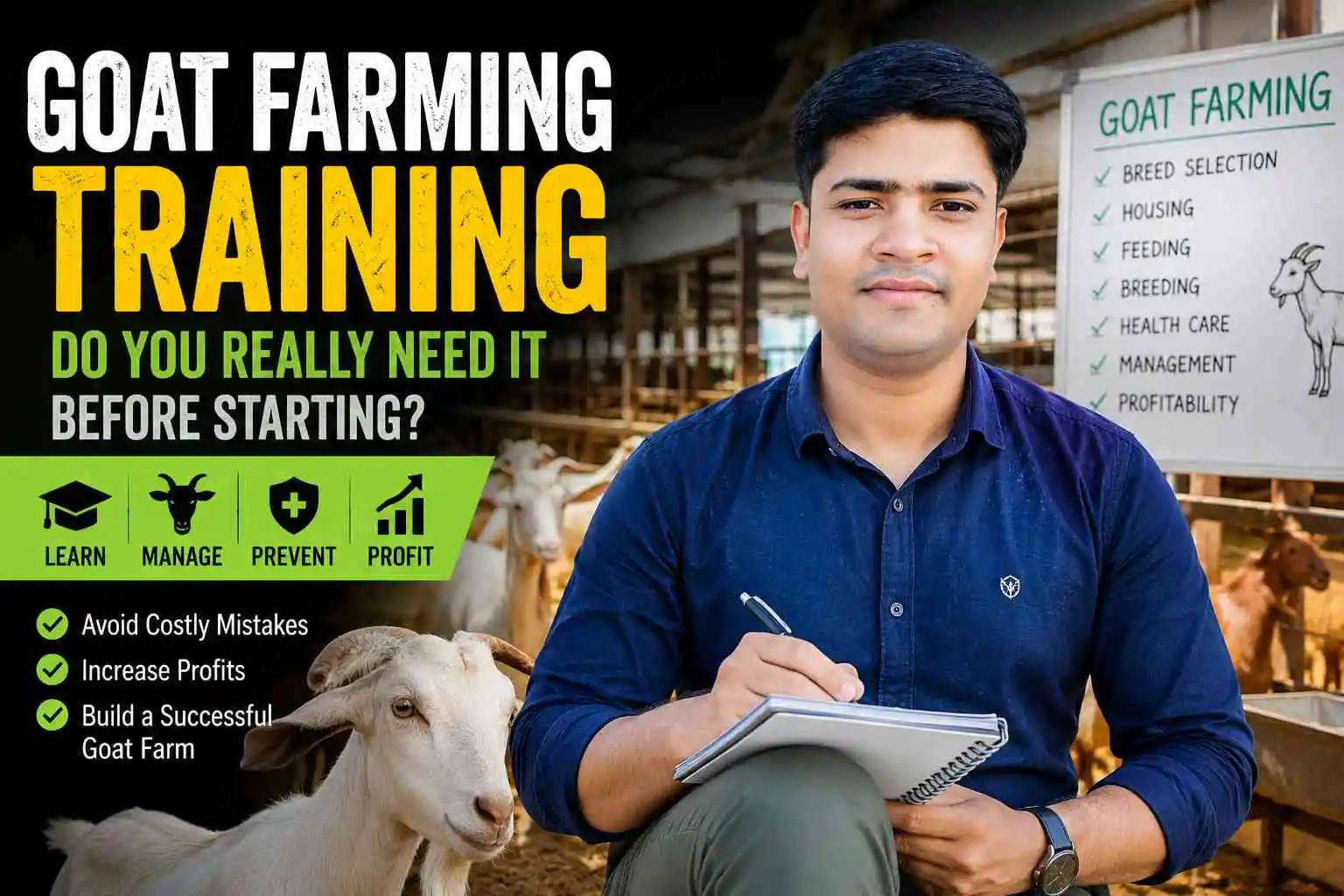

Do You Really Need Goat Farming Training Before Starting?
Here’s a pattern that plays out on hundreds of new goat farms every year: someone buys ten or twenty goats, builds a shed based on what looked reasonable on YouTube, and starts feeding whatever the local feed dealer recommends. Six months later, kids are dying of scours, does aren’t coming into heat on schedule, and the “cheap” feed bill has quietly become the farm’s biggest expense. None of this happened because the person was careless. It happened because goat farming looks simple from the outside, and the mistakes that actually hurt you — a wrong breeding decision, a missed vaccination window, poor ventilation in the shed — don’t show up until weeks or months later.
This is exactly what goat farming training is meant to prevent. It won’t guarantee profit, and it isn’t a substitute for hands-on farm experience. But a well-run training program, even one lasting just three to seven days, can teach you enough about goat selection, feeding, housing, breeding, and disease prevention to avoid the mistakes that quietly drain a new farmer’s capital.
In this article, I’ll walk through what goat farming training actually covers, which skills matter most for a beginner, where you can get genuine practical training in India, what it typically costs, how to tell a serious training institute from a marketing exercise, and what you should do once your training is over. If you’re planning to put several lakhs into goats, sheds, and feed, this is worth reading before you spend a rupee on livestock.
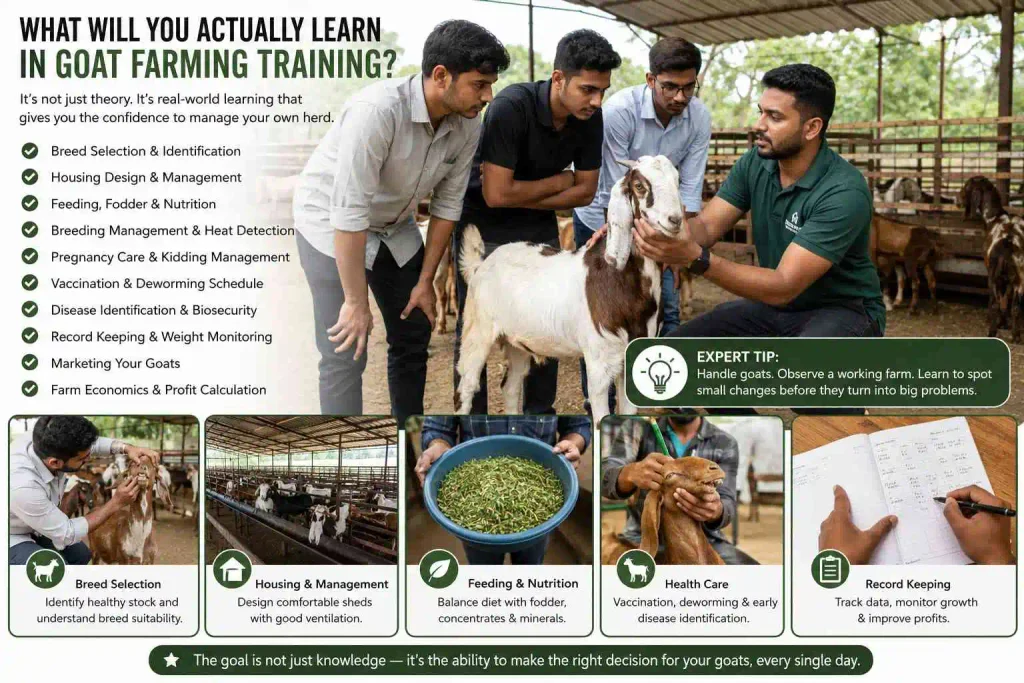
What Will You Actually Learn in Goat Farming Training?
Most people picture a “training course” as a classroom lecture with a PowerPoint on goat breeds. Good goat farming training is closer to an apprenticeship compressed into a few days. You spend time in an actual goat shed, handle real animals, and learn to recognize things that are hard to explain in words — like the difference between a goat that’s mildly off-color and one that needs a vet immediately.
A solid training program typically combines classroom sessions with farm visits and hands-on demonstrations. You should expect to cover:
- How to select healthy breeding stock and identify major goat breeds
- Housing design, ventilation, and space requirements
- Feeding, fodder management, and mineral supplementation
- Breeding management, heat detection, and pregnancy care
- Kidding management and newborn kid care
- Vaccination and deworming schedules
- Disease identification and biosecurity
- Record keeping, weight monitoring, and marketing
- Basic farm economics and cost-profit calculation
Expert Tip: If possible, choose training that lets you physically handle goats and observe a working farm. Reading about goat diseases is useful, but learning to recognize an abnormal goat in a real herd is a different skill entirely — and it’s the one that actually saves animals.
The value of this isn’t the information itself — most of it is available in books and online videos. The value is being shown, in person, what “normal” looks like so you can spot “not normal” later, on your own farm, when there’s no trainer standing next to you.
Which Goat Farming Skills Should Beginners Learn First?
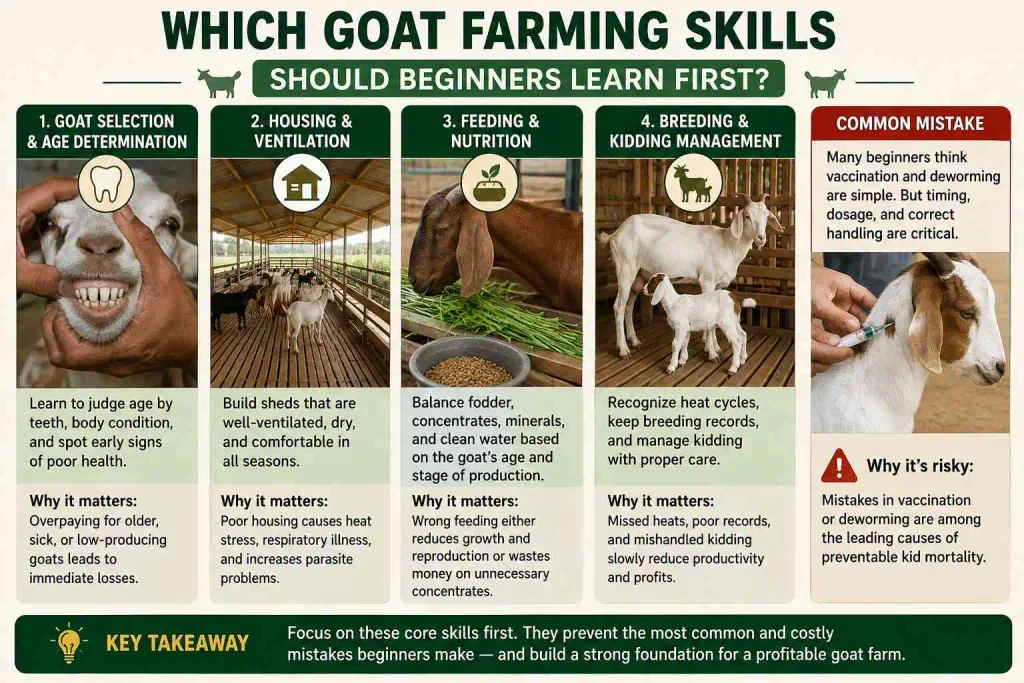
Not every topic in a training curriculum carries equal weight for a first-time farmer. If you’re choosing a short course and can’t cover everything, prioritize the skills where mistakes are both common and expensive.
Goat selection and age determination comes first. A beginner who doesn’t know how to judge a goat’s age from its teeth, or how to spot early signs of poor health, can easily overpay for animals that are older, sicker, or less productive than advertised. This is one of the most common ways new farmers lose money before they’ve even started.
Housing and ventilation is next. Many beginners build sheds that look fine but trap heat and humidity, which is one of the biggest contributors to respiratory disease and parasite load in goats. Training that includes a visit to a well-designed shed is far more useful than a diagram in a manual.
Feeding and nutrition is where training can directly affect farm economics. A farmer who doesn’t understand feed requirements may underfeed goats — slowing growth and reducing reproduction — or overspend on concentrate feed that isn’t necessary. Good training should teach you how to balance fodder, concentrate, minerals, and water according to the goat’s stage of production, not just hand you a generic feeding chart.
Breeding and kidding management rounds out the priority list. Missed heat cycles, poor breeding records, and mishandled kidding are quiet profit killers because the losses accumulate gradually rather than showing up as one obvious disaster.
Common Mistake: Many beginners assume vaccination and deworming are simple enough to learn from a pamphlet. In practice, timing, dosage, and correct handling matter enormously, and getting them wrong is one of the leading causes of preventable kid mortality.
Can Training Help You Avoid Costly Goat Farming Mistakes?
This is really the question behind everything else, so let’s be direct about it: training doesn’t guarantee success, but it meaningfully reduces the odds of the expensive, avoidable mistakes that push new farmers out of the business in their first year.
Here’s the important part — the mistakes that hurt goat farmers financially are rarely dramatic. It’s not usually one catastrophic event. It’s a string of smaller ones: goats bought at the wrong age, a shed that stays damp through monsoon, a feeding routine that’s slightly off, breeding records that don’t exist so you can’t tell which doe is actually productive. Individually, each mistake seems minor. Together, they can turn a farm that should be profitable into one that quietly loses money for years.
Did You Know? A farmer can lose money even when goats appear healthy if breeding records, kidding intervals, kid mortality, and feed costs aren’t tracked properly. Profitability in goat farming is as much about record keeping and management discipline as it is about animal health.
Training compresses years of trial-and-error into a few days by putting you in front of people who have already made — and fixed — these mistakes. If you’re planning to invest several lakhs in goats, sheds, and equipment, spending a few days and a few thousand rupees learning the basics is usually a small cost compared with the mistakes it can prevent.
Where Can You Get Practical Goat Farming Training in India?
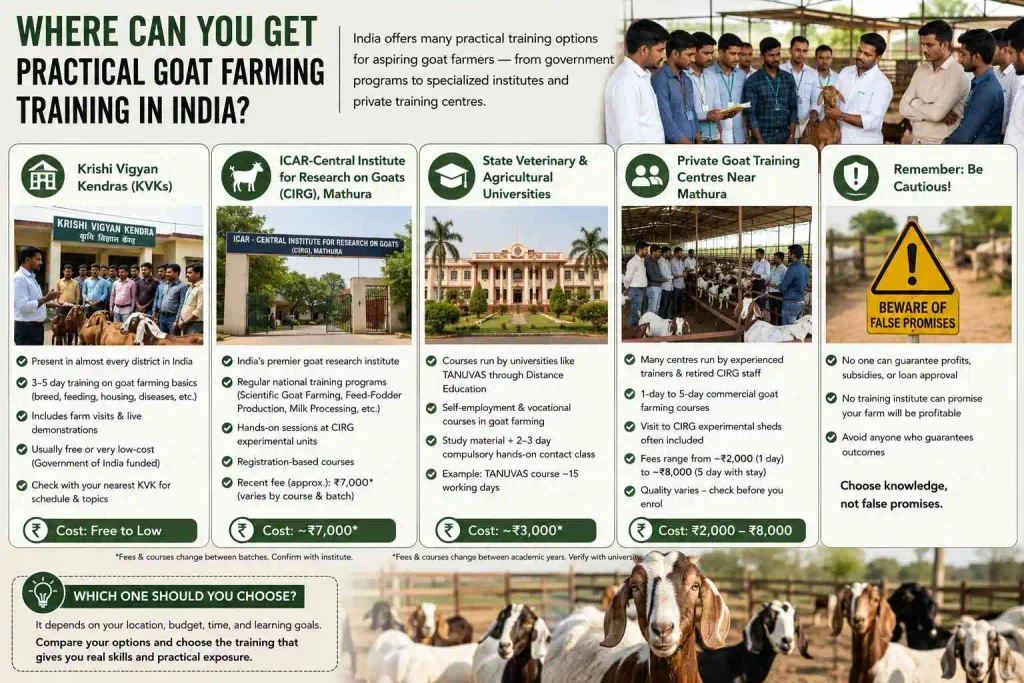
India has a reasonably well-developed ecosystem for goat farming training, ranging from fully government-funded programs to specialized research institutes and private training centres. Here’s how the main categories break down.
Krishi Vigyan Kendras (KVKs): KVKs are agricultural extension centres attached to ICAR, state agricultural universities, government departments, or NGOs, spread across almost every district in India. They regularly run short training programs — typically three to five days — on scientific goat farming, covering breed selection, housing, feeding, and disease management, often with visits to demonstration goat units. KVK training is usually free or very low-cost since it’s funded by the Government of India. Because there are hundreds of KVKs, availability, exact schedules, and topics vary by district, so you’ll need to contact or check the website of the KVK nearest to you.
ICAR-Central Institute for Research on Goats (CIRG), Mathura: CIRG is India’s leading dedicated goat research institute and runs regular national training programs, including multi-day courses such as its “Scientific Goat Farming” programs and specialized courses like feed-fodder production and value-added goat milk product processing. These are conducted by working goat scientists and include practical sessions on the institute’s own experimental goat units. CIRG also periodically organizes registration-based training courses; a recent listing showed a registration payment of roughly ₹7,000 for a consultancy-linked training registration, though exact fees and course structures change between batches, so you should confirm current details directly with CIRG before applying.
State Veterinary and Agricultural Universities: Universities such as Tamil Nadu Veterinary and Animal Sciences University (TANUVAS) run structured self-employment and vocational courses in goat farming through their Directorate of Distance Education, typically combining distance-learning material with a compulsory 2–3 day “contact class” for hands-on practice at a university farm. TANUVAS’s self-employment goat farming course, for example, runs around 15 working days with a course fee of roughly ₹3,000, though you should verify current fees and schedules with the university before enrolling, since these figures can change between academic years.
Private goat training centres near Mathura: Because CIRG Mathura is India’s main goat research hub, a cluster of private training centres has grown up around it, some run by retired CIRG technical staff. These typically offer 1-day to 5-day commercial goat farming courses, often including a visit to CIRG’s experimental sheds, with fees generally ranging from roughly ₹2,000 for a one-day course to around ₹8,000 for a five-day residential course with accommodation. Quality varies significantly between these centres, so treat this category with more scrutiny than a government institute — more on that below.
Warning: Be cautious of training providers promising guaranteed profits, guaranteed government subsidies, or guaranteed loan approval. No training institute, government or private, can promise you a bank loan will be approved or that your farm will be profitable. Anyone who guarantees these outcomes is selling you confidence, not information.
Naturally, the right choice depends partly on where you live and whether you’re prepared to travel — which brings us to comparing your training options directly.
Which Goat Farming Training Institute Is Right for You?
Before comparing specific institutes, it helps to introduce the framework you should be using to evaluate any of them.
| Check | Why It Matters |
|---|---|
| Practical farm exposure | Classroom-only training won’t teach you to handle real goats or spot health problems |
| Trainer qualification | Training led by working goat scientists or experienced farm technicians is more reliable than generic instructors |
| Course syllabus | A vague syllabus often means a vague, low-value course |
| Current batch information | Confirm dates and fees directly with the institute — published information online is often outdated |
| Certificate recognition | Check whether the certificate is actually accepted for the purpose you need (loan, subsidy, employment) |
| Post-training support | Some institutes offer consultancy or farm-visit support after training, which can be valuable for a genuine beginner |
Government institutions — KVKs, CIRG, and state veterinary universities — score well on trainer qualification and farm exposure almost by default, because they’re staffed by working agricultural scientists and have their own demonstration farms. Their main limitation is scheduling: batches run on fixed calendars, and you may need to wait or travel.
Private training centres can be more flexible on timing and sometimes offer more one-on-one attention, but a professional-looking website does not automatically mean the training is credible. Verify who is actually conducting the training, whether you’ll get real hands-on time with goats, and whether the certificate has any actual recognition — don’t take these claims at face value.
How Much Does Goat Farming Training Cost?
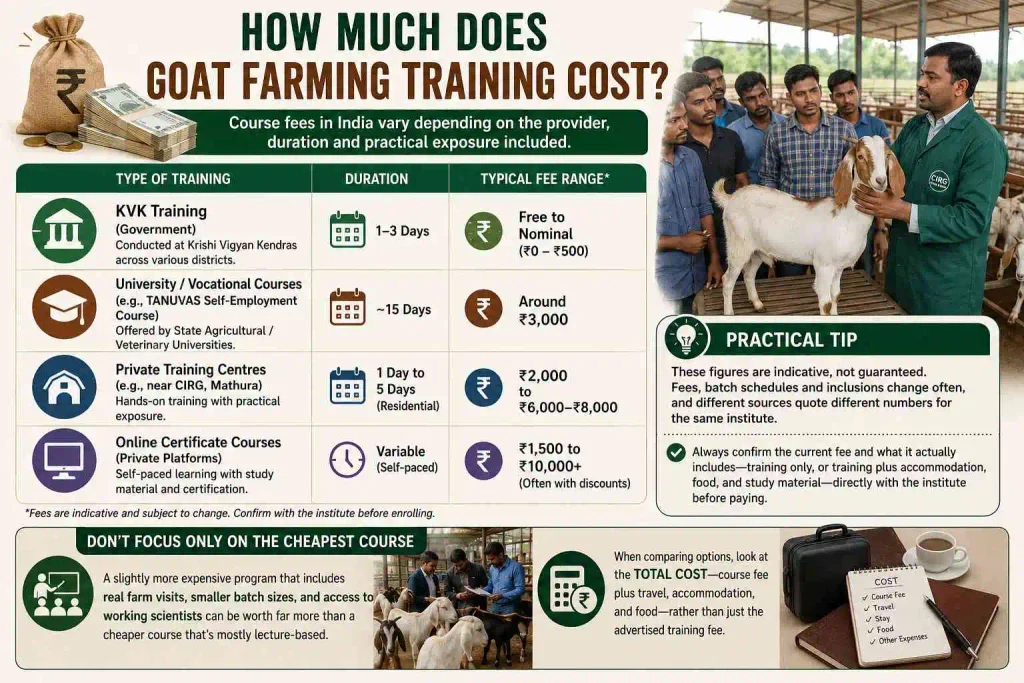
Course fees for goat farming training in India vary widely depending on the provider, duration, and how much practical exposure is included.
Based on publicly available information, KVK training is often free or nominally priced since it’s government-funded. University-run vocational courses, such as TANUVAS’s self-employment programs, have historically been priced around ₹3,000 for roughly a 15-day course. Private training centres near CIRG Mathura typically charge somewhere between ₹2,000 for a single-day session and ₹6,000–₹8,000 for a five-day residential course that includes accommodation. Online certificate courses from private ed-tech platforms can range from a few thousand rupees upward, often with discount pricing that changes frequently.
Practical Tip: These figures are indicative, not guaranteed. Fees, batch schedules, and inclusions change often, and different sources online quote different numbers for the same institute. Always confirm the current fee and what it actually includes — training only, or training plus accommodation, food, and study material — directly with the institute before paying.
Don’t focus only on the cheapest course. A slightly more expensive program that includes real farm visits, smaller batch sizes, and access to working scientists can be worth far more than a cheaper course that’s mostly lecture-based. When comparing options, look at the total cost — course fee plus travel, accommodation, and food — rather than just the advertised training fee.
Online or Offline Goat Farming Training: Which Is Better?
Don’t assume offline training is automatically better — it depends on what you actually need to learn.
| Factor | Online | Offline |
|---|---|---|
| Cost | Generally lower | Generally higher (travel, accommodation) |
| Practical exposure | Limited to video demonstrations | Direct, hands-on with real goats |
| Goat handling skills | Cannot be taught remotely | Learned through supervised practice |
| Flexibility | High — learn at your own pace | Fixed batch dates and locations |
| Farm visits | Rare or virtual only | Usually included |
| Best suited for | Farm economics, record keeping, theory, revision | Goat selection, health checks, breeding, kidding |
Online goat farming training — including distance-learning modules from universities and video-based courses from private platforms — works reasonably well for topics that are primarily conceptual: farm economics, feeding formulas, disease theory, marketing, and record-keeping systems. It’s also useful as a low-cost way to build background knowledge before attending an in-person course, so you get more out of the hands-on time.
Where online training genuinely falls short is anything that depends on physical skill or judgment: learning to palpate a pregnant doe, recognizing early signs of illness by how a goat moves or stands, correctly assisting a difficult kidding, or judging whether a shed’s ventilation is actually adequate. These are skills you learn by doing them under supervision, not by watching a video. If your goal is to actually manage a farm — not just understand the theory — some offline, hands-on component isn’t optional.
What Should You Check Before Paying for a Training Course?
This is where many beginners go wrong: they enroll based on a course description and a certificate promise, without checking the details that actually determine whether the training will be useful.
Before paying for any goat farming training course, ask the institute directly:
- Will I get hands-on time with live goats, or is this a lecture-only course?
- Will we visit a working goat farm, and whose farm is it?
- Who is conducting the training — working scientists, retired technical staff, or general instructors?
- What exactly does the fee include — training only, or also food, accommodation, and study material?
- Is the certificate recognized for the specific purpose I need it for (bank loan documentation, subsidy application, etc.)?
- Can I speak to a past participant about their experience?
Common Mistake: Many beginners choose training based only on the lowest fee. Check what practical exposure is included before comparing prices — a ₹2,000 lecture-only course and a ₹6,000 course with real farm visits and small-group animal handling are not the same product, even though they’re both labeled “goat farming training.”
If an institute is reluctant to answer these questions clearly, or gives vague responses about farm visits and certification, treat that as a warning sign rather than a minor inconvenience.
Does a Goat Farming Certificate Actually Matter?
Be realistic about what a certificate can and can’t do for you. A training certificate is not a guarantee of a successful farm, a bank loan, a government subsidy, or employment. Some banks and subsidy schemes do ask for evidence of training as part of a loan or subsidy application, so in that narrow sense a certificate can be a useful supporting document — but it is a piece of paperwork, not a qualification that determines whether your farm will succeed.
Key Takeaway: The best training should leave you capable of making better decisions on the farm — not just holding a certificate. The real value of training isn’t the certificate. It’s knowing what to do when something goes wrong.
If you’re evaluating two courses and one offers a more impressive-looking certificate but less hands-on time, choose the one with more hands-on time. You’re not collecting credentials — you’re trying to avoid losing money on your first batch of goats.
How to Apply for Goat Farming Training
The application process differs depending on the type of institute:
For KVK training, contact the KVK nearest to your district directly, either by phone or through your state agricultural university’s website, since individual KVKs publish their own training calendars and these change frequently.
For CIRG Mathura, check the institute’s official training section for currently open national training programs and application windows, since CIRG runs multiple different courses through the year rather than one continuous program.
For university vocational courses like TANUVAS’s self-employment programs, applications typically go through the university’s Directorate of Distance Education, with enrollment open through the year and a compulsory contact-class component scheduled separately.
For private training centres, apply directly through the centre, but do your verification (the checklist above) before transferring any fee, and prefer centres that can clearly describe their trainers’ backgrounds and show you their practical training facility.
What Should You Do After Completing Goat Farming Training?
Training is the starting point, not the finish line. Once you’ve completed a course, the sensible next steps are to start small rather than scaling immediately — a beginner-sized herd lets you apply what you’ve learned and catch mistakes while the financial stakes are still manageable. Set up a basic record-keeping system from day one for breeding dates, vaccination schedules, feed costs, and weight tracking, since this is one of the most commonly skipped steps and one of the most damaging to skip. If your training institute offers post-training consultancy or farm-visit support, use it during your first breeding and kidding cycle, when things are most likely to go wrong. And keep learning — a short course gives you a foundation, not a complete education, so plan to build on it with field experience and, where useful, a second, more specialized training as your farm grows.
A New Development Worth Watching: The Goat Trust and Shunya Agritech
Training on paper is one thing. What actually changes farm outcomes is whether farmers can put that training into practice — and for goat nutrition specifically, that has always run into the same wall: green fodder isn’t reliably available twelve months a year. This is why a recent partnership announced from Lucknow is worth flagging for anyone researching goat farming training right now.
On 31st August 2026, The Goat Trust and Shunya Agritech announced a collaboration focused on year-round goat nutrition. Rather than simply deploying a technology, the initiative is built around farmer engagement: training programmes, demonstrations, and workshops on scientific feeding, alongside a hydroponic fodder facility at The Goat Trust’s Lucknow campus that will serve as a live demonstration and training site. The partners have said they intend to extend this engagement into the field, working with goat-rearing communities, FPOs, livestock organisations, and government bodies, and to document adoption, costs, and farmer feedback to build models that could be scaled up elsewhere.
The collaboration is framed as prioritizing farmer engagement over technology deployment alone, aiming to build awareness of scientific feeding and help farmers work reliable fresh fodder access into their existing routines. Dr. Pankaj Yadav, Program Director at The Goat Trust, described the MoU as one they expect will create real opportunities and lasting impact, while Shunya Agritech’s Chief Operations Officer, Pradeep Iyer, framed it as the next step after progress in breed improvement and animal health — strengthening nutrition to unlock what those earlier efforts made possible.
Practical Tip: This is a new initiative, and details like specific training calendars, eligibility, and locations for field-level engagement weren’t public at the time of writing. If you’re interested in the hydroponic fodder demonstration or upcoming training sessions, reach out to The Goat Trust or Shunya Agritech directly through their websites above rather than waiting for this to trickle down through other sources — programmes like this often fill early batches through direct inquiry. If you do reach out, it’s worth mentioning that you learned about the partnership through KisanPreneur, since it helps them understand how word is reaching farmers.
If you want to understand what hydroponic fodder actually costs to set up and run before you get to that conversation — setup budgets, daily seed and labour costs, and the difference between fresh weight and actual dry-matter nutrition — KisanPreneur’s hydroponic fodder cost, setup, and 7-day growing guide breaks down the numbers in detail, including a first-hand look inside Shunya Agritech’s production process.
Note: this section is included because it’s directly relevant to the topic of goat nutrition training in India, not as a paid promotion or sponsored placement.
Making the Decision
The purpose of goat farming training isn’t to collect a certificate. It’s to reduce the number of expensive mistakes you’ll make after buying your first goats. A few days spent learning to select healthy stock, design a proper shed, balance a feed ration, and recognize the early signs of illness is a small cost set against what a single bad breeding decision or a missed disease outbreak can cost you in your first year.
Training won’t guarantee your farm succeeds — nothing can promise that. But it gives you a real foundation to build on, and it means your first mistakes on the farm are smaller and cheaper than they would have been otherwise.
If you’re serious about starting, the next step is practical: shortlist two or three institutes — ideally including at least one government option like a KVK or CIRG — check their current batch dates and fees directly, ask specifically about hands-on farm exposure, and if possible, visit the training centre before enrolling. Learn the basics before you invest heavily in goats, sheds, and equipment. It’s a small step that puts you in a much stronger position for everything that follows.
Newsletter




I am interested
Thank you, Raju! 😊 If you’re planning to start goat farming, practical training can definitely help you avoid costly mistakes in the beginning. You can check the training options mentioned in this article, especially KVKs and CIRG. If you tell me your location, I can also help you identify suitable training options nearby.