

Shrimp Exports from India: A Complete Beginner’s Guide
India ships out well over a million tonnes of frozen shrimp every year, and a good chunk of that trade is run not by giant seafood conglomerates but by small and mid-sized exporters who started with a single container. That’s the good news. The less comfortable news is this: growing shrimp, or even having a good supplier relationship, has almost nothing to do with actually being able to export it.
A farmer who produces excellent shrimp and an exporter who can legally, safely, and profitably ship that shrimp to a buyer in the US or the EU are two very different people with two very different skill sets. Between “I have good shrimp” and “the buyer has paid me” sits a chain of registrations, quality checks, documents, and logistics decisions — and a mistake at almost any point in that chain can hold up a container at port, trigger a rejection, or quietly eat your entire margin.
This guide walks you through that chain the way an exporter would explain it to someone sitting across the table: what the business actually looks like, who does what, which approvals are non-negotiable, how buyers actually evaluate suppliers, where the money is made and lost, and what a first-time exporter should realistically start with. It’s written for farmers, processors, traders, and anyone seriously considering shrimp export as a business — not as a definitive legal reference, since regulations and buyer requirements do change and should always be verified before you commit money to a shipment.
Why Growing Good Shrimp Isn’t the Same as Being an Exporter
It’s tempting to think that if you can produce quality shrimp, exporting is just a matter of finding someone abroad who wants to buy it. In practice, exporting shrimp means taking on responsibility for food safety compliance, export documentation, cold-chain integrity, and international commercial risk — none of which have much to do with pond management.
Here’s the real chain most shrimp travels through before it reaches a plate overseas:
Farmer/producer → Aggregator or trader → Processor/exporter → Quality testing → Buyer confirmation → Processing and packing → Documentation → Cold-chain logistics → Customs/export clearance → Shipment → Import clearance abroad → Buyer payment
Every one of those steps has its own risks. A shipment can be technically excellent shrimp and still get rejected because a document was wrong, a residue test came back borderline, or the packaging didn’t match the buyer’s label specification. This is why experienced exporters treat compliance and documentation with as much seriousness as they treat shrimp quality — because either one can sink a shipment.
Key Takeaway: In shrimp export, “good product” is necessary but nowhere near sufficient. The businesses that survive are the ones that treat registrations, testing, and documentation as core skills, not paperwork to get through.
Which Business Model Should You Actually Start With?
Not every exporter operates the same way, and beginners often assume there’s only one path — buy shrimp, process it, ship it. In reality, there are several distinct models, each with a different capital requirement and risk profile.
| Business Model | What It Involves | Typical Investment | Suitable For Beginners? |
|---|---|---|---|
| Farmer exporting directly | Farmer handles processing, compliance, and shipping themselves | Very high — needs own or contracted processing plant | Rarely practical at the start |
| Manufacturer/exporter | Owns a processing plant, buys raw shrimp, processes and exports | High capital, facility approvals required | Only with prior industry experience |
| Processor-exporter | Processes shrimp on contract or owns smaller-scale facility, exports under own name | Moderate to high | Possible with experience, not typical for first-timers |
| Merchant exporter | Sources already-processed, export-ready shrimp from a processor and exports it under their own documentation | Lower capital, no plant needed | Often the most practical starting point |
| Trader sourcing from processors | Buys finished product and resells, sometimes without ever taking physical possession | Low capital | Good for learning buyer-side of the business |
| Exporting through an established seafood company | Works alongside or under an existing exporter’s infrastructure and registrations | Very low capital, limited independence | Good way to learn before going independent |
For someone new to the business, becoming a merchant exporter — sourcing frozen, export-ready shrimp from an established, compliant processing unit and handling the buyer relationship, documentation, and shipping yourself — is usually the more realistic entry point. It lets you learn buyer negotiation, documentation, and logistics without the enormous capital and regulatory burden of running your own HACCP-certified plant.
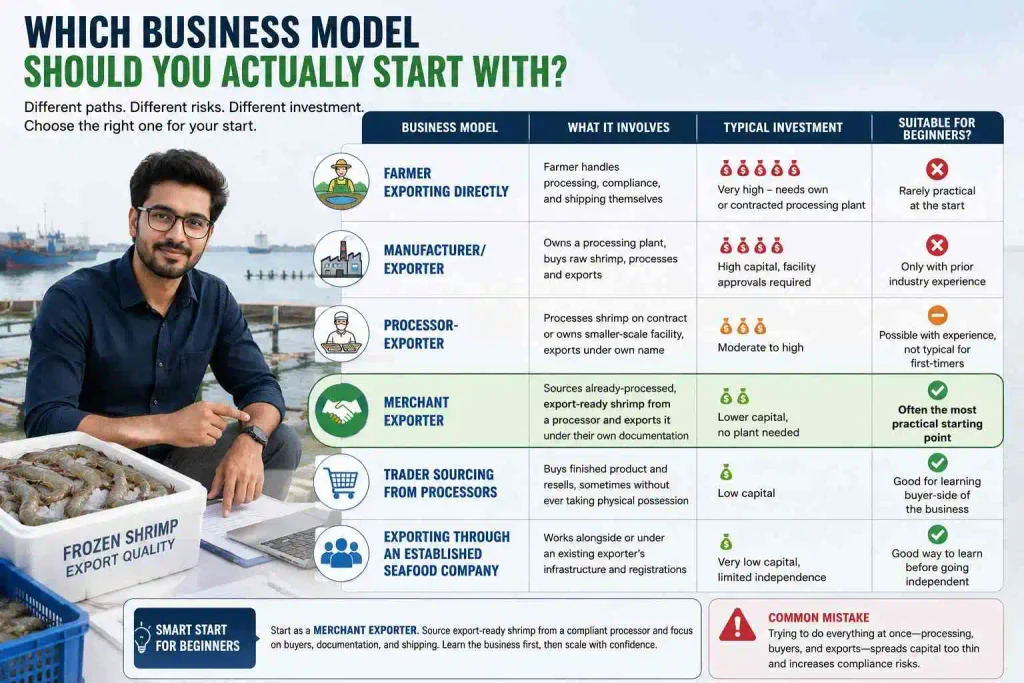
Common Mistake: New entrants often try to do everything at once — build a small processing setup, find buyers, and handle exports in their very first year. This spreads working capital too thin and increases the chance of a compliance gap somewhere in the chain. Starting narrower and expanding once you understand the buyer and regulatory landscape is a safer path.
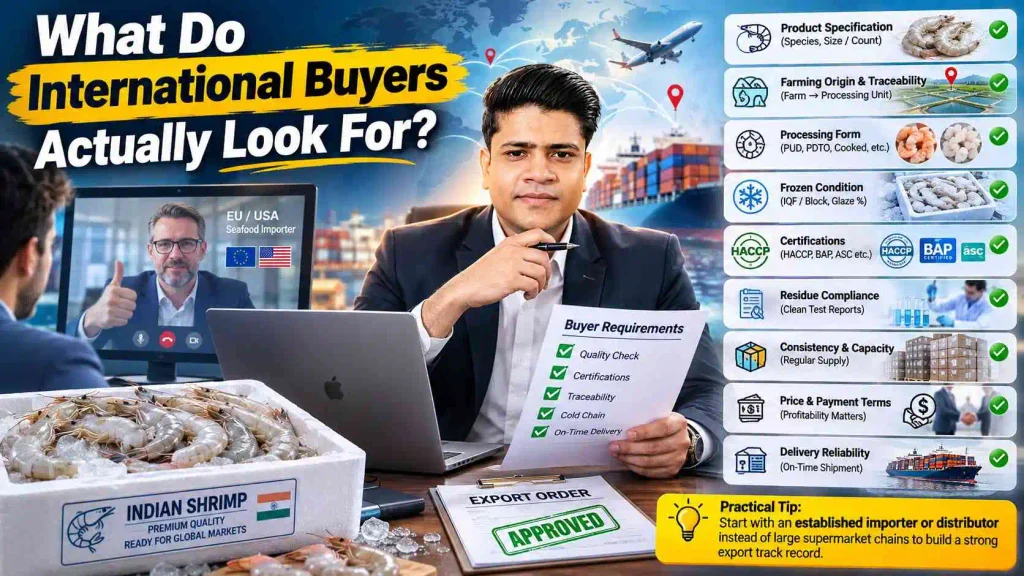
What Do International Buyers Actually Look For?
“Find buyers on Alibaba” is not a strategy — it’s a starting point at best. Professional seafood importers evaluate suppliers on a fairly specific set of criteria, and understanding these criteria before you approach a buyer will save you a lot of wasted conversations.
Buyers typically look at:
- Product specification match — species, size/count, and processing form matching exactly what they need
- Farming origin and traceability — which farm, which cluster, which processing unit the shrimp came from
- Processing form — head-on, headless, peeled, PUD, PDTO, cooked, breaded, and so on
- Frozen condition and glazing — block frozen vs. IQF, glaze percentage, and how consistently it’s applied
- Certifications — HACCP status of the processing plant, and sometimes BAP, ASC, or similar depending on the buyer
- Residue compliance history — whether the exporter’s shipments have a track record of clean test results
- Production capacity and consistency — can you actually supply the volume, and repeat it every month
- Price and payment terms — not just the FOB number, but who bears what risk
- Delivery reliability — on-time shipment history matters more to repeat buyers than a slightly lower price
Here’s the part beginners often miss: getting a buyer to say “yes, send me a quotation” is not the same as getting a profitable, repeatable order. A buyer might accept your price on paper but expect payment terms, packaging customisation, or certification that quietly erodes your margin — or that you simply can’t deliver on. Before you get excited about interest from an overseas buyer, work through the full commercial terms, not just the headline price.
Practical Tip: For a first-time exporter, chasing large supermarket chains overseas directly can look attractive on paper, but it usually comes with heavy compliance audits, strict volume commitments, and working-capital pressure that a new exporter isn’t set up to handle. Starting with an established importer or distributor in the target market — someone who already understands the compliance landscape and can absorb smaller, more flexible orders — is often a more practical route to build a track record.
Understanding Shrimp Exports Specifications From Both Sides
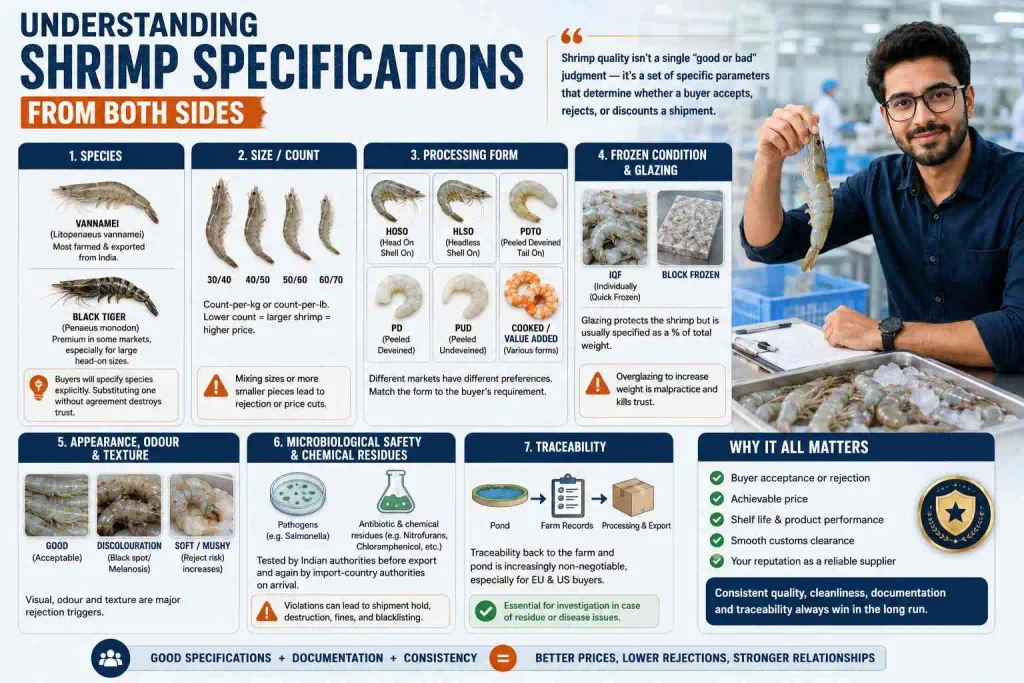
Shrimp quality isn’t a single “good or bad” judgment — it’s a set of specific parameters that determine whether a buyer accepts, rejects, or discounts a shipment. Getting comfortable with this vocabulary is essential before you ever quote a price.
Species — Vannamei (Litopenaeus vannamei) dominates Indian shrimp farming and export volumes today, with black tiger shrimp (Penaeus monodon) commanding a premium in some markets, particularly for larger, head-on product. Buyers will specify species explicitly; substituting one for another without agreement is a fast way to lose a buyer’s trust.
Size/count — Shrimp are sold by count-per-kilogram or count-per-pound (e.g., 30/40, 40/50, 50/60), representing how many pieces make up that weight. Larger shrimp (lower count numbers) generally command higher prices. A buyer ordering 30/40 count and receiving a mixed batch with a meaningful share of smaller pieces will typically reject or demand a price adjustment.
Processing form — Head-on shell-on (HOSO), headless shell-on (HLSO), peeled and deveined (PD), peeled undeveined (PUD), peeled deveined tail-on (PDTO), cooked, breaded, and value-added forms all serve different markets. The EU and US often favour peeled and value-added forms; some Middle Eastern and Southeast Asian markets prefer head-on.
Frozen condition and glazing — Individually Quick Frozen (IQF) vs. block frozen changes both handling and price. Glazing (a thin ice coating for protection) is usually specified as a percentage of total weight — overglazing to inflate weight is a known malpractice that damages trust and can trigger claims.
Appearance, odour, and texture — Discolouration (black spot, melanosis), off-odours, and soft or mushy texture are the most common visual/sensory rejection triggers at the buyer’s end.
Microbiological safety and chemical residues — This is where shipments get held up or destroyed. Pathogens like Salmonella and residues of banned antibiotics (such as nitrofurans and chloramphenicol) or excess levels of restricted substances are tested for by both Indian authorities before export and by import-country authorities on arrival.
Traceability — The ability to trace a batch of shrimp back to the specific farm and pond it came from is increasingly non-negotiable, particularly for EU and US buyers, and is central to how residue and disease issues get investigated when something goes wrong.
Every one of these factors ties directly back to buyer acceptance, rejection risk, achievable price, shelf life, and — ultimately — your reputation as a supplier. A processor with a track record of clean, well-documented, consistent shipments can often command better terms than a slightly cheaper supplier with an inconsistent history.
Why One Failed Residue Test Can Destroy a Shipment
This deserves its own section because it surprises a lot of newcomers with how disproportionate the consequences can be. A single container of frozen shrimp can represent tens of lakhs of rupees in value. If a residue test — done either at the exporter’s end before shipment or by the importing country’s port authority on arrival — comes back positive for a banned or excess substance, the entire consignment can be rejected, destroyed, or sent back at the exporter’s cost.
This isn’t limited to the specific batch that tested positive, either. Repeated violations from Indian shrimp shipments have, in the past, led to increased inspection frequency or heightened scrutiny on Indian consignments more broadly in certain markets — which is why the industry as a whole takes residue compliance seriously, not just individual exporters.
What actually causes this:
- Antibiotic use at the farm level (sometimes without the farmer realising the specific substance is restricted in the destination market)
- Cross-contamination during processing or storage
- Inadequate testing before shipment, relying only on the processor’s word rather than independent verification
What a beginner should do about it:
- Work only with processors and farm sources that can demonstrate a consistent, verifiable testing record
- Understand that pre-shipment residue testing is standard industry practice for serious exporters, even where not always mandated for every shipment — it’s a risk-management tool, not just red tape
- Never treat “the farmer said it’s clean” as sufficient evidence for an export shipment
- Verify current testing requirements and accredited laboratories with the relevant Indian export authority before your first shipment, since testing protocols and monitored substances can be updated
Warning: Never treat compliance testing as an optional cost to save money on your first few shipments. The cost of a residue test is a rounding error compared to the cost of a rejected, destroyed, or returned container — plus the buyer relationship you’ll likely lose along with it.
Which Registrations Does an Indian Shrimp Exporter Need?
This is the part that trips up almost every first-time exporter, mostly because the requirements come from different authorities for different purposes. Below is a general orientation — not a substitute for checking current, official requirements before you register or ship.
| Requirement | What It Generally Covers | Why It Matters |
|---|---|---|
| Import Export Code (IEC) | Basic registration required to legally import or export any goods from India | Without it, you cannot file export documentation at all |
| MPEDA registration | Registration with the Marine Products Export Development Authority, which oversees and promotes India’s marine product exports | Generally required for exporters of marine/seafood products, and MPEDA is also a source of guidance on buyer markets and standards |
| FSSAI licence | Food safety licensing under India’s food regulator | Applies to entities handling, processing, or exporting food products, including seafood |
| EIC/EIA certification | Involves inspection and certification through India’s Export Inspection Council/Export Inspection Agency network, relevant to health certification for seafood exports | Many importing countries require an official health certificate confirming the consignment meets sanitary requirements |
| Processing plant approval | Government approval of the specific processing facility, often tied to HACCP compliance | Determines whether a plant is approved to process seafood for export to specific markets |
| HACCP certification | Hazard Analysis and Critical Control Points — a food safety management system applied at the processing facility | Increasingly expected by both regulators and buyers as baseline evidence of a safe, controlled process |
A few things worth being clear-eyed about:
- Some of these are legal requirements you cannot export without; others are closer to industry-standard practice that most serious buyers will expect even where not strictly mandated by Indian law for every transaction.
- Requirements can be updated, and the exact registration process, fees, and documentation can change — always verify current requirements directly with MPEDA, FSSAI, and the relevant Export Inspection Agency office before you begin the registration process, rather than relying on older articles or hearsay from other exporters.
- If you’re working as a merchant exporter sourcing from an already-approved processing unit, you still need your own IEC and relevant registrations to legally export — you can’t simply “borrow” a processor’s registrations to ship under your own name.
Did You Know? Many beginners assume that if their processor already has HACCP certification and export approval, they personally don’t need any separate registration to export that processor’s product. This isn’t generally the case — as the exporter of record, your own IEC and relevant registrations are what make the shipment yours to export.
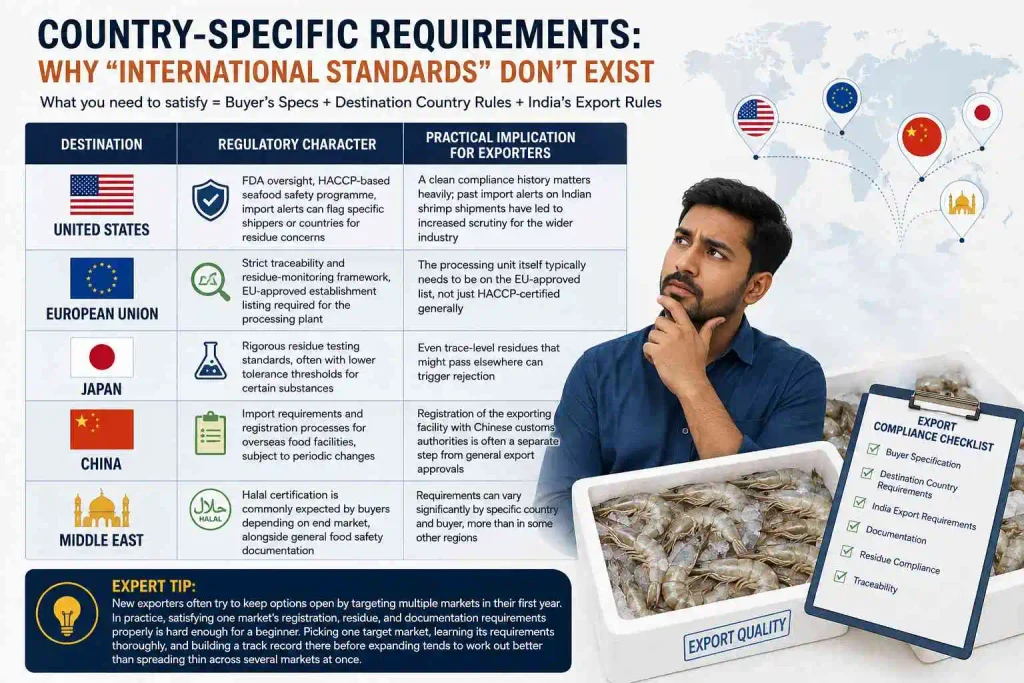
Country-Specific Requirements: Why “International Standards” Don’t Exist
One of the most common mistakes beginners make is assuming there’s a single, universal set of requirements for exporting shrimp anywhere in the world. There isn’t. What you actually need to satisfy is a combination of three separate things:
The buyer’s own specification + the destination country’s regulatory requirements + India’s own export requirements.
All three have to be satisfied simultaneously, and they don’t automatically overlap.
| Destination | General Regulatory Character | Practical Implication for Exporters |
|---|---|---|
| United States | FDA oversight, HACCP-based seafood safety programme, import alerts can flag specific shippers or countries for residue concerns | A clean compliance history matters heavily; past import alerts on Indian shrimp shipments have led to increased scrutiny for the wider industry |
| European Union | Strict traceability and residue-monitoring framework, EU-approved establishment listing required for the processing plant | The processing unit itself typically needs to be on the EU-approved list, not just HACCP-certified generally |
| Japan | Rigorous residue testing standards, often with lower tolerance thresholds for certain substances | Even trace-level residues that might pass elsewhere can trigger rejection |
| China | Import requirements and registration processes for overseas food facilities, subject to periodic changes | Registration of the exporting facility with Chinese customs authorities is often a separate step from general export approvals |
| Middle East | Halal certification is commonly expected by buyers depending on end market, alongside general food safety documentation | Requirements can vary significantly by specific country and buyer, more than in some other regions |
The exact detail of each of these frameworks changes periodically, so treat this table as an orientation to how differently markets are structured, not as a final checklist. Before committing to a specific export market, verify current requirements with MPEDA, the relevant Export Inspection Agency, and — critically — your buyer directly, since buyers often layer their own requirements on top of the legal minimum.
Expert Tip: New exporters often try to keep options open by targeting multiple markets in their first year. In practice, satisfying one market’s registration, residue, and documentation requirements properly is hard enough for a beginner. Picking one target market, learning its requirements thoroughly, and building a track record there before expanding tends to work out better than spreading thin across several markets at once.
FOB, CIF, and CFR: Which One Is Safer for a New Exporter?
Incoterms define exactly where the seller’s responsibility ends and the buyer’s begins — and they directly determine how much risk and cost you’re carrying as the exporter.
- FOB (Free on Board) — Your responsibility ends once the goods are loaded onto the vessel at the Indian port. The buyer arranges and pays for the main freight and insurance from that point. This is generally the lower-risk option for a new exporter, since you aren’t exposed to freight cost fluctuations or the complexities of arranging international shipping insurance.
- CFR (Cost and Freight) — You arrange and pay for freight to the destination port, but the buyer bears the risk once goods are loaded (insurance is the buyer’s responsibility).
- CIF (Cost, Insurance, and Freight) — You arrange and pay for both freight and insurance to the destination port. This gives you more control over the shipping arrangement but also more exposure if freight rates spike or something goes wrong in transit.
For a first-time exporter, FOB is usually the more manageable starting point — it limits your direct exposure to international freight-market volatility while you’re still learning the ropes of documentation and buyer management. As you gain experience and better freight relationships, moving to CFR or CIF can improve margins, since you can sometimes negotiate better freight rates than the buyer would get on their own.
Payment Terms: Where the Real Risk Sits
Getting a good price means very little if you can’t actually collect payment reliably. This is where a lot of first-time exporters get caught out, particularly with buyers they’ve never worked with before.
| Payment Method | How It Works | Risk Level for Exporter |
|---|---|---|
| Advance payment (full or partial) | Buyer pays before or on shipment | Lowest risk for exporter |
| Letter of Credit (LC) | A bank guarantees payment once you present the correct shipping documents | Low risk if documents are prepared correctly; disputes often arise from document discrepancies, not payment refusal |
| Documentary collection | Bank handles document exchange, but payment isn’t guaranteed the way an LC is | Moderate risk |
| Telegraphic Transfer (TT) after shipment | Buyer pays after receiving goods or documents, based on trust | Higher risk — you’ve already shipped before being paid |
| Open account | Buyer pays on agreed credit terms after receiving goods, sometimes 30–90 days later | Highest risk for exporter, most favourable for buyer |
Common Mistake: New exporters, eager to close their first deal, sometimes agree to open account terms with an unfamiliar overseas buyer just to win the business. If the buyer delays payment or defaults, there’s often very little practical recourse, especially early in the relationship. For your first few shipments with a new buyer, insisting on an advance payment or a confirmed Letter of Credit is a reasonable and standard protective step — not something that should cost you the deal with a serious buyer.
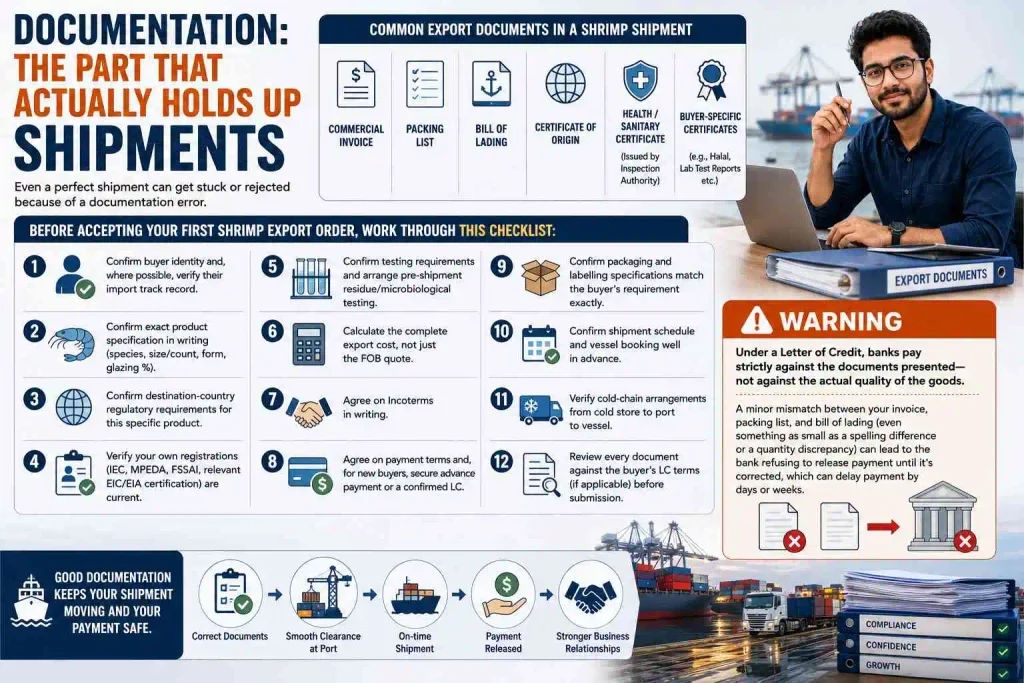
Documentation: The Part That Actually Holds Up Shipments
Even a perfectly compliant, high-quality shipment can sit at port or get held up abroad because of a documentation error. Common export documents in a shrimp shipment include the commercial invoice, packing list, bill of lading, certificate of origin, health/sanitary certificate issued through the relevant inspection authority, and any buyer-specific certificates (such as halal or specific lab test reports).
Before accepting your first shrimp export order, work through this checklist:
- Confirm buyer identity and, where possible, verify their import track record
- Confirm exact product specification in writing (species, size/count, form, glazing %)
- Confirm destination-country regulatory requirements for this specific product
- Verify your own registrations (IEC, MPEDA, FSSAI, relevant EIC/EIA certification) are current
- Confirm testing requirements and arrange pre-shipment residue/microbiological testing
- Calculate the complete export cost, not just the FOB quote
- Agree on Incoterms in writing
- Agree on payment terms and, for new buyers, secure advance payment or a confirmed LC
- Confirm packaging and labelling specifications match the buyer’s requirement exactly
- Confirm shipment schedule and vessel booking well in advance
- Verify cold-chain arrangements from cold store to port to vessel
- Review every document against the buyer’s LC terms (if applicable) before submission
Warning: Under a Letter of Credit, banks pay strictly against the documents presented — not against the actual quality of the goods. A minor mismatch between your invoice, packing list, and bill of lading (even something as small as a spelling difference or a quantity discrepancy) can lead to the bank refusing to release payment until it’s corrected, which can delay payment by days or weeks.
Packaging and the Cold Chain: Where Quality Gets Lost Quietly
Shrimp is a perishable product from the moment of harvest, and the cold chain has to remain unbroken from processing plant to the buyer’s warehouse. A single break — a delayed truck, a warehouse without adequate reefer capacity, a container that isn’t pre-cooled properly before loading — can degrade product quality in ways that aren’t obvious until the buyer opens the carton on arrival.
Packaging specifications aren’t just about protecting the product; they’re often buyer-specific and tied directly to their retail or foodservice requirements — carton size, inner packaging, private labelling, barcode placement, and language requirements on the label can all vary. Getting this wrong, even with perfectly good shrimp inside, can lead to a rejection or a demand for repackaging at your cost.
Practical Tip: Before your first shipment, physically walk through (or have someone reliable walk through) the entire cold-chain path your product will take — from the processing plant’s cold store, through inland transport, to the port’s reefer container stuffing point, and onto the vessel. Identify every point where a delay or temperature lapse could occur, and build in buffer time rather than assuming everything will run exactly on schedule.
How Much Does It Really Cost to Export Shrimp?
A beginner’s instinct is to think of profit as: selling price minus purchase price. That calculation dramatically overstates what you’ll actually take home, because it ignores nearly every cost that sits between buying raw shrimp and getting paid by an overseas buyer.
The real cost structure typically includes:
- Shrimp procurement cost
- Processing charges (if using a contract processor)
- Freezing and cold storage
- Packaging materials and labelling
- Pre-shipment testing and certification costs
- Inland transportation to port
- Port handling and terminal charges
- Ocean freight
- Marine insurance (if you’re bearing that cost under the agreed Incoterm)
- Customs clearance and documentation charges
- Bank charges (especially significant under LC transactions)
- Buyer-related costs (inspection fees, specific certifications the buyer requires)
- Exchange-rate movement between quoting and actual payment realisation
- Provision for potential rejections or quality claims
- Cost of working capital tied up between procurement and final payment
Illustrative example (not actual market figures): Suppose an exporter buys a quantity of frozen shrimp at an indicative procurement price per kilogram. On paper, the gap between that price and the FOB quote to the buyer might look like a healthy margin. But once processing, packaging, testing, inland transport, port charges, freight-related costs (even under FOB, some documentation and handling costs remain with the exporter), banking charges, and a provision for potential claims are deducted, the actual net margin is typically a fraction of that initial “paper” margin — sometimes significantly so, particularly on a first shipment where inefficiencies haven’t yet been worked out.
The right way to think about profitability is:
Revenue → Gross margin (after procurement and processing) → Operating costs (logistics, documentation, financing) → Net profit
Never assume a fixed profit percentage applies to shrimp export — margins vary significantly by market, buyer relationship, shipment size, and how efficiently you manage costs. Anyone quoting you a guaranteed export margin is not being realistic with you.
A Worked Example: 5-Tonne Frozen Vannamei Shipment
Numbers make this easier to follow than percentages alone, so here’s a single hypothetical shipment worked through end to end. Every figure below is invented purely to illustrate how the cost stack behaves — not a benchmark, quote, or market rate.
| Cost Item | Illustrative Amount (₹) |
|---|---|
| Product procurement (5,000 kg raw shrimp) | 22,50,000 |
| Processing charges | 1,25,000 |
| Packaging and labelling | 60,000 |
| Pre-shipment testing and certification | 35,000 |
| Inland transport to port and cold storage | 45,000 |
| Documentation, customs, and port charges | 40,000 |
| Bank charges (LC handling) | 30,000 |
| Provision for claims/contingency | 50,000 |
| Total landed export cost | 26,35,000 |
| Export quotation to buyer (FOB) | 29,00,000 |
| Gross margin (quotation − procurement/processing) | 5,25,000 |
| Estimated net margin (quotation − total landed cost) | 2,65,000 |
Notice the gap between gross margin and net margin — roughly half of the apparent margin disappears once packaging, testing, transport, documentation, and financing costs are accounted for. This is exactly the gap that catches out first-time exporters who quote a price based on procurement cost alone, without mapping out everything that sits between the pond and the buyer’s payment.
Illustrative example only. Actual costs vary by shrimp size and count, processing form, processor charges, destination market, prevailing freight rates, exchange-rate movement at the time of realisation, and the specific commercial terms agreed with the buyer. Always build your own cost sheet from current quotations before pricing a real shipment.
How Much Money Do You Actually Need Before You Get Paid?
This is arguably the single most underestimated question in shrimp export, and it’s a different question from “how much does export cost?” A beginner who works out their total cost per shipment often assumes that’s also the amount of working capital they need. It isn’t — because of the timing gap between when money goes out and when it comes back in.
Here’s the cash cycle a typical export order moves through:
Purchase of raw shrimp → processing → packing → testing → shipment → documentation → buyer/import clearance abroad → payment received
At every one of those stages, you are usually paying money out — to the farmer or aggregator, to the processor, for packaging materials, for testing, for transport and port charges, for the freight forwarder — while the money coming back from the buyer sits somewhere in the future, often weeks away. Depending on the payment terms you’ve agreed, that gap can run from a couple of weeks (advance payment, fast LC processing) to two or three months (open account terms, slow import clearance, or a buyer who pays on a 60–90 day credit cycle).
Why a ₹25 lakh order doesn’t mean you need only ₹25 lakh:
- You typically pay the farmer or aggregator for the raw shrimp at or soon after purchase — long before the buyer pays you.
- Processing, packaging, and testing costs are usually paid within days, not on credit.
- If you’re shipping under an LC, the bank only releases payment once your documents are presented and accepted — which can be one to three weeks after the vessel has sailed, not the moment of shipment.
- If you’re on open account or the buyer’s import clearance is delayed at the destination port, payment can take 30 to 90 days or longer from the shipment date.
- If you want to keep exporting while waiting for that first payment, you need capital for your next shipment’s procurement and processing before the previous one has even been paid for.
In practice, this means an exporter running back-to-back shipments needs working capital that reflects the full length of this cash cycle — not just the cost of a single order. Many established exporters manage this through packing credit or pre-shipment finance from their bank (borrowing against a confirmed export order to fund procurement and processing), and post-shipment finance or bill discounting against shipping documents to release cash before the buyer’s payment actually lands. These are standard trade-finance tools in the export business, but they come with their own interest costs, documentation requirements, and bank relationship — worth exploring with your bank well before you commit to your first order, not after you’ve already paid the farmer.
Common Mistake: A new exporter secures a genuinely good order, calculates the cost of that one shipment, and puts in exactly that much capital — only to find themselves unable to fund the next shipment’s procurement because the buyer’s payment for the first one hasn’t arrived yet. Plan your working capital around your cash cycle length, not around a single order’s cost.
The Risks Nobody Mentions Until Something Goes Wrong
Shrimp exporting can be a genuinely good business, but it isn’t a passive one, and it isn’t risk-free. Being upfront about what can go wrong is what separates a sustainable exporter from someone who gets burned on their second or third shipment.
Real risks to plan for:
- Shipment rejection at destination due to quality, documentation, or specification mismatches
- Residue violations that can lead to destruction of the entire consignment
- Quality claims from buyers after arrival, sometimes disputed and hard to verify remotely
- Price fluctuations between quoting a price and actually shipping, especially on longer lead times
- Currency fluctuations affecting realised value if payment is delayed
- Buyer default or delayed payment, particularly on open account terms
- Cold-chain failures during inland transport or port handling
- Sudden freight rate increases, especially during periods of shipping-capacity disruption
- Documentation errors causing payment delays under LC terms
- Regulatory changes in the destination country that affect an already-planned shipment
- Contract disputes over specification interpretation
Experienced exporters manage these risks by starting with smaller trial shipments, working with buyers who have a verifiable track record, insisting on secure payment terms for new relationships, maintaining a testing and documentation discipline that doesn’t get compromised for the sake of speed, and building relationships with reliable processors and freight forwarders rather than chasing the cheapest quote every time.
What a Beginner Should Actually Do First
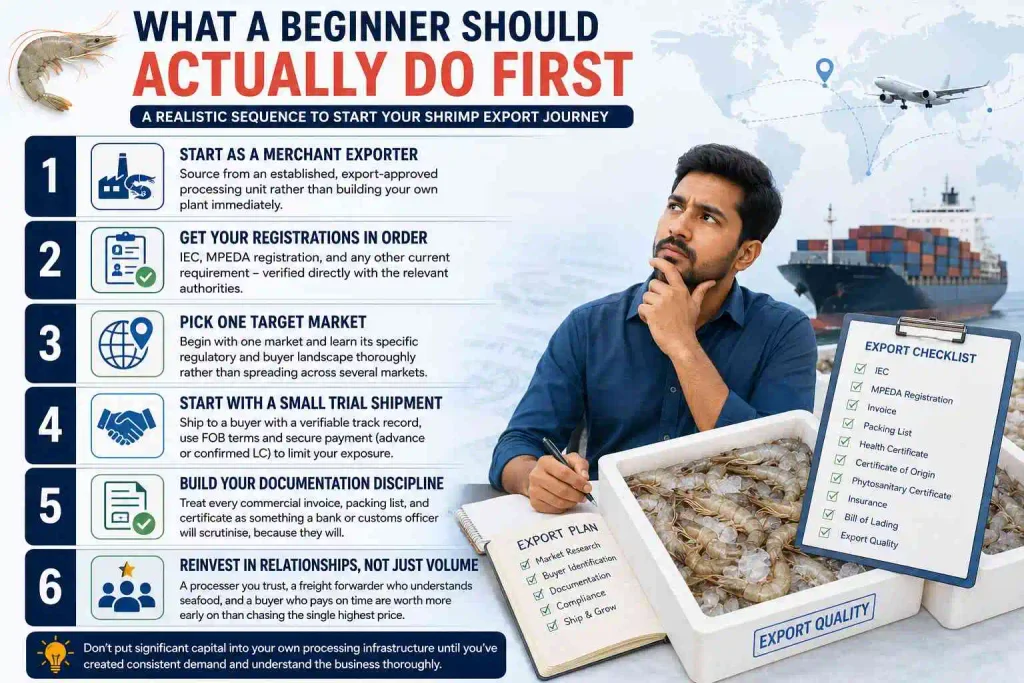
If you’re serious about entering shrimp export, here’s a realistic sequence rather than trying to do everything simultaneously:
- Start as a merchant exporter, sourcing from an established, export-approved processing unit rather than building your own plant immediately.
- Get your own registrations in order — IEC, MPEDA registration, and any other current requirement — verified directly with the relevant authorities.
- Pick one target market to begin with, and learn its specific regulatory and buyer landscape thoroughly rather than spreading across several markets.
- Start with a small trial shipment to a buyer with a verifiable track record, using FOB terms and secure payment (advance or confirmed LC) to limit your exposure while you learn.
- Build your documentation discipline from day one — treat every commercial invoice, packing list, and certificate as something a bank or customs officer will scrutinise, because they will.
- Reinvest in relationships, not just volume — a processor you trust, a freight forwarder who understands seafood, and a buyer who pays on time are worth more early on than chasing the single highest price.
Don’t put significant capital into your own processing infrastructure, multiple simultaneous markets, or large speculative shipments until you’ve been through this cycle successfully at least a few times.
Where This Leaves You
The businesses that succeed in shrimp export aren’t necessarily the ones with the best shrimp or the lowest price — they’re the ones that treat compliance, documentation, and buyer risk management as seriously as they treat sourcing. Money in this business is made in the gap between doing all of this correctly and doing it just well enough to get by; it’s lost in exactly that same gap when something is skipped to save time or cost.
If you’re planning your first shipment, your next concrete step isn’t finding a buyer — it’s getting your registrations verified with MPEDA and the relevant authorities, identifying a compliant processing partner, and working out your complete landed export cost before you quote anyone a price. Get that foundation right, and finding — and keeping — a buyer becomes a far more manageable problem.
And if you’re coming at this from the production side rather than the trading side — say you’re still deciding whether to get into shrimp farming in the first place — it’s worth understanding that end of the business too, since your procurement quality and reliability as an exporter ultimately depends on it. This guide to shrimp farming in India walks through site selection, stocking, disease risk, and farm-level investment and profitability, which pairs well with everything covered here on the export side.
Newsletter