



HF Cow Feeding Chart: What to Feed for Maximum Milk Production
Most farmers do the same thing when milk drops: they add another kilo of concentrate. Sometimes it works. More often, it doesn’t — because the real problem was poor-quality fodder, not enough water, a mineral deficiency, heat stress, or simply the fact that the cow has moved into a different stage of lactation.
Feeding a high-producing HF (Holstein Friesian) cow is not about piling more feed in front of her. It’s about getting the proportions right — enough energy, protein, fibre, minerals and water, in the right balance, at the right time.
In this guide, you’ll get:
- A practical HF cow feeding chart by milk-production level
- How much green fodder, dry fodder and concentrate to feed
- How much water an HF cow actually needs
- Why mineral mixture matters more than most farmers assume
- How feeding should change through lactation and pregnancy
- How to calculate your daily feeding cost
- The most common feeding mistakes — and what to do instead
This won’t guarantee a fixed litre count. What it will do is help you think about the ration the way a nutritionist does, so you stop guessing.

Why HF Cows Need a Carefully Balanced Ration
An HF cow producing 15–25 litres a day is running a very different metabolism than a cow giving 5 litres. She needs considerably more energy and protein, but her rumen still runs on the same basic fuel: fibre. If you push concentrate up without protecting fibre intake, you’re not feeding her better — you’re setting up problems.
A working ration has to supply, every single day:
- Energy — mainly from fodder and grain/concentrate
- Protein — for milk synthesis and body maintenance
- Fibre — to keep the rumen functioning normally
- Minerals and vitamins — for milk, bone, and reproduction
- Water — the single most underrated nutrient on the list
Warning: Cutting fibre to make room for more concentrate is one of the fastest ways to reduce milk fat, cause acidosis, and shorten a cow’s productive life. Concentrate should top up the ration — it should never replace roughage.
When the ration is out of balance, you don’t just lose milk. You can end up with poor body condition, delayed heat cycles, digestive upsets, and lower feed efficiency — meaning you spend more money to get less milk. The goal is never “feed the most.” It’s “feed a ration that matches what she’s actually producing.”
How Much Should an HF Cow Eat Every Day?
An HF cow’s daily ration is generally built from six components:
- Green fodder (fresh, high-moisture forage)
- Dry fodder (straw, hay — the roughage backbone)
- Concentrate feed (grain mix/compound feed for energy and protein)
- Mineral mixture
- Salt, where the concentrate mix doesn’t already include it
- Water
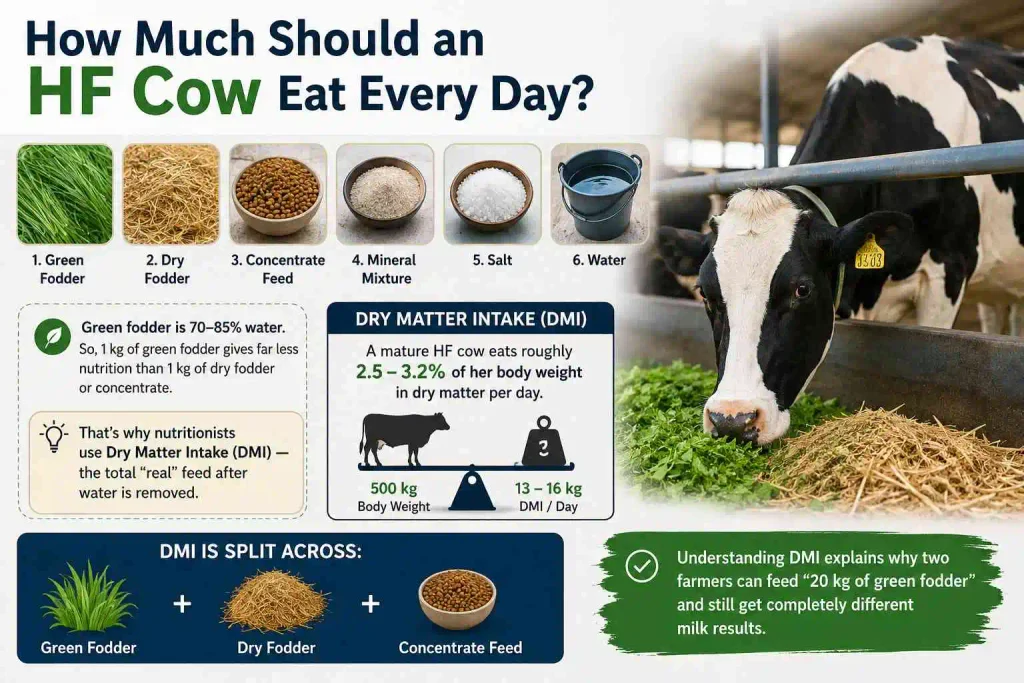
Here’s the part that trips up a lot of farmers: measuring feed in kilograms of “green fodder” isn’t the same as measuring nutrition. Green fodder is 70–85% water. A kilo of green maize fodder gives the cow far less actual dry matter (and therefore energy and protein) than a kilo of dry fodder or concentrate.
That’s why nutritionists talk in terms of dry matter intake (DMI) — the total “real” feed a cow eats once the water is stripped out. As a working rule of thumb, a mature HF cow can eat roughly 2.5–3.2% of her body weight in dry matter per day, adjusted upward for high milk yield. A 500 kg cow might have a DMI capacity of roughly 13–16 kg/day, split across green fodder, dry fodder and concentrate.
You don’t need to run these calculations every day. But understanding the concept explains why two farmers can feed “20 kg of green fodder” and get completely different milk results — one fodder was leafy and young, the other was mature and stemmy.
HF Cow Feeding Chart by Milk Production
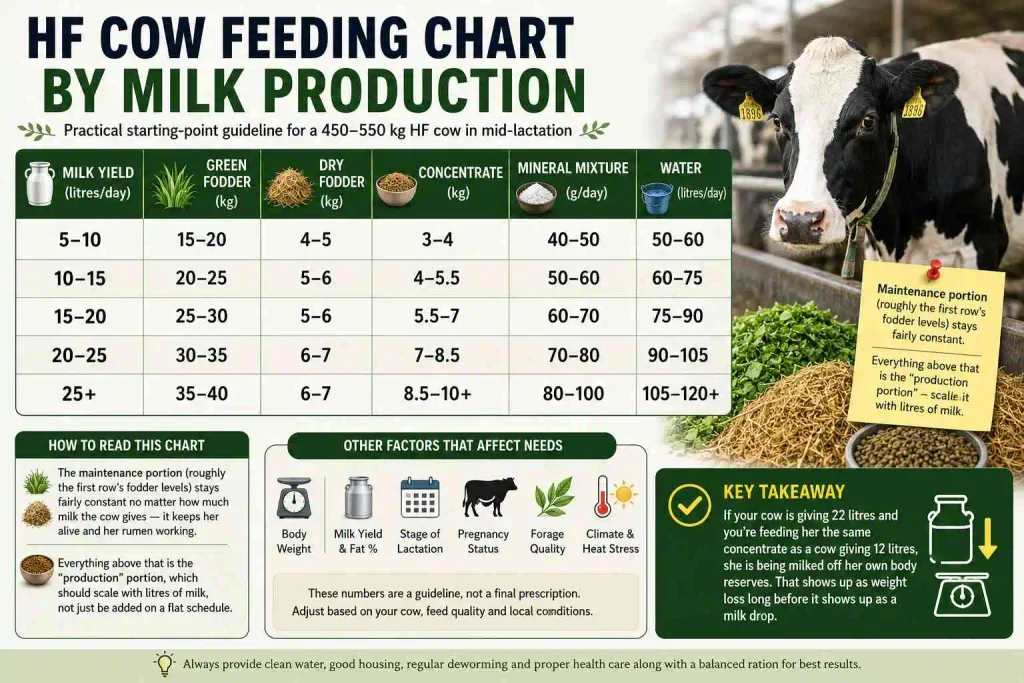
This is the part most farmers come here for. The table below is a practical starting-point guideline, built around commonly referenced Indian dairy-extension recommendations (ICAR/NDDB-style rations) for a mature HF cow of roughly 450–550 kg body weight in mid-lactation, fed reasonable-quality green fodder, dry fodder and a standard 18–20% CP compound concentrate.
Before you use it: your cow’s actual requirement will shift with body weight, milk fat %, stage of lactation, pregnancy, forage quality and climate. Treat these numbers as the first draft of a ration, not the final answer.
| Milk Yield (litres/day) | Green Fodder (kg) | Dry Fodder (kg) | Concentrate (kg) | Mineral Mixture (g) | Water (litres) |
|---|---|---|---|---|---|
| 5–10 | 15–20 | 4–5 | 3–4 | 40–50 | 50–60 |
| 10–15 | 20–25 | 5–6 | 4–5.5 | 50–60 | 60–75 |
| 15–20 | 25–30 | 5–6 | 5.5–7 | 60–70 | 75–90 |
| 20–25 | 30–35 | 6–7 | 7–8.5 | 70–80 | 90–105 |
| 25+ | 35–40 | 6–7 | 8.5–10+ | 80–100 | 105–120+ |
How to read this chart: the maintenance portion (roughly the first row’s fodder levels) stays fairly constant no matter how much milk the cow gives — it’s what keeps her alive and her rumen working. Everything above that is the “production” portion, which should scale with litres of milk, not just be added on a flat schedule.
Key Takeaway: If your cow is giving 22 litres and you’re feeding her the same concentrate as a cow giving 12 litres, she is being milked off her own body reserves. That shows up as weight loss long before it shows up as a milk drop.
Green Fodder — Which Fodder Is Best for HF Cows?
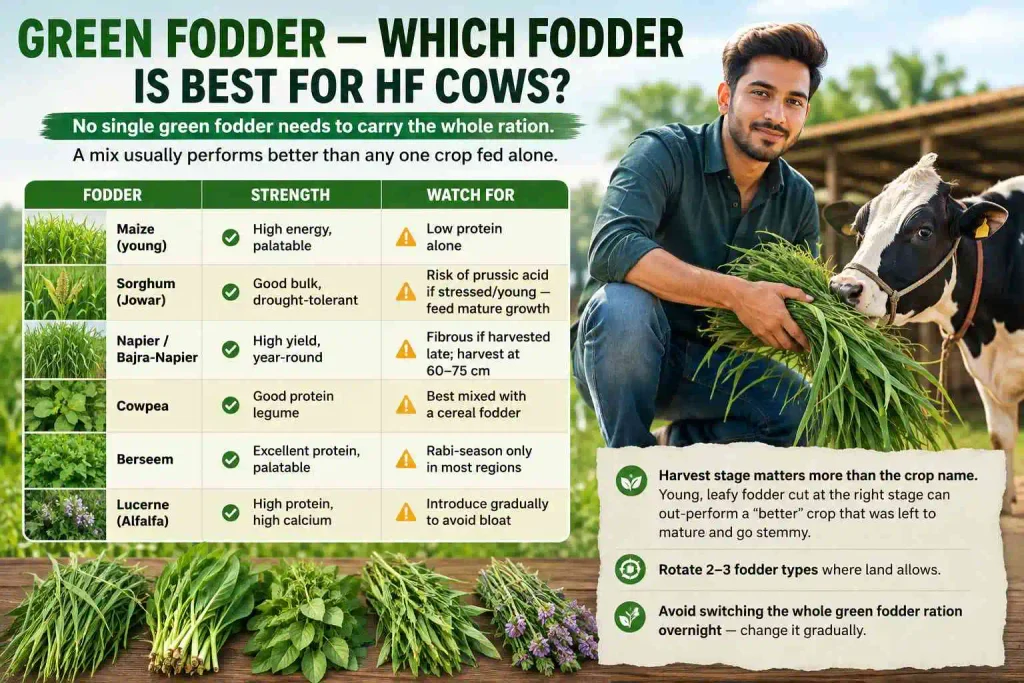
No single green fodder needs to carry the whole ration. In fact, a mix usually performs better than any one crop fed alone.
| Fodder | Strength | Watch for |
|---|---|---|
| Maize (young) | High energy, palatable | Low protein alone |
| Sorghum (Jowar) | Good bulk, drought-tolerant | Risk of prussic acid if stressed/young — feed mature growth |
| Napier / Bajra-Napier | High yield, year-round | Fibrous if harvested late; harvest at 60–75 cm |
| Cowpea | Good protein legume | Best mixed with a cereal fodder |
| Berseem | Excellent protein, palatable | Rabi-season only in most regions |
| Lucerne (Alfalfa) | High protein, high calcium | Introduce gradually to avoid bloat |
Harvest stage matters more than the crop name. Young, leafy fodder cut at the right stage can out-perform a “better” crop that was left to mature and go stemmy. Rotate 2–3 fodder types where land allows, and avoid switching the whole green fodder ration overnight — change it gradually over 4–5 days.
If land, water, or season is limiting your ability to grow a consistent green fodder supply (for example, Berseem being Rabi-only, or space constraints for Napier), hydroponic fodder is worth considering as a year-round supplement — it’s grown indoors in about 7 days and can help fill the gaps between seasonal crop cycles without needing large land area.
Dry Fodder — Why You Should Never Ignore It
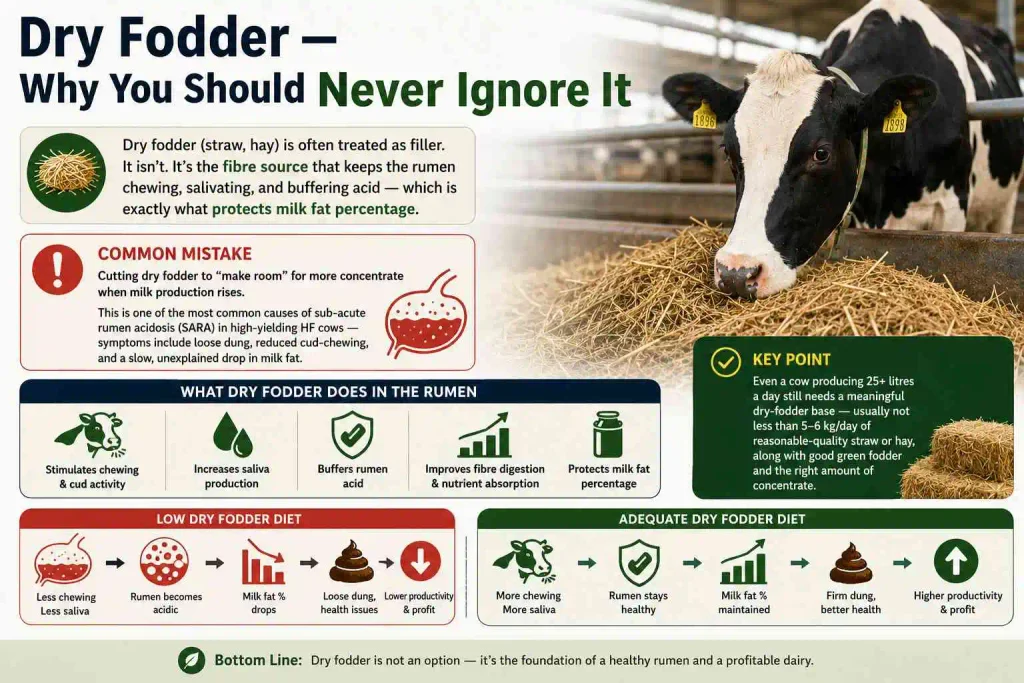
Dry fodder (straw, hay) is often treated as filler. It isn’t. It’s the fibre source that keeps the rumen chewing, salivating, and buffering acid — which is exactly what protects milk fat percentage.
Common Mistake: Cutting dry fodder to “make room” for more concentrate when milk production rises. This is one of the most common causes of sub-acute rumen acidosis (SARA) in high-yielding HF cows — symptoms include loose dung, reduced cud-chewing, and a slow, unexplained drop in milk fat.
Even a cow producing 25+ litres a day still needs a meaningful dry-fodder base — usually not less than 5–6 kg/day of reasonable-quality straw or hay, alongside her green fodder and concentrate, not instead of it.
Concentrate Feed — How Much Is Enough?
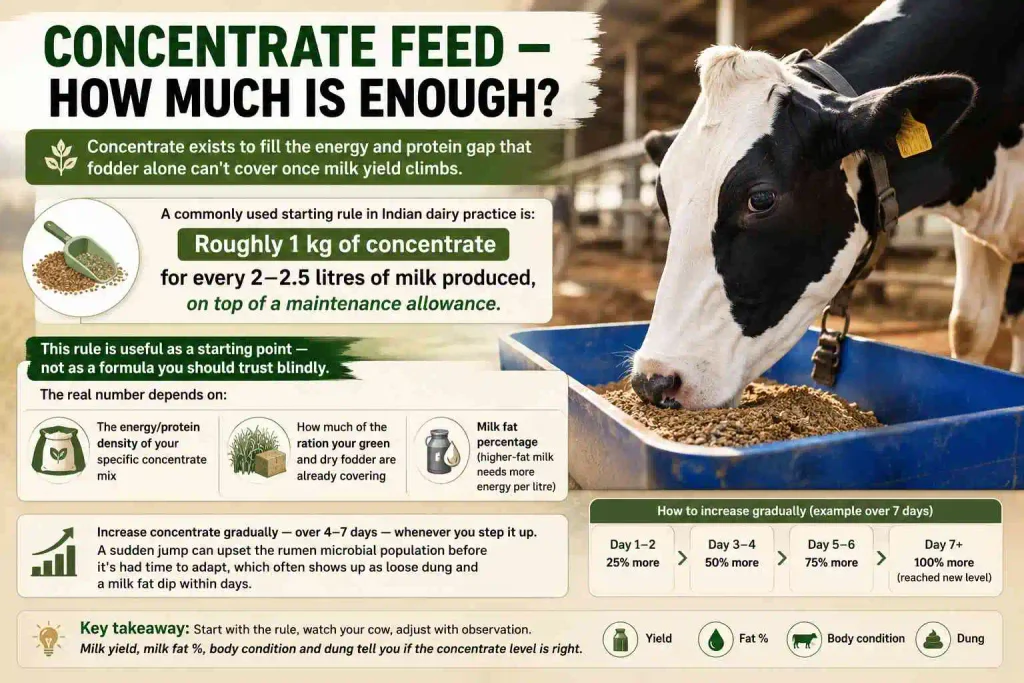
Concentrate exists to fill the energy and protein gap that fodder alone can’t cover once milk yield climbs. A commonly used starting rule in Indian dairy practice is:
Roughly 1 kg of concentrate for every 2–2.5 litres of milk produced, on top of a maintenance allowance.
This rule is useful as a starting point — not as a formula you should trust blindly. The real number depends on:
- The energy/protein density of your specific concentrate mix
- How much of the ration your green and dry fodder are already covering
- Milk fat percentage (higher-fat milk needs more energy per litre)
Increase concentrate gradually — over 4–7 days — whenever you step it up. A sudden jump can upset the rumen microbial population before it’s had time to adapt, which often shows up as loose dung and a milk fat dip within days.
Protein — More Is Not Always Better
Protein drives milk synthesis, but pushing protein % far beyond what the cow needs doesn’t translate into proportionally more milk — it usually just gets burned as extra energy (inefficiently) or excreted, while costing you more per kg of feed.
A reasonable target for a lactating HF cow’s overall ration is roughly 15–18% crude protein on a dry matter basis, coming from a mix of legume fodder (cowpea, berseem, lucerne), oil cakes (groundnut/mustard/soybean cake) and the protein already present in green fodder and concentrate.
Practical Tip: If you’re already feeding a legume fodder like berseem or lucerne, you may need less oil cake in the concentrate mix than a farmer relying only on maize/sorghum fodder. Match the concentrate to what the fodder is already giving you — don’t stack protein sources blindly.
Mineral Mixture — The Small Part of the Ration Farmers Often Miss
Minerals make up a tiny fraction of the ration by weight, but they influence milk yield, bone strength, immunity and — critically — fertility. A cow deficient in calcium, phosphorus or trace minerals can look perfectly healthy on the outside while quietly failing to conceive or losing bone density.
Key minerals to keep in mind:
- Calcium & Phosphorus — bone health, milk production, risk of milk fever around calving
- Magnesium — nerve/muscle function, particularly important pre-calving
- Sodium (salt) — appetite and water balance
- Trace minerals (zinc, copper, manganese, selenium, iodine) — immunity and fertility
Don’t assume more mineral mixture is automatically better. Follow the dosage on the product label, or a nutritionist’s recommendation — most commercial mineral mixtures are formulated to be fed at 40–100 g/day depending on milk yield, and doubling the dose doesn’t double the benefit; it can actually create mineral imbalances (excess calcium interfering with phosphorus or magnesium absorption, for instance).
How Much Water Does an HF Cow Need?
Water is the cheapest input in the whole ration — and the one most likely to be quietly limiting your milk yield.
Milk itself is roughly 87% water, so a cow producing more milk simply needs more water to make it. On top of that, water intake rises with dry matter intake, ambient temperature, humidity, salt intake, and pregnancy.
As a working guide: a lactating HF cow will typically need 3–5 litres of water for every litre of milk produced, plus a maintenance requirement of roughly 40–50 litres/day — which is where the ranges in the Section 3 chart come from. In hot, humid conditions this requirement can climb noticeably higher.
Did You Know? Heat stress can silently cut milk yield even when the ration on paper is perfectly balanced — because a heat-stressed cow eats less and drinks differently. If you’re farming somewhere warm, shade and constant access to cool, clean water often does more for milk yield than an extra kilo of concentrate.
Water should always be clean, fresh, and available on demand — not rationed to fixed times. In larger sheds, multiple watering points reduce competition and encourage more consistent intake, especially for lower-ranking cows in a group.
HF Cow Feeding Schedule — Morning to Night
There’s no single “correct” schedule — it depends on your milking times and shed management — but consistency matters more than the exact clock times you choose.
| Time | What’s typically fed |
|---|---|
| Early morning (pre-milking) | Small quantity of concentrate to encourage the cow into the parlour/stall |
| After morning milking | Green fodder + remaining concentrate + water |
| Midday | Dry fodder + water access |
| Evening (pre-milking) | Small concentrate portion again |
| After evening milking | Remaining green fodder + mineral mixture mixed into feed |
| Night | Dry fodder available for overnight rumination |
Splitting concentrate into 2–3 smaller feedings (rather than one large dump) tends to keep rumen pH more stable than a single big meal. Whatever schedule you settle on, try to keep feeding times within the same 30–45 minute window each day — cows are creatures of habit, and irregular timing itself can suppress intake.
Feeding During Early Lactation
The first 4–8 weeks after calving are the trickiest stretch of the whole lactation. Milk production climbs fast, but the cow’s appetite takes time to catch up — creating a period of negative energy balance, where she’s producing more than she’s eating enough to cover.
This is when body condition drops fastest, and it’s also when ketosis risk is highest. The instinct to dump in a large amount of concentrate immediately after calving is understandable — but a rumen that hasn’t adapted yet can’t handle a sudden jump. Step concentrate up gradually over 1–2 weeks, watch dung consistency and appetite daily, and prioritise the best-quality fodder you have for this window specifically.
Mid-Lactation — Maintain Milk Without Wasting Feed
By 60–150 days into lactation, milk production typically stabilises or plateaus. This is where a lot of farms quietly overspend — continuing to feed the peak-lactation ration long after the cow’s actual requirement has settled.
Here, the job shifts from “chase more milk” to “maintain body condition and feed efficiency.” Track milk yield weekly and body condition monthly, and trim concentrate down in step with any real decline in yield — rather than leaving the ration on autopilot.
Late Lactation — Don’t Overfeed
As milk production tapers in the last trimester of pregnancy, nutrient requirements for milk drop — but requirements for the growing calf rise. The net effect: total feed needs don’t fall as fast as milk yield does, but concentrate specifically should be trimmed back.
Overfeeding concentrate in late lactation is a common way farms end up with over-conditioned cows heading into the dry period — which increases the risk of calving difficulty and metabolic problems (like fatty liver or milk fever) after the next calving.
What Should You Feed a Pregnant HF Cow?
Through most of pregnancy, feeding priorities are body condition maintenance plus fetal growth — the fetus does most of its growing in the final trimester, so nutrient needs rise noticeably in the last 60–90 days before calving.
In this window:
- Maintain (don’t excessively increase) body condition — aim for a healthy score at calving, not an over-conditioned one
- Ensure adequate calcium and phosphorus, but avoid excess calcium in the final 2–3 weeks pre-calving in some feeding systems, since this is linked to milk fever risk — this is a good example of where a nutritionist’s input matters more than a generic rule
- Keep fibre adequate to prepare the rumen for the demands of early lactation
If a pregnant cow is losing condition, going off feed, or showing any complication, that’s a veterinary question — not something to solve by adjusting concentrate.
Transition Period — The Most Important Feeding Stage?
The transition period — roughly 3 weeks before to 3 weeks after calving — is where most metabolic problems (milk fever, ketosis, displaced abomasum) actually originate, even though the symptoms often show up later.
The core principle here is simple: no sudden changes. The rumen needs time to adapt from a dry-cow ration to a lactating ration. Start shifting the ration gradually in the last 2–3 weeks before the expected calving date, rather than making a hard switch the day after calving.
Expert Tip: For a high-producing HF cow, the goal shouldn’t be to keep increasing concentrate whenever milk rises. The entire ration needs to supply enough energy, protein, fibre, minerals and water to support production without sacrificing body condition or rumen health.
How Much Does It Cost to Feed One HF Cow Per Day?
Feed cost is where a lot of “high milk yield” farms quietly lose their profit margin. Here’s a worked example only — your actual costs will depend on your state, season, and whether fodder is home-grown or purchased.
Example: HF cow giving 20 litres/day
| Item | Quantity | Indicative Price | Cost |
|---|---|---|---|
| Green fodder | 30 kg | ₹2/kg | ₹60 |
| Dry fodder (straw) | 6 kg | ₹5/kg | ₹30 |
| Concentrate | 7 kg | ₹22/kg | ₹154 |
| Mineral mixture | 70 g | ₹80/kg | ₹5.6 |
| Total | ≈ ₹250/day |
These prices are indicative only — feed costs vary significantly by state, season, transport distance, and whether you’re growing your own fodder or buying it. Run this same calculation with your own local rates rather than relying on any fixed number.
Quick Summary: Concentrate is almost always the biggest cost line in the ration. It’s also the easiest one to overfeed without noticing. Getting concentrate quantity right — rather than rounding up “just in case” — is usually where the fastest cost savings are found.
Home-Grown Fodder vs Purchased Feed
| Factor | Home-Grown Fodder | Purchased Feed |
|---|---|---|
| Cost per kg | Usually lower (if you have land/water) | Higher, but no land needed |
| Labour | Higher (cultivation, harvesting) | Lower |
| Reliability | Depends on season, irrigation | Consistent, market-dependent |
| Quality control | Full control over harvest stage | Depends on supplier |
| Best for | Farmers with irrigated land | Farmers with limited land or unreliable water |
Most economically efficient dairy operations use a mix: home-grown green fodder for the bulk of the roughage, purchased dry fodder/straw where local crop residue is limited, and a commercial concentrate for the energy-protein top-up.
How to Know Whether Your HF Cow’s Ration Is Working
Milk yield alone isn’t the full picture — a cow can be “producing well” while quietly running down her own body reserves. Watch for:
- Body condition — should stay stable or improve, not decline month after month
- Dung consistency — well-formed, not watery or overly firm
- Cud-chewing — active rumination is a sign of adequate fibre
- Appetite — should clear feed within a reasonable time, not leave large refusals
- Coat condition — a dull, rough coat can flag a nutrient or mineral shortfall
- Reproduction — cows returning to heat on schedule is a good indirect sign of a balanced ration
Warning: A cow producing high milk but visibly losing body condition month after month is not on a sustainable ration — even if the litre count looks impressive on paper. That milk is partly coming from her own body reserves, and it will eventually cost you in fertility or health problems.
Common HF Cow Feeding Mistakes
| Mistake | Why It Happens | What To Do Instead |
|---|---|---|
| Feeding too much concentrate | Chasing more milk quickly | Increase gradually, tied to actual yield increase |
| Not enough fibre | Concentrate feels more “powerful” | Maintain minimum dry fodder regardless of concentrate level |
| Poor-quality/overmature fodder | Convenience, late harvesting | Harvest at the right growth stage; rotate fodder types |
| Sudden ration changes | Reacting to a milk drop overnight | Change rations over 5–7 days |
| Inadequate water access | Assuming cows will “manage” | Provide constant clean water, multiple points if needed |
| Ignoring mineral supplementation | Sold as “optional” or overlooked | Feed as per label consistently, not occasionally |
| Feeding mouldy or spoiled feed | Poor storage, cost-cutting | Store fodder/concentrate dry and covered; discard spoiled feed |
| Not measuring feed quantities | Guessing “by the basket” | Weigh feed periodically to calibrate your usual scoop/basket |
| Same ration regardless of milk yield | Convenience of a fixed routine | Adjust concentrate as yield rises or falls |
| Ignoring body condition | Focused only on the milk can | Score body condition monthly, not just at calving |
How to Prepare a Ration for Your Own HF Cow
- Record body weight (weighbridge, or a girth-tape estimate if unavailable)
- Record daily milk yield — average over the last week, not a single day
- Record milk fat/SNF, if you have access to testing
- List available green fodder and roughly how much you can offer daily
- List available dry fodder
- Check your concentrate’s protein/energy composition (from the feed bag label)
- Build the ration using the Section 3 chart as your starting point
- Add mineral mixture per the product’s recommended dose
- Monitor milk yield, body condition and feed intake for 1–2 weeks
- Adjust gradually based on what you observe — don’t wait for a big problem to show up before correcting course
For high-yielding cows especially, this is worth doing with an actual veterinarian or animal nutritionist at least once — the chart in this article is a starting point, not a formulated ration.
Sample Daily HF Cow Rations (Illustrative Examples Only)
These are examples, built on the assumptions in Section 3 (450–550 kg body weight, mid-lactation, reasonable fodder quality). They are not universal prescriptions — use them as a reference point, then adjust to your own cow and available feed.
Example — Moderate-producing cow (~12 litres/day) Green fodder: 22 kg · Dry fodder: 5.5 kg · Concentrate: 4.5 kg · Mineral mixture: 55 g · Water: ~65 L
Example — High-producing cow (~20 litres/day) Green fodder: 30 kg · Dry fodder: 6 kg · Concentrate: 7 kg · Mineral mixture: 70 g · Water: ~95 L
Example — Very high-producing cow (~28 litres/day) Green fodder: 37 kg · Dry fodder: 6.5 kg · Concentrate: 9.5 kg · Mineral mixture: 90 g · Water: ~115 L
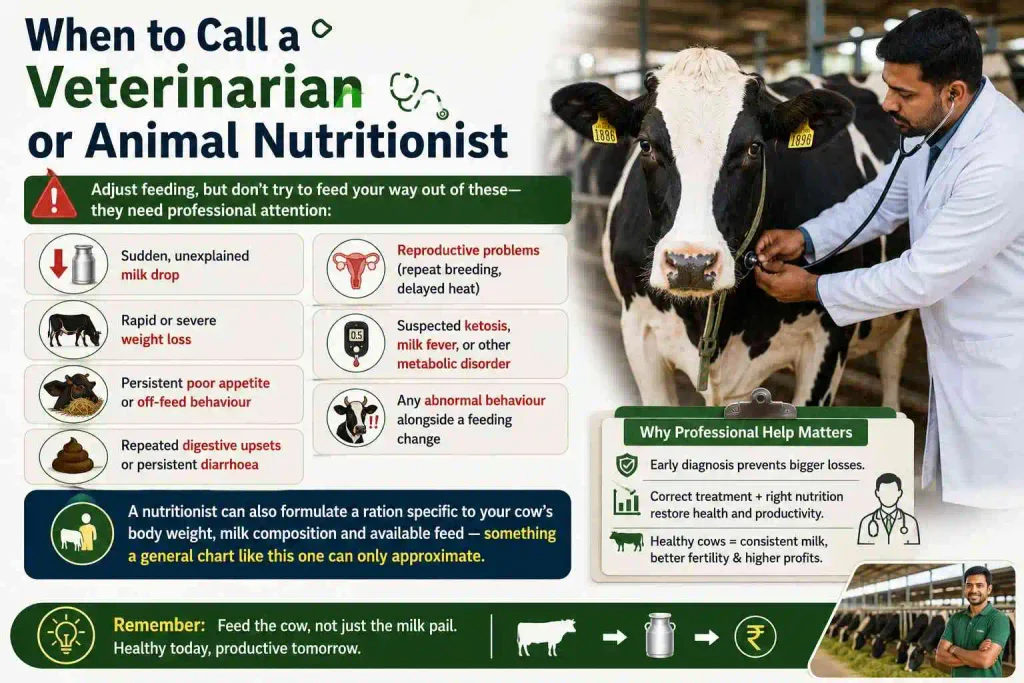
When to Call a Veterinarian or Animal Nutritionist
Adjust feeding, but don’t try to feed your way out of these — they need professional attention:
- Sudden, unexplained milk drop
- Rapid or severe weight loss
- Persistent poor appetite or off-feed behaviour
- Repeated digestive upsets or persistent diarrhoea
- Reproductive problems (repeat breeding, delayed heat)
- Suspected ketosis, milk fever, or other metabolic disorder
- Any abnormal behaviour alongside a feeding change
A nutritionist can also formulate a ration specific to your cow’s body weight, milk composition and available feed — something a general chart like this one can only approximate.
Conclusion
If you want more milk from an HF cow, don’t start by adding another kilo of concentrate. Start by looking at the whole ration — fodder quality, fibre, energy, protein, minerals, water, and the cow’s stage of lactation. A high-producing cow doesn’t need the maximum amount of feed. She needs the right amount, balanced correctly, adjusted as she moves through lactation.
Get that right, and you’re not just protecting milk yield — you’re protecting body condition, fertility, and the money left in your pocket at the end of the month.
Frequently Asked Questions
How much feed does an HF cow need per day?
It depends heavily on milk yield and body weight, but as a broad guide, a cow producing 15–20 litres/day typically needs roughly 25–30 kg green fodder, 5–6 kg dry fodder, and 5.5–7 kg concentrate, alongside minerals and water. See the Section 3 chart for other production levels.
How much green fodder should I give an HF cow?
Roughly 15–40 kg/day depending on milk yield, using a mix of fodder types where possible rather than a single crop.
How much dry fodder does an HF cow need?
Generally 4–7 kg/day — this stays relatively constant even as milk yield rises, since it’s mainly serving the rumen’s fibre requirement.
How much concentrate should an HF cow get?
A common starting rule is roughly 1 kg concentrate per 2–2.5 litres of milk, on top of a maintenance allowance — adjusted for your specific concentrate’s protein/energy density.
How much water does an HF cow drink?
Roughly 3–5 litres of water per litre of milk produced, plus a maintenance amount of 40–50 litres/day — more in hot or humid weather.
Which green fodder is best for HF cows?
No single fodder is “best” — a mix (e.g., maize or Napier for bulk energy plus a legume like berseem, lucerne or cowpea for protein) generally outperforms any single crop fed alone.
Can maize fodder increase milk production?
Young, well-harvested maize fodder is a good energy source and can support milk production, but it’s low in protein alone — it works best paired with a protein source rather than fed as the sole fodder.
How much mineral mixture should I give an HF cow?
Typically 40–100 g/day depending on milk yield and the specific product — always follow the label rather than assuming more is better.
What should I feed an HF cow producing 15 litres of milk?
Roughly 25–30 kg green fodder, 5–6 kg dry fodder, 5.5–7 kg concentrate, 60–70 g mineral mixture, and 75–90 litres of water — adjusted for her body weight and forage quality.
What should I feed an HF cow producing 20 litres of milk?
Roughly 30–35 kg green fodder, 6–7 kg dry fodder, 7–8.5 kg concentrate, 70–80 g mineral mixture, and 90–105 litres of water, as a starting point.
What should I feed an HF cow after calving?
A gradually increasing ration, stepping concentrate up over 1–2 weeks rather than jumping to peak levels immediately, with close attention to appetite and dung consistency (see Section 11).
Why is my HF cow’s milk production decreasing?
It could be fodder quality, insufficient water, mineral deficiency, heat stress, a natural lactation-stage decline, or an unbalanced ration — not necessarily “not enough concentrate.” Check body condition, water access and forage quality before increasing concentrate.
Can too much concentrate harm an HF cow?
Yes — excess concentrate at the expense of fibre is linked to acidosis, reduced milk fat, and digestive upsets. Concentrate should top up the ration, not replace roughage.
How can I reduce HF cow feeding costs?
Focus on matching concentrate to actual milk yield rather than a flat routine, improve fodder quality/harvest timing to get more nutrition per kilogram, and consider growing more of your own green fodder if you have irrigated land.
Newsletter