

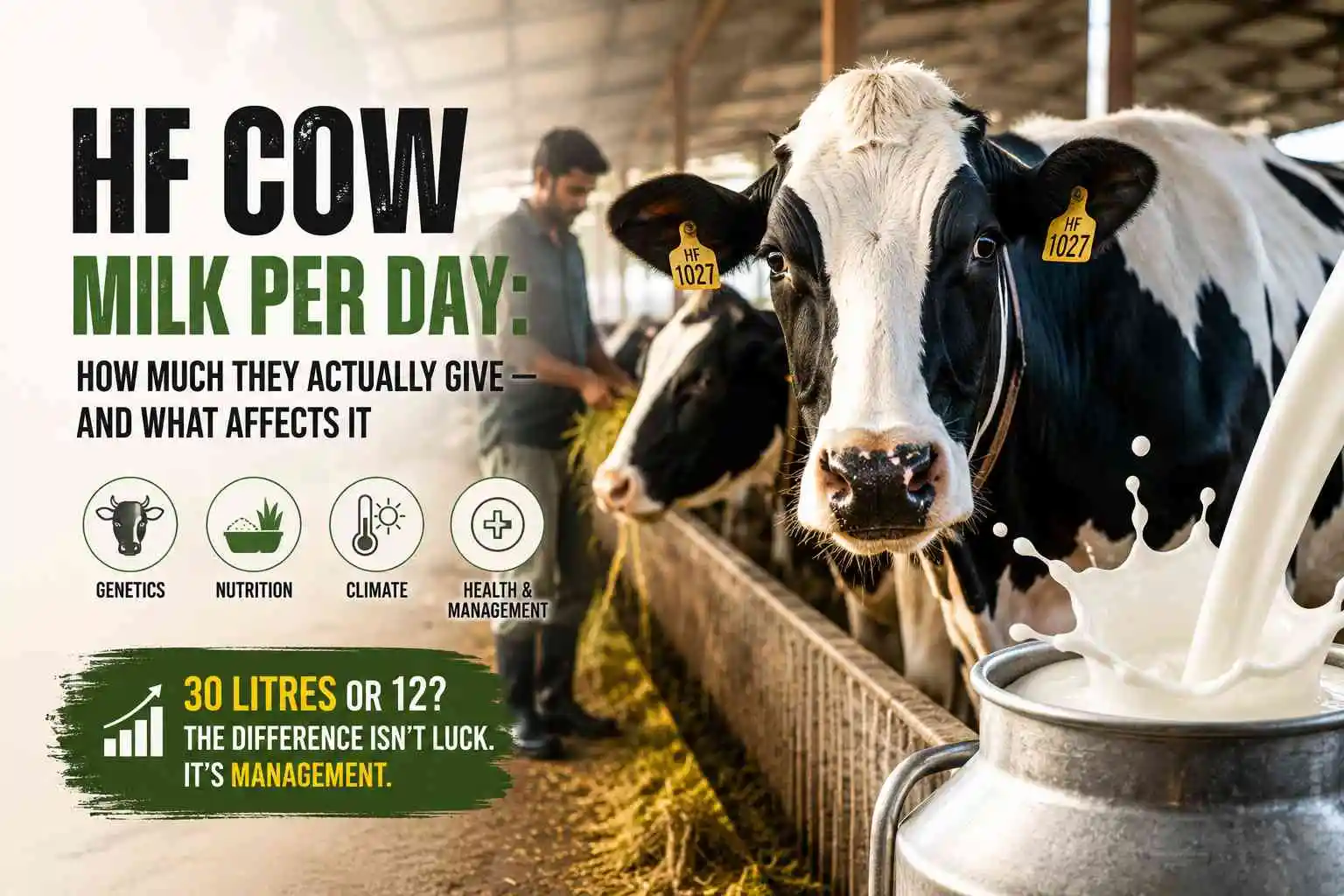

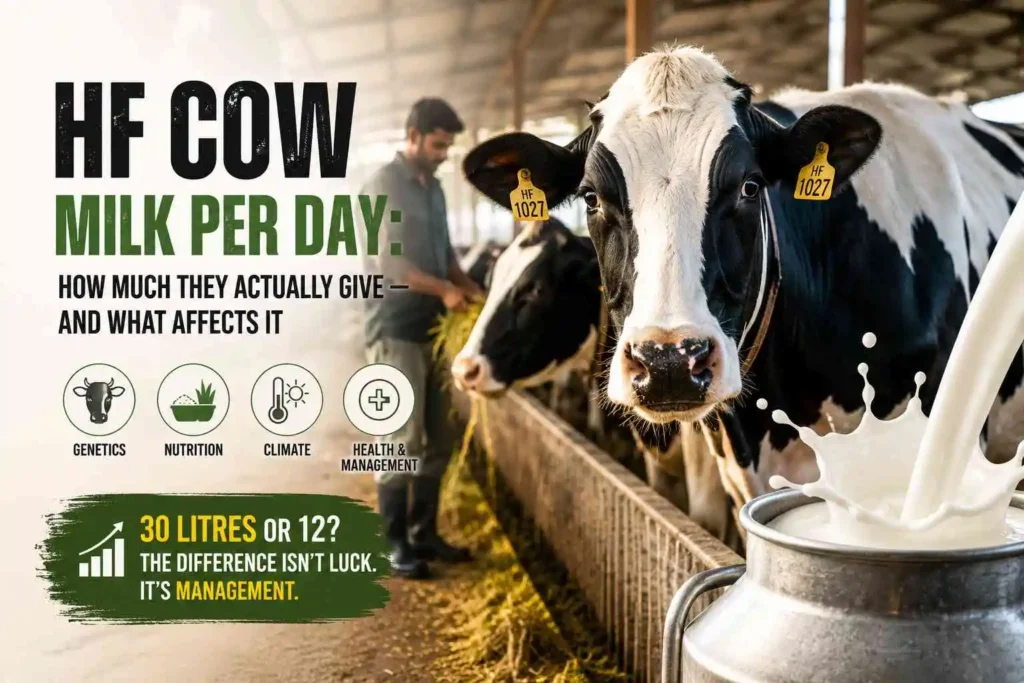
HF Cow Milk Per Day: How Much Milk Does an HF Cow Give?
A purebred HF cow typically gives 25–30 litres of milk per day, with top performers reaching 35–40 litres during peak lactation. A crossbred HF cow (HF × local breed) usually gives 10–15 litres per day, sometimes up to 18–20 at its best.
Ask ten dairy farmers about HF cow milk per day, and you’ll get ten different answers — 15 litres, 25 litres, 35 litres, sometimes even 40. All of them are correct, and that’s exactly the problem. HF cow milk per day isn’t a fixed number you can look up once and plan your farm around. It’s an outcome — the result of genetics, feeding, climate, health, and management decisions you make every single day.
This article goes one level deeper: it breaks down exactly why one HF cow gives 30 litres a day while another, standing in the next shed, gives 12 — and which of those differences are actually within your control.
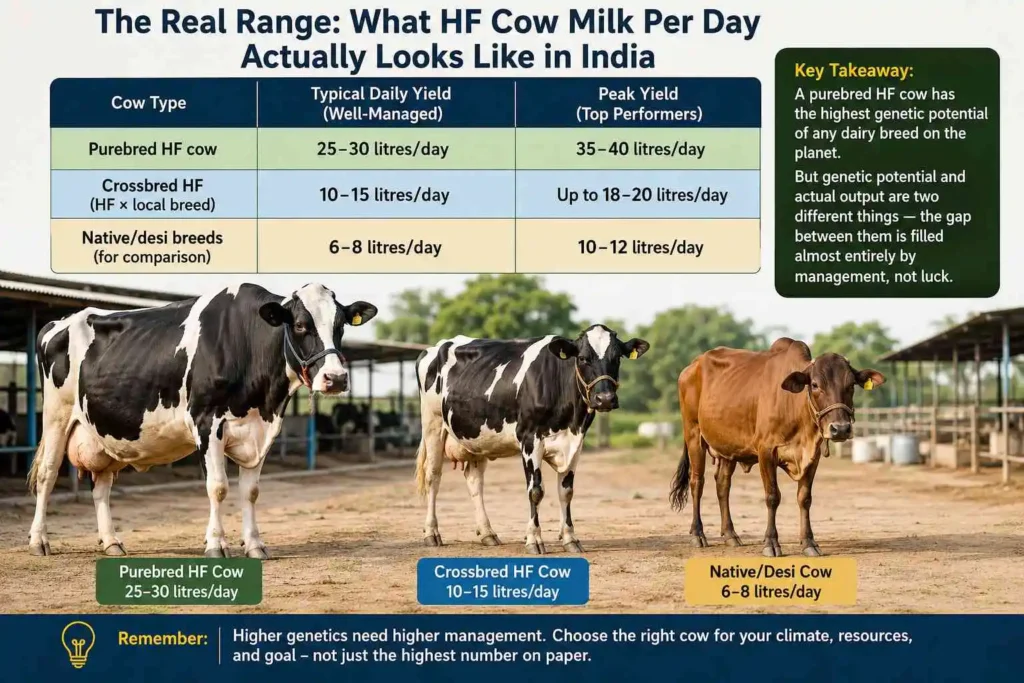
The Real Range: What HF Cow Milk Per Day Actually Looks Like in India
Before anything else, it helps to see the honest spread of numbers, rather than one headline figure.
| Cow Type | Typical Daily Yield (Well-Managed) | Peak Yield (Top Performers) |
|---|---|---|
| Purebred HF cow | 25–30 litres/day | 35–40 litres/day |
| Crossbred HF (HF × local breed) | 10–15 litres/day | Up to 18–20 litres/day |
| Native/desi breeds (for comparison) | 6–8 litres/day | 10–12 litres/day |
Key Takeaway: A purebred HF cow has the highest genetic potential of any dairy breed on the planet. But genetic potential and actual output are two different things — the gap between them is filled almost entirely by management, not luck.
Most farmers in hotter states deliberately choose crossbred HF cattle over purebred ones. They give less milk, but they survive Indian summers, eat local fodder, and fall sick less often — which often means more reliable income even with a lower headline number.
Why Day-60 Milk Isn’t the Same as Day-300 Milk: The Lactation Curve
Here’s something a lot of new farmers don’t realise: an HF cow’s milk yield isn’t steady through her lactation — it follows a curve.
- First 6–8 weeks after calving: Yield climbs to its peak — often 35–40 litres/day in a purebred HF cow during her first lactation
- Middle of lactation: Yield gradually plateaus and then starts declining
- Later months (approaching the next calving): Yield tapers down to 20–25 litres/day or lower, before the cow is dried off ahead of her next calving
Did You Know? A cow’s first lactation is often not her best. Yield typically improves through the second and third lactations as the cow matures, before gradually declining again in later life. This is why buyers and sellers ask specifically which lactation a cow is in — “10–15 litres” on a mature cow in her second lactation means something very different from the same number on a first-time calver.
This is also why comparing “my cow gives 20 litres” to “his cow gives 30 litres” is meaningless unless you also know which week of lactation each cow is in.
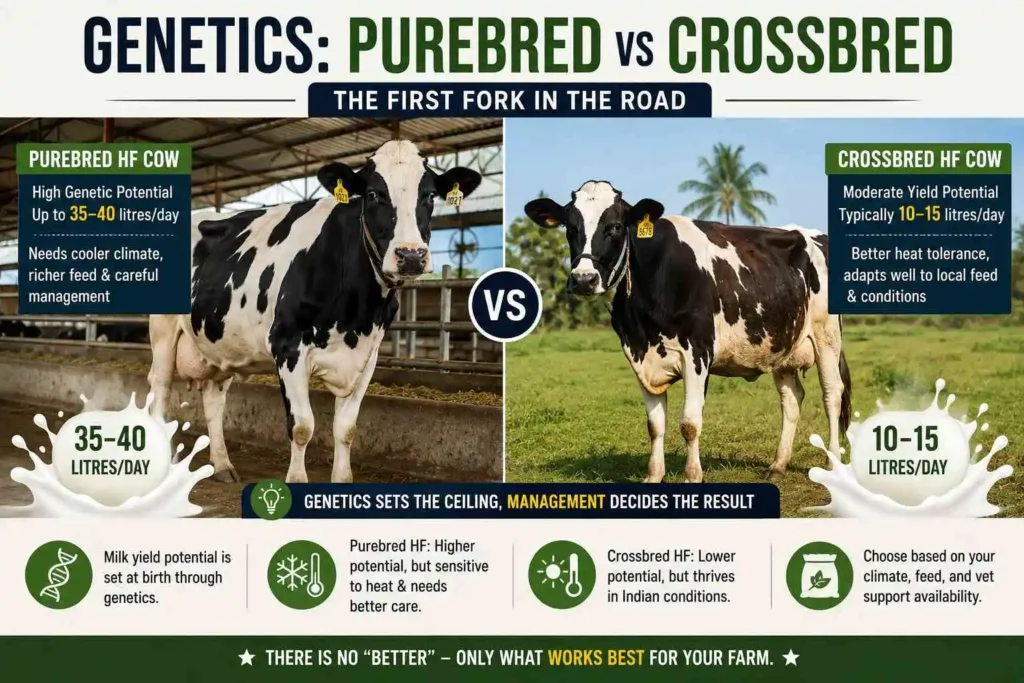
Genetics: Purebred vs Crossbred Is the First Fork in the Road
Milk yield potential is set the day a calf is born, through its genetics — but genetics only sets the ceiling, not the actual result.
- Purebred HF cows carry the highest ceiling (up to 35–40 litres/day) but need cooler temperatures, richer feed, and more careful management to get anywhere close to it
- Crossbred HF cows trade some of that ceiling (typically 10–15 litres/day) for much better heat tolerance and adaptability to local feed and conditions
Neither is “better” in absolute terms — it depends on your climate, your feeding capacity, and how much veterinary support is available to you.
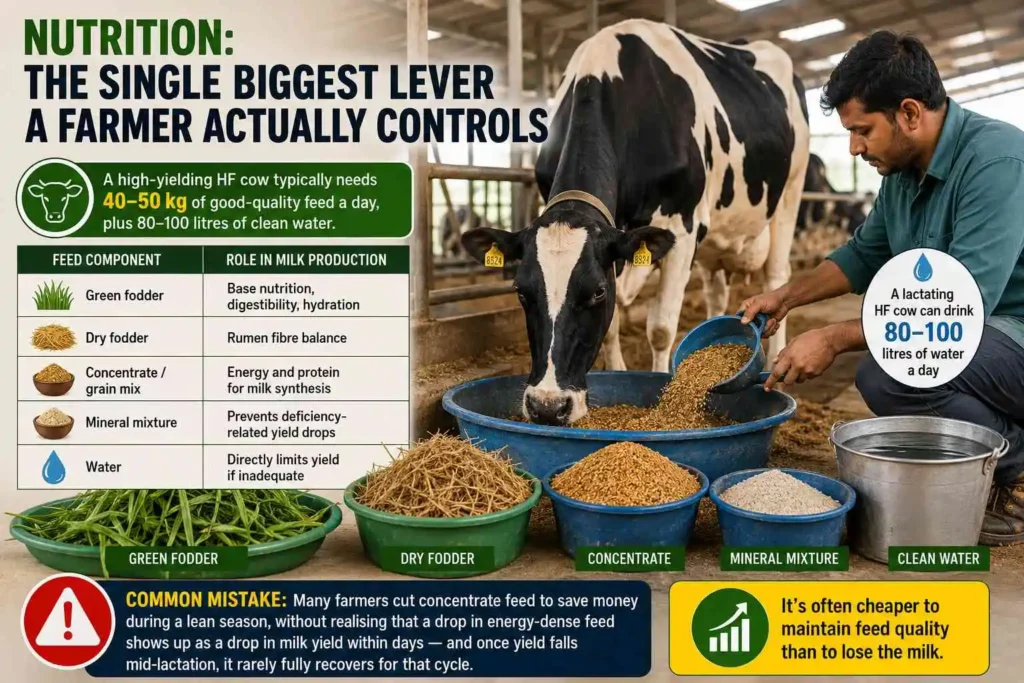
Nutrition: The Single Biggest Lever a Farmer Actually Controls
If genetics sets the ceiling, feeding decides how close you get to it. A high-yielding HF cow typically needs somewhere around 40–50 kg of good-quality feed a day, split across:
- Green fodder — for bulk, moisture, and vitamins
- Dry fodder (straw, hay) — for fibre and rumen health
- Concentrate feed (grains, oilcakes, mineral mixture) — for the energy and protein that actually drives milk production
- Clean drinking water — often overlooked, but a lactating HF cow can drink 80–100 litres of water a day, and under-watering shows up directly as lower milk yield
| Feed Component | Role in Milk Production |
|---|---|
| Green fodder | Base nutrition, digestibility, hydration |
| Dry fodder | Rumen fibre balance |
| Concentrate/grain mix | Energy and protein for milk synthesis |
| Mineral mixture | Prevents deficiency-related yield drops |
| Water | Directly limits yield if inadequate |
Common Mistake: Many farmers cut concentrate feed to save money during a lean season, without realising that a drop in energy-dense feed shows up as a drop in milk yield within days — and once yield falls mid-lactation, it rarely fully recovers for that cycle. It’s often cheaper to maintain feed quality than to lose the milk.
As covered in our HF cow cost and profit guide, feed is typically the single largest recurring cost in HF cow farming — which is exactly why it’s also the single biggest lever on yield.
Climate and Heat Stress: The Factor Most Farmers Underestimate
Holstein Friesian cattle originated in the cool, temperate climates of the Netherlands and Germany. Indian summers — especially in the plains — put real physiological stress on purebred HF cows, and heat-stressed cows simply produce less milk, regardless of how well they’re fed.
Practical steps that reduce heat stress and protect yield:
- Proper shed ventilation and adequate shade
- Fans or sprinklers/misting during peak summer heat
- Access to cool drinking water at all times
- Avoiding overcrowding in the shed
Practical Tip: If you’re farming in a hot climate and consistently seeing yield drop every summer, don’t assume it’s a feeding or health problem first — check ventilation and cooling. It’s often the single cheapest fix with the biggest impact.

Milking Frequency and Technique
Yield isn’t only about what goes into the cow — it’s also about how milk is taken out.
- Cows milked three times a day typically yield more than those milked twice, because more frequent milking signals the udder to produce more
- Rushed, rough, or inconsistent milking causes stress, which can suppress milk let-down
- Poor hygiene during milking increases the risk of mastitis — which directly reduces yield in the affected quarter or the whole udder
Warning: Milking time and stress levels affect output more than most farmers expect. A calm, consistent milking routine — same time, same handler, same process — often produces a measurable difference over a few weeks, without any change in feed.
Health, Reproduction, and Calving Interval
A few health and reproductive factors that quietly shape lifetime and per-lactation yield:
- Mastitis — one of the most common causes of sudden yield drop; early detection matters far more than late treatment
- Calving interval — HF cows typically calve every 13–14 months; longer gaps between calvings mean fewer full lactation cycles over the cow’s productive life
- Body condition — an overly thin or overly fat cow around calving time often underperforms in the following lactation
- Age/parity — yield typically rises through the second and third lactation, then gradually declines in later life
What You Can Actually Control vs What You Can’t
| Factor | Can You Control It? |
|---|---|
| Breed/genetics of the cow you buy | Yes — at purchase/breeding stage |
| Feed quality and quantity | Yes — ongoing |
| Water availability | Yes — ongoing |
| Shed ventilation and cooling | Yes — one-time investment, ongoing benefit |
| Milking routine and hygiene | Yes — ongoing |
| Ambient climate/season | No — but its impact is manageable |
| Cow’s age and lactation stage | No — but predictable, so plan around it |
| Underlying health issues | Partially — through prevention and early detection |
Key Takeaway: Roughly half the factors that decide your cow’s daily milk yield are within your direct control. The other half — climate, lactation stage, age — can’t be changed, but their impact on yield can be managed with the right shed design, feeding calendar, and health monitoring.
The Real Lesson Behind HF Cow Milk Per Day
HF cow milk per day was never really a question with one fixed answer. It’s a question about how well genetics, feeding, climate, milking practice, and health are being managed together, day after day. The farmers who consistently get 30 litres out of a cow aren’t necessarily working with better animals — they’re usually just controlling the things on this list that were always within their control.
If you’re deciding between a purebred or crossbred HF cow, or trying to figure out why your own cow’s daily milk isn’t matching what you expected, start with feeding and shed conditions first — they’re the two levers most likely to move the number, and the two you can act on this week.
FAQs on HF Cow Milk Per Day
1. How much milk does an HF cow give per day on average?
A well-managed purebred HF cow typically gives 25–30 litres per day, with top performers reaching 35–40 litres during peak lactation. Crossbred HF cows usually give 10–15 litres per day.
2. Why do two HF cows on the same farm give different amounts of milk?
Differences usually come down to lactation stage, parity (which lactation the cow is in), individual genetics, health status, and how consistently each cow is fed and milked.
3. Does an HF cow give the same amount of milk throughout her lactation?
No. Yield rises to a peak around 6–8 weeks after calving, then gradually declines until the cow is dried off before her next calving.
4. Do crossbred HF cows give less milk than purebred HF cows?
Yes, typically 10–15 litres per day versus 25–30+ litres for purebred HF cows — but crossbreds handle Indian heat and local feed conditions much better.
5. What is the biggest factor affecting HF cow milk yield?
Nutrition is usually the single biggest lever a farmer directly controls, though genetics sets the upper ceiling and heat stress can suppress yield regardless of feeding.
6. Does heat affect HF cow milk production in India?
Yes, significantly. Purebred HF cows are especially sensitive to heat stress, and yield often drops in summer without proper shed ventilation and cooling.
7. How many times a day should an HF cow be milked?
Twice a day is standard; some farms milk three times a day to boost yield, since more frequent milking encourages more production, provided it’s managed consistently.
8. Does milking technique really affect how much milk a cow gives?
Yes. Rushed or inconsistent milking can cause stress that suppresses milk let-down, while a calm, regular routine tends to support better output over time.
9. Which lactation gives the highest milk yield in an HF cow?
Yield often improves through the second and third lactations compared to the first, before gradually declining in later life.
10. Can poor health reduce an HF cow’s milk yield?
Yes — mastitis and other health issues are among the most common causes of a sudden, noticeable drop in daily milk output.
Newsletter