


Potato Farming: Complete Guide to Planting, Cost, Yield & Profit
Most potato farmers lose money not because of bad weather or bad luck, but because of decisions made weeks before the first sprout ever breaks through the soil. Seed quality, soil preparation, spacing, and nutrition planning quietly decide 70-80% of your final yield — long before late blight or a dry spell ever shows up to take the blame.
That’s the part most beginner guides skip. They’ll tell you potatoes need water, sunlight, and fertile soil — as if that’s news to anyone holding a hoe. What they won’t tell you is why two farmers using the same variety, same district, and same season can end up with completely different profits at harvest.
This guide walks through potato farming the way it actually plays out in the field — the decisions that matter, the mistakes that quietly eat into yield, and the practical steps that separate an average crop from a genuinely profitable one. Whether you’re planting your first acre or you’ve been growing potatoes for years and want to tighten up your practices, there’s something here worth applying before your next planting window.
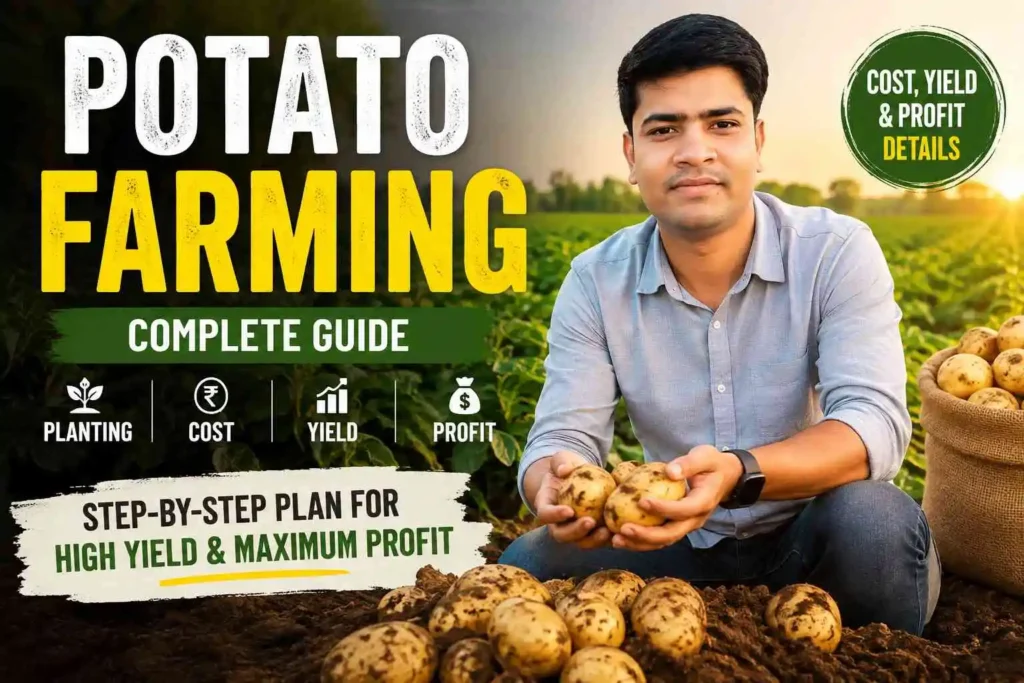
Why Your Seed Potato Choice Decides the Crop Before You’ve Even Planted
Here’s something a lot of new growers don’t realize: the health of your seed potato matters more than almost any input you’ll apply afterward. A weak or diseased seed tuber can’t be “fixed” with fertilizer later in the season.
Seed quality directly affects germination rate, plant population, disease pressure, and — ultimately — how many marketable tubers you harvest per acre. Plant compromised seed, and you’re fighting an uphill battle from day one, no matter how good your soil or irrigation is.
Certified seed vs. farm-saved seed is the first real decision point:
- Certified seed potatoes are produced under controlled conditions, tested for viral and bacterial diseases, and generally give more uniform emergence and healthier plants.
- Farm-saved seed (tubers kept from your own previous harvest) is cheaper upfront but carries a real risk of carrying over diseases like bacterial wilt or viral infections, especially if saved for multiple seasons without testing.
For most commercial growers, certified disease-free seed is usually the safer investment. A cheaper seed lot carrying hidden disease can end up costing far more through poor plant establishment, patchy fields, and reduced yield than the extra money spent on quality seed upfront.
Expert Tip Don’t judge seed quality by size alone. A medium-sized, firm, disease-free tuber with healthy eyes will usually outperform a large tuber that’s been stored poorly or shows early signs of shriveling or discoloration.
Seed Size, Cutting, and Treatment — Getting the Basics Right
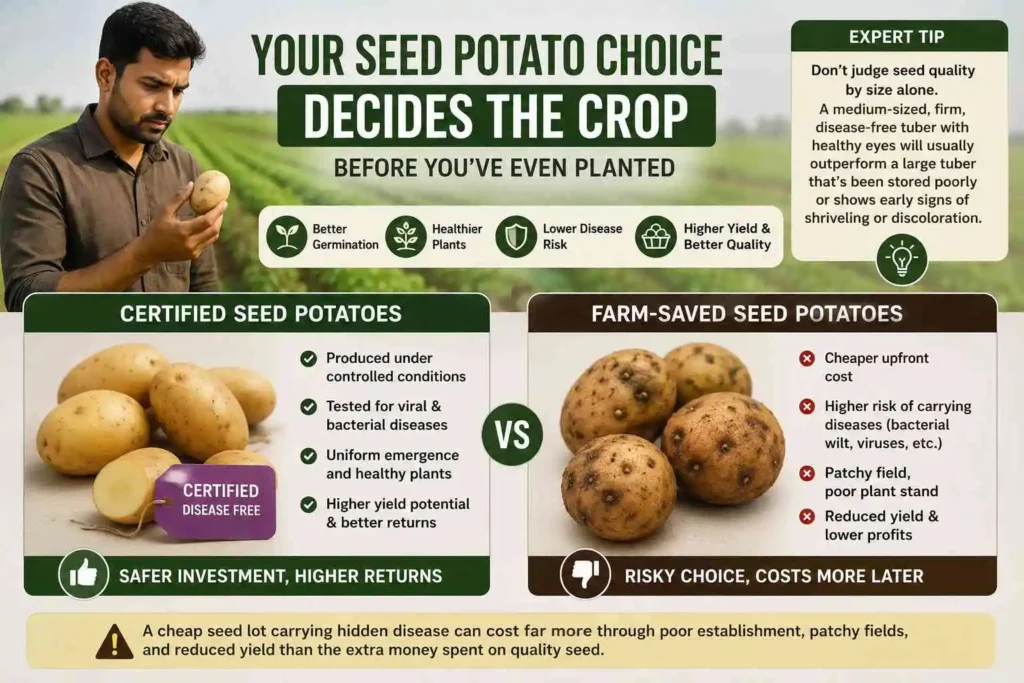
Seed size affects sprout vigor and plant population. Smaller seed pieces (around 30-50 grams) work fine for many growers if cut and handled correctly, while whole small tubers avoid cutting-related disease risk entirely.
If you do cut seed potatoes, make sure each piece has at least 2-3 healthy eyes, and always treat cut surfaces with a recommended fungicide before planting to reduce rot risk. Letting cut seed cure for a day or two in a cool, shaded spot before planting also helps the cut surface heal over.
Common Mistake Planting freshly cut seed immediately without curing time. This is one of the most preventable causes of poor germination and seed piece rot in the early weeks after planting.
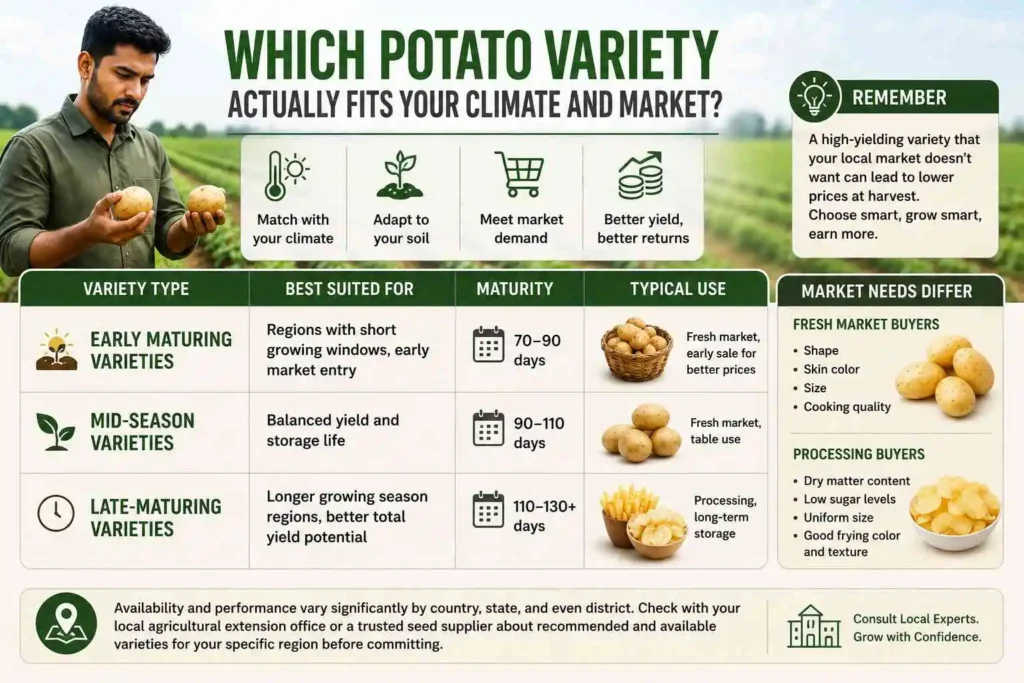
Which Potato Variety Actually Fits Your Climate and Market?
Picking a variety isn’t just about yield numbers on a seed packet. It’s about matching the variety to your climate, your soil, and — just as importantly — what buyers in your market actually want.
Fresh-market buyers often care about tuber shape, skin color, and cooking quality. Processing buyers (chips, fries) care more about dry matter content and sugar levels, since these affect frying color and texture. Choosing a high-yielding variety that your local market doesn’t want is a common way growers end up accepting lower prices at harvest.
| Variety Type | Best Suited For | Maturity | Typical Use |
|---|---|---|---|
| Early maturing varieties | Regions with short growing windows, early market entry | 70-90 days | Fresh market, early sale for better prices |
| Mid-season varieties | Balanced yield and storage life | 90-110 days | Fresh market, table use |
| Late-maturing varieties | Longer growing season regions, better total yield potential | 110-130+ days | Processing, long-term storage |
Availability and performance vary significantly by country, state, and even district, so it’s worth checking with your local agricultural extension office or a trusted seed supplier about which varieties are actually recommended and available for your specific region before committing.
Why Poor Drainage Can Quietly Destroy an Otherwise Healthy Potato Crop
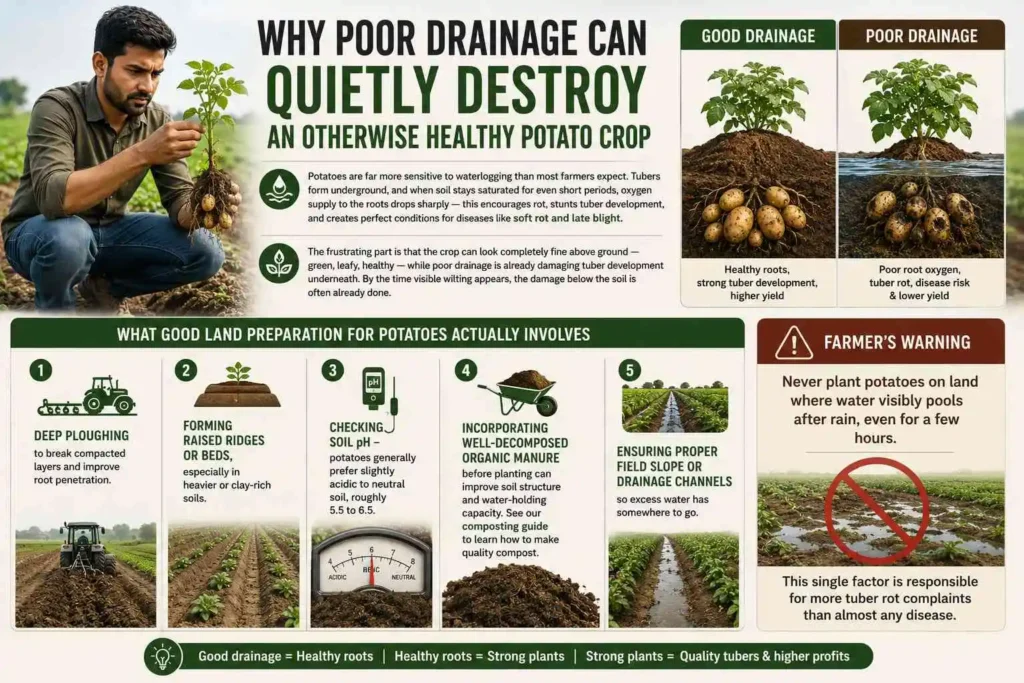
Potatoes are far more sensitive to waterlogging than most farmers expect. Tubers form underground, and when soil stays saturated for even short periods, oxygen supply to the roots drops sharply — this encourages rot, stunts tuber development, and creates perfect conditions for diseases like soft rot and late blight.
The frustrating part is that the crop can look completely fine above ground — green, leafy, healthy — while poor drainage is already damaging tuber development underneath. By the time visible wilting appears, the damage below the soil is often already done.
What good land preparation for potatoes actually involves:
- Deep ploughing to break compacted layers and improve root penetration
- Forming raised ridges or beds, especially in heavier or clay-rich soils
- Checking soil pH — potatoes generally prefer slightly acidic to neutral soil, roughly 5.5 to 6.5
- Incorporating well-decomposed organic manure before planting can improve soil structure and water-holding capacity. See our composting guide to learn how to make quality compost.
- Ensuring proper field slope or drainage channels so excess water has somewhere to go
Farmer’s Warning Never plant potatoes on land where water visibly pools after rain, even for a few hours. This single factor is responsible for more tuber rot complaints than almost any disease.
How to Actually Know When Your Potato Crop Needs Water
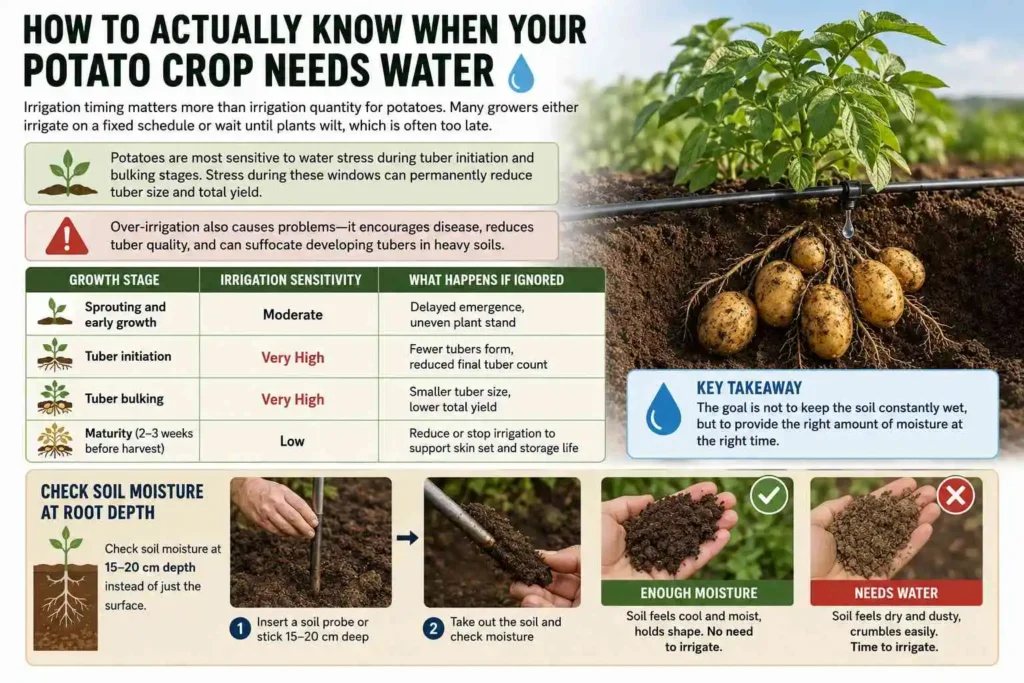
Irrigation timing matters more than irrigation quantity for potatoes. This is where many new growers struggle — they either irrigate on a fixed schedule regardless of conditions, or they wait until the crop visibly wilts, which is often too late.
Potatoes are especially sensitive to water stress during two critical stages: tuber initiation (when tubers first begin forming) and bulking (when tubers rapidly gain size and weight). Water stress during these windows can permanently reduce tuber size and total yield, even if you irrigate generously afterward.
Over-irrigation carries its own risks — it encourages disease, reduces tuber quality, and can actually suffocate developing tubers in heavier soils.
| Growth Stage | Irrigation Sensitivity | What Happens If Ignored |
|---|---|---|
| Sprouting and early growth | Moderate | Delayed emergence, uneven plant stand |
| Tuber initiation | Very High | Fewer tubers form, reduced final tuber count |
| Tuber bulking | Very High | Smaller tuber size, lower total yield |
| Maturity (2-3 weeks before harvest) | Low | Reduce or stop irrigation to support skin set and storage life |
A simple way to improve irrigation decisions is checking soil moisture at root depth (roughly 15-20 cm) rather than just looking at the surface. If soil at that depth still feels moist, the crop usually doesn’t need water yet — regardless of how dry the top layer looks.
Can Too Much Nitrogen Actually Reduce Your Potato Yield?
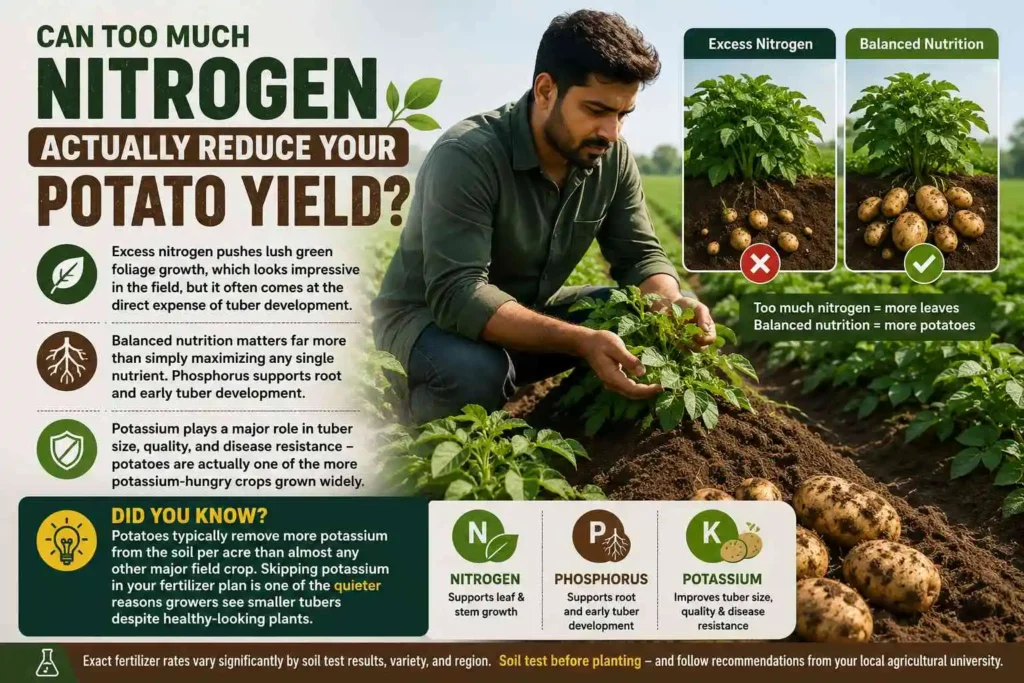
This surprises a lot of growers, but yes — excess nitrogen can genuinely hurt your yield. Heavy nitrogen application pushes lush green foliage growth, which looks impressive in the field, but it often comes at the direct expense of tuber development. The plant puts its energy into leaves and stems instead of bulking up tubers underground.
Balanced nutrition matters far more than simply maximizing any single nutrient. Phosphorus supports root and early tuber development, while potassium plays a major role in tuber size, quality, and disease resistance — potatoes are actually one of the more potassium-hungry crops grown widely.
Did You Know? Potatoes typically remove more potassium from the soil per acre than almost any other major field crop. Skipping potassium in your fertilizer plan is one of the quieter reasons growers see smaller tubers despite healthy-looking plants.
Exact fertilizer rates vary significantly by soil test results, variety, and region, so a soil test before planting — and following recommendations from your local agricultural university or extension service — will always give more reliable guidance than a generic one-size-fits-all number.
Why Late Blight Spreads Faster Than Most Farmers Expect
Late blight remains one of the most destructive potato diseases worldwide, and it earns that reputation because of how fast it moves. Under cool, humid conditions with prolonged leaf wetness, the disease can spread across an entire field within days, not weeks.
Early signs to watch for:
- Dark, water-soaked patches on leaves, often starting at leaf edges or tips
- A pale green or yellow ring surrounding the dark patch
- White, fuzzy fungal growth on the underside of leaves during humid mornings
- Rapid blackening and collapse of foliage in severe cases
The problem is delay. Waiting even 3-4 days after first symptoms appear, hoping it’s something minor, can allow the disease to establish across the whole field before any fungicide has a real chance to work.
Practical prevention steps:
- Monitor the crop closely during cool, humid weather, especially after rain
- Avoid overhead irrigation late in the day, since it extends leaf wetness overnight
- Use resistant or tolerant varieties where available for your region
- Apply preventive fungicide sprays based on local weather-based disease forecasting where available
- Remove and destroy infected plant debris promptly rather than leaving it in the field
Always follow the product label, recommended dosage, and pre-harvest interval when using any fungicide. For region-specific spray schedules and approved products, check ICAR–Central Potato Research Institute or your local agricultural advisory service.
Where Most Potato Farming Profits Actually Disappear
Profitability in potato farming isn’t just about yield — it’s about managing costs against realistic returns. The figures below are illustrative estimates for a one-acre commercial potato crop and will vary by region, input prices, and season, so treat them as a planning framework rather than a fixed guarantee.
| Cost Category | Estimated Cost (₹ per acre) |
|---|---|
| Land preparation | 4,000 – 6,000 |
| Seed potatoes | 15,000 – 22,000 |
| Seed treatment | 500 – 800 |
| Fertilizer and manure | 8,000 – 12,000 |
| Irrigation | 4,000 – 7,000 |
| Labour (planting, earthing up, weeding) | 10,000 – 15,000 |
| Plant protection (fungicide/pesticide) | 3,000 – 6,000 |
| Harvesting labour | 4,000 – 6,000 |
| Bags and packaging | 2,000 – 3,000 |
| Transportation | 2,000 – 4,000 |
| Estimated total cost | ₹52,500 – ₹81,800 |
Against this, a well-managed acre might yield somewhere between 8-12 tonnes under good management, though this varies enormously by variety, region, and season. At an illustrative farm-gate price of ₹8-12 per kg, gross revenue could range roughly from ₹64,000 to ₹1,44,000 per acre — but this swings sharply with market prices at harvest time, which are notoriously unpredictable for potatoes.
Quick Summary Net profit in potato farming depends heavily on controlling seed and labour costs, minimizing disease losses, and timing your sale well. Never assume a fixed profit figure — calculate your own costs and check current local market rates before planting.
The biggest reason growers lose money isn’t usually poor yield — it’s poor timing. Selling immediately at harvest when everyone else is also selling often means accepting the lowest price of the season. Farmers with proper curing and storage facilities often have the flexibility to wait for better prices later.
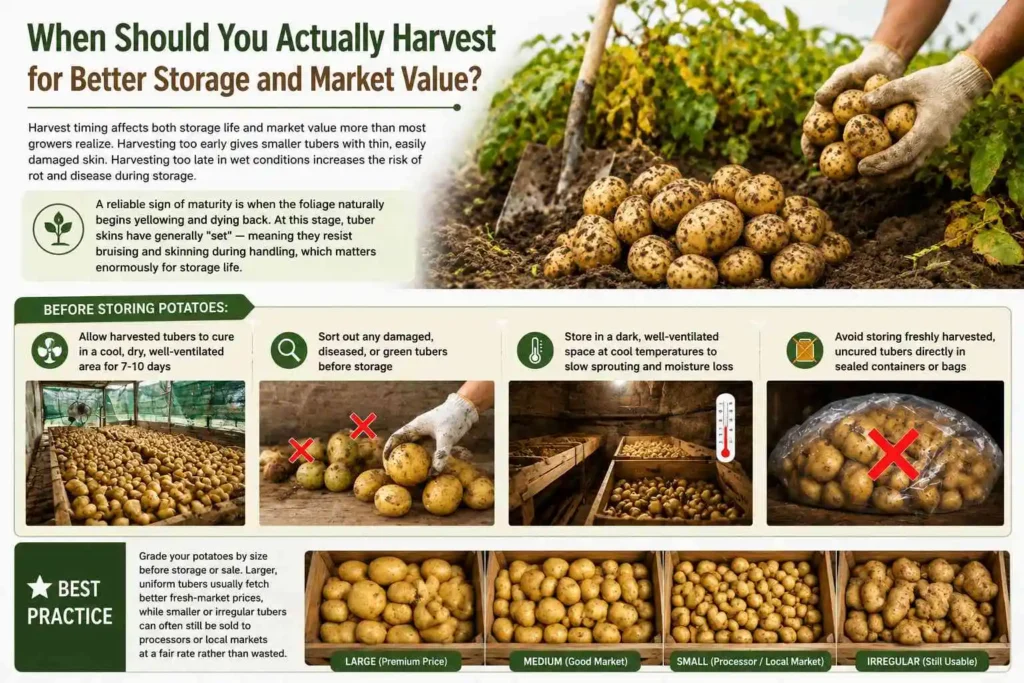
When Should You Actually Harvest for Better Storage and Market Value?
Harvest timing affects both storage life and market value more than most growers realize. Harvesting too early gives smaller tubers with thin, easily damaged skin. Harvesting too late in wet conditions increases the risk of rot and disease during storage.
A reliable sign of maturity is when the foliage naturally begins yellowing and dying back. At this stage, tuber skins have generally “set” — meaning they resist bruising and skinning during handling, which matters enormously for storage life.
Before storing potatoes:
- Allow harvested tubers to cure in a cool, dry, well-ventilated area for 7-10 days
- Sort out any damaged, diseased, or green tubers before storage
- Store in a dark, well-ventilated space at cool temperatures to slow sprouting and moisture loss
- Avoid storing freshly harvested, uncured tubers directly in sealed containers or bags
Best Practice Grade your potatoes by size before storage or sale. Larger, uniform tubers usually fetch better fresh-market prices, while smaller or irregular tubers can often still be sold to processors or local markets at a fair rate rather than wasted.
The One Thing That Actually Separates Profitable Potato Growers
Profitable potato farming isn’t about having perfect weather or the most expensive inputs. It’s about making the right decisions early — before planting, before problems appear, before the market forces your hand. Seed quality, drainage, irrigation timing, and balanced nutrition all quietly compound into the final yield and price you get at harvest.
Before your next planting season, take these steps seriously: get your soil tested, source seed from a reliable certified supplier, plan your irrigation and nutrition around actual crop stages rather than guesswork, and check local market demand before locking in a variety. These small, deliberate decisions — made weeks before harvest — are what actually decide whether your potato crop turns a profit or just breaks even.
Frequently Asked Questions About Potato Farming
How do I start potato farming if I’m a complete beginner?
Start small — even half an acre — and focus on getting three things right: certified disease-free seed, well-drained soil with a pH between 5.5 and 6.5, and a planting time that matches your region’s recommended window. Get a basic soil test done before planting, and connect with your local agricultural extension office. They can tell you which varieties and practices actually work in your specific district, which matters more than any generic advice.
What is the best soil for potato farming?
Potatoes do best in loose, well-drained, sandy loam or loamy soil that doesn’t stay waterlogged after rain. Heavy clay soils can work if you form raised ridges or beds to improve drainage, but compacted or poorly drained land is one of the fastest ways to lose a crop to tuber rot, regardless of how good your seed or fertilizer program is.
What is the best fertilizer for potatoes?
There’s no single “best” fertilizer — it depends on what your soil test shows. As a general pattern, potatoes need balanced nitrogen, phosphorus, and potassium, with potassium often needed in larger amounts than farmers expect, since it directly affects tuber size and quality. Excess nitrogen without matching phosphorus and potassium usually produces heavy foliage but disappointing tuber yield. Always base your fertilizer plan on a soil test and local university or extension recommendations rather than a fixed formula.
How often should I irrigate potatoes?
Instead of following a fixed schedule, check soil moisture at root depth (about 15-20 cm) and irrigate based on actual crop stage. Potatoes are most sensitive to water stress during tuber initiation and bulking, so consistent moisture matters most during these windows. Reduce irrigation 2-3 weeks before harvest to support proper skin set and better storage life.
What is the average potato farming cost and profit per acre?
Estimated input costs for one acre typically range from about ₹52,500 to ₹81,800, covering seed, fertilizer, labour, irrigation, plant protection, and harvesting. Revenue depends heavily on yield and market price at the time of sale, which can swing significantly. Rather than expecting a fixed profit, calculate your own costs against current local seed and input prices, and track market rates before deciding when to sell.
Newsletter




Require newsletters
Thanks, Justin! We appreciate the suggestion. We’ll definitely keep newsletters in mind as we expand KisanPreneur and look for better ways to keep our readers updated.
Great presentation, do you also have a guide on Potato Seed Multiplication?
Thanks, Justin! Yes, potato seed multiplication is a separate and important topic, especially for farmers looking to produce quality planting material. We’ll be covering the different methods, seed classes, multiplication stages, and practical requirements in a dedicated guide. Stay tuned!
Bài chia sẻ chất lượng.