
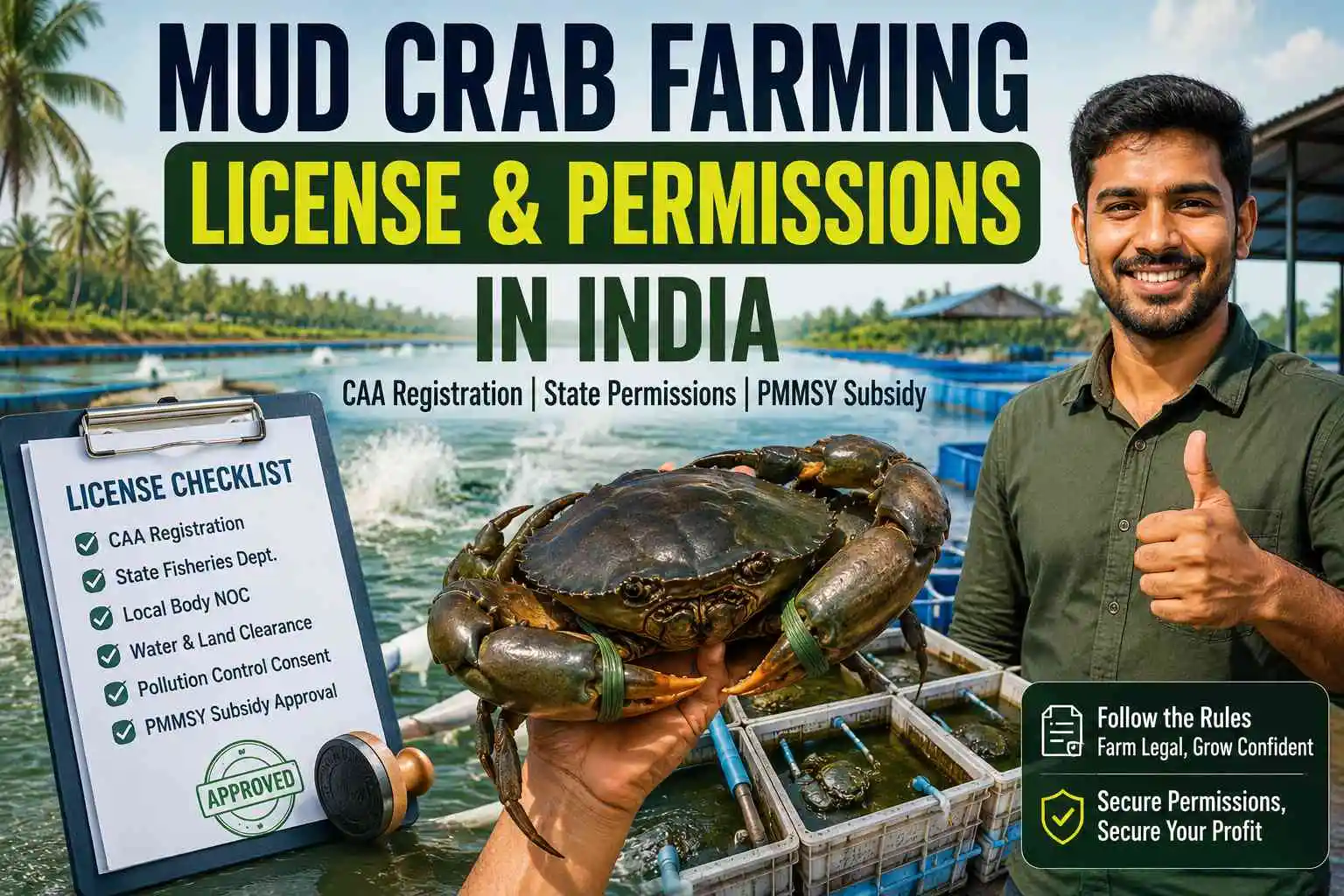

Mud Crab Farming License & Government Permissions in India
Most people planning a mud crab farm start in the same place: land, crablets, tanks or ponds, feed, and a rough profit calculation. Very few start by asking, “Does my location and my production method require any registration or approval?”
That question deserves to come first, not last. A farmer who builds ponds or vertical crab boxes without checking this can end up with a structure that a State or District Fisheries Office refuses to register, a subsidy application that gets rejected because construction happened before approval, or a local objection over water discharge after the money has already been spent.
This article covers the role of the Coastal Aquaculture Authority (CAA), the State Fisheries Department, local bodies, and PMMSY, and how these requirements shift depending on whether you’re farming a coastal pond, an inland tank, or a stacked vertical/RAS system — ending with a step-by-step process and a pre-investment checklist.
One thing this article will not do: tell you “no license is required” or “CAA registration is mandatory for everyone.” Neither statement holds up across all mud crab farms in India — it depends on where and how you farm.
Do You Actually Need a License to Start Mud Crab Farming in India?
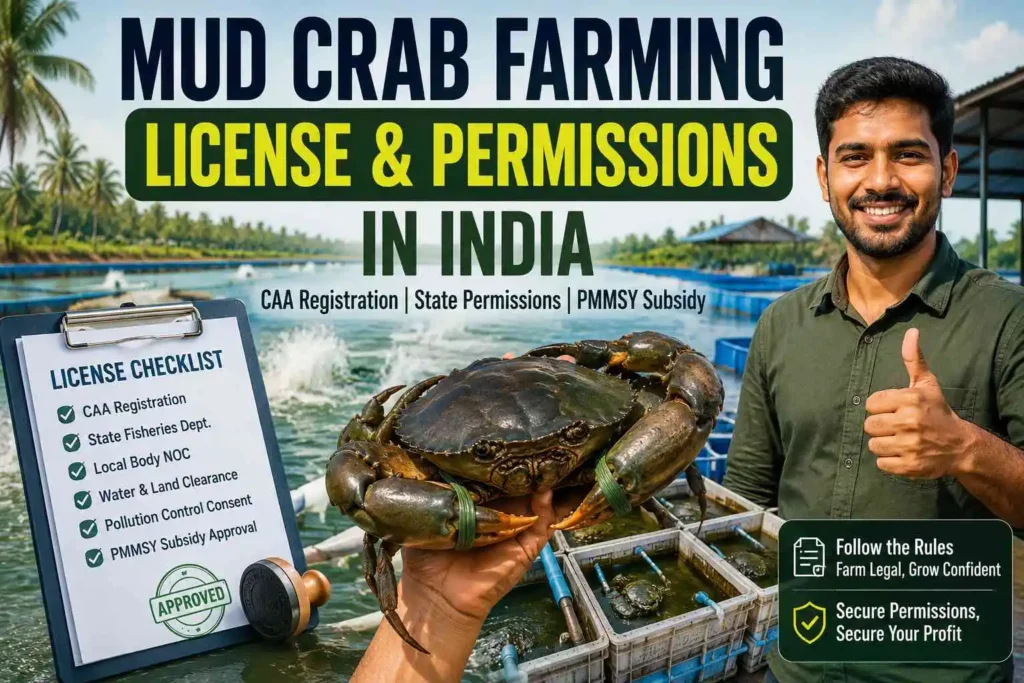
The honest answer is: it depends on your farming method, your location, and your scale. Before going further, it helps to untangle four words that new farmers often use interchangeably but which mean different things in practice:
| Term | What It Generally Means |
|---|---|
| License | Permission to conduct a specific regulated activity |
| Registration | Official recording of a farm/unit with an authority (this is the term CAA itself uses for coastal farms) |
| Permission/Approval | A one-time or periodic sign-off from an authority — electricity connection, water extraction, building plan, etc. |
| NOC (No-Objection Certificate) | A statement from a body, such as a Panchayat, confirming it has no objection to your activity — usually a supporting document rather than a standalone authorization |
| Consent | A regulatory approval often tied to a specific activity, such as effluent discharge (Pollution Control Board consent) |
| Subsidy approval | Government sign-off for financial assistance — this is not the same thing as operating permission |
A farmer may end up dealing with more than one of these at once, but they are not interchangeable, and mixing them up when talking to officials can cost you time. A brackish-water pond in a coastal district is a very different regulatory case from a tank-based operation on inland private land.
Common Mistake: Assuming that because a neighboring shrimp or fish farmer needed CAA registration, a mud crab farmer automatically needs the same thing in the same way. Farm type, water source, and land classification all affect the answer.
CAA Registration: Who Actually Needs to Deal With the Coastal Aquaculture Authority?
The Coastal Aquaculture Authority was set up under the Coastal Aquaculture Authority Act, 2005, after the Supreme Court restricted unregulated shrimp farming near the coast in the 1990s. Its job is to regulate coastal aquaculture so that it doesn’t damage the coastal environment, and it operates under India’s Department of Fisheries.
CAA’s own guidance is clear on one underlying principle: registration is required for activities that fall within the Act’s definition of “coastal aquaculture.” Whether a particular mud crab farm falls under that definition depends on factors including its precise location relative to the notified coastal area, the specific farming activity involved, and the version of the framework currently in force — so it needs to be confirmed for your specific site rather than assumed from a general description. Where registration does apply, it’s granted for five years and must be renewed.
The practical rule: if you’re planning a coastal or brackish-water pond farm, start by checking CAA registration with the CAA regional office or your State Fisheries Department. If you’re planning an inland, vertical, or tank-based unit, start with your District Fisheries Department and ask them directly which permissions — CAA or otherwise — apply to your specific location and water source. Either way, that first conversation should happen before you finalize the land, not after.
The 2023 amendment to the Act broadened the definition of “coastal aquaculture” to more clearly cover the full value chain — farms, hatcheries, broodstock and nucleus breeding centres — reducing earlier ambiguity about what counts as regulated activity. The amendment also sought to align a valid CAA registration with applicable Coastal Regulation Zone (CRZ) requirements for regulated coastal aquaculture activities. This does not mean CRZ considerations disappear once you’re registered — farmers should still confirm the specific requirements that apply to their site, particularly around construction near the coast, before building anything.
Whether your mud crab farm needs CAA registration depends on:
- Location — CAA’s jurisdiction is the coastal area as defined under the Act (broadly, land use within a defined distance of the coast and connected creeks/estuaries, mapped state-by-state). A genuinely inland tank system on non-saline groundwater, well outside that notified area, is less likely to fall under CAA — but this should be confirmed for your exact site rather than assumed.
- Water type — brackish or saline water aquaculture in the coastal zone is the core activity CAA regulates. Freshwater or artificially-salinized inland systems are handled differently (see the next section).
- Farm size — for farms under roughly 2 hectares of water-spread area, the District Level Committee can recommend registration directly to CAA; larger farms go through the State Level Committee as well. This affects the process, not whether registration is needed.
- Type of activity — pond farming, crab fattening in pens, and hatchery/nursery operations in the coastal zone can each fall within CAA’s expanded post-2023 scope, though the practical registration process and documentation may differ.
Your situation may be different if your farm is on inland private land using borewell or artificially prepared saline water, or if it’s a small indoor/vertical system with no direct connection to a coastal water body — in these cases, CAA may not be the primary regulatory authority, and the State Fisheries Department or local bodies tend to become more central. But that’s a starting expectation, not a guarantee: don’t assume either way, and get CAA’s regional office or your State Fisheries Department to confirm applicability to your specific plot before you build.
Expert Tip: CAA’s website (caa.gov.in) lists application forms, fee structures, and the state/district committees you’ll deal with. It’s worth a look even before you contact the Fisheries Department, so you walk in with the right questions.
State Fisheries Department: The First Office Most Farmers Should Contact
If there’s one office a new mud crab farmer should visit before spending money, it’s the State or District Fisheries Department. In practice, this is usually where farmers first learn whether CAA applies to them, what state-specific rules exist, and whether any subsidy scheme fits their plan.
The State Fisheries Department (often working through Brackishwater Fish Farmers Development Agencies, or BFDAs, in coastal states) typically helps with:
- Fisheries-related registration of the farm, independent of or alongside CAA registration
- Site verification and technical feasibility guidance
- Training programs on crab farming techniques (some state subsidy schemes make completing a training programme a precondition for disbursal)
- Information on PMMSY and state-specific subsidy schemes
- Guidance on which other approvals (local, environmental, water-related) may apply in your district
Because states run their own variations of central schemes, and because the practical registration workflow differs from state to state, this department is usually a faster and more useful starting point than trying to interpret national rules on your own.
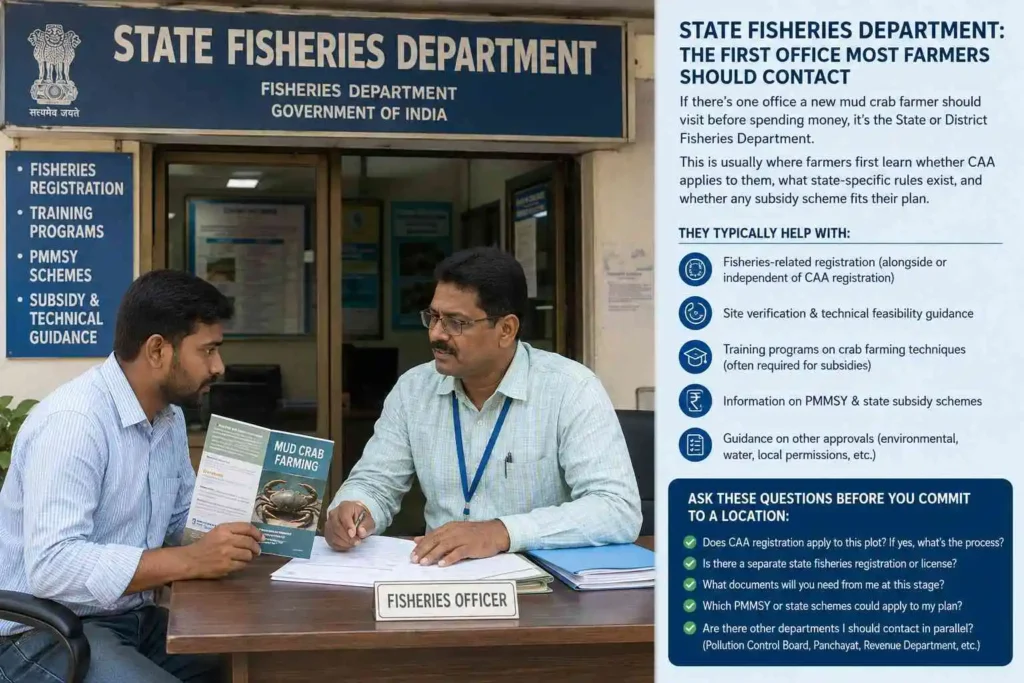
Ask these questions before you commit to a location:
- Does CAA registration apply to this specific plot, and if so, what’s the process here?
- Is there a separate state fisheries registration or license for crab farming?
- What documents will you need from me at this stage?
- Which PMMSY or state schemes could apply to my type and scale of farming?
- Are there other departments (Pollution Control Board, Panchayat, Revenue Department) I should contact in parallel?
Coastal vs Inland Mud Crab Farming: Does Your Location Change the Rules?
This is where many farmers get the wrong idea in one direction or the other — either assuming coastal automatically means heavy regulation and inland means none, or assuming that because mud crab is a “brackish water” species, the rules are identical everywhere.
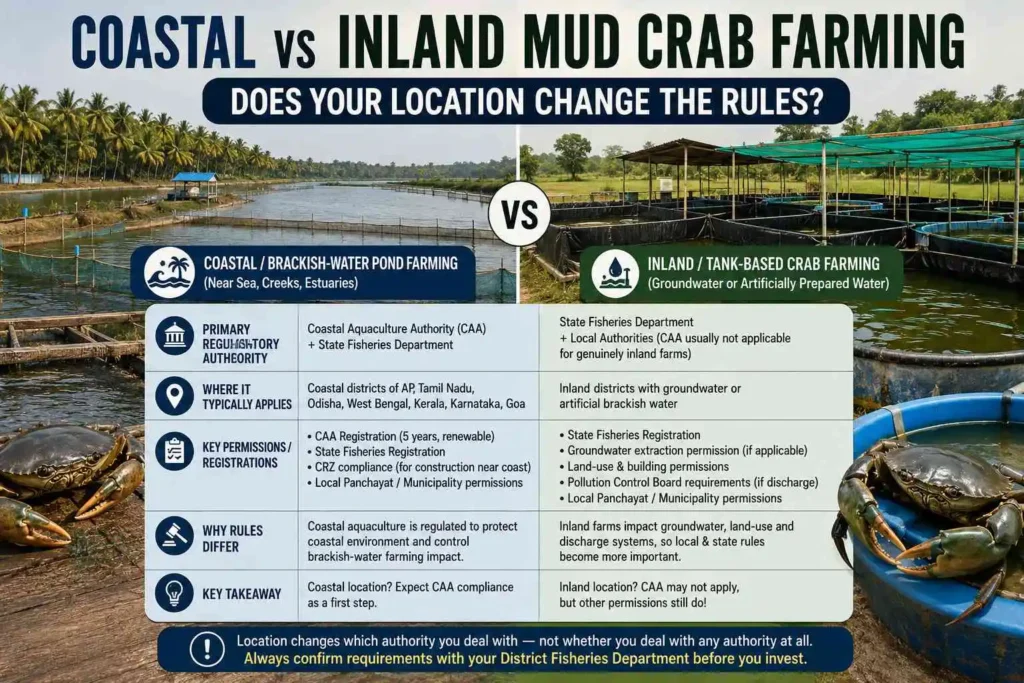
Coastal and brackish-water pond farming is the traditional and best-studied model — ponds fed by tidal creeks or pumped estuarine water, typically in states like Andhra Pradesh, Tamil Nadu, Odisha, West Bengal, Kerala, Karnataka, and Goa. This is squarely where CAA’s registration regime is designed to apply, alongside any state fisheries registration, CRZ considerations for construction near the coast, and local Panchayat awareness of the activity.
Inland locations using groundwater or artificially prepared saline water sit differently. CAA’s mandate is specifically about coastal aquaculture, so a genuinely inland farm may fall outside CAA’s jurisdiction. But “inland” doesn’t mean “no permissions needed anywhere.” Depending on the state and district, an inland crab farm may still need to deal with:
- Groundwater extraction rules if using a borewell for large volumes
- Land-use classification (agricultural vs. other use) with local revenue authorities
- Panchayat or municipal permission for construction of sheds, tanks, or ponds
- Pollution Control Board requirements if wastewater discharge could affect a drain, water body, or agricultural land nearby
For a genuinely inland operation — say, a district in northern Karnataka with no tidal or estuarine connection — CAA is less likely to be the primary regulatory authority, but this should be confirmed with the Fisheries Department rather than assumed from the district’s geography, since land use, groundwater, and discharge rules can still apply. A farmer setting up brackish-water ponds in coastal Andhra Pradesh or Tamil Nadu, by contrast, is far more likely to need CAA registration as a first step. Neither example is “the norm” nationwide — the point is that location changes which authority you deal with, not whether you deal with any authority at all.
Before deciding on a location, it’s also worth understanding inland mud crab farming water quality requirements and how they compare with coastal brackish-water systems, since water management approaches differ significantly between the two.
What About Vertical or Indoor Mud Crab Farming?
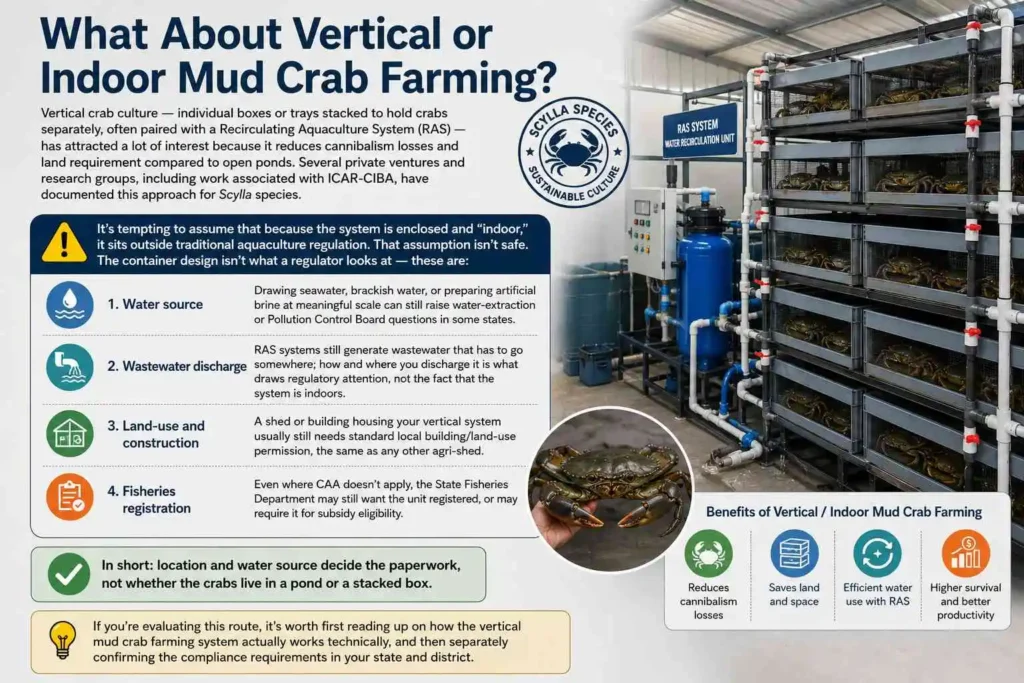
Vertical crab culture — individual boxes or trays stacked to hold crabs separately, often paired with a Recirculating Aquaculture System (RAS) — has attracted a lot of interest because it reduces cannibalism losses and land requirement compared to open ponds. Several private ventures and research groups, including work associated with ICAR-CIBA, have documented this approach for Scylla species.
It’s tempting to assume that because the system is enclosed and “indoor,” it sits outside traditional aquaculture regulation. That assumption isn’t safe. The container design isn’t what a regulator looks at — these are:
- Water source — drawing seawater, brackish water, or preparing artificial brine at meaningful scale can still raise water-extraction or Pollution Control Board questions in some states.
- Wastewater discharge — RAS systems still generate wastewater that has to go somewhere; how and where you discharge it is what draws regulatory attention, not the fact that the system is indoors.
- Land-use and construction — a shed or building housing your vertical system usually still needs standard local building/land-use permission, the same as any other agri-shed.
- Fisheries registration — even where CAA doesn’t apply, the State Fisheries Department may still want the unit registered, or may require it for subsidy eligibility.
In short: location and water source decide the paperwork, not whether the crabs live in a pond or a stacked box.
If you’re evaluating this route, it’s worth first reading up on how the vertical mud crab farming system actually works technically, and then separately confirming the compliance angle with your State Fisheries Department — the technology and the paperwork are two different conversations.
Approvals and Requirements You May Need to Check Before Construction
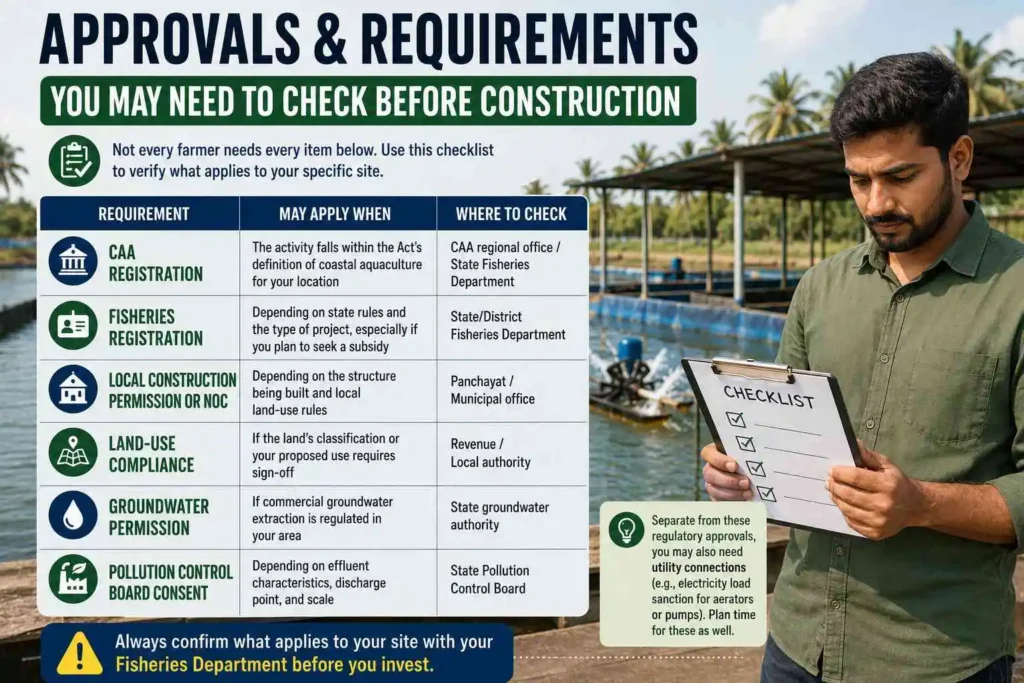
Not every farmer needs every item below, and none of these should be read as a universal rule. Treat this as a checklist of things to verify for your specific site, not a list of boxes every farm must tick.
| Requirement | May Apply When | Where to Check |
|---|---|---|
| CAA registration | The activity falls within the Act’s definition of coastal aquaculture for your location | CAA regional office / State Fisheries Department |
| Fisheries registration | Depending on state rules and the type of project, especially if you plan to seek a subsidy | State/District Fisheries Department |
| Local construction permission or NOC | Depending on the structure being built and local land-use rules | Panchayat/Municipal office |
| Land-use compliance | If the land’s classification or your proposed use requires sign-off | Revenue/Local authority |
| Groundwater permission | If commercial groundwater extraction is regulated in your area | State groundwater authority |
| Pollution Control Board consent | Depending on effluent characteristics, discharge point, and scale | State Pollution Control Board |
Separate from these regulatory approvals, most commercial farms will also need standard utility connections (electricity load sanction for aerators or pumps, for instance) — that’s an operational requirement rather than a farming license, but worth budgeting time for alongside everything else.
If any of these don’t apply to your specific setup, your Fisheries Department contact should be able to tell you so directly — don’t assume you need the entire list, and don’t assume you need none of it either.
What Documents Should You Keep Ready?
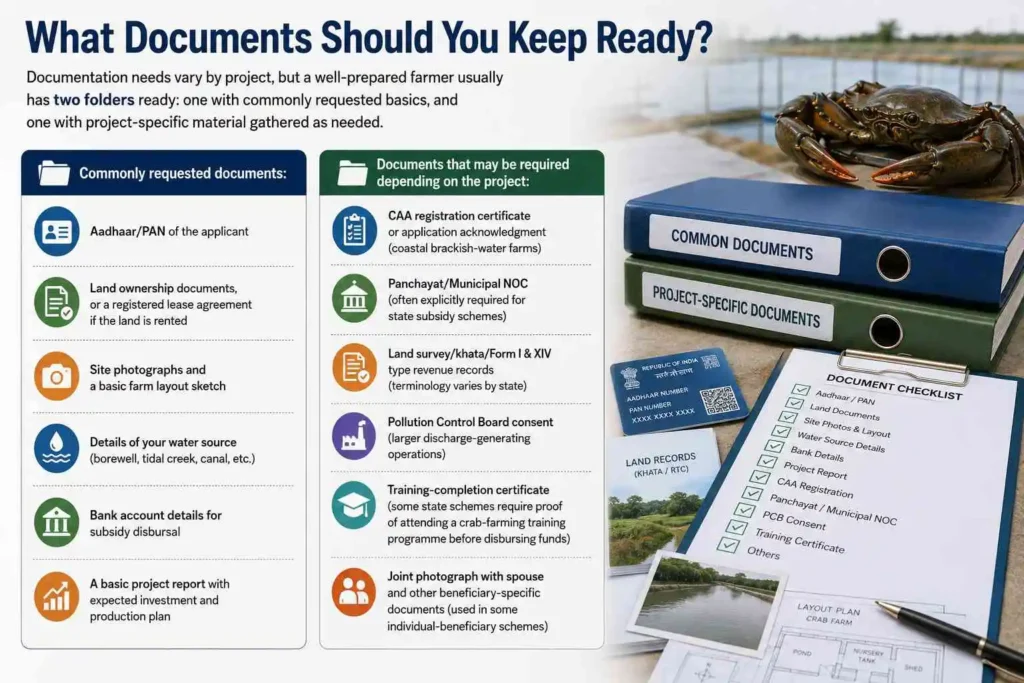
Documentation needs vary by project, but a well-prepared farmer usually has two folders ready: one with commonly requested basics, and one with project-specific material gathered as needed.
Commonly requested documents:
- Aadhaar/PAN of the applicant
- Land ownership documents, or a registered lease agreement if the land is rented
- Site photographs and a basic farm layout sketch
- Details of your water source (borewell, tidal creek, canal, etc.)
- Bank account details for subsidy disbursal
- A basic project report with expected investment and production plan
Documents that may be required depending on the project:
- CAA registration certificate or application acknowledgment (coastal brackish-water farms)
- Panchayat/Municipal NOC (often explicitly required for state subsidy schemes)
- Land survey/khata/Form I & XIV type revenue records (terminology varies by state)
- Pollution Control Board consent (larger discharge-generating operations)
- Training-completion certificate (some state schemes require proof of attending a crab-farming training programme before disbursing funds)
- Joint photograph with spouse and other beneficiary-specific documents (used in some individual-beneficiary schemes)
How to Apply: A Practical Step-by-Step Process
Step 0: Don’t buy the land or sign the lease until you’ve checked the site. The most expensive mistake isn’t always building first — sometimes it’s committing to a plot before discovering it doesn’t suit the intended aquaculture activity, or that it sits in a zone with restrictions you didn’t know about.
Step 1: Confirm your farm location — coastal notified zone, brackish-adjacent inland area, or clearly inland freshwater area.
Step 2: Identify your farming system — pond-based, pen/fattening, nursery, tank-based, or vertical/RAS.
Step 3: Contact the District or State Fisheries Office and describe your location, system, and scale honestly.
Step 4: Check whether CAA registration applies — don’t assume either way; get this confirmed in writing or via official correspondence if possible.
Step 5: Verify land and water permissions — ownership/lease status, water source legality, and any extraction limits.
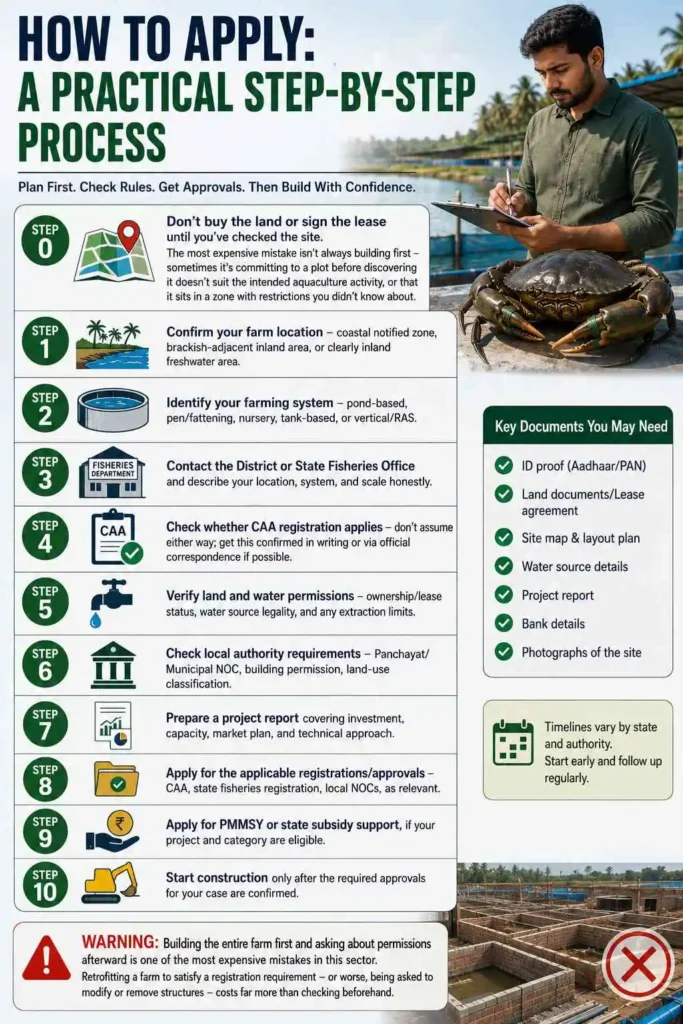
Step 6: Check local authority requirements — Panchayat/Municipal NOC, building permission, land-use classification.
Step 7: Prepare a project report covering investment, capacity, market plan, and technical approach.
Step 8: Apply for the applicable registrations/approvals — CAA, state fisheries registration, local NOCs, as relevant.
Step 9: Apply for PMMSY or state subsidy support, if your project and category are eligible.
Step 10: Start construction only after the required approvals for your case are confirmed.
Warning: Building the entire farm first and asking about permissions afterward is one of the most expensive mistakes in this sector. Retrofitting a farm to satisfy a registration requirement — or worse, being asked to modify or remove structures — costs far more than checking beforehand.
PMMSY Subsidy: Can Government Support Reduce Your Startup Cost?
The Pradhan Mantri Matsya Sampada Yojana (PMMSY) is the Government of India’s flagship fisheries scheme, covering fish and shellfish farming broadly, including species diversification into high-value items like mud crab. It’s implemented jointly by the Centre and states, which means the exact components, unit costs, and subsidy percentages you’ll see can differ from state to state.
A few things worth knowing:
- PMMSY-supported activities have historically included pond-based crab culture, crab fattening infrastructure, and related equipment, subject to the specific guidelines current at the time you apply.
- Subsidy shares are typically differentiated by beneficiary category (general category vs. SC/ST and women beneficiaries commonly receive a higher share), but the exact percentages and caps are set in the operational guidelines applicable in your state and year — always confirm the current figures rather than relying on an old article.
- Some states also run their own crab-specific schemes on top of or alongside PMMSY. Goa, for instance, has at times run a dedicated scheme for setting up pen-culture and vertical-box crab farming units with its own subsidy caps by beneficiary category. Treat any such example as illustrative of the kind of state-level support that can exist, not as a current rate you can rely on — these schemes are announced, revised, and closed on their own timelines, so confirm the live details directly with the state Fisheries Department or official scheme notification rather than an article.
- Eligibility generally extends to individual fish farmers, registered groups, self-help groups, cooperatives, and companies, but each scheme sets its own conditions (residency requirements, training completion, land documents, etc.).
Do not assume a specific percentage or amount applies to you without checking the current guidelines through your State Fisheries Department or the PMMSY portal — subsidy availability depends on approved unit costs, budget allocation for the year, project type, and your eligibility category.
What Happens If You Start Without Checking Permissions?
The consequences aren’t always immediate or dramatic, but they add up in practical ways:
- Subsidy applications can get delayed or rejected if the farm wasn’t registered before construction began.
- Site inspections tied to registration or subsidy disbursal can flag issues that require rework.
- Difficulty obtaining CAA or fisheries registration retroactively, especially if the site doesn’t conform to guidelines.
- Water discharge or extraction issues can attract objections from neighbors or the Pollution Control Board later, when it’s harder and costlier to fix.
- Banks and financial institutions increasingly ask for proof of registration before sanctioning loans for aquaculture projects, so missing paperwork can block financing.
- Expansion becomes harder if your original unit was never formally registered — you’re effectively trying to regularize an existing structure instead of registering a proposed one.
None of this is meant to scare a first-time farmer away from the business. It’s meant to make the point that sequencing matters: paperwork first, big spending second.
Common Mistakes New Crab Farmers Make
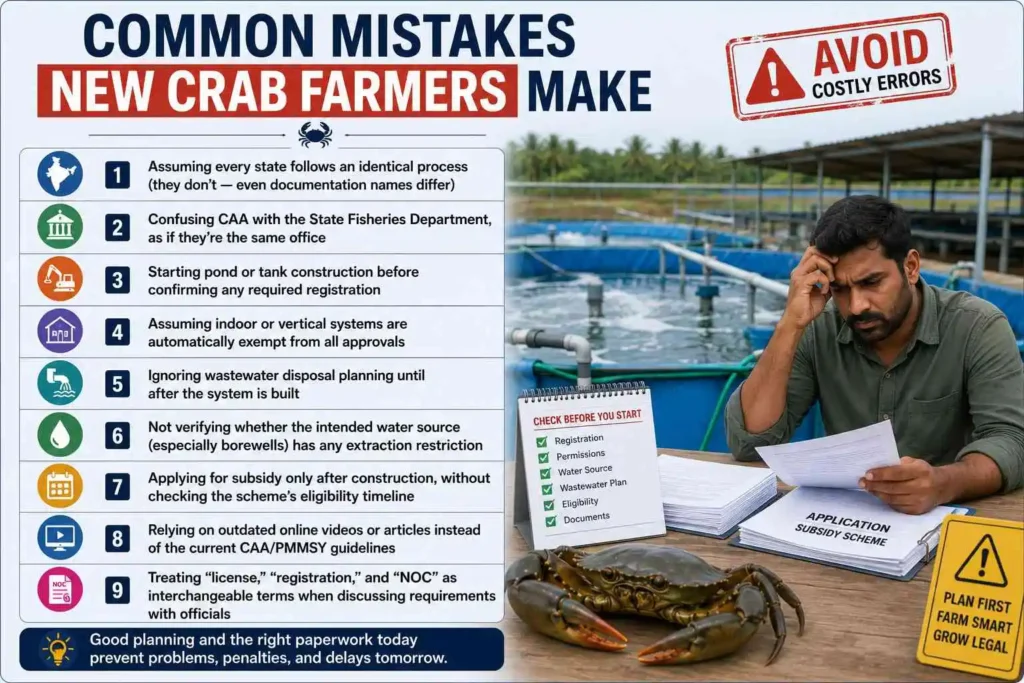
- Assuming every state follows an identical process (they don’t — even documentation names differ)
- Confusing CAA with the State Fisheries Department, as if they’re the same office
- Starting pond or tank construction before confirming any required registration
- Assuming indoor or vertical systems are automatically exempt from all approvals
- Ignoring wastewater disposal planning until after the system is built
- Not verifying whether the intended water source (especially borewells) has any extraction restriction
- Applying for subsidy only after construction, without checking the scheme’s eligibility timeline
- Relying on outdated online videos or articles instead of the current CAA/PMMSY guidelines
- Treating “license,” “registration,” and “NOC” as interchangeable terms when discussing requirements with officials
Expert Tip: Talk to the Fisheries Department Before Spending Money
Before your first visit or call to the Fisheries Department, have these ready:
- Exact location (village, district, distance from coast/creek if relevant)
- Approximate farm size
- Intended farming method (pond, pen, nursery, tank, vertical/RAS)
- Expected number of crabs/stocking density
- Water source
- Land ownership status (owned/leased)
- Expected investment
Then ask directly:
- Do I need registration for this specific location and system?
- Does CAA apply here?
- Do I need any local NOC?
- Are there water-use or discharge requirements I should know about?
- Can my project qualify for PMMSY or a state scheme?
Getting clear answers to these five questions before you buy crablets or start construction is, in practice, the single most cost-effective thing a new crab farmer can do.
State-Wise Differences: Why You Shouldn’t Copy Another Farmer’s Process
Coastal states with established brackish-water aquaculture — Andhra Pradesh, Tamil Nadu, Odisha, West Bengal, Kerala, Karnataka, and Goa among them — each run their own state fisheries registration processes, their own BFDA or equivalent support structures, and in some cases their own dedicated crab-farming schemes on top of PMMSY. A process that works smoothly in one state’s district office may involve different documentation, timelines, or even different departmental names in another.
Rather than copying a procedure a farmer in another state followed, treat their experience as a rough guide to what kind of questions to ask, and then verify the actual process with your own State or District Fisheries Department.
Final Checklist: Are You Ready to Start Your Mud Crab Farm?
☐ Location confirmed (coastal notified zone / inland)
☐ Land ownership or lease verified
☐ Water source confirmed and checked for any extraction restriction
☐ Farming system selected (pond, pen, nursery, tank, vertical/RAS)
☐ Fisheries Department contacted
☐ CAA applicability checked
☐ Local Panchayat/Municipal permissions checked
☐ Wastewater management planned
☐ Project report prepared
☐ PMMSY or state subsidy eligibility checked
☐ Buyer/market identified
☐ All required approvals for your specific case confirmed
Only after working through this list should a major investment — pond construction, vertical box purchase, or crablet stocking at scale — begin.
Related reading once your compliance basics are sorted: mud crab farming cost and profit, mud crab seed/crablet sourcing, and mud crab feed and feeding will help with the operational side once your paperwork is in order.
Sources & Where to Verify Current Rules
Regulations and scheme guidelines change, so treat this article as a starting map, not a substitute for checking the primary source closest to your case:
- Coastal Aquaculture Authority — caa.gov.in for the Act, amendments, registration guidelines, forms, and regional contacts
- Coastal Aquaculture Authority (Amendment) Act, 2023 — available via the Ministry of Fisheries, Animal Husbandry and Dairying and PIB press releases on the amendment
- PMMSY — pmmsy.dof.gov.in and the Department of Fisheries, Government of India, for current operational guidelines and eligible components
- Your State Fisheries Department / BFDA — for state-specific registration processes, documentation, and any state-run crab-farming schemes
- ICAR-CIBA (Central Institute of Brackishwater Aquaculture) — for technical guidance on mud crab culture systems, including vertical/RAS approaches
- MPEDA — where export of processed or live crab is involved
If a rule described here seems to have changed, the department or portal above will have the current version — that’s the one to follow.
The Bottom Line
The smartest mud crab farmer checks the rules before spending money. Government permissions aren’t just paperwork sitting between you and your first harvest — they shape where you can build, how you source and discharge water, whether subsidies are available to you, and whether you can expand later without complications.
Before buying crablets or constructing tanks, put together a basic project plan and visit your State or District Fisheries Department with details of your location, farming system, water source, and planned capacity. It’s a short conversation that can save months of rework and a significant amount of money.
Important Note : This article is intended as practical guidance, not legal advice. Requirements can change and can vary by state — always verify current rules with the Coastal Aquaculture Authority, your State Fisheries Department, and local authorities before making investment decisions.
Frequently Asked Questions
Do I need a license to start mud crab farming in India?
It depends on your location and system. Brackish-water pond farming in the coastal zone typically requires CAA registration and often state fisheries registration. Inland or small-scale setups may face different, sometimes lighter, requirements — but “different” doesn’t mean “none.” Confirm with your State Fisheries Department.
Is CAA registration mandatory for mud crab farming?
It’s mandatory for coastal aquaculture activity as defined under the Coastal Aquaculture Authority Act — broadly, brackish/saline water farming within the notified coastal zone. It is not automatically mandatory for every mud crab farm regardless of location or water source; genuinely inland freshwater operations may fall outside CAA’s jurisdiction, though other approvals can still apply.
Do inland mud crab farms need permission?
Possibly, but usually from different authorities than CAA — think land-use permission, Panchayat NOC, groundwater extraction rules, or Pollution Control Board consent for discharge, depending on scale and location. “Inland” is not the same as “no permission required.”
Do vertical mud crab farms require registration?
The container design (boxes, RAS) doesn’t decide this — water source, discharge, land use, and location relative to the coast do. A vertical system inside the coastal zone using brackish water can still fall under CAA’s scope; one that’s inland on freshwater generally faces a different set of requirements.
Can I start mud crab farming on leased land?
Yes, this is common, but you’ll typically need a registered lease agreement as part of your documentation, and the landowner’s cooperation for site inspections and NOCs.
Do I need permission to use borewell water?
It depends on the state and the volume of extraction. Significant borewell use for commercial aquaculture can attract groundwater extraction rules in some states — check with the local groundwater authority or Fisheries Department.
Can I get PMMSY subsidy for mud crab farming?
Mud crab culture has been supported under PMMSY and various state schemes in the past, but exact eligibility, unit costs, and subsidy percentages depend on the current guidelines in your state and year. Don’t assume a fixed percentage without checking with your Fisheries Department.
Which department should I contact first?
For most new farmers, the State or District Fisheries Department is the most practical starting point — they can direct you to CAA if it applies, explain local requirements, and guide you on subsidy options.
Can I start a small mud crab farm without registering a company?
Individual farmers, not just companies, are eligible beneficiaries under most fisheries schemes and can typically register farms in their own name. Whether a business entity is needed depends more on your own scale, financing, and tax planning than on aquaculture regulation itself.
What documents are needed to start a mud crab farm?
At minimum, expect to need identity proof, land ownership or lease documents, water source details, and a basic project report. Depending on your location and system, you may additionally need CAA registration, a Panchayat NOC, Pollution Control Board consent, or training-completion proof for certain subsidy schemes.
Newsletter