

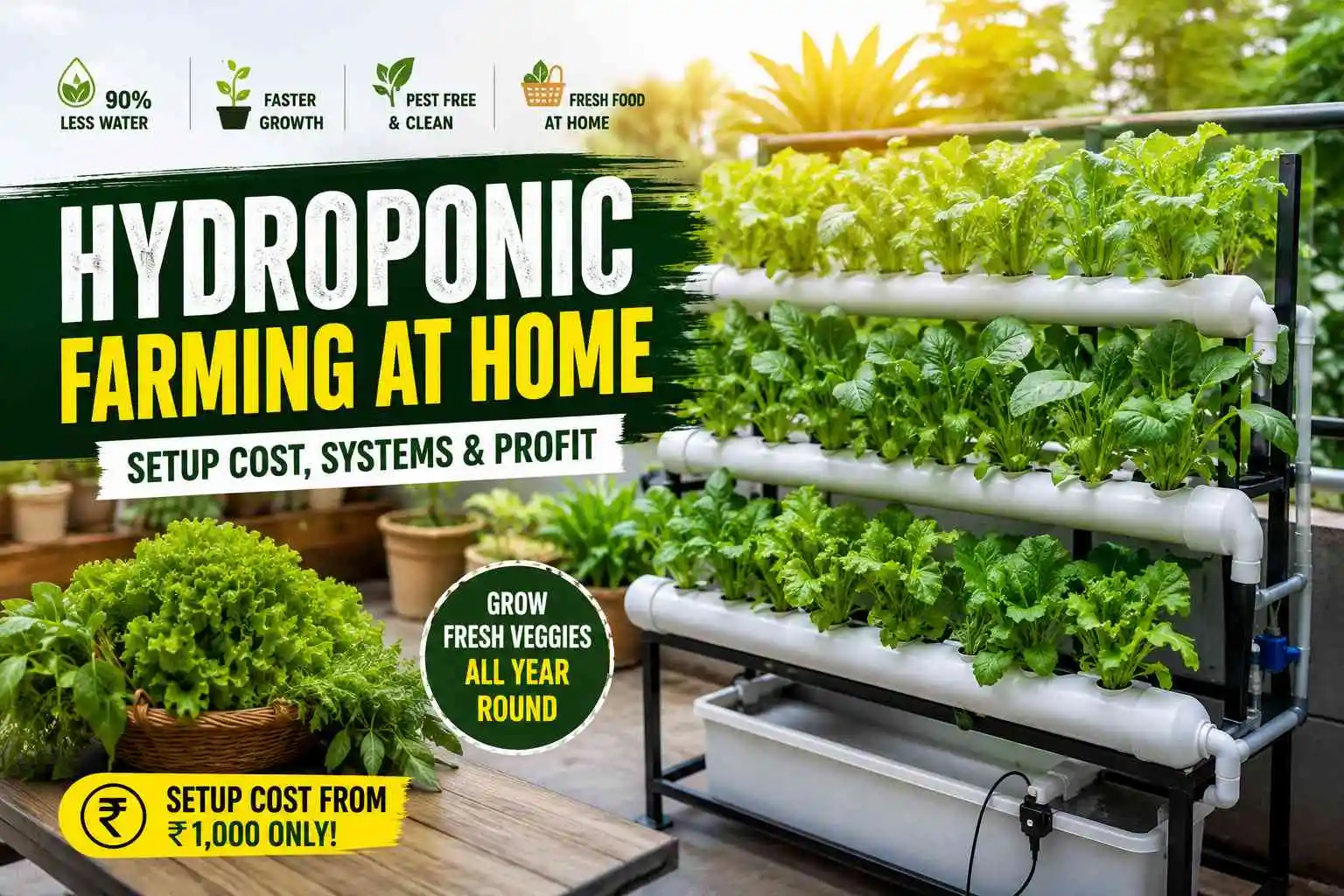

Hydroponic Farming at Home: Setup Cost, Systems and Profit
Have you ever looked at your balcony or terrace and thought about growing your own vegetables there — without digging soil, without weeds, and without waiting for the right season? That’s exactly what hydroponic farming at home lets you do.
More Indian households are now trying home hydroponics to grow fresh, pesticide-free vegetables in small spaces like flats, terraces, and even kitchen windows. You don’t need a farm, or even soil. Just water, a few nutrients, and a bit of sunlight or a grow light.
This guide covers what it really means, its cost in rupees, which system suits your space and budget, and which vegetables grow fastest. No confusing science, just simple, practical facts.
What Is Hydroponic Farming at Home?
This simply means growing plants in nutrient-rich water instead of soil. The roots either float directly in the water or sit in a material like cocopeat, perlite, or clay balls, which just holds the plant in place. All the food a plant needs comes straight from the water around its roots.
Think of it this way: in soil, roots search around for food. In hydroponics, you deliver food directly to the roots — like feeding a baby with a spoon instead of making it search the kitchen. That’s why hydroponic plants often grow faster and healthier.
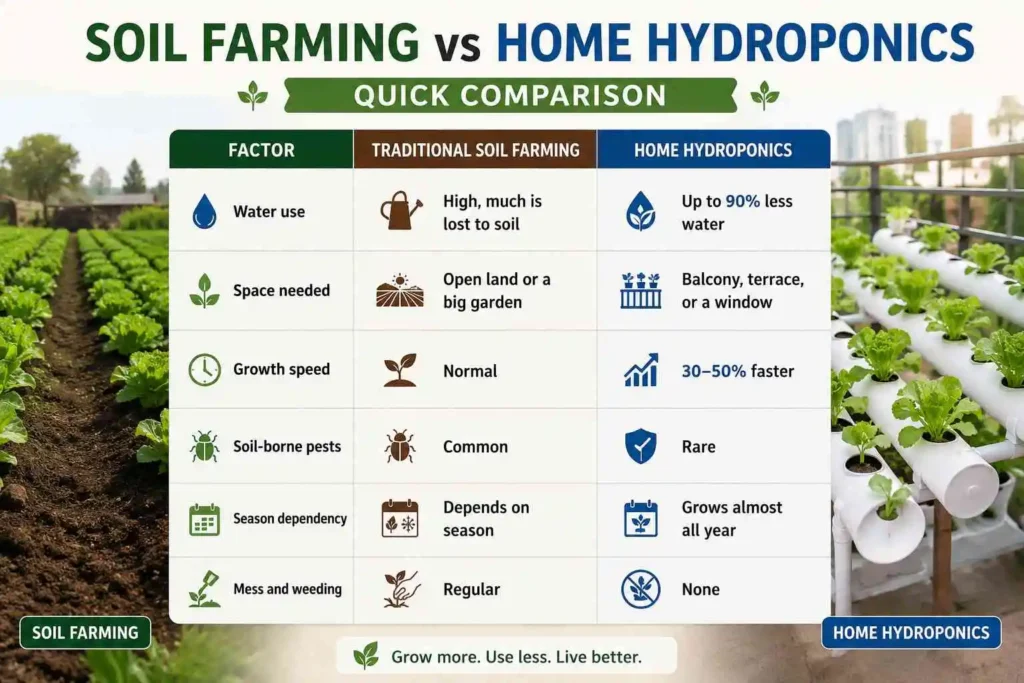
Soil Farming vs Home Hydroponics: Quick Comparison
| Factor | Traditional Soil Farming | Home Hydroponics |
|---|---|---|
| Water use | High, much is lost to soil | Up to 90% less water |
| Space needed | Open land or a big garden | Balcony, terrace, or a window |
| Growth speed | Normal | 30–50% faster |
| Soil-borne pests | Common | Rare |
| Season dependency | Depends on season | Grows almost all year |
| Mess and weeding | Regular | None |
Why Home Hydroponics Is Gaining Popularity in India
Here’s why more people are trying this in Indian homes:
- Saves water: Uses close to 90% less water than soil, since the same water keeps circulating.
- Works in tiny spaces: A 3×3 feet balcony corner is enough for leafy greens.
- Grows faster: Many leafy vegetables are ready in 25 to 30 days.
- Fewer pests, no mud: No soil means no soil-borne disease and far less weeding.
- Fresh, chemical-free food: You decide exactly what goes into the nutrient water.
- Possible extra income: Many home growers now sell surplus greens to neighbours or local shops.
Industry estimates put India’s hydroponics sector on track to become a multi-thousand-crore market within a decade — and home balconies are very much part of that growth story.
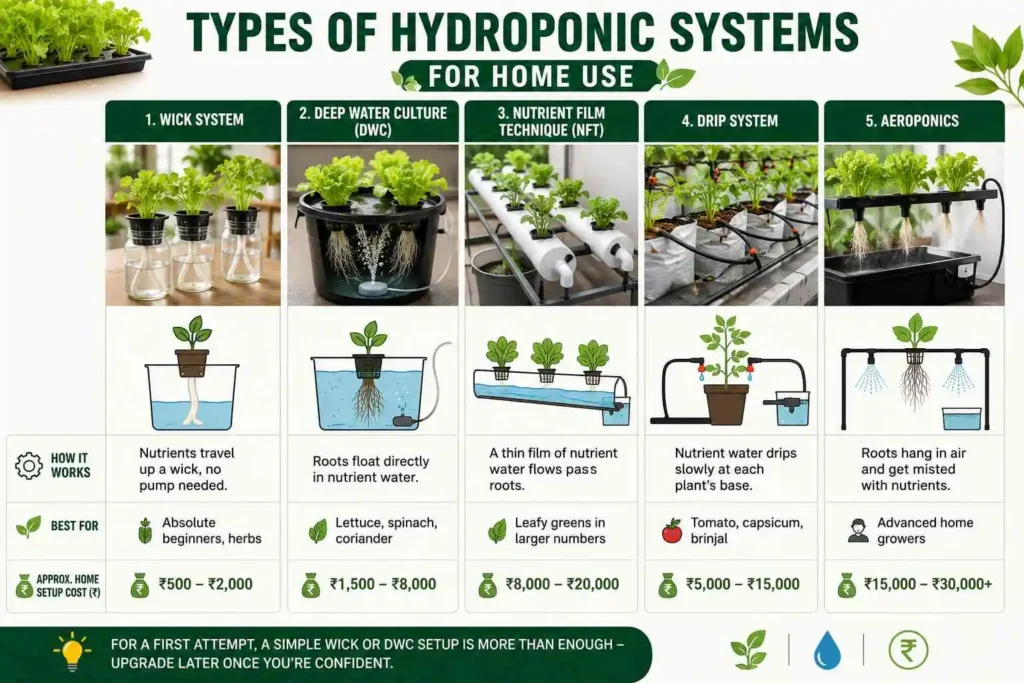
Types of Hydroponic Systems for Home Use
Not every setup needs heavy machines. Some can be built with things already lying around your house.
| System Type | How It Works | Best For | Approx. Home Setup Cost (₹) |
|---|---|---|---|
| Wick System | Nutrients travel up a wick, no pump needed | Absolute beginners, herbs | ₹500 – ₹2,000 |
| Deep Water Culture (DWC) | Roots float directly in nutrient water | Lettuce, spinach, coriander | ₹1,500 – ₹8,000 |
| Nutrient Film Technique (NFT) | A thin film of nutrient water flows past roots | Leafy greens in larger numbers | ₹8,000 – ₹20,000 |
| Drip System | Nutrient water drips slowly at each plant’s base | Tomato, capsicum, brinjal | ₹5,000 – ₹15,000 |
| Aeroponics | Roots hang in air and get misted with nutrients | Advanced home growers | ₹15,000 – ₹30,000+ |
For a first attempt, a simple wick or DWC setup is more than enough — upgrade later once you’re confident.
How to Start Hydroponic Farming at Home: Step by Step
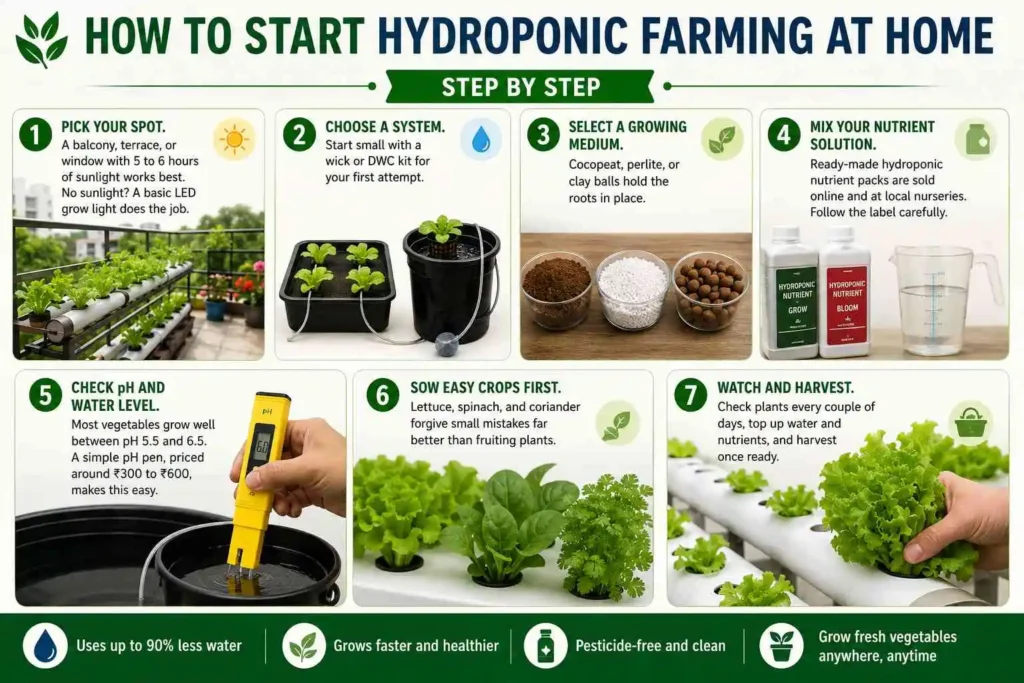
- Pick your spot. A balcony, terrace, or window with 5 to 6 hours of sunlight works best. No sunlight? A basic LED grow light does the job.
- Choose a system. Start small with a wick or DWC kit for your first attempt.
- Select a growing medium. Cocopeat, perlite, or clay balls hold the roots in place.
- Mix your nutrient solution. Ready-made hydroponic nutrient packs are sold online and at local nurseries. Follow the label carefully.
- Check pH and water level. Most vegetables grow well between pH 5.5 and 6.5. A simple pH pen, priced around ₹300 to ₹600, makes this easy.
- Sow easy crops first. Lettuce, spinach, and coriander forgive small mistakes far better than fruiting plants.
- Watch and harvest. Check plants every couple of days, top up water and nutrients, and harvest once ready.
Hydroponic Farming at Home: Setup Cost in India
Cost depends entirely on how big, and how automated, you want your setup to be.
| Setup Level | What You Get | Approx. Cost (₹) |
|---|---|---|
| Bare-basic DIY (jars, bottles, PVC pipes) | 4–6 plants, fully manual | ₹1,000 – ₹5,000 |
| Ready-made beginner kit | 5–10 plants, simple DWC/NFT kit | ₹3,000 – ₹10,000 |
| Mid-range home system | 20–30 plants, sturdy stand, better nutrients | ₹10,000 – ₹25,000 |
| Advanced balcony/terrace setup | 50–100 sq ft, semi-automated, grow lights | ₹30,000 – ₹60,000 |
On top of this, budget roughly ₹200 to ₹600 a month for nutrients and electricity — often less than what a family already spends buying vegetables from the market.
Best Vegetables to Grow in Home Hydroponics
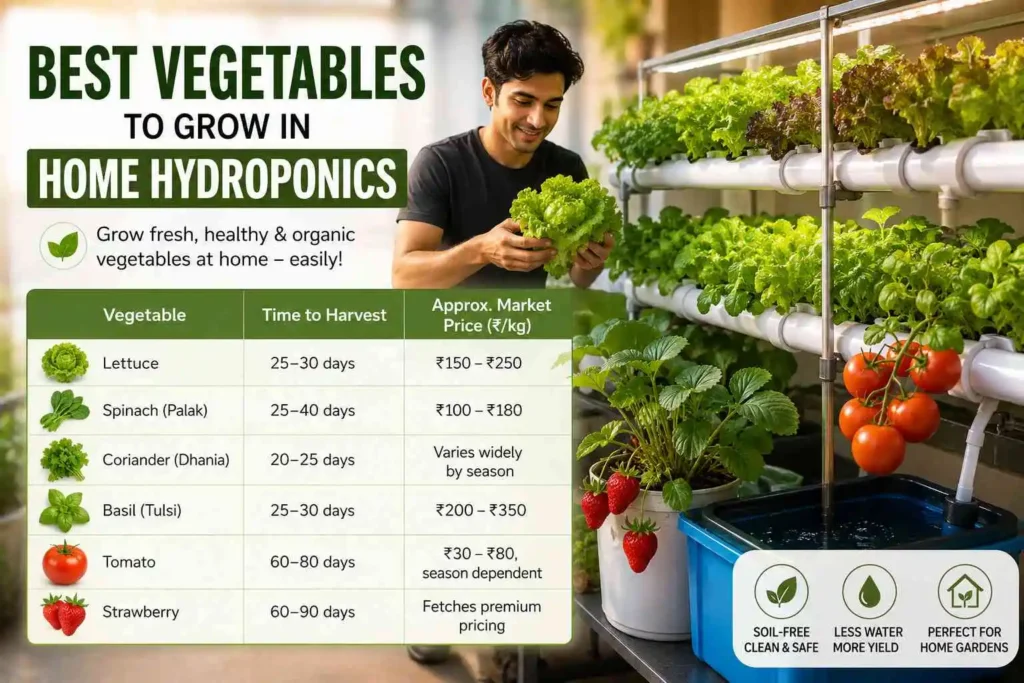
| Vegetable | Time to Harvest | Approx. Market Price (₹/kg) |
|---|---|---|
| Lettuce | 25–30 days | ₹150 – ₹250 |
| Spinach (Palak) | 25–40 days | ₹100 – ₹180 |
| Coriander (Dhania) | 20–25 days | Varies widely by season |
| Basil (Tulsi) | 25–30 days | ₹200 – ₹350 |
| Tomato | 60–80 days | ₹30 – ₹80, season dependent |
| Strawberry | 60–90 days | Fetches premium pricing |
Leafy greens are the easiest place to start. Once you’re comfortable, move on to fruiting plants like tomato and capsicum, which need a bit more light and patience.
Government Support for Hydroponic Farming in India
Hydroponic farming isn’t just a personal hobby anymore — the government is backing it too. Under schemes like the National Horticulture Mission (NHM) and the Mission for Integrated Development of Horticulture (MIDH), growers can get a subsidy of up to 50% on protected cultivation structures and equipment. States like Maharashtra, Gujarat, and Karnataka run their own horticulture subsidy schemes as well, and the PM-KUSUM scheme can help cover solar power costs for your setup.
These schemes usually target bigger, semi-commercial setups rather than a small balcony kit, and rules change often. Check with your local Krishi Vigyan Kendra or state Horticulture Department for the latest numbers before planning a bigger investment.
Common Mistakes to Avoid
- Ignoring pH levels, which quietly stunts growth
- Adding too many nutrients, thinking “more is better”
- Placing the setup somewhere with less than 5 hours of light
- Jumping into a big system before mastering a small one
- Forgetting to check water levels during summer heat
Is Home Hydroponic Farming Profitable?
For most families, the first benefit is simple: lower grocery bills and fresher food on the table. A small setup growing leafy greens can easily offset ₹500 to ₹1,000 worth of vegetable purchases every month.
Once confident, many home growers scale up and sell surplus produce to neighbours, local stores, or small online groups, since leafy greens like lettuce and basil fetch a decent price per kilo. It won’t replace a full income overnight, but it’s a low-risk way to test the waters before thinking bigger.
Final Thoughts
Hydroponic farming at home is no longer just for scientists or big commercial farms. With a budget as small as a few thousand rupees, anyone with a sunny balcony or window can start growing fresh vegetables at home. Start small, get comfortable with one or two easy crops, and expand only once you’re confident. Once you’ve mastered leafy greens, you can move on to fruiting crops like tomatoes. If you’re planning to grow them, check out our complete guide on Tomato Farming at Home for step-by-step planting, care, and harvesting tips. The soil may be missing, but the harvest is very real.
FAQs on Hydroponic Farming at Home
1. Is hydroponic farming at home expensive to start?
No. A basic DIY setup can start from as little as ₹1,000 to ₹5,000, using simple containers and easily available material.
2. Can I grow hydroponically at home without electricity?
Yes. Wick systems need no pump or power at all. Only NFT, drip, and aeroponic systems need electricity for pumps or grow lights.
3. How much water does home hydroponic farming save?
It typically uses up to 90% less water than soil farming, since the same water is reused again and again.
4. Which vegetables grow fastest in home hydroponics?
Leafy greens like lettuce, spinach, and coriander are the fastest, often ready within 20 to 30 days.
5. Is hydroponic produce safe to eat?
Yes. With no soil involved, there’s far less risk of soil-borne disease, and you control exactly what nutrients go into the water.
Newsletter