

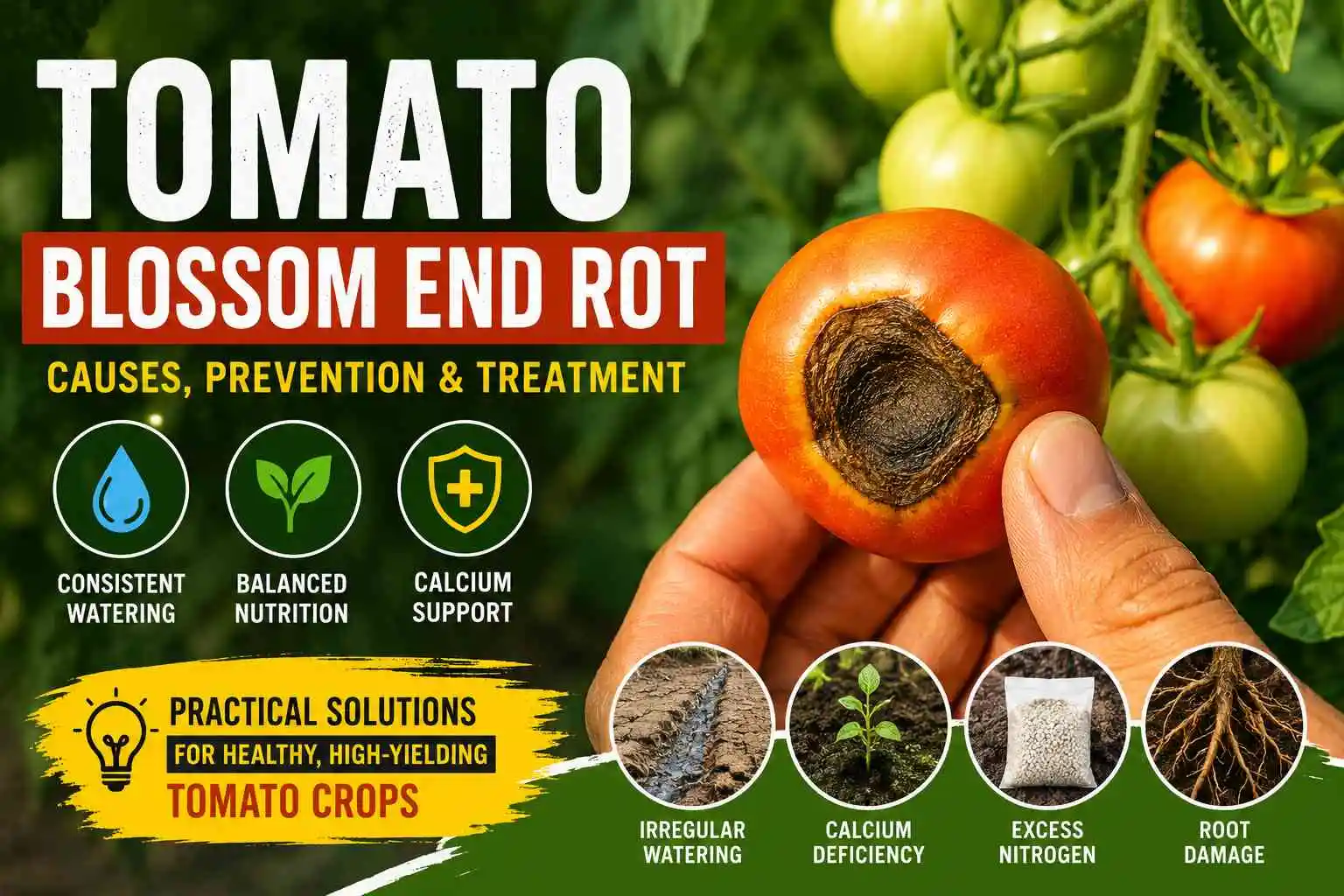

Tomato Blossom End Rot: Causes, Prevention, and Treatment
If you grow tomatoes, you have probably seen it before. A healthy-looking fruit hanging on the vine, and then one day you notice a dark, sunken, leathery patch at the bottom — right at the blossom end. This is tomato blossom end rot, and it is one of the most common and most frustrating problems tomato growers face, whether you are farming half an acre in a village or managing a large commercial polyhouse.
The good news is that blossom end rot is not caused by an insect or a fungus. It cannot spread from plant to plant like a disease. It is a physiological disorder, which means it is fixable once you understand what is really going on inside the plant. In this guide, we will break down the causes, the early warning signs, and practical, budget-friendly solutions — with real cost figures in Indian Rupees — so you can protect your crop and your income.
What Exactly Is Tomato Blossom End Rot?
Blossom end rot (BER) shows up as a water-soaked spot near the blossom end of the tomato — the bottom of the fruit, opposite the stem. Over a few days, this spot turns brown or black, becomes leathery, and sinks inward. In humid conditions, secondary fungi or bacteria can move into the damaged tissue and cause further rotting, but the original cause is not an infection at all.
At its core, blossom end rot happens because of a localized calcium deficiency in the developing fruit. Even if your soil has enough calcium, the fruit itself may not be getting enough of it — usually because of uneven watering, fast plant growth, or root stress.
Which Crops Does It Affect?
While tomato is the crop most commonly affected, blossom end rot also shows up in:
- Brinjal (eggplant)
- Capsicum and chilli (pepper)
- Watermelon and other cucurbits
- Squash
If you grow any of these alongside tomato, keep an eye on them too.
Why Does Blossom End Rot Happen? The Real Causes
Many farmers assume the problem is simply “not enough calcium in the soil,” and rush to buy expensive calcium sprays. But in most Indian tomato fields, soil calcium is actually sufficient. The real issue is usually one of these:
1. Irregular or Inconsistent Watering
Calcium moves through the plant only when there is a steady flow of water from the roots to the leaves and fruit. If the soil dries out and then gets flooded again (a common pattern during erratic monsoon rains or inconsistent irrigation scheduling), calcium transport to the fruit gets interrupted. This is the single biggest cause of BER in open-field tomato cultivation across India.
2. Rapid, Lush Vegetative Growth
When plants are pushed too hard with high-nitrogen fertilizers (especially urea) early in the season, they grow very fast and leafy. Since calcium moves toward the leaves faster than it moves toward the fruit, the developing tomatoes get “left behind” and end up calcium-starved.
3. Root Damage
Deep or careless intercultural operations, nematode damage, or waterlogged roots can all reduce the plant’s ability to absorb calcium from the soil, even when calcium is present in good quantity.
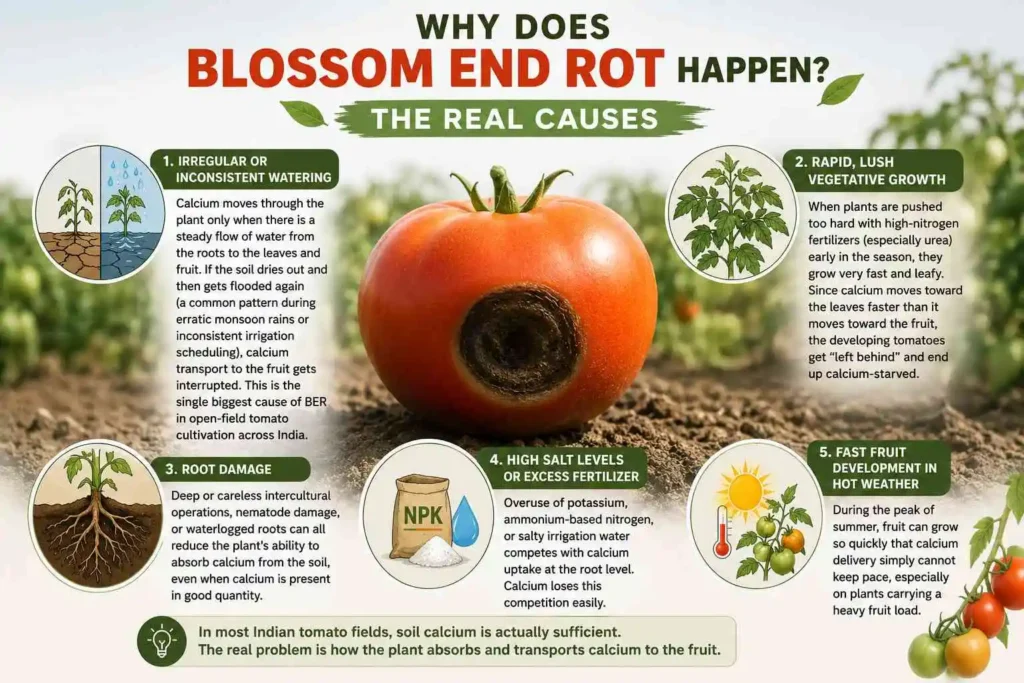
4. High Salt Levels or Excess Fertilizer
Overuse of potassium, ammonium-based nitrogen, or salty irrigation water competes with calcium uptake at the root level. Calcium loses this competition easily.
5. Fast Fruit Development in Hot Weather
During the peak of summer, fruit can grow so quickly that calcium delivery simply cannot keep pace, especially on plants carrying a heavy fruit load.
How to Identify Blossom End Rot Early
| Stage | What You’ll See | Action Needed |
|---|---|---|
| Early stage | Small, water-soaked, light tan spot at blossom end | Correct irrigation immediately, apply calcium spray |
| Mid stage | Spot enlarges, turns brown, slightly sunken | Remove affected fruit, adjust fertigation schedule |
| Advanced stage | Black, leathery, flattened patch, possible fungal growth | Discard fruit, review entire nutrient and water program |
Catching it in the early stage is key — once the tissue has collapsed, that particular fruit cannot be saved, but you can absolutely stop it from spreading to the rest of your crop.
Step-by-Step Prevention and Management
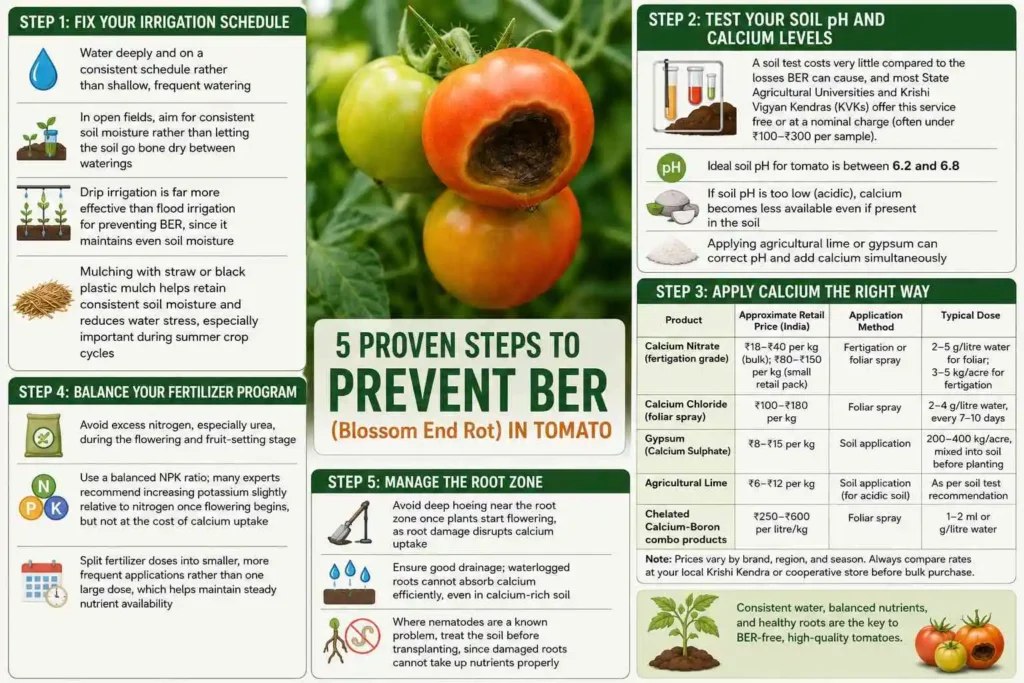
Step 1: Fix Your Irrigation Schedule First
Before buying any input, look at your watering pattern. Irregular watering is responsible for the majority of BER cases in Indian conditions.
- Water deeply and on a consistent schedule rather than shallow, frequent watering
- In open fields, aim for consistent soil moisture rather than letting the soil go bone dry between waterings
- Drip irrigation is far more effective than flood irrigation for preventing BER, since it maintains even soil moisture
- Mulching with straw or black plastic mulch helps retain consistent soil moisture and reduces water stress, especially important during summer crop cycles
Step 2: Test Your Soil pH and Calcium Levels
A soil test costs very little compared to the losses BER can cause, and most State Agricultural Universities and Krishi Vigyan Kendras (KVKs) offer this service free or at a nominal charge (often under ₹100–₹300 per sample).
- Ideal soil pH for tomato is between 6.2 and 6.8
- If soil pH is too low (acidic), calcium becomes less available even if present in the soil
- Applying agricultural lime or gypsum can correct pH and add calcium simultaneously
Step 3: Apply Calcium the Right Way
Foliar calcium sprays are the fastest way to correct an active BER problem because they bypass the root system and slow transport issues entirely.
| Product | Approximate Retail Price (India) | Application Method | Typical Dose |
|---|---|---|---|
| Calcium Nitrate (fertigation grade) | ₹18–₹40 per kg (bulk); ₹80–₹150 per kg (small retail pack) | Fertigation or foliar spray | 2–5 g/litre water for foliar; 3–5 kg/acre for fertigation |
| Calcium Chloride (foliar spray) | ₹100–₹180 per kg | Foliar spray | 2–4 g/litre water, every 7–10 days |
| Gypsum (Calcium Sulphate) | ₹8–₹15 per kg | Soil application | 200–400 kg/acre, mixed into soil before planting |
| Agricultural Lime | ₹6–₹12 per kg | Soil application (for acidic soil) | As per soil test recommendation |
| Chelated Calcium-Boron combo products | ₹250–₹600 per litre/kg | Foliar spray | 1–2 ml or g/litre water |
Note: Prices vary by brand, region, and season. Always compare rates at your local Krishi Kendra or cooperative store before bulk purchase.
Step 4: Balance Your Fertilizer Program
- Avoid excess nitrogen, especially urea, during the flowering and fruit-setting stage
- Use a balanced NPK ratio; many experts recommend increasing potassium slightly relative to nitrogen once flowering begins, but not at the cost of calcium uptake
- Split fertilizer doses into smaller, more frequent applications rather than one large dose, which helps maintain steady nutrient availability
Step 5: Manage the Root Zone
- Avoid deep hoeing near the root zone once plants start flowering, as root damage disrupts calcium uptake
- Ensure good drainage; waterlogged roots cannot absorb calcium efficiently, even in calcium-rich soil
- Where nematodes are a known problem, treat the soil before transplanting, since damaged roots cannot take up nutrients properly
Sample Cost of a Prevention Program (Per Acre)
Here is a rough estimate for a mid-sized tomato plot, based on average Indian market rates:
| Input | Quantity per Acre | Approximate Cost (₹) |
|---|---|---|
| Gypsum (pre-planting soil application) | 300 kg | ₹2,400–₹4,500 |
| Calcium Nitrate (fertigation, full season) | 15–20 kg | ₹700–₹1,800 |
| Calcium Chloride foliar spray (3–4 rounds) | 400–500 g total | ₹150–₹300 |
| Soil testing | 1 sample | ₹100–₹300 |
| Mulching material (plastic mulch, if used) | As per plot size | ₹4,000–₹8,000 |
| Total (without mulching) | ₹3,350–₹6,900 | |
| Total (with plastic mulching) | ₹7,350–₹14,900 |
Compare this to the potential loss: even a moderate BER outbreak affecting 15–20% of fruit on a one-acre tomato plot yielding around 8–10 tonnes can mean a loss of ₹15,000–₹40,000 or more, depending on market price at harvest time. Prevention is clearly the cheaper path.
Common Mistakes Farmers Make
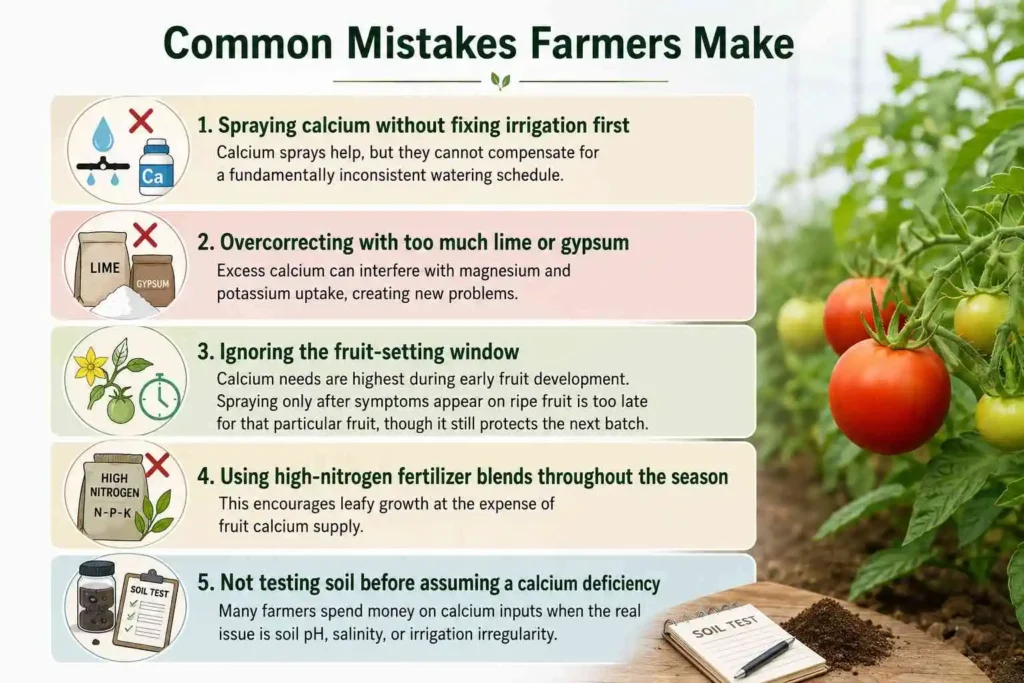
- Spraying calcium without fixing irrigation first — Calcium sprays help, but they cannot compensate for a fundamentally inconsistent watering schedule.
- Overcorrecting with too much lime or gypsum — Excess calcium can interfere with magnesium and potassium uptake, creating new problems.
- Ignoring the fruit-setting window — Calcium needs are highest during early fruit development. Spraying only after symptoms appear on ripe fruit is too late for that particular fruit, though it still protects the next batch.
- Using high-nitrogen fertilizer blends throughout the season — This encourages leafy growth at the expense of fruit calcium supply.
- Not testing soil before assuming a calcium deficiency — Many farmers spend money on calcium inputs when the real issue is soil pH, salinity, or irrigation irregularity.
Final Thoughts
Tomato blossom end rot is one of those problems that looks alarming but is very manageable once you understand the root cause. In almost every case, the fix comes down to three things: steady and consistent watering, balanced fertilization, and timely calcium support. None of these require expensive or exotic inputs — gypsum, calcium nitrate, and better irrigation planning are all affordable and widely available at local agri-input stores across India.
By addressing irrigation first and using calcium as a support tool rather than a cure-all, you can significantly reduce BER losses and protect the quality and market value of your tomato crop season after season.
his is all about BER (Bottom End Rot), but this is not the only way to increase your tomato yield. Check out our tomato farming guide to learn more about how to grow tomatoes.
Frequently Asked Questions
Is blossom end rot contagious?
No. It does not spread from plant to plant. It results from calcium movement issues within an individual plant, not from a pathogen.
Can I still eat tomatoes with blossom end rot?
If you cut away the damaged portion and the rest of the fruit looks and smells normal, it is generally safe to eat. However, for market sale, affected fruit should be sorted out since buyers will reject it.
Will blossom end rot go away on its own?
Once corrective steps like consistent irrigation and calcium application are in place, new fruit set after the correction typically shows far less or no BER. Already-affected fruit will not recover.
Does mulching really help with blossom end rot?
Yes. Mulching reduces soil moisture fluctuation, which is one of the leading triggers of BER, especially in regions with unpredictable rainfall or high summer temperatures.
Which tomato varieties are more prone to blossom end rot?
Varieties producing large, elongated, or paste-type fruit (such as Roma-type tomatoes) tend to show BER more often than smaller round varieties, since bigger fruit demand more calcium during rapid growth phases.
Newsletter