



Blueberry Farming in India: Cost, Profit, Varieties, and Complete Guide (2026)
If someone had told me five years ago that a small blue fruit the size of my thumbnail could earn me ₹8–12 lakh per acre every year, I would have laughed and gone back to my wheat field. But today, blueberry farming is quietly making smart Indian farmers very, very rich — and most people don’t even know it yet.
In this complete guide, I will walk you through everything — from preparing your soil to selling your crop — in plain language that any farmer can understand. No fancy jargon. No big words. Just facts, figures, and the truth about what blueberry farming really takes.

What Is Blueberry Farming and Why Should You Care?
Blueberry farming is the growing of blueberry plants (Vaccinium species) for their small, sweet, antioxidant-rich fruit. These berries are dark blue to purple in colour and are considered a “superfood” across the world.
In India, blueberry farming is still in its early stage — which means the opportunity is HUGE right now. Demand is growing fast in cities like Mumbai, Delhi, Bangalore, and Pune. Hotels, hospitals, smoothie bars, bakeries, and health-conscious families are all desperate to buy fresh Indian blueberries instead of expensive imported ones.
Here is the truth: India currently imports most of its blueberries from Chile, Peru, and the USA. One kilogram of imported blueberries sells for ₹500–₹1,200 in Indian supermarkets. If you can grow them locally and sell at even half that price, you are still making fantastic profit.
Can Blueberries Grow in India? Yes — But Location Matters
Blueberry plants are not like mango or wheat — they are very choosy about where they grow. But several parts of India have perfect conditions for blueberry farming.
Best states for blueberry farming in India:
- Himachal Pradesh (Shimla, Kullu, Manali)
- Uttarakhand (Nainital, Mussoorie belts)
- Jammu & Kashmir (especially Kashmir Valley)
- Arunachal Pradesh and Meghalaya
- Nilgiris in Tamil Nadu
- Parts of Maharashtra (Mahabaleshwar region)
- Sikkim and Darjeeling, West Bengal
These areas have cool winters, mild summers, and the right kind of acidic soil that blueberries absolutely love.
What climate does the blueberry plant need?
- Temperature: 15°C to 28°C (ideal growing season)
- Chilling hours: 800–1,000 hours below 7°C (for the fruit to set properly)
- Rainfall: 600–900 mm per year, or equivalent through irrigation
- Altitude: 1,000 to 2,500 metres above sea level works best

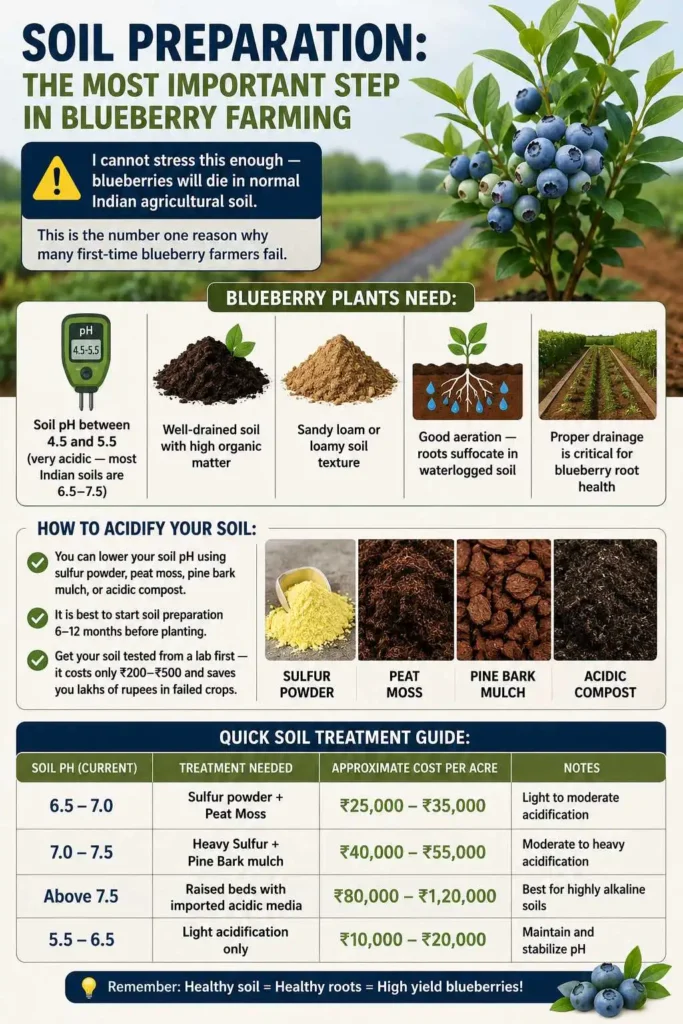
Soil Preparation: The Most Important Step in Blueberry Farming
I cannot stress this enough — blueberries will die in normal Indian agricultural soil. This is the number one reason why many first-time blueberry farmers fail.
Blueberry plants need:
- Soil pH between 4.5 and 5.5 (very acidic — most Indian soils are 6.5–7.5)
- Well-drained soil with high organic matter
- Sandy loam or loamy soil texture
- Good aeration — roots suffocate in waterlogged soil
How to acidify your soil:
You can lower your soil pH using sulfur powder, peat moss, pine bark mulch, or acidic compost. It is best to start soil preparation 6–12 months before planting. Get your soil tested from a lab first — it costs only ₹200–₹500 and saves you lakhs of rupees in failed crops.
Quick Soil Treatment Guide:
| Soil pH (Current) | Treatment Needed | Approximate Cost per Acre |
|---|---|---|
| 6.5 – 7.0 | Sulfur powder + Peat Moss | ₹25,000 – ₹35,000 |
| 7.0 – 7.5 | Heavy Sulfur + Pine Bark mulch | ₹40,000 – ₹55,000 |
| Above 7.5 | Raised beds with imported acidic media | ₹80,000 – ₹1,20,000 |
| 5.5 – 6.5 | Light acidification only | ₹10,000 – ₹20,000 |
Which Blueberry Variety Should You Plant in India?
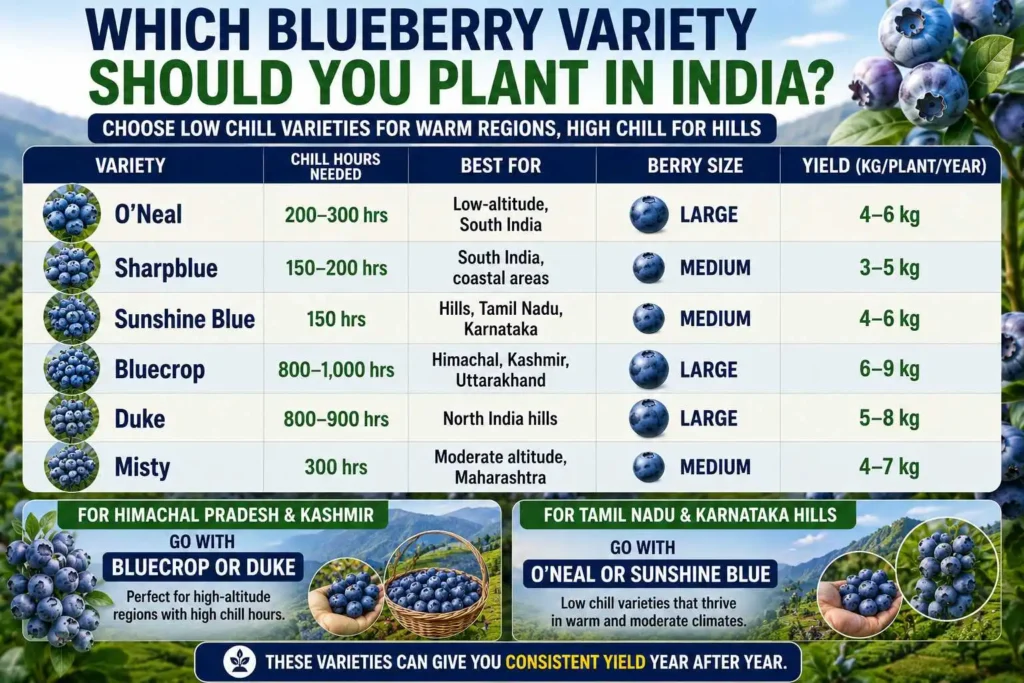
Not all blueberry varieties are the same. For Indian conditions, choose varieties with low chill hour requirements unless you are farming in high-altitude areas.
Best blueberry varieties for India:
| Variety | Chill Hours Needed | Best For | Berry Size | Yield (kg/plant/year) |
|---|---|---|---|---|
| O’Neal | 200–300 hrs | Low-altitude, South India | Large | 4–6 kg |
| Sharpblue | 150–200 hrs | South India, coastal areas | Medium | 3–5 kg |
| Sunshine Blue | 150 hrs | Hills, Tamil Nadu, Karnataka | Medium | 4–6 kg |
| Bluecrop | 800–1,000 hrs | Himachal, Kashmir, Uttarakhand | Large | 6–9 kg |
| Duke | 800–900 hrs | North India hills | Large | 5–8 kg |
| Misty | 300 hrs | Moderate altitude, Maharashtra | Medium | 4–7 kg |
For farmers in Himachal Pradesh and Kashmir, go with Bluecrop or Duke. For farmers in Tamil Nadu or Karnataka hills, go with O’Neal or Sunshine Blue. These varieties can give you consistent yield year after year.
Step-by-Step Blueberry Farming Process
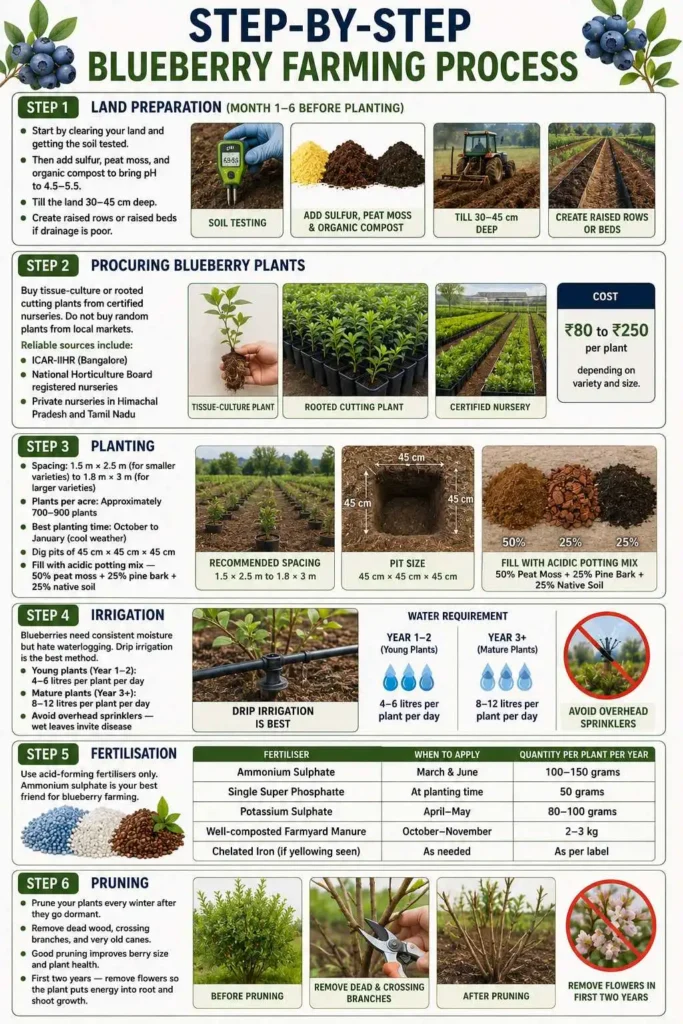
Step 1: Land Preparation (Month 1–6 Before Planting)
Start by clearing your land and getting the soil tested. Then add sulfur, peat moss, and organic compost to bring pH to 4.5–5.5. Till the land 30–45 cm deep. Create raised rows or raised beds if drainage is poor.
Step 2: Procuring Blueberry Plants
Buy tissue-culture or rooted cutting plants from certified nurseries. Do not buy random plants from local markets. Reliable sources include:
- ICAR-IIHR (Bangalore)
- National Horticulture Board registered nurseries
- Private nurseries in Himachal Pradesh and Tamil Nadu
Cost: ₹80 to ₹250 per plant depending on variety and size.
Step 3: Planting
- Spacing: 1.5 m × 2.5 m (for smaller varieties) to 1.8 m × 3 m (for larger varieties)
- Plants per acre: Approximately 700–900 plants
- Best planting time: October to January (cool weather)
- Dig pits of 45 cm × 45 cm × 45 cm
- Fill with acidic potting mix — 50% peat moss + 25% pine bark + 25% native soil
Step 4: Irrigation
Blueberries need consistent moisture but hate waterlogging. Drip irrigation is the best method.
- Young plants (Year 1–2): 4–6 litres per plant per day
- Mature plants (Year 3+): 8–12 litres per plant per day
- Avoid overhead sprinklers — wet leaves invite disease
Step 5: Fertilisation
Use acid-forming fertilisers only. Ammonium sulphate is your best friend for blueberry farming.
| Fertiliser | When to Apply | Quantity per Plant per Year |
|---|---|---|
| Ammonium Sulphate | March & June | 100–150 grams |
| Single Super Phosphate | At planting time | 50 grams |
| Potassium Sulphate | April–May | 80–100 grams |
| Well-composted Farmyard Manure | October–November | 2–3 kg |
| Chelated Iron (if yellowing seen) | As needed | As per label |
Step 6: Pruning
Prune your plants every winter after they go dormant. Remove dead wood, crossing branches, and very old canes. Good pruning improves berry size and plant health. First two years — remove flowers so the plant puts energy into root and shoot growth.
Pest and Disease Management
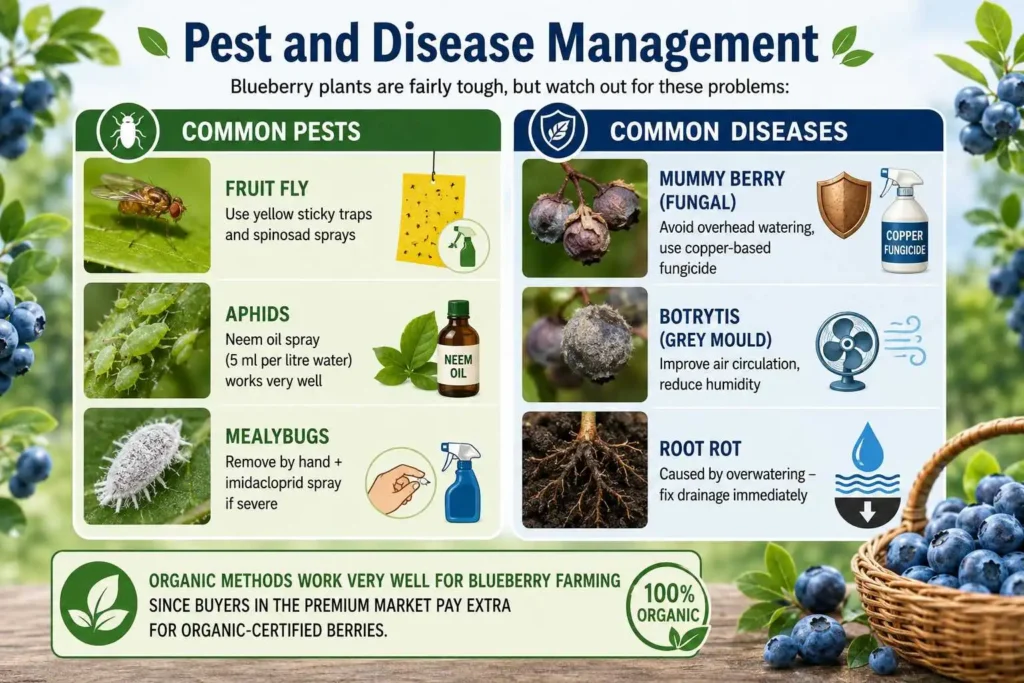
Blueberry plants are fairly tough, but watch out for these problems:
Common pests:
- Fruit fly: Use yellow sticky traps and spinosad sprays
- Aphids: Neem oil spray (5 ml per litre water) works very well
- Mealybugs: Remove by hand + imidacloprid spray if severe
Common diseases:
- Mummy berry (fungal): Avoid overhead watering, use copper-based fungicide
- Botrytis (grey mould): Improve air circulation, reduce humidity
- Root rot: Caused by overwatering — fix drainage immediately
Organic methods work very well for blueberry farming since buyers in the premium market pay extra for organic-certified berries.
Blueberry Farming: Investment and Profit Calculation
This is the part every farmer wants to see. Let us be honest about costs and income.
One-time Setup Cost for 1 Acre of Blueberry Farming:
| Item | Estimated Cost (₹) |
|---|---|
| Soil testing and preparation | 30,000 – 50,000 |
| Peat moss, pine bark, sulfur | 40,000 – 70,000 |
| Blueberry plants (800 plants × ₹150) | 1,00,000 – 1,50,000 |
| Drip irrigation system | 50,000 – 80,000 |
| Labour for planting | 15,000 – 25,000 |
| Trellising / support structure | 20,000 – 40,000 |
| Miscellaneous | 10,000 – 20,000 |
| Total One-Time Investment | ₹2,65,000 – ₹4,35,000 |
Annual Running Cost (after establishment):
| Item | Annual Cost (₹) |
|---|---|
| Fertilisers and soil amendments | 25,000 – 40,000 |
| Pesticide / organic sprays | 10,000 – 20,000 |
| Labour (pruning, harvesting, etc.) | 30,000 – 60,000 |
| Water / electricity for drip | 10,000 – 20,000 |
| Packaging and transport | 15,000 – 30,000 |
| Total Annual Cost | ₹90,000 – ₹1,70,000 |
Expected Income:
Blueberry plants take 2–3 years to give a good yield. From Year 4 onwards, expect full production.
| Year | Yield per Acre (kg) | Selling Price (₹/kg) | Gross Income (₹) |
|---|---|---|---|
| Year 1 | Nil (establishment) | — | — |
| Year 2 | 200 – 400 kg | 400 – 700 | 80,000 – 2,80,000 |
| Year 3 | 600 – 1,000 kg | 400 – 700 | 2,40,000 – 7,00,000 |
| Year 4+ (Full yield) | 1,500 – 2,500 kg | 400 – 700 | 6,00,000 – 17,50,000 |
Even at conservative numbers — 1,500 kg per acre at ₹400 per kg — you are looking at ₹6,00,000 gross income per acre. After running costs of ₹1,70,000, your net profit is ₹4,30,000+ per acre per year — and this continues for 15–20 years without replanting.
Where to Sell Your Blueberries?
This is the question farmers fear most. But the good news is: demand for Indian blueberries far outstrips supply.
Best selling channels:
- Local supermarkets and gourmet stores — Direct supply, ₹400–₹600 per kg
- Hotels and restaurants — 5-star hotels pay premium prices
- Online platforms — BigBasket, Amazon Fresh, and Blinkit are actively sourcing
- Processing units — For dried blueberries, jams, and juice extract
- Exporters — Once your volume is consistent, exporters will approach you
- Farmers’ markets — In big cities, organic farmers’ markets sell berries for ₹600–₹900 per kg
Tie up with a buyer BEFORE you plant. Even a simple letter of intent from a hotel or supermarket gives you security and often a better price.
Key Tips From Experienced Blueberry Farmers
Having spoken to successful blueberry farmers across Himachal Pradesh and Tamil Nadu, here are the lessons they wish they had known on Day 1:
Do not skip the soil preparation. Every rupee you spend fixing pH before planting saves you ten rupees later in failed plants and lost yield.
Start small, then expand. Begin with half an acre. Learn the crop, understand your local market, then expand in Year 3 or 4 when your income covers expansion costs.
Go organic from Day 1. Organic-certified blueberries sell for 30–50% more. The certification takes 3 years — and you are already waiting 3 years for full yield, so they happen together.
Build cold storage or partner with someone who has it. Fresh blueberries need cold chain (1–4°C) to extend shelf life to 2–3 weeks. Without it, you must sell within 3–4 days of harvest, which weakens your bargaining power.
Join a farmers’ cluster. Alone, 800 plants is small volume for big buyers. With 5–10 neighbouring farmers, your combined volume opens bigger doors.

Is Blueberry Farming Right for You?
Blueberry farming is not for someone who wants quick money. It demands patience for 2–3 years, careful attention to soil and nutrition, and smart market connections.
But for a farmer willing to invest time and modest capital, blueberry farming offers something rare in Indian agriculture — a high-value, long-term crop with 15–20 years of productive life, growing export demand, and almost no price crashes (unlike tomatoes or onions).
The Indian blueberry market is still very young. The farmers who enter now — get the soil right, build their connections, and learn the crop — are setting themselves up for years of premium income while the rest of the world catches on.
Final Word
Blueberry farming in India is not a dream — it is a real, proven, and profitable agricultural business for farmers in the right locations. The soil work is non-negotiable, the patience is required, but the reward — ₹4 to ₹12 lakh net profit per acre per year, for 15–20 years — is unlike almost anything else you can grow.
Start with your soil test today. That one small step is the beginning of something that can truly change your family’s future. you can choose the right crop with confidence. Whether you decide to grow oranges, onions, or another suitable crop, success starts with making informed decisions
Frequently Asked Questions About Blueberry Farming
Q: How many years does a blueberry plant live?
A well-maintained blueberry plant lives 20–50 years and gives productive yield for at least 15–20 years. It is a one-time plantation with decades of income.
Q: Can blueberries grow in the plains of Punjab or Haryana?
Unfortunately, no — standard varieties need cool weather and chilling hours. However, if you have a controlled environment (polyhouse with cooling), certain low-chill varieties can be tried.
Q: Do blueberries need pollination?
Yes — plant at least two different varieties side by side for cross-pollination. This significantly improves fruit set and yield.
Q: Is there any government subsidy for blueberry farming?
Under the National Horticulture Mission (NHM) and MIDH scheme, you can avail 50–65% subsidy on planting material, drip irrigation, and cold storage. Contact your district horticulture officer for details.
Q: What is the minimum land required?
You can start blueberry farming in as little as 10 cents (0.1 acre) in raised beds. But for commercial profitability, 0.5 to 1 acre is recommended.
Newsletter