


| Cost Head | Estimated Amount (INR) |
|---|---|
| Land (owned or leased) | ₹0 – ₹2,00,000 |
| Civil Construction / Shed | ₹2,00,000 – ₹5,00,000 |
| Equipment & Machinery | ₹5,40,000 – ₹13,10,000 |
| Licences & Registrations | ₹15,000 – ₹30,000 |
| Electricity & Water Connection | ₹30,000 – ₹80,000 |
| Initial Working Capital (raw material, packaging, labour) | ₹1,00,000 – ₹2,00,000 |
| Marketing & Branding (labels, website, samples) | ₹30,000 – ₹75,000 |
| Total Project Cost (Estimate) | ₹9,15,000 – ₹22,95,000 |
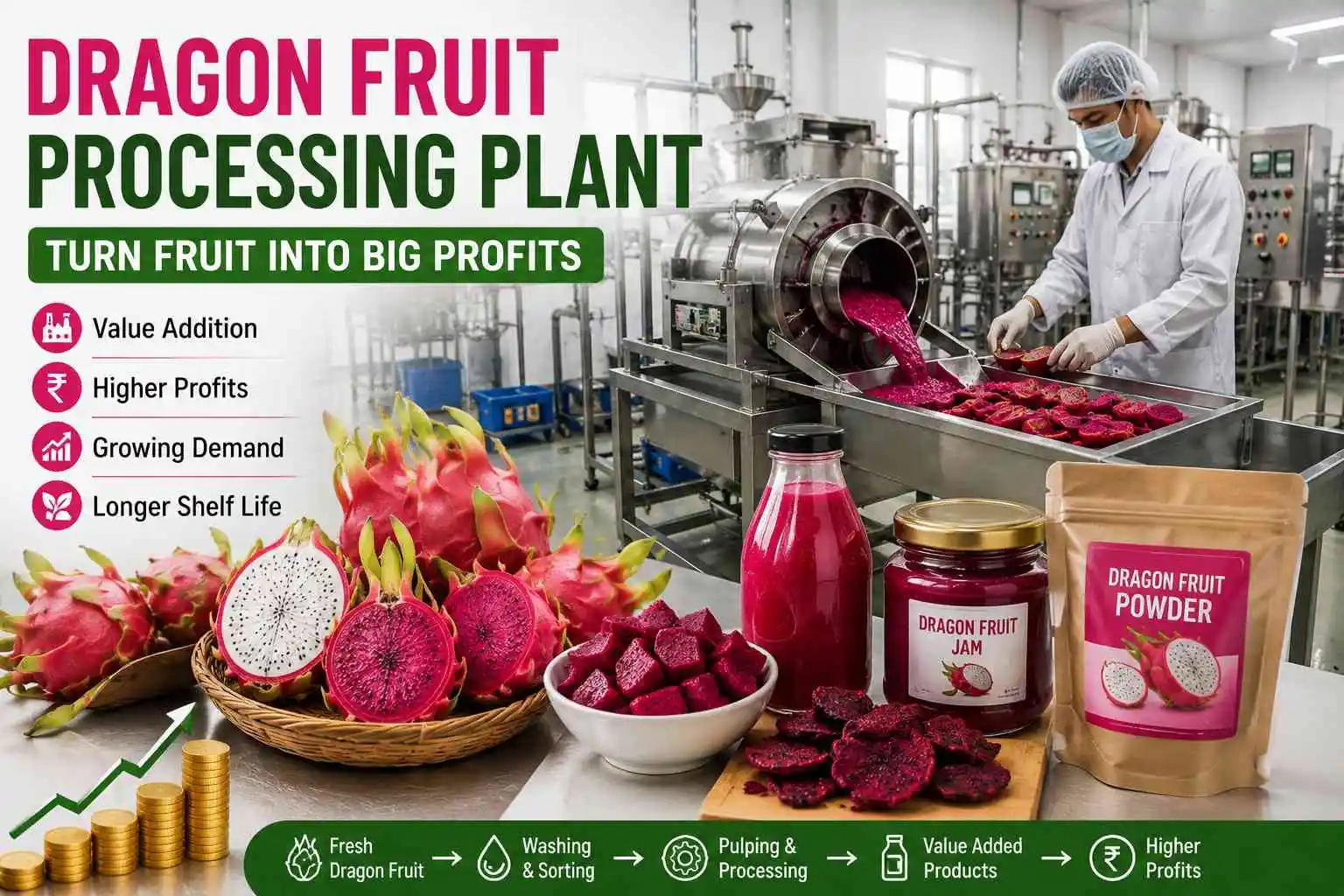
Dragon Fruit Processing Plant: Turn Fruit Into Big Profits
Introduction: Your Dragon Fruit Farm Can Do So Much More
You grow dragon fruit. You put in months of hard work. And then what happens? You sell it fresh at the mandi for ₹40–₹80 per kg. Good money — but is it the best you can do?
Not even close.
Farmers who have set up a dragon fruit processing plant are earning 3x to 5x more from the same fruit. They are making juices, dried slices, pulp, jams, face packs, and even wine — and selling it all at much higher prices.
India’s dragon fruit market is growing fast. The government is giving subsidies. Demand from urban consumers, hotels, and export markets is booming. And the good news? You do not need to be a big industrialist to start a dragon fruit processing unit. Many small and medium farmers have done it — and you can too.
This guide will walk you through everything. Step by step. No complicated words. Just what you need to know to get started.
Why Dragon Fruit Processing Is a Golden Opportunity Right Now
Dragon fruit — also called pitaya or Kamalam in India — is no longer just an exotic item for rich people. It is going mainstream.
Here are some facts that should get you excited:
- India produced over 1.5 lakh metric tonnes of dragon fruit in 2023–24, mostly from Gujarat, Karnataka, Andhra Pradesh, Maharashtra, and Tamil Nadu.
- Fresh dragon fruit has a shelf life of only 10–15 days. After that, it spoils and the farmer loses money.
- Processed products like pulp, juice, and dried dragon fruit have a shelf life of 6–24 months.
- Export demand for processed dragon fruit is growing at 18–22% per year globally.
- A fresh dragon fruit sells for ₹60/kg at the farm gate. Processed dragon fruit pulp sells for ₹200–₹350/kg in B2B markets.
That gap between ₹60 and ₹350 — that is your opportunity. A dragon fruit processing plant fills that gap.
What Exactly Is a Dragon Fruit Processing Plant?
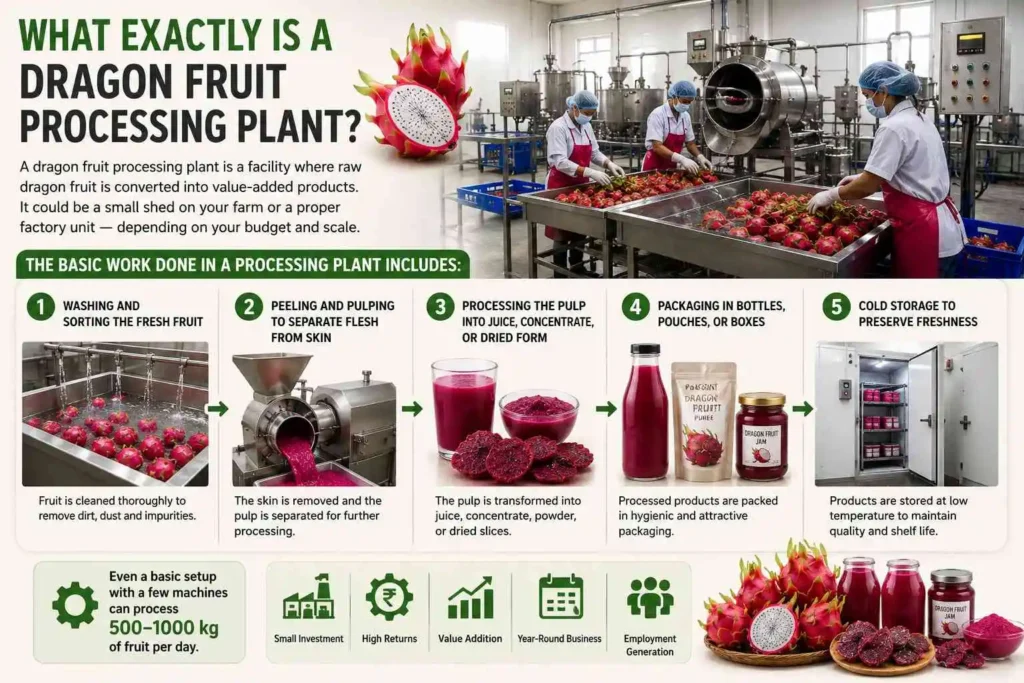
A dragon fruit processing plant is a facility where raw dragon fruit is converted into value-added products. It could be a small shed on your farm or a proper factory unit — depending on your budget and scale.
The basic work done in a processing plant includes:
- Washing and sorting the fresh fruit
- Peeling and pulping to separate flesh from skin
- Processing the pulp into juice, concentrate, or dried form
- Packaging in bottles, pouches, or boxes
- Cold storage to preserve freshness
Even a basic setup with a few machines can process 500–1000 kg of fruit per day. That is enough to run a profitable small business.
Products You Can Make in a Dragon Fruit Processing Plant
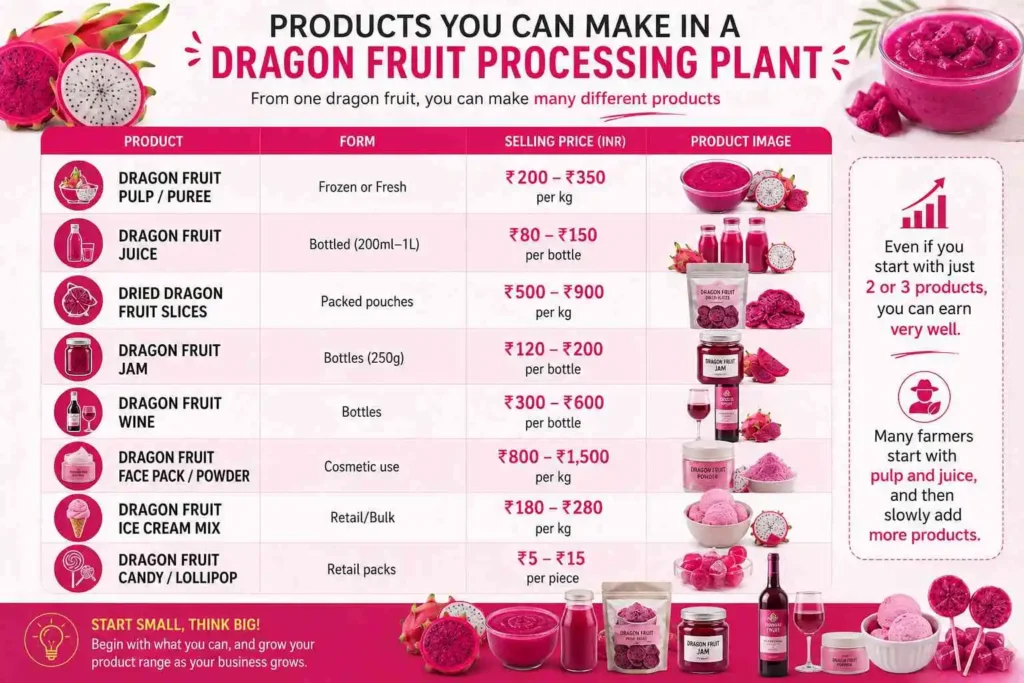
This is the most exciting part. From one dragon fruit, you can make many different products:
| Product | Form | Selling Price (INR/kg or unit) |
|---|---|---|
| Dragon Fruit Pulp / Puree | Frozen or Fresh | ₹200 – ₹350 per kg |
| Dragon Fruit Juice | Bottled (200ml–1L) | ₹80 – ₹150 per bottle |
| Dried Dragon Fruit Slices | Packed pouches | ₹500 – ₹900 per kg |
| Dragon Fruit Jam | Bottles (250g) | ₹120 – ₹200 per bottle |
| Dragon Fruit Wine | Bottles | ₹300 – ₹600 per bottle |
| Dragon Fruit Face Pack / Powder | Cosmetic use | ₹800 – ₹1,500 per kg |
| Dragon Fruit Ice Cream Mix | Retail/Bulk | ₹180 – ₹280 per kg |
| Dragon Fruit Candy / Lollipop | Retail packs | ₹5 – ₹15 per piece |
Even if you start with just 2 or 3 products, you can earn very well. Many farmers start with pulp and juice, and then slowly add more products.
How to Set Up a Dragon Fruit Processing Plant: Step-by-Step
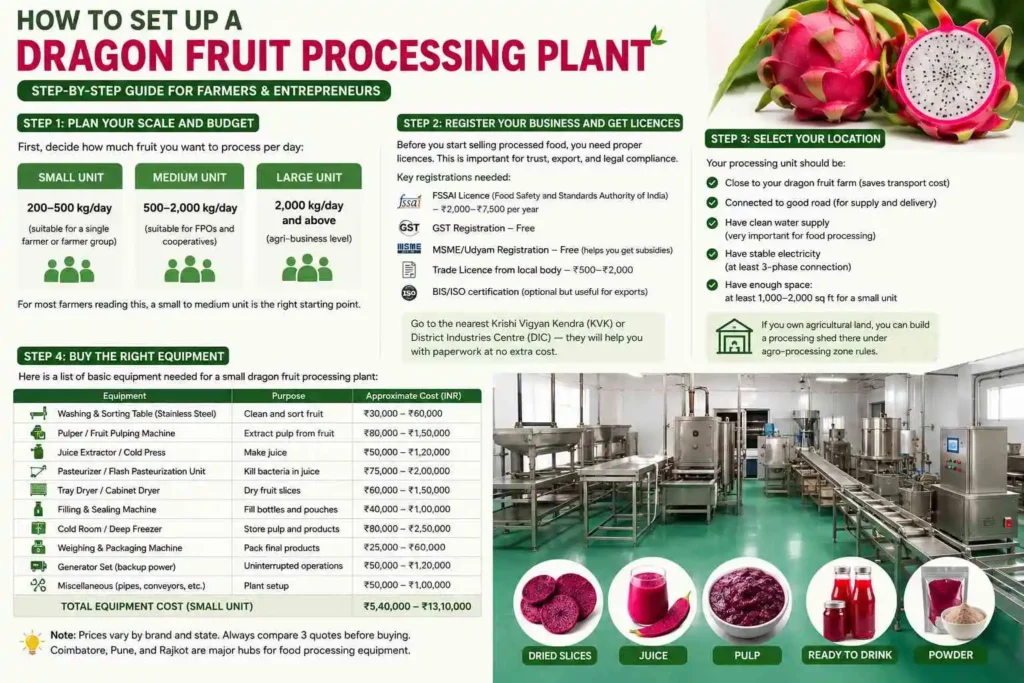
Step 1: Plan Your Scale and Budget
First, decide how much fruit you want to process per day:
- Small unit: 200–500 kg/day (suitable for a single farmer or farmer group)
- Medium unit: 500–2,000 kg/day (suitable for FPOs and cooperatives)
- Large unit: 2,000 kg/day and above (agri-business level)
For most farmers reading this, a small to medium unit is the right starting point.
Step 2: Register Your Business and Get Licences
Before you start selling processed food, you need proper licences. This is important for trust, export, and legal compliance.
Key registrations needed:
- FSSAI Licence (Food Safety and Standards Authority of India) — ₹2,000–₹7,500 per year
- GST Registration — Free
- MSME/Udyam Registration — Free (helps you get subsidies)
- Trade Licence from local body — ₹500–₹2,000
- BIS/ISO certification (optional but useful for exports)
Go to the nearest Krishi Vigyan Kendra (KVK) or District Industries Centre (DIC) — they will help you with paperwork at no extra cost.
Step 3: Select Your Location
Your processing unit should be:
- Close to your dragon fruit farm (saves transport cost)
- Connected to good road (for supply and delivery)
- Have clean water supply (very important for food processing)
- Have stable electricity (at least 3-phase connection)
- Have enough space: at least 1,000–2,000 sq ft for a small unit
If you own agricultural land, you can build a processing shed there under agro-processing zone rules.
Step 4: Buy the Right Equipment
Here is a list of basic equipment needed for a small dragon fruit processing plant:
| Equipment | Purpose | Approximate Cost (INR) |
|---|---|---|
| Washing & Sorting Table (Stainless Steel) | Clean and sort fruit | ₹30,000 – ₹60,000 |
| Pulper / Fruit Pulping Machine | Extract pulp from fruit | ₹80,000 – ₹1,50,000 |
| Juice Extractor / Cold Press | Make juice | ₹50,000 – ₹1,20,000 |
| Pasteurizer / Flash Pasteurization Unit | Kill bacteria in juice | ₹75,000 – ₹2,00,000 |
| Tray Dryer / Cabinet Dryer | Dry fruit slices | ₹60,000 – ₹1,50,000 |
| Filling & Sealing Machine | Fill bottles and pouches | ₹40,000 – ₹1,00,000 |
| Cold Room / Deep Freezer | Store pulp and products | ₹80,000 – ₹2,50,000 |
| Weighing & Packaging Machine | Pack final products | ₹25,000 – ₹60,000 |
| Generator Set (backup power) | Uninterrupted operations | ₹50,000 – ₹1,20,000 |
| Miscellaneous (pipes, conveyors, etc.) | Plant setup | ₹50,000 – ₹1,00,000 |
| Total Equipment Cost (Small Unit) | ₹5,40,000 – ₹13,10,000 |
Note: Prices vary by brand and state. Always compare 3 quotes before buying. Coimbatore, Pune, and Rajkot are major hubs for food processing equipment.
Total Cost to Set Up a Dragon Fruit Processing Plant (Small Scale)
A small dragon fruit processing plant can be set up in ₹10–₹20 lakhs for most farmers. And with government subsidies, your actual pocket expense can be much less.
Government Subsidies You Must Know About
The Indian government is actively supporting food processing units. Here is what is available:
1. PMFME Scheme (PM Formalisation of Micro Food Enterprises)
- Credit-Linked Subsidy: 35% of project cost (up to ₹10 lakh per unit)
- Targeted at individual farmers, SHGs, and FPOs
- Apply at: pmfme.mofpi.gov.in
2. MIDH (Mission for Integrated Development of Horticulture)
- Subsidy for cold storage, post-harvest units, and packaging
- Up to 50% subsidy for general category, 75% for hilly/tribal areas
3. NHB (National Horticulture Board) Schemes
- Capital subsidy for commercial horticulture processing
- Up to 20–40% of the total project cost
4. State-Level Schemes
- Gujarat, Karnataka, and Andhra Pradesh have special dragon fruit and exotic fruit promotion schemes
- Check with your District Horticulture Officer
Tip: Combine PMFME + MIDH subsidies. Many smart farmers have covered 50–60% of their total project cost through government support.
How Much Money Can You Actually Earn?
Let us do a simple calculation for a small plant processing 500 kg of dragon fruit per day:
Revenue Estimate (Monthly — 25 working days)
| Product (from 500 kg/day) | Quantity per Month | Sale Price | Monthly Revenue |
|---|---|---|---|
| Dragon Fruit Pulp (60% yield) | 7,500 kg | ₹250/kg | ₹18,75,000 |
| Dragon Fruit Juice (20% yield) | 2,500 kg | ₹100/kg (bulk) | ₹2,50,000 |
| Dried Slices (5% yield) | 625 kg | ₹700/kg | ₹4,37,500 |
| Total Monthly Revenue | ₹25,62,500 |
Cost Estimate (Monthly)
| Cost Head | Monthly Amount (INR) |
|---|---|
| Raw Dragon Fruit (500 kg/day × 25 days × ₹60/kg) | ₹7,50,000 |
| Labour (5–6 workers) | ₹60,000 – ₹90,000 |
| Electricity & Water | ₹40,000 – ₹60,000 |
| Packaging Materials | ₹80,000 – ₹1,20,000 |
| Transport & Logistics | ₹40,000 – ₹60,000 |
| Miscellaneous | ₹30,000 |
| Total Monthly Cost | ₹10,00,000 – ₹11,10,000 |
Monthly Profit: ₹14,52,500 – ₹15,62,500 (approx.)
This is a realistic figure based on actual market rates. Your earnings will depend on product mix, market access, and efficiency. But even at 50% efficiency, you are looking at a strong business.
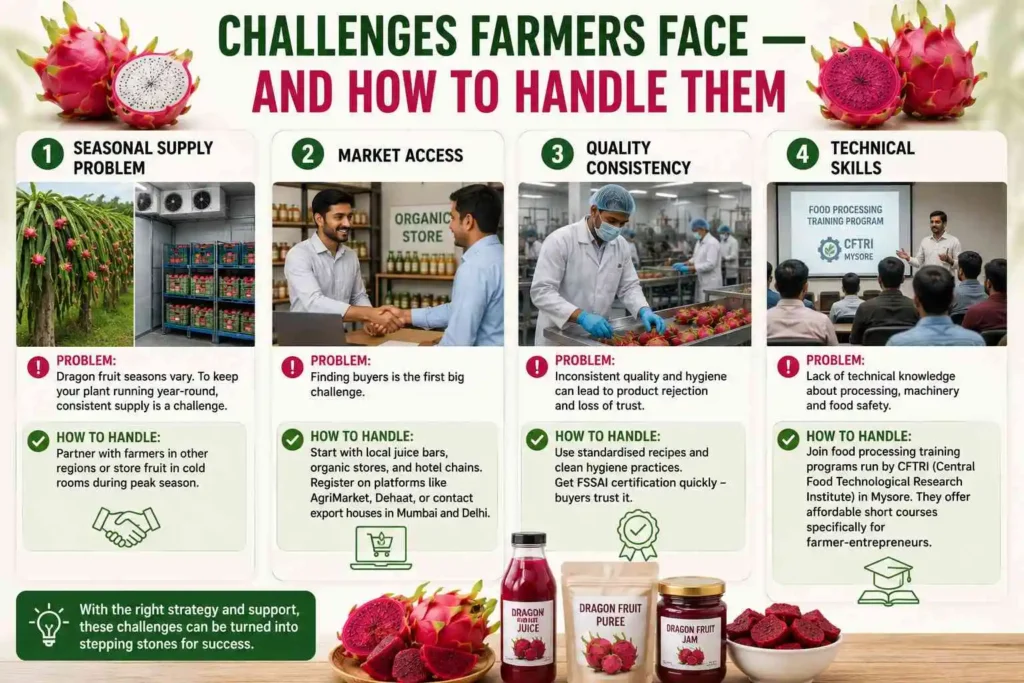
Challenges Farmers Face — And How to Handle Them
1. Seasonal Supply Problem Dragon fruit seasons vary. To keep your plant running year-round, partner with farmers in other regions or store fruit in cold rooms during peak season.
2. Market Access Finding buyers is the first big challenge. Start with local juice bars, organic stores, and hotel chains. Register on platforms like AgriMarket, Dehaat, or contact export houses in Mumbai and Delhi.
3. Quality Consistency Use standardised recipes and clean hygiene practices. Get FSSAI certification quickly — buyers trust it.
4. Technical Skills Join food processing training programs run by CFTRI (Central Food Technological Research Institute) in Mysore. They offer affordable short courses specifically for farmer-entrepreneurs.
Expert Tips From the Ground
- Start with pulp. It is the easiest to make, has the highest demand, and requires the least equipment.
- Tie up with an FPO (Farmer Producer Organisation) if you cannot raise capital alone.
- Brand your product properly. A good label and name can double your selling price.
- Target B2B first — restaurants, bakeries, and ice cream companies are much easier to sell to than retail.
- Never skip FSSAI. Without it, no serious buyer will touch your product.
Conclusion: The Time to Act Is Now
Setting up a dragon fruit processing plant is one of the smartest moves a dragon fruit farmer can make today. You grow the fruit. You do the hard work. Why let a middleman take the biggest profit?
With the Indian government supporting agro-processing like never before, with demand from cities and exports growing every year, and with technology becoming more affordable — the barriers are falling fast.
Start small. Learn. Grow. Your dragon fruit farm does not have to stop at the mandi gate.
The next step is yours. Start small, learn the process, and gradually scale your business. But remember—a successful processing plant begins with a well-managed dragon fruit farm, be sure to check out our Complete Dragon Fruit Farming Guide to learn everything from land preparation and planting to irrigation, fertilization, pest management, and harvesting.
Frequently Asked Questions (FAQs)
Q: Can a small farmer with just 2 acres of dragon fruit set up a processing unit?
Yes, absolutely. A micro-unit processing 100–200 kg/day can be set up for as low as ₹3–₹5 lakhs with government help.
Q: Is there demand for processed dragon fruit in India?
Yes, and it is growing rapidly. Urban health-conscious consumers, export markets (Middle East, Southeast Asia, EU), and the food industry are all buying processed dragon fruit.
Q: How long does it take to recover the investment?
For a small unit run efficiently, payback period is typically 2–3 years.
Q: Do I need to hire a food technologist?
For a small unit, no. Basic training from KVK or CFTRI is enough. For a medium or large plant, hiring a food technologist is recommended.
Newsletter