
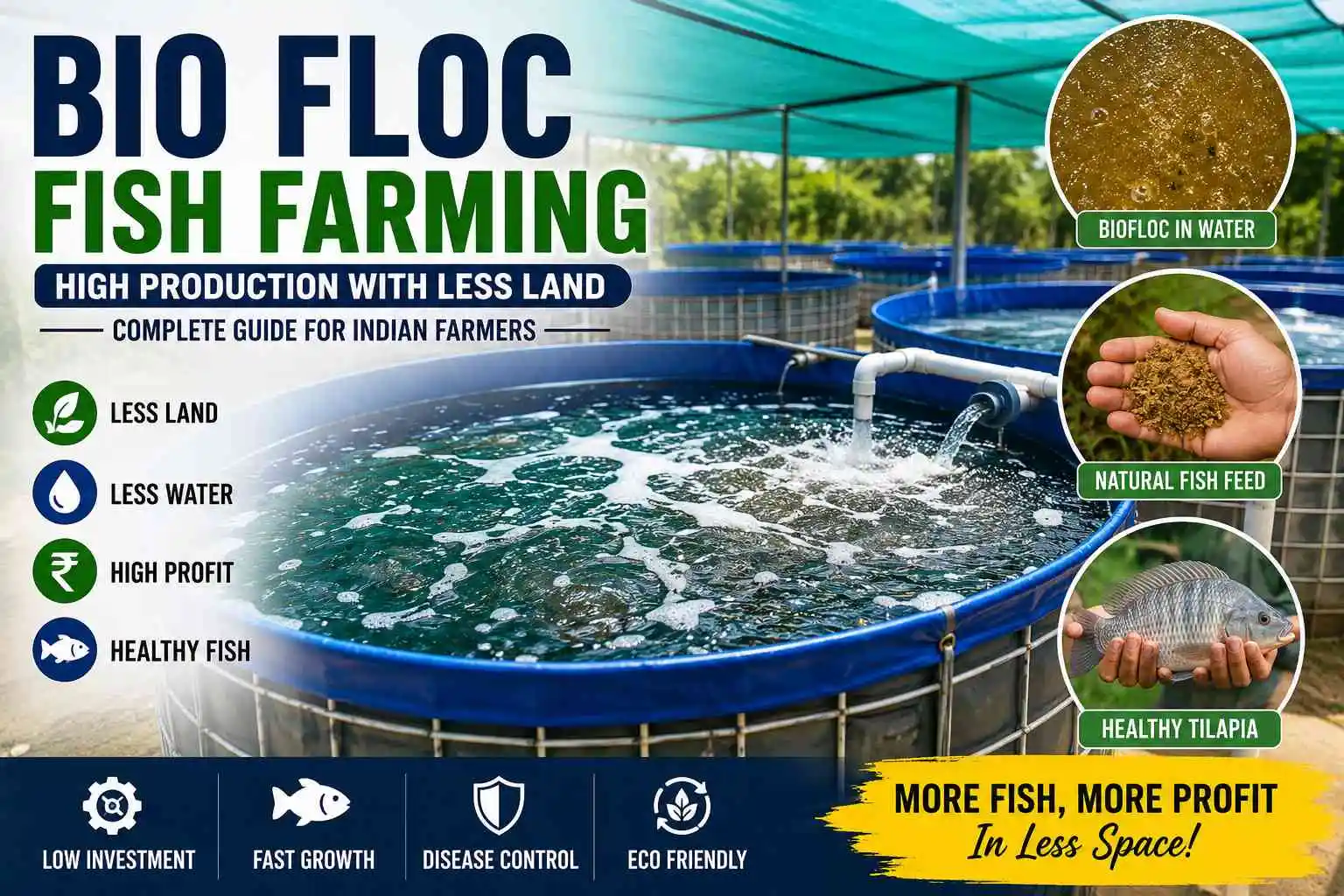

Bio Floc Fish Farming in India: High Production with Less Land
If you have a small piece of land—even just 500 square feet—and are tired of depending on unpredictable crop income, bio floc(bioflock) fish farming could be the opportunity you’ve been looking for. It requires very little land, uses less water than traditional fish farming, and can produce a surprisingly high quantity of fish in a small space.
In this guide, you’ll learn everything you need to know about bio floc fish farming in India—from setup costs and tank requirements to feeding, management, profits, and common mistakes to avoid. No jargon. No complicated science. Just practical, step-by-step information to help you start, grow, and earn.
Let’s begin.
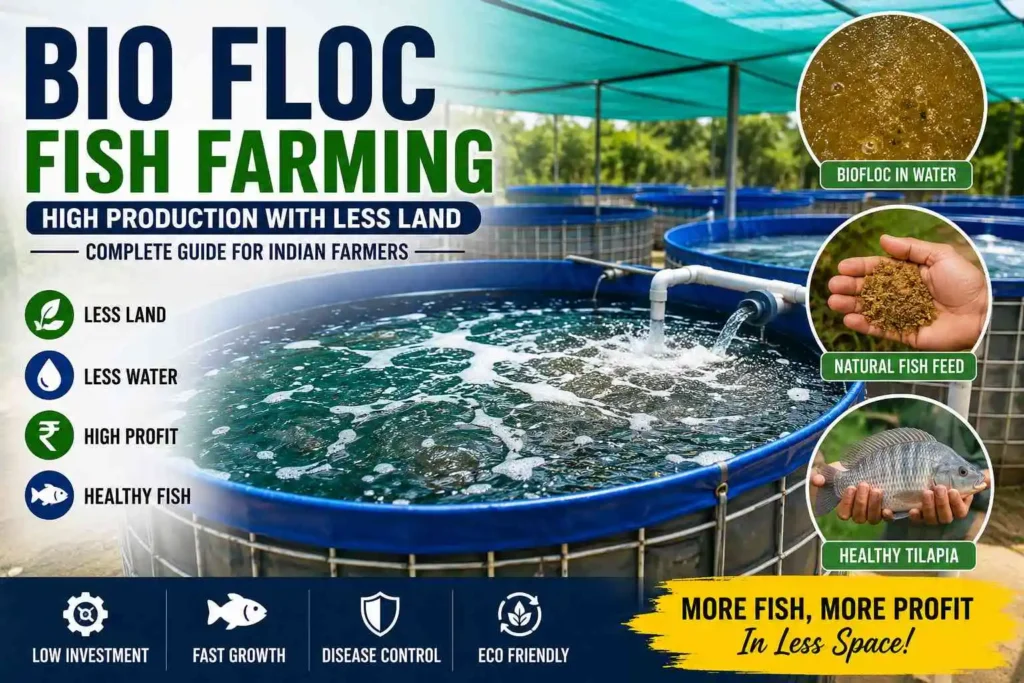
What Is Bio Flock Fish Farming?
Bio flock fish farming is a modern method of growing fish in tanks — not ponds, not rivers — with the help of good bacteria called microbes.
Here’s how it works in simple words:
- Fish eat food → they produce waste (which is poisonous ammonia)
- You add special bacteria to the tank → these bacteria eat the ammonia
- The bacteria form tiny clusters called “flocs” — full of protein (25–40%)
- Fish eat these flocs as extra food!
So the fish clean their own water and get extra nutrition. You use less water, less feed, less land — and grow more fish in less space in bio flock technology.
Think of it like a self-cleaning fish tank that also feeds itself. That’s the beauty of bio flock.
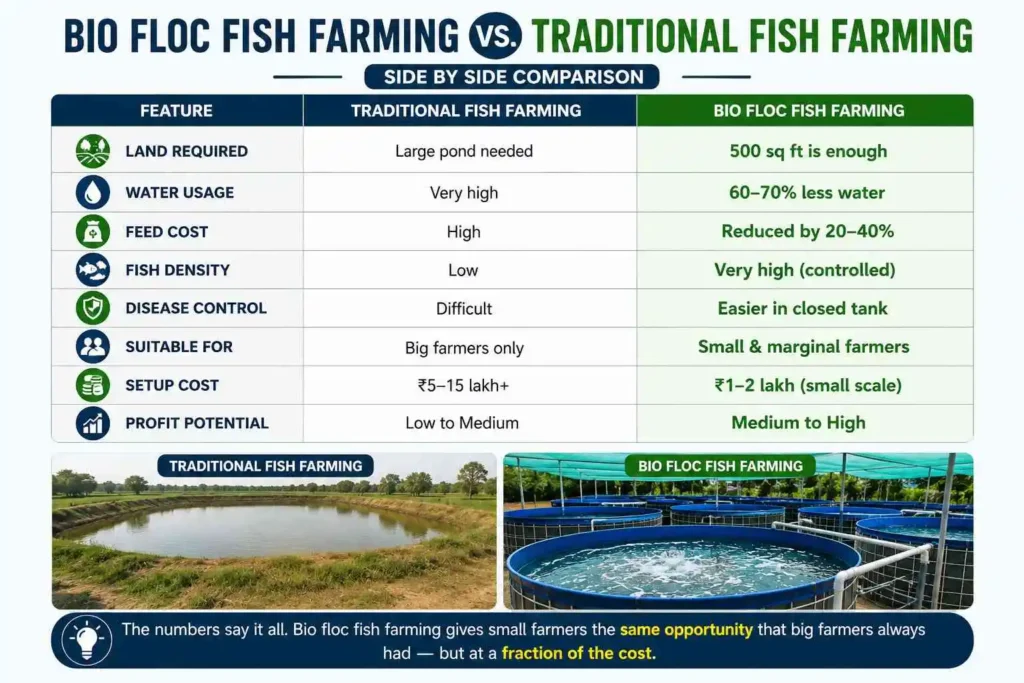
Bio Flock Fish Farming vs. Traditional Fish Farming: Side by Side
| Feature | Traditional Fish Farming | Bio Flock Fish Farming |
|---|---|---|
| Land Required | Large pond needed | 500 sq ft is enough |
| Water Usage | Very high | 60–70% less water |
| Feed Cost | High | Reduced by 20–40% |
| Fish Density | Low | Very high (controlled) |
| Disease Control | Difficult | Easier in closed tank |
| Suitable For | Big farmers only | Small & marginal farmers |
| Setup Cost | ₹5–15 lakh+ | ₹1–2 lakh (small scale) |
| Profit Potential | Low to Medium | Medium to High |
The numbers say it all. Bio flock fish farming gives small farmers the same opportunity that big farmers always had — but at a fraction of the cost.
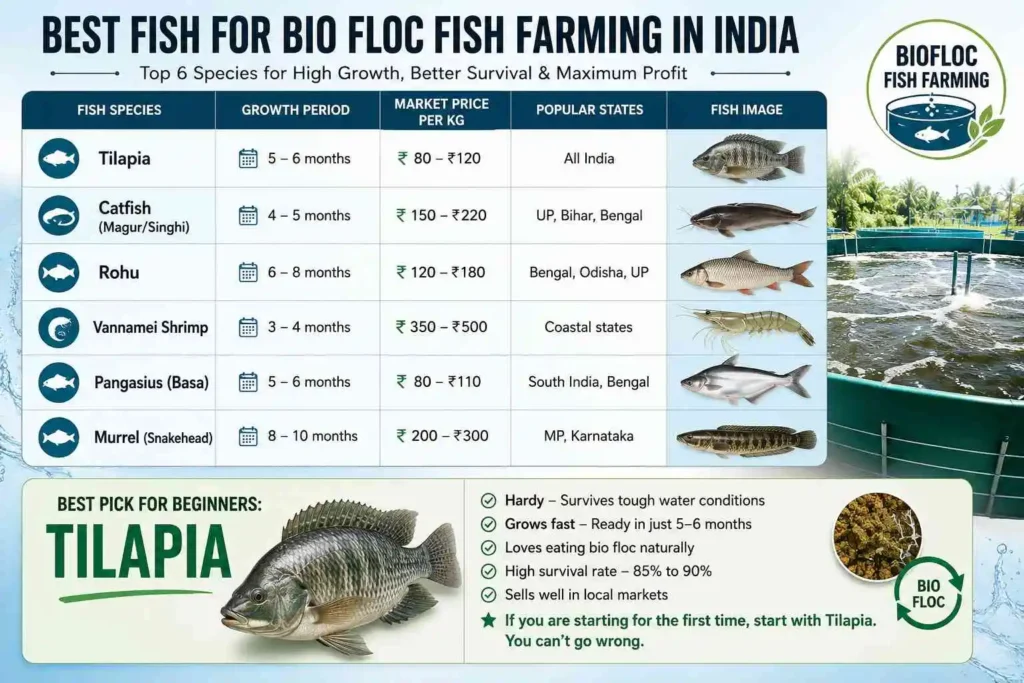
Best Fish for Bio Floc Fish Farming in India (Top 6 Species)
Not every fish suits bio flock conditions. Here are the best fish for Indian conditions:
| Fish Species | Growth Period | Market Price Per Kg | Popular States |
|---|---|---|---|
| Tilapia | 5–6 months | ₹80 – ₹120 | All India |
| Catfish (Magur/Singhi) | 4–5 months | ₹150 – ₹220 | UP, Bihar, Bengal |
| Rohu | 6–8 months | ₹120 – ₹180 | Bengal, Odisha, UP |
| Vannamei Shrimp | 3–4 months | ₹350 – ₹500 | Coastal states |
| Pangasius (Basa) | 5–6 months | ₹80 – ₹110 | South India, Bengal |
| Murrel (Snakehead) | 8–10 months | ₹200 – ₹300 | MP, Karnataka |
Best Pick for Beginners: Tilapia.
Tilapia is Hardy. It survives tough water conditions. It grows fast, loves eating bio floc naturally, gives good survival rate (85–90%), and sells well in local markets. If you are starting for the first time, start with Tilapia. You can’t go wrong.
Bio Floc Fish Farming Setup Cost in India (2026 Complete Breakdown)
Let’s talk money — the most important part for every farmer.
Below is the complete cost breakdown for a small-scale setup with 2 tanks (10,000 litres each) — a perfect starter unit.
One-Time Setup Cost (You Pay This Only Once)
| Item | Estimated Cost (₹) |
|---|---|
| 2 HDPE / Tarpaulin Tanks (10,000 L each) | ₹25,000 – ₹35,000 |
| Aerators / Blowers (for oxygen) | ₹8,000 – ₹12,000 |
| Plumbing, Pipes & Fittings | ₹5,000 – ₹8,000 |
| Water Pump | ₹4,000 – ₹6,000 |
| Shade Net / Greenhouse Cover | ₹5,000 – ₹10,000 |
| Water Testing Kit (pH, Ammonia, DO) | ₹2,000 – ₹3,000 |
| Miscellaneous Materials | ₹3,000 – ₹5,000 |
| Total Setup Cost | ₹52,000 – ₹79,000 |
Recurring Cost Per Batch (Every 5–6 Months)
| Item | Cost Per Batch (₹) |
|---|---|
| Fish Fingerlings (2,000 pieces @ ₹5 each) | ₹10,000 |
| Fish Feed (quality pellets, 5–6 months) | ₹25,000 – ₹35,000 |
| Bio Flock Starter Culture + Probiotics | ₹3,000 – ₹5,000 |
| Molasses / Carbon Source | ₹2,000 – ₹3,000 |
| Electricity (Blowers 24×7) | ₹4,000 – ₹6,000 |
| Labour (if hiring outside help) | ₹10,000 – ₹15,000 |
| Medicines & Emergency Supplies | ₹2,000 – ₹3,000 |
| Total Per Batch Cost | ₹56,000 – ₹77,000 |
Total First Investment (Setup + First Batch): ₹1,08,000 – ₹1,56,000
This is the all-in cost to get started. Most farmers recover this investment within 1–2 harvests.
Bio Flock Fish Farming Income: How Much Can You Really Earn?
Here is a realistic earning example with 2 tanks of 10,000 litres and Tilapia fish:
Per Batch Income Calculation
| Parameter | Value |
|---|---|
| Total Fish Stocked | 2,000 fingerlings |
| Survival Rate | 85% = ~1,700 fish |
| Average Weight at Harvest | 500 grams per fish |
| Total Fish Produced | 850 kg |
| Market Rate (Tilapia) | ₹100 per kg |
| Gross Income (One Batch) | ₹85,000 |
| Total Batch Running Cost | ₹65,000 (average) |
| Net Profit (One Batch) | ₹20,000 – ₹30,000 |
Annual Income (Running 2 Batches Per Year)
| Factor | Per Batch | Per Year (2 Batches) |
|---|---|---|
| Gross Income | ₹85,000 | ₹1,70,000 |
| Running Cost | ₹65,000 | ₹1,30,000 |
| Net Profit | ₹20,000 | ₹40,000 |
This is from just 2 small tanks. Farmers who scale up to 6–10 tanks easily earn ₹2.5 to ₹6 lakh per year from bio flock fish farming.
Step-by-Step: How to Start Bio Flock Fish Farming at Home
Follow these 7 steps and you will be on the right path from Day 1.
Step 1: Tank Preparation for Bio Flock
Fill the tank with clean water. If you use tap water, let it sit for 24 hours to remove chlorine (or add sodium thiosulfate). Chlorine kills your good bacteria — so this step is important.
Step 2: Build the Bio Flock Culture (7–10 Days Before Fish)
Add bio flock bacterial starter culture to the tank. Also add a carbon source — molasses or jaggery (1 litre per 1,000 litres of water). Turn on the aerators. Let the system run for 7–10 days. The water will turn light brown or greenish — this means floc is forming. This is good!
Step 3: Test Water Before Adding Fish
Never add fish to untested water. Check these levels:
| Parameter | Safe Range |
|---|---|
| pH | 7.0 – 8.5 |
| Ammonia (NH₃) | Less than 0.5 mg/L |
| Dissolved Oxygen (DO) | More than 5 mg/L |
| Temperature | 25°C – 32°C |
| Settleable Solids (Floc Volume) | 15 – 50 ml/L |
If all is good, you’re ready for fish.
Step 4: Add Fish Fingerlings Carefully
Buy healthy fingerlings (2–3 inch size) from a trusted hatchery. Float the bag in tank water for 20 minutes before releasing the fish. This prevents temperature shock. Then slowly let them into the tank.
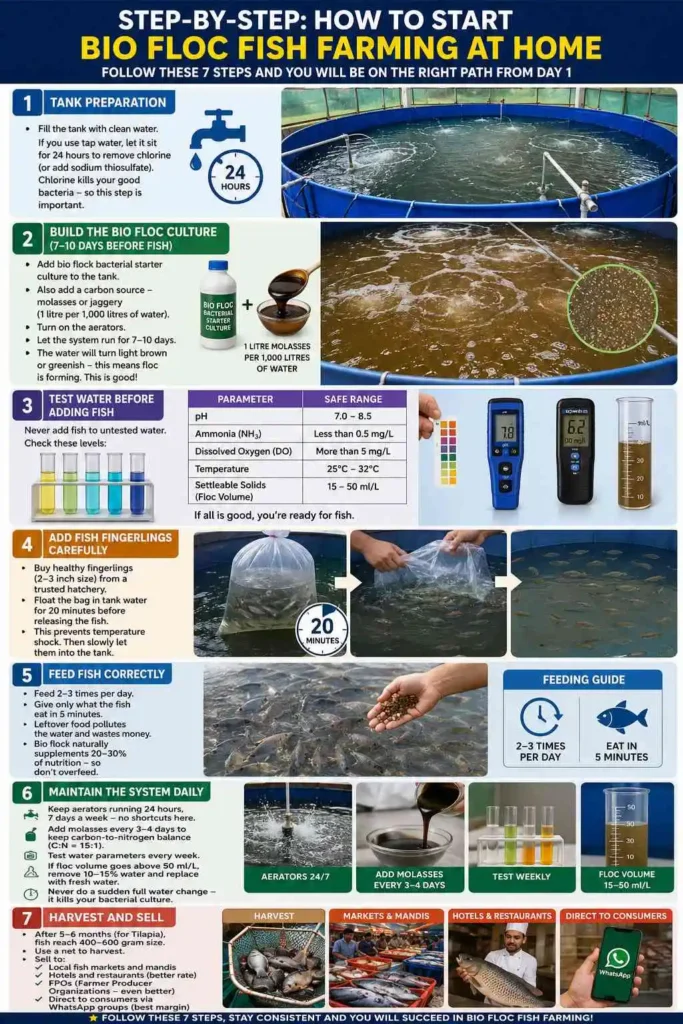
Step 5: Feed Fish Correctly
Feed 2–3 times per day. Give only what the fish eat in 5 minutes. Leftover food pollutes the water and wastes money. Bio flock naturally supplements 20–30% of nutrition — so don’t overfeed.
Step 6: Maintain the System Daily
- Keep aerators running 24 hours, 7 days a week — no shortcuts here
- Add molasses every 3–4 days to keep carbon-to-nitrogen balance (C:N = 15:1)
- Test water parameters every week
- If floc volume goes above 50 ml/L, remove 10–15% water and replace with fresh water
- Never do a sudden full water change — it kills your bacterial culture
Step 7: Harvest and Sell
After 5–6 months (for Tilapia), fish reach 400–600 gram size. Use a net to harvest. Sell to:
- Local fish markets and mandis
- Hotels and restaurants (better rate)
- FPOs (Farmer Producer Organizations — even better)
- Direct to consumers via WhatsApp groups (best margin)
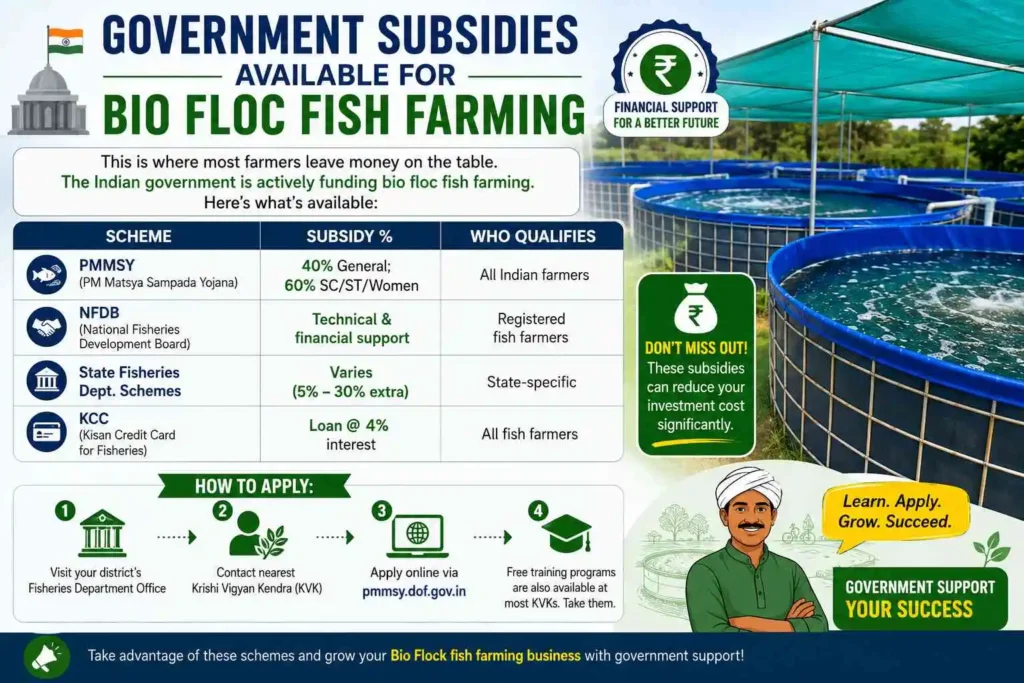
Government Subsidies Available for Bio Flock Fish Farming
This is where most farmers leave money on the table. The Indian government is actively funding bio flock fish farming. Here’s what’s available:
| Scheme | Subsidy % | Who Qualifies |
|---|---|---|
| PMMSY (PM Matsya Sampada Yojana) | 40% General; 60% SC/ST/Women | All Indian farmers |
| NFDB (National Fisheries Development Board) | Technical & financial support | Registered fish farmers |
| State Fisheries Dept. Schemes | Varies (5% – 30% extra) | State-specific |
| KCC (Kisan Credit Card for Fisheries) | Loan @ 4% interest | All fish farmers |
How to Apply:
- Visit your district’s Fisheries Department Office
- Contact nearest Krishi Vigyan Kendra (KVK)
- Apply online via pmmsy.dof.gov.in
Free training programs are also available at most KVKs. Take them. They save you from costly mistakes.
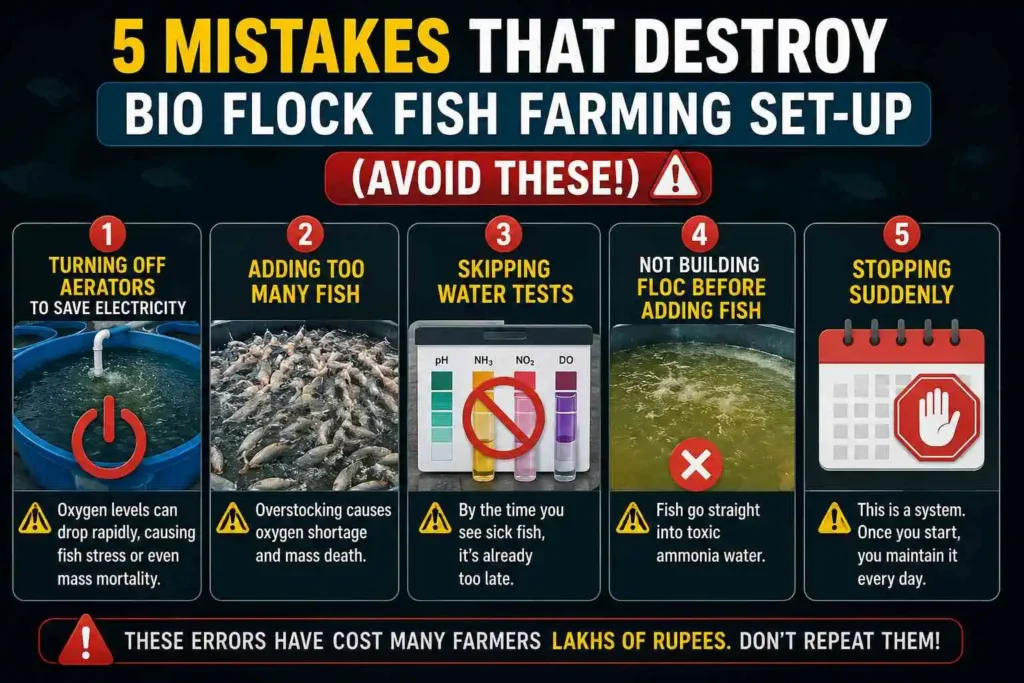
5 Mistakes That Destroy Bio Flock Fish Farming Set-up (Avoid These!)
These errors have cost many farmers lakhs of rupees. Don’t repeat them:
- Turning off aerators to save electricity — oxygen levels can drop rapidly, causing fish stress or even mass mortality.
- Adding too many fish — Overstocking causes oxygen shortage and mass death.
- Skipping water tests — By the time you see sick fish, it’s already too late.
- Not building floc before adding fish — Fish go straight into toxic ammonia water.
- Stopping suddenly — This is a system. Once you start, you maintain it every day.
Final Words: Is Bio Flock Fish Farming the Right Choice for You?
If you are reading this, you are already one step ahead of most farmers.
Bio flock fish farming is not magic. It is science, made simple. It requires consistent effort, basic water management, and a willingness to learn. But once the system is running, it gives you steady income every 5–6 months — rain or no rain, market up or down.
Here’s what makes it truly special for Indian farmers:
✅ Low investment — start with ₹1.5 lakh ✅ No large land needed — 500 sq ft is enough ✅ Government support available — up to 60% subsidy ✅ Works alongside crop farming ✅ Growing fish demand in India — market is ready
Start with 1–2 tanks. Master the process. Then expand.
The fish don’t care how much money you have in the bank. They just need good water, proper feeding, and a farmer who shows up every day. Be that farmer.
The water is ready. The market is waiting. Your next income stream starts today.
If you have enough land and are interested in aquaculture, don’t forget to check out our other blogs on carp culture , shrimp farming and RAS system aquaculture for more useful information and practical tips.
Frequently Asked Questions About Bio Flock Fish Farming
Q1. Is bio flock fish farming profitable in India?
Yes. Even a small 2-tank setup can give ₹40,000 net profit per year. Larger setups of 6–10 tanks generate ₹2–6 lakh annually.
Q2. How much land do I need to start?
As little as 500 to 1,000 square feet. A backyard, rooftop, or empty plot near your house works fine.
Q3. Which fish is best for bio flock beginners?
Tilapia. It’s tough, fast-growing, floc-friendly, and has good market demand all across India.
Q4. Can I get a government loan for bio flock fish farming?
Yes. Under PMMSY, bank loans are available with 40–60% subsidy. Apply through your district fisheries office or KVK.
Q5. Do I need training before starting?
Strongly recommended. Mistakes in bio flock are costly. Free training is available at KVKs and state fisheries departments.
Q6. How often should I test water quality?
Weekly minimum. Daily during the first 2 weeks and whenever fish seem stressed or inactive.
Q7. Can I do bio flock fish farming along with regular farming?
Absolutely. Most farmers run it as a secondary income. It takes 1–2 hours per day once the system is set up.
Newsletter