



Onion Farming Per Acre Yield — Can You Really Earn ₹1 Lakh Per Acre?
Onion farming is one of the most commercially significant vegetable crops in India — yet most guides online either give you vague averages or optimistic numbers that don’t survive contact with real conditions.
This guide is different. We’ve broken down per acre yield by season, variety, and input level — with cost and profit figures rooted in current mandi data and ICAR-published benchmarks, not guesswork. Whether you’re a first-time farmer planning your acreage or a seasoned grower trying to benchmark against your own numbers, this is the resource you’ve been looking for.

What Does “Per Acre Yield” Actually Mean in Onion Farming?
When agronomists say the national average onion yield is around 120 quintals per acre, they mean exactly that — a national average. Half of India’s farmers are doing better. Half are doing worse.
The ICAR-Directorate of Onion and Garlic Research (DOGR), Pune, estimates India’s average onion productivity at approximately 10–12 tonnes per acre under normal field conditions. But that number hides enormous variation driven by five factors:
- Agro-climatic zone — Nashik, Pune, Rajasthan, Madhya Pradesh, and Karnataka behave very differently
- Season — Rabi, Kharif, and Late Kharif each have distinct yield ceilings
- Variety — A well-chosen variety in the right season can yield 40% more than a mismatched one
- Input quality — Seeds, fertilizers, and irrigation together account for 30–40% of output variation
- Crop management — Transplanting depth, earthing up, and harvest timing all shift the needle
Use the national average as your baseline. Your goal is to beat it — and this guide shows you exactly how.
Onion Farming Seasons and Their Per Acre Yield
dia follows three primary onion-growing seasons. Each has its own yield ceiling, price behavior, and risk profile.
| Season | Sowing Period | Harvesting | Expected Yield (Per Acre) | Price Stability |
|---|---|---|---|---|
| Kharif (Rainy) | June – July | October – November | 60 – 80 quintals | Volatile (glut risk) |
| Late Kharif | August – September | January – February | 80 – 100 quintals | Moderate |
| Rabi (Winter) | October – November | March – May | 100 – 200 quintals | Best (longer storage) |
Why Rabi dominates: Rabi onions have two structural advantages. First, cooler temperatures during bulb development produce denser, firmer bulbs with lower moisture content — which means they store significantly longer (3–5 months vs. 1–2 months for Kharif onions).
Second, because they can be held in storage, farmers have more control over when they sell, which reduces the risk of being forced to sell into a price crash.
The Kharif trap: Kharif yields are lower and arrive at market at the same time as every other Kharif farmer’s crop. Price crashes in October–November are common. Unless you have cold storage or process into dried onion, Kharif farming requires careful planning.
Variety Selection: The Decision That Changes Everything
No factor determines onion farming per acre yield more than variety selection. Planting an unsuitable variety for your region or season is the single most common and costly mistake first-generation onion farmers make.
Here’s a detailed breakdown of India’s most commercially important varieties, with realistic yield expectations:
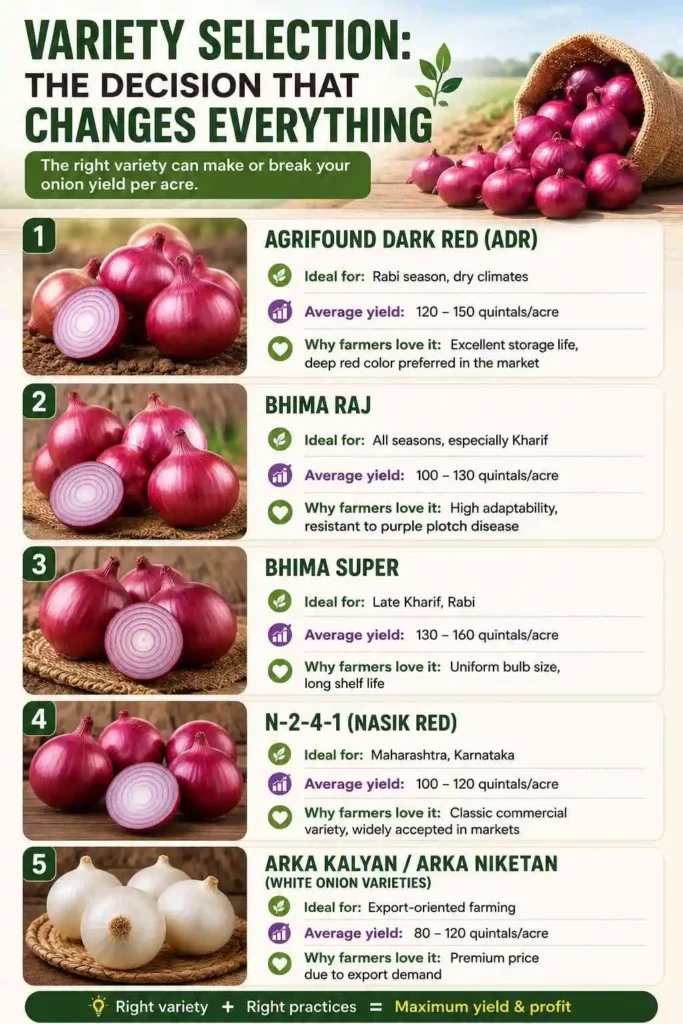
1. Agrifound Dark Red (ADR)
- Developed by: National Horticultural Research and Development Foundation (NHRDF)
- Best for: Rabi season, dry and semi-arid climates (Rajasthan, Madhya Pradesh, Gujarat)
- Realistic yield range: 120 – 150 quintals/acre
- Maturity: 120–130 days
- Key strengths: Excellent post-harvest shelf life (up to 5 months in ambient storage), deep red color commands premium mandi prices
- Watch out for: Susceptible to thrips in high-humidity conditions
2. Bhima Raj
- Developed by: ICAR-DOGR, Pune
- Best for: All seasons, particularly Kharif; highly adaptable across India Realistic yield range: 100 – 130 quintals/acre
- Maturity: 95–110 days
- Key strengths: Strong resistance to purple blotch (Alternaria porri), consistent yield across climatic variation
- Watch out for: Slightly lower storage life compared to Rabi-specific varieties
3. Bhima Super
- Developed by: ICAR-DOGR, Pune
- Best for: Late Kharif and Rabi seasons
- Realistic yield range: 130 – 160 quintals/acre
- Maturity: 110–120 days
- Key strengths: Uniform bulb size (critical for export grading), long shelf life, higher dry matter content
- Watch out for: Requires more precise irrigation management during bulb formation
4. N-2-4-1 (Nasik Red)
- Best for: Maharashtra and Karnataka
- Realistic yield range: 100 – 120 quintals/acre
- Maturity: 120–130 days
- Key strengths: Widely accepted by mandis in Maharashtra, reliable performance in known conditions
- Watch out for: Less adaptable outside its native region; don’t plant in Rajasthan or Punjab without a small trial first
5. Arka Kalyan / Arka Niketan (White Onion Varieties)
- Developed by: ICAR-IIHR, Bangalore
- Best for: Export-oriented farming, Maharashtra coast, Karnataka
- Realistic yield range: 80 – 120 quintals/acre
- Maturity: 130–140 days
- Key strengths: Commands premium prices from exporters (Sri Lanka, Malaysia, Southeast Asia); mild flavor profile preferred internationally
- Watch out for: Lower domestic mandi price; only viable if you have an export buyer relationship
Pro tip from experienced farmers: Don’t just pick based on yield alone. Factor in your local mandi’s demand, your storage capacity, and the disease pressure in your region.
Soil Preparation and Fertilization: Where Yields Are Won or Lost
Onions are shallow-rooted. The feeder roots rarely go below 20–25 cm, which means your topsoil quality is essentially your entire agronomic asset.
Ideal soil conditions:
- Soil type: Well-drained loamy or sandy-loam
- pH range: 6.0 – 7.5 (slightly acidic to neutral)
- Organic matter: Above 1% (2%+ is ideal)
- Drainage: Critical — even brief waterlogging causes basal rot
Get a soil test before you do anything else. A basic soil test costs ₹200–500 at your nearest KVK (Krishi Vigyan Kendra) or state agriculture department. It tells you your actual pH, available phosphorus, potassium, and micronutrient levels. Two farmers in the same village can have vastly different soil profiles. Blanket fertilizer recommendations leave money on the table.
| Stage | Inputs | Quantity |
|---|---|---|
| Land preparation | FYM (well-composted) | 10–12 tonnes |
| Basal dose (at transplanting) | DAP | 50 kg |
| Basal dose | MOP (Muriate of Potash) | 30 kg |
| First top-dressing (3–4 weeks after transplanting) | Urea | 30 kg |
| Second top-dressing (6–7 weeks after transplanting) | Urea | 30 kg |
| Micronutrient supplementation | Sulphur (bentonite sulphur) | 8–10 kg/acre |
The two micronutrients farmers consistently overlook:
- Sulphur: Essential for pungency, storage life, and disease resistance. Deficiency can reduce yield by 15–20%. India’s soils are increasingly sulphur-deficient due to the shift away from SSP to DAP and urea. Sprinkle 8–10 kg of bentonite sulphur per acre during land preparation.
- Boron: Deficiency causes hollow heart and cracking in bulbs, increasing unmarketable yield. Apply 500g borax per acre as foliar spray at 30 and 60 days after transplanting.
Fertigation advantage: Farmers using drip irrigation with soluble fertilizer application (fertigation) consistently report 10–25% higher yields versus conventional broadcasting. Nutrients are delivered directly to the root zone, reducing loss to leaching and surface runoff.
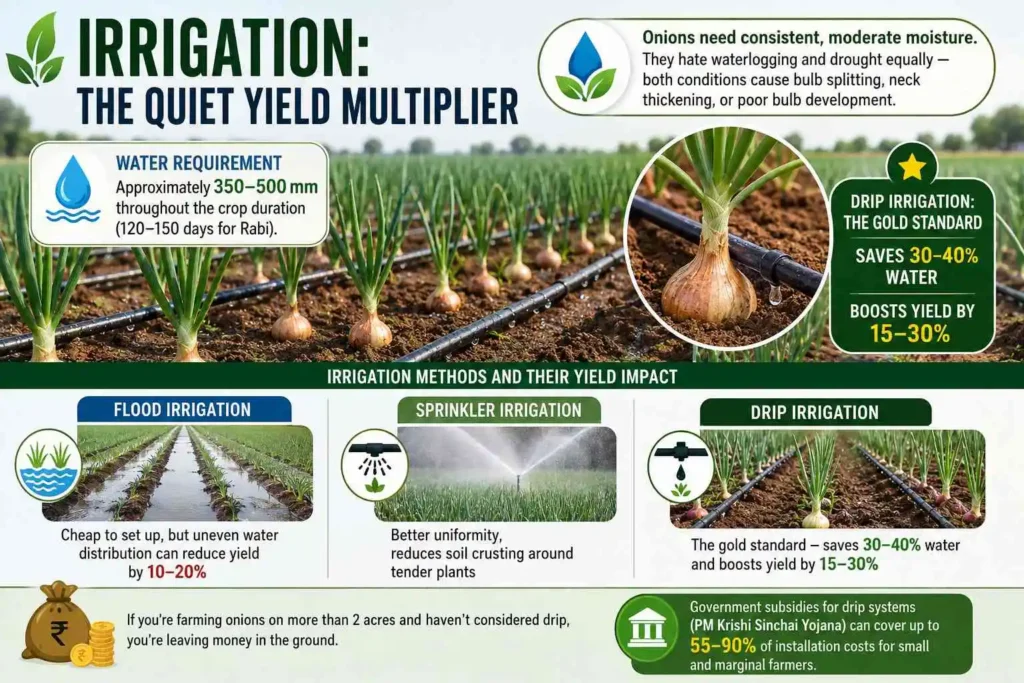
Irrigation: The Quiet Yield Multiplier
Onions have a shallow root system and moderate but consistent water demand. Both overwatering and water stress are damaging — and the damage shows up not in plant death but in reduced bulb quality and size.
Total water requirement: 350–500 mm across the full crop duration (approximately 120–150 days for Rabi).
Critical irrigation windows:
- Transplanting phase: Light, frequent irrigation for 2 weeks to establish roots
- Vegetative growth (weeks 3–8): Moderate irrigation every 7–10 days
- Bulb initiation and development (weeks 8–14): Most critical phase — consistent moisture, avoid both stress and waterlogging
- Pre-harvest (10–14 days before harvest): Stop all irrigation. This is non-negotiable. Continuing irrigation at this stage causes neck rot, reduces dry matter content, and shortens storage life.
Irrigation Method Comparison
| Method | Setup Cost (Per Acre) | Water Saving | Yield Impact | Best For |
|---|---|---|---|---|
| Flood irrigation | ₹0–5,000 | Baseline | Baseline | Small holdings, water-abundant areas |
| Sprinkler irrigation | ₹15,000–25,000 | 20–30% | +5–10% | Medium holdings |
| Drip irrigation | ₹40,000–60,000 | 30–45% | +15–30% | Any scale (subsidies available) |
If you’re farming onions on more than 2 acres and haven’t considered drip, you’re leaving money in the ground. Government subsidies for drip systems (PM Krishi Sinchai Yojana) can cover up to 55–90% of installation costs for small and marginal farmers.
Pest and Disease Management: Don’t Let the Garden Eat Your Profits
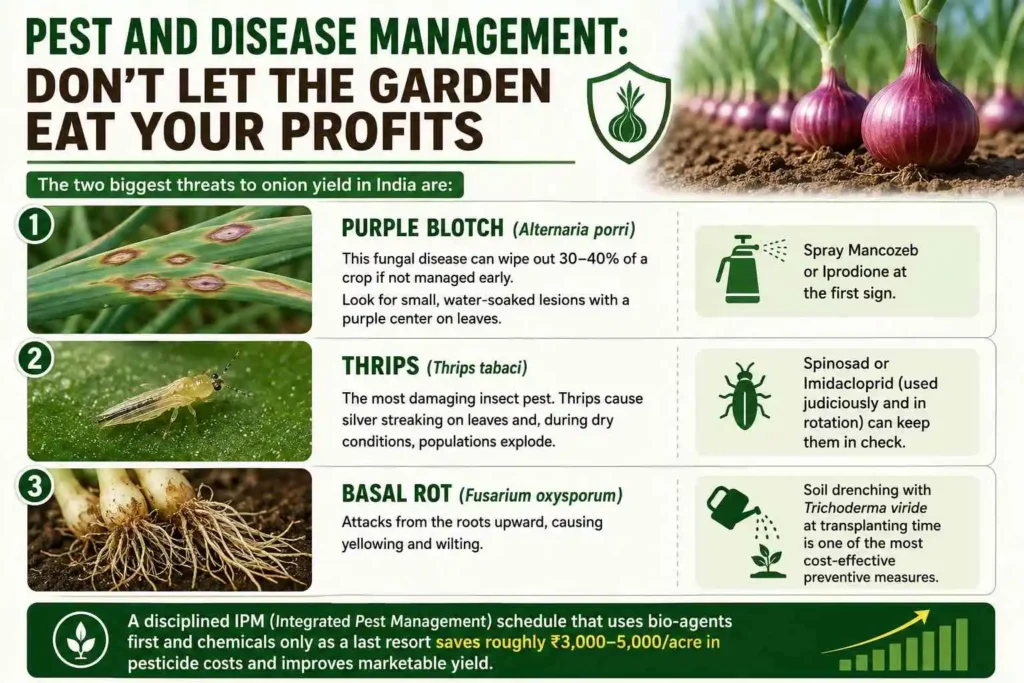
Pest and disease pressure is responsible for 20–40% yield loss in poorly managed onion fields. The good news: the major threats are well-understood and manageable with disciplined monitoring.
Threat 1: Purple Blotch (Alternaria porri)
What it looks like: Small, water-soaked lesions with a white centre and purple halo on leaves. In humid conditions, it spreads rapidly.
Yield impact: 30–40% crop loss if uncontrolled
Management:
- Preventive: Spray Mancozeb 75 WP (2g/litre) at 15-day intervals during vulnerable periods
- Curative: Iprodione 50 WP (2g/litre) at first sign
- Cultural: Avoid overhead irrigation after canopy closes; improve air circulation by avoiding dense planting
Threat 2: Thrips (Thrips tabaci)
What it looks like: Silver streaking on leaves; heavily infested plants appear whitish and stunted
Yield impact: Severe infestations during dry weather can reduce yield by 30–50%
Management:
- Monitoring: Install blue sticky traps (15/acre) to track population thresholds
- Chemical: Spinosad 45 SC (0.3 ml/litre) or Imidacloprid 17.8 SL (0.3 ml/litre) — rotate modes of action to prevent resistance
- Note: Thrips resistance to common insecticides is increasingly documented. If standard sprays aren’t working, ask your KVK about current resistance patterns in your region.
Threat 3: Basal Rot (Fusarium oxysporum)
What it looks like: Yellowing from leaf tips downward; white-pink fungal growth at bulb base; plants pull out easily with rotted roots
Yield impact: Can kill 15–30% of stand in affected fields
Management:
- Prevention (highest ROI): Seed treatment with Trichoderma viride (4g/kg seed) + soil application at transplanting (2.5 kg/acre mixed with 250 kg FYM)
- Crop rotation: Avoid planting onion or garlic in the same field for at least 2 consecutive years
- Chemical drench: Carbendazim 50 WP (1g/litre) as a drench around affected plants
Integrated Pest Management (IPM) Approach
A disciplined IPM schedule that uses biocontrol agents first and synthetic chemicals only when thresholds are breached saves ₹3,000–5,000/acre in pesticide costs annually. More importantly, it reduces pesticide residue levels — increasingly critical for export-quality onions.
Realistic Profit Calculation: Onion Farming Per Acre
All your effort through the season can be compromised by harvesting at the wrong time. This is more nuanced than most guides suggest.
The 50–70% tops-down rule: Harvest when 50–70% of plants have naturally fallen over (tops have lodged). This is your window. Earlier means smaller, immature bulbs. Later means increased neck rot and storage losses.
Signs the crop is ready:
- Majority of tops have turned yellow and lodged
- Outer skin (skin) has dried and formed a papery layer
- Bulbs feel firm when squeezed
Field curing before storage: After harvest, leave bulbs in windrows in the field (tops covering bulbs to prevent sunburn) for 3–5 days. Then move to a shaded, well-ventilated shed for another 7–10 days of curing. Skipping this step is one of the biggest causes of storage rot.
Profit Calculation: Three Realistic Scenarios
Rather than one optimistic number, here are three scenarios that reflect the range of outcomes farmers actually experience.
Common input costs, Rabi season (per acre):
| Cost Head | Amount (₹) |
|---|---|
| Land preparation & transplanting | ₹8,000 |
| Nursery + certified seeds | ₹3,500 |
| Fertilizers (organic + chemical) | ₹7,000 |
| Irrigation costs | ₹5,000 |
| Pesticides & fungicides | ₹4,500 |
| Labour (weeding, harvesting, grading) | ₹12,000 |
| Packaging & transportation | ₹4,000 |
| Total cost of cultivation | ~₹44,000/acre |
Scenario 1: Poor Season (Yield: 80 quintals, Price: ₹800/quintal)
- Revenue: ₹64,000
- Net result: Loss of ~₹20,000/acre
- When does this happen: Kharif crop, price crash at harvest, or significant pest damage
Scenario 2: Average Season (Yield: 120 quintals, Price: ₹1,200/quintal)
- Revenue: ₹1,44,000
- Net profit: ~₹1,00,000/acre
- When does this happen: Well-managed Rabi crop, normal mandi conditions
Scenario 3: Good Season (Yield: 150 quintals, Price: ₹1,500/quintal)
- Revenue: ₹2,25,000
- Net profit: ~₹1,81,000/acre
- When does this happen: Rabi crop with drip irrigation, quality variety, and favorable market timing
The price volatility reality: Onion mandi prices in India can range from ₹300/quintal (crash) to ₹4,000+/quintal (shortage peak) within a single year. Farmers with cold storage or processing options can hold stock and sell into higher prices. Those who must sell at harvest have no pricing power.
Cold Storage: The Strategy That Separates Profitable Farmers from the Rest
Onion prices historically spike between June–September when domestic stocks thin out. Rabi onions harvested in March–May can be stored and sold at 2–3x the harvest-time price if you have cold storage access.
Storage options:
- Ventilated traditional storage (kothi/dheri): Low-cost, stores for 2–3 months; 15–20% weight loss is typical
- Commercial cold storage (0–2°C, 65–70% RH): Stores up to 6 months; weight loss under 5%; rental typically ₹150–250 per quintal per month
- Zero Energy Cool Chambers: Low-cost evaporative coolers recommended by ICAR for small farmers in areas without electricity access
For farms above 5 acres, understanding cold storage economics and local rental availability is as important as agronomic knowledge.
How to Push Your Onion Yield Above 150 Quintals Per Acre
These are the levers that experienced Nashik and Pune farmers pull consistently to exceed average yields:
- Use certified, treated seed — every season. Fresh certified seed gives 15–20% better germination and more uniform bulb sizing. Farmer-saved seed from 3 seasons ago is a guaranteed ceiling on performance.
- Maintain correct plant spacing. For Rabi: 10 cm × 15 cm. Too dense produces small bulbs competing for nutrients. Too sparse wastes land potential.
- Weed aggressively in the first 6 weeks. The period from transplanting to 40 days is the critical nutrient competition window. Two manual weedings in this period typically yield better results than one post-competition chemical spray.
- Time irrigation stoppages precisely. Stop all irrigation 10–14 days before expected harvest. Early stoppage reduces bulb weight; late stoppage causes neck rot. Set a date and stick to it.
- Add sulphur and boron. These two micronutrients are consistently deficient in Indian onion fields and consistently overlooked. Cost per acre: under ₹500. Yield impact: 15–20%.
- Switch to drip with fertigation. Even partial conversion (main field on drip, nursery on flood) produces measurable gains in water efficiency and nutrient uptake.
- Grade aggressively at harvest. Separating A-grade (premium market), B-grade (local market), and C-grade (industrial/dehydration) allows you to maximize price realization across all yield — rather than averaging down because of mixed lots.
Regional Yield Benchmarks: How Does Your Farm Compare?
| State/Region | Average Yield (Quintals/Acre) | Key Season | Major Variety |
|---|---|---|---|
| Nashik, Maharashtra | 120 – 160 | Rabi | Bhima Super, N-2-4-1 |
| Pune, Maharashtra | 110 – 140 | Rabi, Late Kharif | Bhima Raj, ADR |
| Rajasthan (Alwar, Sikar) | 100 – 130 | Rabi | Agrifound Dark Red |
| Karnataka (Gadag, Belgaum) | 90 – 120 | Rabi | N-2-4-1, Bhima Raj |
| Madhya Pradesh (Mandsaur) | 100 – 130 | Rabi | Agrifound Dark Red |
| Gujarat (Saurashtra) | 90 – 120 | Rabi | ADR, Bhima Super |
| Andhra Pradesh / Telangana | 80 – 110 | Rabi | Local red varieties |
If your yield is more than 20% below your region’s average with good variety selection and inputs, the limiting factor is likely soil health (pH, organic matter, micronutrients) or irrigation inconsistency — both of which soil testing and drip adoption can address.
nion farming is one of the most rewarding short-duration crops in India when managed well — and it pairs naturally with other high-return ventures. Coastal farmers often combine it with shrimp farming for year-round income, while those with larger land holdings use the gaps between young coconut trees for onion intercropping — something we cover in detail in our coconut plantation guide.
Frequently Asked Questions (FAQs)
1.Which onion variety gives the highest yield per acre in India?
Among the popular varieties, Bhima Super can produce around 130–160 quintals per acre under good management practices. However, actual yields depend on climate, soil fertility, irrigation, and pest control.
2.How do I choose the right onion variety for my farm?
Select a variety based on your region, season, market demand, and storage requirements. For example, Agrifound Dark Red performs well in the Rabi season, while Bhima Raj is suitable for Kharif cultivation.
3.What is the most profitable onion variety?
Profitability depends on both yield and market price. Varieties with good storage life, such as Agrifound Dark Red and Bhima Super, often provide better returns because farmers can sell when prices improve.
4.What causes Basal Rot in onions?
Basal Rot is caused by the fungus Fusarium oxysporum. It attacks the root system, leading to yellowing, wilting, and bulb decay. Proper crop rotation and biological treatments can reduce the risk.
Newsletter