


Shrimp Farming in India: Starting, Growing, and Profiting in 2026
India has quietly become one of the most powerful names in the global seafood industry. Walk into a supermarket in the United States, Japan, or Europe and there’s a good chance the frozen shrimp on the shelf was raised right here — in the backwaters of Andhra Pradesh, the coastal belts of Odisha, or the tidal flats of Gujarat.
Shrimp farming in India is no longer just a coastal occupation. It’s a full-blown commercial enterprise generating thousands of crores in export revenue every year, supporting over a million livelihoods, and attracting serious investors who earlier wouldn’t have looked twice at aquaculture.
But here’s what most guides won’t tell you: this industry is accessible. You don’t need to be a marine biologist or a millionaire to get started. You need the right information, a plan, and a willingness to learn. That’s exactly what this guide is here to give you.
Why Shrimp Farming in India Is Booming Right Now
India is one of the world’s leading seafood exporters and the second-largest exporter of shrimp globally. The country’s seafood export sector continues to expand, reaching a record high in FY 2025–26 with exports of 19.72 lakh metric tonnes valued at ₹73,890 crore (US$8.46 billion) (Refrence- MPEDA & NFDP).
Frozen shrimp remained the dominant export product, accounting for 7.93 lakh metric tonnes and contributing 66.5% of total seafood export earnings, highlighting its critical role in India’s aquaculture and export economy.
The reasons for this boom aren’t accidental. India has a unique combination of advantages that most competing countries simply don’t have:
Favourable geography: India has over 8,000 km of coastline and millions of hectares of brackish water land suitable for aquaculture. The climate in most coastal states supports year-round farming.
Low labour costs: Compared to Thailand or Ecuador, India’s production costs are significantly lower, giving Indian shrimp a price advantage in international markets.
Government push: Schemes like PMMSY (Pradhan Mantri Matsya Sampada Yojana) and MPEDA support have poured thousands of crores into the sector. The government has actively positioned aquaculture as a priority area.
Rising global demand: The global shrimp market is expected to cross USD 70 billion by 2030. Demand is growing in the US, EU, China, and Southeast Asia — and India is perfectly positioned to supply it.
All of this adds up to one thing: shrimp farming in India is one of the most lucrative agribusiness opportunities available today.
Types of Shrimp Farmed in India
Choosing the right species is one of the most critical decisions you’ll make. Each species has different growth rates, disease resistance, feed requirements, and market value.
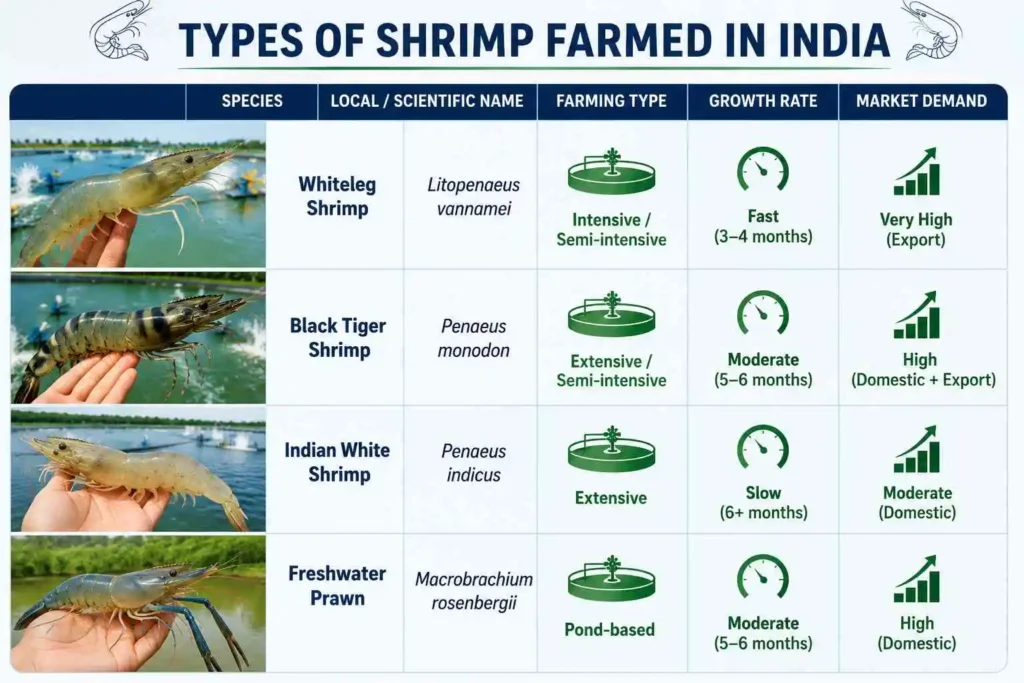
| Species | Local/Scientific Name | Farming Type | Growth Rate | Market Demand |
|---|---|---|---|---|
| Whiteleg Shrimp | Litopenaeus vannamei | Intensive/Semi-intensive | Fast (3–4 months) | Very High (Export) |
| Black Tiger Shrimp | Penaeus monodon | Extensive/Semi-intensive | Moderate (5–6 months) | High (Domestic + Export) |
| Indian White Shrimp | Penaeus indicus | Extensive | Slow (6+ months) | Moderate (Domestic) |
| Freshwater Prawn | Macrobrachium rosenbergii | Pond-based | Moderate (5–6 months) | High (Domestic) |
Vannamei shrimp (Whiteleg Shrimp) dominates modern commercial shrimp farming in India, accounting for over 90% of total production. It was introduced to India around 2009 and completely transformed the sector. The reasons are simple: it grows fast, survives in high-density ponds, and commands strong export prices.
Black Tiger Shrimp (Penaeus monodon) was the original king of Indian aquaculture, but it’s been largely displaced by vannamei in commercial settings. That said, it fetches a premium in certain markets and is still popular among traditional farmers.
For inland farmers away from the coast, freshwater prawns are an excellent option — less infrastructure-intensive and with a strong domestic market.
Key Shrimp Farming States in India
Not every state is equally suited for shrimp farming, and geography plays a huge role in determining your success. Here’s a quick overview of the major producing states:
| State | Key Districts/Regions | Primary Species | Contribution to Output |
|---|---|---|---|
| Andhra Pradesh | Krishna, West Godavari, East Godavari | Vannamei | ~70% of national output |
| Odisha | Chilika, Balasore, Bhadrak | Vannamei, Black Tiger | ~8–10% |
| West Bengal | South 24 Parganas, North 24 Parganas | Black Tiger, Freshwater Prawn | ~7–8% |
| Gujarat | Navsari, Valsad, Bharuch | Vannamei | Growing rapidly |
| Tamil Nadu | Nagapattinam, Ramanathapuram | Vannamei, Black Tiger | ~5–6% |
| Kerala | Alappuzha, Ernakulam | Black Tiger, Freshwater Prawn | ~3–4% |
Andhra Pradesh is in a league of its own — it’s basically the Silicon Valley of shrimp farming in India. The infrastructure, the expertise, the seed supply, the processing units — all of it is concentrated there. If you’re new to the industry, studying how Andhra Pradesh operates is a masterclass in itself.
How to Start Shrimp Farming in India: Step by Step
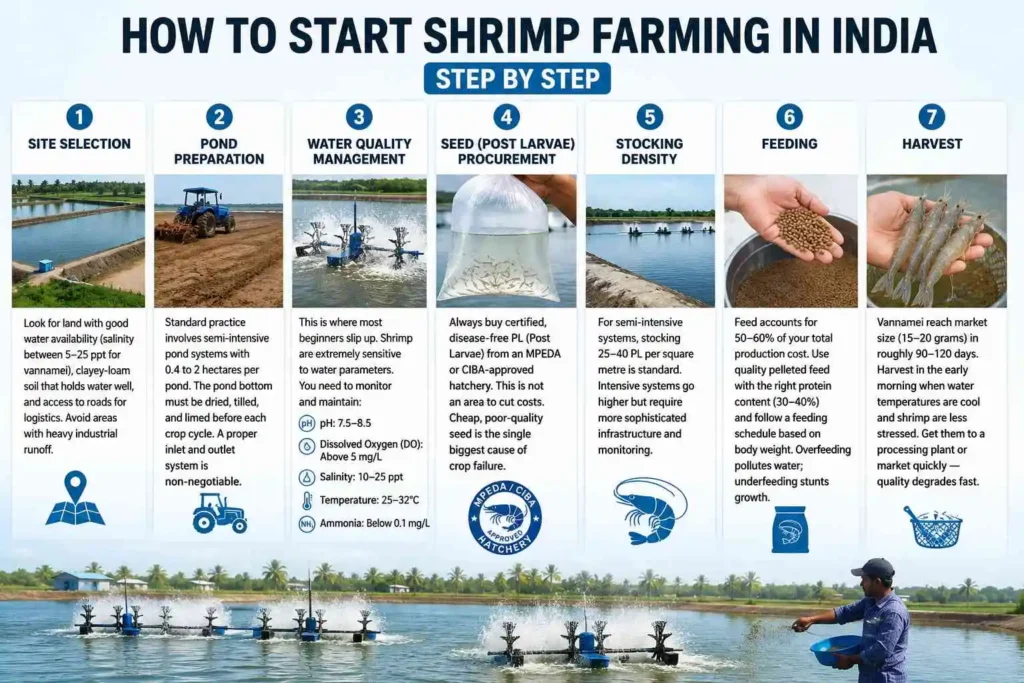
1. Site Selection
Look for land with good water availability (salinity between 5–25 ppt for vannamei), clayey-loam soil that holds water well, and access to roads for logistics. Avoid areas with heavy industrial runoff.
2. Pond Preparation
Standard practice involves semi-intensive pond systems with 0.4 to 2 hectares per pond. The pond bottom must be dried, tilled, and limed before each crop cycle. A proper inlet and outlet system is non-negotiable.
3. Water Quality Management
This is where most beginners slip up. Shrimp are extremely sensitive to water parameters. You need to monitor and maintain:
- pH: 7.5–8.5
- Dissolved Oxygen (DO): Above 5 mg/L
- Salinity: 10–25 ppt
- Temperature: 25–32°C
- Ammonia: Below 0.1 mg/L
4. Seed (Post Larvae) Procurement
Always buy certified, disease-free PL (Post Larvae) from an MPEDA or CIBA-approved hatchery. This is not an area to cut costs. Cheap, poor-quality seed is the single biggest cause of crop failure.
5. Stocking Density
For semi-intensive systems, stocking 25–40 PL per square metre is standard. Intensive systems go higher but require more sophisticated infrastructure and monitoring.
6. Feeding
Feed accounts for 50–60% of your total production cost. Use quality pelleted feed with the right protein content (30–40%) and follow a feeding schedule based on body weight. Overfeeding pollutes water; underfeeding stunts growth.
7. Harvest
Vannamei reach market size (15–20 grams) in roughly 90–120 days. Harvest in the early morning when water temperatures are cool and shrimp are less stressed. Get them to a processing plant or market quickly — quality degrades fast.
Investment and Profitability: What to Expect
This is the section everyone wants. Let’s be realistic — shrimp farming is profitable, but it’s not a guaranteed gold mine. Proper planning and disease management are everything.
Estimated Cost for 1 Hectare of Vannamei Shrimp Farming (Semi-Intensive)
| Cost Head | Approximate Cost (₹) |
|---|---|
| Pond construction & preparation | ₹2,00,000 – ₹3,50,000 |
| Post Larvae (PL) purchase | ₹40,000 – ₹60,000 |
| Feed (entire crop cycle) | ₹1,80,000 – ₹2,50,000 |
| Aerators, pumps, equipment | ₹80,000 – ₹1,50,000 |
| Labour (per crop cycle) | ₹50,000 – ₹80,000 |
| Medicines, probiotics, lime | ₹30,000 – ₹50,000 |
| Electricity | ₹30,000 – ₹50,000 |
| Miscellaneous | ₹20,000 – ₹40,000 |
| Total Estimated Cost | ₹6,30,000 – ₹9,30,000 |
Revenue and Profit Potential
With a successful crop, a 1-hectare pond can produce approximately 4,000–6,000 kg of shrimp per cycle. At ₹300–₹450 per kg (current farm-gate prices for 50-count vannamei), revenue can range from ₹12 lakh to ₹27 lakh per crop cycle. Most farmers run 2 crop cycles per year.
Even after accounting for costs, a well-managed 1-hectare farm can net ₹6–₹12 lakh per year. Scale that to 5 or 10 hectares and you’re looking at a serious business.
Challenges Every Shrimp Farmer Must Know About
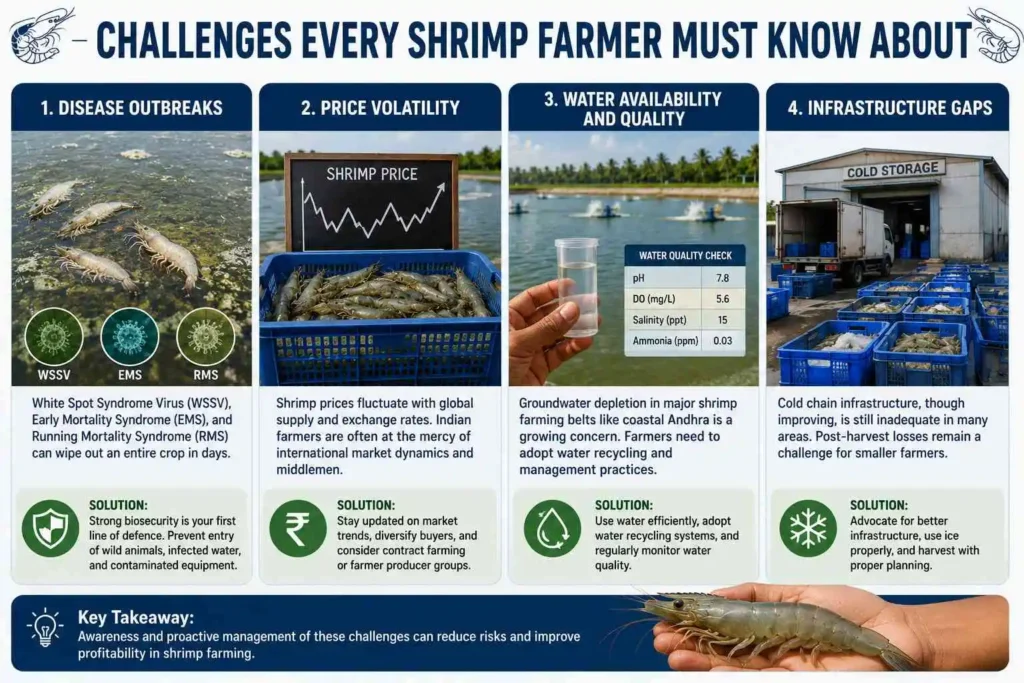
Shrimp farming in India is rewarding, but it’s not without its headaches. Here are the challenges you’ll face and how to approach them:
Disease outbreaks: White Spot Syndrome Virus (WSSV), Early Mortality Syndrome (EMS), and Running Mortality Syndrome (RMS) can wipe out an entire crop in days. Biosecurity — keeping wild animals, infected water, and contaminated equipment away from your ponds — is your first line of defence.
Price volatility: Shrimp prices fluctuate with global supply and exchange rates. Indian farmers are often at the mercy of international market dynamics and middlemen.
Water availability and quality: Groundwater depletion in major shrimp farming belts like coastal Andhra is a growing concern. Farmers need to adopt water recycling and management practices.
Infrastructure gaps: Cold chain infrastructure, though improving, is still inadequate in many areas. Post-harvest losses remain a challenge for smaller farmers.
Government Support and Schemes to Tap Into
The good news? The government really does want this sector to grow, and there are real subsidies and support mechanisms available.
PMMSY (Pradhan Mantri Matsya Sampada Yojana): A ₹20,050 crore scheme specifically for the fisheries sector. Provides subsidies for pond construction, aerators, equipment, and even insurance.
MPEDA (Marine Products Export Development Authority): Provides training, technical assistance, and market linkage. Their registered farmers also get easier access to export channels.
NABARD Credit Linkage: KCC (Kisan Credit Card) and NABARD-backed aquaculture loans offer working capital at subsidised interest rates.
State Government Subsidies: States like Andhra Pradesh, Odisha, and Gujarat have their own schemes offering subsidies on seed, feed, and infrastructure. Check with your local fisheries department.
Tips to Succeed in Shrimp Farming
Hard-won wisdom from experienced farmers, distilled into actionable points:
- Never compromise on seed quality. It’s the foundation of everything.
- Invest in aeration. Dissolved oxygen management is the single most important operational factor.
- Keep a farm diary. Log water parameters, feed quantities, and observations daily. Patterns save crops.
- Join a farmer cluster or cooperative. Collective bargaining for better prices and shared technical knowledge make a huge difference.
- Build relationships with a good processing unit before you farm. Don’t figure out where to sell your shrimp after harvest.
- Plan for one crop failure. Not pessimism — just smart financial planning.
Conclusion
Shrimp farming in India is one of those rare intersections where geography, economics, and policy all align in your favour. The market is there. The support is there. The knowledge base is there. What’s needed is more farmers who approach it as a serious, science-backed business rather than a seasonal gamble.
Whether you’re a coastal landowner thinking about utilising fallow brackish land, an agri-entrepreneur looking for your next venture, or a fisheries student wanting to understand the business — the opportunity is real and the timing is right. If you’re ready to explore what it actually takes to turn this into a viable export-oriented venture, this complete beginner’s guide to starting shrimp export is a solid place to start.
India’s shrimp story is still being written. There’s plenty of room to add your chapter.
Have questions about shrimp farming in your specific state or budget range? Drop them in the comments — let’s figure it out together.
Explore more guides on goat farming, poultry farming, dragon fruit farming, and other profitable agribusiness opportunities
Shrimp Farming in India – FAQs
Is shrimp farming profitable in India?
Yes, it can be very profitable, especially if managed well. India has strong export demand (USA, China, Europe), but profit depends on:
Seed quality
Feed cost
Disease control
Market price
Which shrimp species are commonly farmed in India?
The most popular species is:
Vannamei shrimp (Litopenaeus vannamei) – high demand, fast growth, widely farmed
Earlier species:
Black Tiger shrimp (less common now)
How much land is required for shrimp farming in India?
You can start from:
1 acre minimum (small commercial scale)
Larger farms (5–20 acres) are more profitable
How long does one shrimp crop take?
Around 90–120 days per cycle
Usually 2–3 crops per year are possible
Newsletter



I am interested to start a ilisi fish prawns and shrimp farming in paradeep or jagatsingpur ir shorthand near chilika as a resident from here.
Hi Sukanta, since you’re from the Paradip/Jagatsinghpur–Chilika region, shrimp farming can be a good opportunity, but site suitability is the first step. Please share your **location, land area, and whether you have access to brackish water**. We can then guide you on the suitable farming model, approximate investment, and key permissions required.