


Pomegranate Farming in India:Complete Guide to Cost, Yield and Profit (2026)
Pomegranate farming has quietly become one of the most attractive fruit crops for Indian farmers, especially in dry, water-stressed regions where cotton, soybean, or sugarcane no longer pay well. The tree handles heat that would kill most fruit crops, needs comparatively less water once it’s established, and the fruit sells at a price that few other crops can match — in the local mandi and in the export container.
But pomegranate farming is not a “plant it and walk away” crop. Get the bahar cycle wrong, ignore bacterial blight, or skip your subsidy paperwork, and your returns will fall well short of what the internet promises. This guide covers everything worth knowing before you put a single sapling in the ground — climate and soil, the right variety, spacing, irrigation, fertilizer, pest and disease control, real cost figures in rupees, expected yield and profit, and the government schemes that can cut your setup cost almost in half.
Why Pomegranate Farming Makes Sense Right Now
A few reasons pomegranate cultivation keeps expanding across Maharashtra, Karnataka, Gujarat, Rajasthan, and parts of Andhra Pradesh and Telangana:
- It handles drought and heat better than most fruit crops. Pomegranate thrives in semi-arid conditions where mango, banana, or citrus would struggle.
- One planting pays you for two to three decades. A well-managed orchard stays productive for 20-25 years or more, so your setup cost is a one-time affair, not an annual one.
- Export demand keeps climbing. In FY 2023-24, India exported over 72,000 tonnes of pomegranates worth close to USD 69 million, mainly to the UAE, Bangladesh, Nepal, the Netherlands, and Saudi Arabia — and fresh market access has since opened up in the USA and Australia too.
- Real research backs it. The ICAR-National Research Centre on Pomegranate (NRCP) in Solapur runs dedicated research on varieties, disease control, and cultivation practices, so you’re not farming on guesswork.
That said, pomegranate is a high-value, high-management crop, not a shortcut. The sections below will help you plan it properly instead of chasing a profit number you saw on someone’s reel.
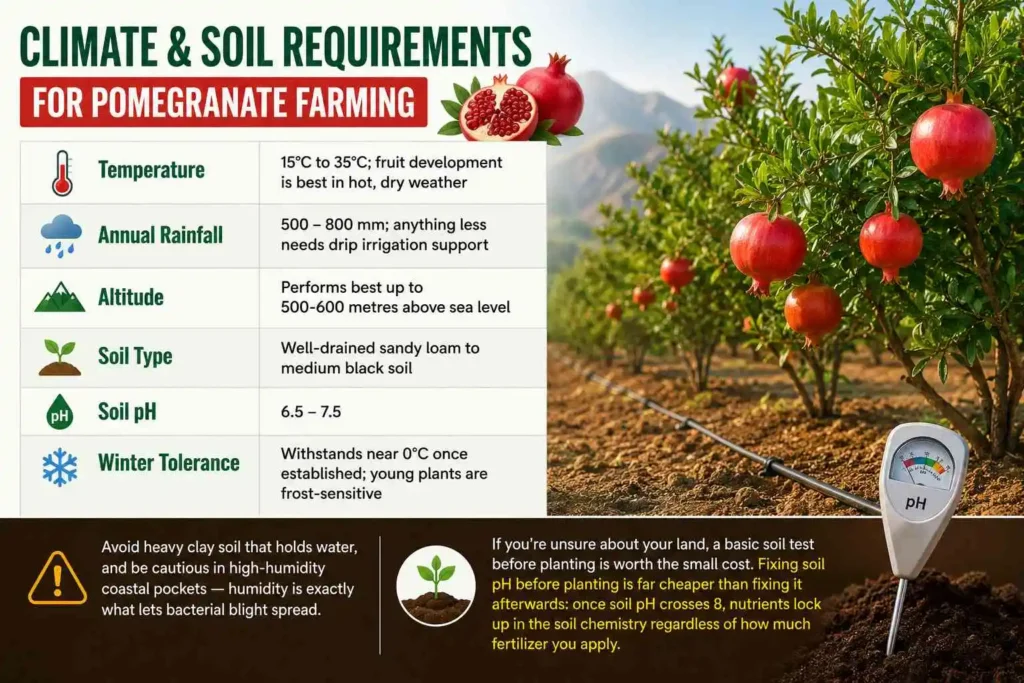
Climate and Soil Requirements for Pomegranate Farming
Pomegranate is fairly forgiving on soil compared to most fruit trees, but a few things matter a lot.
| Parameter | Ideal Range for Pomegranate Farming |
|---|---|
| Temperature | 15°C to 35°C; fruit development is best in hot, dry weather |
| Annual rainfall | 500 – 800 mm; anything less needs drip irrigation support |
| Altitude | Performs best up to 500-600 metres above sea level |
| Soil type | Well-drained sandy loam to medium black soil |
| Soil pH | 6.5 – 7.5 |
| Winter tolerance | Withstands near 0°C once established; young plants are frost-sensitive |
Avoid heavy clay soil that holds water, and be cautious in high-humidity coastal pockets — humidity is exactly what lets bacterial blight spread. If you’re unsure about your land, a basic soil test before planting is worth the small cost. Fixing soil pH before planting is far cheaper than fixing it afterwards: once soil pH crosses 8, nutrients lock up in the soil chemistry regardless of how much fertilizer you apply.
Best Pomegranate Varieties for Indian Farmers
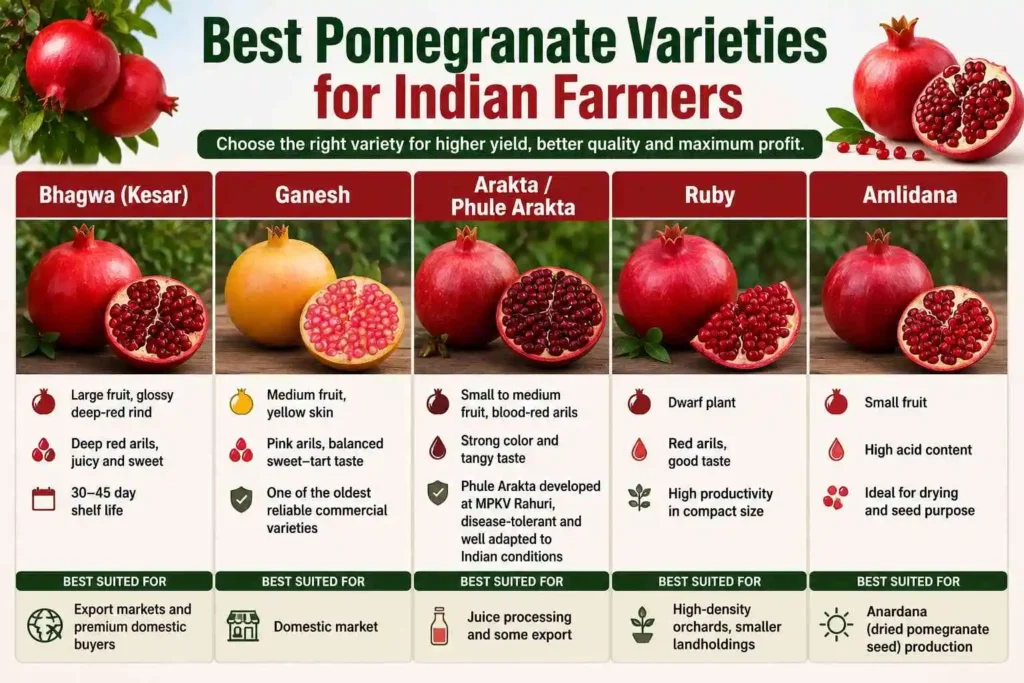
Variety choice affects everything downstream — yield, disease pressure, shelf life, and whether export buyers will even look at your fruit.
| Variety | Key Features | Best Suited For |
|---|---|---|
| Bhagwa (Kesar) | Large fruit, glossy deep-red rind, deep red arils, 30-45 day shelf life | Export markets and premium domestic buyers |
| Ganesh | Medium fruit, yellow skin, pink arils, balanced sweet-tart taste | Domestic market; one of the oldest reliable commercial varieties |
| Arakta / Phule Arakta | Small to medium, blood-red arils, strong color and tangy taste | Juice processing and some export; Phule Arakta was developed at MPKV Rahuri and is a solid, disease-tolerant option bred for Indian conditions |
| Ruby | Dwarf plant, red arils, good taste | High-density orchards, smaller landholdings |
| Amlidana | Small, high-acid fruit | Anardana (dried pomegranate seed) production |
Bhagwa now covers more than 80% of India’s total pomegranate area, and for good reason — it combines export-grade looks, decent shelf life, and strong buyer demand. It’s the safest starting point for most new growers, but talk to your local Krishi Vigyan Kendra (KVK) or State Horticulture Department before finalizing, since local disease pressure and water availability can change the right answer for your plot.
Land Preparation, Spacing and Planting
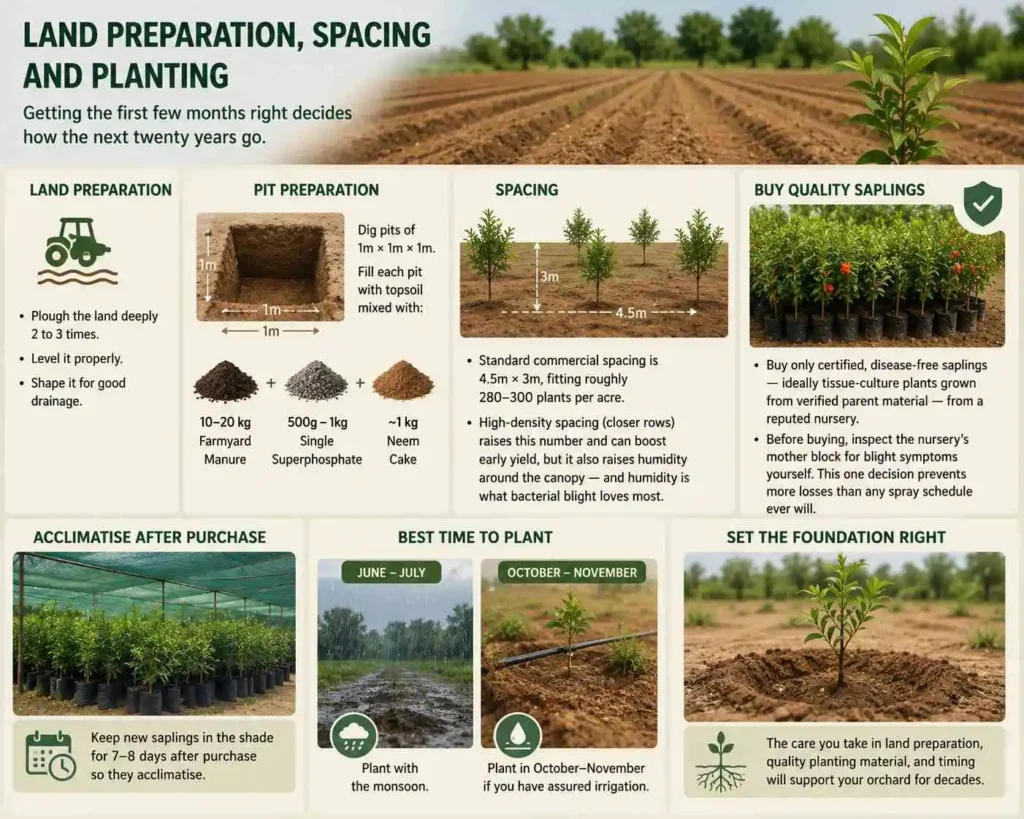
Getting the first few months right decides how the next twenty years go.
- Plough the land deeply two to three times, level it properly, and shape it for drainage.
- Dig pits of 1m × 1m × 1m, and fill each with topsoil mixed with 10-20 kg farmyard manure, 500g-1kg single superphosphate, and about 1 kg neem cake.
- Standard commercial spacing is 4.5m × 3m, fitting roughly 280-300 plants per acre. High-density spacing (closer rows) raises this number and can boost early yield, but it also raises humidity around the canopy — and humidity is what bacterial blight loves most.
- Buy only certified, disease-free saplings — ideally tissue-culture plants grown from verified parent material — from a reputed nursery. Before buying, inspect the nursery’s mother block for blight symptoms yourself. This one decision prevents more losses than any spray schedule ever will.
- Keep new saplings in the shade for 7-8 days after purchase so they acclimatise before planting.
- Plant in June-July with the monsoon, or October-November if you have assured irrigation.
Irrigation and the Bahar System
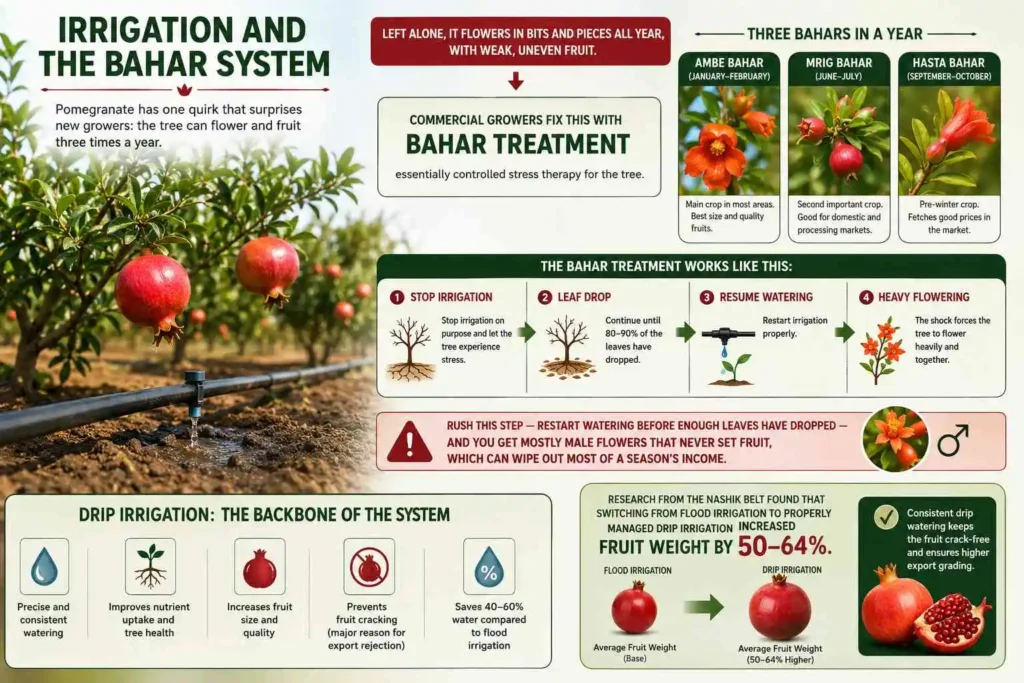
Pomegranate has one quirk that surprises new growers: the tree can flower and fruit three times a year — Ambe bahar (January-February), Mrig bahar (June-July), and Hasta bahar (September-October). Left alone, it flowers in bits and pieces all year, with weak, uneven fruit.
Commercial growers fix this with bahar treatment — essentially controlled stress therapy for the tree. You stop irrigation on purpose until 80-90% of the leaves drop. Then you resume watering. This shock forces the tree to flower heavily and together, instead of scattered and weak. Rush this step — restart watering before enough leaves have dropped — and you get mostly male flowers that never set fruit, which can wipe out most of a season’s income.
Once flowering begins after bahar treatment, healthy bee populations help improve pollination and fruit set. Some growers place bee colonies in the orchard during the flowering period, creating an additional source of income through honey production. Learn more in our Honey Farming Guide.
Drip irrigation isn’t optional here; it’s the backbone of the whole system. Research from the Nashik belt found that switching from flood irrigation to properly managed drip irrigation increased fruit weight by 50–64%. Beyond that, consistent drip watering prevents fruit cracking, which is one of the biggest reasons fruit gets rejected at the export grading stage. If you’re new to the system, read our complete guide on drip irrigation, including installation, costs, and maintenance, before setting up your orchard.
Fertilizer and Nutrient Management
| Plant Age | Nitrogen (per plant/year) | Phosphorus (per plant/year) | Potash (per plant/year) |
|---|---|---|---|
| 1-3 years (young) | 600 – 700 g | 200 – 250 g | 200 – 250 g |
| 4+ years (bearing) | 625 – 750 g | 250 – 300 g | 250 – 300 g |
Add 10-20 kg farmyard manure per plant every year, along with micronutrient sprays of zinc, boron, and iron — boron in particular helps cut down fruit cracking. Potash deserves special attention. Producing just one tonne of pomegranate draws around 3.7 kg of potash from the soil, and this single nutrient shapes fruit size, rind color, sugar content, and disease resistance more than any other. Always base your exact dose on a soil test rather than a fixed formula — overdoing fertilizer on soil with the wrong pH just wastes money.
Pest and Disease Management
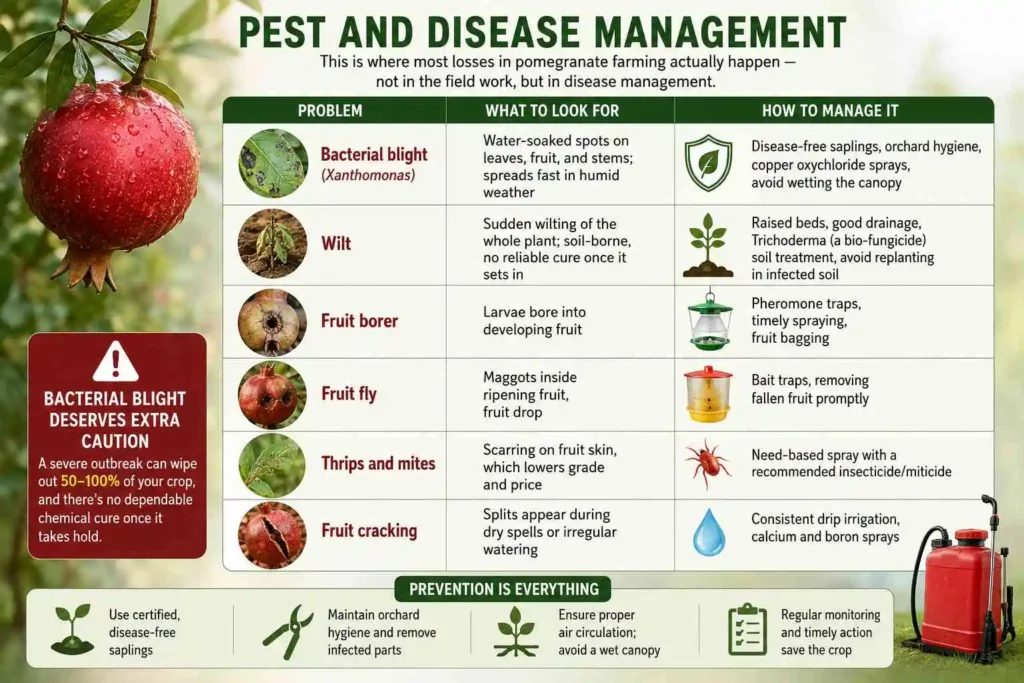
This is where most losses in pomegranate farming actually happen — not in the field work, but in disease management.
| Problem | What to Look For | How to Manage It |
|---|---|---|
| Bacterial blight (Xanthomonas) | Water-soaked spots on leaves, fruit, and stems; spreads fast in humid weather | Disease-free saplings, orchard hygiene, copper oxychloride sprays, avoid wetting the canopy |
| Wilt | Sudden wilting of the whole plant; soil-borne, no reliable cure once it sets in | Raised beds, good drainage, Trichoderma (a bio-fungicide) soil treatment, avoid replanting in infected soil |
| Fruit borer | Larvae bore into developing fruit | Pheromone traps, timely spraying, fruit bagging |
| Fruit fly | Maggots inside ripening fruit, fruit drop | Bait traps, removing fallen fruit promptly |
| Thrips and mites | Scarring on fruit skin, which lowers grade and price | Need-based spray with a recommended insecticide/miticide |
| Fruit cracking | Splits appear during dry spells or irregular watering | Consistent drip irrigation, calcium and boron sprays |
Bacterial blight deserves extra caution — a severe outbreak can wipe out 50-100% of your crop, and there’s no dependable chemical cure once it takes hold. Everything about prevention — certified saplings, orchard hygiene, avoiding a wet canopy — matters more here than in almost any other fruit crop grown in India.
Pruning and Training
In the first two to three years, train the plant to 3-4 strong main branches instead of letting it grow wild. After every bahar cycle, remove root suckers, water shoots, and criss-crossing branches. Good canopy management lets sunlight reach the fruit properly, which directly improves fruit color — and color is one of the biggest factors buyers use to decide your price.
Harvesting Pomegranates
Fruit is usually ready 120-130 days after fruit set, though this shifts a little by variety and bahar. Watch for the skin turning from green to yellowish-red or deep red depending on the variety, and tap the fruit — a slightly metallic sound usually means it’s ripe. Harvest with a small stalk (about 1 cm) still attached, sort by size and weight (fruit above 180g typically qualifies for export grading), and handle every fruit gently. Rough handling bruises the rind, and bruised fruit loses both shelf life and price fast.
Cost of Pomegranate Farming Per Acre (Year 1 Setup)
Here’s a realistic breakdown of what setting up one acre of pomegranate orchard costs before any subsidy is applied.
| Item | Approx. Cost (₹/acre) |
|---|---|
| Land preparation and ploughing | 8,000 – 12,000 |
| Certified saplings (~300 plants) | 9,000 – 15,000 |
| Pit digging and filling (FYM, SSP, neem cake) | 20,000 – 30,000 |
| Drip irrigation system (with fertigation unit) | 50,000 – 75,000 |
| Mulching / weed mat | 20,000 – 30,000 |
| Fencing (if required) | 25,000 – 40,000 |
| First-year labor and plant protection | 20,000 – 30,000 |
| Miscellaneous (tools, transport) | 8,000 – 15,000 |
| Total Year 1 cost (approx.) | ₹1.6 lakh – ₹2.5 lakh |
This is before any subsidy. As the schemes section below explains, MIDH and drip irrigation subsidies can bring your actual out-of-pocket cost down closer to ₹70,000 – ₹1.3 lakh — provided you apply for approval before starting the work, not after.
Yield and Profit From Pomegranate Farming: Year-Wise Estimate
This is the number every new grower wants first — so here it is, with the honest caveats attached.
| Year | Approx. Cost (₹/acre) | Expected Yield (tonnes/acre) | Approx. Revenue (₹/acre) | Approx. Net Return (₹/acre) |
|---|---|---|---|---|
| Year 1 | ₹1.6 – 2.5 lakh (setup) | 0 | ₹0 | -₹1.6 to -2.5 lakh |
| Year 2 | ₹70,000 – 90,000 | 0 – 1 | ₹0 – 60,000 | -₹70,000 to -30,000 |
| Year 3 | ₹80,000 – 1 lakh | 3 – 5 | ₹1.8 – 5 lakh | ₹1 – 4 lakh |
| Year 4 | ₹90,000 – 1.2 lakh | 5 – 8 | ₹3 – 8 lakh | ₹2 – 7 lakh |
| Year 5 onwards (full bearing) | ₹1 – 1.2 lakh | 6 – 12 | ₹4 – 14 lakh | ₹3 – 13 lakh |
Revenue above is calculated on a blended price of roughly ₹60-120/kg, mixing ordinary mandi sales with premium and export-grade fruit — Agmark-graded, export-quality Bhagwa can fetch an FOB price of ₹180-250/kg on its own, while ordinary mandi rates commonly run ₹50-170/kg depending on grade, season, and location.
The gap between the lower and upper end of the Year 5 row is mostly about management, not luck. A modestly managed orchard tends to sit near the lower figures; a well-managed, correctly bahar-timed, disease-controlled orchard in a good pomegranate belt tends to sit near the upper ones. A bad blight outbreak or a weak mandi season can pull either scenario down sharply — treat this table as a planning tool, not a guarantee.
Government Schemes and Subsidies for Pomegranate Farming
| Scheme | What It Covers | Who It’s For |
|---|---|---|
| MIDH (Mission for Integrated Development of Horticulture) | 40% subsidy on new plantation/planting material cost (50% for SC/ST and women farmers) | New orchard establishment |
| PMKSY – Per Drop More Crop | 45-55% subsidy on drip irrigation under central norms; several states add a top-up that pushes total support to 70-80% for small and marginal farmers | Drip irrigation system installation |
| National Horticulture Board (NHB) | Loan-linked subsidy for bigger commercial orchards and post-harvest infrastructure, paid out after the project is verified | Larger orchards, cold storage, packhouse projects |
| APEDA support (AnarNet traceability, Agmark grading) | Export facilitation, phytosanitary certification (a mandatory health clearance for exported fruit), EU-compliant packhouse access | Farmers and FPOs targeting export markets |
| State Horticulture Mission top-ups | Extra state-specific subsidy on top of MIDH, varies widely by state | Check with your local District Horticulture Officer |
How to actually get these subsidies:
- Visit your District Horticulture Officer (DHO) or State Horticulture Mission office and ask about MIDH-funded activities under the current year’s Annual Action Plan.
- Apply early — ideally April to June — since every state has a fixed yearly target, and applications stop once that target fills.
- Keep your land records (7/12 extract, patta, or your state’s equivalent), Aadhaar, and bank details ready.
- For bigger projects, prepare a proper Detailed Project Report (DPR) — your local KVK can help, and a weak DPR is the most common reason applications get rejected.
Marketing Your Pomegranate Harvest
For the domestic market, you can sell through your local mandi/APMC, directly to retailers and wholesalers, or through contract arrangements with agri-companies, which are becoming more common for export-oriented Bhagwa production. Joining or forming a Farmer Producer Organisation (FPO) usually improves your bargaining position, since you’re negotiating as a group rather than alone.
For exports, register with APEDA through the agriexchange portal, and get your farm/plot registered with your state’s horticulture department, since export shipments are traced back to individual registered plots through the AnarNet system. Major current buyers of Indian pomegranate include the UAE, Bangladesh, Nepal, the Netherlands, and Saudi Arabia, and provisional numbers for the first nine months of the 2025-26 season already show over 60,000 tonnes shipped, worth close to USD 53 million. Export-grade fruit needs Agmark grading and a phytosanitary certificate, and your spray program has to stay within the residue limits of the importing country — non-negotiable if you want repeat buyers rather than a single rejected shipment.
Common Mistakes to Avoid in Pomegranate Farming
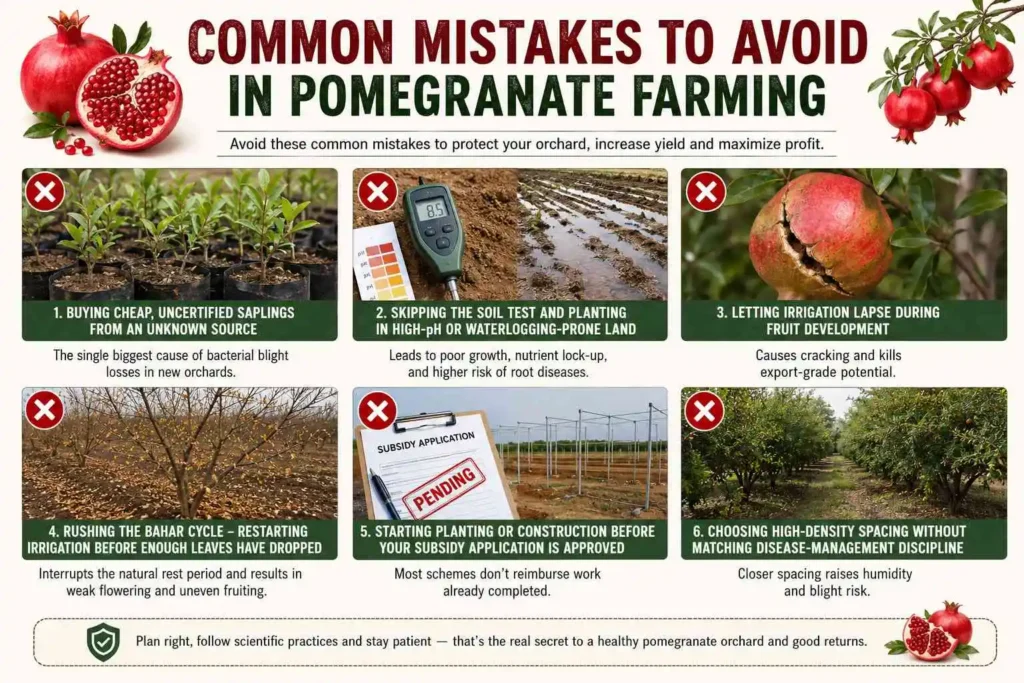
- Buying cheap, uncertified saplings from an unknown source — the single biggest cause of bacterial blight losses in new orchards.
- Skipping the soil test and planting in high-pH or waterlogging-prone land.
- Letting irrigation lapse during fruit development, which causes cracking and kills export-grade potential.
- Rushing the bahar cycle — restarting irrigation before enough leaves have dropped.
- Starting planting or construction before your subsidy application is approved; most schemes don’t reimburse work already completed.
- Choosing high-density spacing without matching disease-management discipline, since closer spacing raises humidity and blight risk.
Final Word
Pomegranate farming rewards patience and discipline more than most crops. The first two years test your nerve, since money goes out with nothing coming back in. But get your variety, spacing, bahar timing, and disease prevention right, and the same orchard can keep paying you for two decades or more. Before you commit your land and capital, walk into your nearest KVK or District Horticulture Office, get your soil tested, and talk to a couple of growers in your district who are already three or four years into their own orchard. The numbers in this guide will hold up far better once they’re checked against your own soil, water, and local market.
Frequently Asked Questions About Pomegranate Farming
Is pomegranate farming profitable in India?
Yes, when it’s managed well. From Year 4-5 onwards, an established orchard can generate anywhere from roughly ₹2 lakh to ₹13 lakh net return per acre depending on variety, region, and that year’s market price. The first two years are pure investment, with no income to offset the cost.
How many pomegranate plants fit in one acre?
At the standard 4.5m × 3m spacing, about 280-300 plants fit in one acre. High-density spacing can push this number higher, but it also raises disease-management demands.
Which pomegranate variety is best for export?
Bhagwa (also called Kesar) is the most widely planted export-grade variety in India, valued for its deep red color, high juice content, and 30-45 day shelf life.
How long does a pomegranate tree take to bear fruit?
Light bearing can begin in Year 2, but commercial harvest usually starts in Year 3, with full bearing from Year 5 onwards. A well-maintained orchard stays productive for 20-25 years or longer.
What is bahar treatment, and why does it matter?
Bahar is the practice of deliberately withholding irrigation until most leaves drop, then resuming watering to trigger one concentrated flowering cycle. India follows three bahars — Ambe, Mrig, and Hasta — and commercial growers pick one main bahar per cycle to get uniform, high-quality fruit instead of weak, scattered flowering through the year.
Which government scheme gives a subsidy for pomegranate farming?
MIDH covers part of your planting cost, and PMKSY’s Per Drop More Crop component subsidizes your drip irrigation system. Exact rates vary by state and farmer category, so check with your District Horticulture Officer for the current year’s allocation before you start.
Newsletter